
Table of contents
If you are learning English, you have surely run into the million-dollar question: how many verb tenses are there in English? The short answer is twelve. The long answer is that, however much the books present them as twelve different monsters, they are really three times multiplied by four ways of looking at an action. Maths that, for once, works in your favour. 🙂
In this guide I show you the twelve tenses in a single table, with an example of each and a link to its in-depth explanation. You will see how to read the table (the time × aspect trick), how affirmative, negative and question forms are built in all of them, which tenses you need at each level (from A2 to C1) and which are the rare ones, how they compare with Spanish, the typical mistakes and a simple way to choose the right tense. At the end there are thirty practice sentences with answers.
The 12 English verb tenses in one table
This is the table that puts everything in order. The columns show when the action happens (past, present or future) and the rows show how you look at it (simple, continuous, perfect or perfect continuous). The example is always the same verb, study, so you can see only what changes:
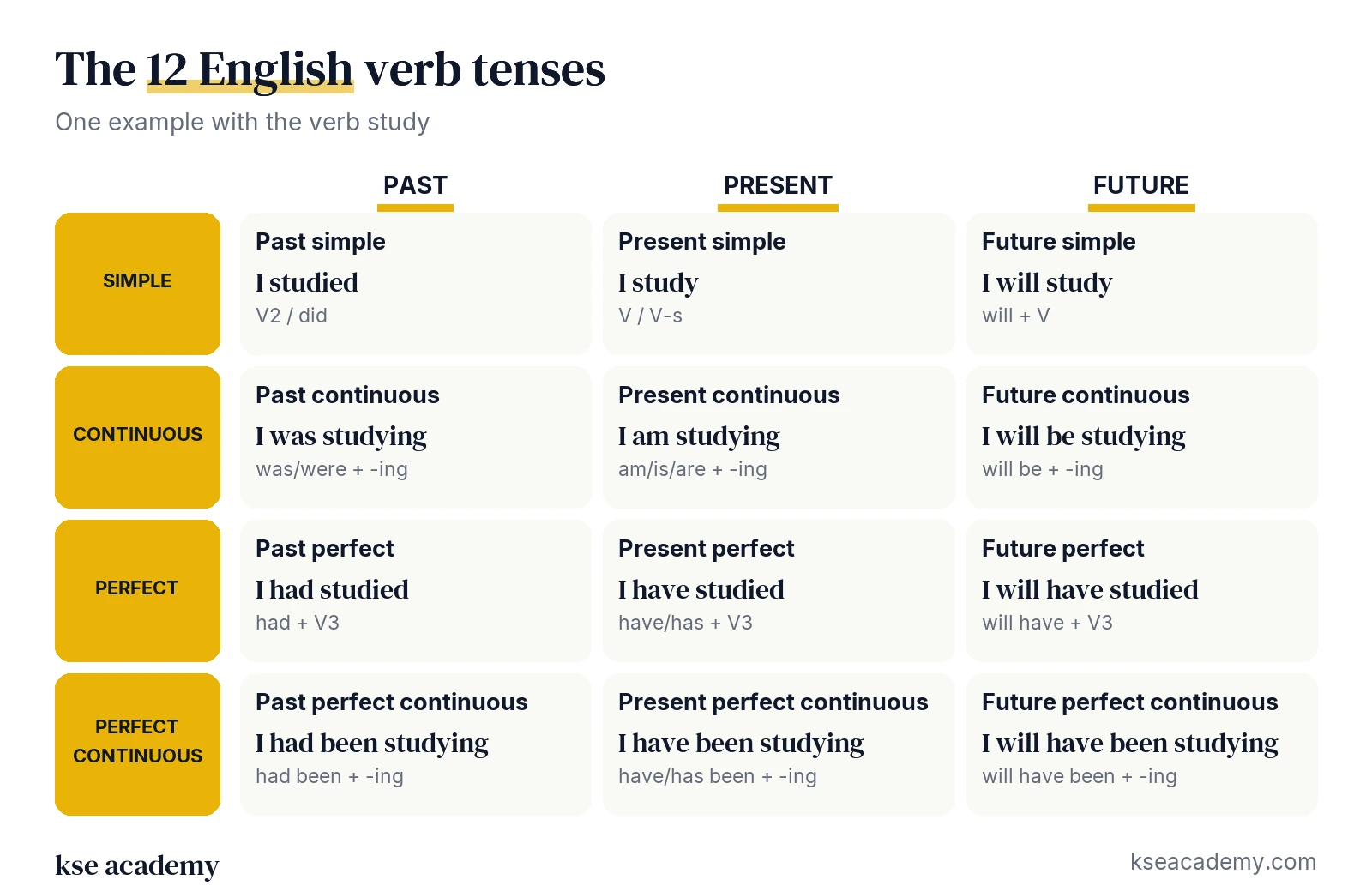
And here is the same table as text, with each tense linked to its full guide:
| Past | Present | Future | |
|---|---|---|---|
| Simple | Past simple I studied | Present simple I study | Future simple I will study |
| Continuous | Past continuous I was studying | Present continuous I am studying | Future continuous I will be studying |
| Perfect | Past perfect I had studied | Present perfect I have studied | Future perfect I will have studied |
| Perfect continuous | Past perfect continuous I had been studying | Present perfect continuous I have been studying | Future perfect continuous I will have been studying |
A note for the purists: grammatically, English only has two real tenses, present and past. The future has no form of its own and is built with will, going to and company. But in class, in books and in exams people talk about «the 12 tenses», and it is the most convenient way to organise them. Some websites count 13 or more if they add going to and the conditionals. Here we keep the twelve classics.
How to read the table: time × aspect
The starting mistake of many learners is to memorise twelve names as if they were twelve unrelated things. Look at the table again: there are only two ideas being combined.
The time: past, present or future
This is the horizontal axis, and the one you understand without effort. The only thing that changes is the auxiliary verb: did / was / had in the past, nothing or am / is / are / have / has in the present, and will in the future.
The aspect: how you look at the action
This is the vertical axis and what is really hard. The aspect does not say when something happens but how you look at it: as a fact, as something in progress, as something finished or as something that lasts. And it is always the same for the three times:
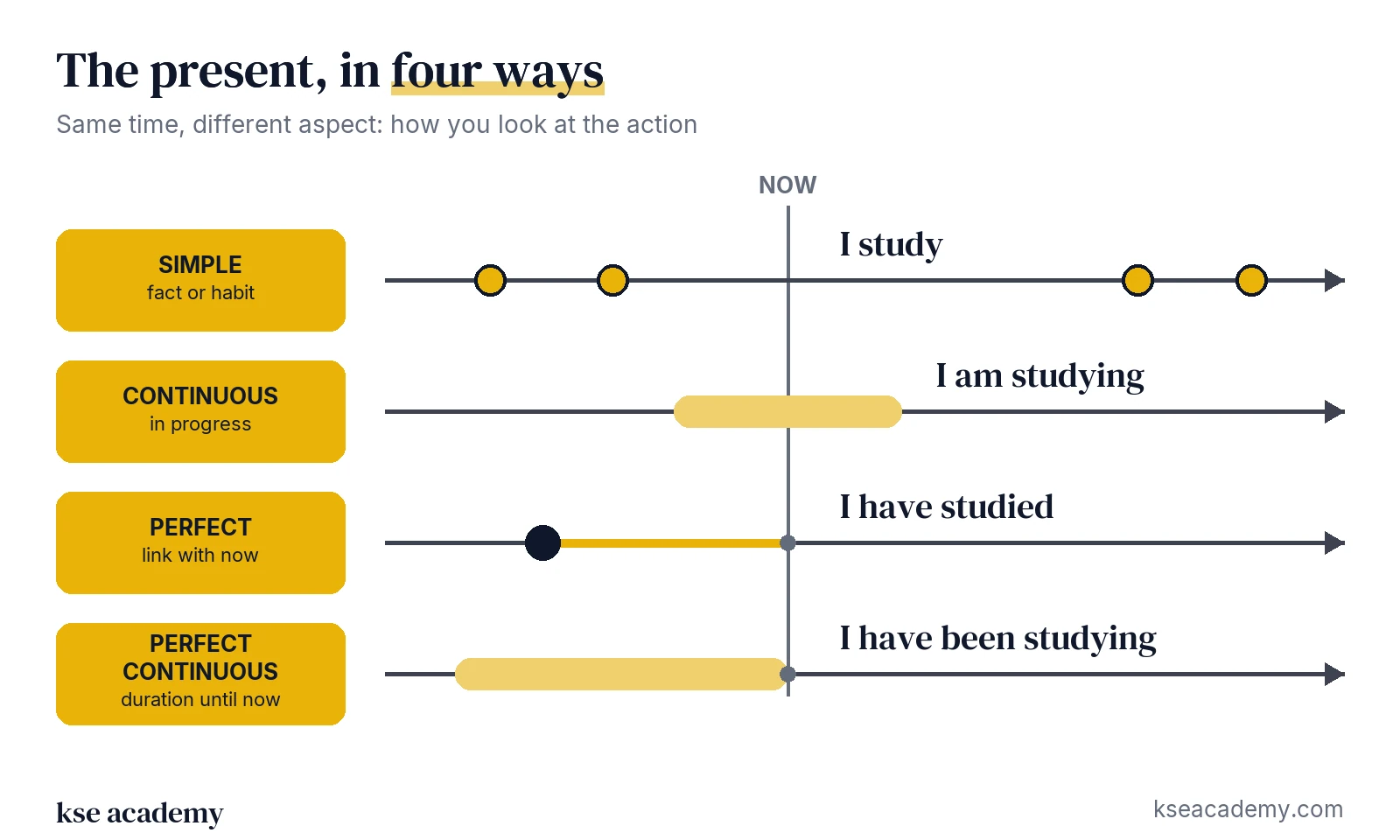
| Aspect | Idea | Form | Question it answers |
|---|---|---|---|
| Simple | a fact, a habit, something seen as a whole | verb (or did / will + verb) | What happens / happened / will happen? |
| Continuous | the action is in progress, temporary or unfinished | be + -ing | What is / was / will be happening? |
| Perfect | the action is completed and connects with another moment (the result matters) | have + past participle | What has / had / will have happened already? |
| Perfect continuous | the action has been going on until that moment, and the duration is what counts | have + been + -ing | How long has / had / will have been happening? |
Notice that the name of the tense gives you the formula: past perfect continuous is «past + perfect + continuous», that is had (the past of have) + been + -ing. Once you see this, you no longer have twelve things to memorise: you have a system.
Form: affirmative, negative and question in the 12 tenses
These are the three forms of each tense with the same verb and the subject she, so you can see when the auxiliary changes:
| Tense | Affirmative | Negative | Question |
|---|---|---|---|
| Present simple | She studies. | She doesn’t study. | Does she study? |
| Present continuous | She is studying. | She isn’t studying. | Is she studying? |
| Present perfect | She has studied. | She hasn’t studied. | Has she studied? |
| Present perfect continuous | She has been studying. | She hasn’t been studying. | Has she been studying? |
| Past simple | She studied. | She didn’t study. | Did she study? |
| Past continuous | She was studying. | She wasn’t studying. | Was she studying? |
| Past perfect | She had studied. | She hadn’t studied. | Had she studied? |
| Past perfect continuous | She had been studying. | She hadn’t been studying. | Had she been studying? |
| Future simple | She will study. | She won’t study. | Will she study? |
| Future continuous | She will be studying. | She won’t be studying. | Will she be studying? |
| Future perfect | She will have studied. | She won’t have studied. | Will she have studied? |
| Future perfect continuous | She will have been studying. | She won’t have been studying. | Will she have been studying? |
Two rules that hold for all of them and save a lot of trouble: the first auxiliary is the one that moves to make a question and the one that takes the negation (Has she been studying?, She hasn’t been studying), and only the present simple and the past simple need do / does / did (the others already have an auxiliary of their own).
When each tense is used
A one-line summary of each tense, grouped by time. If you want the full explanation, the link takes you to its guide with examples, mistakes and exercises.
Present
- Present simple: habits, facts and timetables. She studies every night.
- Present continuous: what is happening now or temporarily, and arranged plans. She is studying right now.
- Present perfect: experiences and past actions that matter today. She has studied in London.
- Present perfect continuous: actions that started in the past and are still going on, or have just finished, with the emphasis on duration. She has been studying for two hours.
Past
- Past simple: finished actions at a specific moment in the past. She studied last night.
- Past continuous: what was in progress at a moment in the past, or the background scene. She was studying when I called.
- Past perfect: what had already happened before another moment in the past. She had studied before the exam.
- Past perfect continuous: the duration of something up to another moment in the past. She had been studying for hours when I called.
Future
- Future simple: decisions at the moment, promises, predictions. She will study tomorrow.
- Future continuous: what will be in progress at a moment in the future. This time tomorrow she will be studying.
- Future perfect: what will already be finished at a moment in the future. By Friday she will have studied everything.
- Future perfect continuous: the duration of something up to a moment in the future. By June she will have been studying English for ten years.
And to talk about the future you have more options besides will: going to, the present continuous and the present simple. They are all in the guide to the future in English, and the comparison between the two most confused ones is in will vs going to.
Which verb tenses you need at each level
You do not need to master all twelve from day one. Tenses appear by levels, and the last ones are rare even for native speakers. This is the map I follow with my students, approximate and based on what I see in the syllabus and in the Cambridge exams:
| Level | Tenses you should handle | What is expected |
|---|---|---|
| A1 | Present simple (with be, have got and routines), very basic present continuous and was / were | Introduce yourself and talk about what you have and what you do every day |
| A2 (Key) | Present simple, present continuous, past simple, basic going to and will | Talk about routines, what is happening now, what you did and simple plans |
| B1 (Preliminary) | The above + past continuous, present perfect and future simple | Tell stories with background and foreground; present perfect versus past simple |
| B2 (First) | The above + present perfect continuous, past perfect and future continuous | Order actions in time and choose between simple and continuous with ease |
| C1 (Advanced) | The above + past perfect continuous, future perfect and future perfect continuous | Use all of them naturally, also in formal structures |
| C2 (Proficiency) | All twelve, no exceptions | Choose the exact nuance in every context and handle them in any register, formal or informal |
The rare tenses
If you look at the table above, the least frequent ones are those in the lower and right-hand part: future perfect continuous, past perfect continuous and future perfect. You will not see them every day in normal conversation, and that is fine: learning them at the end of the road is the logical thing. That said, at B2 and C1 they do appear in transformation and gap-fill exercises, so it is worth recognising them even if you do not use them often.
Verb tenses in English and in Spanish
The good news is that almost every tense has an equivalent in Spanish. The bad news is that the equivalents almost never match one hundred per cent:
| In Spanish | In English | Watch out for… |
|---|---|---|
| Estudio todos los días | I study every day. (present simple) | «Estoy estudiando» is another tense: I am studying |
| He estudiado mucho esta semana | I have studied a lot this week. (present perfect) | With «yesterday», «last year» or a date: past simple, not present perfect |
| Estudié inglés en Londres | I studied English in London. (past simple) | If you do not say when, and it counts as an experience: I have studied English in London |
| Estudiaba mientras comía | I was studying while I ate. (past continuous + past simple) | The Spanish imperfect is not always past continuous: «estudiaba cada día» is I used to study or I studied |
| Llevo tres años estudiando inglés | I have been studying English for three years. (present perfect continuous) | English does not use the present: I study English since… is a very typical mistake |
| Cuando llegué, ya habían salido | When I arrived, they had already left. (past perfect) | In Spanish we sometimes skip it; in English it usually marks the order of events |
| Estudiaré mañana | I will study tomorrow. (future simple) | «Voy a estudiar» is going to, and «estudio mañana» is usually present continuous |
How to choose the tense with three questions
When in doubt, do not search the table of twelve: ask these three questions in order, and the tense comes out by itself.
- When does it happen? Past, present or future: that gives you the column.
- Is it finished, in progress, or a fact? If it matters that it is already completed, perfect. If it is in progress, continuous. If it is a fact or a habit, simple.
- Does the length of time matter? If what counts is the duration up to that moment, perfect continuous.
An example: «Llevo dos horas esperando el autobús». When? Present. Is it in progress? Yes. Does the duration matter? Yes, two hours. Answer: I have been waiting for the bus for two hours. Present perfect continuous. And, meanwhile, the bus has not arrived.
Typical mistakes with verb tenses
The ones I see most in class and in exams, with the tense you should use instead:
| Incorrect | Correct | Why |
|---|---|---|
| I am knowing the answer. | I know the answer. | State verbs (know, like, want) do not usually go in continuous |
| I live here since 2015. | I have lived here since 2015. | With since and for you use present perfect |
| I have seen him yesterday. | I saw him yesterday. | With a finished moment, past simple |
| She doesn’t studied. | She didn’t study. | After did or does, the verb is in the infinitive |
| If it will rain, I’ll stay home. | If it rains, I’ll stay home. | After if and when, the present |
| I will can help you. | I will be able to help you. | Two modals cannot be combined |
| When I was child, I played chess. | When I was a child, I played chess. | An article is needed |
| I am waiting for two hours. | I have been waiting for two hours. | Duration up to now needs the perfect continuous |
Frequently asked questions about English verb tenses
How many verb tenses are there in English?
Twelve, if you count the three times (past, present and future) multiplied by the four aspects (simple, continuous, perfect and perfect continuous). Some sources add going to and the conditionals and reach 13 or more.
What is the order to learn verb tenses?
The order of the level table: first present simple, present continuous and past simple (A1 and A2), then past continuous, present perfect and future simple (B1), then present perfect continuous, past perfect and future continuous (B2) and finally the perfect continuous tenses and the future perfect (C1).
What is the difference between aspect and tense?
The tense says when the action happens: past, present or future. The aspect says how you look at it: as a fact, in progress, completed or in duration. Every verb tense is the combination of both.
What are the most used verb tenses?
In conversation, the present simple, the present continuous, the past simple, the present perfect and the future forms with will and going to. The perfect continuous tenses and the future perfect are the least frequent.
Is there a PDF with all the verb tenses?
Yes: at the end of this post you have the downloadable PDF with the table and the summaries, so you can keep it at hand.
Why does English have so many tenses with «perfect»?
Because perfect here does not mean «flawless» but «completed»: a finished action that connects with another moment. It is the aspect that Spanish speakers find hardest, which is why there is an in-depth guide for each one.
Verb tenses exercises
Thirty sentences to check you have understood. Below you have three interactive exercises that mark themselves, so you will know straight away how you did.
And if you prefer a version in text that you can copy and paste, you have it down here 👇
Exercise 1: choose the correct tense
Choose the correct option to complete each sentence.
- I (study / am studying) every day after dinner.
- Look! It (rains / is raining).
- I (live / have lived) in Granada since 2015.
- She (saw / has seen) that film last week.
- When I arrived, the film (already started / had already started).
- At 8 tonight I (will watch / will be watching) the match.
- By next June, I (will finish / will have finished) the course.
- They (have waited / have been waiting) for an hour and the bus still hasn’t come.
- I (was cooking / cooked) when the phone rang.
- If it (rains / will rain) tomorrow, we’ll stay at home.
Show answers
- study
- is raining
- have lived
- saw
- had already started
- will be watching
- will have finished
- have been waiting
- was cooking
- rains
Exercise 2: put the verb in the correct tense
Complete each sentence with the verb in brackets in the correct tense. Write only the missing words.
- She _______________ (not / like) coffee.
- We _______________ (watch) TV when the lights went out.
- I _______________ (know) him since 2010.
- By the time we arrived, the concert _______________ (already / start).
- This time next week, I _______________ (lie) on a beach.
- He is tired because he _______________ (work) all day.
- By 2030, she _______________ (live) here for twenty years.
- Yesterday I _______________ (go) to the cinema.
- They _______________ (finish) the project by Friday.
- She was exhausted. She _______________ (run) for two hours.
Show answers
- doesn’t like
- were watching
- have known
- had already started
- will be lying
- has been working
- will have been living
- went
- will have finished
- had been running
Exercise 3: name the tense
Write the name of the tense of the underlined verb in each sentence (for example: present simple, past perfect).
- I have finished my homework.
- He has been waiting for an hour.
- We visited Rome last summer.
- I was sleeping when you called.
- She had left before I arrived.
- They had been walking for hours.
- I will call you tomorrow.
- This time tomorrow, I will be flying to Rome.
- By Friday, she will have finished the report.
- By June, he will have been working here for ten years.
Show answers
- present perfect
- present perfect continuous
- past simple
- past continuous
- past perfect
- past perfect continuous
- future simple
- future continuous
- future perfect
- future perfect continuous
Conclusion
To sum up in three ideas: the twelve verb tenses are three times (past, present and future) by four aspects (simple, continuous, perfect and perfect continuous); the aspect does not say when something happens but how you look at it: as a fact, in progress, completed or in duration; and you do not need all twelve at once: they are learned by levels, and the rarest ones come last.
If you want to keep going, start with the tense you find hardest using the links in the table. Do you have doubts about verb tenses? Write to me and I will help you.
Did you find this post useful? Share it with other students and teachers of English. And if you want more content like this, subscribe to my newsletter and follow me on Facebook, Twitter, Pinterest, Instagram and YouTube.
See you in the next post. Until then, don’t forget to keep smiling! 🙂
