
Table of contents
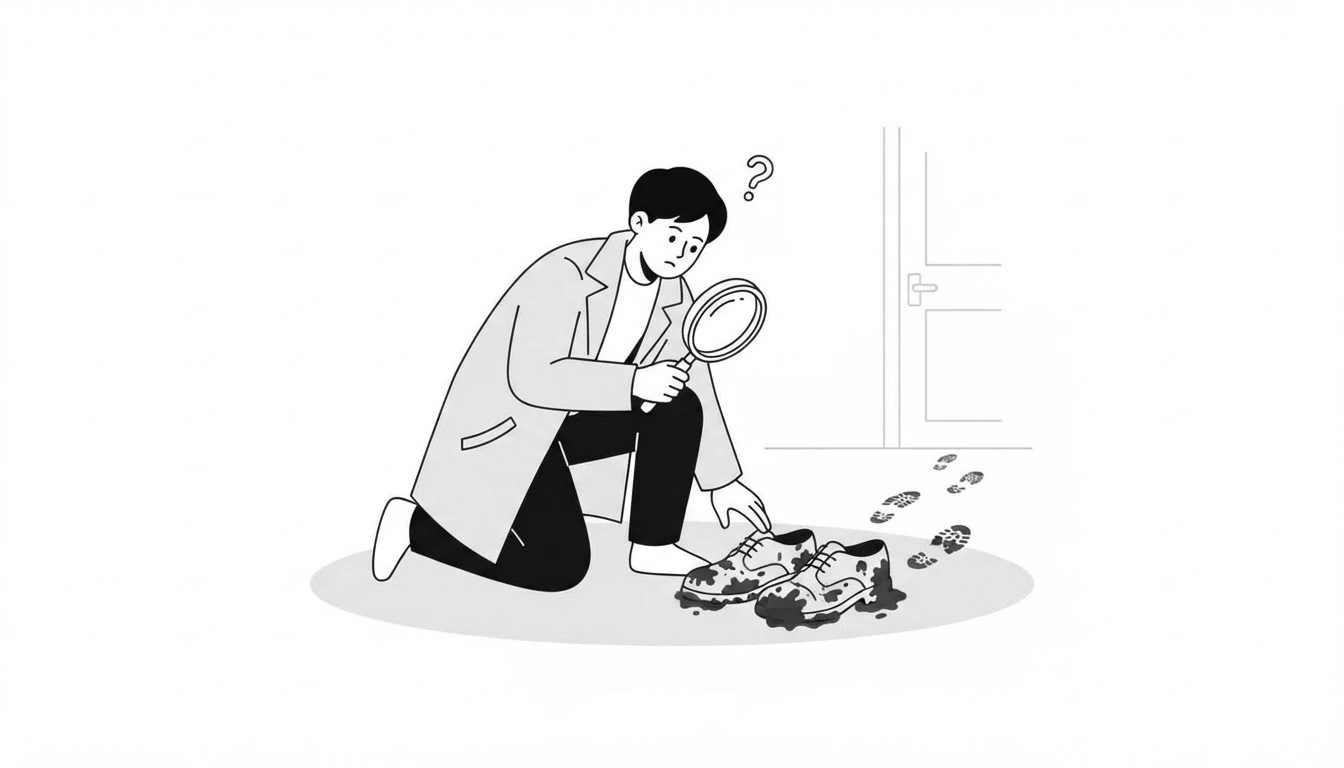
You get home and the kitchen smells of burning. There is flour on the floor, an apron hanging on the door handle and a frying pan in the sink. Nobody is cooking now, but it is perfectly clear what has happened: Someone had been cooking. You do not know whether they finished or not, or what they made; what matters is the activity and how long it lasted. That is the past perfect continuous (in Spanish, pasado perfecto continuo): the tense for saying what had been going on for a while before another moment in the past.
The name is scary (three words: had been doing), but it is easier than it looks, because you already know its pieces: had (from the past perfect) and been + -ing (from the present perfect continuous). In this guide I explain how it is formed, when it is used, how it differs from the past perfect simple, the past continuous and the present perfect continuous, the typical mistakes, how it helps you in Cambridge exams and how to use it to solve mysteries (and to explain your dark circles). At the end there are thirty practice sentences with answers. Let’s get started! 🙂
The past perfect continuous at a glance
| Past perfect continuous | |
|---|---|
| Form | had been + verb + -ing |
| What it is for | Talking about an activity that had been going on for some time before another past moment |
| Example | She had been waiting for two hours when the bus arrived. |
| Spanish | «Llevaba dos horas esperando cuando llegó el autobús» (había estado esperando) |
| Words that go with it | for, since, how long, all day / morning, when, before, by the time |
What the past perfect continuous is
It is the present perfect continuous (I have been working) moved into the past. With the present perfect continuous you look back from now; with the past perfect continuous you look back from a moment in the past. What matters is what had been going on before, for how long, and often the result you can see:
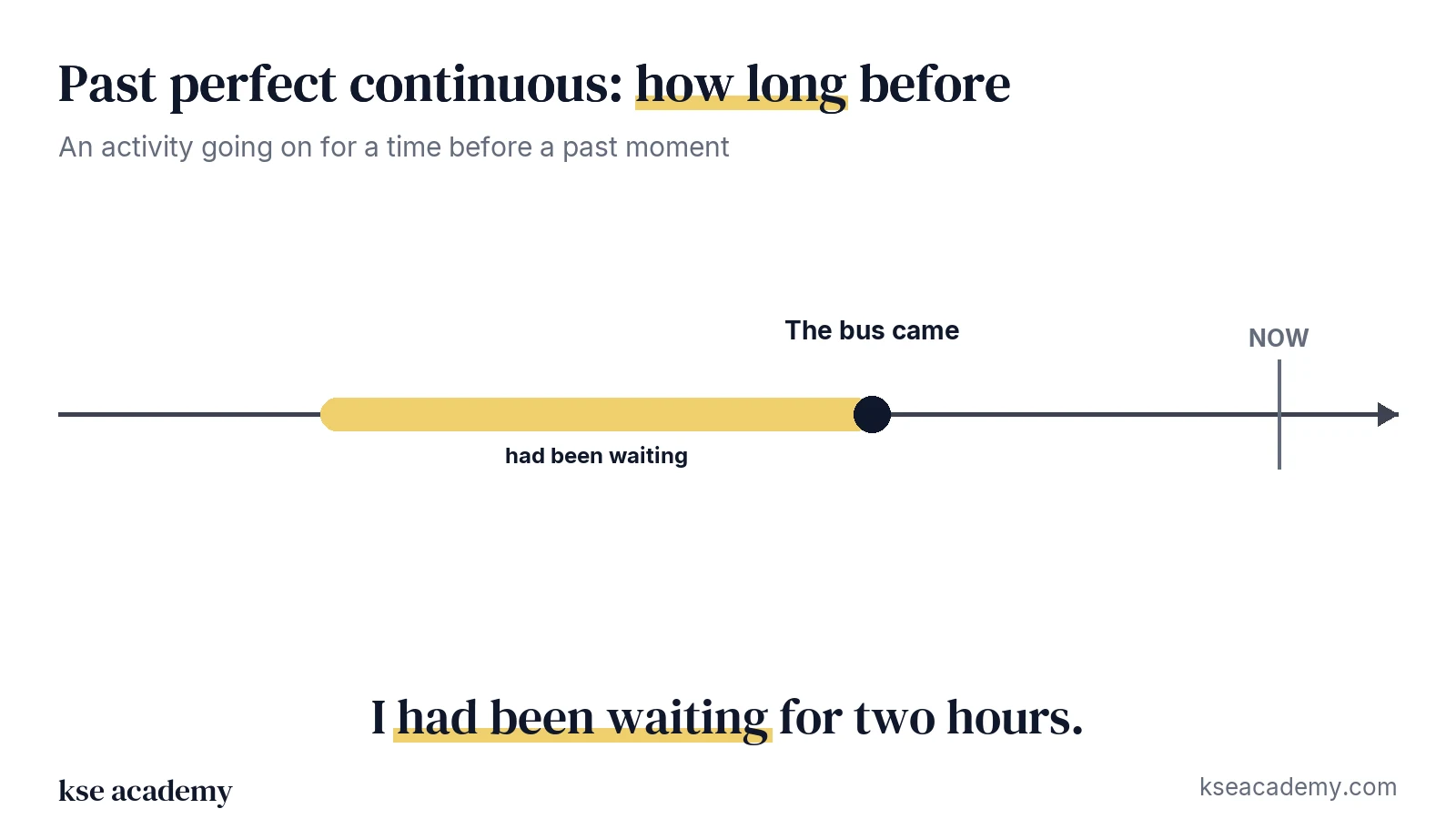
The activity starts before the past moment and goes up to it (or almost). That is why it is perfect for saying «I had been doing something when…».
How the past perfect continuous is formed
The form is always had been + verb with -ing, and had is the same for all persons.
Affirmative, negative and questions
| Form | Structure | Example |
|---|---|---|
| Affirmative | subject + had been + -ing | She had been working. |
| Negative | subject + hadn’t been + -ing | She hadn’t been working. |
| Question | Had + subject + been + -ing…? | Had she been working? |
| With a question word | question word + had + subject + been + -ing…? | How long had she been working? |
| Short answer | Yes, she had. / No, she hadn’t. | Had you been waiting long? Yes, I had. |
Contractions
| Full form | Contraction |
|---|---|
| I had been waiting | I’d been waiting |
| She had not been sleeping | She hadn’t been sleeping |
| They had been playing | They’d been playing |
As in the past perfect, ‘d can be had or would. If it is followed by been, it is had.
When the past perfect continuous is used
1. The duration of an activity before a past moment
This is the main use. You want to say how long something had been going on before another event:
- She had been waiting for two hours when the bus finally arrived.
- We had been trying to open the door for five minutes when Jane found her key.
- By the time he got the job, he had been looking for work for almost a year.
2. The cause of something you could see in the past
Very useful to explain why there was a visible result:
- His eyes were red because he had been crying.
- The ground was wet. It had been raining all night.
- She was covered in paint: she had been decorating the kitchen.
3. With «for» and «since» to talk about duration
- They had been living there for ten years when the factory closed.
- I had been working since six o’clock, so I was exhausted.
4. In reported speech
When you report what someone said, the present perfect continuous (and the past continuous) of their words step back to the past perfect continuous:
- «I have been working all day.» → She said she had been working all day.
- «I was waiting for you.» → He told me he had been waiting for me.
I cover it in depth in my guide to reported speech.
5. To tell stories
In a narrative, the past perfect continuous gives the long background of what had been going on before the scene begins:
It was midnight. Anna was still awake. She had been reading since dinner, and she hadn’t noticed that the storm had started.
Words and expressions that go with the past perfect continuous
| Word | What it shows | Example |
|---|---|---|
| for | how long | They had been waiting for an hour. |
| since | since when | She had been studying since eight. |
| how long | asks about duration | How long had you been waiting? |
| all day / all morning / all night | throughout a whole period | He had been working all day. |
| when / before / by the time | the past reference moment | She had been crying when I came in. |
| recently / lately | in the period before that moment | He had been feeling tired lately. |
Past perfect continuous versus past perfect simple
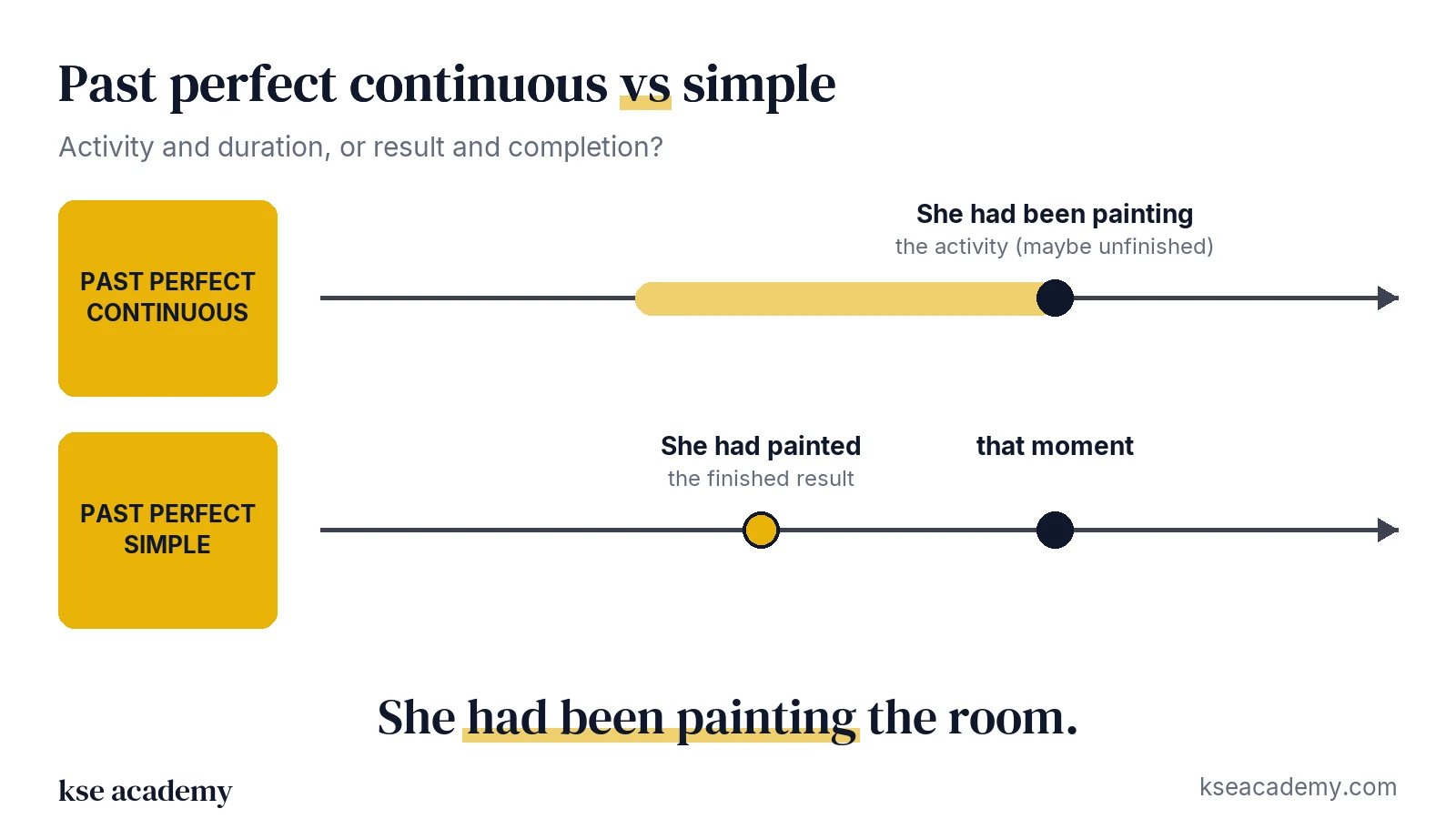
It is the most typical doubt. The difference is one of focus: the continuous focuses on the activity and its duration; the simple, on the result or on what is finished:
| Past perfect continuous | Past perfect simple |
|---|---|
| She had been painting the room. (The activity; perhaps unfinished.) | She had painted the room. (She finished, it is painted.) |
| He had been eating for hours. (Duration.) | He had eaten all the food. (Result: there is nothing left.) |
| How long had you been waiting? (How long?) | How many emails had you written? (How many?) |
| I had been reading that book. (I was in the middle of it.) | I had read that book. (I finished it.) |
A practical rule: if the natural question is «how long?», use the continuous; if it is «how many?» or «did it finish?», the simple. And with state verbs (know, be, have, like, want) the simple is always used: She had known him for years (and not had been knowing). You have the list in the guide to stative and dynamic verbs.
Past perfect continuous versus past continuous
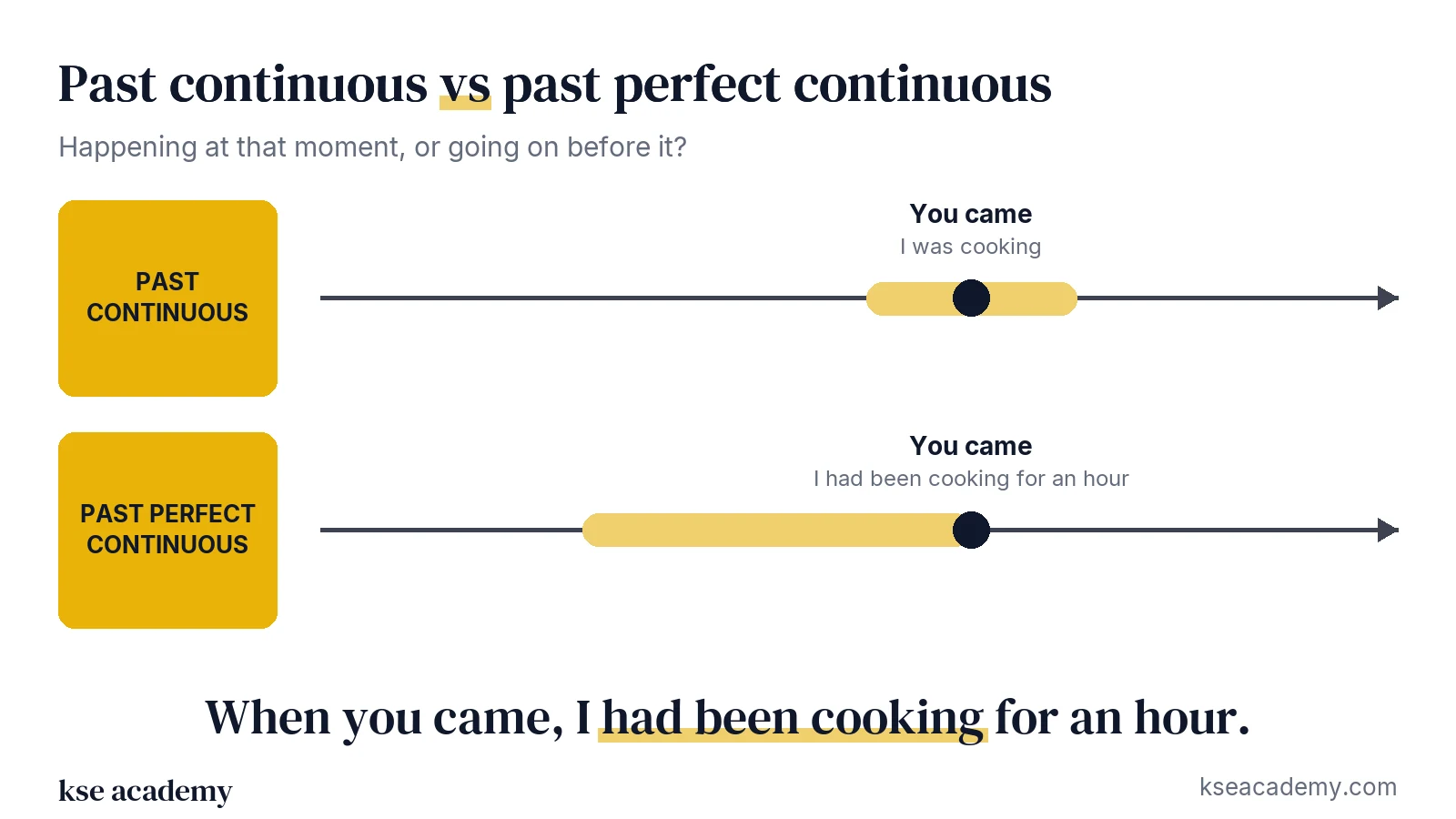
The past continuous talks about what was happening at that moment; the past perfect continuous, about what had been going on from before up to that moment:
| Tense | Example | Meaning |
|---|---|---|
| Past continuous | When you came, I was cooking. | When you came, I was in the middle of cooking. |
| Past perfect continuous | When you came, I had been cooking for an hour. | When you came, I had been cooking for an hour already. |
Past perfect continuous versus present perfect continuous
Both talk about an activity in progress, but from a different moment. The present perfect continuous looks from now; the past perfect continuous, from a past moment:
| Tense | Example | Meaning |
|---|---|---|
| Present perfect continuous | I have been waiting for two hours. | I have been waiting for two hours (and I still am). |
| Past perfect continuous | I had been waiting for two hours when he arrived. | I had been waiting for two hours when he arrived. |
The past tenses, all together
In a story, the past tenses take turns, each with its role. See how they work together in a single paragraph:
It was a cold night. The streets were empty (past simple). Mark was walking home (past continuous: the action in progress) when he realised that someone was following him. He had been working late (past perfect continuous: the long background) and he had forgotten his phone at the office (past perfect simple: what was finished earlier). He turned round and saw the cat.
| Tense | Its role in the story |
|---|---|
| Past simple | What happened (the plot) |
| Past continuous | What was in progress in the scene |
| Past perfect simple | What had already happened (finished) |
| Past perfect continuous | What had been going on from before (duration) |
Spanish versus English: where we get confused
In Spanish, this idea is almost always expressed with «llevaba + gerundio» or with the imperfect; «había estado + gerundio» exists, but is used less. These are the most useful equivalences:
| 🇪🇸 Spanish | 🇬🇧 English | What happens |
|---|---|---|
| Llevaba dos horas esperando cuando llegó. | I had been waiting for two hours when he arrived. | «Llevaba + gerundio» equals had been + -ing. |
| Estaba cansado porque había estado trabajando todo el día. | I was tired because I had been working all day. | Direct equivalent («había estado + gerundio»). |
| Hacía diez años que vivían allí. | They had been living there for ten years. | «Hacía… que» is translated with had been + -ing + for. |
| Hacía años que se conocían. | They had known each other for years. | State verbs: simple, not had been knowing. |
Common mistakes with the past perfect continuous
| ❌ Incorrect | ✅ Correct | Why |
|---|---|---|
| I had been wait for an hour. | I had been waiting for an hour. | After been, the verb takes -ing. |
| She had waiting for two hours. | She had been waiting for two hours. | Been is missing: it is had been + -ing. |
| They had been knowing each other for years. | They had known each other for years. | Know is a state verb: simple. |
| Had been you studying all night? | Had you been studying all night? | In questions: Had + subject + been. |
| He was tired because he has been working all night. | He was tired because he had been working all night. | If the sentence is in the past, had been is used. |
| I had been eating three sandwiches. | I had eaten three sandwiches. | With quantities (three) the simple is used. |
| They had been been living there. | They had been living there. | Been appears only once. |
The past perfect continuous in Cambridge exams
You are expected to master this tense from B2 First onwards, and it is common in C1 Advanced:
- Use of English (Part 4, key word transformations) in B2 First and C1 Advanced: with key words such as FOR, SINCE or the -ing verb itself.
- Writing in B2 First and C1 Advanced: in stories, the past perfect continuous gives the background and the cause of what happens.
- Speaking: telling an anecdote («I’d been waiting for hours when…») sounds natural and precise.
Two examples in the style of Use of English Part 4:
- I started waiting at six and the bus arrived at eight. WAITING
I ______ for two hours when the bus arrived. → had been waiting - It started to rain at nine and we left at midnight. RAINING
It ______ for three hours when we left. → had been raining
Fun uses: the past perfect continuous detective
This tense is the favourite of detectives: they see the evidence and deduce what had been going on. A small collection of clues:
| The clue | The deduction |
|---|---|
| Muddy shoes | He had been walking in the park. |
| Red eyes | She had been crying. (Or cutting onions.) |
| Flour all over the kitchen | The kids had been baking. |
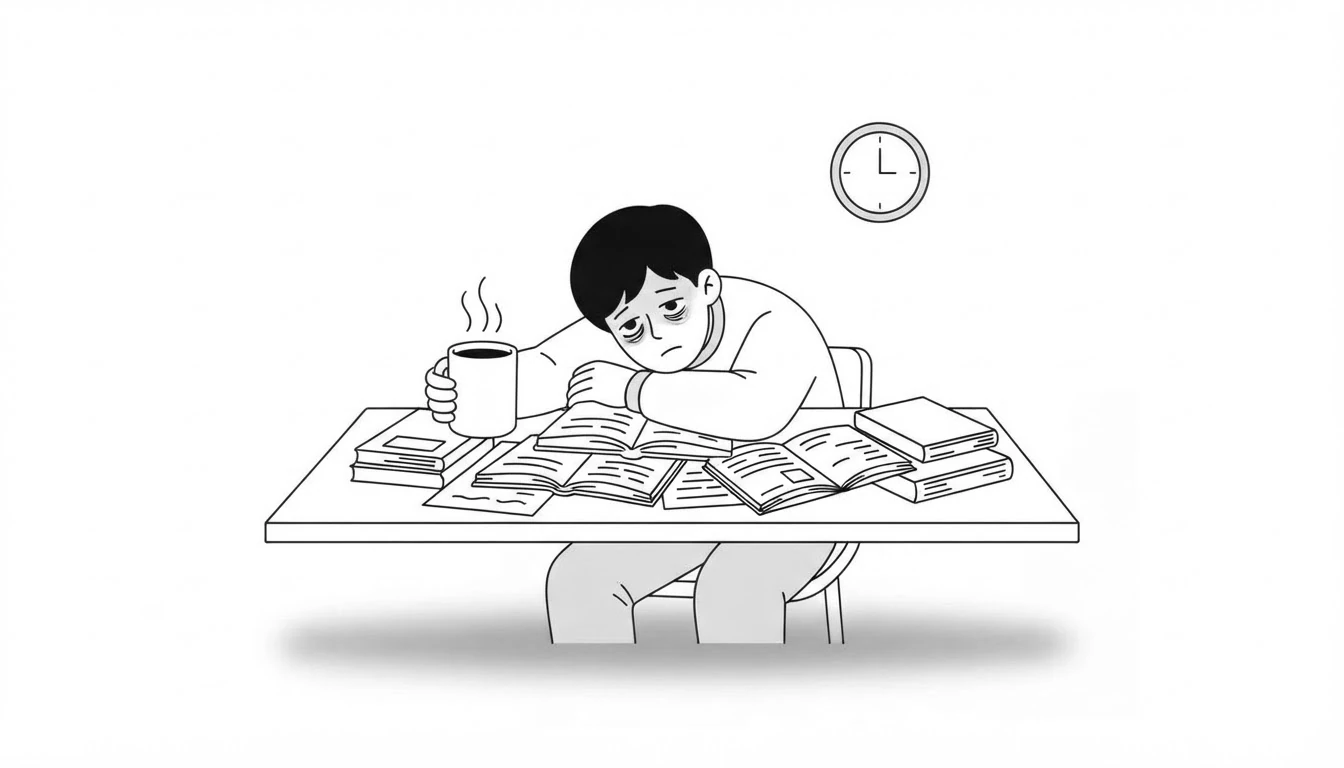
| Dark circles and a huge coffee | I had been studying all night. |
| Wet hair | It had been raining. Or someone had been in the shower. |
| The sofa, all messed up | Someone had been sleeping here. |
Past perfect continuous summary table
| What | How | Example |
|---|---|---|
| Form | had been + -ing | She had been working. |
| Negative | hadn’t been + -ing | She hadn’t been working. |
| Question | Had + subject + been + -ing | Had she been working? |
| Main use | Duration of an activity before a past moment | I had been waiting for two hours. |
| Cause | Explaining a visible result in the past | His eyes were red: he had been crying. |
| Reported speech | Backshift of tenses | She said she had been working. |
FAQ: the past perfect continuous
When is the past perfect continuous used?
To talk about an activity that had been going on for some time before another moment in the past, to explain the cause of a visible result and in reported speech.
How is the past perfect continuous formed?
With had been + verb + -ing: She had been working. For the negative, hadn’t been; for questions, Had she been working?
What is the difference between the past perfect simple and the past perfect continuous?
The simple focuses on the result or on what is finished (She had painted the room); the continuous, on the activity and its duration (She had been painting the room).
Can it be used with state verbs?
No. With know, be, have, like, want, understand… the past perfect simple is used: He had known her for years.
What is the difference between «I had been waiting» and «I was waiting»?
I was waiting talks about what you were doing at that moment; I had been waiting adds that you had been doing it for some time before that moment (for two hours).
Is it the same as the present perfect continuous?
No. The present perfect continuous looks back from the present (I have been waiting). The past perfect continuous looks back from a moment in the past (I had been waiting).
Past perfect continuous exercises
Thirty sentences to check you have understood. Below you have three interactive exercises that mark themselves, so you will know straight away how you did.
And if you prefer a version in text that you can copy and paste, you have it down here 👇
Exercise 1: choose the correct form
Choose the correct option to complete each sentence.
- She was exhausted because she (had run / had been running) for two hours.
- I (had read / had been reading) three chapters before dinner.
- Her eyes were red. She (cried / had been crying).
- How long (had you waited / had you been waiting) when the bus came?
- The room smelled of smoke. Someone (smoked / had been smoking).
- I (have been working / had been working) there for ten years when I was fired.
- He told me he (has been working / had been working) all morning.
- She (had known / had been knowing) him since 2010.
- They (had been building / had built) the house for months, but it still wasn’t finished.
- By nine o’clock, the children (were playing / had been playing) for three hours.
Show answers
- had been running
- had read
- had been crying
- had you been waiting
- had been smoking
- had been working
- had been working
- had known
- had been building
- had been playing
Exercise 2: complete the sentences
Complete each sentence with the past perfect continuous of the verb in brackets. Write only the missing words.
- I was tired because I _______________ (work) all day.
- They _______________ (wait) for an hour when the bus finally arrived.
- _______________ (she / cry)? Her eyes were red.
- How long _______________ (you / learn) English before you moved to London?
- He _______________ (not / sleep) well, so he looked terrible.
- The ground was wet. It _______________ (rain) all night.
- We _______________ (drive) for six hours when the car broke down.
- She said she _______________ (study) since seven.
- My hands were covered in paint because I _______________ (paint) the kitchen.
- Why _______________ (they / argue)? Everyone was staring.
Show answers
- had been working
- had been waiting
- Had she been crying
- had you been learning
- hadn’t been sleeping
- had been raining
- had been driving
- had been studying
- had been painting
- had they been arguing
Exercise 3: correct or incorrect?
Decide whether each sentence is correct. If it is incorrect, rewrite it correctly.
- She had been waiting for two hours when he arrived.
- I had been wait for an hour.
- They had been knowing each other for years.
- How long had you been working there?
- He was tired because he has been working all night.
- She hadn’t been sleeping well, so she looked tired.
- We had been walking since eight when it started to rain.
- I had been eating three sandwiches before the film.
- Had been you studying all night?
- They had been been living there for ten years.
Show answers
- Correct
- I had been waiting for an hour.
- They had known each other for years.
- Correct
- He was tired because he had been working all night.
- Correct
- Correct
- I had eaten three sandwiches before the film.
- Had you been studying all night?
- They had been living there for ten years.
Conclusion
To sum up in three ideas: the past perfect continuous (had been + -ing) talks about an activity that had been going on for some time before a past moment; it is used to give duration, explain the cause of something visible and give background in stories; and the simple focuses on the result, the continuous on the activity, and with state verbs the simple is always used.
If you want to continue with verb tenses, see the guides to the Past Perfect, the Past Continuous and the Present Perfect Continuous. Do you have doubts about the past perfect continuous? Write to me and I will help.
Did you find this post useful? Share it with other English students and teachers. And if you want more content like this, subscribe to my newsletter and follow me on Facebook, Twitter, Pinterest, Instagram and YouTube.
See you in the next post. Until then, don’t forget to keep smiling! 🙂
