
Table of contents
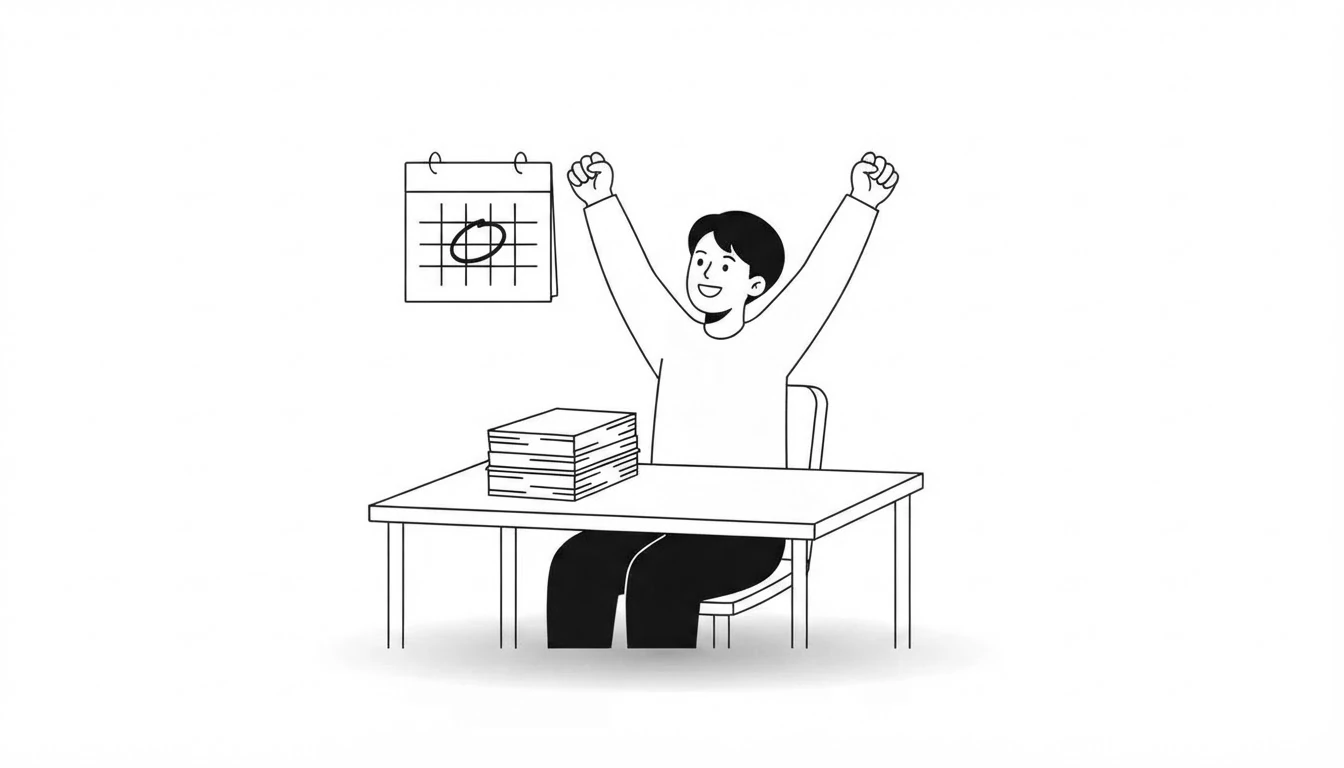
A curious fact: by the time you finish reading this post, you will have learned the future perfect. In English, it is said like this: By the time you finish this post, you will have learned the future perfect. Look at the trick: right now you are in the present, you are reading, but I place myself at a point in the future (when you finish) and from there I look back to tell you it will already be done. That is the future perfect (in Spanish, futuro perfecto): the tense for talking about what will already have finished before a moment in the future.
It is very similar to Spanish («habré terminado», «habrás aprendido»), so it is one of the friendliest tenses for a Spanish speaker. In this guide I explain how it is formed, when it is used (six uses with examples), how it differs from the future simple, the present perfect and the future continuous, the typical mistakes, how it helps you in Cambridge exams and how to use it to talk about deadlines, goals and the resolutions you never keep. At the end there are thirty practice sentences with answers. Let’s get started! 🙂
The future perfect at a glance
| Future perfect | |
|---|---|
| Form | will have + past participle |
| What it is for | Talking about something that will already have finished before a moment in the future |
| Example | I will have finished the report by Friday. |
| Spanish | futuro perfecto: «Para el viernes habré terminado el informe» |
| Words that go with it | by, by then, by the time, before, in two years’ time, until |
What the future perfect is
With the future perfect you choose a point in the future (a date, a time, an event) and look back from that point. What you describe will already be complete when that moment arrives:
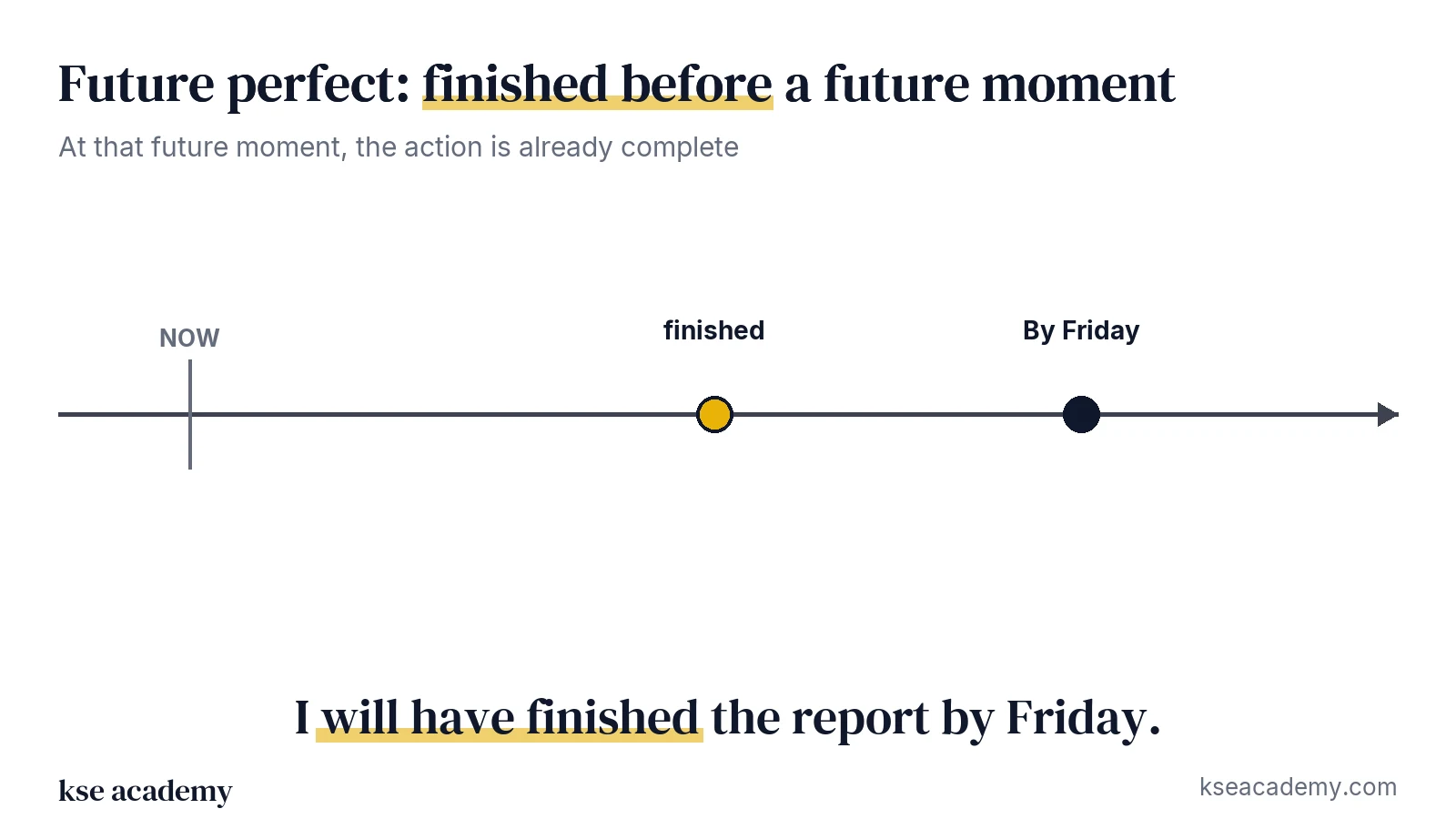
It does not tell you when exactly it will finish. It only guarantees that, by that moment, it will be done. That is why it almost always goes with expressions such as by Friday, by then or by the time.
How the future perfect is formed
The form is always will have + past participle, for all persons. It is the same participle as in the present perfect and the past perfect.
Affirmative, negative and questions
| Form | Structure | Example |
|---|---|---|
| Affirmative | subject + will have + participle | I will have finished. |
| Negative | subject + won’t have + participle | I won’t have finished. |
| Question | Will + subject + have + participle…? | Will you have finished? |
| With a question word | question word + will + subject + have + participle…? | What will you have done by then? |
| Short answer | Yes, I will. / No, I won’t. | Will you have finished? Yes, I will. |
Contractions
| Full form | Contraction |
|---|---|
| I will have finished | I’ll have finished |
| She will have arrived | She’ll have arrived |
| They will not have left | They won’t have left |
The participle: regular and irregular
Regular verbs end in -ed (finished, arrived, worked) and irregular ones have their own form (go → gone, see → seen, do → done, write → written). If you need to review them, I have a list of irregular verbs with pronunciation and a PDF.
When the future perfect is used
1. An action that will have finished before a future moment
This is the main use:
- By 8 o’clock, she will have finished dinner.
- By the time we get there, the film will have started.
- In two years’ time, I will have finished my degree.
2. Deadlines and targets
Very common at work and in studies, to talk about what has to be done by a date:
- I’ll have finished the report by Friday.
- We will have completed the project by the end of the month.
- Will you have sent the invoice by tomorrow?
3. Long-term goals and achievements
- By 2030, we will have built 100 new schools.
- By the time I’m forty, I will have travelled to every continent.
4. Guesses about what has already happened
Just as in Spanish («habrán llegado ya»), the future perfect is used to guess something about the present or the recent past:
- It’s nine o’clock. They will have arrived by now.
- You will have heard the news already.
5. Duration up to a future moment (with state verbs)
To say «it will have been X time» up to a future point with state verbs (be, know, have, live…), which do not take the continuous:
- In June, we will have been married for ten years.
- By the end of the year, I will have known him for a decade.
6. With «before», «by the time» and «until» + present
In sentences with two future events, only the first takes the future perfect, and the second goes in the present simple (never will):
- By the time you arrive, I will have left.
- I won’t have finished until you get back.
- Before you wake up, I’ll have made breakfast.
Time expressions that go with the future perfect
| Expression | Meaning | Example |
|---|---|---|
| by + date or time | no later than | I’ll have finished by Friday. |
| by then / by that time | at that point | By then, she’ll have left. |
| by the time + present | when | By the time you call, I’ll have gone. |
| before | earlier than | She’ll have left before you arrive. |
| in two years’ time | two years from now | In two years’ time, I’ll have graduated. |
| until / not until | up to the point when | I won’t have finished until Monday. |
| by now / already | already (a guess) | They’ll have arrived by now. |
Future perfect versus future simple (will)
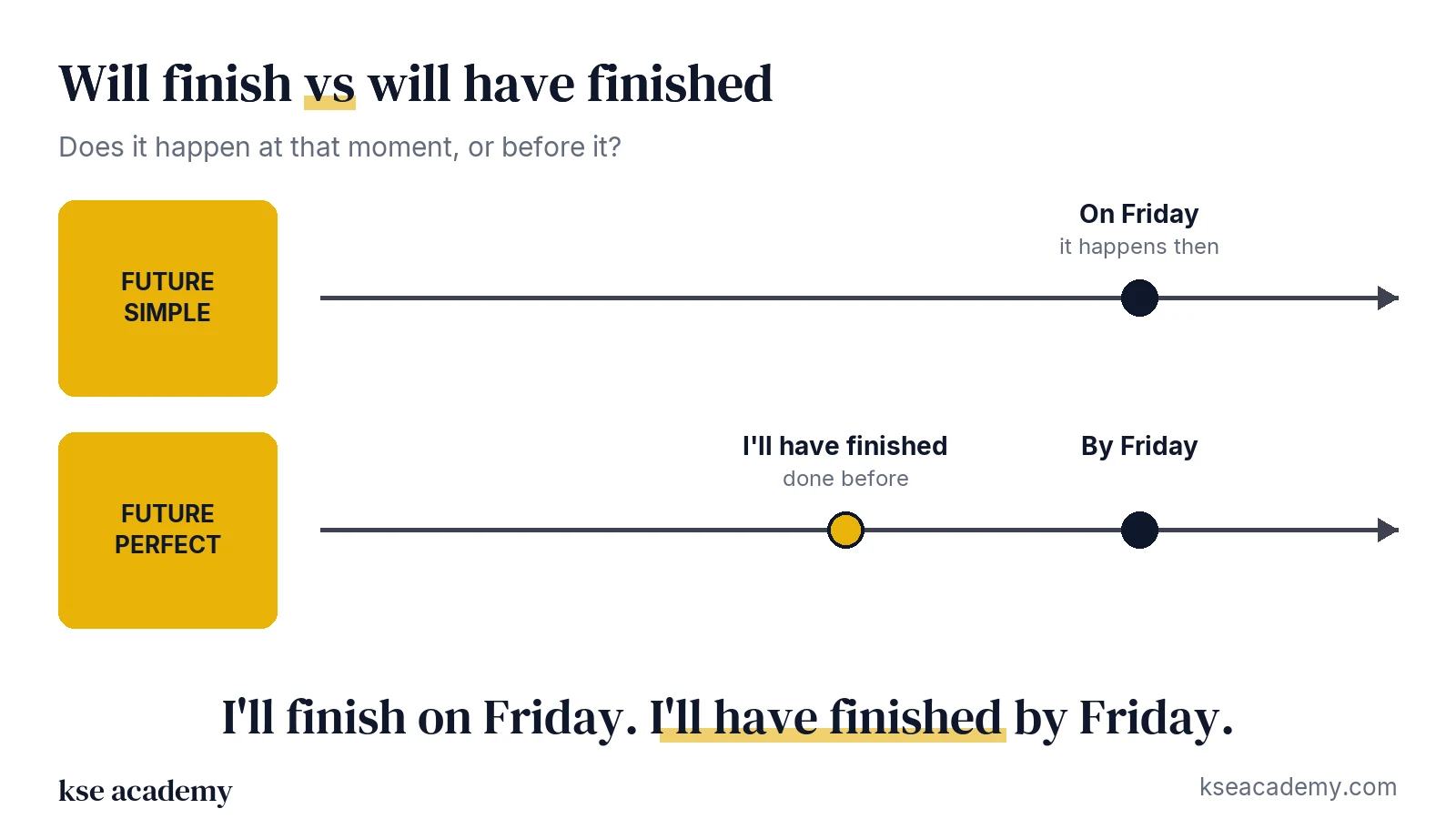
The difference is in when it happens. With will you talk about something that will happen at that moment; with will have + participle, before that moment, and it will already be done:
| Future simple | Future perfect |
|---|---|
| I’ll finish the report on Friday. (I finish it on Friday.) | I’ll have finished the report by Friday. (By Friday it will already be finished.) |
| She’ll leave at six. (She leaves at six.) | She’ll have left by six. (At six she will already have gone.) |
| They’ll arrive at eight. (They arrive at eight.) | They’ll have arrived by eight. (At eight they will already have arrived.) |
Future perfect versus present perfect
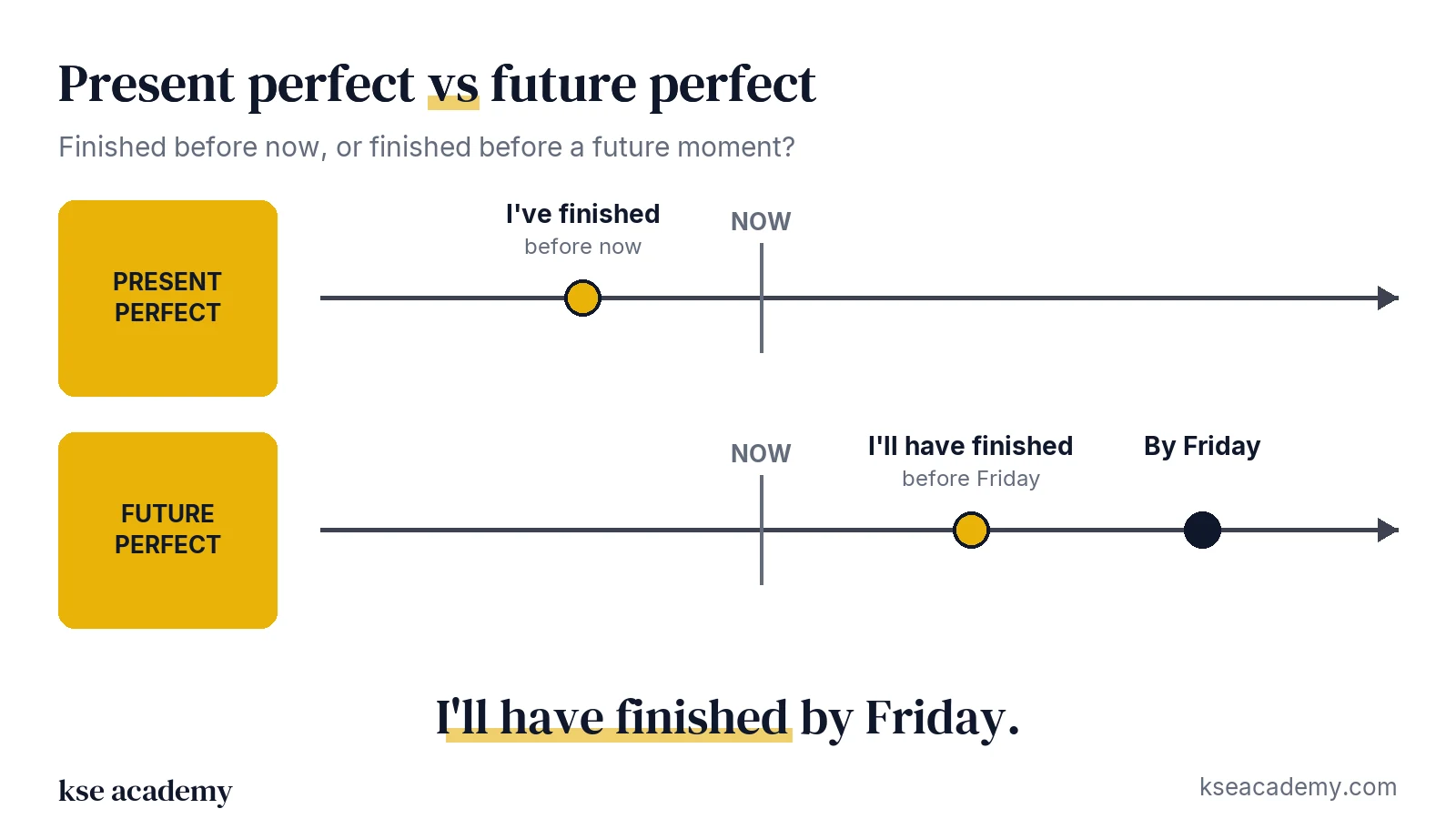
Both use have + participle and both look at a finished action, but from a different point: the present perfect looks from now; the future perfect, from a moment in the future:
| Tense | Example | Meaning |
|---|---|---|
| Present perfect | I have finished the report. | I have finished it (now). |
| Future perfect | I will have finished the report by Friday. | By Friday I will have finished it. |
Future perfect versus future continuous
If I think of a future moment, the future continuous talks about what will be in progress at that moment, and the future perfect, about what will already have finished: At 8 I’ll be cooking versus By 8 I’ll have cooked.
Spanish versus English: where we get confused
The good news: Spanish has the same tense («habré terminado») and it is used almost the same way. These are the equivalences and the traps:
| 🇪🇸 Spanish | 🇬🇧 English | What happens |
|---|---|---|
| Para el viernes habré terminado el informe. | By Friday I will have finished the report. | Direct equivalent: will have + participle. |
| Ya habrán llegado. | They will have arrived by now. | The Spanish futuro perfecto is also used to guess. |
| Cuando llegues, ya me habré ido. | By the time you arrive, I will have left. | After by the time comes the present (in Spanish, the subjunctive). |
| Habré terminado para el viernes. | I will have finished by Friday. | It is not the same as «habría terminado» (I would have finished), which is conditional. |
Common mistakes with the future perfect
| ❌ Incorrect | ✅ Correct | Why |
|---|---|---|
| By Friday I will have finish the report. | By Friday I will have finished the report. | After have comes the participle, not the infinitive. |
| They will have went home. | They will have gone home. | Participle, not past simple. |
| By the time you will arrive, I will have left. | By the time you arrive, I will have left. | After by the time, present, not will. |
| She will has finished before noon. | She will have finished before noon. | After will, always have (never has). |
| They will have been arrived by now. | They will have arrived by now. | Been is extra: it is will have + participle. |
| He will have not finished by Friday. | He won’t have finished by Friday. | The negative goes with will: won’t have or will not have. |
| I will finish the book by Sunday. (you mean «it will already be finished») | I will have finished the book by Sunday. | With by + date, the future perfect is usually required. |
The future perfect in Cambridge exams
You are expected to master this tense from B2 First onwards, and it is frequently tested in C1 Advanced:
- Use of English (Part 4, key word transformations) in B2 First and C1 Advanced: with key words such as WILL, BY or BEFORE.
- Writing in B2 First and C1 Advanced: in essays about the future (By 2050, technology will have changed…), the future perfect adds precision.
- Speaking: to talk about your goals («By this time next year, I will have passed the exam»).
Two examples in the style of Use of English Part 4:
- She will finish her degree before the end of the year. HAVE
She ______ her degree before the end of the year. → will have finished - I’m sure they have arrived at the hotel by now. WILL
I’m sure they ______ at the hotel by now. → will have arrived
Fun uses: the future perfect of the procrastinator
The future perfect is the favourite tense of people who promise a lot. A small collection of good intentions:
| Situation | Sentence |
|---|---|
| New Year | By December, I will have learned Chinese. (Spoiler: I won’t have.) |
| The gym | By March, I will have lost ten kilos. Or at least I’ll have paid for the gym. |
| The exam | By the time the exam arrives, I will have studied everything. (I really will.) |
| Work | By the time my boss notices, I’ll have left. |
| The pizza | By the time you get home, I will have eaten the whole pizza. |
| The chores | I’ll have done the dishes by tomorrow. Probably. |
Future perfect summary table
| What | How | Example |
|---|---|---|
| Form | will have + participle | I’ll have finished. |
| Negative | won’t have + participle | I won’t have finished. |
| Question | Will + subject + have + participle | Will you have finished? |
| Main use | Finished before a future moment | By Friday I’ll have finished. |
| Guess | What will already have happened | They’ll have arrived by now. |
| Duration | With state verbs | I’ll have known her for ten years. |
FAQ: the future perfect
When is the future perfect used?
To talk about something that will already have finished before a moment in the future, for deadlines and goals, to guess what has already happened and for durations up to a future point with state verbs.
How is the future perfect formed?
With will have + past participle: I will have finished. For the negative, won’t have; for questions, Will you have finished?
What is the difference between the future simple and the future perfect?
I’ll finish on Friday: it happens on Friday. I’ll have finished by Friday: by Friday it will already be done.
Do you say «by the time you will arrive»?
No. After by the time, before, when or until the present is used: By the time you arrive, I’ll have left.
Is it the same as the future continuous?
No. The future continuous talks about what will be in progress at a moment; the future perfect, about what will already have finished before it. At 8 I’ll be cooking versus By 8 I’ll have cooked.
What is the future perfect continuous?
It is will have been + -ing: By June I will have been working here for five years. It is used when the duration of an activity up to a future point matters. You will find it in the guide to the future perfect continuous.
Can it be used with «going to»?
Yes: I’m going to have finished by Friday is possible, although it is much less common. The usual form is will have.
Future perfect exercises
Thirty sentences to check you have understood. Below you have three interactive exercises that mark themselves, so you will know straight away how you did.
And if you prefer a version in text that you can copy and paste, you have it down here 👇
Exercise 1: choose the correct form
Choose the correct option to complete each sentence.
- By 2030, I (will finish / will have finished) my degree.
- I (will finish / will have finished) the report on Friday. I promise.
- By the time you arrive, I (will cook / will have cooked) dinner.
- It’s 9 p.m. They (will arrive / will have arrived) by now.
- This time next week, I (will lie / will be lying) on the beach.
- In June, we (will be / will have been) married for ten years.
- By the time she gets home, her kids (will go / will have gone) to bed.
- When you (will arrive / arrive), I will have left.
- By next year, she (will have lived / will live) here for twenty years.
- At nine tomorrow morning, I (will have taken / will be taking) my exam.
Show answers
- will have finished
- will finish
- will have cooked
- will have arrived
- will be lying
- will have been
- will have gone
- arrive
- will have lived
- will be taking
Exercise 2: complete the sentences
Complete each sentence with the future perfect of the verb in brackets. Write only the missing words.
- By the end of the year, she _______________ (save) enough money to travel.
- I _______________ (finish) the book by Sunday.
- _______________ (you / complete) the form by tomorrow?
- They _______________ (not / arrive) before eight.
- By the time we get there, the film _______________ (start).
- In May, he _______________ (work) here for five years.
- By 2040, scientists _______________ (find) a cure.
- We _______________ (spend) all our money by the end of the holiday.
- By midnight, the guests _______________ (leave).
- She _______________ (not / do) her homework by tonight, I’m sure.
Show answers
- will have saved
- will have finished
- Will you have completed
- won’t have arrived
- will have started
- will have worked
- will have found
- will have spent
- will have left
- won’t have done
Exercise 3: correct or incorrect?
Decide whether each sentence is correct. If it is incorrect, rewrite it correctly.
- By Friday, I will have finished the report.
- By Friday, I will have finish the report.
- By the time you arrive, I will have left.
- By the time you will arrive, I will have left.
- They will have been arrived by now.
- Will you have finished by six?
- I will have went home before dinner.
- She will has finished before noon.
- By next June, we will have lived here for ten years.
- He will have not finished by Friday.
Show answers
- Correct
- By Friday, I will have finished the report.
- Correct
- By the time you arrive, I will have left.
- They will have arrived by now.
- Correct
- I will have gone home before dinner.
- She will have finished before noon.
- Correct
- He won’t have finished by Friday.
Conclusion
To sum up in three ideas: the future perfect (will have + participle) talks about what will already have finished before a moment in the future; it is used for deadlines, goals and guesses, almost always with by, by then or by the time + present; and it is not the same as will + verb (it happens at that moment) or the future continuous (in progress at that moment).
If you want to continue with verb tenses, see the guides to the Future Continuous, the Past Perfect and the future in English. Do you have doubts about the future perfect? Write to me and I will help.
Did you find this post useful? Share it with other English students and teachers. And if you want more content like this, subscribe to my newsletter and follow me on Facebook, Twitter, Pinterest, Instagram and YouTube.
See you in the next post. Until then, don’t forget to keep smiling! 🙂
