
Tabla de contenidos
El Reading del B2 de la EOI tiene fama de ser la parte «fácil» del examen, y en parte es verdad: no tienes que producir nada, solo entender. Pero cada año veo a gente que suspende esta parte por dos motivos muy concretos: se queda sin tiempo o cae en las trampas de las opciones. Las dos cosas se arreglan practicando con tareas como las del examen y sabiendo qué busca cada una.
En esta guía te explico cómo es el Reading B2 de la EOI (oficialmente, la comprensión de textos escritos): cuántas tareas tiene, cuánto dura en cada comunidad, qué tipos de tarea te puedes encontrar y cómo se corrige. Y, sobre todo, tienes cuatro ejercicios completos, uno de cada tipo de tarea, con las respuestas explicadas. ¡Vamos allá! 🙂
Si quieres ver antes el examen completo, lo tienes en mi guía de EOI B2 inglés.
Reading B2 EOI: qué nivel se pide
En el B2 tienes que entender textos largos sobre temas generales y de actualidad: artículos, reportajes, entrevistas, reseñas, consejos o fragmentos de libros. No basta con captar la idea general. Te piden también detalles concretos, la opinión o la actitud de quien escribe, lo que se deduce aunque no se diga con esas palabras y cómo se organiza el texto.
No hace falta que conozcas todas las palabras. Un lector de B2 entiende por el contexto las que no sabe y no se para en cada una. Eso es lo que hay que entrenar.
Cómo es el Reading B2 de la EOI
La comprensión de textos escritos se hace el mismo día que el resto de la parte escrita, normalmente al principio. En casi todas las comunidades tiene 3 tareas de tipos distintos y unos 25 ítems, y dura entre 55 y 60 minutos. En total lees entre 1.500 y 2.000 palabras, repartidas en tres o más textos.
- Cada tarea empieza con un ejemplo (el ítem 0), ya resuelto. Te enseña cómo se contesta y, además, ese título, frase o palabra ya no vale para las demás.
- Las respuestas no restan en casi ninguna comunidad, así que no dejes nada en blanco. La excepción es Andalucía, que en los cuadernillos de 2026 resta un punto por cada título de más en la primera tarea.
- Para aprobar necesitas al menos un 50 % en esta parte, y un 65 % de media en todo el examen.
Esto es lo que dicen las especificaciones y los modelos oficiales más recientes de cada comunidad (Asturias, Ceuta y Melilla no tienen un modelo oficial que se pueda descargar):
| Comunidad | Tareas e ítems | Tiempo | Tipos de tarea del modelo |
|---|---|---|---|
| Andalucía | 3 tareas, 26 ítems | 75 min | títulos, «quién dice qué» y elección múltiple |
| Aragón | 3 tareas, 26 ítems | 55 min | títulos, elección múltiple y huecos con opciones |
| Baleares | 5 tareas en el modelo | 70 min | elección múltiple, emparejar y tres de uso de la lengua |
| Canarias | 3 tareas, 25 ítems | 70 min | emparejar, huecos con banco de palabras y verdadero o falso |
| Cantabria | 3 tareas, 25 ítems | 55 min | elección múltiple, huecos con opciones y buscar palabras en el texto |
| Castilla-La Mancha | 3 tareas, 25 ítems | 50 min | elección múltiple, reinsertar frases y emparejar |
| Castilla y León | 3 tareas, 25 ítems | 55 min | emparejar frases con párrafos, elección múltiple y reinsertar frases |
| Cataluña | 3 tareas, 30 ítems | 50 min | verdadero o falso, elección múltiple y emparejar |
| Comunidad Valenciana | 3 tareas, 26 ítems | 60 min | huecos con banco de palabras, elección múltiple y títulos |
| Extremadura | 3 tareas, 27 ítems | 60 min | elección múltiple y dos tareas de reinsertar |
| Galicia | 4 tareas, 25 ítems | 60 min | títulos, emparejar, verdadero o falso y elección múltiple |
| La Rioja | 3 tareas, 25 ítems | 60 min | huecos con banco de palabras, elección múltiple y reinsertar frases |
| Madrid | 3 tareas, 25 ítems | 60 min | títulos, elección múltiple y reinsertar frases |
| Murcia | 3 tareas, 26 ítems | 75 min | elección múltiple, elegir las afirmaciones verdaderas y reinsertar |
| Navarra | 4 tareas, 26 ítems | 60 min | elección múltiple, títulos, reinsertar frases y huecos con opciones |
| País Vasco | 4 tareas, 30 ítems | 60 min | reinsertar frases, elección múltiple y dos de huecos |
Tipos de tareas del Reading B2 de la EOI
He revisado los modelos de las 16 comunidades que publican uno, y casi todo se reduce a cuatro tipos de tarea:
Elección múltiple
Un texto largo y unas preguntas con tres opciones (a, b, c). Sale en 15 de las 16 comunidades, así que es casi seguro que te toque. Las preguntas siguen el orden del texto.
Emparejar títulos con párrafos
Un texto dividido en secciones y una lista de títulos o enunciados, con dos o tres que sobran. Sale en 11 comunidades. Hay una variante, el «¿quién dice qué?», en la que emparejas frases con varias personas o textos.
Reinsertar frases
Un texto al que le han quitado frases, y tienes que devolver cada una a su hueco. Sobran dos o tres. Sale en 8 comunidades (y probablemente también en Andalucía).
Huecos
Un texto con huecos que completas con palabras de un banco (Canarias, Comunidad Valenciana, La Rioja) o eligiendo entre tres o cuatro opciones para cada hueco (Aragón, Cantabria, Navarra, País Vasco). Aquí cuenta tanto el significado como la gramática.
Además, hay tareas que solo salen en algunas comunidades: verdadero o falso (Canarias, Cataluña y Galicia), elegir las afirmaciones verdaderas de una lista (Murcia), buscar en el texto la palabra que corresponde a una definición (Cantabria) o tareas de uso de la lengua, como la formación de palabras (Baleares y País Vasco).
Ejemplos de Reading B2 de la EOI
Los cuatro ejercicios de esta sección los he escrito para esta guía, con los formatos de los modelos oficiales y al nivel de un B2. Hazlos con reloj antes de mirar las respuestas: un texto largo como el del primero no debería llevarte más de 20 minutos.
Ejemplo de elección múltiple
Lee primero las preguntas, sin las opciones, para saber qué buscas. Luego lee el texto y, cuando llegues a la parte de cada pregunta, compara las tres opciones con lo que dice el texto, no con lo que te parece lógico.
Read the article and choose the correct answer (a, b or c). Question 0 is an example.
Borrowed, not bought
In one small town, the shelves of a former shoe shop hold drills, tents and sewing machines that nobody owns. I went to borrow one.
The first thing I borrowed from the Scarbrook Lending Shed was a wallpaper steamer, and I did not want it to go well. I had come to write about the place with the slightly superior attitude of someone who owns a perfectly good toolbox. Its shelves hold carpet cleaners, a pasta machine, three sewing machines and a ladder so long that it has a corner of its own. The steamer came with clear instructions and stripped my back bedroom in an afternoon. I took it back feeling a little foolish about my toolbox.
The Shed is the work of Euphemia Varcoe, a retired school caretaker with a lifelong habit of mending things. The idea came to her while she was clearing out her garage before moving house. She counted fourteen things she had hardly ever used, including a hedge trimmer bought for a single summer. «I wasn’t upset about the money,» she tells me. «What bothered me was that half my street probably had the same hedge trimmer sitting in the dark.» She spent that winter knocking on doors. By spring she had forty donated items and a landlord willing to accept a very low rent.
The system is simple. Members pay what they can afford, from nothing to twenty pounds a year, and borrow items for a week. Each item is looked over by a volunteer when it comes back. Anything that needs attention goes to the workbench, where Euphemia and two retired electricians spend their Thursday mornings. «Nothing leaves this room that I wouldn’t lend to my sister,» she says. Members are trusted to read the instructions, but a volunteer will happily show anyone how to use the more frightening machines.
I had assumed the members would be young, green and short of space, and some are. But the names that keep coming up in Euphemia’s loans book belong to people in their sixties and seventies, many of whom have a garage full of equipment already. «They come for the chat as much as the carpet cleaner,» she says. On the Saturday I spend there, I can see what she means: a man returning a tile cutter stays for forty minutes to explain to a stranger how it works. Families borrow tents for a first camping trip before deciding whether to buy one; most, she says, never do.
Not everything comes back as it went out. Euphemia keeps a box of «casualties»: a strimmer with its cable cut, a tent smelling strongly of a music festival, a jigsaw puzzle missing, quite understandably, several pieces. Then there are the things that never come back at all: eleven in three years, including a rather good pressure washer. I expected this to make her furious. Instead, she talks about it calmly, almost cheerfully. «If I took money from everyone as security, I’d lose fewer things,» she admits, «but I’d also lose the people who need us most, and that would be a much worse deal.» Most borrowers who break something, she adds, come to her first, red in the face and offering to pay.
Whether the Shed changes how people think about owning things is harder to judge. Kenwyn Tregunna, a joiner who borrows the long ladder twice a year, doubts that it does. «People round here still buy plenty,» he says. «They just buy different things.» Yet since joining, he has given away a cement mixer, two drills and a tile saw to friends who actually use them. This, he insists, had nothing to do with principles and everything to do with getting his van into the garage. Still, he has not replaced any of them.
Euphemia has never claimed to be saving the planet. What she hopes for is more modest: that someone who has borrowed a drill four times will stop and think before buying one, and that the pause slowly becomes a habit. «You don’t have to stop wanting things,» she says. «You just have to stop assuming you need to own them.» I came to Scarbrook expecting a charming idea that would not survive real life. After three years, it is plainly here to stay. How far it will spread is another matter, whatever its fans believe. But I have not bought a wallpaper steamer, and I no longer feel any need to.
0 In the first paragraph, what does the writer say about the first visit to the Shed? (ejemplo)
- a The steamer was harder to use than the writer had expected.
- b The writer had been more doubtful about the Shed than it deserved.
- c The writer had borrowed the steamer to avoid buying a new toolbox.
1 What made Euphemia decide to start the Shed?
- a She had found that several neighbours were willing to share their things.
- b She felt a little guilty about the money she had spent on a hedge trimmer.
- c She pictured the same waste being repeated in house after house.
2 What do we learn about the items in the third paragraph?
- a None of them is lent out again until it is in good working order.
- b Each of them is repaired at the workbench after it has been returned.
- c Some of the larger ones can only be borrowed after a short lesson.
3 What does the writer find out about the people who use the Shed?
- a Most of them join because they have nowhere to keep things of their own.
- b Families usually buy a tent after borrowing one from the Shed.
- c Its busiest borrowers are not the people the writer expected.
4 How does Euphemia feel about the things that are never returned?
- a She puts up with them because most of those responsible offer to pay.
- b She has no regrets about her decision not to ask for deposits.
- c She still hopes that some of the missing items will come back one day.
5 In the sixth paragraph, the word ‘This’ refers to
- a Kenwyn’s passing on several tools to friends
- b Kenwyn’s managing without buying replacements
- c Kenwyn’s doubt that the Shed changes habits
6 What does Euphemia hope the Shed will do?
- a help people to want slightly fewer new things than they do now
- b get people into the routine of thinking twice before buying
- c show people that sharing things is better for the environment
7 What is the writer’s attitude to the Shed by the end of the article?
- a convinced by it, and determined never to buy tools again
- b sure that it will spread to other towns, as its fans believe
- c sure that it will last, but unsure if it will catch on widely
Ver respuestas
- 0. b (ejemplo): El autor ‘did not want it to go well’ y llegó con ‘the slightly superior attitude of someone who owns a perfectly good toolbox’, pero la máquina funcionó y la devolvió ‘feeling a little foolish about my toolbox’: había desconfiado del Shed más de lo que merecía. La a la contradice el texto: la máquina ‘came with clear instructions and stripped my back bedroom in an afternoon’. La c juega con ‘toolbox’: el autor ya ‘owns a perfectly good toolbox’ y había ‘come to write about the place’.
- 1. c: Contó ‘fourteen things she had hardly ever used, including a hedge trimmer’, y pensó que ‘half my street probably had the same hedge trimmer sitting in the dark’: se imaginó el mismo desperdicio repetido en las casas de sus vecinos. La a es otro momento: supo qué querían compartir los vecinos después de tener la idea, cuando ‘She spent that winter knocking on doors’ y ‘By spring she had forty donated items’. La b la contradice ella misma: ‘I wasn’t upset about the money’.
- 2. a: Cada objeto ‘is looked over by a volunteer when it comes back’, se arregla lo que haga falta, y ‘Nothing leaves this room that I wouldn’t lend to my sister’: ningún objeto vuelve a salir hasta que está en buen estado. La b exagera: todo lo revisa ‘a volunteer’, pero solo ‘Anything that needs attention goes to the workbench’. La c convierte una oferta en una norma: ‘Members are trusted to read the instructions’, y un voluntario solo ‘will happily show anyone how to use the more frightening machines’.
- 3. c: El autor ‘had assumed the members would be young, green and short of space’, pero ‘the names that keep coming up in Euphemia’s loans book belong to people in their sixties and seventies, many of whom have a garage full of equipment already’: quienes más piden prestado son personas mayores que ya tienen de todo. La a es la suposición equivocada del autor: los socios son ‘young, green and short of space’ solo en parte (‘and some are’), y los que más usan el Shed ‘have a garage full of equipment already’. La b la contradice el texto: las familias piden tiendas ‘before deciding whether to buy one; most, she says, never do’.
- 4. b: Reconoce que ‘If I took money from everyone as security, I’d lose fewer things’, pero ‘I’d also lose the people who need us most, and that would be a much worse deal’, y habla de lo que pierde ‘calmly, almost cheerfully’: no se arrepiente de su decisión. La a mezcla dos grupos: quienes llegan ‘red in the face and offering to pay’ son los que ‘break something’, no aquellos cuyas cosas ‘never come back at all’. La c no es lo que dice: son ‘the things that never come back at all’, y las da por perdidas, ‘eleven in three years’.
- 5. a: ‘he has given away a cement mixer, two drills and a tile saw to friends who actually use them. This … had nothing to do with principles and everything to do with getting his van into the garage’: regalar las herramientas es lo que le dejó sitio para la furgoneta. La b viene después de ‘This’ y se contrapone con ‘Still’: ‘Still, he has not replaced any of them.’ La c es su opinión anterior, ‘People round here still buy plenty’, de la que se aleja la frase siguiente, que empieza por ‘Yet’.
- 6. b: Espera ‘that someone who has borrowed a drill four times will stop and think before buying one, and that the pause slowly becomes a habit’: que la gente se acostumbre a pensárselo antes de comprar. La a no es su objetivo: para ella el problema no es querer cosas, ‘You don’t have to stop wanting things’, sino poseerlas: ‘You just have to stop assuming you need to own them.’ La c es una suposición que el texto descarta: ‘Euphemia has never claimed to be saving the planet’, y lo que espera ‘is more modest’.
- 7. c: El autor dice ‘After three years, it is plainly here to stay’, pero ‘How far it will spread is another matter, whatever its fans believe’: está seguro de que durará, pero no de que se extienda. La a exagera el final: el autor solo dice ‘I have not bought a wallpaper steamer, and I no longer feel any need to’, que habla de una sola cosa, y nunca menciona dejar de comprar herramientas. La b es la opinión de sus defensores, no la del autor: ‘How far it will spread is another matter, whatever its fans believe’.
Cómo se resuelve: la opción correcta casi nunca repite las palabras del texto; las repite una incorrecta. Si una opción usa la misma palabra que el párrafo, desconfía y comprueba que dice lo mismo.
Ejemplo de emparejar títulos con párrafos
Un título resume todo el párrafo, no una frase suelta. Lee cada sección entera y pregúntate «¿de qué va esto?» antes de mirar la lista.
Read the text and choose the best heading (A-I) for each section. There are two headings you do not need. Section 0 is an example.
New flat, new people: getting through the first month
A Don’t wait to be invited
B Remember that your visitors affect everyone
C Speak up while it’s still no big deal
D Find out how things already work
E Keep the noise down late at night
F Ask before you take, however small
G Talk about money before it gets awkward
H Be generous with your food
I Do a bit more than your share
Moving in with people you have never met? Here’s how to survive the first few weeks, and maybe make a few friends along the way.
0. [D]
Whoever lived there before you has probably sorted out a system for the bins, the post and the heating, even if nobody has written it down. Before you change anything, ask. Which day is the recycling collected? Does someone turn the boiler off at night? Is the bathroom busy at seven? Ten minutes of chat over a cup of tea will save you a week of embarrassing mistakes.
1. ______
A friend of mine left a flat she loved barely speaking to her flatmates, all because of one cold winter nobody had planned for. Sit down in your first week, not your fifth. Will you buy coffee, oil and toilet paper together? Should the biggest bedroom pay a little more? Who deals with the companies, and how soon do the others pay them back? An app can help, but only later.
2. ______
It may feel like your flat, but it is the others’ home too. Your sister or old school friends are welcome, but they also use the shower, the hot water and the sofa, and may still be laughing in the kitchen at two in the morning. So before anyone comes, send a quick message: ‘My sister’s coming on Friday, is that OK?’ It costs nothing, unlike a surprise at breakfast.
3. ______
In the first weeks your flatmates are deciding what kind of person you are, and most of the evidence is in the kitchen. Wash your plates straight after eating, wipe the hob, take the rubbish down without being asked, and now and then sort out something nobody has noticed, like the shower drain. Nobody will thank you, but it buys goodwill for later, when you are the one who leaves a pan in the sink.
4. ______
Many people’s worst memory of a shared flat is not a dirty kitchen but feeling like a guest at home. You come back tired, close your door, and a month later the others have their jokes and Sunday plans. Saying yes to a film or a drink is a start, but suggest them yourself, and if you have cooked too much pasta, offer it round. People who only ever say yes stay polite strangers.
5. ______
A splash of milk at midnight, a spoonful of someone’s coffee, ten minutes with their charger: none of it seems worth mentioning, and that is exactly why people remember it. If it’s on someone else’s shelf in the fridge, check with the owner first, and the same goes for shampoo and that nice frying pan. If you finish something, replace it the same week rather than just offering the money.
6. ______
Shared flats rarely fall apart over one terrible argument. More often it is weeks of silence about a pan left soaking, or music through the wall when you are trying to sleep, then an explosion over something silly. Mention it calmly, in person, the first or second time. You don’t need a house rule for everything, and don’t stick a note on the fridge: notes always sound colder than you meant.
Ver respuestas
- 0. D (ejemplo): La sección habla de lo que ya funcionaba en el piso antes de que llegaras: ‘a system for the bins, the post and the heating’, y el consejo es ‘Before you change anything, ask.’ (el día del reciclaje, la caldera, el baño a las siete). Es decir, averiguar cómo funcionan ya las cosas.
- 1. G: La sección empieza con una amiga que se fue de un piso ‘barely speaking to her flatmates, all because of one cold winter nobody had planned for’, y el consejo es ‘Sit down in your first week, not your fifth.’ Las preguntas son sobre quién paga: ‘Should the biggest bedroom pay a little more?’ y ‘how soon do the others pay them back?’. Es decir, hablar de dinero antes de que resulte incómodo. La C es la trampa más cercana, porque esta sección también va de hablar pronto, pero todavía no pasa nada: es un plan para repartir gastos, no una pequeña molestia que comentar. La I juega con ‘pay a little more’: es una pregunta sobre cómo repartir, no sobre hacer más tareas. La H es una trampa con ‘coffee, oil and toilet paper’: la pregunta es si comprarlos ‘together’, no si ser generoso.
- 2. B: La sección parte de que el piso ‘is the others’ home too’: tus visitas ‘also use the shower, the hot water and the sofa’, así que ‘before anyone comes, send a quick message’. Es decir, recordar que tus visitas afectan a todos. La E es la trampa más cercana, porque pueden seguir ‘laughing in the kitchen at two in the morning’, pero es solo un ejemplo de cómo afectan al piso: el consejo es avisar, no hacer menos ruido. La F es una trampa con ‘is that OK?’: preguntar por una visita no es coger las cosas de otros. La G juega con ‘It costs nothing’: aquí no hay facturas.
- 3. I: La sección dice que tus compañeros están ‘deciding what kind of person you are’, sobre todo por la cocina, y el consejo va más allá de lo básico: ‘take the rubbish down without being asked’ y ‘now and then sort out something nobody has noticed’, porque ‘it buys goodwill for later’. Es decir, hacer un poco más de lo que te toca. La A es una trampa con ‘without being asked’: la A va de planes con los demás, y esta sección va de tareas de casa. La C es una trampa con ‘leaves a pan in the sink’: eso es que te perdonen más adelante, no comentar un problema.
- 4. A: La sección describe ‘feeling like a guest at home’ y dice ‘Saying yes to a film or a drink is a start, but suggest them yourself’, porque ‘People who only ever say yes stay polite strangers.’ Es decir, no esperar a que te inviten. La H es la trampa más cercana: ‘if you have cooked too much pasta, offer it round’ es un ejemplo de dar el primer paso, no la idea de la sección. La B juega con ‘guest’: aquí no viene nadie de fuera. La I es una trampa con ‘a dirty kitchen’, pero el autor dice que su peor recuerdo es ‘not a dirty kitchen’.
- 5. F: La sección enumera cosas pequeñas, ‘A splash of milk at midnight, a spoonful of someone’s coffee, ten minutes with their charger’, y el consejo es ‘check with the owner first’. Es decir, preguntar antes de coger algo, por pequeño que sea. La C es una trampa con ‘none of it seems worth mentioning’: aquí eres tú quien coge, no quien tiene un problema que comentar. La H es una trampa con la leche y el café: la sección trata de no usar la comida de otros, no de compartir la tuya. La G juega con ‘rather than just offering the money’: el autor rechaza pagar en lugar de reponer.
- 6. C: La sección dice que los pisos se estropean tras ‘weeks of silence about a pan left soaking’ y luego ‘an explosion over something silly’, así que ‘Mention it calmly, in person, the first or second time.’ Es decir, hablar mientras todavía no es nada grave. La E es la trampa más cercana, por la ‘music through the wall when you are trying to sleep’, pero el autor dice ‘You don’t need a house rule for everything’: el consejo es decírselo a la otra persona, no hacer tú menos ruido. La G es una trampa por lo de hablar pronto, pero aquí no hay dinero. La I juega con la sartén: esta sección va del desorden de otro, no de hacer tú más.
Cómo se resuelve: empieza por los párrafos que tengas más claros y tacha los títulos que uses. Los que sobran suelen recoger un detalle que sí aparece en algún párrafo, pero que no es su idea principal.
Ejemplo de reinsertar frases
Aquí lo que cuenta es la cohesión: cada frase tiene que encajar con lo que va antes y con lo que va después.
Read the article. Choose the sentence (A-J) that best fits each gap (1-7). There are two sentences you do not need. Gap 0 is an example.
The milkman is back
In one small town, milk in glass bottles is winning back the doorsteps that supermarkets took decades ago.
At twenty to four on a wet Tuesday morning, the streets of Garwell are empty except for a small electric milk float humming quietly past the terraced houses. (0) ______ Behind the wheel is Alwyn Petherick, who has been delivering milk to the town for eleven years and who still, he says, enjoys the first dark hour more than any other part of the day.
When Alwyn took over the round from his uncle, it had shrunk to fewer than ninety households. Most of them belonged to elderly people who had simply never got out of the habit of finding a pint on the step. (1) ______ Today he delivers to more than four hundred homes, and he has had to buy a second float and take on a part-time driver to cope.
The change began, Alwyn believes, with a television documentary about plastic waste in the oceans. Within a fortnight of it being shown, he had taken more new orders than in the whole of the previous year. (2) ______ ‘People would say, «I didn’t even know you still existed,»‘ he laughs. ‘Then they’d ask whether I could bring yoghurt as well.’
For most new customers, the attraction has less to do with the milk than with what it comes in. (3) ______ Each of Alwyn’s glass bottles goes back to the dairy to be washed and refilled up to twenty-five times before it is finally recycled. Many people tell him that the rubbish they put out each week has noticeably shrunk.
The milk inside has changed too. Alwyn’s uncle bought from a large company that collected from farms all over the region and took it to a factory a hundred miles away. Alwyn now buys directly from Senara Trebilcock, whose small herd grazes on the hills just outside the town. (4) ______ The arrangement suits Senara as well: she is paid almost twice what the big companies offered her, and she knows exactly where every litre goes.
Yet if you ask Alwyn’s older customers what they value most, few of them mention plastic or food miles. What they talk about instead is the knock on the door. (5) ______ Last winter, when Morva Faulding, a retired teacher, failed to take in the previous day’s milk, Alwyn looked through her window, saw her lying on the kitchen floor after a fall and called an ambulance.
None of this comes cheap, however. A pint on Alwyn’s round costs ninety-five pence, roughly double what the supermarkets charge. (6) ______ Even so, he admits that every time his prices rise, a few households quietly cancel their order, and most of them never come back.
A bigger problem, surprisingly, is the bottles. Each one costs the dairy around forty pence, and fewer and fewer of them find their way back. (7) ______ Alwyn has started leaving polite notes on doorsteps, and last spring he offered a free pint for every ten bottles returned. It worked, he says, for about a month.
Still, standing beside his float as the sky begins to lighten, Alwyn is optimistic. ‘My uncle thought he was running the last milk round in Garwell,’ he says. ‘I think I might be running the first of a new kind.’
A A family that buys its milk at the supermarket can easily throw away several hundred plastic containers a year.
B He defends the difference by pointing out that customers are paying for a service, not just a drink.
C Friends told him he was wasting his time on a trade that would be dead within five years.
D A few of his older customers have already told him that they cannot afford another rise.
E For those who live alone, he may be the only person they see all day, and he soon notices when something is not right.
F It makes so little noise that most of the people it serves never hear it arrive.
G Some end up as flower vases on kitchen windowsills, while others go out with the recycling.
H Most of them came from young parents who had grown up with nothing but supermarket cartons.
I Many of them were former customers who had cancelled their order years before.
J On most mornings, the milk left on a Garwell doorstep was still on the farm the evening before.
Ver respuestas
- 0. F (ejemplo): La F describe el vehículo de reparto que se acaba de mencionar: ‘It makes so little noise’ retoma ‘humming quietly’, e ‘it serves’ solo tiene sentido con un vehículo. La frase siguiente, ‘Behind the wheel is Alwyn Petherick’, nos dice quién lo conduce.
- 1. C: Antes del hueco, el reparto ‘had shrunk to fewer than ninety households’, casi todos de gente mayor, así que sus amigos pensaban que el oficio estaría ‘dead within five years’. Después, ‘Today he delivers to more than four hundred homes’ demuestra lo equivocados que estaban. La E tienta porque parece hablar de gente mayor, pero la frase siguiente va de cómo crece el reparto, no de clientes que viven solos; la D también habla de clientes mayores, pero todavía no se ha dicho nada de precios, así que ‘another rise’ no tiene sentido.
- 2. H: ‘Most of them’ se refiere a los ‘new orders’ que llegaron tras el documental. Quien ‘had grown up with nothing but supermarket cartons’ nunca ha visto un lechero, y por eso después del hueco dicen ‘I didn’t even know you still existed’. La A tienta porque va después del documental ‘about plastic waste’, pero es un dato general sobre cualquier familia: no explica quiénes eran los nuevos clientes ni por qué no lo conocían. La I tienta porque ‘Many of them’ también podría referirse a los ‘new orders’, pero los antiguos clientes sabrían que el lechero seguía existiendo, así que no podrían decir ‘I didn’t even know you still existed’.
- 3. A: El texto dice que lo que atrae no es la leche sino ‘what it comes in’; la A explica por qué importa el envase mostrando la alternativa: ‘several hundred plastic containers a year’. La frase de después da la otra cara del contraste, sin conector: ‘Each of Alwyn’s glass bottles goes back to the dairy’, y ‘the rubbish they put out each week has noticeably shrunk’ porque ya no hay plástico. La G no encaja: ‘Some’ y ‘others’ tendrían que ser los ‘new customers’, que no pueden ‘end up as flower vases’, y además unas botellas que acaban de floreros contradicen las que vuelven a la lechería.
- 4. J: Alwyn ahora compra la leche a Senara, ‘whose small herd grazes on the hills just outside the town’, en lugar de a una empresa que la llevaba a ‘a factory a hundred miles away’. La J da el resultado para los clientes: la leche ‘was still on the farm the evening before’. Después, ‘The arrangement suits Senara as well’ pasa de la ventaja para los clientes a la ventaja para la granjera.
- 5. E: Los clientes mayores valoran ‘the knock on the door’; la E explica por qué: para quien vive solo, Alwyn ‘may be the only person they see all day’. Su segunda mitad, ‘he soon notices when something is not right’, es una idea general, y la historia de después es un ejemplo: cuando Morva Faulding no recogió la leche, Alwyn ‘looked through her window’ y ‘called an ambulance’. La D tienta porque habla de ‘older customers’ y de lo que le han ‘told him’, como la frase anterior, pero trata de dinero, justo lo que el párrafo acaba de decir que no es de lo que hablan, y no lleva a la historia de la caída.
- 6. B: ‘the difference’ se refiere a la diferencia de precio que se acaba de describir: ‘ninety-five pence, roughly double what the supermarkets charge’. Después, ‘Even so, he admits’ necesita que Alwyn haya defendido antes su precio, y eso hace la B: ‘customers are paying for a service, not just a drink’. La D tienta porque también habla del precio, pero si los clientes ya hubieran dicho que ‘cannot afford another rise’, ‘Even so’ no tendría sentido y ‘he admits’ no tendría nada a lo que oponerse.
- 7. G: Antes del hueco, ‘fewer and fewer of them find their way back’; la G da ejemplos de adónde van las botellas que faltan: ‘Some end up as flower vases’, ‘others go out with the recycling’. Después, las ‘polite notes’ de Alwyn y ‘a free pint for every ten bottles returned’ son su respuesta a ese problema.
Cómo se resuelve: busca las pistas de unión. Un pronombre (it, they, this) necesita algo a lo que referirse justo antes; un but o un however necesita una idea contraria; un also necesita algo a lo que sumarse. Cuando creas que tienes una frase, lee el párrafo entero con ella dentro.
Ejemplo de huecos con banco de palabras
Las palabras del banco no se repiten y sobran algunas. Para cada hueco, pregúntate primero qué clase de palabra falta (un nombre, un verbo, un adjetivo, un conector) y luego cuál encaja por el significado.
Read the text and complete each gap (1-10) with a word from the box (A-O). Use each word only once. There are four words you do not need. Gap 0 is an example.
Hangry? Blame your brain
A alert · B badly · C before · D calm · E character · F fall · G impulsive · H jump · I mood · J shortage · K skip · L slowly · M steady · N whereas · O word
We have all been there. Lunch is late, the queue is long, and suddenly a colleague’s harmless joke feels like a personal attack. English even has a (0) ______ for this state: «hangry», a mix of hungry and angry. But is it just a convenient excuse, or is something really happening inside us?
When we go several hours without eating, the amount of glucose, or sugar, in our blood begins to (1) ______. The brain depends on this sugar for almost all its energy, so it is one of the first organs to notice a (2) ______ of fuel. To protect itself, the body releases stress hormones such as cortisol and adrenaline, the same chemicals our body uses in an emergency. They keep us (3) ______, but they also make us tense and quick to lose our temper.
Hunger affects how we think, too. Some scientists think that when fuel runs low, the part of the brain that helps us stop and consider before we act works less well, so we are more likely to react (4) ______ to minor problems. Studies of shoppers suggest that hunger also leads to more (5) ______ choices: people who go to the supermarket on an empty stomach often end up buying more food than they planned.
Interestingly, hunger does not affect everyone in the same way. Research suggests that people who pay attention to their feelings are less likely to become hangry, (6) ______ those who ignore what their body is telling them get annoyed more easily. In other words, learning to recognise the early signs of hunger, such as a headache, poor concentration or a sudden bad (7) ______, is half the battle.
So what can we do? The simplest answer is not to (8) ______ meals, especially breakfast. Food that releases energy slowly, like nuts, wholemeal bread or yoghurt, helps to keep blood sugar (9) ______ for longer than sweets or sugary drinks do. Finally, if you feel your patience running out, have a small snack (10) ______ replying to that annoying email or making an important decision.
Ver respuestas
- 0. O (word) (ejemplo): ‘Have a word for’ algo significa que existe un término para nombrarlo, y justo después se da ese término: «hangry». Después de ‘a’ hace falta un sustantivo en singular; ‘a mood’ o ‘a character for this state’ no introducirían un nombre.
- 1. F (fall): Después de ‘begins to’ necesitamos un verbo en infinitivo. Sin comida, el azúcar en sangre baja, y más adelante el texto dice ‘fuel runs low’. ‘Jump’ encaja en la gramática, pero significa ‘subir de golpe’, justo lo contrario de lo que pasa ‘without eating’. ‘Steady’ y ‘calm’ pueden ser verbos, pero el azúcar que escasea no se estabiliza ni se calma.
- 2. J (shortage): ‘A shortage of’ algo significa que no hay suficiente: el azúcar está bajando, y el cerebro ‘depends on this sugar for almost all its energy’. ‘Fall’ también es un sustantivo, pero se dice ‘a fall in sugar levels’, no ‘a fall of fuel’. ‘Mood’ y ‘character’ también son sustantivos, pero no dicen nada del combustible.
- 3. A (alert): Son las sustancias que ‘our body uses in an emergency’: nos mantienen alerta, listos para actuar. ‘Calm’ encaja en la gramática (‘keep us calm’ es muy común), pero esas mismas hormonas ‘make us tense’, y nadie está tranquilo y tenso a la vez: las hormonas del estrés no nos calman. ‘Steady’ falla por lo mismo.
- 4. B (badly): Después de ‘react’ necesitamos un adverbio. La parte del cerebro que nos ayuda a ‘stop and consider before we act works less well’, así que actuamos sin pensar y reaccionamos mal. ‘Slowly’ también es un adverbio, y con hambre puede parecer que el cerebro va lento, pero perder la parte que nos hace parar significa reaccionar más rápido, no más despacio: el texto acaba de decir que estamos ‘quick to lose our temper’. ‘Impulsive’ es un adjetivo, así que no puede ir después de ‘react’.
- 5. G (impulsive): Delante del sustantivo ‘choices’ hace falta un adjetivo. El ejemplo de después de los dos puntos lo explica: los compradores con hambre ‘end up buying more food than they planned’, que es justo lo que son las decisiones impulsivas (sin planear, de repente). ‘Calm’ encaja en la gramática, pero comprar más de lo previsto es lo contrario de una decisión tranquila; ‘alert’ y ‘steady’ no se dicen de las decisiones.
- 6. N (whereas): La frase compara dos grupos: la gente que presta atención a lo que siente y ‘those who ignore’ lo que su cuerpo les dice. ‘Whereas’ une dos oraciones que contrastan. ‘Before’ también puede unir dos oraciones, pero crea una relación de tiempo (primero esto, luego aquello) que aquí no tiene sentido.
- 7. I (mood): ‘A bad mood’ es un rato de mal humor o de estar molesto: puede ser ‘sudden’ y luego pasarse, como ‘a headache’ o ‘poor concentration’. ‘Character’ es una trampa para hispanohablantes (‘mal carácter’): tu carácter es cómo eres siempre, así que no puede aparecer de repente como señal de hambre, y ‘a bad character’ es una persona poco honrada.
- 8. K (skip): ‘Skip a meal’ significa saltarse una comida, y el consejo es comer con regularidad, ‘especially breakfast’. ‘Jump’ es una trampa para hispanohablantes (‘saltarse una comida’): en inglés se salta (jump) una valla o un muro, pero una comida se ‘skip’. ‘Fall’ también es un verbo, pero no puede llevar complemento directo (‘meals’).
- 9. M (steady): ‘Keep + complemento + adjetivo’ describe el estado que buscamos: un azúcar en sangre que se mantiene igual ‘for longer’, gracias a alimentos que ‘releases energy slowly’, al contrario que ‘sweets or sugary drinks’. ‘Calm’ encaja en la gramática, pero se dice de las personas, del mar o del tiempo, no de un nivel de azúcar: los niveles se mantienen ‘steady’. ‘Alert’ e ‘impulsive’ describen personas o sus decisiones, y ‘slowly’ es un adverbio, que no puede ir después de ‘keep blood sugar’.
- 10. C (before): ‘Before + -ing’ dice qué debe pasar primero: toma algo de comer y luego contesta el correo o toma la decisión. ‘Whereas’ necesita una oración completa, no una forma en -ing, y con ‘slowly’ ‘replying’ quedaría sin nada que lo uniera al resto de la frase.
Cómo se resuelve: haz primero los huecos que tengas claros y tacha esas palabras; así el banco se reduce. Al final, relee el texto completo: una palabra que encaja en su frase puede no tener sentido con la siguiente.
Cómo se corrige el Reading B2 de la EOI
La corrección es objetiva: hay una respuesta correcta por ítem y todos los ítems valen lo mismo en casi todas las comunidades. Hay algunas diferencias que conviene conocer:
- En la Comunidad Valenciana, los ítems de elección múltiple y de emparejar valen el doble que los de huecos; en Aragón, cada hueco de la tarea de opciones vale medio punto.
- En Andalucía se resta un punto por cada título usado de más en la primera tarea (cuadernillos de 2026). En el resto, los errores no restan.
- En casi todas las comunidades se contesta en el propio cuadernillo, pero en algunas (Aragón, Baleares, Cataluña, Murcia o País Vasco, por ejemplo) hay una hoja de respuestas aparte. Deja unos minutos para pasar las respuestas.
Consejos para el Reading B2 de la EOI
- Reparte el tiempo antes de empezar. Con 60 minutos y tres tareas, unos 18 minutos por tarea y 5 para revisar. Si una tarea se te atasca, pasa a la siguiente y vuelve después.
- Lee las preguntas antes que el texto. Sabrás qué buscas y no tendrás que leerlo todo dos veces.
- No te quedes en una palabra. Si no la conoces, sigue leyendo: casi siempre se entiende por el contexto o no es necesaria para contestar.
- Desconfía de las opciones que repiten palabras del texto. Es la trampa más habitual de la elección múltiple.
- Usa el ejemplo. El ítem 0 te dice cómo funciona la tarea y elimina una opción.
- No dejes nada en blanco, salvo en la primera tarea de Andalucía, donde los títulos de más restan.
- Lee en inglés todos los días un poco: artículos, noticias, blogs de temas que te gusten. Es lo que más rápido mejora esta parte.
Y si quieres seguir con las otras partes, tienes mis guías de Writing B2 EOI, Speaking B2 EOI, mediación escrita y mediación oral, y la del Listening B2 EOI.
Libros para el B2 de la EOI
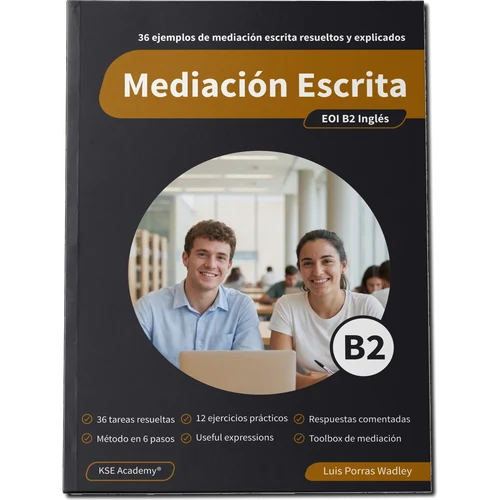
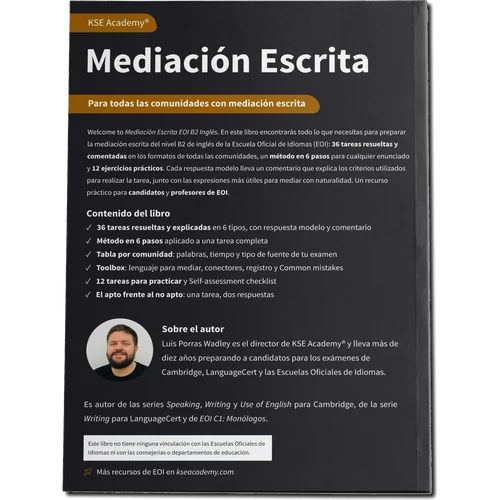
Para la mediación, la parte que más cuesta preparar por libre, tienes mi libro Mediación Escrita EOI B2 Inglés, con 36 ejemplos resueltos y explicados para todas las comunidades.
¿Te ha parecido útil esta guía? Compártela con quien esté preparando el B2. Y si quieres más contenido como este, suscríbete a mi newsletter y sígueme en Facebook, Twitter, Pinterest, Instagram y YouTube.
Mucho ánimo con el examen y, hasta la próxima, don’t forget to keep smiling! 🙂
