
Table of contents
EOI B2 Reading has a reputation for being the «easy» part of the exam, and in a way it is: you don’t have to produce anything, just understand. But every year I see people fail this part for two very specific reasons: they run out of time or they fall into the traps in the options. Both can be fixed by practising with exam-style tasks and knowing what each one is looking for.
In this guide I explain what EOI B2 Reading is like (officially, reading comprehension, comprensión de textos escritos): how many tasks there are, how long it lasts in each region, which task types you might get and how it’s marked. And, above all, there are four complete exercises, one of each task type, with the answers explained. Let’s get started! 🙂
If you’d like to see the whole exam first, it’s all in my guide to EOI B2 English.
EOI B2 Reading: the level expected
At B2 you have to understand long texts on general and topical subjects: articles, features, interviews, reviews, advice or extracts from books. Getting the general idea isn’t enough. You’re also asked about specific details, the writer’s opinion or attitude, what you can infer even if it isn’t said in those words, and how the text is organised.
You don’t need to know every word. A B2 reader works out the ones they don’t know from the context and doesn’t stop at each one. That’s what you need to practise.
What EOI B2 Reading is like
Reading comprehension takes place on the same day as the rest of the written exam, usually first. In almost every region it has 3 tasks of different types and about 25 items, and it lasts between 55 and 60 minutes. In total you read between 1,500 and 2,000 words, spread over three or more texts.
- Every task starts with an example (item 0), already answered. It shows you how to answer and, on top of that, that heading, sentence or word can’t be used again.
- Wrong answers don’t lose marks in almost any region, so don’t leave anything blank. The exception is Andalusia, whose 2026 booklets take off one mark for every extra heading used in the first task.
- To pass you need at least 50% in this part, and an average of 65% across the whole exam.
This is what the most recent specifications and official sample tests of each region say (Asturias, Ceuta and Melilla have no official sample you can download):
| Region | Tasks and items | Time | Task types in the sample |
|---|---|---|---|
| Andalusia | 3 tasks, 26 items | 75 min | headings, «who says what» and multiple choice |
| Aragon | 3 tasks, 26 items | 55 min | headings, multiple choice and a multiple-choice cloze |
| Balearic Islands | 5 tasks in the sample | 70 min | multiple choice, matching and three use of English tasks |
| Canary Islands | 3 tasks, 25 items | 70 min | matching, gaps with a word bank and true or false |
| Cantabria | 3 tasks, 25 items | 55 min | multiple choice, a multiple-choice cloze and finding words in the text |
| Castile-La Mancha | 3 tasks, 25 items | 50 min | multiple choice, missing sentences and matching |
| Castile and León | 3 tasks, 25 items | 55 min | matching sentences with paragraphs, multiple choice and missing sentences |
| Catalonia | 3 tasks, 30 items | 50 min | true or false, multiple choice and matching |
| Valencian Community | 3 tasks, 26 items | 60 min | gaps with a word bank, multiple choice and headings |
| Extremadura | 3 tasks, 27 items | 60 min | multiple choice and two missing-sentence tasks |
| Galicia | 4 tasks, 25 items | 60 min | headings, matching, true or false and multiple choice |
| La Rioja | 3 tasks, 25 items | 60 min | gaps with a word bank, multiple choice and missing sentences |
| Madrid | 3 tasks, 25 items | 60 min | headings, multiple choice and missing sentences |
| Murcia | 3 tasks, 26 items | 75 min | multiple choice, choosing the true statements and missing lines |
| Navarre | 4 tasks, 26 items | 60 min | multiple choice, headings, missing sentences and a multiple-choice cloze |
| Basque Country | 4 tasks, 30 items | 60 min | missing sentences, multiple choice and two gap tasks |
EOI B2 Reading task types
I’ve gone through the sample tests of the 16 regions that publish one, and almost everything comes down to four task types:
Multiple choice
A long text and some questions with three options (a, b, c). It appears in 15 of the 16 regions, so you’re almost certain to get it. The questions follow the order of the text.
Matching headings with paragraphs
A text divided into sections and a list of headings or statements, with two or three you don’t need. It appears in 11 regions. There’s a variant, «who says what?», where you match statements with several people or texts.
Missing sentences
A text with some sentences taken out, and you have to put each one back in its gap. There are two or three extra sentences. It appears in 8 regions (and probably in Andalusia too).
Gaps
A text with gaps that you fill with words from a word bank (Canary Islands, Valencian Community, La Rioja) or by choosing from three or four options for each gap (Aragon, Cantabria, Navarre, Basque Country). Here both meaning and grammar count.
There are also tasks that only appear in some regions: true or false (Canary Islands, Catalonia and Galicia), choosing the true statements from a list (Murcia), finding the word in the text that matches a definition (Cantabria) or use of English tasks such as word formation (Balearic Islands and Basque Country).
EOI B2 Reading examples
I’ve written the four exercises in this section for this guide, using the formats of the official sample tests and at B2 level. Do them against the clock before you look at the answers: a long text like the one in the first exercise shouldn’t take you more than 20 minutes.
Multiple choice example
Read the questions first, without the options, so you know what you’re looking for. Then read the text and, when you reach the part for each question, compare the three options with what the text says, not with what seems logical.
Read the article and choose the correct answer (a, b or c). Question 0 is an example.
Borrowed, not bought
In one small town, the shelves of a former shoe shop hold drills, tents and sewing machines that nobody owns. I went to borrow one.
The first thing I borrowed from the Scarbrook Lending Shed was a wallpaper steamer, and I did not want it to go well. I had come to write about the place with the slightly superior attitude of someone who owns a perfectly good toolbox. Its shelves hold carpet cleaners, a pasta machine, three sewing machines and a ladder so long that it has a corner of its own. The steamer came with clear instructions and stripped my back bedroom in an afternoon. I took it back feeling a little foolish about my toolbox.
The Shed is the work of Euphemia Varcoe, a retired school caretaker with a lifelong habit of mending things. The idea came to her while she was clearing out her garage before moving house. She counted fourteen things she had hardly ever used, including a hedge trimmer bought for a single summer. «I wasn’t upset about the money,» she tells me. «What bothered me was that half my street probably had the same hedge trimmer sitting in the dark.» She spent that winter knocking on doors. By spring she had forty donated items and a landlord willing to accept a very low rent.
The system is simple. Members pay what they can afford, from nothing to twenty pounds a year, and borrow items for a week. Each item is looked over by a volunteer when it comes back. Anything that needs attention goes to the workbench, where Euphemia and two retired electricians spend their Thursday mornings. «Nothing leaves this room that I wouldn’t lend to my sister,» she says. Members are trusted to read the instructions, but a volunteer will happily show anyone how to use the more frightening machines.
I had assumed the members would be young, green and short of space, and some are. But the names that keep coming up in Euphemia’s loans book belong to people in their sixties and seventies, many of whom have a garage full of equipment already. «They come for the chat as much as the carpet cleaner,» she says. On the Saturday I spend there, I can see what she means: a man returning a tile cutter stays for forty minutes to explain to a stranger how it works. Families borrow tents for a first camping trip before deciding whether to buy one; most, she says, never do.
Not everything comes back as it went out. Euphemia keeps a box of «casualties»: a strimmer with its cable cut, a tent smelling strongly of a music festival, a jigsaw puzzle missing, quite understandably, several pieces. Then there are the things that never come back at all: eleven in three years, including a rather good pressure washer. I expected this to make her furious. Instead, she talks about it calmly, almost cheerfully. «If I took money from everyone as security, I’d lose fewer things,» she admits, «but I’d also lose the people who need us most, and that would be a much worse deal.» Most borrowers who break something, she adds, come to her first, red in the face and offering to pay.
Whether the Shed changes how people think about owning things is harder to judge. Kenwyn Tregunna, a joiner who borrows the long ladder twice a year, doubts that it does. «People round here still buy plenty,» he says. «They just buy different things.» Yet since joining, he has given away a cement mixer, two drills and a tile saw to friends who actually use them. This, he insists, had nothing to do with principles and everything to do with getting his van into the garage. Still, he has not replaced any of them.
Euphemia has never claimed to be saving the planet. What she hopes for is more modest: that someone who has borrowed a drill four times will stop and think before buying one, and that the pause slowly becomes a habit. «You don’t have to stop wanting things,» she says. «You just have to stop assuming you need to own them.» I came to Scarbrook expecting a charming idea that would not survive real life. After three years, it is plainly here to stay. How far it will spread is another matter, whatever its fans believe. But I have not bought a wallpaper steamer, and I no longer feel any need to.
0 In the first paragraph, what does the writer say about the first visit to the Shed? (example)
- a The steamer was harder to use than the writer had expected.
- b The writer had been more doubtful about the Shed than it deserved.
- c The writer had borrowed the steamer to avoid buying a new toolbox.
1 What made Euphemia decide to start the Shed?
- a She had found that several neighbours were willing to share their things.
- b She felt a little guilty about the money she had spent on a hedge trimmer.
- c She pictured the same waste being repeated in house after house.
2 What do we learn about the items in the third paragraph?
- a None of them is lent out again until it is in good working order.
- b Each of them is repaired at the workbench after it has been returned.
- c Some of the larger ones can only be borrowed after a short lesson.
3 What does the writer find out about the people who use the Shed?
- a Most of them join because they have nowhere to keep things of their own.
- b Families usually buy a tent after borrowing one from the Shed.
- c Its busiest borrowers are not the people the writer expected.
4 How does Euphemia feel about the things that are never returned?
- a She puts up with them because most of those responsible offer to pay.
- b She has no regrets about her decision not to ask for deposits.
- c She still hopes that some of the missing items will come back one day.
5 In the sixth paragraph, the word ‘This’ refers to
- a Kenwyn’s passing on several tools to friends
- b Kenwyn’s managing without buying replacements
- c Kenwyn’s doubt that the Shed changes habits
6 What does Euphemia hope the Shed will do?
- a help people to want slightly fewer new things than they do now
- b get people into the routine of thinking twice before buying
- c show people that sharing things is better for the environment
7 What is the writer’s attitude to the Shed by the end of the article?
- a convinced by it, and determined never to buy tools again
- b sure that it will spread to other towns, as its fans believe
- c sure that it will last, but unsure if it will catch on widely
Show answers
- 0. b (example): The writer ‘did not want it to go well’ and arrived with ‘the slightly superior attitude of someone who owns a perfectly good toolbox’, but the steamer worked and the writer took it back ‘feeling a little foolish about my toolbox’. a is contradicted: the steamer ‘came with clear instructions and stripped my back bedroom in an afternoon’. c is a word match on ‘toolbox’: the writer already ‘owns a perfectly good toolbox’ and had ‘come to write about the place’.
- 1. c: She counted ‘fourteen things she had hardly ever used, including a hedge trimmer’, and then thought that ‘half my street probably had the same hedge trimmer sitting in the dark’: she imagined her own wasted things repeated in her neighbours’ houses. a is the wrong time: she found out what neighbours would share only after the idea, when ‘She spent that winter knocking on doors’ and ‘By spring she had forty donated items’. b is contradicted: she rules the money out herself, ‘I wasn’t upset about the money’.
- 2. a: Each item ‘is looked over by a volunteer when it comes back’, anything that needs it is repaired, and ‘Nothing leaves this room that I wouldn’t lend to my sister’: no item goes out again until it is good enough. b overstates: every item is checked by ‘a volunteer’, but only ‘Anything that needs attention goes to the workbench’. c turns an offer into a rule: ‘Members are trusted to read the instructions’, and a volunteer only ‘will happily show anyone how to use the more frightening machines’.
- 3. c: The writer ‘had assumed the members would be young, green and short of space’, but ‘the names that keep coming up in Euphemia’s loans book belong to people in their sixties and seventies, many of whom have a garage full of equipment already’: the most frequent borrowers are older people who already own a lot. a is the writer’s own wrong guess: the members are ‘young, green and short of space’ only in part (‘and some are’), and the most frequent borrowers ‘have a garage full of equipment already’. b is contradicted: families borrow tents ‘before deciding whether to buy one; most, she says, never do’.
- 4. b: She admits that ‘If I took money from everyone as security, I’d lose fewer things’, but ‘I’d also lose the people who need us most, and that would be a much worse deal’, and she talks about the losses ‘calmly, almost cheerfully’: she is happy with her choice. a mixes up two groups: it is those ‘who break something’ who come to her ‘red in the face and offering to pay’, not those whose things ‘never come back at all’. c is not what she says: these are ‘the things that never come back at all’, and she counts them as lost, ‘eleven in three years’.
- 5. a: ‘he has given away a cement mixer, two drills and a tile saw to friends who actually use them. This … had nothing to do with principles and everything to do with getting his van into the garage’: giving the tools away is what made room for the van. b comes after ‘This’ and is contrasted with it by ‘Still’: ‘Still, he has not replaced any of them.’ c is his earlier view, ‘People round here still buy plenty’, which the next sentence, starting ‘Yet’, moves away from.
- 6. b: She hopes ‘that someone who has borrowed a drill four times will stop and think before buying one, and that the pause slowly becomes a habit’. a is not her aim: wanting is not the problem for her, ‘You don’t have to stop wanting things’, only owning: ‘You just have to stop assuming you need to own them.’ c is a plausible assumption the writer rules out: ‘Euphemia has never claimed to be saving the planet’, and what she hopes for ‘is more modest’.
- 7. c: The writer says ‘After three years, it is plainly here to stay’, but ‘How far it will spread is another matter, whatever its fans believe’. a overstates the ending: the writer only says ‘I have not bought a wallpaper steamer, and I no longer feel any need to’, which is about one item, and never mentions any plan to stop buying tools. b is the fans’ view, not the writer’s: ‘How far it will spread is another matter, whatever its fans believe’.
How to do it: the right option hardly ever repeats the words of the text; a wrong one does. If an option uses the same word as the paragraph, be suspicious and check that it really says the same thing.
Matching headings example
A heading sums up the whole paragraph, not one sentence of it. Read each section to the end and ask yourself «what is this about?» before you look at the list.
Read the text and choose the best heading (A-I) for each section. There are two headings you do not need. Section 0 is an example.
New flat, new people: getting through the first month
A Don’t wait to be invited
B Remember that your visitors affect everyone
C Speak up while it’s still no big deal
D Find out how things already work
E Keep the noise down late at night
F Ask before you take, however small
G Talk about money before it gets awkward
H Be generous with your food
I Do a bit more than your share
Moving in with people you have never met? Here’s how to survive the first few weeks, and maybe make a few friends along the way.
0. [D]
Whoever lived there before you has probably sorted out a system for the bins, the post and the heating, even if nobody has written it down. Before you change anything, ask. Which day is the recycling collected? Does someone turn the boiler off at night? Is the bathroom busy at seven? Ten minutes of chat over a cup of tea will save you a week of embarrassing mistakes.
1. ______
A friend of mine left a flat she loved barely speaking to her flatmates, all because of one cold winter nobody had planned for. Sit down in your first week, not your fifth. Will you buy coffee, oil and toilet paper together? Should the biggest bedroom pay a little more? Who deals with the companies, and how soon do the others pay them back? An app can help, but only later.
2. ______
It may feel like your flat, but it is the others’ home too. Your sister or old school friends are welcome, but they also use the shower, the hot water and the sofa, and may still be laughing in the kitchen at two in the morning. So before anyone comes, send a quick message: ‘My sister’s coming on Friday, is that OK?’ It costs nothing, unlike a surprise at breakfast.
3. ______
In the first weeks your flatmates are deciding what kind of person you are, and most of the evidence is in the kitchen. Wash your plates straight after eating, wipe the hob, take the rubbish down without being asked, and now and then sort out something nobody has noticed, like the shower drain. Nobody will thank you, but it buys goodwill for later, when you are the one who leaves a pan in the sink.
4. ______
Many people’s worst memory of a shared flat is not a dirty kitchen but feeling like a guest at home. You come back tired, close your door, and a month later the others have their jokes and Sunday plans. Saying yes to a film or a drink is a start, but suggest them yourself, and if you have cooked too much pasta, offer it round. People who only ever say yes stay polite strangers.
5. ______
A splash of milk at midnight, a spoonful of someone’s coffee, ten minutes with their charger: none of it seems worth mentioning, and that is exactly why people remember it. If it’s on someone else’s shelf in the fridge, check with the owner first, and the same goes for shampoo and that nice frying pan. If you finish something, replace it the same week rather than just offering the money.
6. ______
Shared flats rarely fall apart over one terrible argument. More often it is weeks of silence about a pan left soaking, or music through the wall when you are trying to sleep, then an explosion over something silly. Mention it calmly, in person, the first or second time. You don’t need a house rule for everything, and don’t stick a note on the fridge: notes always sound colder than you meant.
Show answers
- 0. D (example): The section is about the arrangements the flat had before you arrived: ‘a system for the bins, the post and the heating’, and the advice is ‘Before you change anything, ask.’ (recycling day, the boiler, the bathroom at seven). That is finding out how things already work.
- 1. G: The section opens with a friend who left a flat ‘barely speaking to her flatmates, all because of one cold winter nobody had planned for’, and the advice is ‘Sit down in your first week, not your fifth.’ The questions are about who pays: ‘Should the biggest bedroom pay a little more?’ and ‘how soon do the others pay them back?’. That is talking about money before it gets awkward. C is the closest lure, because this section is also about talking early, but nothing is wrong yet: it is a plan for sharing costs, not a small problem to mention. I is a word match on ‘pay a little more’: that is a question about splitting costs, not about doing extra work. H is a lure on ‘coffee, oil and toilet paper’: the question is whether to buy them ‘together’, not about being generous.
- 2. B: The section starts from the idea that the flat ‘is the others’ home too’: your visitors ‘also use the shower, the hot water and the sofa’, so ‘before anyone comes, send a quick message’. That is remembering that your visitors affect everyone. E is the closest lure, because they ‘may still be laughing in the kitchen at two in the morning’, but that is one example of how visitors affect the flat: the advice is to warn the others, not to keep quiet. F is a lure on ‘is that OK?’: asking about a visit is not taking other people’s things. G is a word match on ‘It costs nothing’: there are no bills here.
- 3. I: The section says your flatmates are ‘deciding what kind of person you are’, mostly from the kitchen, and the advice goes beyond the basics: ‘take the rubbish down without being asked’ and ‘now and then sort out something nobody has noticed’, because ‘it buys goodwill for later’. That is doing a bit more than your share. A is a lure on ‘without being asked’: A is about social plans, and this section is about housework. C is a lure on ‘leaves a pan in the sink’: that is about being forgiven later, not about mentioning a problem.
- 4. A: The section describes ‘feeling like a guest at home’ and says ‘Saying yes to a film or a drink is a start, but suggest them yourself’, because ‘People who only ever say yes stay polite strangers.’ That is not waiting to be invited. H is the closest lure: ‘if you have cooked too much pasta, offer it round’ is one example of making the first move, not the point of the section. B is a word match on ‘guest’: nobody comes from outside here. I is a lure on ‘a dirty kitchen’, but the writer says the worst memory is ‘not a dirty kitchen’.
- 5. F: The section lists tiny things, ‘A splash of milk at midnight, a spoonful of someone’s coffee, ten minutes with their charger’, and the advice is ‘check with the owner first’. That is asking before you take, however small. C is a lure on ‘none of it seems worth mentioning’: here you are the one borrowing, not someone with a problem to raise. H is a lure on the milk and the coffee: the section is about not using other people’s food, not about sharing your own. G is a word match on ‘rather than just offering the money’: the writer rejects paying instead of replacing.
- 6. C: The section says flats go wrong after ‘weeks of silence about a pan left soaking’ and then ‘an explosion over something silly’, so ‘Mention it calmly, in person, the first or second time.’ That is speaking up while it is still no big deal. E is the closest lure, because of the ‘music through the wall when you are trying to sleep’, but the writer says ‘You don’t need a house rule for everything’: the advice is to tell the other person, not to keep the noise down yourself. G is a lure on talking early, but there is no money here. I is a word match on the pan: this section is about someone else’s mess, not about doing extra yourself.
How to do it: start with the paragraphs you’re surest about and cross out the headings you use. The extra headings usually pick up a detail that does appear in a paragraph, but isn’t its main idea.
Missing sentences example
What counts here is cohesion: each sentence has to fit with what comes before and what comes after.
Read the article. Choose the sentence (A-J) that best fits each gap (1-7). There are two sentences you do not need. Gap 0 is an example.
The milkman is back
In one small town, milk in glass bottles is winning back the doorsteps that supermarkets took decades ago.
At twenty to four on a wet Tuesday morning, the streets of Garwell are empty except for a small electric milk float humming quietly past the terraced houses. (0) ______ Behind the wheel is Alwyn Petherick, who has been delivering milk to the town for eleven years and who still, he says, enjoys the first dark hour more than any other part of the day.
When Alwyn took over the round from his uncle, it had shrunk to fewer than ninety households. Most of them belonged to elderly people who had simply never got out of the habit of finding a pint on the step. (1) ______ Today he delivers to more than four hundred homes, and he has had to buy a second float and take on a part-time driver to cope.
The change began, Alwyn believes, with a television documentary about plastic waste in the oceans. Within a fortnight of it being shown, he had taken more new orders than in the whole of the previous year. (2) ______ ‘People would say, «I didn’t even know you still existed,»‘ he laughs. ‘Then they’d ask whether I could bring yoghurt as well.’
For most new customers, the attraction has less to do with the milk than with what it comes in. (3) ______ Each of Alwyn’s glass bottles goes back to the dairy to be washed and refilled up to twenty-five times before it is finally recycled. Many people tell him that the rubbish they put out each week has noticeably shrunk.
The milk inside has changed too. Alwyn’s uncle bought from a large company that collected from farms all over the region and took it to a factory a hundred miles away. Alwyn now buys directly from Senara Trebilcock, whose small herd grazes on the hills just outside the town. (4) ______ The arrangement suits Senara as well: she is paid almost twice what the big companies offered her, and she knows exactly where every litre goes.
Yet if you ask Alwyn’s older customers what they value most, few of them mention plastic or food miles. What they talk about instead is the knock on the door. (5) ______ Last winter, when Morva Faulding, a retired teacher, failed to take in the previous day’s milk, Alwyn looked through her window, saw her lying on the kitchen floor after a fall and called an ambulance.
None of this comes cheap, however. A pint on Alwyn’s round costs ninety-five pence, roughly double what the supermarkets charge. (6) ______ Even so, he admits that every time his prices rise, a few households quietly cancel their order, and most of them never come back.
A bigger problem, surprisingly, is the bottles. Each one costs the dairy around forty pence, and fewer and fewer of them find their way back. (7) ______ Alwyn has started leaving polite notes on doorsteps, and last spring he offered a free pint for every ten bottles returned. It worked, he says, for about a month.
Still, standing beside his float as the sky begins to lighten, Alwyn is optimistic. ‘My uncle thought he was running the last milk round in Garwell,’ he says. ‘I think I might be running the first of a new kind.’
A A family that buys its milk at the supermarket can easily throw away several hundred plastic containers a year.
B He defends the difference by pointing out that customers are paying for a service, not just a drink.
C Friends told him he was wasting his time on a trade that would be dead within five years.
D A few of his older customers have already told him that they cannot afford another rise.
E For those who live alone, he may be the only person they see all day, and he soon notices when something is not right.
F It makes so little noise that most of the people it serves never hear it arrive.
G Some end up as flower vases on kitchen windowsills, while others go out with the recycling.
H Most of them came from young parents who had grown up with nothing but supermarket cartons.
I Many of them were former customers who had cancelled their order years before.
J On most mornings, the milk left on a Garwell doorstep was still on the farm the evening before.
Show answers
- 0. F (example): F describes the milk float that has just been mentioned: ‘It makes so little noise’ picks up ‘humming quietly’, and ‘it serves’ only makes sense with a vehicle. The next sentence, ‘Behind the wheel is Alwyn Petherick’, then tells us who is driving it.
- 1. C: Before the gap, the round ‘had shrunk to fewer than ninety households’, most of them elderly, so friends expected the trade to be ‘dead within five years’. After the gap, ‘Today he delivers to more than four hundred homes’ shows how wrong they were. E is tempting because it seems to describe ‘elderly people’, but the next sentence is about the round growing, not about lonely customers; D also mentions older customers, but nothing has been said about prices yet, so ‘another rise’ makes no sense.
- 2. H: ‘Most of them’ refers to the ‘new orders’ that came in after the documentary. People who ‘had grown up with nothing but supermarket cartons’ have never seen a milkman, which is why they say ‘I didn’t even know you still existed’ after the gap. A is tempting because it follows the documentary ‘about plastic waste’, but it is a general fact about any family, so it does not explain who these new customers were or why they had not heard of him. I is tempting because ‘Many of them’ could also refer to the ‘new orders’, but former customers would know the milkman still existed, so they could not say ‘I didn’t even know you still existed’.
- 3. A: The text says the attraction is not the milk but ‘what it comes in’; A explains why the container matters by showing what the alternative means: ‘several hundred plastic containers a year’. The sentence after the gap gives the other side of the contrast, without a linking word: ‘Each of Alwyn’s glass bottles goes back to the dairy’, and ‘the rubbish they put out each week has noticeably shrunk’ because the plastic is gone. G does not fit: ‘Some’ and ‘others’ would have to mean the ‘new customers’, who cannot ‘end up as flower vases’, and bottles that ‘end up as flower vases’ contradict the bottles that go back to the dairy.
- 4. J: Alwyn now buys from Senara, ‘whose small herd grazes on the hills just outside the town’, instead of from a company that took the milk to ‘a factory a hundred miles away’. J gives the result for customers: the milk ‘was still on the farm the evening before’. After the gap, ‘The arrangement suits Senara as well’ moves from the benefit for customers to the benefit for the farmer.
- 5. E: Older customers value ‘the knock on the door’; E says why: for those who live alone, Alwyn ‘may be the only person they see all day’. Its second half, ‘he soon notices when something is not right’, is a general point, and the story after the gap is an example of it: when Morva Faulding did not take in her milk, Alwyn ‘looked through her window’ and ‘called an ambulance’. D is tempting because it is about ‘older customers’ and what they have ‘told him’, like the sentence before the gap, but it is about money, which the paragraph has just said is not what they talk about, and it does not lead into the story of the fall.
- 6. B: ‘the difference’ refers to the price gap just described: ‘ninety-five pence, roughly double what the supermarkets charge’. After the gap, ‘Even so, he admits’ needs Alwyn to have defended his price first, and B does that: ‘customers are paying for a service, not just a drink’. D is tempting because it is also about price, but if customers had already said they ‘cannot afford another rise’, ‘Even so’ would make no sense and ‘he admits’ would have nothing to go against.
- 7. G: Before the gap, ‘fewer and fewer of them find their way back’; G gives examples of where the missing bottles go: ‘Some end up as flower vases’, ‘others go out with the recycling’. After the gap, Alwyn’s ‘polite notes’ and ‘a free pint for every ten bottles returned’ are his answer to this problem.
How to do it: look for the links. A pronoun (it, they, this) needs something to refer to just before it; a but or however needs an opposite idea; an also needs something to add to. When you think you’ve found a sentence, read the whole paragraph with it in place.
Gaps with a word bank example
The words in the bank can only be used once and some are extra. For each gap, first ask yourself what kind of word is missing (a noun, a verb, an adjective, a linker) and then which one fits the meaning.
Read the text and complete each gap (1-10) with a word from the box (A-O). Use each word only once. There are four words you do not need. Gap 0 is an example.
Hangry? Blame your brain
A alert · B badly · C before · D calm · E character · F fall · G impulsive · H jump · I mood · J shortage · K skip · L slowly · M steady · N whereas · O word
We have all been there. Lunch is late, the queue is long, and suddenly a colleague’s harmless joke feels like a personal attack. English even has a (0) ______ for this state: «hangry», a mix of hungry and angry. But is it just a convenient excuse, or is something really happening inside us?
When we go several hours without eating, the amount of glucose, or sugar, in our blood begins to (1) ______. The brain depends on this sugar for almost all its energy, so it is one of the first organs to notice a (2) ______ of fuel. To protect itself, the body releases stress hormones such as cortisol and adrenaline, the same chemicals our body uses in an emergency. They keep us (3) ______, but they also make us tense and quick to lose our temper.
Hunger affects how we think, too. Some scientists think that when fuel runs low, the part of the brain that helps us stop and consider before we act works less well, so we are more likely to react (4) ______ to minor problems. Studies of shoppers suggest that hunger also leads to more (5) ______ choices: people who go to the supermarket on an empty stomach often end up buying more food than they planned.
Interestingly, hunger does not affect everyone in the same way. Research suggests that people who pay attention to their feelings are less likely to become hangry, (6) ______ those who ignore what their body is telling them get annoyed more easily. In other words, learning to recognise the early signs of hunger, such as a headache, poor concentration or a sudden bad (7) ______, is half the battle.
So what can we do? The simplest answer is not to (8) ______ meals, especially breakfast. Food that releases energy slowly, like nuts, wholemeal bread or yoghurt, helps to keep blood sugar (9) ______ for longer than sweets or sugary drinks do. Finally, if you feel your patience running out, have a small snack (10) ______ replying to that annoying email or making an important decision.
Show answers
- 0. O (word) (example): ‘Have a word for’ something means there is a term that names it, and the next words give that term: «hangry». After ‘a’ a singular noun is needed; ‘a mood’ or ‘a character for this state’ would not introduce a name.
- 1. F (fall): After ‘begins to’ we need a verb in the base form. Without food the sugar in our blood goes down, and later the text says ‘fuel runs low’. ‘Jump’ fits the grammar, but it means ‘go up suddenly’, the opposite of what happens ‘without eating’. ‘Steady’ and ‘calm’ can be verbs, but sugar that runs short does not become steady or calm.
- 2. J (shortage): ‘A shortage of’ something means there is not enough of it: the sugar is falling, and the brain ‘depends on this sugar for almost all its energy’. ‘Fall’ is also a noun, but we say ‘a fall in sugar levels’, not ‘a fall of fuel’. ‘Mood’ and ‘character’ are nouns too, but they say nothing about fuel.
- 3. A (alert): These are the chemicals ‘our body uses in an emergency’: they keep us alert, ready to act. ‘Calm’ fits the grammar (‘keep us calm’ is common), but the same hormones ‘make us tense’, and nobody is calm and tense at once; stress hormones do not calm us. ‘Steady’ fails for the same reason.
- 4. B (badly): After ‘react’ we need an adverb. The part of the brain that helps us ‘stop and consider before we act works less well’, so we act without thinking and ‘react badly’ (in a way we regret). ‘Slowly’ is also an adverb, and hunger can feel like a slow brain, but losing the part that makes us stop means we react faster, not slower: the text has just said we are ‘quick to lose our temper’. ‘Impulsive’ is an adjective, so it cannot follow ‘react’.
- 5. G (impulsive): An adjective is needed before the noun ‘choices’. The example after the colon explains it: hungry shoppers ‘end up buying more food than they planned’, which is what impulsive (unplanned, sudden) choices are. ‘Calm’ fits the grammar, but buying more than you planned is the opposite of a calm choice; ‘alert’ and ‘steady’ do not describe choices.
- 6. N (whereas): The sentence compares two groups: people who pay attention to their feelings and ‘those who ignore’ them. ‘Whereas’ joins two clauses that contrast. ‘Before’ can also join two clauses, but it makes a time link (‘first this, then that’) that makes no sense here.
- 7. I (mood): ‘A bad mood’ is a short time of feeling annoyed or unhappy: it can be ‘sudden’ and then pass, like ‘a headache’ or ‘poor concentration’. ‘Character’ is a trap for Spanish speakers (‘mal carácter’): your character is the kind of person you always are, so it cannot appear suddenly as a sign of hunger, and ‘a bad character’ means a dishonest person.
- 8. K (skip): ‘Skip a meal’ means not to eat it, and the advice is to eat regularly, ‘especially breakfast’. ‘Jump’ is a trap for Spanish speakers (‘saltarse una comida’): in English you jump a fence or a wall, but you skip a meal. ‘Fall’ is a verb too, but it cannot take an object (‘meals’).
- 9. M (steady): ‘Keep + object + adjective’ describes the state we want: blood sugar that stays at the same level ‘for longer’, thanks to food that ‘releases energy slowly’, unlike ‘sweets or sugary drinks’. ‘Calm’ fits the grammar, but it describes people, the sea or the weather, not a level of sugar: levels stay steady. ‘Alert’ and ‘impulsive’ describe people or their choices, and ‘slowly’ is an adverb, which cannot follow ‘keep blood sugar’.
- 10. C (before): ‘Before + -ing’ says what should happen first: eat a snack, then reply to the email or make the decision. ‘Whereas’ needs a full clause, not an -ing form, and ‘slowly’ would leave ‘replying’ without a link to the rest of the sentence.
How to do it: fill in the gaps you’re sure about first and cross those words out, so the bank gets smaller. At the end, read the whole text again: a word that fits its own sentence may not make sense with the next one.
How EOI B2 Reading is marked
Marking is objective: there’s one right answer per item and every item is worth the same in almost every region. There are a few differences worth knowing:
- In the Valencian Community, multiple-choice and matching items are worth twice as much as gap items; in Aragon, each gap in the multiple-choice cloze is worth half a mark.
- In Andalusia one mark is taken off for every extra heading used in the first task (2026 booklets). Elsewhere, wrong answers don’t lose marks.
- In most regions you answer in the question booklet, but in some (Aragon, Balearic Islands, Catalonia, Murcia or Basque Country, for example) there’s a separate answer sheet. Leave a few minutes to copy your answers.
Tips for EOI B2 Reading
- Plan your time before you start. With 60 minutes and three tasks, that’s about 18 minutes per task and 5 to check. If you get stuck on a task, move on and come back to it.
- Read the questions before the text. You’ll know what you’re looking for and won’t have to read it all twice.
- Don’t get stuck on one word. If you don’t know it, keep reading: you can almost always work it out from the context, or you don’t need it to answer.
- Be suspicious of options that repeat words from the text. It’s the most common trap in multiple choice.
- Use the example. Item 0 shows you how the task works and removes one option.
- Don’t leave anything blank, except in the first task in Andalusia, where extra headings lose marks.
- Read a little English every day: articles, news, blogs on topics you like. Nothing improves this part faster.
And if you want to move on to the other parts, there are my guides to EOI B2 Writing, EOI B2 Speaking, written mediation and spoken mediation, and the one on EOI B2 Listening.
Books for EOI B2
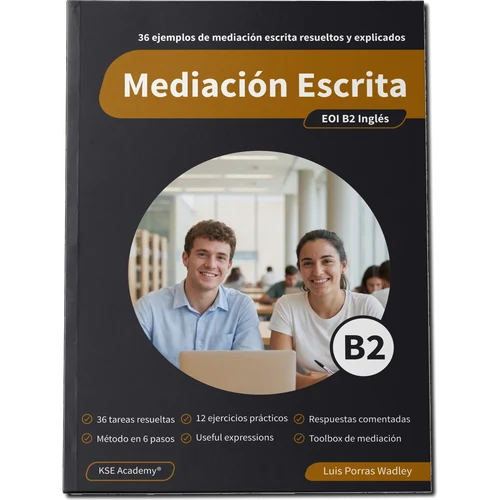
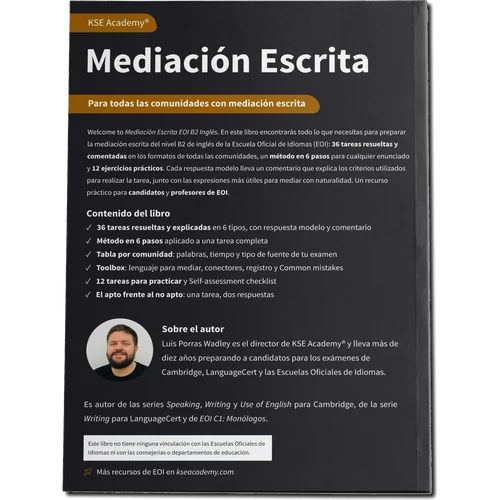
For mediation, the hardest part to prepare on your own, there’s my book Mediación Escrita EOI B2 Inglés, with 36 worked and explained examples for every region.
Did you find this guide useful? Share it with anyone preparing for B2. And if you’d like more content like this, subscribe to my newsletter and follow me on Facebook, Twitter, Pinterest, Instagram and YouTube.
Good luck with the exam and, until next time, don’t forget to keep smiling! 🙂
