
Table of contents
We’ve reached the final stop of the Reading paper: B1 Preliminary Reading Part 6. It’s the only one of the six parts where Cambridge doesn’t give you any options to choose from. You get a short text with six gaps, and for each one you have to come up with the missing word yourself. One word, no hints, no A, B, C or D.
In this guide I’ll explain what B1 Reading Part 6 looks like, what kind of words Cambridge is actually after here (and what kind it isn’t), and we’ll solve an official sample together about a trip to the Natural History Museum. 🙂
What B1 Reading Part 6 looks like
The Reading paper of the B1 Preliminary has six parts, 32 questions and 45 minutes, and it’s worth 25% of the final score. This is the last one:
| Fact | B1 Reading Part 6 |
|---|---|
| What you have to do | Read a short text with 6 gaps and write the missing word yourself in each one |
| Number of questions | 6 (numbered 27 to 32) |
| Options | None: no alternatives are given, you have to produce the word |
| Scoring | 1 point per correct answer |
| Recommended time | Between 6 and 8 minutes |
| What it tests | Grammar knowledge: prepositions, discourse markers, articles, possessives and other function words |
Like Part 4, this task was introduced with the 2020 reform and didn’t exist in the previous exam. It’s the little sibling of B2 First’s Use of English Part 2: if you already know that task, you’ll find the same mechanics here, at a simpler level.
What kind of words this part asks for (and which it doesn’t)
This is the key difference from Part 5: there, you chose between four content words (nouns, verbs, adjectives) competing on meaning. Here, the missing words are almost always function words, the ones that hold the sentence’s structure together rather than carry its meaning. Specifically, you’ll usually get gaps like these:
- Prepositions: of, in, at, to…
- Conjunctions and discourse markers: if, so, because, although…
- Articles and determiners: a, the, every, each…
- Possessives and pronouns: your, their, which, who…
- Auxiliary verbs and the infinitive marker: to, have, did, can…
You’re almost never asked for a noun, a content verb or an adjective, because the text already gives you those. What’s being tested is whether you know which small grammatical piece is missing for the sentence to work.
A real B1 Reading Part 6 example, solved gap by gap
Let’s work through an official Cambridge sample task: a text about a visit to the Natural History Museum.
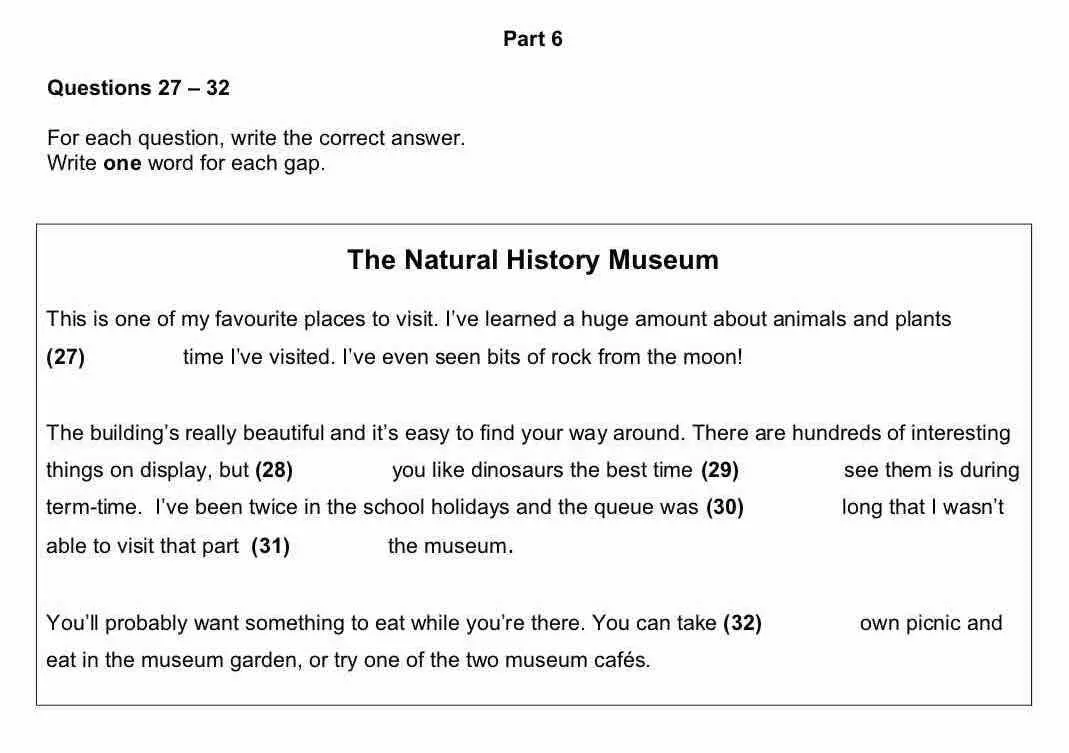
Try filling in the gaps yourself before reading on.
Gap 27
«I’ve learned a huge amount about animals and plants (27)……… time I’ve visited.»
every / each, correct. Every time or each time means «on each occasion», and it’s the only way to say she learns something different on every visit.
Gap 28
«There are hundreds of interesting things on display, but (28)……… you like dinosaurs the best time…»
if, correct. It’s the conjunction that introduces the condition: «but if you like dinosaurs…».
Gap 29
«…the best time (29)……… see them is during term-time.»
to, correct. After the best time you need an infinitive with to: «the best time to see them».
Gap 30
«…the queue was (30)……… long that I wasn’t able to visit that part…»
so, correct. This is the so + adjective + that structure, expressing a result: «so long that I couldn’t…».
Gap 31
«…I wasn’t able to visit that part (31)……… the museum.»
of, correct. Part of is the fixed preposition that always goes with part when talking about a section of something.
Gap 32
«You can take (32)……… own picnic and eat in the museum garden…»
your, correct. The subject of the sentence is you, so the matching possessive is your.
Answers, in case you were keeping track: 27. every/each · 28. if · 29. to · 30. so · 31. of · 32. your.
Strategy for Reading Part 6: think grammar, not vocabulary
- Identify what type of word is missing before thinking of which one it is. Ask yourself whether the gap needs a preposition, a conjunction, an article or a possessive. Narrowing down the category cuts your options right down.
- Look for fixed expressions. Part of, so…that, the best time to: a lot of English’s grammatical vocabulary comes in fixed combinations that are worth memorising as whole chunks.
- Check the subject of the sentence. If the gap is a possessive or a pronoun, look at who the subject is so you don’t get the person wrong.
- Write only one word. The instructions are strict: one word per gap. If you write two, the answer is marked wrong even if one of them was correct.
- Check your spelling. Unlike the parts with A-D options, here you’re writing the word yourself, so a spelling mistake can cost you the point.
Common mistakes in B1 Preliminary Reading Part 6
- Trying to fill the gap with a content word. If a noun or a meaningful verb comes to mind, you’re probably on the wrong track, so check whether what’s missing is actually grammatical.
- Leaving the gap blank. There’s no penalty for a wrong answer, so it’s always worth writing your best guess, even if you’re not sure.
- Writing more than one word. The instructions ask for a single word per gap; adding a second one invalidates the answer.
- Not checking the whole sentence once you’re done. Read it back with your word in place: if it doesn’t sound natural in English, something’s probably off.
Frequently asked questions about B1 Preliminary Reading Part 6
How many questions does B1 Reading Part 6 have?
Six numbered gaps (27 to 32), with no options to choose from.
How much time should I spend on it?
Between six and eight minutes. The text is short, but working out the exact word with no hints takes a bit of thought.
What kind of words come up in this part?
Mostly function words: prepositions, conjunctions, articles, possessives, pronouns and auxiliary verbs. Rarely a content noun, verb or adjective.
Is this a new part of the exam?
Yes, it was introduced with the 2020 reform, just like Part 4, and it resembles B2 First’s Use of English Part 2.
Does spelling matter?
Yes. Since you write the word yourself, a spelling mistake can mean the answer is marked wrong.
Are wrong answers penalised?
There’s no penalty in the B1 Preliminary, so fill in all six gaps even if you’re unsure.
Practise B1 Preliminary Reading Part 6 with my book
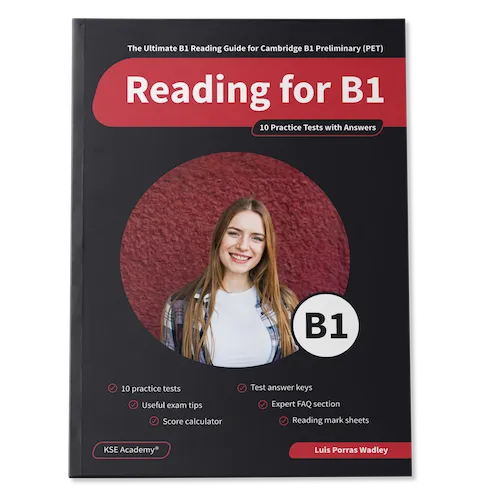
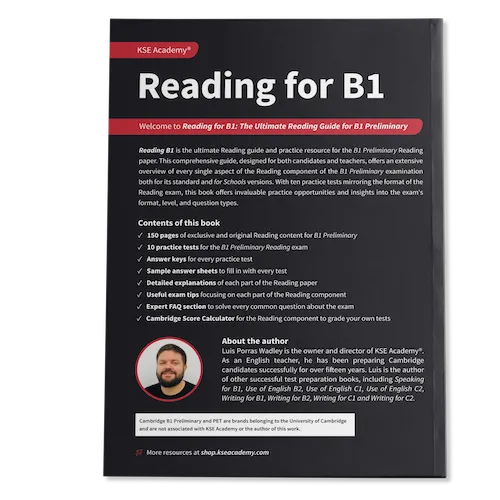
If you’d rather practise with full exams and mark your own work, I have a book dedicated to exactly that: Reading B1: The Ultimate B1 Reading Guide & 10 B1 Reading Tests with Answers. It includes:
- A guide to the Reading component of the B1 Preliminary, part by part.
- Ten full Reading exams, with all six parts each.
- The answer key for every test.
- A photocopiable answer sheet and instructions to work out your own score.
You now have all six parts of B1 Reading
This is the sixth guide in a six-part series covering each part of B1 Preliminary Reading. You’ll find the rest at Reading Part 1, Reading Part 2, Reading Part 3, Reading Part 4 and Reading Part 5, or you can go back to the overall picture in my guide to B1 Preliminary Reading and the main B1 Preliminary page.
If these guides were useful, share them with whoever’s preparing for the PET alongside you, and if you’re left with any doubts about any part of the Reading paper, leave them in the comments. I answer every one.
Good luck in your exam. And remember, don’t forget to keep smiling! 🙂
