
Table of contents
B1 Preliminary Reading Part 5 switches the exam’s focus completely: no more texts to interpret. Now it’s about proving you really know English vocabulary. A short text, six gaps, and four almost-identical words where only one is the one actually used in that spot.
In this guide I’ll explain what B1 Reading Part 5 looks like, why the other three options in each question don’t work even though they look like valid synonyms, and we’ll solve an official Cambridge sample together about the coconut tree and its uses. 🙂
What B1 Reading Part 5 looks like
The Reading paper of the B1 Preliminary has six parts, 32 questions and 45 minutes, and it’s worth 25% of the final score. Here’s the fifth part:
| Fact | B1 Reading Part 5 |
|---|---|
| What you have to do | Read a short text with 6 gaps and choose, for each one, the correct word out of 4 options |
| Number of questions | 6 (numbered 21 to 26) |
| Options per question | 4 (A, B, C or D) |
| Scoring | 1 point per correct answer |
| Recommended time | Between 6 and 8 minutes |
| What it tests | Vocabulary and collocation: which word is actually used, not just its meaning |
The task itself isn’t new: it already existed before the 2020 reform. What did change is the length: it used to be ten gaps, now it’s six. It’s also the part of the Reading paper that most closely resembles B2 First’s Use of English Part 1, so if you already know that task, the mechanics will feel familiar.
Why this part isn’t about meaning, but about collocation
The trap in Reading Part 5 is that the four options in each question usually mean similar things on their own. What sets them apart is whether that specific word combines with the words around it the way a native speaker would actually say it. This is called collocation, and it’s the real skill being tested here: knowing what a word means isn’t enough; you need to know which other words it «goes with» in English.
A real B1 Reading Part 5 example, solved question by question
Let’s work through an official Cambridge sample task about the coconut tree. The text and all six questions come together in the same image:
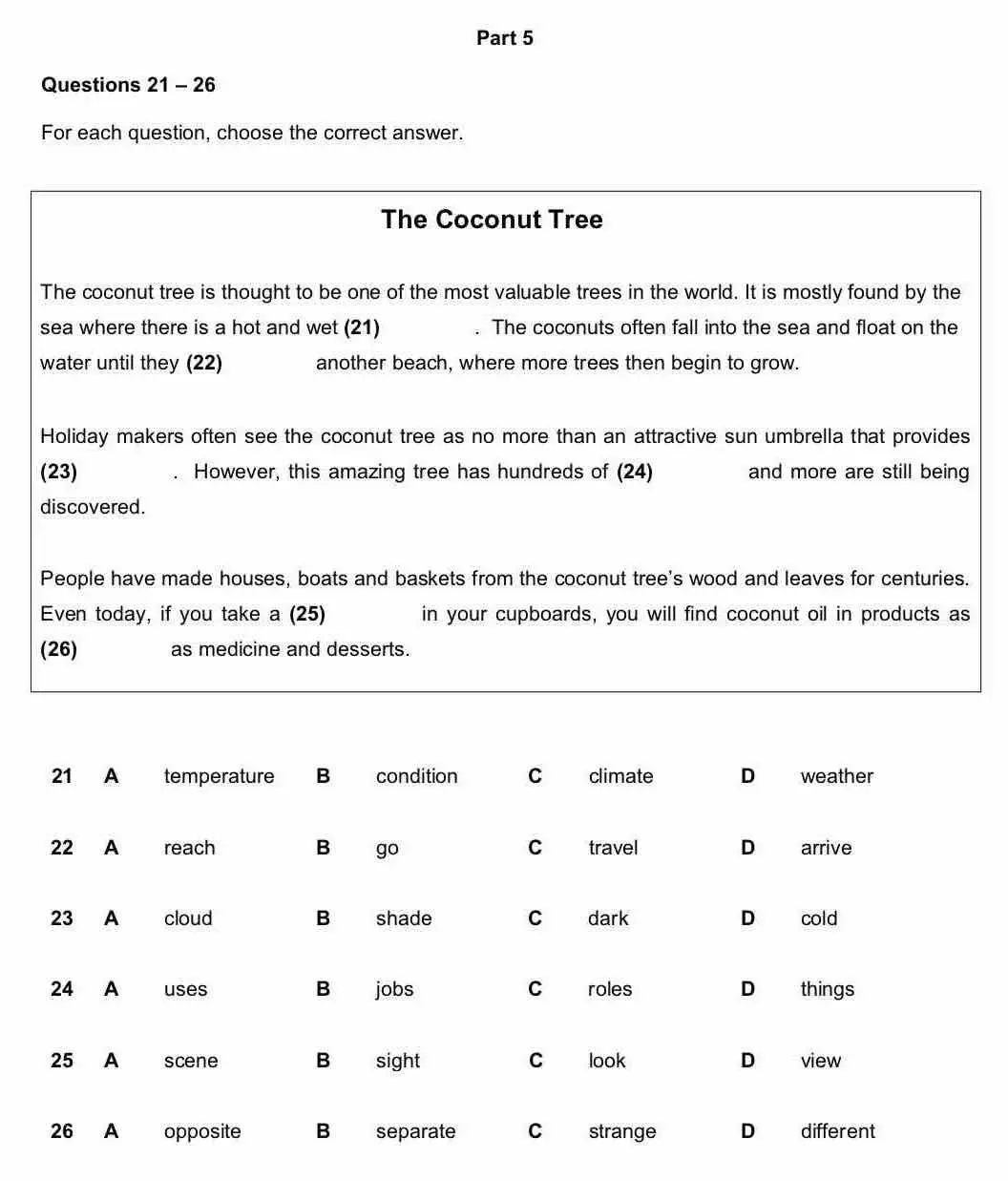
Try solving it yourself before reading on.
Question 21
«It is mostly found by the sea where there is a hot and wet (21)……… «
C. climate, correct. A hot and wet climate is the general weather pattern of an area over time, which is exactly what the sentence is about. Temperature is a specific value (it doesn’t describe «wet»), weather refers to a single day’s conditions, and condition doesn’t combine with hot and wet in this sense.
Question 22
«The coconuts often fall into the sea and float on the water until they (22)……… another beach»
A. reach, correct. Reach is the only one of the four verbs that goes straight before a place with no preposition: reach a beach. Arrive would need arrive at, and go and travel would need to. Grammar decides this one, not just meaning.
Question 23
«…an attractive sun umbrella that provides (23)……… «
B. shade, correct. What an umbrella provides is shade. Cloud, dark and cold might sound related to shade, but none of them is what English says an umbrella «provides».
Question 24
«…this amazing tree has hundreds of (24)……… «
A. uses, correct. Hundreds of uses means hundreds of applications. Jobs and roles would oddly personify the tree, and things is too vague for the idea of «practical use» the sentence needs.
Question 25
«…if you take a (25)……… in your cupboards, you will find coconut oil»
C. look, correct. Take a look is a fixed expression meaning to have a glance at something. Scene, sight and view are all related to «seeing», but none of them combines with the verb take in this expression.
Question 26
«…you will find coconut oil in products as (26)……… as medicine and desserts»
D. different, correct. As different as X and Y is the natural way to say there’s a lot of variety between two very different things. Opposite, separate and strange don’t work with this comparative structure.
Answers, in case you were keeping track: 21C, 22A, 23B, 24A, 25C, 26D.
How to study for Reading Part 5: collocation over translation
Go back over the six questions and you’ll notice this part is almost never solved by translating each option into Spanish and picking whichever «sounds best». The real strategy is different:
- Look at the word right before the gap. Many verbs and adjectives only combine with one specific preposition or noun (provide shade, take a look). That combination is the most reliable clue.
- Check whether the gap needs a preposition after it or not. As in question 22, the difference between the four options is often purely grammatical, not about meaning.
- Be suspicious of the option that «means the same» in your own language. Several English words share a translation but not a use: view, sight and look translate similarly, but they’re not interchangeable.
- Learn whole expressions, not single words. Take a look, provide shade, hundreds of uses: the more vocabulary you learn in chunks rather than word by word, the easier this part becomes.
Common mistakes in B1 Preliminary Reading Part 5
- Choosing based on meaning in isolation. Almost every option is grammatically correct on its own; the mistake is not checking which specific word the context calls for.
- Not reading the whole sentence before deciding. Sometimes the clue comes after the gap, not before, as in question 22.
- Memorising vocabulary without its usual combinations. Knowing that shade means «sombra» isn’t enough if you don’t know it’s used with the verb provide.
- Following the «false friend» of translation. Picking the option closest to your own language, instead of the one a native speaker would actually use.
Frequently asked questions about B1 Preliminary Reading Part 5
How many questions and options does B1 Reading Part 5 have?
Six questions (numbered 21 to 26), each with four options (A, B, C or D).
How much time should I spend on it?
Between six and eight minutes. The text is short, so most of your time goes into deciding on the correct word, not reading.
Did this part change with the 2020 reform?
The task type didn’t change, but it was reduced from ten questions to six.
What kind of vocabulary comes up in this part?
Mostly verbs, nouns and adjectives that combine in a specific way with the words around them (collocations), not technical or rare vocabulary.
Are wrong answers penalised?
There’s no penalty in the B1 Preliminary, so answer all six even if you’re torn between two options.
Can I use a dictionary in the exam?
No, the B1 Preliminary is done without a dictionary in every part. That’s why it’s worth training your ear for collocations through regular reading and listening in English, rather than memorising isolated vocabulary lists.
Practise B1 Preliminary Reading Part 5 with my book
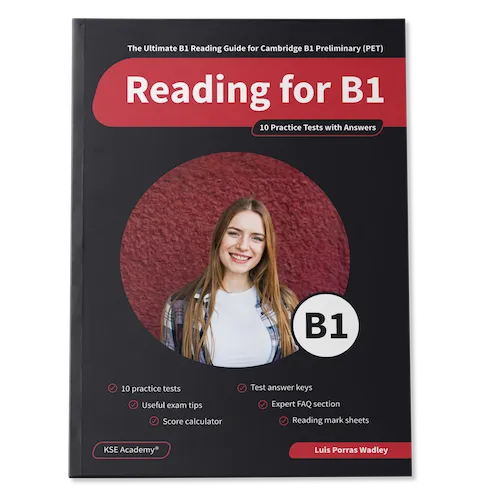
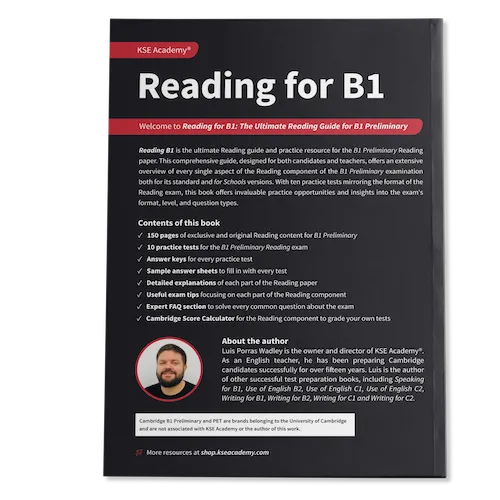
If you’d rather practise with full exams and mark your own work, I have a book dedicated to exactly that: Reading B1: The Ultimate B1 Reading Guide & 10 B1 Reading Tests with Answers. It includes:
- A guide to the Reading component of the B1 Preliminary, part by part.
- Ten full Reading exams, with all six parts each.
- The answer key for every test.
- A photocopiable answer sheet and instructions to work out your own score.
Keep preparing B1 Reading
This is the fifth guide in a six-part series covering each part of B1 Preliminary Reading. You’ll find the rest at Reading Part 1, Reading Part 2, Reading Part 3, Reading Part 4 and Reading Part 6, or you can go back to the overall picture in my guide to B1 Preliminary Reading and the main B1 Preliminary page.
If this guide was useful, share it with whoever’s preparing alongside you, and if you’re left with any doubts, leave them in the comments. I answer every one.
See you in the last part, Part 6. Until then, don’t forget to keep smiling! 🙂
