
Table of contents
B1 Preliminary Reading Part 4 tends to catch people off guard right after they’ve got the hang of the first three parts. There’s no more choosing between A, B or C here: you get a long text with five gaps, eight candidate sentences, and you have to work out which sentence fits which gap by paying attention to how the ideas link together, not just what each sentence says on its own.
In this guide I’ll explain how B1 Reading Part 4 works, the trick Cambridge uses to plant the three sentences you won’t need, and I’ll solve an official sample task with you, gap by gap: the story of someone who leaves everything behind to volunteer on an island. 🙂
What B1 Reading Part 4 looks like
The Reading paper of the B1 Preliminary has six parts, 32 questions and 45 minutes, and it’s worth 25% of the final score. This is the fourth part:
| Fact | B1 Reading Part 4 |
|---|---|
| What you have to do | Read a long text with 5 numbered gaps and pick, from 8 sentences, which one fills each gap |
| Number of questions | 5 (numbered 16 to 20) |
| Sentences available | 8, of which 3 aren’t used |
| Scoring | 1 point per correct answer |
| Recommended time | Between 10 and 12 minutes |
| What it tests | Textual cohesion: how sentences connect through pronouns, discourse markers and the flow of the story |
Unlike the previous three parts, this one was added in the 2020 reform: it didn’t exist in the old exam. Cambridge introduced it partly to bring the B1 format closer to B2 First’s Use of English, where you’ll find an almost identical task.
What kind of text comes up in B1 Preliminary Reading Part 4
The text in this part is longer than in any of the previous ones: usually a first-person article or account of an experience with a beginning, a middle and an end. This isn’t about answering questions on isolated facts. It’s about showing you can follow the thread of a story and notice when a sentence fits naturally into the narrative and when it breaks that flow.
A real B1 Reading Part 4 example, solved gap by gap
Let’s work through an official Cambridge sample task: a photography lecturer who decides to volunteer on an island in the Indian Ocean. Here’s the full text:
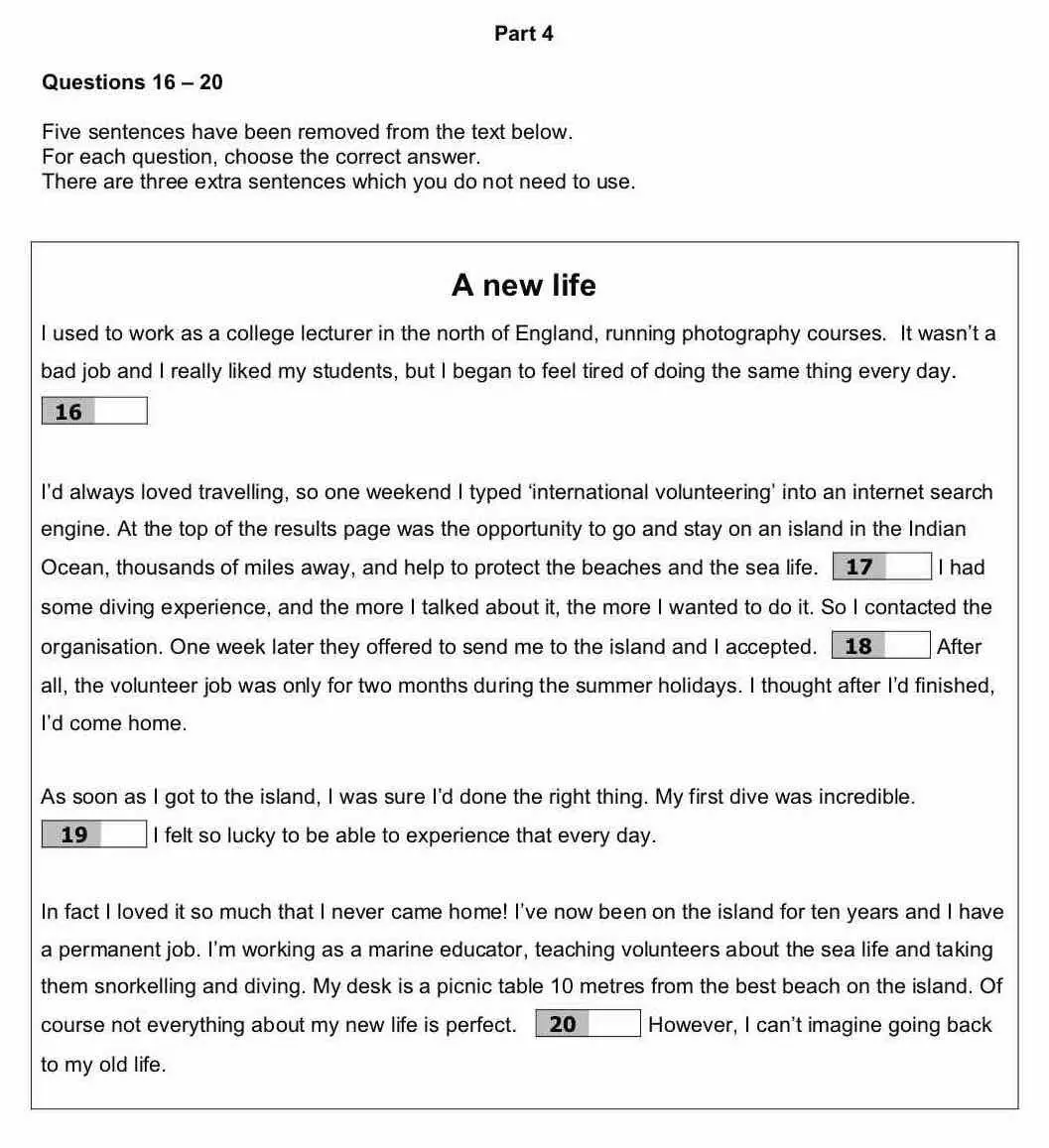
And here are the eight sentences to choose from:
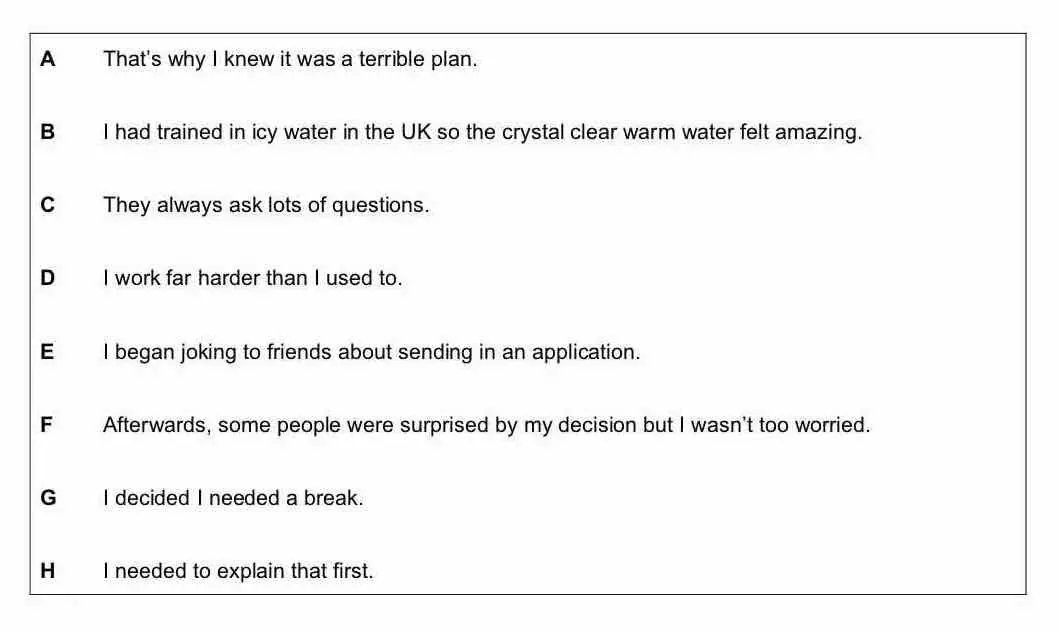
Try solving it yourself first, paying attention to which sentence continues the meaning right before and after each gap.
Gap 16

The narrator says she got tired of doing the same thing every day. We need something that moves her from that tiredness to searching «international volunteering» online.
G. Correct. «I decided I needed a break» is the perfect bridge: the tiredness leads to the decision to make a change, and that decision is what pushes her to look for something new.
Gap 17
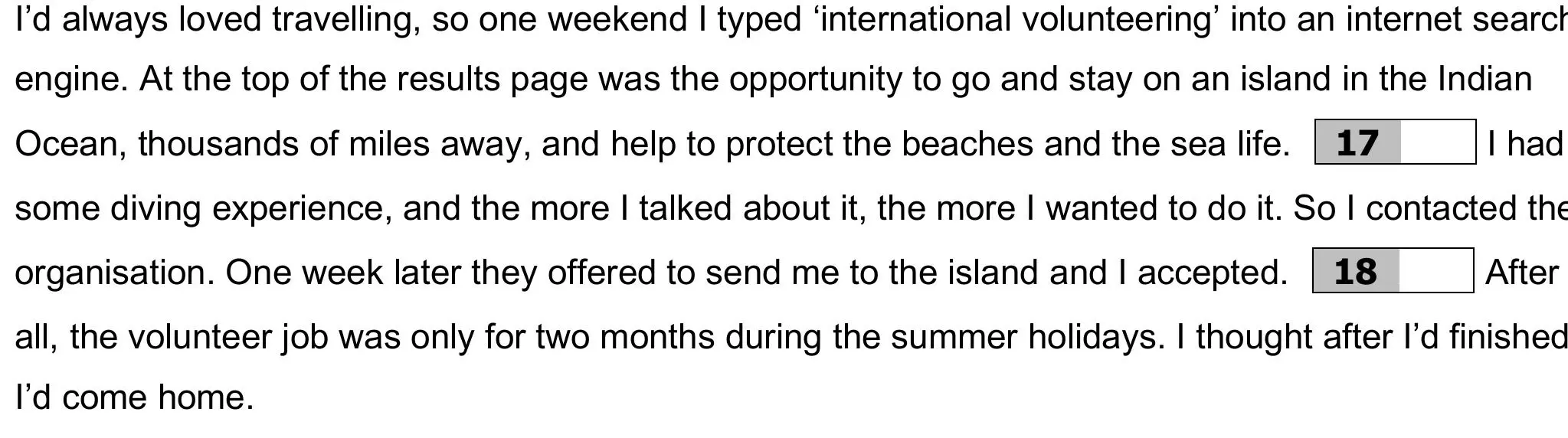
Right after gap 17 we read «I had some diving experience, and the more I talked about it, the more I wanted to do it». That «it» needs an antecedent: something that was already being talked about.
E. Correct. «I began joking to friends about sending in an application» gives that «it» something to point to: talking about it with friends is exactly what makes her want to actually do it.
Gap 18
Gap 18 is followed by «After all, the volunteer job was only for two months». The phrase «after all» introduces a reason that justifies something said just before, usually to play down a worry.
F. Correct. «Afterwards, some people were surprised by my decision but I wasn’t too worried» fits perfectly: she wasn’t bothered by other people’s surprise, and the «after all» that follows explains why: it was only two months.
Gap 19

Before gap 19 we read that her first dive was incredible. After the gap, she says «I felt so lucky to be able to experience that every day». That «that» has to point to something very specific: whatever makes diving there special.
B. Correct. «I had trained in icy water in the UK so the crystal clear warm water felt amazing» gives that «that» its content: the warm, clear water, in contrast with the cold back in the UK.
Gap 20

Right before the gap we read «not everything about my new life is perfect», and right after, «However, I can’t imagine going back». We need something concrete for that imperfect part, so the «however» makes sense as a contrast.
D. Correct. «I work far harder than I used to» is exactly that: the real downside of her new life, which the final however contrasts with how worthwhile it all is.
Answers, in case you were keeping track: 16G, 17E, 18F, 19B, 20D.
Why the three leftover sentences don’t work
Of the eight sentences, three are never used: A, C and H. Cambridge doesn’t place them at random, and understanding why they don’t fit anywhere matters just as much as knowing why the other five do.
- A. «That’s why I knew it was a terrible plan.» The «that» needs a previous reason explaining why the plan would be bad, and at no point in the text does the narrator doubt her decision. This sentence flips the overall tone of the story, which is positive from start to finish.
- C. «They always ask lots of questions.» The «they» has nothing to point to: no group of people asking questions has been mentioned before. It sounds plausible near the part where she contacts the organisation, but there’s no real antecedent to back it up.
- H. «I needed to explain that first.» The «that» fails again: there’s nothing in the text that needs explaining before things can continue. It’s the kind of sentence that sounds like a useful connector without actually connecting to anything.
Notice the pattern: all three fail for the same reason: a pronoun (that or they) with nothing to hold on to. It’s the most reliable clue in this whole part.
How to find the right sentence: the cohesion technique
Cambridge isn’t testing your vocabulary here. It’s testing whether you can spot how sentences are stitched together in English. Here’s what to look for around each gap:
- Unresolved pronouns. If the sentence after the gap starts with it, that, this or they, ask yourself what it refers to. The sentence that fills the gap almost always contains whatever that pronoun is pointing to.
- Discourse markers that signal a relationship. Words like however, after all, afterwards or so tell you whether what follows is going to contrast, justify or continue the previous idea. Choose the sentence that fulfils that role.
- Vocabulary that’s repeated or rephrased. If a word from the gap turns up reworded further on (like the warm water in gap 19, picked up again in «experience that every day»), that repetition is your clue.
- Verb tense and the point in the story. A sentence in the simple past won’t fit a gap describing a current routine, and vice versa.
Step-by-step strategy for B1 Reading Part 4
Here’s the sequence I recommend, following Cambridge’s own advice for this task:
- 1. Read the whole text first, without looking at the sentences. You need to understand the full story before filling in anything.
- 2. Go gap by gap. Read the sentence before and after each one, and look for pronouns and discourse markers before checking the eight options.
- 3. Try the candidate sentence in place. Read it slotted into the gap: if it sounds natural grammatically and follows the thread of the story, that’s a good sign.
- 4. Check why the others don’t work. A sentence sounding reasonable isn’t enough: it has to fit better than the rest in that specific gap.
- 5. Cross off sentences you’ve already used. Each one is used only once, so your options narrow as you go.
- 6. Reread the whole text at the end. With all five gaps filled, check that the story makes sense from start to finish.
Common mistakes in B1 Preliminary Reading Part 4
- Choosing based on meaning alone, not connection. A sentence can be true or make sense on its own and still not belong in that particular gap, because it doesn’t link to what comes before or after.
- Ignoring the pronouns. This is the costliest mistake in this part: if you don’t ask what an it or a that refers to, you miss the clearest clue Cambridge gives you.
- Filling the gaps out of order without going back. Sometimes a later sentence gives you the clue you needed for an earlier gap. It pays to reread.
- Not reading the whole text once you’re done. It’s the only way to catch a slip where four sentences are placed correctly but the fifth isn’t.
- Running out of time. This is the longest text in the Reading paper so far, so don’t leave it until the very end of the exam.
Frequently asked questions about B1 Preliminary Reading Part 4
How many gaps and sentences does B1 Reading Part 4 have?
Five numbered gaps (16 to 20) and eight possible sentences (A-H), three of which aren’t used.
How much time should I spend on it?
Between ten and twelve minutes: it’s the longest text in the first four parts of the Reading paper, and you need to read it in full at least twice.
Are wrong answers penalised?
There’s no penalty of any kind in the B1 Preliminary, so fill in all five gaps even if you’re unsure about one of them.
Is this a new part of the exam?
Yes. Unlike the first three parts of the Reading paper, this one was introduced with the 2020 reform and closely resembles a Use of English task from B2 First.
What should I look for to find the right sentence?
Mainly unresolved pronouns (it, that, they) and discourse markers (however, after all, so) in the sentences around the gap. These are almost always the deciding clue, more than the general meaning of the sentence.
Can I use a dictionary during the exam?
The B1 Preliminary is done without a dictionary in any of its parts, so the best preparation is getting used to reading long texts in English without relying on translating every word.
Practise B1 Preliminary Reading Part 4 with my book
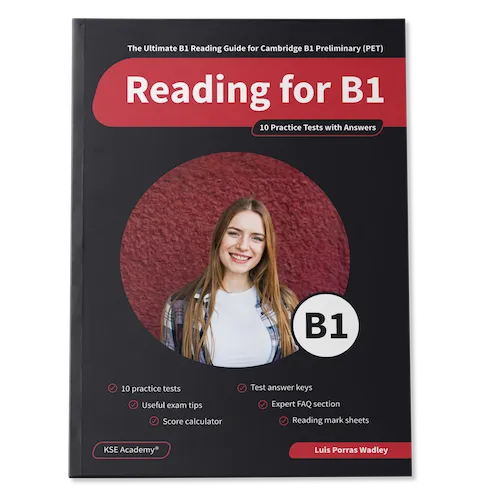
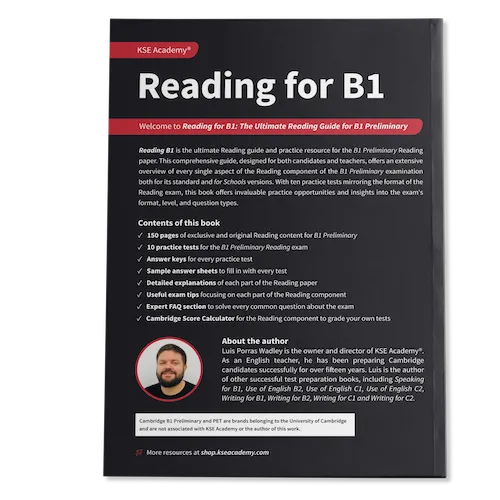
If you’d rather practise with full exams and mark your own work, I have a book dedicated to exactly that: Reading B1: The Ultimate B1 Reading Guide & 10 B1 Reading Tests with Answers. It includes:
- A guide to the Reading component of the B1 Preliminary, part by part.
- Ten full Reading exams, with all six parts each.
- The answer key for every test.
- A photocopiable answer sheet and instructions to work out your own score.
Keep preparing B1 Reading
This is the fourth guide in a six-part series covering each part of B1 Preliminary Reading. You’ll find the rest at Reading Part 1, Reading Part 2, Reading Part 3, Reading Part 5 and Reading Part 6, or you can go back to the overall picture in my guide to B1 Preliminary Reading and the main B1 Preliminary page.
If this guide was useful, share it with whoever’s preparing alongside you, and if you’re left with any doubts, leave them in the comments. I answer every one.
See you in Part 5. Until then, don’t forget to keep smiling! 🙂
