
Table of contents
If you’re preparing for the B1 Preliminary (PET), Reading Part 2 of the B1 Preliminary is the first part of the exam where you have to compare several texts against each other, not just understand one. There are five people with a specific need and eight short texts, and only one really matches each person, so the challenge is no longer just comprehension: it’s careful comparison.
In this guide I’ll walk you through exactly what B1 Reading Part 2 looks like, what kind of situations come up, and I’ll comment question by question on an official Cambridge sample task: why the correct option meets everything each person is asking for and, above all, why the others fail on just one detail. That’s exactly where the difficulty of this part lies. Let’s get started! 🙂
What B1 Reading Part 2 looks like
Before we get into it, let’s place it in context. The Reading paper of the B1 Preliminary has six parts, 32 questions and 45 minutes, and it makes up 25% of the final exam score. The second part is this one:
| Fact | B1 Reading Part 2 |
|---|---|
| What you have to do | Read 5 descriptions of people and match each one to the most suitable text out of 8 |
| Number of questions | 5 (numbered 6 to 10 within the full exam) |
| Options per question | 8 (A-H), and each text is used only once |
| Scoring | 1 point per correct answer |
| Recommended time | Between 8 and 10 minutes |
| What it tests | Detailed comprehension: matching one point isn’t enough, the text has to meet every one of the person’s criteria |
Look at the last row, because it’s the key to the whole part: each person gives two or three criteria, and the correct text has to meet all of them. A text that only meets one or two of those criteria isn’t the answer, no matter how good a fit it looks like at first glance.
And a heads-up I always give in class: this part didn’t change with the 2020 reform either. If you’re using older materials to practise Part 2, they still work perfectly well.
What kind of situations come up in B1 Preliminary Reading Part 2
Cambridge always sets up the same structure: five people (or groups of people) who want or need something, and eight real texts describing possible options. The exact content varies from exam to exam, but it tends to revolve around everyday topics like these:
- Leisure and activities: markets, weekend events, local activities, TV programmes.
- Accommodation and work: properties to rent, job or volunteering opportunities.
- Food and shopping: restaurants, local shops.
- Sport and wellbeing: gyms, classes or activities to keep fit.
In every case, the structure is identical: the person describes what they’re looking for in two or three sentences, and each text describes a real offer with its own conditions, timing or target audience. Cambridge’s trick is that several texts almost fit, and only one meets absolutely everything.
A real B1 Reading Part 2 example, commented question by question
Let’s work through an official Cambridge sample task about city markets. Here’s what the whole part looks like: first the five people, then on the next page the eight markets to choose from.
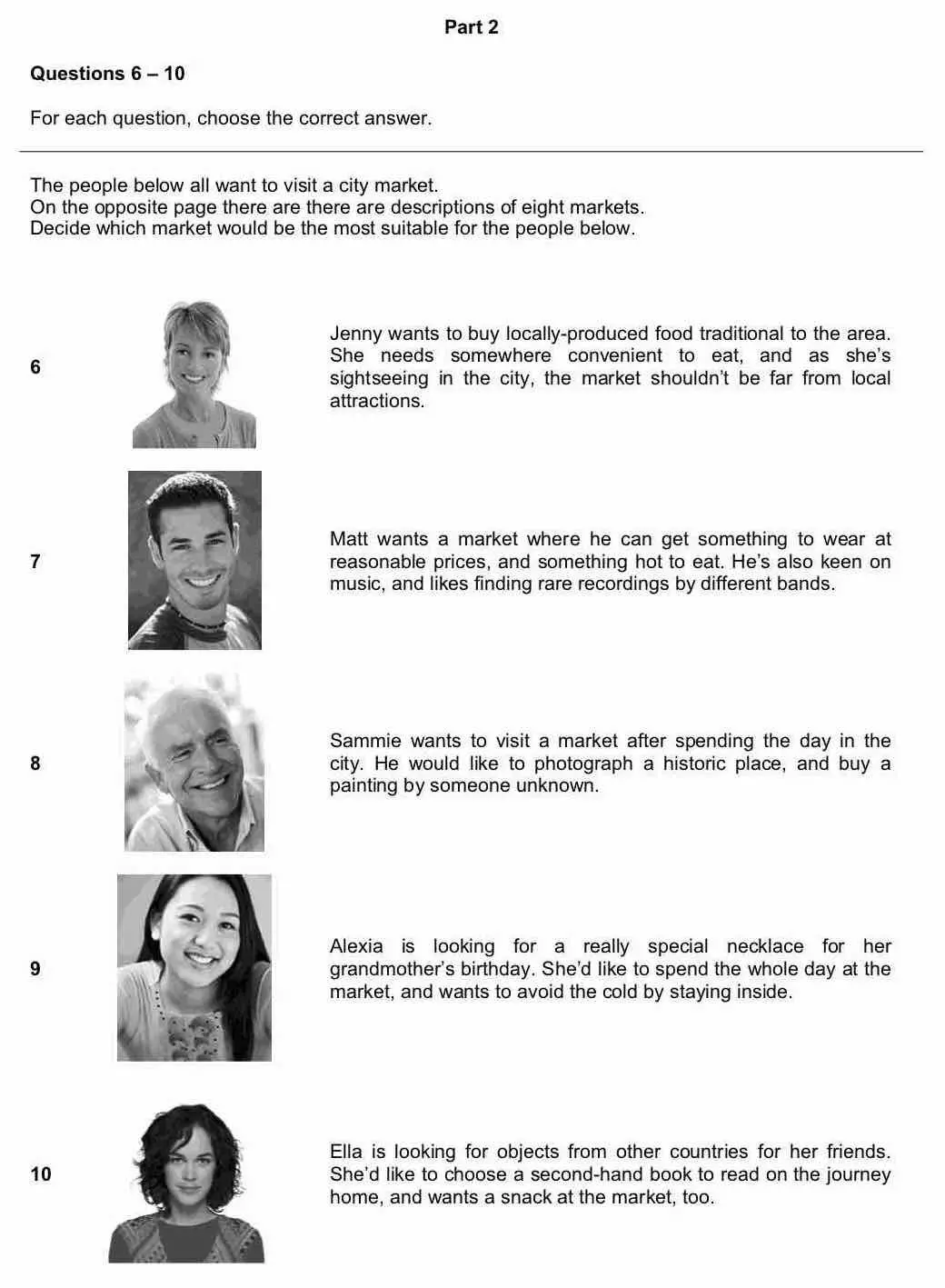
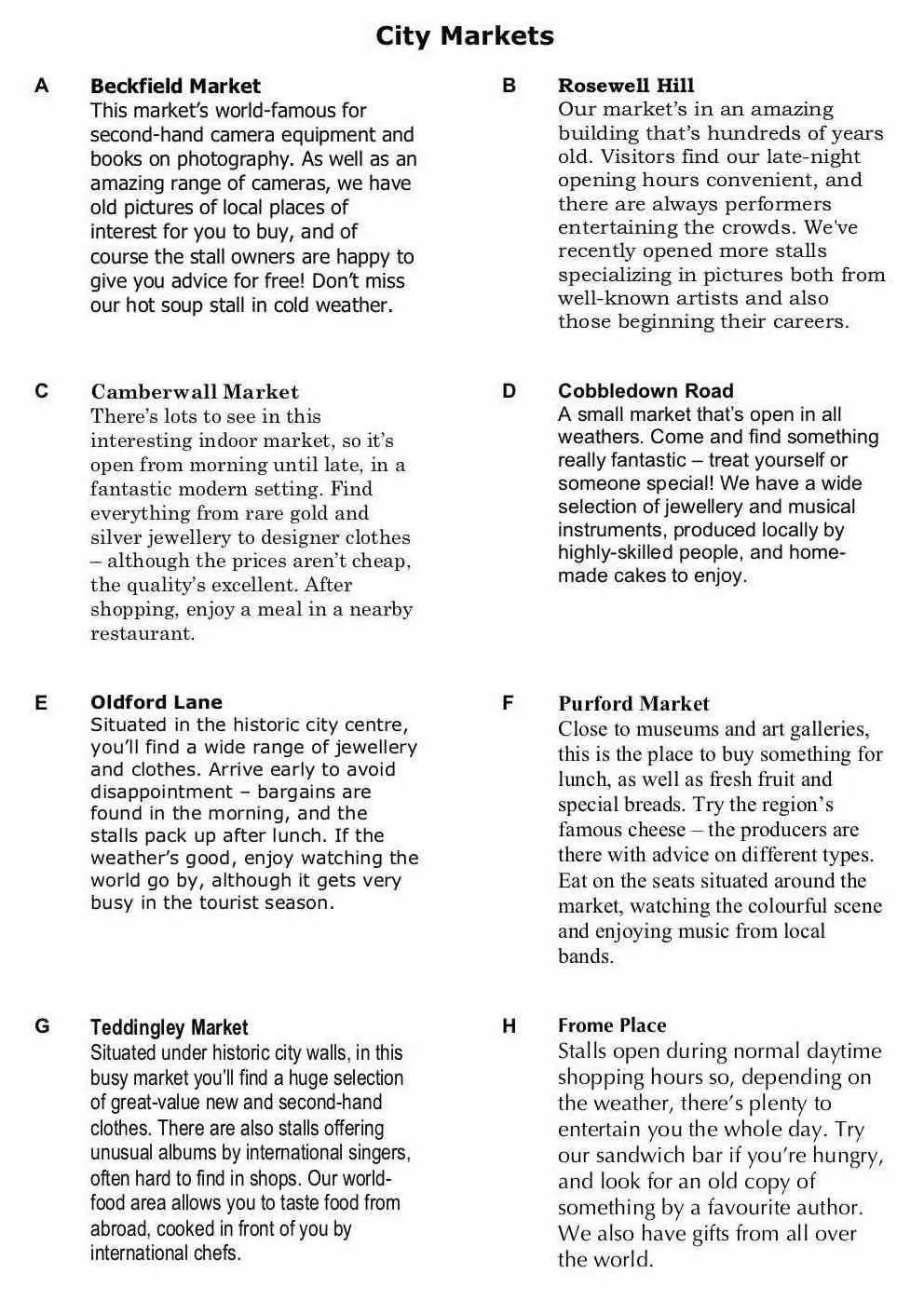
Now let’s go through them one by one. I’d recommend trying to answer them yourself before reading my explanation.
Question 6: Jenny

Jenny is after three things: locally-produced food that’s traditional to the area, somewhere to eat, and a market that’s close to the city’s tourist attractions.
- Correct answer: F (Purford Market). It’s close to museums and art galleries (the attractions), sells the region’s cheese and special breads (local food), and has seats around the market to eat.
- A (Beckfield Market), wrong. It has a hot soup stall, but the market itself sells cameras and photography books, not local food. No mention of tourist attractions at all.
- G (Teddingley Market), wrong: the fine trap. It’s under historic city walls (that would count as an attraction), but the food in its world-food area comes from abroad, cooked by international chefs. That’s the exact opposite of «local food traditional to the area».
Question 7: Matt

Matt wants clothes at a reasonable price, something hot to eat, and he’s into music: he’s after rare recordings by different bands.
- Correct answer: G (Teddingley Market). New and second-hand clothes at great value, hot food cooked in front of you in the international area, and unusual albums by international singers that are hard to find in shops.
- D (Cobbledown Road), wrong. It sells musical instruments, not recordings. Matt doesn’t want to play music, he wants to find albums.
- C (Camberwall Market), wrong. It has designer clothes, but the text warns «the prices aren’t cheap»: the exact opposite of what Matt wants.
Question 8: Sammie

Sammie wants to visit the market after spending the whole day in the city, photograph a historic place, and buy a painting by an unknown artist.
- Correct answer: B (Rosewell Hill). The building itself is hundreds of years old (the historic place to photograph), it opens late (fits visiting it after a full day out), and it has stalls with paintings from both well-known artists and those just starting their careers.
- A (Beckfield Market), wrong: the fine trap. It mentions cameras and photography everywhere, but it sells camera equipment and old photos of local places, not paintings. It sounds like the topic of the question without being the answer.
- F (Purford Market), wrong. It’s close to museums and galleries (the historic place would fit), but what it sells is food, not paintings.
Question 9: Alexia
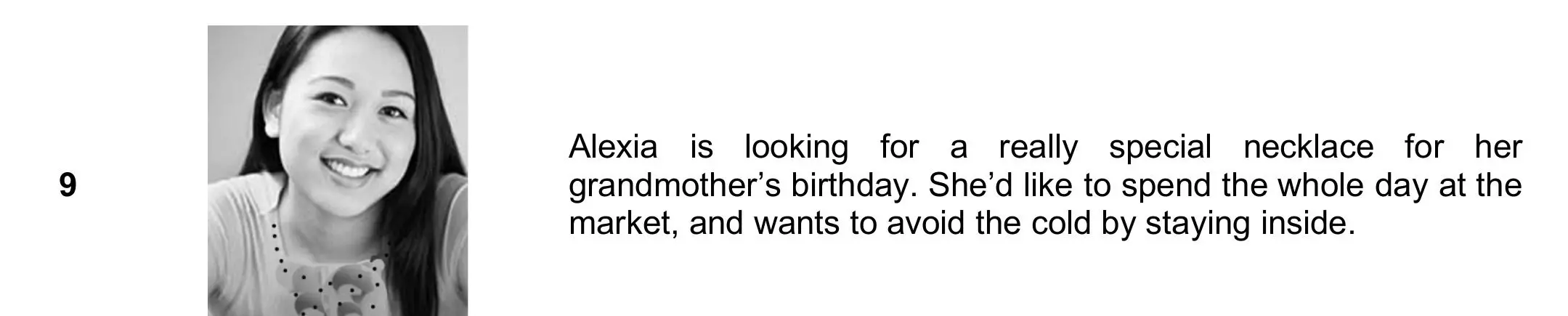
Alexia is after a really special necklace for her grandmother’s birthday, wants to spend the whole day at the market, and prefers to stay inside to avoid the cold.
- Correct answer: C (Camberwall Market). It’s an indoor market, open from morning until late (the whole day, under a roof), and sells everything from gold and silver to special jewellery: expensive, but excellent quality, perfect for a gift like this.
- E (Oldford Lane), wrong. It has jewellery, but the stalls «pack up after lunch»: you can’t spend the whole day there. And enjoying it depends on good weather, so it’s not clearly indoors either.
- D (Cobbledown Road), wrong. It sells locally made jewellery, but it’s a small market and doesn’t say it’s fully covered or that you can spend the whole day there.
Question 10: Ella

Ella is looking for objects from other countries for her friends, a second-hand book to read on the journey home, and a snack at the market itself.
- Correct answer: H (Frome Place). It has a sandwich bar (the snack), old copies of books by favourite authors (the second-hand book), and gifts from all over the world (the objects from other countries).
- A (Beckfield Market), wrong. It does sell books, but only on photography, and its old photos are of local places, not objects from other countries.
- G (Teddingley Market), wrong. Its food area is international (objects from abroad, in a way), but it doesn’t sell books or mention gifts to bring back for other people.
Answers, in case you were keeping track: 6F, 7G, 8B, 9C, 10H.
Cambridge’s classic distractors in Reading Part 2
Look closely at the five questions and you’ll see that almost every strong distractor shares the same pattern: it isn’t entirely wrong, it just fails on one of the two or three criteria the person asks for. The mechanisms that come up again and again are these:
- Meets two criteria out of three, but not the third. This is the most common case: Cobbledown Road in question 7 has music and instruments, but no hot food or clothes. A text that meets «almost everything» is still wrong.
- Bait vocabulary. The text uses words from the same semantic field as the question to lure you in, without actually saying what’s being asked for. «Cameras» and «photos» aren’t the same as «photographing a historic place» or «buying a painting» (questions 8 and 10).
- Reverses the meaning. «International food» instead of «local food», as in question 6: it uses almost the same words as the original text but flips the meaning.
- A time or place condition that doesn’t fit. A market that closes after lunch, or that depends on good weather, doesn’t work if the person wants to spend the whole day indoors (question 9).
One more thing worth flagging about the format: this part has eight texts for five questions, so three are always left over. A text not being used doesn’t mean it’s badly written or that you’ve made a mistake. This time, it simply isn’t anyone’s answer.
Step-by-step strategy for B1 Reading Part 2
This is the routine I get my students to practise:
- 1. Read the five people first. Underline their two or three key criteria before looking at any text. That’s your shopping list.
- 2. Start with the most specific person. The more criteria, and the more precise they are, the fewer texts can possibly fit: that question usually gets solved first and with less doubt.
- 3. Quickly rule out anything that fails an obvious criterion. If the person wants «indoors» and the text doesn’t mention it or sounds outdoor, cross it out. No need to read it twice.
- 4. Check that your final candidate meets every criterion, not just the most eye-catching one. This is the step most people skip, and it’s exactly where the «two out of three» distractors get you.
- 5. Cross off texts you’ve already used. Each text can only be the answer for one person. Once you’ve assigned it, it can’t come up again.
- 6. Always answer. There’s no penalty for wrong answers, so if you’re torn between two options, pick the one that meets more criteria and move on.
Common mistakes in B1 Preliminary Reading Part 2
- Settling for the first text that «sounds right». The first one that matches something doesn’t have to be correct: keep reading all eight before deciding.
- Accepting a partial match. Meeting one or two out of three criteria isn’t enough. Cambridge builds the distractors precisely to reward anyone who settles for «almost».
- Getting distracted by repeated words. Seeing «photo» or «camera» in a text doesn’t mean it’s the answer to a question about photographing something. Check the full meaning, not the loose word.
- Forgetting that each text is used only once. If you think two people need the same text, one of them is mismatched: go back and check.
- Managing your time badly. Comparing five people against eight texts takes longer than Part 1. If you get stuck on one question, move on and come back to it at the end.
Frequently asked questions about B1 Preliminary Reading Part 2
How many questions and options does B1 Reading Part 2 have?
Five questions (numbered 6 to 10) and eight texts (A-H) to choose from. Each text is used at most once, so three are always left over.
How much time should I spend on it?
Between eight and ten minutes. The whole exam is 45 minutes for six parts and 32 questions, so it’s best not to get stuck comparing extra options.
Are wrong answers penalised?
No. There’s no deduction for wrong answers, so answer every question, even if it’s with the option that meets the most criteria.
What kind of situations come up in this part?
Everyday topics like markets, rentals, job or volunteering opportunities, weekend events, restaurants, TV programmes, local activities or gyms. The structure is always the same: five people with a need and eight texts that either describe it or don’t.
Did this part change with the 2020 reform?
No. B1 Preliminary Reading Part 2 stayed the same, so practice material from before 2020 is still valid for this part.
I understand the texts but I still get questions wrong. Why?
It’s almost always down to settling for the first option that matches something, instead of checking the person’s full set of criteria. Cambridge designs the distractors to meet one or two of the three points each person asks for: if you don’t check all three, you fall for it. Go back to the distractors section of this guide and review the four mechanisms.
What do I do if I don’t know a word in a text?
Don’t get stuck on a single word: the eight texts are independent of each other, so if one word in a text doesn’t ring a bell, keep reading the rest of that text and compare it against the person’s criteria. Usually the rest of the text will already tell you whether it fits or not.
Can I use a dictionary in the exam?
No, dictionaries aren’t allowed in the B1 Preliminary. That’s exactly why it’s worth practising with real texts like the ones in this part, to get used to the vocabulary Cambridge tends to use in adverts, offers and descriptions.
Practise B1 Preliminary Reading Part 2 with my book
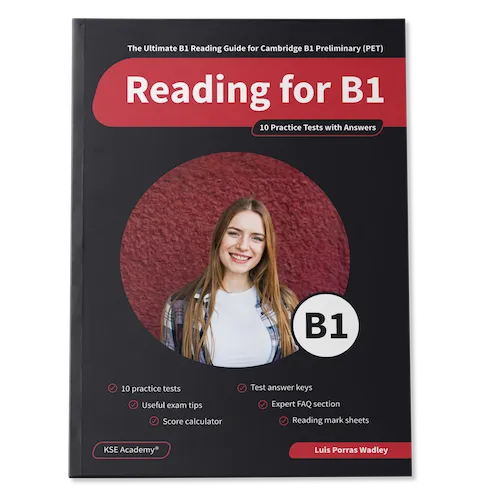
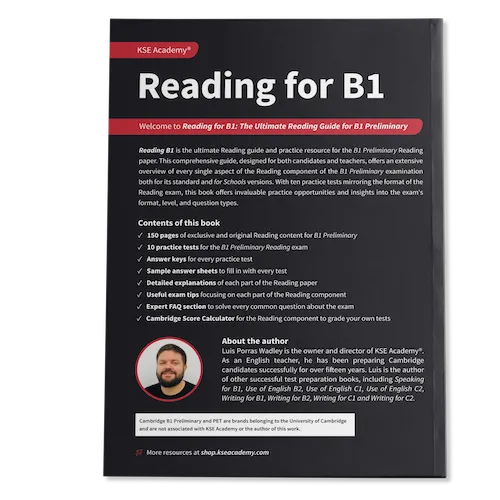
If you want to practise this part with full exams and mark your own work, I have a book dedicated to exactly that: Reading B1: The Ultimate B1 Reading Guide & 10 B1 Reading Tests with Answers. Inside you’ll find:
- A guide to the Reading component of the B1 Preliminary, part by part.
- Ten full Reading exams, with all six parts each.
- The answer key for every test.
- A photocopiable answer sheet and instructions to work out your own score.
Keep preparing B1 Reading
This is the second guide in a six-part series covering each part of B1 Preliminary Reading. You’ll find the rest at Reading Part 1, Reading Part 3, Reading Part 4, Reading Part 5 and Reading Part 6, or you can go back to the overall picture in my guide to B1 Preliminary Reading and the main B1 Preliminary page.
Did you find this guide useful? Share it with other students and teachers preparing for the PET. And if you’re left with any doubts about this part, leave them in the comments. I read every one.
See you in the next part. Until then, don’t forget to keep smiling! 🙂
