
Table of contents
If you are preparing for B1 Preliminary (PET), Reading Part 1 of B1 Preliminary is where your reading paper begins, and it is also the part that gives the most false sense of security. Five very short texts, the kind you read in two seconds, and that is exactly why so many candidates rush through them and drop silly marks.
In this guide I will show you exactly what B1 Reading Part 1 looks like, which text types come up, how to work through each question, and I will walk you through the five questions of an official Cambridge sample paper one by one: why the right answer is right and, above all, why the other two options are there at all. That is where the trick to this part lives. Let’s get started! 🙂
What B1 Reading Part 1 looks like
Some context first. The B1 Preliminary Reading paper has six parts, 32 questions and 45 minutes, and it is worth 25% of your final mark. The first part is the shortest of them all:
| Detail | B1 Reading Part 1 |
|---|---|
| What you have to do | Read five very short real-world texts and understand the main message |
| Number of questions | 5 |
| Options per question | 3 (A, B or C) |
| Marks | 1 mark per correct answer |
| Recommended time | 5 to 7 minutes |
| What it tests | Understanding of the overall message, not of the detail |
Look at that last row, because it is the key to the whole part: you are not being asked about one specific piece of information, but about what the message means as a whole. That is why all three options tend to use words from the text, and only one of them actually captures what the message says.
And a point I always make in class: this part did not change in the 2020 update. If you are practising Part 1 with older material, it still works perfectly.
Which text types come up in Reading Part 1 of B1 Preliminary
Cambridge works with real-world texts rather than texts invented for the exam. According to their own teaching material, in this part you can expect:
- Notices and signs: warnings in a building, a shop, a park.
- Packaging information: instructions or warnings on a product.
- Notes, emails, cards, text messages and postcards: communication between two people who know each other.
- Website texts: notices, conditions, messages from a platform.
In practice there are two big families: public notices, where what is being tested is whether you understand a rule, and personal messages, where what is being tested is whether you understand what one person wants from another. They come with different traps, as you are about to see.
A real B1 Reading Part 1 example, question by question
Here is an official Cambridge sample paper. This is what the full part looks like:
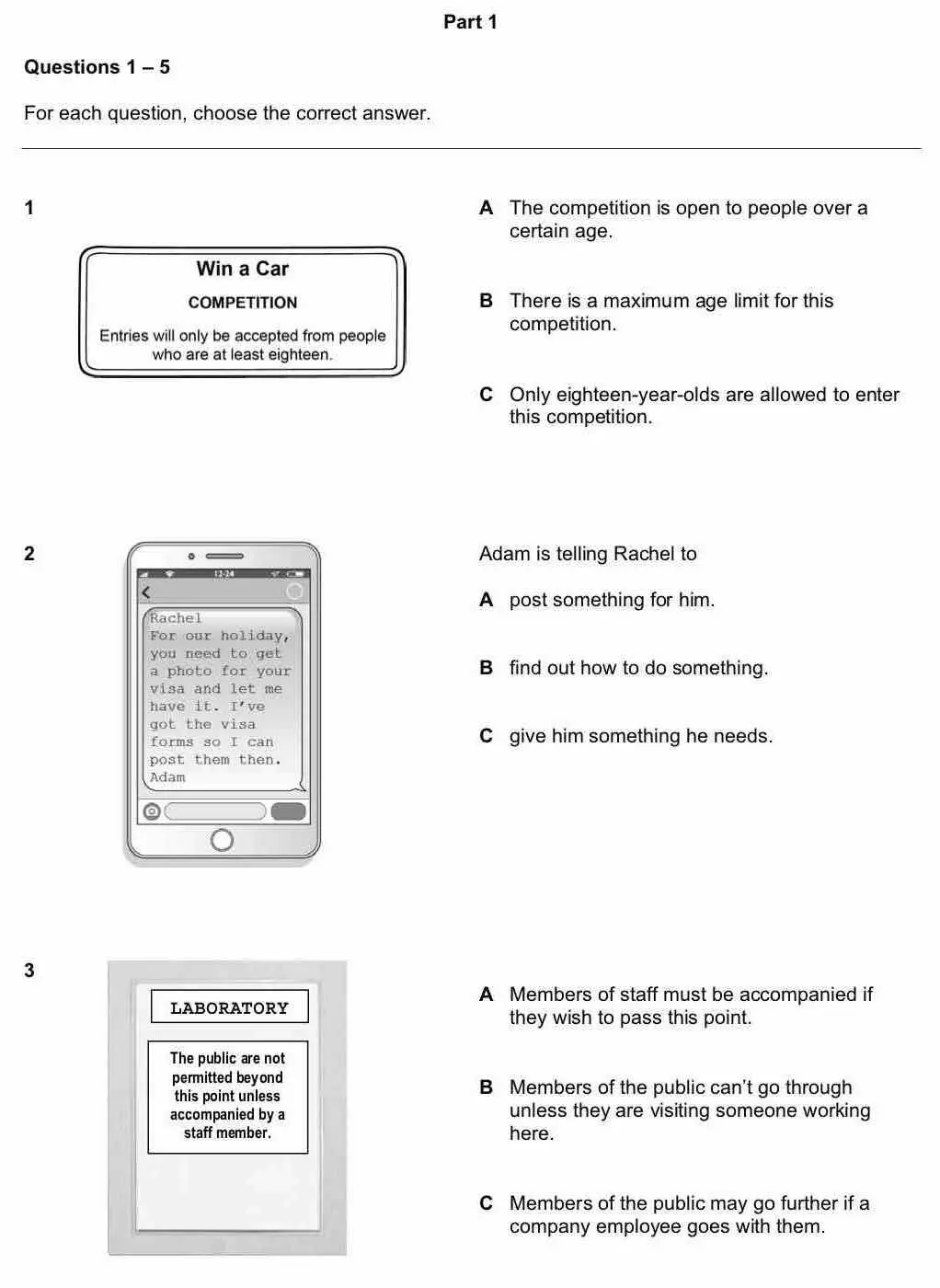
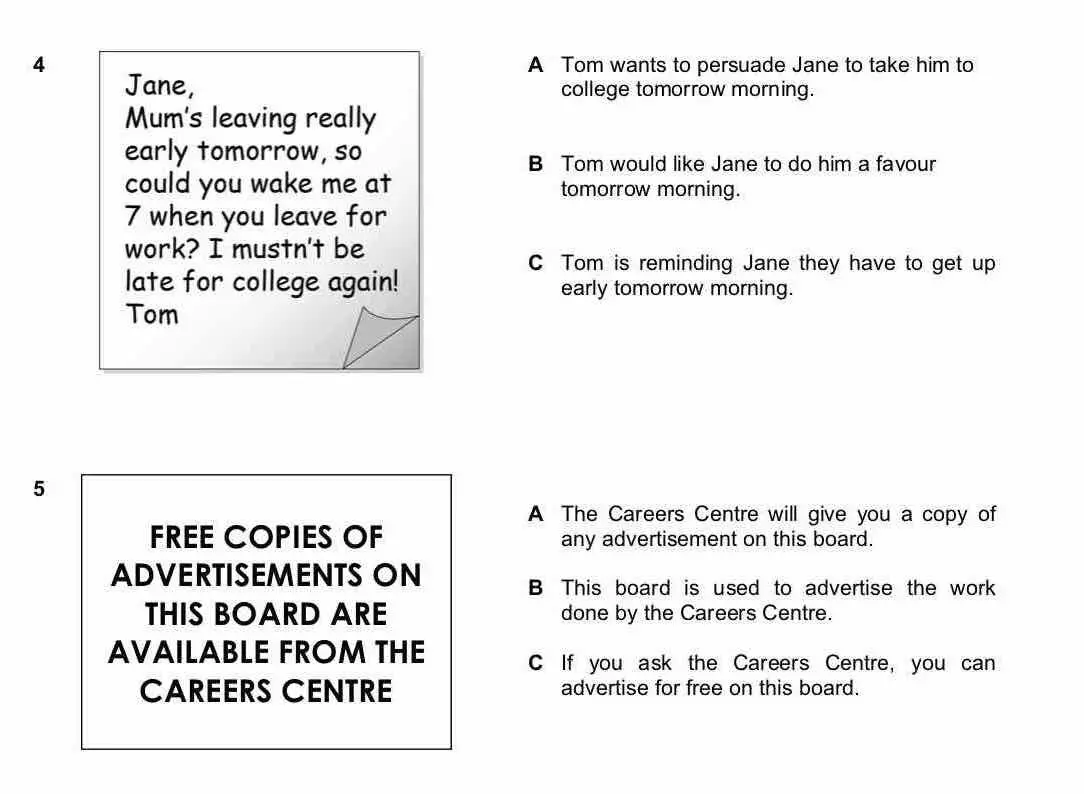
Now let’s take them one at a time. I would try to answer them yourself before reading my explanation.
Question 1: the competition
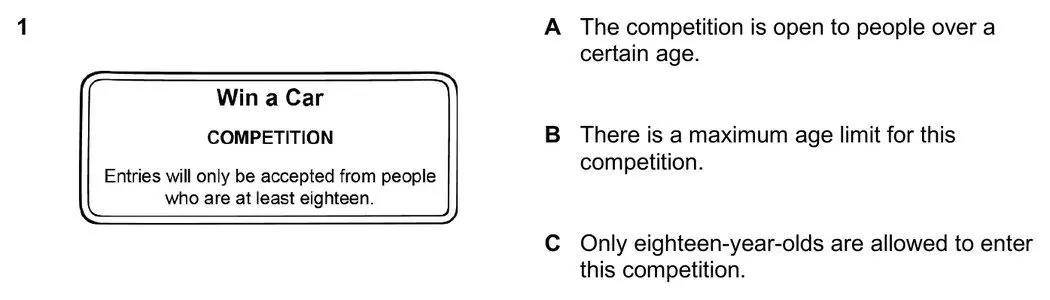
The notice says entries are only accepted from people who are at least eighteen, that is, eighteen or older.
- A. Correct. Open to people over a certain age is exactly that: there is a minimum age.
- B. Wrong. It says maximum age limit. The text sets a minimum, not a maximum. This is the classic trap of flipping the information round.
- C. Wrong. Only eighteen-year-olds leaves out anyone who is nineteen, thirty or sixty. At least eighteen includes them all.
Question 2: Adam’s message
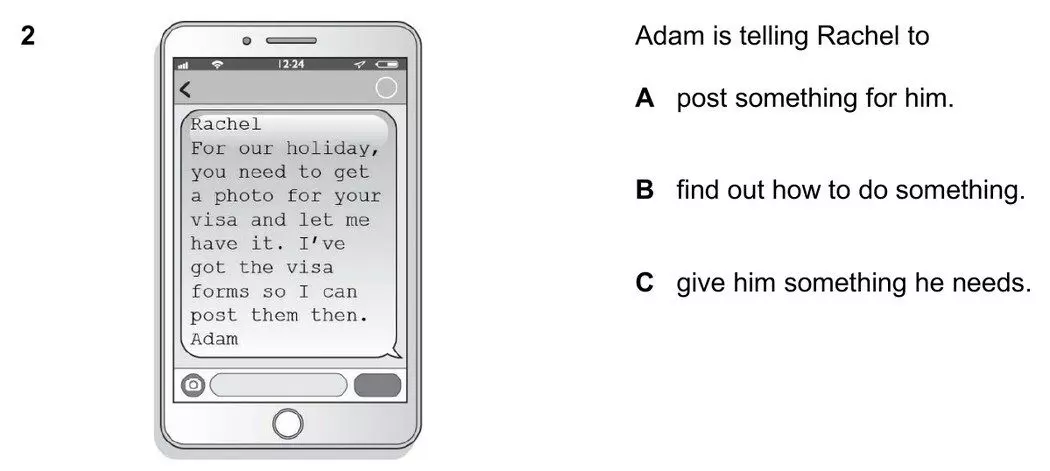
Adam tells Rachel he needs a photo for the visa and adds let me have it. He then makes it clear that he already has the forms and that he will post them himself.
- A. Wrong. It talks about posting something, and the word post does appear in the text, but the one posting is Adam, not Rachel. The subject has been swapped.
- B. Wrong. Nobody has to find out how to do anything.
- C. Correct. Give him something he needs is a rewording of let me have it: hand over the photo.
Question 3: the laboratory sign
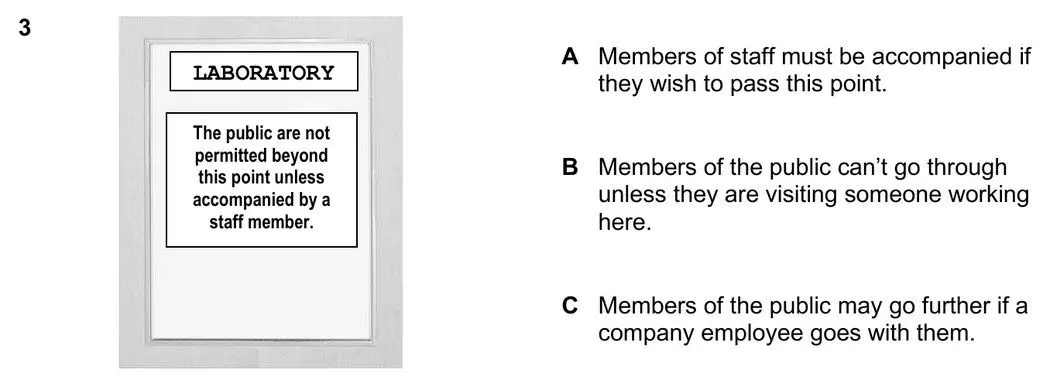
The sign says the public cannot go beyond that point unless accompanied by a staff member.
- A. Wrong. It says it is the members of staff who must be accompanied. That is the other way round: staff can go through, it is the public who need company.
- B. Wrong. It changes the condition: the sign is not about visiting someone, it is about being accompanied by someone who works there. You can be accompanied without visiting anyone.
- C. Correct. May go further if a company employee goes with them says the same as the sign, in different words.
Question 4: Tom’s note
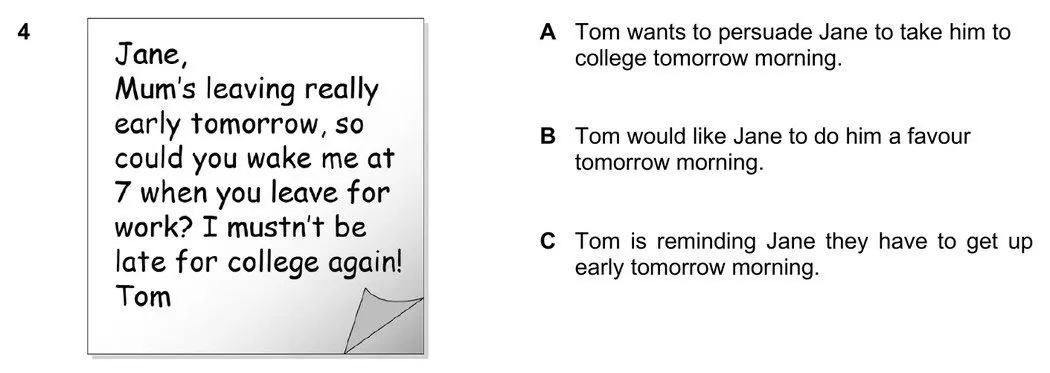
Tom asks Jane to wake him at seven when she leaves for work, because his mum is leaving very early and he does not want to be late again.
- A. Wrong. It talks about giving him a lift to college. Tom is not asking for a lift, he is asking to be woken up.
- B. Correct. Do him a favour sums the request up perfectly.
- C. Wrong. It turns a request into a reminder, and on top of that it says they both have to get up early. The one with the early start is his mum.
Question 5: the noticeboard

The notice says copies of the advertisements on the board are available free from the Careers Centre.
- A. Correct. The centre will give you a copy of any advertisement on the board.
- B. Wrong. It says the board advertises the work done by the Careers Centre. That is not it: the centre hands out copies, it does not advertise itself.
- C. Wrong. Here is the subtle trap. What is free is the copies, not putting up an advert. The option moves free somewhere else.
Answers, in case you were keeping score: 1A, 2C, 3C, 4B, 5A.
The four classic Cambridge distractors
Look back at those five questions and you will see the wrong options are not there by accident. The same four mechanisms come up again and again, and spotting them is half the battle:
- They flip the information. Minimum for maximum, before for after, allowed for forbidden. That is question 1.
- They swap who does the action. The action in the text is real, but somebody else is doing it. Questions 2 and 3.
- They change the condition. The text says «if someone goes with you» and the option says «if you are visiting someone». Question 3.
- They move a word. The free in question 5 shifts from the copies to the advert, and the whole sentence changes meaning.
There is a fifth, subtler mechanism worth keeping on your radar: the reasonable but unstated option. It is a sentence that fits the situation and would probably be true in real life, but that the text never says. In the exam, only what is written counts.
A step-by-step strategy for B1 Reading Part 1
This is the routine I have my students practise, and it works especially well when nerves kick in:
- 1. Read the text before the options. If you read A, B and C first, you go in biased and start looking for whichever one sounds closest.
- 2. Say it in your own words. Before looking at the options, sum the message up in one sentence: you can’t go in alone, he wants the photo. That summary is your answer.
- 3. Watch who does what. In personal messages, note who is asking and who is doing. That is where half of all candidates slip.
- 4. Compare each option in full. Do not stop at the first half of the sentence. Plenty of options start well and go wrong at the end.
- 5. Rule out with a reason. If you eliminate A, do it because you know which word makes it false, not on instinct.
- 6. Always answer. There is no penalty for a wrong answer, so a blank question is a mark given away.
The most common mistakes in Reading Part 1 of B1 Preliminary
- Going too fast. The texts are short, true, but the message is precise. Five or six minutes spent well here beat two minutes spent rushing.
- Choosing by repeated words. An option that repeats a word from the text is often precisely the sign that it is the distractor.
- Translating in your head. With texts this short, translation eats the nuance of unless, at least or let me have it.
- Not re-reading the option you chose. Before moving on, check that your option says the same as the text, not something similar.
- Leaving answers to transfer later. In the B1 Reading paper there is no extra time to copy answers onto the answer sheet, so mark them as you go.
Frequently asked questions about B1 Reading Part 1
How many questions are there in Reading Part 1 of B1 Preliminary?
Five, each with three options (A, B or C) and one mark per correct answer.
How long should I spend on it?
Five to seven minutes. The whole paper is 45 minutes for six parts and 32 questions, so this is not the place to linger.
Is there a penalty for wrong answers?
No. Nothing is deducted for a wrong answer, so answer every question, even by elimination.
Is it the easiest part of the B1 Reading paper?
It usually is, which is exactly why losing marks here stings. The texts are simple, but the options are designed to catch you when you relax.
What kind of texts come up?
Notices and signs, packaging information, notes, emails, cards, text messages, postcards and website texts.
Did this part change in the 2020 update?
No. Reading Part 1 of B1 Preliminary stayed the same, so older practice material is still valid for this part.
I understand the texts but I still get questions wrong. Why?
Almost always because of rushing and focusing on individual words instead of the whole message. Cambridge builds its distractors with vocabulary that looks like the text but means something different, so recognising words is not enough: you need to hold on to what the message says as a whole. If this keeps happening to you, go back to the distractor section of this guide and review the four mechanisms.
What should I do if I don’t know a word in the text?
Don’t freeze. The questions are designed so that you can answer them without understanding every single word, so work the meaning out from context and focus on the part of the message the question is actually asking about. In this part, though, the texts are so short that it pays to watch the words that set the condition, such as unless, only or at least: those do change the whole meaning.
Can I use a dictionary in the exam?
No, dictionaries are not allowed in B1 Preliminary. You rely on the vocabulary you bring with you and on what you can work out from context, which is exactly why reading widely in English while you prepare pays off so much on exam day.
Practise Reading Part 1 of B1 Preliminary with my book
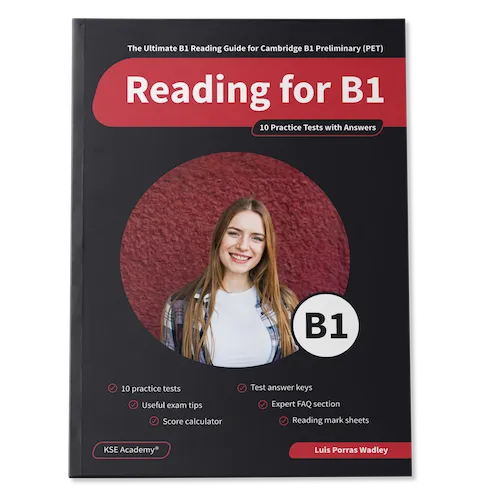
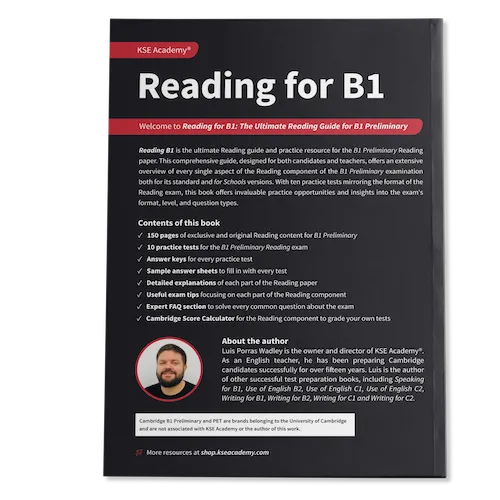
If you want to practise this part with complete papers and mark yourself, I have a book dedicated to exactly that: Reading B1: The Ultimate B1 Reading Guide & 10 B1 Reading Tests with Answers. Inside you will find:
- A guide to the Reading paper of B1 Preliminary, part by part.
- Ten complete Reading tests, with all six parts each.
- The answer key for every test.
- A photocopiable answer sheet and instructions for working out your own score.
Keep preparing the B1 Reading paper
This is the first guide in a six-part series covering each part of B1 Preliminary Reading. You’ll find the rest at Reading Part 2, Reading Part 3, Reading Part 4, Reading Part 5 and Reading Part 6, or you can go back to the overall picture in my guide to B1 Preliminary Reading and the main B1 Preliminary page.
Did you find this guide useful? Share it with other students and teachers preparing for the PET. And if you are still unsure about anything in this part, leave me a comment, I read them all.
See you in the next part. Until then, don’t forget to keep smiling! 🙂
