
Table of contents
If you’re preparing for the B1 Preliminary (PET), Reading Part 3 of the B1 Preliminary is the first part of the Reading paper where you face a genuinely long text with an opinion behind it. No more notices or short messages: here someone is telling you something, and you have to understand not just what they say, but what they think about it and why.
In this guide I’ll walk you through exactly what B1 Reading Part 3 looks like, what kind of text comes up, and I’ll comment question by question on an official Cambridge sample task: why the correct option reflects what the writer says and thinks and, above all, why the other three don’t, even when they borrow words from the text. Let’s get started! 🙂
What B1 Reading Part 3 looks like
Before we get into it, let’s place it in context. The Reading paper of the B1 Preliminary has six parts, 32 questions and 45 minutes, and it makes up 25% of the final exam score. The third part is this one:
| Fact | B1 Reading Part 3 |
|---|---|
| What you have to do | Read a text that expresses an opinion or attitude and answer 5 multiple-choice questions |
| Number of questions | 5 (numbered 11 to 15) |
| Options per question | 4 (A, B, C or D) |
| Scoring | 1 point per correct answer |
| Recommended time | Between 7 and 9 minutes |
| What it tests | Detailed comprehension (questions 11-14) and overall comprehension of the text (question 15) |
Look at the last row, because according to Cambridge’s own material for teachers, it’s the key to this part: questions 11, 12, 13 and 14 follow the order of the text, each focused on a specific section, while question 15 is always about the global meaning of the whole text, usually asking you for the best possible introduction or summary.
And a heads-up I always give in class: this part didn’t change with the 2020 reform either. If you’re using older materials to practise Part 3, they still work perfectly well.
What kind of text comes up in B1 Preliminary Reading Part 3
Cambridge is very specific here: the text in this part expresses an opinion or an attitude. It might be an article, a blog entry or an interview in which someone recounts a personal experience, usually in the first person, making clear throughout what they think or feel about what happened to them.
That completely changes what you’re looking for compared to Part 1: here it’s not enough to spot a piece of information. You need to understand why the person did something, how they felt about it, and what they think now. The questions often start with phrases like «Peter enjoys… because» or «How does Peter feel about…», which point straight at that opinion dimension.
A real B1 Reading Part 3 example, commented question by question
Let’s work through an official Cambridge sample task: an artist talks about his passion for mountain biking. Here’s the full text:
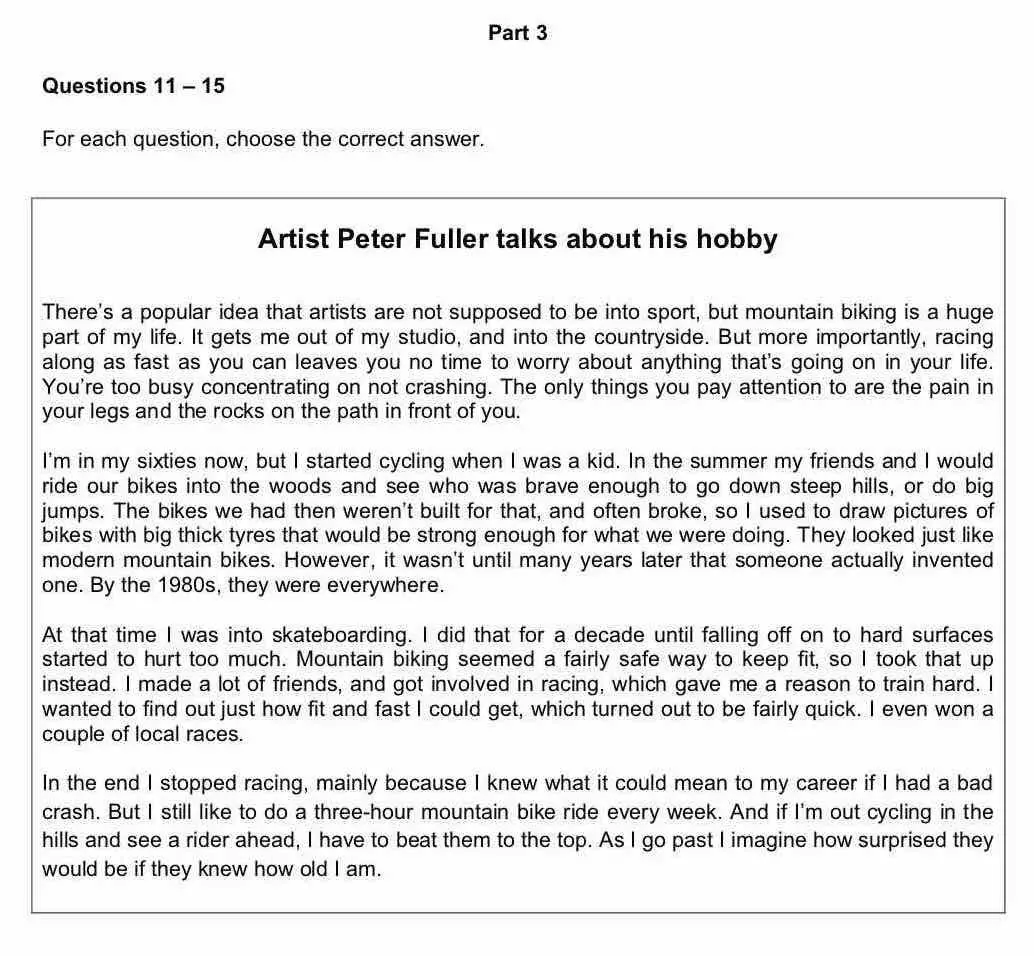
Now let’s go through them one by one. I’d recommend trying to answer them yourself before reading my explanation.
Question 11: why Peter enjoys mountain biking
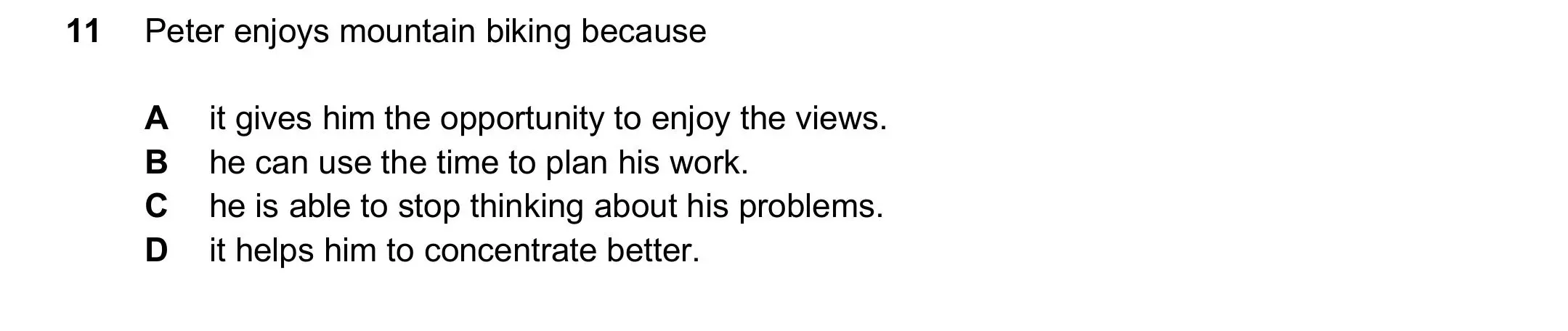
Peter says that going as fast as he can «leaves you no time to worry about anything that’s going on in your life», and that he only pays attention to the pain in his legs and the rocks on the path.
- C. Correct. «He is able to stop thinking about his problems» captures exactly that: cycling disconnects him from his worries.
- A. Wrong. It mentions it gets him out of his studio and into the countryside, but the text itself makes clear he only pays attention to the pain and the path ahead, not the views. It’s the setting trap: nature is mentioned without saying he enjoys looking at it.
- B. Wrong. It’s the exact opposite: cycling takes his mind off anything in his life, it doesn’t help him plan his work.
Question 12: his childhood bike
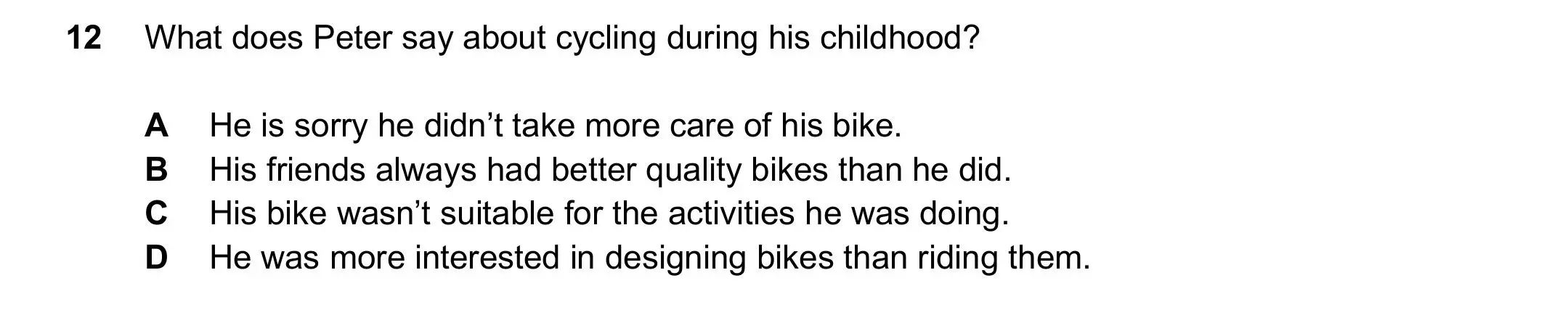
Peter says the bikes they had as kids «weren’t built for that, and often broke», so he used to draw pictures of bikes with thicker tyres that would hold up to what they were doing.
- C. Correct. «His bike wasn’t suitable for the activities he was doing» describes exactly that: his bike wasn’t made for what he used it for.
- D. Wrong: the fine trap. Drawing bikes sounds like «designing», but he did it because his real bike wasn’t good enough, not because he preferred design over riding. The text never says he was more interested in design than riding.
- B. Wrong. The text talks about riding with his friends, but it never compares whose bikes were better.
Question 13: why he returned to cycling

Peter gave up skateboarding because falling on hard surfaces started to hurt too much, and mountain biking seemed «a fairly safe way to keep fit», so he took it up «instead».
- D. Correct. «To replace an activity he had given up» is exactly what happened: he swapped skateboarding for biking.
- B. Wrong: a sequencing trap. The text does mention he got into racing, but after he took up biking again, as a consequence, not as the reason he came back to it.
- C. Wrong: same trap. Making friends is also mentioned later, as something that happened once he was already cycling, not as the original reason.
Question 14: how Peter feels about cycling now
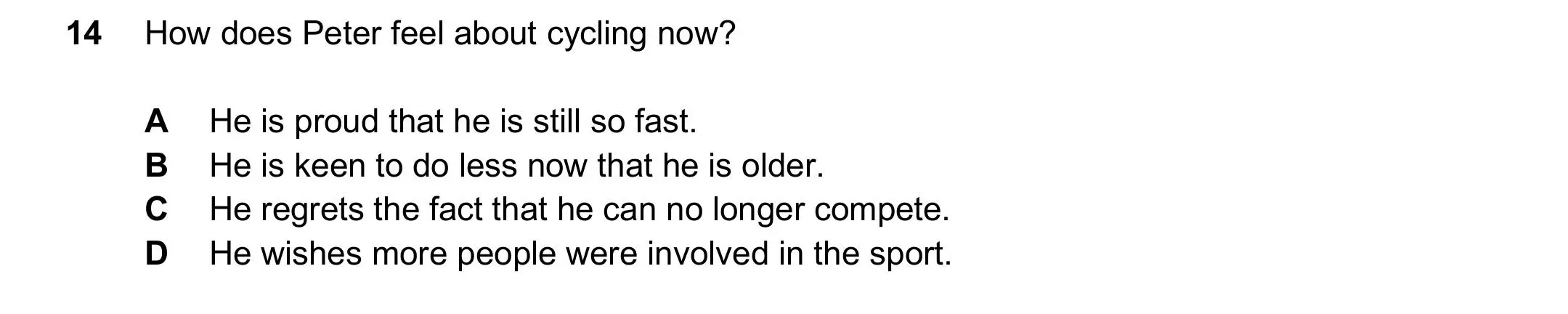
Peter still does a three-hour ride every week, and if he sees another rider ahead, he overtakes them and imagines how surprised they’d be if they knew his age.
- A. Correct. «He is proud that he is still so fast» fits that closing image: he takes pride in still beating riders who are probably younger.
- C. Wrong. It’s true he stopped racing competitively to protect his art career, but that’s not regret: he’s still «competing» informally on his rides, so the idea that he «can no longer compete» is false.
- B. Wrong. It’s the opposite: he still rides three hours a week, he hasn’t cut back at all because of his age.
Question 15: the best introduction to the article
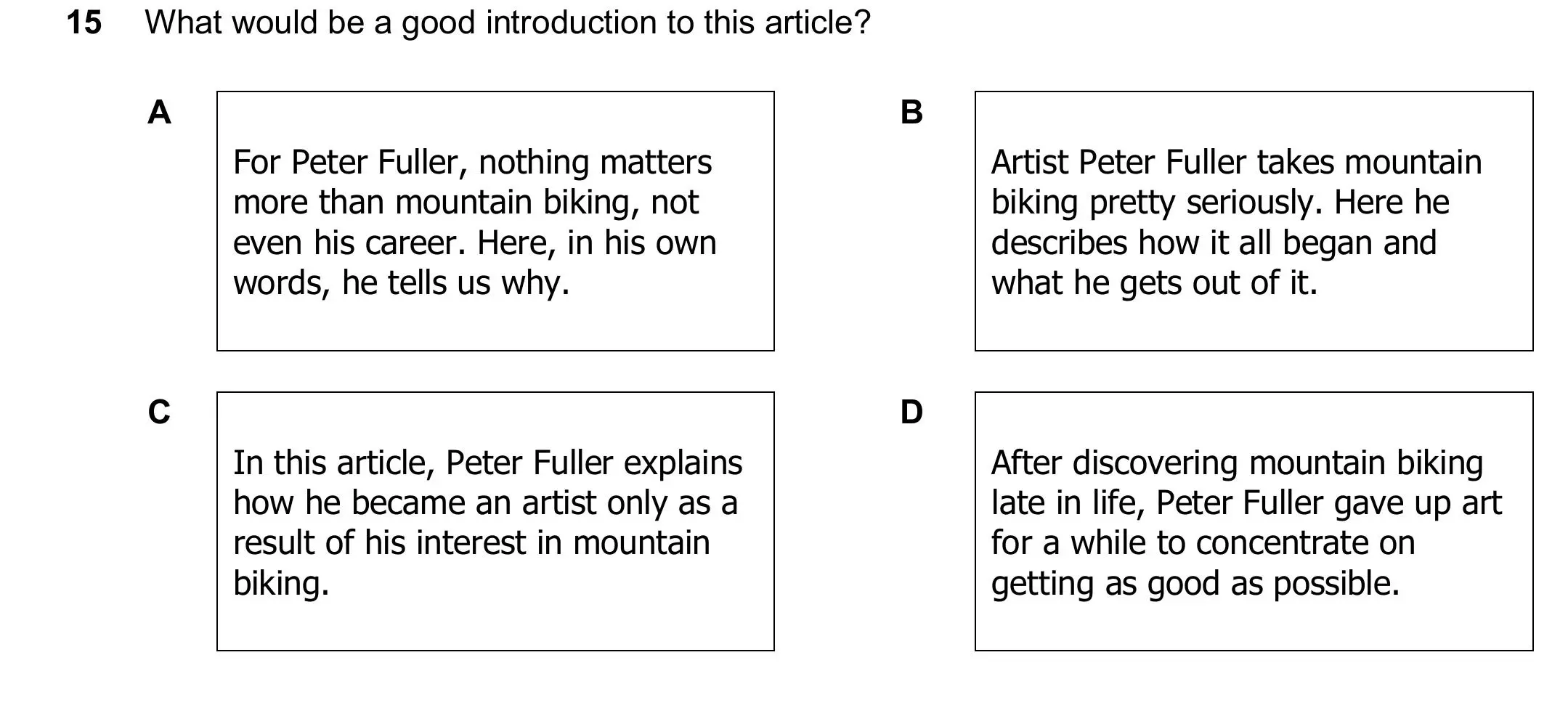
This question is different from the previous four: it isn’t answered with a specific part of the text, but with the overall meaning of the whole article.
- B. Correct. «Artist Peter Fuller takes mountain biking pretty seriously. Here he describes how it all began and what he gets out of it» sums up both halves of the article well: how it started (childhood, skateboarding) and what he gets out of it now (switching off, keeping fit, pride).
- A. Wrong. It overstates things: the text says he gave up racing precisely to protect his career as an artist, so his profession clearly does matter to him, quite a lot.
- C. Wrong. It flips the article on its head: it isn’t about how he became an artist thanks to cycling, but about his relationship with cycling as someone who’s already an artist.
Answers, in case you were keeping track: 11C, 12C, 13D, 14A, 15B.
Cambridge’s classic distractors in Reading Part 3
Go back over the five questions and you’ll notice the strongest distractors don’t invent information: they twist it or move it out of place. The mechanisms that come up again and again are these:
- They reorder cause and consequence. Something the text presents as a result (getting into racing, making friends) becomes, in the option, the original cause. Questions 13 and 11.
- Bait vocabulary from the same semantic field. «Drawing bikes» sounds like «designing bikes», but the text never says that was his real interest. Question 12.
- They reverse the feeling. «He can no longer compete» versus what the text actually says: he’s still competing, just informally. Question 14.
- They exaggerate an idea that is there, but taken to the extreme. Caring about cycling doesn’t mean «nothing matters more, not even his career». Question 15.
One important note on question 15: since it’s the only global-meaning question, don’t answer it based on a single sentence. Compare it against the overall impression left by the whole text, not a specific detail.
Step-by-step strategy for B1 Reading Part 3
This is the routine I get my students to practise, following Cambridge’s own advice:
- 1. Skim the text first. Just to get a sense of the topic and who’s speaking. Don’t look for answers yet.
- 2. Read it a second time, carefully. Now pay attention to the details and to how the person feels or what they think at each point.
- 3. Go through the questions in order. Questions 11-14 follow the order of the text, so the information for question 12 comes after the information for question 11, and so on. Use that to your advantage.
- 4. Check each option against the text, not your gut feeling. Before choosing, find the exact sentence that confirms or rules out each option.
- 5. Leave question 15 for last. It only really makes sense to answer it once you have the whole story clear in your head.
- 6. Always answer. There’s no penalty for wrong answers, so if you’re unsure, go with the option that best fits the text as a whole.
Common mistakes in B1 Preliminary Reading Part 3
- Answering after a single read. The text is meant to be read twice: once for the general idea, once for detail. Skipping the second read is the number one cause of mistakes.
- Mistaking a mentioned fact for the main reason. Just because something appears in the text doesn’t mean it’s the cause of what the question is asking. Always check the order of the ideas.
- Answering question 15 with a single detail. It’s the only global question: if your answer relies on one sentence, you’ve probably fallen for a distractor.
- Ignoring tone and focusing only on content. This part tests opinions and feelings, not just facts. Always ask yourself how the person feels, not just what they did.
- Managing your time badly. It’s a longer text than in earlier parts. If you get stuck on one question, move on and come back to it at the end.
Frequently asked questions about B1 Preliminary Reading Part 3
How many questions and options does B1 Reading Part 3 have?
Five questions (numbered 11 to 15), each with four options (A, B, C or D).
How much time should I spend on it?
Between seven and nine minutes. The whole exam is 45 minutes for six parts and 32 questions.
Are wrong answers penalised?
No. There’s no deduction for wrong answers, so answer every question, even if it’s with the option that fits best.
What kind of text comes up in this part?
A text that expresses an opinion or an attitude, usually a first-person article or interview about a personal experience: a hobby, a trip, an anecdote.
Are all the questions the same type?
No. Questions 11 to 14 follow the order of the text and focus on detail; question 15 is always about the overall meaning of the whole article, usually asking for the best introduction or summary.
Did this part change with the 2020 reform?
No. B1 Preliminary Reading Part 3 stayed the same, so practice material from before 2020 is still valid for this part.
I understand the text but I still get questions wrong. Why?
It’s almost always down to accepting an option that mentions something from the text without checking whether it’s the cause of what the question is asking or just a consequence mentioned later on. Go back to the distractors section of this guide and review how Cambridge reorders cause and consequence.
Can I use a dictionary in the exam?
No, dictionaries aren’t allowed in the B1 Preliminary. That’s exactly why it’s worth practising with real opinion texts like this one, to get used to the vocabulary people use to describe how they feel in English.
Practise B1 Preliminary Reading Part 3 with my book
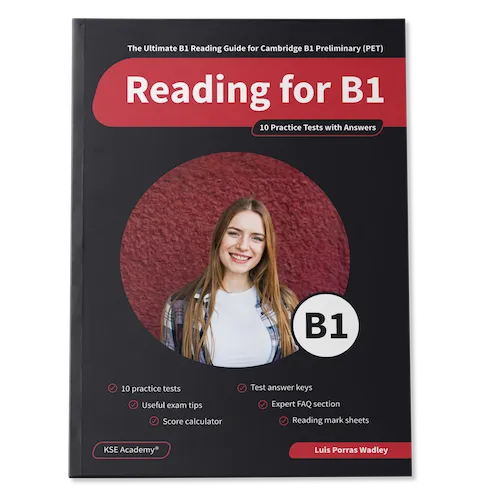
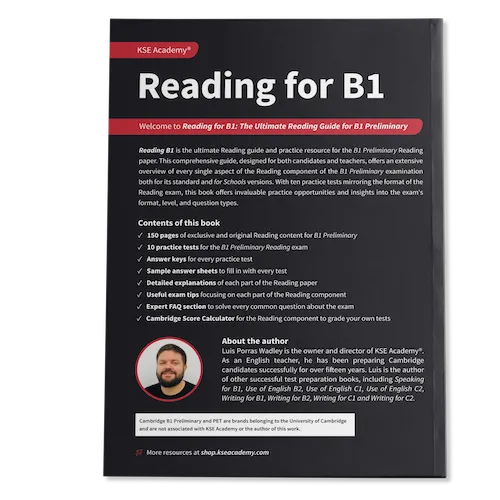
If you want to practise this part with full exams and mark your own work, I have a book dedicated to exactly that: Reading B1: The Ultimate B1 Reading Guide & 10 B1 Reading Tests with Answers. Inside you’ll find:
- A guide to the Reading component of the B1 Preliminary, part by part.
- Ten full Reading exams, with all six parts each.
- The answer key for every test.
- A photocopiable answer sheet and instructions to work out your own score.
Keep preparing B1 Reading
This is the third guide in a six-part series covering each part of B1 Preliminary Reading. You’ll find the rest at Reading Part 1, Reading Part 2, Reading Part 4, Reading Part 5 and Reading Part 6, or you can go back to the overall picture in my guide to B1 Preliminary Reading and the main B1 Preliminary page.
Did you find this guide useful? Share it with other students and teachers preparing for the PET. And if you’re left with any doubts about this part, leave them in the comments. I read every one.
See you in the next part. Until then, don’t forget to keep smiling! 🙂
