
Tabla de contenidos
La Parte 4 del Use of English del C1 Advanced es el key word transformation: seis frases que tienes que reescribir con una palabra clave, sin cambiar el significado. Es la parte que más respeto da, y con razón: cada pregunta pide dos cambios a la vez, normalmente una estructura gramatical y una expresión de vocabulario, y hay que hacerlos en muy pocas palabras.
La buena noticia es que las transformaciones del C1 se repiten mucho más de lo que parece. En esta guía te explico cómo es el key word transformation del C1, cómo se puntúa (con medio punto por cada mitad), qué estructuras salen según las tareas oficiales de Cambridge, un método paso a paso y el examen de muestra oficial resuelto pregunta por pregunta. Al final tienes cuatro ejercicios originales, con 24 transformaciones para practicar y sus respuestas explicadas. ¡Vamos allá!
Cómo es la Parte 4 del Use of English del C1 Advanced
| Dato | C1 Use of English Part 4 |
|---|---|
| Qué tienes que hacer | Completar la segunda frase para que signifique lo mismo que la primera, usando la palabra clave |
| Número de preguntas | 6 (numeradas del 25 al 30), más un ejemplo resuelto (0) |
| Qué escribes | Entre 3 y 6 palabras, contando la palabra clave; las contracciones cuentan como dos (salvo can’t) |
| La palabra clave | Tienes que usarla y no puedes cambiarla de ninguna forma |
| Puntuación | 2 puntos por pregunta (1 por cada mitad de la respuesta), 12 en total |
| Ortografía | Tiene que ser correcta; en el examen en papel, respuestas en MAYÚSCULAS |
| Qué mide | Gramática y vocabulario a la vez: estructuras, expresiones fijas, sustantivos que sustituyen a verbos, phrasal verbs |
La Parte 4 forma parte de la nota de Use of English, junto con la Parte 2 y la Parte 3. Fíjate en un dato: las Partes 2 y 3 dan 8 puntos cada una, y la Parte 4 da 12 con solo seis preguntas. Cada transformación vale el doble que un hueco de las otras partes.
Las reglas que no puedes romper
- Entre tres y seis palabras. Si escribes siete, pierdes los dos puntos, aunque la frase sea perfecta. Didn’t cuenta como dos palabras (did not); solo can’t cuenta como una. Ojo: en el B2 el límite es de dos a cinco; en el C1 es de tres a seis.
- La palabra clave, tal cual. Si la palabra es COMPARISON, no vale compare ni comparing. Si no la usas o la cambias, pierdes los puntos.
- El mismo significado. La segunda frase tiene que decir lo mismo que la primera: ni más fuerte ni más suave, ni en otro momento, ni con otra persona haciendo la acción.
- Solo las palabras que faltan. En la hoja de respuestas escribes únicamente lo que va en el hueco, incluida la palabra clave.
Cómo se puntúa: las dos mitades
Esto es lo más útil que puedes saber de la Parte 4. Cambridge divide cada respuesta en dos mitades, y cada una vale un punto. Normalmente, una mitad es la estructura que trae la palabra clave y la otra es el segundo cambio que pide la frase.
Por ejemplo, en la pregunta 29 del examen que vamos a resolver, la respuesta es in spite of her lack, y la clave oficial la divide así: in spite of | a/her lack. Si escribes in spite of having little, aciertas la primera mitad y te llevas un punto. La consecuencia práctica es clara: nunca dejes una pregunta en blanco. Media respuesta vale más que ninguna.
Qué estructuras salen en el key word transformation del C1
Para preparar esta guía he analizado diez tareas oficiales de Cambridge de la Parte 4 del C1 (60 transformaciones). Como cada pregunta combina dos cosas, los porcentajes suman más de cien. Esto es lo que más se repite:
| Qué se evalúa | Frecuencia | Ejemplo del tipo de cambio |
|---|---|---|
| Expresiones fijas e idioms | Casi la mitad de las preguntas | It doesn’t matter what you say. → It makes no difference what you say. |
| Sustantivo en lugar de verbo o adjetivo | 3 de cada 10 | She explained it clearly. → She gave a clear explanation of it. |
| Estructuras verbales | 1 de cada 4 | I didn’t realise… → I failed to realise… |
| Pasiva (también it is said that) | Casi 1 de cada 5 | People believe he left. → He is believed to have left. |
| Phrasal verbs | 1 de cada 10 | They cancelled the match. → The match was called off. |
| Condicionales y if it hadn’t been for | Menos de 1 de cada 10 | Without your help, I’d have failed. → If it hadn’t been for your help… |
| Estilo indirecto y verbos de habla | Menos de 1 de cada 10 | «Don’t go,» he said. → He advised me not to go. |
| Inversión | Pocas veces | As soon as we arrived, it rained. → Hardly had we arrived when it rained. |
Dos cosas más que te conviene saber de las tareas oficiales:
- La respuesta suele tener cinco palabras. Más de la mitad de las respuestas oficiales tienen cinco palabras, y casi un tercio, cuatro. Si la tuya tiene tres, revisa que no te falte el segundo cambio; si tiene siete, sobra algo.
- La palabra clave no siempre es la difícil. Muchas veces es un sustantivo (COMPARISON, DANGERS) o una partícula (OFF, FOR, BUT) que forma parte de una expresión. Lo difícil suele ser la otra mitad.
En qué se diferencia de la Parte 4 del B2 First
En la Parte 4 del Use of English del B2, la mayoría de las preguntas combinan una estructura gramatical (pasiva, estilo indirecto, condicional) con un phrasal verb o una colocación sencilla. En el C1 pesan mucho más las expresiones fijas y los cambios de verbo a sustantivo (decide → make a decision), y las respuestas tienen una palabra más.
El método en cuatro pasos
- Compara las dos frases y subraya lo que no cambia. Lo que ya está escrito en la segunda frase no lo tienes que tocar. Así ves qué parte del significado falta.
- Mira qué te obliga a hacer la palabra clave. Si es un sustantivo como COMPARISON, casi seguro que forma una expresión (in comparison with). Si es una partícula como OFF, busca el phrasal verb. Si es un verbo en pasado, piensa en la pasiva o en un tiempo concreto.
- Busca el segundo cambio. Casi siempre hay otro: un verbo que pasa a sustantivo, una preposición que cambia, una negación que se mueve. Si tu respuesta solo tiene un cambio, probablemente le falte algo.
- Cuenta las palabras y relee la frase entera. Entre tres y seis, con las contracciones contadas como dos. Y comprueba que el tiempo verbal y el significado son los mismos que en la primera frase.
El examen de muestra, resuelto pregunta por pregunta
Estas son las seis transformaciones del examen de muestra oficial de Cambridge para el C1 Advanced. Intenta hacerlas antes de leer las explicaciones:
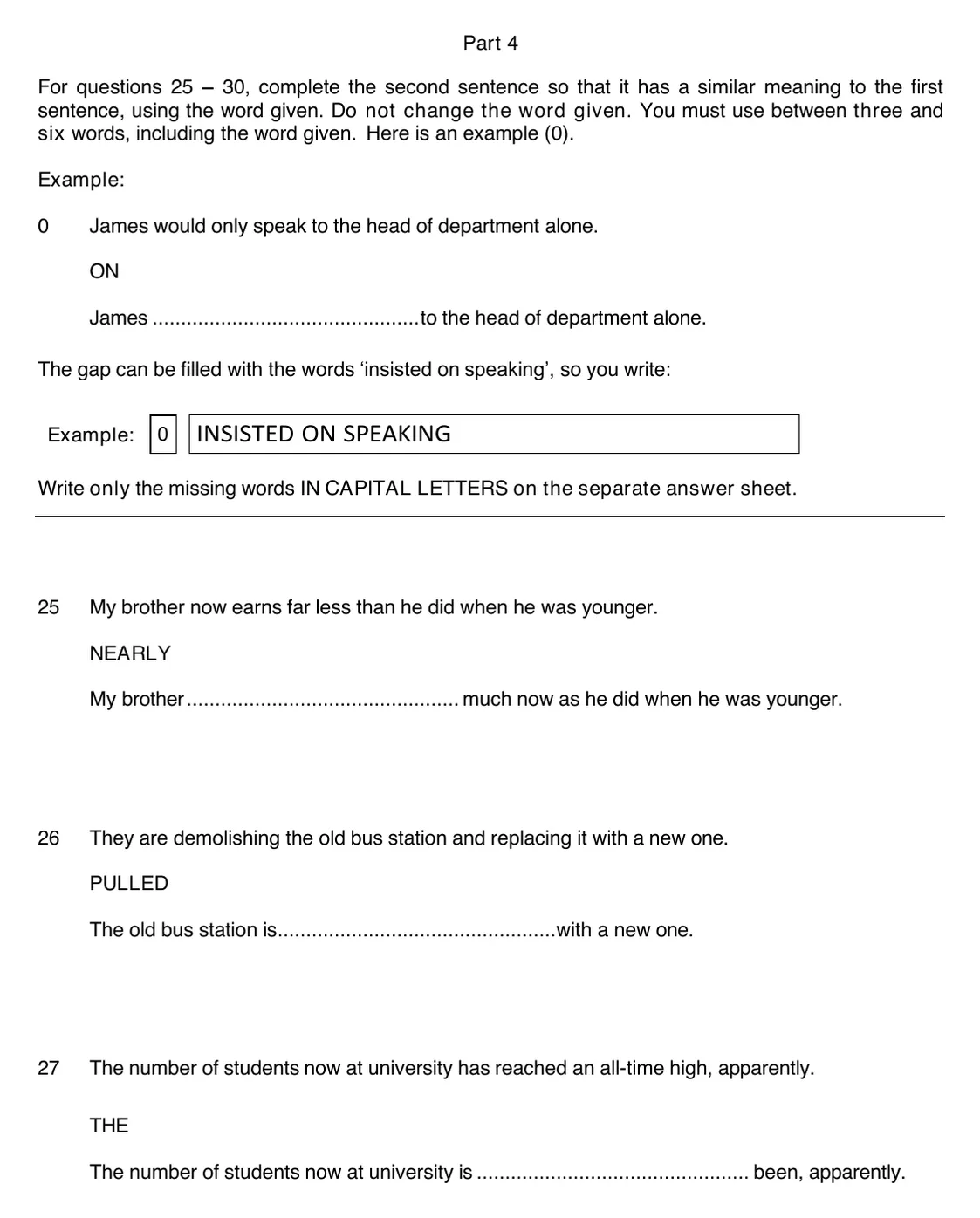
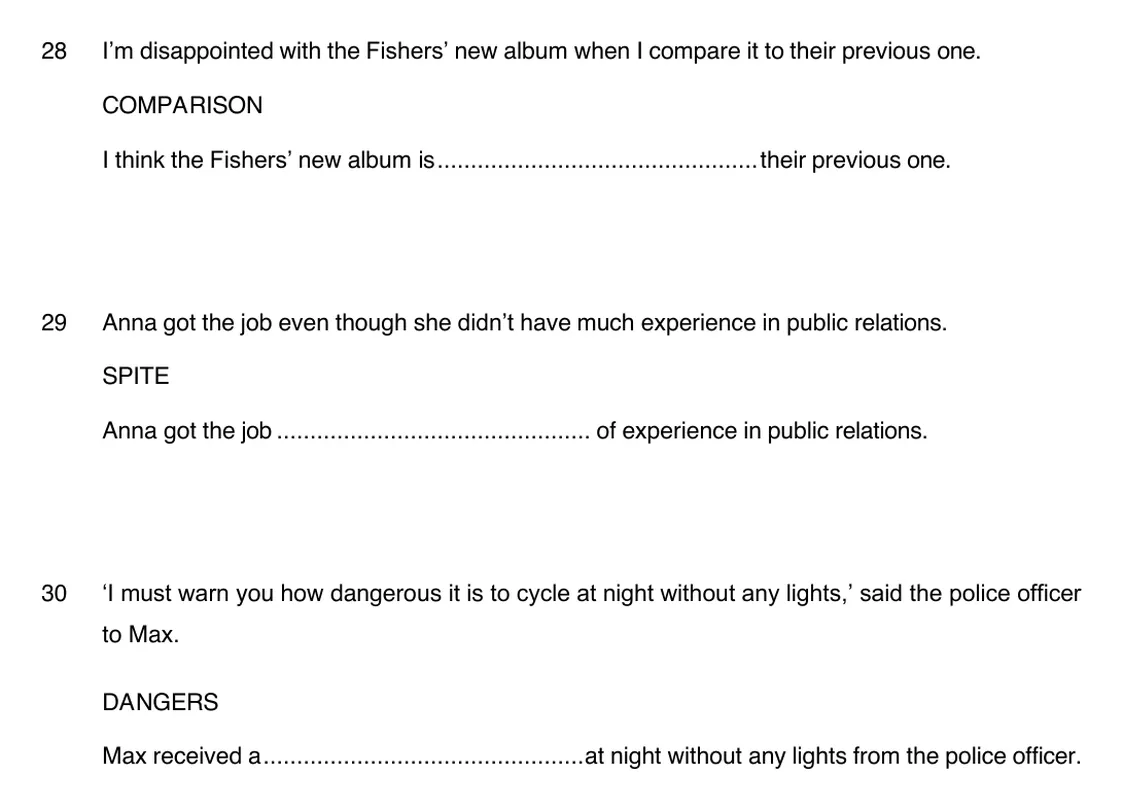
Pulsa en una página para verla a tamaño completo. Examen de muestra oficial del C1 Advanced (Sample Paper 1, Reading and Use of English). © Cambridge University Press & Assessment.
El ejemplo ya muestra cómo funciona: James would only speak to the head of department alone con la palabra ON se convierte en James insisted on speaking to the head of department alone. Hay dos cambios: would only pasa a insisted, y detrás de insist on va el gerundio.
25. NEARLY → does not earn nearly as. My brother now earns far less than he did… → My brother ………… much now as he did… Hay que darle la vuelta a la comparación: far less than pasa a not nearly as much as. Una mitad es la negación con el verbo (does not earn o doesn’t make) y la otra, nearly as (o so). Cuidado: doesn’t earn nearly as son cinco palabras, porque doesn’t cuenta como dos.
26. PULLED → being pulled down and replaced. They are demolishing the old bus station and replacing it… → The old bus station is ………… with a new one. Dos cambios: el phrasal verb pull down (derribar) y la pasiva continua (is being pulled down). La segunda mitad es and (being) replaced. Cambridge acepta también to be pulled down and replaced.
27. THE → the highest it has ever. The number… has reached an all-time high… → The number… is ………… been. An all-time high significa que nunca había estado tan alto, y eso se dice con un superlativo y el presente perfecto: the highest (that) it has ever been. Una mitad es the highest; la otra, it has ever.
28. COMPARISON → disappointing in comparison with. I’m disappointed with the new album when I compare it to their previous one. → I think the new album is ………… their previous one. Dos cambios: el adjetivo que describe al disco (disappointing o a disappointment, no disappointed, que describe a la persona) y la expresión fija in comparison with/to.
29. SPITE → in spite of her lack. Anna got the job even though she didn’t have much experience… → Anna got the job ………… of experience… La palabra clave pide in spite of, y detrás tiene que ir un sustantivo: didn’t have much experience se convierte en her lack of experience. Es un cambio típico del C1: de verbo a sustantivo.
30. DANGERS → warning about the dangers of. ‘I must warn you how dangerous it is to cycle…’ → Max received a ………… at night… Después de received a va un sustantivo: warning. Y how dangerous it is pasa a the dangers of cycling. Dos sustantivos en lugar de un verbo y un adjetivo: la nominalización en estado puro.
Qué pedía cada pregunta
| Pregunta | Palabra clave | Primera mitad | Segunda mitad |
|---|---|---|---|
| 25 | NEARLY | Negación con el verbo | Comparación not nearly as |
| 26 | PULLED | Pasiva continua + phrasal verb | Segundo verbo en pasiva |
| 27 | THE | Superlativo | Presente perfecto con ever |
| 28 | COMPARISON | Adjetivo en -ing o sustantivo | Expresión fija in comparison with |
| 29 | SPITE | Expresión fija in spite of | Verbo → sustantivo (lack) |
| 30 | DANGERS | Verbo → sustantivo (warning) | Adjetivo → sustantivo (dangers) |
Respuestas, por si has ido apuntando: 25 does not earn | nearly as, 26 being pulled down | and replaced, 27 the highest | it has ever, 28 disappointing | in comparison with, 29 in spite of | her lack, 30 warning about | the dangers of.
Errores más comunes en el key word transformation del C1
- Pasarse de seis palabras. Es el error más caro: dos puntos fuera. Cuenta siempre, y recuerda que doesn’t, I’d o it’s son dos palabras.
- Cambiar la palabra clave. Escribir compare cuando te dan COMPARISON, o pull cuando te dan PULLED, son cero puntos.
- Hacer solo un cambio. Si tu respuesta tiene tres palabras y solo cambia una cosa, casi seguro que te falta la otra mitad.
- Cambiar el significado. Poner la frase en otro tiempo, hacerla más fuerte (never en lugar de rarely) o cambiar quién hace la acción.
- Confundir los adjetivos en -ed y en -ing. Disappointed describe a la persona; disappointing, a la cosa. Sale mucho.
- Dejar preguntas en blanco. Cada mitad vale un punto. Escribe siempre lo que sepas.
Cómo preparar la Parte 4 del C1 Advanced
- Aprende expresiones fijas con su estructura completa. Make no difference to, have nothing to do with, in the light of, lose sight of, with the exception of. Apúntalas con un ejemplo y con la frase «normal» que sustituyen.
- Practica el paso de verbo a sustantivo. Decide → make a decision, object → have an objection to, increase → a rise in. Fíjate en el verbo y la preposición que acompañan a cada sustantivo.
- Repasa las estructuras de gramática del C1. Pasiva con verbos de opinión (is said to have), if it hadn’t been for, wish y would rather, la inversión, los verbos de estilo indirecto. Te vendrá bien repasar los cleft sentences y los conectores de nivel C1.
- Haz muchas transformaciones, pero corrígelas por mitades. Cuando falles, mira qué mitad has fallado. Así sabes si tu problema es la gramática o el vocabulario.
- Déjale tiempo suficiente. Cambridge no fija tiempos por parte, pero es la parte del Use of English en la que más hay que pensar. Unos 10 o 12 minutos es razonable.
Ejercicios de key word transformation C1
Aquí tienes cuatro ejercicios originales de la Parte 4 del C1, con el mismo formato que el examen: un ejemplo (0) y seis transformaciones. Hazlos primero sin mirar las respuestas y, cuando termines, compruébalas: cada una tiene sus respuestas aceptadas, divididas en las dos mitades que puntúan, y una explicación.
Ejercicio 1
For questions 1–6, complete the second sentence so that it has a similar meaning to the first sentence, using the word given. Do not change the word given. You must use between three and six words, including the word given. Here is an example (0).
0 It is very unlikely that our team will win the cup this year.
CHANCE
Our team has little CHANCE of winning the cup this year.
1 Students were not allowed to influence the choice of the new head teacher.
SAY
Students ………… the new head teacher.
2 It is not at all certain that the factory will stay open next year.
MEANS
The factory ………… to stay open next year.
3 Max’s colleagues think very highly of his work.
OPINION
Max’s colleagues ………… his work.
4 Analysts estimate that the strike cost the airline around £5 million.
ESTIMATED
The strike ………… the airline around £5 million.
5 The manager never once suggested that our jobs might be at risk.
TIME
At no ………… that our jobs might be at risk.
6 Zara won’t go to bed until she has checked her emails.
WITHOUT
Zara never ………… checked her emails.
Ver respuestas
- 1. had/got no SAY | in choosing/selecting/picking/appointing (también: were given/allowed no SAY | in choosing/selecting/picking/appointing; had/got no SAY | in deciding on; had no SAY | in who became; had/got no SAY | whatsoever in choosing/selecting/picking/appointing; had/got no SAY | over who became): ‘Were not allowed to influence’ pasa a la expresión fija ‘have no say’ (no tener voz ni voto), y el sustantivo ‘the choice of’ pasa a ‘in’ + -ing: had no say in choosing. *Had no say in the choice of* tiene siete palabras, y *did not have a say in choosing* también se pasa.
- 2. is by no MEANS | certain/sure/guaranteed (también: is not by any MEANS | certain/sure/guaranteed; is by no MEANS | bound): La fábrica pasa a ser el sujeto, así que ‘it is certain that it will’ se convierte en ‘is certain to’, y ‘not at all’ pasa a la expresión fija ‘by no means’ (o ‘not by any means’). *Is by no means likely to* cambia el significado: no es seguro no es lo mismo que es poco probable.
- 3. have/hold | a (very) high OPINION of (también: have/hold | a very good OPINION of; have/hold | an extremely high OPINION of; have/hold | the highest OPINION of; have/hold | a very favourable OPINION of): El verbo ‘think highly of’ pasa a la estructura con sustantivo ‘have a high opinion of’, así que el adverbio ‘highly’ se convierte en el adjetivo ‘high’ delante del sustantivo. *Have a very highly opinion* mantiene el adverbio, y un simple *good opinion* se queda corto frente a ‘very highly’.
- 4. is ESTIMATED | to have cost (también: has been ESTIMATED | to have cost): ‘Analysts estimate that …’ pasa a la pasiva con verbo de opinión ‘is estimated’, con la huelga como sujeto, y el pasado ‘cost’ se convierte en el infinitivo perfecto ‘to have cost’, porque el coste fue anterior a la estimación. *Is estimated to cost* habla del futuro.
- 5. TIME did | the manager (ever) suggest/hint/indicate/imply: ‘Never once’ pasa a la expresión negativa ‘at no time’, y una expresión negativa al principio de la frase exige inversión con ‘did’ + infinitivo sin to: at no time did the manager suggest. *At no time the manager suggested* no tiene inversión, *did the manager say* se queda corto frente a ‘suggest’ (alguien que nunca lo dijo pudo insinuarlo) y *was it suggested* pierde quién lo dijo.
- 6. goes to bed | WITHOUT having (también: goes to bed | WITHOUT first having): ‘Won’t … until she has checked’ pasa a ‘never … without’, y como ‘without’ es una preposición, el verbo en perfecto pasa a ‘having’ + participio: never goes to bed without having checked. *Goes to bed until having* mantiene el conector equivocado, y *without to have* es el error de gramática más habitual.
Ejercicio 2
For questions 1–6, complete the second sentence so that it has a similar meaning to the first sentence, using the word given. Do not change the word given. You must use between three and six words, including the word given. Here is an example (0).
0 I thought the exam would be much harder than it actually was.
THAN
The exam was much easier THAN I expected.
1 The storm has caused serious damage to several villages along the coast.
BY
Several villages along the coast ………… the storm.
2 Heidi found her novel so absorbing that she had no idea how much time had passed.
TRACK
Heidi’s novel was so absorbing that it ………… time.
3 Far more people realise how important sleep is for health than they did twenty years ago.
AWARENESS
There is far ………… of sleep for health than twenty years ago.
4 None of the staff would admit that they had broken the photocopier.
OWN
None of the staff were willing to ………… the photocopier.
5 Nobody discovered the mistake in the figures until the report had been published.
LIGHT
The mistake in the figures ………… the report had been published.
6 It surprised me that Yvonne reacted so calmly to the news.
REACTION
I was surprised that Yvonne ………… to the news.
Ver respuestas
- 1. have been | seriously/severely/badly/heavily/extensively damaged BY (también: have been | very seriously/severely/badly damaged BY; have been | damaged seriously/severely/badly BY; have been left | seriously/severely/badly damaged BY; have suffered/sustained | serious/severe/heavy/extensive damage caused BY): La frase pasa a pasiva en el mismo tiempo, con los pueblos como sujeto y la tormenta como agente (have been … damaged by), y el sustantivo ‘serious damage’ se convierte en el verbo ‘damaged’ con el adverbio ‘seriously’ (o badly, severely). *Were seriously damaged by* cambia el tiempo, y *have been serious damaged by* usa un adjetivo donde hace falta un adverbio.
- 2. made her/Heidi lose | TRACK of (también: made her/Heidi lose all | TRACK of; made her/Heidi completely lose | TRACK of; caused her/Heidi to lose | TRACK of; meant (that) she/Heidi lost | TRACK of; meant she/Heidi lost all | TRACK of; led her/Heidi to lose | TRACK of): Con la novela (it) como sujeto hace falta un verbo causativo: made her lose (infinitivo sin to) o caused her to lose; y ‘had no idea how much time had passed’ pasa a la expresión fija ‘lose track of time’. *Made her to lose* es el error más frecuente.
- 3. greater/more/wider/broader (public) AWARENESS of | the importance/significance (también: more widespread AWARENESS of | the importance/significance): Dos nominalizaciones: el verbo ‘realise’ pasa al sustantivo ‘awareness’ (far greater awareness of), y la oración ‘how important sleep is’ pasa a ‘the importance of sleep’. *Greater awareness about how important* no encaja con ‘of sleep’.
- 4. OWN up to | breaking (también: OWN up to | having broken): ‘Admit’ pasa al phrasal verb ‘own up to’ (reconocer algo que has hecho mal), y como aquí ‘to’ es una preposición, la oración ‘that they had broken’ pasa a gerundio: breaking o having broken. *Own up to break* es el error más frecuente.
- 5. did/had not | come to LIGHT until/before (también: never | came to LIGHT until; was not | brought to LIGHT until/before; only | came to LIGHT after/when/once; was only | brought to LIGHT after/when/once; came to LIGHT | only after/when/once; was brought to LIGHT | only after/when/once; first | came to LIGHT after/when/once): Con el error como sujeto, ‘nobody discovered’ pasa a la expresión fija ‘come to light’ (salir a la luz), y ‘nobody … until’ pasa a ‘did not … until’ u ‘only … after’. *Came to light until* pierde la negación y el segundo punto.
- 6. had/showed/displayed such a | calm/composed/measured/relaxed REACTION (también: had/showed/displayed so calm/composed/relaxed a | REACTION; had/showed/displayed a very | calm/composed/measured/relaxed REACTION): El verbo ‘reacted’ pasa a la estructura con sustantivo ‘have a reaction’, y ‘so calmly’ se convierte en ‘such a calm’ delante del sustantivo (o la forma más formal ‘so calm a reaction’). *Had a calm reaction* pierde el ‘so’ y un punto; *had such calm reaction* se olvida del artículo.
Ejercicio 3
For questions 1–6, complete the second sentence so that it has a similar meaning to the first sentence, using the word given. Do not change the word given. You must use between three and six words, including the word given. Here is an example (0).
0 We cancelled the picnic because of the bad weather.
OWING
The picnic was cancelled OWING to the bad weather.
1 The outdoor film screening on Saturday will only be cancelled if there is heavy rain.
PROVIDED
The outdoor film screening will go ahead on Saturday ………… heavily.
2 This old fridge should have been replaced a long time ago.
HIGH
It is ………… this old fridge.
3 We shouldn’t judge Howard’s work too harshly, as he has very little experience.
ALLOWANCES
When we judge Howard’s work, we should ………… of experience.
4 My grandfather almost always goes for a walk after lunch.
HABIT
My grandfather ………… for a walk after lunch.
5 I have no recollection of anyone asking me to sign this form when I opened my account.
REMEMBER
I ………… asked to sign this form when I opened my account.
6 Victor didn’t want to answer, so he gave the impression of not having heard the question.
PRETENDED
Victor didn’t want to answer, so he ………… the question.
Ver respuestas
- 1. PROVIDED (that) | it does not rain (también: PROVIDED (that) | it is not raining): ‘Will only be cancelled if there is heavy rain’ pasa a la condición positiva ‘provided (that)’ con el resultado contrario (‘will go ahead’), y ‘heavy rain’ se convierte en el verbo con adverbio ‘it does not rain heavily’. *Provided it rains heavily* le da la vuelta al significado.
- 2. HIGH time | we/someone/somebody replaced (también: HIGH time that | we/someone/somebody replaced; HIGH time | we got rid of; HIGH time | for us to replace): ‘Should have been replaced a long time ago’ pasa a la expresión fija ‘it is high time’ (ya va siendo hora), y detrás de ‘it is high time’ + sujeto el verbo va en pasado simple aunque se refiera al presente: high time we replaced. *High time we replace* mantiene el presente, y *high time to replace* necesita ‘for us’ delante del infinitivo.
- 3. make (some) ALLOWANCES | for his lack (también: make ALLOWANCES | for Howard’s lack; make (some) ALLOWANCES | given/considering his lack; make ALLOWANCES | because of his lack; make ALLOWANCES | owing/due to his lack): ‘Shouldn’t judge too harshly’ pasa a la expresión fija ‘make allowances for’ (ser comprensivo con alguien teniendo en cuenta sus circunstancias), y la oración ‘he has very little experience’ pasa al sustantivo ‘his lack of experience’. *Make allowances that he lacks* no encaja con el ‘of experience’ que va detrás.
- 4. is in the HABIT | of going (también: makes a HABIT | of going; has made a HABIT | of going; has a/the HABIT | of going; makes a HABIT | of going out; has a HABIT | of going out; makes it a HABIT | to go; has got a HABIT | of going; has the HABIT | of going out): ‘Almost always goes’ pasa a la expresión fija ‘be in the habit of’ (o ‘make a habit of’), y como ‘of’ es una preposición, el verbo pasa a la forma -ing: is in the habit of going. *Is in the habit to go* es el error más frecuente.
- 5. do not REMEMBER | being (también: do not REMEMBER | ever being; do not REMEMBER | having been; do not REMEMBER | ever having been; cannot REMEMBER | being; cannot REMEMBER | ever being; cannot REMEMBER | having been; cannot REMEMBER | ever having been; do not ever REMEMBER | being): El sustantivo ‘recollection’ pasa al verbo ‘remember’ (nominalización a la inversa), y como la persona recibe la acción, hace falta un gerundio pasivo: do not remember being asked. *Do not remember asking* le da la vuelta a quién pregunta.
- 6. PRETENDED | not to have heard (también: PRETENDED | not to hear; PRETENDED | to not have heard; PRETENDED | to not hear; PRETENDED (that) he | had not heard; PRETENDED (that) he | did not hear; PRETENDED | to have not heard): ‘Gave the impression of not having heard’ pasa a ‘pretend’ + infinitivo negativo: pretended not to have heard (o not to hear). La negación va delante de ‘to’. *Pretended to not hear* también se acepta, pero *pretended not hearing* es incorrecto.
Ejercicio 4
For questions 1–6, complete the second sentence so that it has a similar meaning to the first sentence, using the word given. Do not change the word given. You must use between three and six words, including the word given. Here is an example (0).
0 The instructions were so complicated that I couldn’t follow them.
TOO
The instructions were TOO complicated for me to follow.
1 ‘Why on earth didn’t you tell the client that the delivery would be late, Ronald?’ his manager asked.
CRITICISED
Ronald’s manager ………… the client that the delivery would be late.
2 It was a mistake for Henry to let his cousin borrow his car for the weekend.
NEVER
Henry ………… his car to his cousin for the weekend.
3 Our hotel room this year was just as small as the one we had last year, even though we paid more for it.
NO
Our hotel room this year ………… the one we had last year, even though we paid more for it.
4 The management told the staff nothing about the plans to close the branch.
DARK
The staff ………… about the plans to close the branch.
5 Philip is happy to help his neighbours, but he refuses to lend them money.
LINE
Philip is happy to help his neighbours, but he ………… them money.
6 Monica did not hesitate at all to accept the job in Madrid.
HESITATION
Monica ………… the job in Madrid.
Ver respuestas
- 1. CRITICISED him/Ronald | for not telling/warning/informing/notifying/alerting/advising (también: CRITICISED him/Ronald | for not having told/warned/informed/notified/alerted/advised; CRITICISED him/Ronald | for failing/neglecting to tell/warn/inform/notify/alert/advise): La pregunta enfadada ‘Why on earth didn’t you …?’ es un reproche, así que se transmite con ‘criticise’ + objeto + ‘for’, y la acción pasada negativa pasa a gerundio negativo: for not telling (o for not having told, for failing to tell). *Criticised him not to tell* y *criticised that he didn’t tell* son estructuras incorrectas.
- 2. should NEVER | have lent/loaned (también: ought NEVER | to have lent/loaned; should have NEVER | lent/loaned; NEVER should | have lent/loaned): ‘It was a mistake’ sobre una acción pasada pasa al modal perfecto ‘should never have’ (o ‘ought never to have’), y ‘let his cousin borrow’ se convierte en el verbo ‘lend’, participio ‘lent’, para encajar con ‘his car to his cousin’. *Should never have borrowed* le da la vuelta a quién presta el coche.
- 3. was NO | bigger/larger/roomier than (también: was NO | more spacious than; was in NO way | bigger/larger/roomier than; had NO | more space/room than): ‘Just as … as’ pasa a ‘no’ + comparativo + ‘than’, que significa ‘en absoluto más … que’, y ‘small’ se convierte en su contrario, ‘bigger’ o ‘more spacious’. *Was no smaller than* dice lo contrario, y *no bigger as* mezcla dos estructuras.
- 4. were (all) kept/left | in the DARK (también: had been kept/left | in the DARK; were kept/left completely/totally/entirely | in the DARK; was kept/left | in the DARK): El personal pasa a ser el sujeto, así que la activa ‘told the staff nothing’ necesita una pasiva (were kept), y ‘told nothing’ pasa a la expresión fija ‘keep someone in the dark’ (no contarle a alguien lo que pasa). *Were kept in dark* sin ‘the’ pierde el punto.
- 5. draws the LINE | at lending/loaning (también: would draw the LINE | at lending/loaning; always draws the LINE | at lending/loaning): ‘Refuses to’ pasa a la expresión fija ‘draw the line at’ (poner el límite en algo), y como ‘at’ es una preposición, el infinitivo ‘to lend’ pasa a la forma -ing: at lending. *Draws the line to lend* es el error más frecuente.
- 6. had no HESITATION | in accepting/taking (también: had no HESITATION | about accepting/taking; showed/felt no HESITATION | in accepting/taking; had no HESITATION whatsoever | in accepting/taking; had absolutely no HESITATION | in accepting/taking; showed/felt no HESITATION | about accepting/taking): El verbo ‘hesitate’ pasa a la estructura con sustantivo ‘have no hesitation’, con ‘not … at all’ convertido en ‘no’, y el sustantivo va con ‘in’ (o ‘about’), así que ‘to accept’ pasa a la forma -ing: in accepting. *Had no hesitation to accept* es el error más frecuente, y *did not have any hesitation in accepting* tiene siete palabras.
Preguntas frecuentes sobre la Parte 4 del Use of English del C1
¿Cuántas palabras puedo escribir en el key word transformation del C1?
Entre tres y seis, contando la palabra clave. Las contracciones cuentan como dos palabras (don’t = do not), salvo can’t, que cuenta como una.
¿Cuánto vale cada pregunta?
Dos puntos: uno por cada mitad de la respuesta. En total, la Parte 4 da 12 puntos, frente a los 8 de la Parte 2 y los 8 de la Parte 3.
¿Puedo cambiar la forma de la palabra clave?
No. Tiene que aparecer exactamente como te la dan: ni otro tiempo verbal, ni plural, ni otra categoría gramatical.
¿Puede haber más de una respuesta correcta?
Sí, y es habitual. Las claves oficiales aceptan de media dos o tres variantes por pregunta: otro orden de palabras, una preposición sinónima o un that opcional. Lo que no cambia es la estructura que pide la palabra clave.
¿Restan puntos las respuestas incorrectas?
No. Lo peor que puede pasar es que no sumes. Por eso conviene escribir siempre algo, aunque solo estés seguro de una mitad.
Use of English C1: 100 Key Word Transformation Sentences
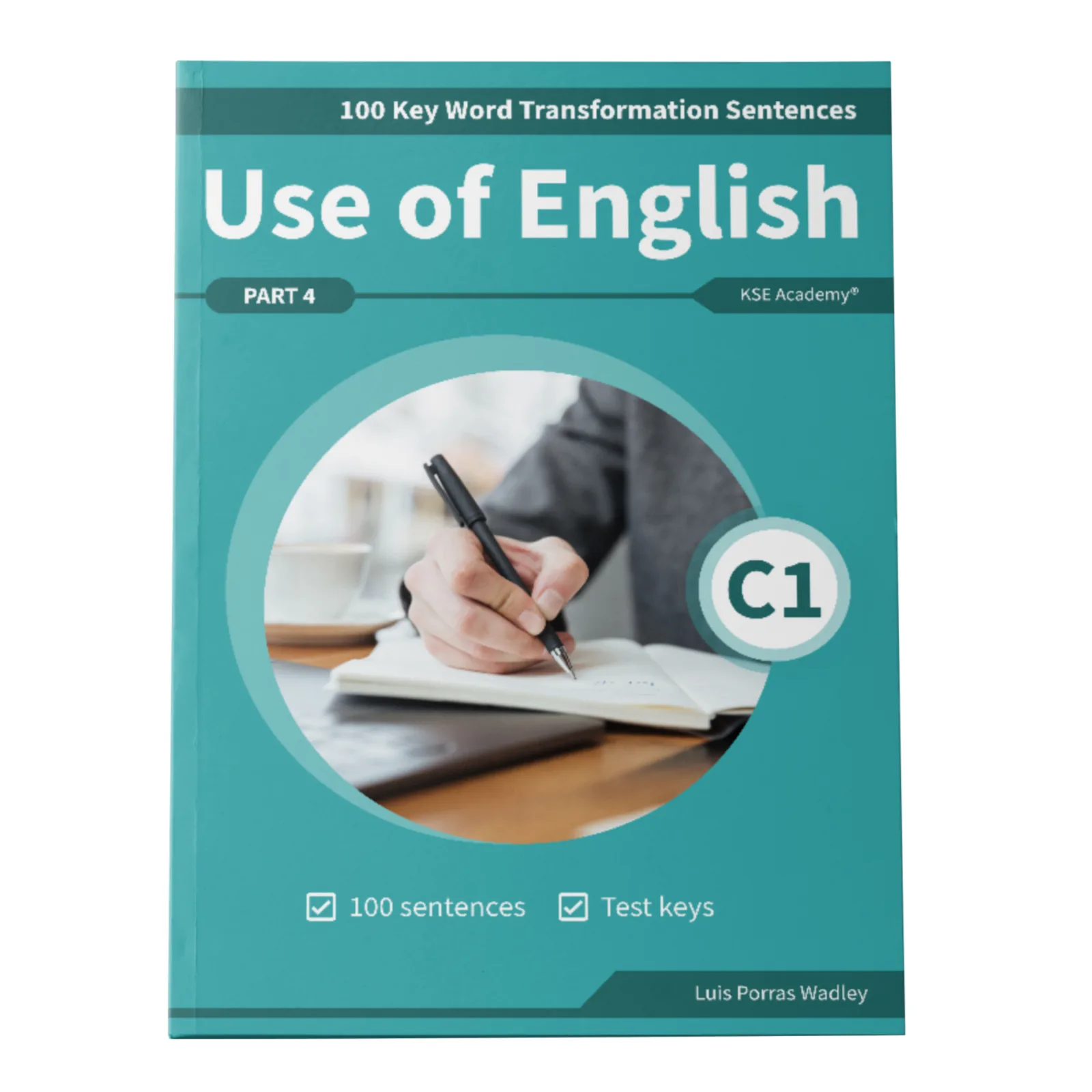
Si quieres practicar a fondo esta parte, echa un vistazo a mi libro Use of English C1: 100 Key Word Transformation Sentences, dedicado entero a la Parte 4 del C1 Advanced. Puedes descargar una muestra gratuita para ver cómo es antes de comprarlo.
Y si lo que buscas son tests completos con las cuatro partes del Use of English, tienes también Use of English C1: 10 Use of English Tests for C1 Advanced (CAE).
Sigue preparando el Use of English del C1
Con esta guía ya tienes las cuatro partes del Use of English del C1 Advanced. Si quieres repasar las anteriores:
- Parte 1, el multiple-choice cloze.
- Parte 2, el open cloze.
- Parte 3, el word formation.
- Calculadora de nota del C1.
¿Te ha resultado útil esta guía? Compártela con otros estudiantes y profesores que estén preparando el CAE. Y si te queda alguna duda con alguna transformación, déjamela en los comentarios, que las leo todas.
Nos vemos en la próxima guía. Hasta entonces, don’t forget to keep smiling! 🙂
