
Table of contents
C1 Advanced Use of English Part 4 is the key word transformation task: six sentences you have to rewrite using a key word, without changing the meaning. It’s the part candidates fear most, and with good reason: each question asks for two changes at once, usually a grammatical structure and a vocabulary item, and you have to make them in very few words.
The good news is that C1 transformations repeat far more than you might think. In this guide I’ll explain how C1 key word transformations work, how they’re marked (with a mark for each half), which structures come up according to Cambridge’s official tasks, a step-by-step method and the official sample test solved question by question. At the end there are four original exercises, with 24 transformations to practise and every answer explained. Let’s get started!
What C1 Advanced Use of English Part 4 looks like
| Feature | C1 Use of English Part 4 |
|---|---|
| What you have to do | Complete the second sentence so that it means the same as the first, using the key word |
| Number of questions | 6 (numbered 25 to 30), plus a solved example (0) |
| What you write | Between 3 and 6 words, including the key word; contractions count as two (except can’t) |
| The key word | You must use it and you can’t change it in any way |
| Marks | 2 marks per question (1 for each half of the answer), 12 in total |
| Spelling | It must be correct; in the paper-based exam, answers go in CAPITAL LETTERS |
| What it tests | Grammar and vocabulary at once: structures, fixed phrases, nouns that replace verbs, phrasal verbs |
Part 4 counts towards your Use of English score, together with Part 2 and Part 3. Note this: Parts 2 and 3 are worth 8 marks each, while Part 4 is worth 12 with only six questions. Each transformation is worth twice as much as a gap in the other parts.
The rules you can’t break
- Between three and six words. If you write seven, you lose both marks, even if the sentence is perfect. Didn’t counts as two words (did not); only can’t counts as one. Watch out: at B2 the limit is two to five; at C1 it’s three to six.
- The key word, exactly as given. If the word is COMPARISON, compare or comparing won’t do. If you don’t use it, or you change it, you lose the marks.
- The same meaning. The second sentence has to say the same as the first: no stronger or weaker, no different time, no different person doing the action.
- Only the missing words. On the answer sheet you write only what goes in the gap, including the key word.
How it’s marked: the two halves
This is the most useful thing you can know about Part 4. Cambridge splits each answer into two halves, and each one is worth a mark. Usually one half is the structure the key word brings with it and the other is the second change the sentence needs.
For example, in question 29 of the test we’re about to solve, the answer is in spite of her lack, and the official key splits it like this: in spite of | a/her lack. If you write in spite of having little, you get the first half right and score one mark. The practical consequence is clear: never leave a question blank. Half an answer is worth more than none.
What structures come up in C1 key word transformations?
To prepare this guide, I analysed ten official Cambridge Part 4 tasks at C1 (60 transformations). Since each question combines two things, the percentages add up to more than a hundred. This is what comes up most:
| What’s tested | How often | Example of the change |
|---|---|---|
| Fixed phrases and idioms | Almost half the questions | It doesn’t matter what you say. → It makes no difference what you say. |
| A noun instead of a verb or adjective | 3 in 10 | She explained it clearly. → She gave a clear explanation of it. |
| Verb patterns | 1 in 4 | I didn’t realise… → I failed to realise… |
| Passive (including it is said that) | Almost 1 in 5 | People believe he left. → He is believed to have left. |
| Phrasal verbs | 1 in 10 | They cancelled the match. → The match was called off. |
| Conditionals and if it hadn’t been for | Fewer than 1 in 10 | Without your help, I’d have failed. → If it hadn’t been for your help… |
| Reported speech and reporting verbs | Fewer than 1 in 10 | «Don’t go,» he said. → He advised me not to go. |
| Inversion | Occasionally | As soon as we arrived, it rained. → Hardly had we arrived when it rained. |
Two more things worth knowing about the official tasks:
- The answer usually has five words. More than half the official answers have five words, and almost a third have four. If yours has three, check you haven’t missed the second change; if it has seven, something has to go.
- The key word isn’t always the hard part. It’s often a noun (COMPARISON, DANGERS) or a particle (OFF, FOR, BUT) inside a phrase. The difficult bit is usually the other half.
How it differs from B2 First Part 4
In B2 Use of English Part 4, most questions combine a grammatical structure (passive, reported speech, conditional) with a phrasal verb or a simple collocation. At C1, fixed phrases and changes from verb to noun (decide → make a decision) carry much more weight, and answers are a word longer.
The four-step method
- Compare the two sentences and underline what doesn’t change. Whatever is already written in the second sentence stays as it is. That way you can see which part of the meaning is missing.
- See what the key word forces you to do. If it’s a noun like COMPARISON, it almost certainly forms a phrase (in comparison with). If it’s a particle like OFF, look for the phrasal verb. If it’s a verb in the past, think of the passive or a particular tense.
- Find the second change. There’s almost always another one: a verb that becomes a noun, a preposition that changes, a negative that moves. If your answer only makes one change, it’s probably missing something.
- Count the words and reread the whole sentence. Between three and six, with contractions counted as two. And check that the tense and the meaning match the first sentence.
The sample test, solved question by question
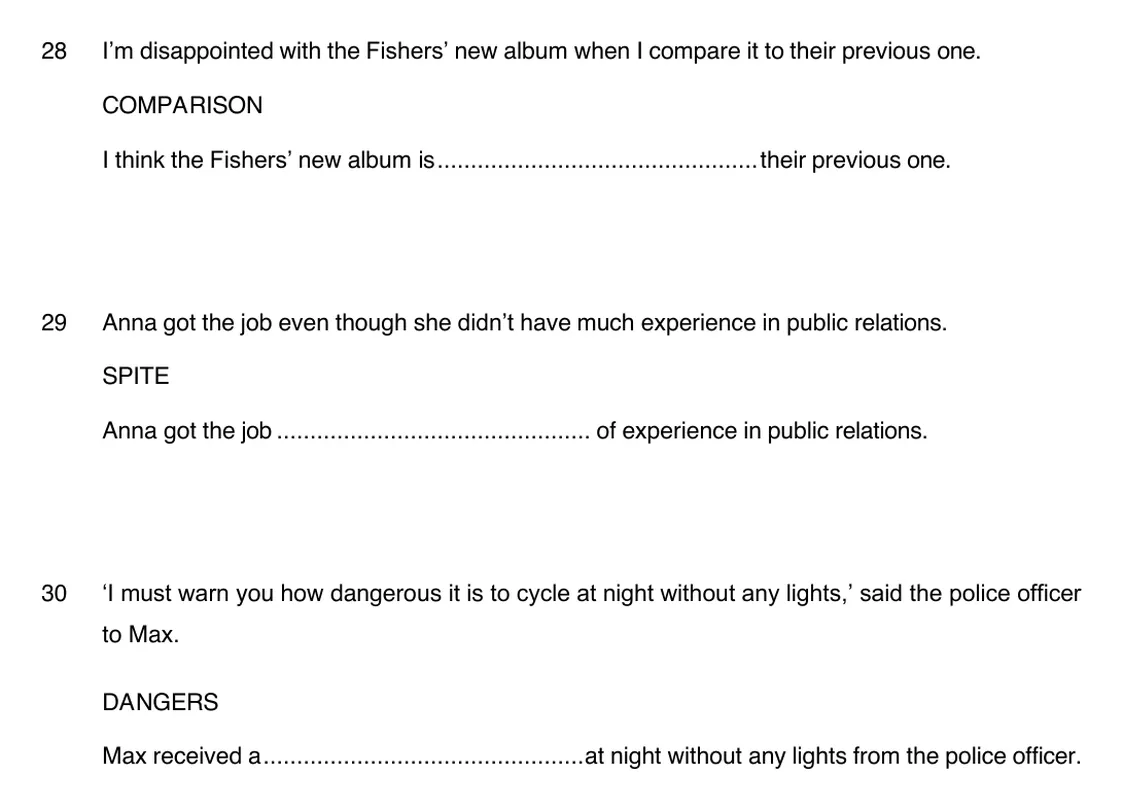
These are the six transformations from Cambridge’s official C1 Advanced sample paper. Try them before reading the explanations:
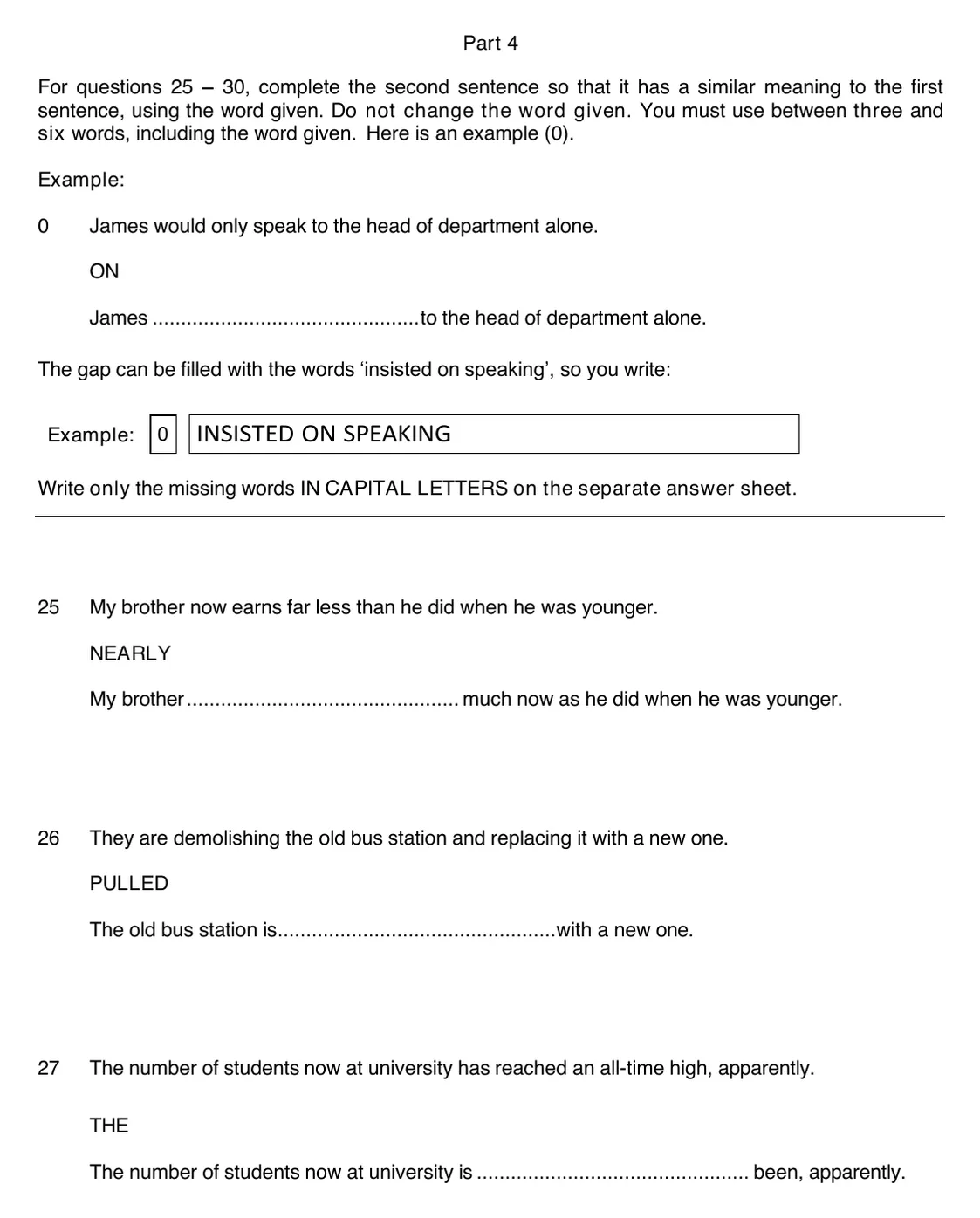
Click on a page to see it full size. Official C1 Advanced sample paper (Sample Paper 1, Reading and Use of English). © Cambridge University Press & Assessment.
The example already shows how it works: James would only speak to the head of department alone with the word ON becomes James insisted on speaking to the head of department alone. There are two changes: would only becomes insisted, and insist on is followed by the -ing form.
25. NEARLY → does not earn nearly as. My brother now earns far less than he did… → My brother ………… much now as he did… You have to turn the comparison round: far less than becomes not nearly as much as. One half is the negative with the verb (does not earn or doesn’t make) and the other is nearly as (or so). Careful: doesn’t earn nearly as is five words, because doesn’t counts as two.
26. PULLED → being pulled down and replaced. They are demolishing the old bus station and replacing it… → The old bus station is ………… with a new one. Two changes: the phrasal verb pull down and the continuous passive (is being pulled down). The second half is and (being) replaced. Cambridge also accepts to be pulled down and replaced.
27. THE → the highest it has ever. The number… has reached an all-time high… → The number… is ………… been. An all-time high means it has never been this high before, which you express with a superlative and the present perfect: the highest (that) it has ever been. One half is the highest; the other, it has ever.
28. COMPARISON → disappointing in comparison with. I’m disappointed with the new album when I compare it to their previous one. → I think the new album is ………… their previous one. Two changes: the adjective that describes the album (disappointing or a disappointment, not disappointed, which describes the person) and the fixed phrase in comparison with/to.
29. SPITE → in spite of her lack. Anna got the job even though she didn’t have much experience… → Anna got the job ………… of experience… The key word needs in spite of, which must be followed by a noun: didn’t have much experience becomes her lack of experience. A typical C1 change: from verb to noun.
30. DANGERS → warning about the dangers of. ‘I must warn you how dangerous it is to cycle…’ → Max received a ………… at night… After received a you need a noun: warning. And how dangerous it is becomes the dangers of cycling. Two nouns instead of a verb and an adjective: nominalisation at its purest.
What each question needed
| Question | Key word | First half | Second half |
|---|---|---|---|
| 25 | NEARLY | Negative with the verb | Comparison not nearly as |
| 26 | PULLED | Continuous passive + phrasal verb | Second verb in the passive |
| 27 | THE | Superlative | Present perfect with ever |
| 28 | COMPARISON | -ing adjective or noun | Fixed phrase in comparison with |
| 29 | SPITE | Fixed phrase in spite of | Verb → noun (lack) |
| 30 | DANGERS | Verb → noun (warning) | Adjective → noun (dangers) |
Answers, in case you’ve been keeping track: 25 does not earn | nearly as, 26 being pulled down | and replaced, 27 the highest | it has ever, 28 disappointing | in comparison with, 29 in spite of | her lack, 30 warning about | the dangers of.
Most common mistakes in C1 key word transformations
- Going over six words. The most expensive mistake: both marks gone. Always count, and remember that doesn’t, I’d or it’s are two words.
- Changing the key word. Writing compare when you’re given COMPARISON, or pull when you’re given PULLED, scores nothing.
- Making only one change. If your answer has three words and only changes one thing, you’re almost certainly missing the other half.
- Changing the meaning. Putting the sentence in another tense, making it stronger (never instead of rarely) or changing who does the action.
- Mixing up -ed and -ing adjectives. Disappointed describes the person; disappointing, the thing. It comes up a lot.
- Leaving questions blank. Each half is worth a mark. Always write what you know.
How to prepare for C1 Advanced Part 4
- Learn fixed phrases with their whole structure. Make no difference to, have nothing to do with, in the light of, lose sight of, with the exception of. Note each one with an example and with the «plain» sentence it replaces.
- Practise turning verbs into nouns. Decide → make a decision, object → have an objection to, increase → a rise in. Notice the verb and the preposition that go with each noun.
- Revise C1 grammar structures. The passive with opinion verbs (is said to have), if it hadn’t been for, wish and would rather, inversion, reporting verbs. Going over cleft sentences and the C1 linkers will help.
- Do lots of transformations, but mark them by halves. When you get one wrong, check which half you missed. That way you’ll know whether your problem is grammar or vocabulary.
- Give it enough time. Cambridge doesn’t set a time for each part, but this is the part of Use of English that needs the most thinking. About 10 to 12 minutes is reasonable.
C1 key word transformation exercises
Here are four original C1 Part 4 exercises in the same format as the exam: an example (0) and six transformations. Do them first without looking at the answers, then check them: each one lists the accepted answers, split into the two halves that score, with an explanation.
Exercise 1
For questions 1–6, complete the second sentence so that it has a similar meaning to the first sentence, using the word given. Do not change the word given. You must use between three and six words, including the word given. Here is an example (0).
0 It is very unlikely that our team will win the cup this year.
CHANCE
Our team has little CHANCE of winning the cup this year.
1 Students were not allowed to influence the choice of the new head teacher.
SAY
Students ………… the new head teacher.
2 It is not at all certain that the factory will stay open next year.
MEANS
The factory ………… to stay open next year.
3 Max’s colleagues think very highly of his work.
OPINION
Max’s colleagues ………… his work.
4 Analysts estimate that the strike cost the airline around £5 million.
ESTIMATED
The strike ………… the airline around £5 million.
5 The manager never once suggested that our jobs might be at risk.
TIME
At no ………… that our jobs might be at risk.
6 Zara won’t go to bed until she has checked her emails.
WITHOUT
Zara never ………… checked her emails.
Show answers
- 1. had/got no SAY | in choosing/selecting/picking/appointing (also: were given/allowed no SAY | in choosing/selecting/picking/appointing; had/got no SAY | in deciding on; had no SAY | in who became; had/got no SAY | whatsoever in choosing/selecting/picking/appointing; had/got no SAY | over who became): ‘Were not allowed to influence’ becomes the fixed phrase ‘have no say’, and the noun ‘the choice of’ becomes ‘in’ + -ing: had no say in choosing. *Had no say in the choice of* needs seven words, and *did not have a say in choosing* is also too long.
- 2. is by no MEANS | certain/sure/guaranteed (also: is not by any MEANS | certain/sure/guaranteed; is by no MEANS | bound): The factory becomes the subject, so ‘it is certain that it will’ becomes ‘is certain to’, and ‘not at all’ becomes the fixed phrase ‘by no means’ (or ‘not by any means’). *Is by no means likely to* changes the meaning: not certain is not the same as unlikely.
- 3. have/hold | a (very) high OPINION of (also: have/hold | a very good OPINION of; have/hold | an extremely high OPINION of; have/hold | the highest OPINION of; have/hold | a very favourable OPINION of): The verb ‘think highly of’ becomes the noun phrase ‘have a high opinion of’, so the adverb ‘highly’ becomes the adjective ‘high’ before the noun. *Have a very highly opinion* keeps the adverb, and a plain *good opinion* is weaker than ‘very highly’.
- 4. is ESTIMATED | to have cost (also: has been ESTIMATED | to have cost): ‘Analysts estimate that …’ becomes the passive reporting structure ‘is estimated’ with the strike as subject, and the past ‘cost’ becomes the perfect infinitive ‘to have cost’ because the cost came before the estimate. *Is estimated to cost* refers to the future.
- 5. TIME did | the manager (ever) suggest/hint/indicate/imply: ‘Never once’ becomes the negative phrase ‘at no time’, and a negative phrase at the start of the sentence needs inversion with ‘did’ + the bare infinitive: at no time did the manager suggest. *At no time the manager suggested* has no inversion, *did the manager say* is weaker than ‘suggest’ (a manager who never said it could still have hinted it), and *was it suggested* loses who said it.
- 6. goes to bed | WITHOUT having (also: goes to bed | WITHOUT first having): ‘Won’t … until she has checked’ becomes ‘never … without’, and ‘without’ is a preposition, so the perfect verb becomes ‘having’ + past participle: never goes to bed without having checked. *Goes to bed until having* keeps the wrong linker, and *without to have* is the commonest grammar mistake.
Exercise 2
For questions 1–6, complete the second sentence so that it has a similar meaning to the first sentence, using the word given. Do not change the word given. You must use between three and six words, including the word given. Here is an example (0).
0 I thought the exam would be much harder than it actually was.
THAN
The exam was much easier THAN I expected.
1 The storm has caused serious damage to several villages along the coast.
BY
Several villages along the coast ………… the storm.
2 Heidi found her novel so absorbing that she had no idea how much time had passed.
TRACK
Heidi’s novel was so absorbing that it ………… time.
3 Far more people realise how important sleep is for health than they did twenty years ago.
AWARENESS
There is far ………… of sleep for health than twenty years ago.
4 None of the staff would admit that they had broken the photocopier.
OWN
None of the staff were willing to ………… the photocopier.
5 Nobody discovered the mistake in the figures until the report had been published.
LIGHT
The mistake in the figures ………… the report had been published.
6 It surprised me that Yvonne reacted so calmly to the news.
REACTION
I was surprised that Yvonne ………… to the news.
Show answers
- 1. have been | seriously/severely/badly/heavily/extensively damaged BY (also: have been | very seriously/severely/badly damaged BY; have been | damaged seriously/severely/badly BY; have been left | seriously/severely/badly damaged BY; have suffered/sustained | serious/severe/heavy/extensive damage caused BY): The sentence becomes passive in the same tense, with the villages as subject and the storm as agent (have been … damaged by), and the noun phrase ‘serious damage’ becomes the verb ‘damaged’ with the adverb ‘seriously’ (or badly, severely). *Were seriously damaged by* changes the tense, and *have been serious damaged by* uses an adjective where an adverb is needed.
- 2. made her/Heidi lose | TRACK of (also: made her/Heidi lose all | TRACK of; made her/Heidi completely lose | TRACK of; caused her/Heidi to lose | TRACK of; meant (that) she/Heidi lost | TRACK of; meant she/Heidi lost all | TRACK of; led her/Heidi to lose | TRACK of): With the novel (it) as subject, a causative verb is needed: made her lose (bare infinitive) or caused her to lose; and ‘had no idea how much time had passed’ becomes the fixed phrase ‘lose track of time’. *Made her to lose* is the commonest mistake.
- 3. greater/more/wider/broader (public) AWARENESS of | the importance/significance (also: more widespread AWARENESS of | the importance/significance): Two nominalisations: the verb ‘realise’ becomes the noun ‘awareness’ (far greater awareness of), and the clause ‘how important sleep is’ becomes the noun phrase ‘the importance of sleep’. *Greater awareness about how important* does not fit ‘of sleep’.
- 4. OWN up to | breaking (also: OWN up to | having broken): ‘Admit’ becomes the phrasal verb ‘own up to’, and because ‘to’ is a preposition here, the clause ‘that they had broken’ becomes a gerund: breaking or having broken. *Own up to break* is the commonest mistake.
- 5. did/had not | come to LIGHT until/before (also: never | came to LIGHT until; was not | brought to LIGHT until/before; only | came to LIGHT after/when/once; was only | brought to LIGHT after/when/once; came to LIGHT | only after/when/once; was brought to LIGHT | only after/when/once; first | came to LIGHT after/when/once): With the mistake as subject, ‘nobody discovered’ becomes the fixed phrase ‘come to light’ (= become known), and ‘nobody … until’ becomes ‘did not … until’ or ‘only … after’. *Came to light until* loses the negative and the second mark.
- 6. had/showed/displayed such a | calm/composed/measured/relaxed REACTION (also: had/showed/displayed so calm/composed/relaxed a | REACTION; had/showed/displayed a very | calm/composed/measured/relaxed REACTION): The verb ‘reacted’ becomes the noun phrase ‘have a reaction’, and ‘so calmly’ becomes ‘such a calm’ before the noun (or the formal ‘so calm a reaction’). *Had a calm reaction* drops the ‘so’ and loses a mark; *had such calm reaction* misses the article.
Exercise 3
For questions 1–6, complete the second sentence so that it has a similar meaning to the first sentence, using the word given. Do not change the word given. You must use between three and six words, including the word given. Here is an example (0).
0 We cancelled the picnic because of the bad weather.
OWING
The picnic was cancelled OWING to the bad weather.
1 The outdoor film screening on Saturday will only be cancelled if there is heavy rain.
PROVIDED
The outdoor film screening will go ahead on Saturday ………… heavily.
2 This old fridge should have been replaced a long time ago.
HIGH
It is ………… this old fridge.
3 We shouldn’t judge Howard’s work too harshly, as he has very little experience.
ALLOWANCES
When we judge Howard’s work, we should ………… of experience.
4 My grandfather almost always goes for a walk after lunch.
HABIT
My grandfather ………… for a walk after lunch.
5 I have no recollection of anyone asking me to sign this form when I opened my account.
REMEMBER
I ………… asked to sign this form when I opened my account.
6 Victor didn’t want to answer, so he gave the impression of not having heard the question.
PRETENDED
Victor didn’t want to answer, so he ………… the question.
Show answers
- 1. PROVIDED (that) | it does not rain (also: PROVIDED (that) | it is not raining): ‘Only be cancelled if’ is turned round into the condition for going ahead, so it becomes ‘provided (that)’ with a negative verb, and the noun phrase ‘heavy rain’ becomes the verb ‘rain’ (heavily is given): provided it does not rain. *Provided it rains* says the opposite; *provided there is no rain* cannot be followed by ‘heavily’.
- 2. HIGH time | we/someone/somebody replaced (also: HIGH time that | we/someone/somebody replaced; HIGH time | we got rid of; HIGH time | for us to replace): ‘Should have been replaced a long time ago’ becomes the fixed phrase ‘it is high time’, which says something is overdue, and after ‘it is high time’ + subject the verb goes in the past simple even though it refers to now: high time we replaced. *High time we replace* keeps the present, and *high time to replace* needs ‘for us’ before the infinitive.
- 3. make (some) ALLOWANCES | for his lack (also: make ALLOWANCES | for Howard’s lack; make (some) ALLOWANCES | given/considering his lack; make ALLOWANCES | because of his lack; make ALLOWANCES | owing/due to his lack): ‘Not judge too harshly’ becomes the fixed phrase ‘make allowances for’, and the clause ‘he has very little experience’ becomes the noun phrase ‘his lack of experience’: make allowances for his lack. *Make allowance for* changes the key word, and *make allowances for his little* does not fit ‘of experience’.
- 4. is in the HABIT | of going (also: makes a HABIT | of going; has made a HABIT | of going; has a/the HABIT | of going; makes a HABIT | of going out; has a HABIT | of going out; makes it a HABIT | to go; has got a HABIT | of going; has the HABIT | of going out): The adverb ‘almost always’ becomes the fixed phrase ‘be in the habit of’ (or ‘make a habit of’), and because a preposition comes before the verb, ‘goes’ becomes ‘going’: is in the habit of going. *Is in the habit to go* is the wrong pattern, and *has got into the habit of going* is seven words.
- 5. do not REMEMBER | being (also: do not REMEMBER | ever being; do not REMEMBER | having been; do not REMEMBER | ever having been; cannot REMEMBER | being; cannot REMEMBER | ever being; cannot REMEMBER | having been; cannot REMEMBER | ever having been; do not ever REMEMBER | being): The noun phrase ‘have no recollection of’ becomes the verb ‘not remember’, and because ‘asked’ follows, ‘anyone asking me’ becomes a passive gerund: do not remember being asked. *Do not remember to be asked* is the wrong pattern: ‘remember to’ is about a duty still to be done.
- 6. PRETENDED | not to have heard (also: PRETENDED | not to hear; PRETENDED | to not have heard; PRETENDED | to not hear; PRETENDED (that) he | had not heard; PRETENDED (that) he | did not hear; PRETENDED | to have not heard): ‘Gave the impression of’ becomes ‘pretend’ (he did it on purpose, as he didn’t want to answer), and the gerund after ‘of’ becomes an infinitive with ‘not’: pretended not to have heard (or a clause: pretended he had not heard). *Pretended not having heard* is the commonest mistake.
Exercise 4
For questions 1–6, complete the second sentence so that it has a similar meaning to the first sentence, using the word given. Do not change the word given. You must use between three and six words, including the word given. Here is an example (0).
0 The instructions were so complicated that I couldn’t follow them.
TOO
The instructions were TOO complicated for me to follow.
1 ‘Why on earth didn’t you tell the client that the delivery would be late, Ronald?’ his manager asked.
CRITICISED
Ronald’s manager ………… the client that the delivery would be late.
2 It was a mistake for Henry to let his cousin borrow his car for the weekend.
NEVER
Henry ………… his car to his cousin for the weekend.
3 Our hotel room this year was just as small as the one we had last year, even though we paid more for it.
NO
Our hotel room this year ………… the one we had last year, even though we paid more for it.
4 The management told the staff nothing about the plans to close the branch.
DARK
The staff ………… about the plans to close the branch.
5 Philip is happy to help his neighbours, but he refuses to lend them money.
LINE
Philip is happy to help his neighbours, but he ………… them money.
6 Monica did not hesitate at all to accept the job in Madrid.
HESITATION
Monica ………… the job in Madrid.
Show answers
- 1. CRITICISED him/Ronald | for not telling/warning/informing/notifying/alerting/advising (also: CRITICISED him/Ronald | for not having told/warned/informed/notified/alerted/advised; CRITICISED him/Ronald | for failing/neglecting to tell/warn/inform/notify/alert/advise): The angry question ‘Why on earth didn’t you …?’ is a reproach, so it is reported with ‘criticise’ + object + ‘for’, and the negative past action becomes a negative gerund: for not telling (or for not having told, for failing to tell). *Criticised him not to tell* and *criticised that he didn’t tell* are wrong patterns.
- 2. should NEVER | have lent/loaned (also: ought NEVER | to have lent/loaned; should have NEVER | lent/loaned; NEVER should | have lent/loaned): ‘It was a mistake’ about a past action becomes the modal perfect ‘should never have’ (or ‘ought never to have’), and ‘let his cousin borrow’ becomes the verb ‘lend’, past participle ‘lent’, to fit ‘his car to his cousin’. *Should never have borrowed* reverses who gives the car.
- 3. was NO | bigger/larger/roomier than (also: was NO | more spacious than; was in NO way | bigger/larger/roomier than; had NO | more space/room than): ‘Just as … as’ becomes ‘no’ + comparative + ‘than’, which means ‘not at all more … than’, and ‘small’ becomes its opposite, ‘bigger’ or ‘more spacious’. *Was no smaller than* says the opposite, and *no bigger as* mixes two structures.
- 4. were (all) kept/left | in the DARK (also: had been kept/left | in the DARK; were kept/left completely/totally/entirely | in the DARK; was kept/left | in the DARK): The staff become the subject, so the active ‘told the staff nothing’ needs a passive (were kept), and ‘told nothing’ becomes the fixed phrase ‘keep someone in the dark’ (= not tell them what is happening). *Were kept in dark* without ‘the’ loses the mark.
- 5. draws the LINE | at lending/loaning (also: would draw the LINE | at lending/loaning; always draws the LINE | at lending/loaning): ‘Refuses to’ becomes the fixed phrase ‘draw the line at’ (= refuse to go as far as), and because ‘at’ is a preposition, the infinitive ‘to lend’ becomes the -ing form: at lending. *Draws the line to lend* is the commonest mistake.
- 6. had no HESITATION | in accepting/taking (also: had no HESITATION | about accepting/taking; showed/felt no HESITATION | in accepting/taking; had no HESITATION whatsoever | in accepting/taking; had absolutely no HESITATION | in accepting/taking; showed/felt no HESITATION | about accepting/taking): The verb ‘hesitate’ becomes the noun phrase ‘have no hesitation’, with ‘not … at all’ turned into ‘no’, and the noun takes ‘in’ (or ‘about’), so ‘to accept’ becomes the -ing form: in accepting. *Had no hesitation to accept* is the commonest mistake, and *did not have any hesitation in accepting* is seven words.
Frequently asked questions about C1 Use of English Part 4
How many words can I write in a C1 key word transformation?
Between three and six, including the key word. Contractions count as two words (don’t = do not), except can’t, which counts as one.
How much is each question worth?
Two marks: one for each half of the answer. In total, Part 4 is worth 12 marks, compared with 8 for Part 2 and 8 for Part 3.
Can I change the form of the key word?
No. It has to appear exactly as given: no other tense, no plural, no other word class.
Can there be more than one correct answer?
Yes, and it’s common. The official keys accept two or three variants per question on average: a different word order, a synonym preposition or an optional that. What doesn’t change is the structure the key word requires.
Do wrong answers lose marks?
No. The worst that can happen is that you don’t score. That’s why you should always write something, even if you’re only sure of one half.
Use of English C1: 100 Key Word Transformation Sentences
If you’d like to practise this part in depth, have a look at my book Use of English C1: 100 Key Word Transformation Sentences, devoted entirely to C1 Advanced Part 4. You can download a free sample to see what it’s like before you buy it.
And if you’re after full tests with all four Use of English parts, there’s also Use of English C1: 10 Use of English Tests for C1 Advanced (CAE).
Keep preparing for C1 Use of English
With this guide, you’ve now covered all four parts of C1 Advanced Use of English. If you’d like to go over the previous ones:
- Part 1, the multiple-choice cloze.
- Part 2, the open cloze.
- Part 3, word formation.
- C1 score calculator.
Did you find this guide useful? Share it with other students and teachers preparing for the CAE. And if you have any questions about any of the transformations, leave them in the comments: I read every single one.
See you in the next guide. Until then, don’t forget to keep smiling! 🙂
