
Table of contents
C1 Advanced Use of English Part 3 is the famous word formation task: a text with eight gaps and, at the end of each line, a word in capitals that you have to transform so that it fits. It’s the part where it really shows whether you’ve worked on your vocabulary in depth, because knowing the word isn’t enough: you have to be able to build its whole family, with its prefixes, suffixes and spelling changes.
In this guide I’ll explain how C1 word formation works, what kind of words you’re asked for according to Cambridge’s official tasks, a list of the suffixes and prefixes that come up most, a method to avoid throwing marks away and the official sample test solved gap by gap. At the end there are four original exercises for you to practise with, with every answer explained. Let’s get started!
What C1 Advanced Use of English Part 3 looks like
| Feature | C1 Use of English Part 3 |
|---|---|
| What you have to do | Read a text with 8 gaps and use the word in capitals on each line to form the word that fits the gap |
| Number of questions | 8 (numbered 17 to 24), plus a solved example (0) |
| What you write | One word, from the same family as the word you’re given |
| Spelling | It must be correct; in the paper-based exam, answers go in CAPITAL LETTERS |
| Marks | 1 mark per gap |
| What it tests | Vocabulary: prefixes, suffixes, internal changes (strong → strength) and compounds |
Part 3 counts towards your Use of English score, together with Part 2 and Part 4. They’re all part of the Reading and Use of English paper: 1 hour 30 minutes, eight parts and 56 questions.
What kind of words do you need in C1 word formation?
To prepare this guide, I analysed ten official Cambridge Part 3 tasks at C1 (80 gaps), from the sample papers and the official practice test books. This is what comes up:
| The answer is… | How often | Examples from the official tasks |
|---|---|---|
| An adjective | Almost 4 in 10 | beneficial, significant, unfavourable |
| A noun | Almost 4 in 10 | strength, pursuit, instability |
| A verb | A little over 1 in 10 | enables, intensifies, overcome |
| An adverb | A little over 1 in 10 | considerably, progressively, typically |
But what matters isn’t so much the word class as what you have to do to the word. Almost every official task includes these four things:
- A negative prefix in most texts: un-, in-, im-, ir-, dis-. Cambridge’s handbook says there is «usually» at least one. It’s trap number one: if the text is talking about something negative and you write the positive form, you lose the mark.
- Internal changes: the root changes inside, rather than just having something added. Strong → strength, high → height, pursue → pursuit, solve → solution, benefit → beneficial.
- Words with two or three affixes, which make up almost 4 in 10 answers: un-favour-able, in-stabil-ity, progress-ive-ly, use-ful-ness.
- Prefixed verbs with the right ending: Cambridge’s favourites are verbs with en- (enable, ensure, endanger) and with over- or under-. And if the answer is a verb, it needs the ending the sentence requires: enables, originated.
How it differs from B2 word formation
The format is the same as B2 Use of English Part 3, but C1 is more demanding in three ways: there are internal changes in almost every text (at B2 there’s usually one), many more words with several affixes, and prefixed verbs such as enable or overcome appear. On top of that, at C1 adjectives come up as often as nouns.
A list of suffixes and prefixes for C1 word formation
These are the suffixes and prefixes you’ll need most for Part 3. Don’t learn them as a bare list: look at the examples, which show the kind of change you’ll have to make.
Suffixes that form nouns
| Suffix | 🇬🇧 Examples |
|---|---|
| -tion / -sion / -ation | reduce → reduction, decide → decision, adapt → adaptation |
| -ment | achieve → achievement, commit → commitment |
| -ance / -ence | endure → endurance, depend → dependence |
| -ity | severe → severity, able → ability, curious → curiosity |
| -ness | aware → awareness, useful → usefulness |
| -ship / -hood | relation → relationship, likely → likelihood |
| -er / -or / -ist / -ant (people) | research → researcher, enthusiasm → enthusiast, inhabit → inhabitant |
Suffixes that form adjectives
| Suffix | 🇬🇧 Examples |
|---|---|
| -able / -ible | rely → reliable, access → accessible |
| -al / -ial / -ical | profession → professional, benefit → beneficial, type → typical |
| -ive / -ative | impress → impressive, inform → informative |
| -ous / -ious | danger → dangerous, ambition → ambitious |
| -ful / -less | doubt → doubtful, point → pointless |
| -ant / -ent | signify → significant, depend → dependent |
Verbs and adverbs
| Pattern | 🇬🇧 Examples |
|---|---|
| en- + adjective or noun | able → enable, sure → ensure, danger → endanger, large → enlarge |
| -en / -ify / -ise | short → shorten, intense → intensify, modern → modernise |
| over- / under- / out- | come → overcome, take → undertake, stand → outstanding |
| -ly on an adjective that’s already derived | consider → considerably, type → typically, progress → progressively |
Negative prefixes and internal changes
| What you need to change | 🇬🇧 Examples |
|---|---|
| un- | favourable → unfavourable, likely → unlikely |
| in- / im- / il- / ir- | ability → inability, possible → impossible, legal → illegal, relevant → irrelevant |
| dis- / mis- | agree → disagreement, understand → misunderstanding |
| Internal change | strong → strength, high → height, long → length, pursue → pursuit, wide → width |
The method in four questions
For each gap, ask yourself these four questions, in this order:
- What word class do I need? Look at what’s around the gap. After the or an adjective comes a noun; after be, more or very, an adjective; before an adjective or a participle, an adverb; after a subject or can, a verb.
- Positive or negative? Read the whole sentence, and sometimes the next one. If the text is talking about a problem, a difficulty or a failure, you probably need a negative prefix.
- Singular or plural? Which verb form? Look at the determiner (many, their various), at agreement with the subject and at the tense of the sentence.
- Is it spelt correctly? Check the spelling letter by letter: double consonants, -able or -ible, the e that disappears (severe → severity) or stays (manage → manageable).
The sample test, solved gap by gap
This is the Part 3 text from Cambridge’s official C1 Advanced sample paper, about how elite athletes train. Try it before reading the explanations:
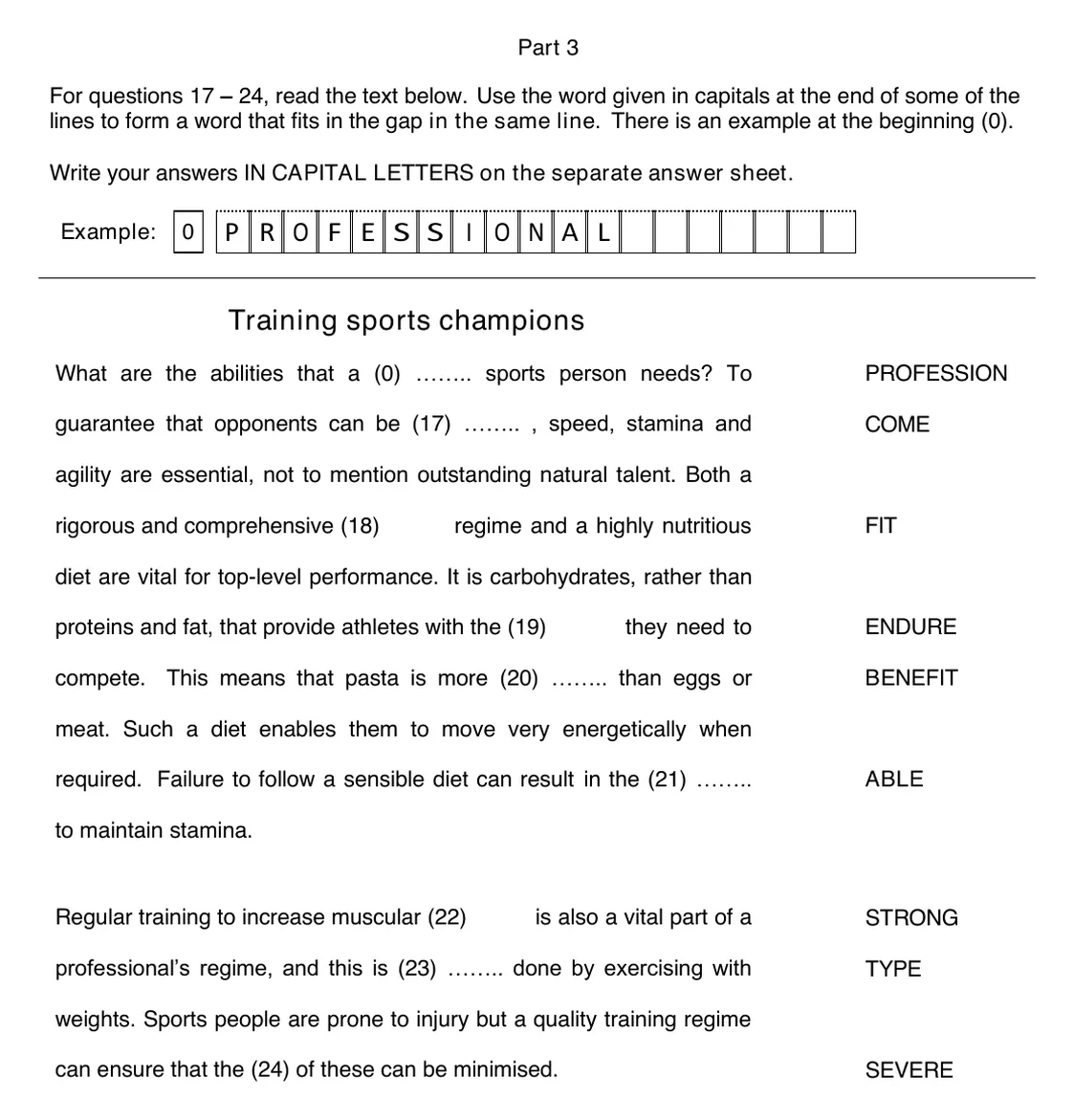
Click on the image to see it full size. Official C1 Advanced sample paper (Sample Paper 1, Reading and Use of English). © Cambridge University Press & Assessment.
The example already shows how it works: What are the abilities that a (0) …… sports person needs? with PROFESSION. Between a and the noun sports person you need an adjective: professional.
First paragraph: gaps 17 to 21
17. COME → overcome. To guarantee that opponents can be (17) …… After can be you need a participle, and the meaning is beating your opponents: overcome. It’s a prefixed verb (over-), the kind Cambridge loves, and the past participle of come is irregular (come, not comed).
18. FIT → fitness. Both a rigorous and comprehensive (18) …… regime. After two adjectives and before regime comes a noun used as a modifier: a fitness regime.
19. ENDURE → endurance. Provide athletes with the (19) …… they need to compete. After the comes a noun: endurance. Watch the spelling: the e of endure disappears.
20. BENEFIT → beneficial. Pasta is more (20) …… than eggs or meat. After more and before than comes an adjective. The change isn’t just a suffix: benefit changes inside and becomes beneficial. It’s one of the internal changes that comes up most in the official tasks.
21. ABLE → inability. Failure to follow a sensible diet can result in the (21) …… to maintain stamina. After the comes a noun (ability), but the sentence is about the consequences of not following the diet: not being able to keep up your stamina. You need the negative prefix, and with ability it’s in-, not un-. This gap combines three things: a change of word class, an internal change and a negative prefix.
Second paragraph: gaps 22 to 24
22. STRONG → strength. Regular training to increase muscular (22) …… After the adjective muscular comes a noun: strength. A classic internal change (strong → strength, like long → length).
23. TYPE → typically. This is (23) …… done by exercising with weights. Between is and the participle done comes an adverb: typically. It has two suffixes, -ical and -ly.
24. SEVERE → severity. A quality training regime can ensure that the (24) …… of these can be minimised. After the and before of comes a noun: severity (how serious the injuries are). The final e disappears when you add -ity.
Answers, in case you’ve been keeping track: 17 overcome, 18 fitness, 19 endurance, 20 beneficial, 21 inability, 22 strength, 23 typically, 24 severity.
What change each gap needed
| Gap | Word given | Answer | What you had to do |
|---|---|---|---|
| 17 | COME | overcome | Prefix over- + irregular participle |
| 18 | FIT | fitness | Noun with -ness |
| 19 | ENDURE | endurance | Noun with -ance |
| 20 | BENEFIT | beneficial | Adjective with an internal change |
| 21 | ABLE | inability | Noun + negative prefix + internal change |
| 22 | STRONG | strength | Noun with an internal change |
| 23 | TYPE | typically | Adverb with two suffixes |
| 24 | SEVERE | severity | Noun with -ity |
Notice that only two of the eight gaps could be solved just by adding a suffix. The rest needed a prefix, an internal change or two affixes at once. That’s C1 word formation.
Most common mistakes in C1 word formation
- Forgetting the negative prefix. This is the mistake that costs the most marks. Before writing, always ask yourself whether the text is talking about something positive or negative.
- Using the wrong negative prefix. Unability, unpossible or inlegal don’t exist. Each word has its own, and you have to learn it with the word.
- Getting the class right but not the form. If the gap needs a plural (many of their …) or a verb in the third person, the word without the ending doesn’t score.
- Writing a word from the family that doesn’t fit. Success, successful and successfully belong to the same family, but only one fits the sentence.
- Misspelling the word. Dependant / dependent, responsable, managable or developement score nothing, even if the word is the right one.
- Making up words. If you’ve never seen a form before (strongness), it probably doesn’t exist. Go for the one you do know.
How to prepare for C1 Advanced Part 3
- Learn words in families. When you note down a new word, note its noun, adjective, adverb and opposite too: rely, reliable, reliability, unreliable.
- Make your own list of internal changes. Strong / strength, wide / width, pursue / pursuit, explain / explanation… There aren’t many, and they come up again and again.
- Revise negative prefixes with their word. Unable but inability; unlikely but impossible. No single rule covers them all.
- Read popular science and the press in English. Part 3 texts are of that kind and are full of abstract nouns and evaluative adjectives, which are exactly what you’ll be asked for.
- Practise with whole texts. The context is what decides the number, the tense and whether the word is positive or negative.
C1 Use of English Part 3 exercises
Here are four original C1 word formation exercises in the same format as the exam: a text with an example (0) and eight gaps, with the word you need to transform next to each one. Do them first without looking at the answers, then check them: each one comes with an explanation.
Exercise 1: Crops above the traffic
For questions 1–8, read the text below. Use the word given in capitals to form a word that fits in the gap. There is an example at the beginning (0).
Crops above the traffic
Across many cities, flat roofs that once held little more than air-conditioning units are being put to (0) productive (PRODUCE) use. Vegetable beds, greenhouses and even beehives now sit several storeys up, and restaurants below can take (1) ………… (PROUD) in salads picked an hour before they are served.
The gardens bring other gains too. A layer of soil and plants acts as (2) ………… (INSULATE), keeping the rooms on the top floor (3) ………… (NOTICE) cooler in summer and cutting energy bills. Compost made from the building’s kitchen waste (4) ………… (RICH) the beds, and shared plots give neighbours who had never spoken a reason to meet. For many volunteers, these friendships are what makes the work truly (5) ………… (MEAN).
Yet the idea has clear limits. Wet soil is heavy, and few older roofs were built to carry much of it, so beds are rarely more than thirty centimetres in (6) ………… (DEEP). Pumps, greenhouses and waterproofing all need regular (7) ………… (MAINTAIN), which adds a steady cost, and harvests are small and (8) ………… (PREDICT): a single storm can flatten a whole season’s crop.
Show answers
- 1. PROUD → pride: A noun is needed in the fixed phrase ‘take … in’ (= be pleased with and value). Internal change: proud → pride (ou becomes i and -e is added); ‘proudness’ is not used.
- 2. INSULATE → insulation: An uncountable noun is needed after ‘acts as’ with no article: the material that keeps heat out. Drop the -e and add -ion; ‘insulator’ would need ‘an’.
- 3. NOTICE → noticeably: An adverb is needed before the comparative ‘cooler’ to say the difference is clear enough to feel. Two suffixes: notice-able-ly, keeping the -e of notice; ‘noticeable’ cannot modify an adjective.
- 4. RICH → enriches: A verb is needed after the singular subject ‘Compost made from the building’s kitchen waste’, in the present like ‘give’: so -es. The prefix en- turns the adjective into a verb (= makes the beds richer).
- 5. MEAN → meaningful: An adjective is needed after ‘makes the work truly’: the friendships give the work value and purpose. Two suffixes: mean-ing-ful; ‘meaning’ alone is a noun and does not fit.
- 6. DEEP → depth: A noun is needed in the pattern ‘thirty centimetres in …’. Internal change: deep → depth (the vowel changes and -th is added); ‘deepness’ is not used for measurements.
- 7. MAINTAIN → maintenance: An uncountable noun is needed after ‘need regular’: the work of keeping pumps and greenhouses in good condition. Internal change: maintain → maint-en-ance (ai becomes e).
- 8. PREDICT → unpredictable: An adjective is needed after ‘are small and’, and ‘a single storm can flatten a whole season’s crop’ shows a negative meaning. Negative prefix un- and suffix -able; ‘predictable’ contradicts the sentence.
Exercise 2: Seeing sounds
For questions 1–8, read the text below. Use the word given in capitals to form a word that fits in the gap. There is an example at the beginning (0).
Seeing sounds
For a small (0) minority (MINOR) of people, music has colour: a cello may arrive as a ribbon of deep blue. Doctors once dismissed this blending of the senses, known as synaesthesia, as pure (1) ………… (IMAGINE), but it is now taken seriously. Its (2) ………… (PREVAIL), however, is hard to pin down. Because few people mention such experiences, early surveys vastly (3) ………… (ESTIMATE) it; recent studies suggest a much higher figure, nearer one in twenty-five.
To spot genuine cases, researchers ask people to pair letters with colours, then repeat the test months later without warning. Synaesthetes give almost identical answers, while volunteers inventing pairings prove hopelessly (4) ………… (CONSIST). Brain scans suggest a physical rather than a (5) ………… (PSYCHOLOGY) cause: in synaesthetes, areas handling sounds or letters seem unusually well connected to those processing colour.
Strangest of all, many synaesthetes reach adulthood without realising their experience is unusual. As children, they (6) ………… (UNDERSTAND) assumed that everyone saw letters in colour. The (7) ………… (REVEAL) often comes in a casual conversation, when a friend’s (8) ………… (BEWILDER) at a remark about ‘the yellow sound of Tuesday’ gives the game away.
Show answers
- 1. IMAGINE → imagination (also: imaginings): A noun is needed after ‘dismissed … as pure’: something that exists only in the mind. Suffix -ation (imagine → imagination; the plural ‘imaginings’ is also correct); the adjective ‘imaginary’ cannot follow ‘pure’ without a noun.
- 2. PREVAIL → prevalence: A noun is needed after ‘Its’ and before ‘is’: how common the condition is. Internal change: the ai of prevail becomes a before -ence (prevalence).
- 3. ESTIMATE → underestimated: A past verb is needed after ‘early surveys vastly’, with ‘it’ as its object. ‘Vastly’ rules out plain ‘estimated’, and because few people mention the experience and recent studies give ‘a much higher figure’, the surveys counted too few: prefix under- and past -ed (‘overestimated’ gives the opposite meaning).
- 4. CONSIST → inconsistent: An adjective is needed after ‘prove hopelessly’, and the contrast with the synaesthetes’ ‘almost identical answers’ shows a negative meaning: their answers change from one test to the next. Negative prefix in- and suffix -ent; ‘consistent’ describes the synaesthetes, not these volunteers.
- 5. PSYCHOLOGY → psychological: An adjective is needed before ‘cause’, in contrast with ‘physical’ (a cause in the brain, not in the mind). Internal change: the y of psychology becomes ic, then -al.
- 6. UNDERSTAND → understandably: An adverb is needed between ‘they’ and the verb ‘assumed’: it was natural for them to think so, as they had nothing to compare their experience with. Suffixes -able and -ly (understandably).
- 7. REVEAL → revelation: A singular noun is needed after ‘The’, as ‘comes’ shows: the moment they discover the truth. Internal change: the ea of reveal becomes e before -ation (revelation, not revealation).
- 8. BEWILDER → bewilderment: A noun is needed after the possessive ‘a friend’s’ and before ‘at’: the friend’s confusion at the remark. Suffix -ment; the participle ‘bewildered’ would need a noun after it.
Exercise 3: Meat from a tank
For questions 1–8, read the text below. Use the word given in capitals to form a word that fits in the gap. There is an example at the beginning (0).
Meat from a tank
Eating meat has always meant raising and killing animals, but cultivated meat marks a radical (0) departure (DEPART) from that tradition. It starts with a few cells taken (1) ………… (PAIN) from a living animal in a quick procedure that leaves it unharmed. Kept warm in steel tanks of nutrient-rich liquid, the cells multiply until they form edible tissue. The process therefore (2) ………… (PASS) the slaughterhouse altogether.
Supporters also point to the environment. Meat produced this way might need only a fraction of the land now used for grazing, and could cut the greenhouse gas (3) ………… (EMIT) linked to cattle.
Critics remain doubtful. Growing cells on a large scale is still (4) ………… (PROHIBIT) expensive, and the energy needed to keep the tanks sterile and warm is (5) ………… (SUBSTANCE). In fact, some experts greet the claim that the product is automatically greener with (6) ………… (BELIEF): if that energy comes from fossil fuels, its climate advantage may shrink considerably. Many shoppers, meanwhile, are (7) ………… (SUSPECT) of food made in a laboratory, and (8) ………… (REGULATE) in most countries have yet to approve its sale.
Show answers
- 1. PAIN → painlessly: An adverb is needed after ‘taken’ to say how the cells are removed, and ‘leaves it unharmed’ shows that the animal does not suffer. Two suffixes: pain → painless → painlessly; ‘painfully’ contradicts the sentence.
- 2. PASS → bypasses (also: by-passes): A verb in the present with -es is needed after the singular subject ‘The process’, with ‘the slaughterhouse’ as its object: bypass = avoid by going round. The prefix by- is the change; ‘passes’ does not give this meaning.
- 3. EMIT → emissions: A plural noun is needed in the collocation ‘greenhouse gas emissions’, the gases that cattle give off. Internal change: the t of emit becomes ss before -ion, plus the plural -s.
- 4. PROHIBIT → prohibitively: An adverb is needed before the adjective ‘expensive’, in the collocation ‘prohibitively expensive’ (= so expensive that people cannot buy it). Two suffixes: prohibit → prohibitive → prohibitively.
- 5. SUBSTANCE → substantial: An adjective is needed after ‘is’: the amount of energy is large. Internal change: substance → substanti- before -al; ‘substantive’ means ‘important, real’ and does not describe an amount.
- 6. BELIEF → disbelief: A noun is needed after ‘greet the claim … with’, and the warning about fossil fuels shows that the experts do not believe the claim: negative prefix dis-, belief → disbelief. ‘Unbelief’ is a religious word and ‘belief’ gives the opposite meaning.
- 7. SUSPECT → suspicious: An adjective is needed after ‘are’ and before ‘of’: shoppers do not trust food made in a laboratory. Internal change: suspect → suspic- before -ious.
- 8. REGULATE → regulators: A plural person noun is needed as the subject of ‘have yet to approve’: the official bodies that control what food can be sold. Suffix -or with the plural -s; ‘regulations’ are rules and cannot approve anything.
Exercise 4: Four days on, three off
For questions 1–8, read the text below. Use the word given in capitals to form a word that fits in the gap. There is an example at the beginning (0).
Four days on, three off
The idea of a shorter working week has been steadily gaining (0) popularity (POPULAR). In a number of trials where companies kept paying staff in full for four days’ work, employees reported lower levels of stress, (1) ………… (ANXIOUS) and exhaustion, and many firms saw a marked drop in (2) ………… (RESIGN), which made it easier to hold on to experienced people.
Many managers had expected output to fall. (3) ………… (SURPRISE), it generally held steady or even rose. Supporters argue that a three-day weekend gives people time to recover and (4) ………… (COURAGE) them to cut out pointless meetings. In a (5) ………… (COMPETE) labour market, an extra day off can also attract good candidates.
Not everyone is convinced, however. Some economists have expressed (6) ………… (SCEPTIC), noting that the firms taking part had volunteered, so they may have been unusually well suited to the change. In hospitals and schools, where someone must always be present, the model is far harder to apply and may even be entirely (7) ………… (PRACTICE). Others wonder whether the gains will simply fade once the (8) ………… (NOVEL) wears off.
Show answers
- 1. ANXIOUS → anxiety (also: anxiousness): A noun is needed in the list ‘stress, … and exhaustion’, after ‘levels of’. Internal change: anxious → anxiety (-ous goes and -iety is added); the rarer ‘anxiousness’ has the same meaning and is also correct.
- 2. RESIGN → resignations: A plural noun is needed after ‘a marked drop in’: fewer people leaving their jobs, which is why firms could ‘hold on to experienced people’. Suffix -ation plus plural -s; the singular ‘resignation’ does not fit naturally here, because we count people leaving.
- 3. SURPRISE → Surprisingly: An adverb commenting on the whole sentence is needed before the comma. Managers ‘had expected output to fall’, so the result was unexpected: suffixes -ing and -ly; ‘Unsurprisingly’ says the opposite.
- 4. COURAGE → encourages: A verb is needed, parallel to ‘gives’ with the singular subject ‘a three-day weekend’, so it needs -s; the pattern ‘… them to cut out’ is encourage + object + to-infinitive. Prefix en- turns the noun into a verb; ‘discourages’ would contradict the supporters’ argument.
- 5. COMPETE → competitive: An adjective is needed between ‘a’ and ‘labour market’: a market where firms fight for the best workers. Internal change: compete → competit- before -ive.
- 6. SCEPTIC → scepticism: An uncountable noun is needed as the object of ‘have expressed’ (express scepticism = say you have doubts), and ‘Not everyone is convinced’ gives the meaning. Suffix -ism; ‘sceptics’ (people) cannot be expressed.
- 7. PRACTICE → impractical (also: impracticable): An adjective is needed after ‘may even be entirely’, and ‘far harder to apply’ points to a negative meaning (= not workable in practice). Negative prefix im- and suffix -al (practice → practical); ‘impracticable’ (= impossible to carry out) has the same meaning and is also correct.
- 8. NOVEL → novelty: A noun is needed after ‘the’ as the subject of ‘wears off’, in the fixed phrase ‘the novelty wears off’ (= something stops being new and exciting). Suffix -ty.
Frequently asked questions about C1 Use of English Part 3
How many questions are there in C1 Advanced Use of English Part 3?
Eight gaps (numbered 17 to 24), plus a solved example at the beginning. Each gap is worth one mark.
Is there always a negative prefix?
Not always, but almost. Cambridge’s handbook says there is usually at least one gap with a negative prefix, and it appears in most official texts. If you finish and haven’t used one, check the gaps with a negative meaning again.
Can there be more than one correct answer?
Rarely. Usually only one word from the family fits. When the context allows both singular and plural, or two forms with the same meaning, Cambridge accepts both.
Does spelling count?
Yes, a lot. A well-chosen but misspelt word doesn’t score. British and American spelling differences (organise / organize) are accepted.
Is there an official word list for word formation?
No. Cambridge doesn’t publish a word list for this part. What does repeat is the type of change: the suffixes, prefixes and internal changes in the tables in this guide.
Use of English C1: 10 Use of English Tests for C1 Advanced (CAE)
If you’d like to practise with full tests, have a look at my book Use of English C1: 10 Use of English Tests for C1 Advanced (CAE). Inside, you’ll find:
- 10 practice tests with Parts 1 to 4 of Reading and Use of English.
- A photocopiable answer sheet for each test.
- Instructions to work out your own score.
- The answer key for every test.
You can download a free sample with the whole of Test 1 to see what it’s like before you buy it. And if you want more, there’s also volume 2, with another ten tests.
Keep preparing for C1 Use of English
This guide is part of the series on C1 Advanced Use of English. If you haven’t seen them yet, go over Part 1, the multiple-choice cloze, and Part 2, the open cloze. And to see how it all fits into the exam, go back to the C1 Advanced main page or try the C1 score calculator.
Did you find this guide useful? Share it with other students and teachers preparing for the CAE. And if you have any questions about any of the gaps, leave them in the comments: I read every single one.
See you in Part 4. Until then, don’t forget to keep smiling! 🙂
