
Table of contents
C1 Advanced Use of English Part 1 opens the Reading and Use of English paper, and at first sight it looks like the friendliest part: a short text, eight gaps and four options for each one. All you have to do is choose. The catch is that at C1 the four options often mean almost the same thing, and what decides the answer is a shade of meaning, a preposition or a fixed phrase you either know or you don’t.
In this guide I’ll explain how CAE Use of English Part 1 (the multiple-choice cloze) works, what kind of questions come up according to Cambridge’s official tasks, how it differs from B2, a method for tackling it and the official sample test solved question by question. At the end there are four original exercises for you to practise with, with every answer explained. Let’s get started!
What C1 Advanced Use of English Part 1 looks like
| Feature | C1 Use of English Part 1 |
|---|---|
| What you have to do | Read a text with 8 gaps and choose the right option for each one from 4 (A, B, C or D) |
| Number of questions | 8 (numbered 1 to 8), plus a solved example (0) in the paper-based exam |
| Marks | 1 mark per correct answer; wrong answers don’t lose marks |
| Length of the text | Between 150 and 190 words, in two or three paragraphs |
| How you answer | On paper, by shading the box on the answer sheet; in the computer-based exam, by clicking on the gap to see the options |
| What it tests | Vocabulary: collocations, fixed phrases, idioms, the prepositions and patterns that follow a word, phrasal verbs and precise meaning |
All this is part of the Reading and Use of English paper, which lasts 1 hour 30 minutes and has eight parts and 56 questions. Part 1 is one of the shortest, so you shouldn’t need much more than 10 minutes for it.
Is Part 1 Reading or Use of English?
Here’s a detail that confuses a lot of candidates. According to Cambridge, the Reading section is made up of Parts 1, 5, 6, 7 and 8, and the Use of English section of Parts 2, 3 and 4. In other words, for scoring purposes, Part 1 counts as Reading.
Even so, I treat it as part of Use of English, and that’s how I recommend you prepare for it: what it tests isn’t whether you understand the text, but whether you know which word goes with which. You’ll find the full picture of the Reading section in my C1 Advanced Reading guide.
What kind of questions come up in C1 Use of English Part 1?
To prepare this guide, I analysed ten official Cambridge Part 1 tasks at C1 (80 questions in total), from the sample papers and the official practice test books. This is roughly what gets tested:
| Question type | How often | What it asks you to do |
|---|---|---|
| Collocations | Almost 3 in 10 | Know which words go together: win sb’s trust, highly regarded, feature prominently |
| Precise meaning | 1 in 4 | Choose, from four near-synonyms, the one that fits the exact meaning of the sentence |
| What follows the word | 1 in 5 | Know which preposition or pattern each option takes: insight into, portrayed as, involves + -ing |
| Fixed phrases and idioms | A little over 1 in 10 | Recognise set phrases: contrary to popular belief, take into account |
| Phrasal verbs | Almost 1 in 10 | Choose, from four phrasal verbs, the one with the right meaning |
| Linkers | Very few | Choose the linker or adverb that expresses the logical relationship: consequently, nevertheless |
There’s one more figure worth remembering: in four out of ten questions, the word straight after the gap (a preposition, a that, an infinitive) is part of what’s being tested. If you only read up to the gap, you miss half the clues.
How it differs from B2 First Part 1
The format is the same as B2 Use of English Part 1, but C1 raises the bar in two ways:
- Far more precise meaning. At B2, around 1 in 10 questions is decided by the difference between near-synonyms. At C1 it’s 1 in 4. Options like perception, awareness, insight and vision mean something similar, and only one fits.
- Less frequent vocabulary. The options are no longer just common B2 words: you’ll see dispute, misled, dismantle or appreciably. That said, Cambridge doesn’t use rare or literary words; it’s all C1 vocabulary you’d find in the press and in popular science.
The three-step method
- Read the whole text before looking at the options. It’s about 170 words and takes two minutes. That way you understand the topic and the tone, and some questions (like number 5 in the test below) are decided by the meaning of the whole sentence, not by the word next to the gap.
- For each gap, read what comes before and what comes after. A preposition, a that or an object after the gap rules out options straight away. This is the step that wins you the most marks.
- Try all four options in the sentence and rule them out. First by what follows (the pattern), then by the combination (the collocation or fixed phrase) and, only at the end, by shades of meaning. If you’re torn between two, go for the one you’ve seen more often in that combination.
The sample test, solved question by question
This is the Part 1 text from Cambridge’s official C1 Advanced sample paper, about a biologist who studies black bears. Try it before reading the explanations:
For questions 1–8, read the text below and decide which answer (A, B, C or D) best fits each gap. There is an example at the beginning (0).
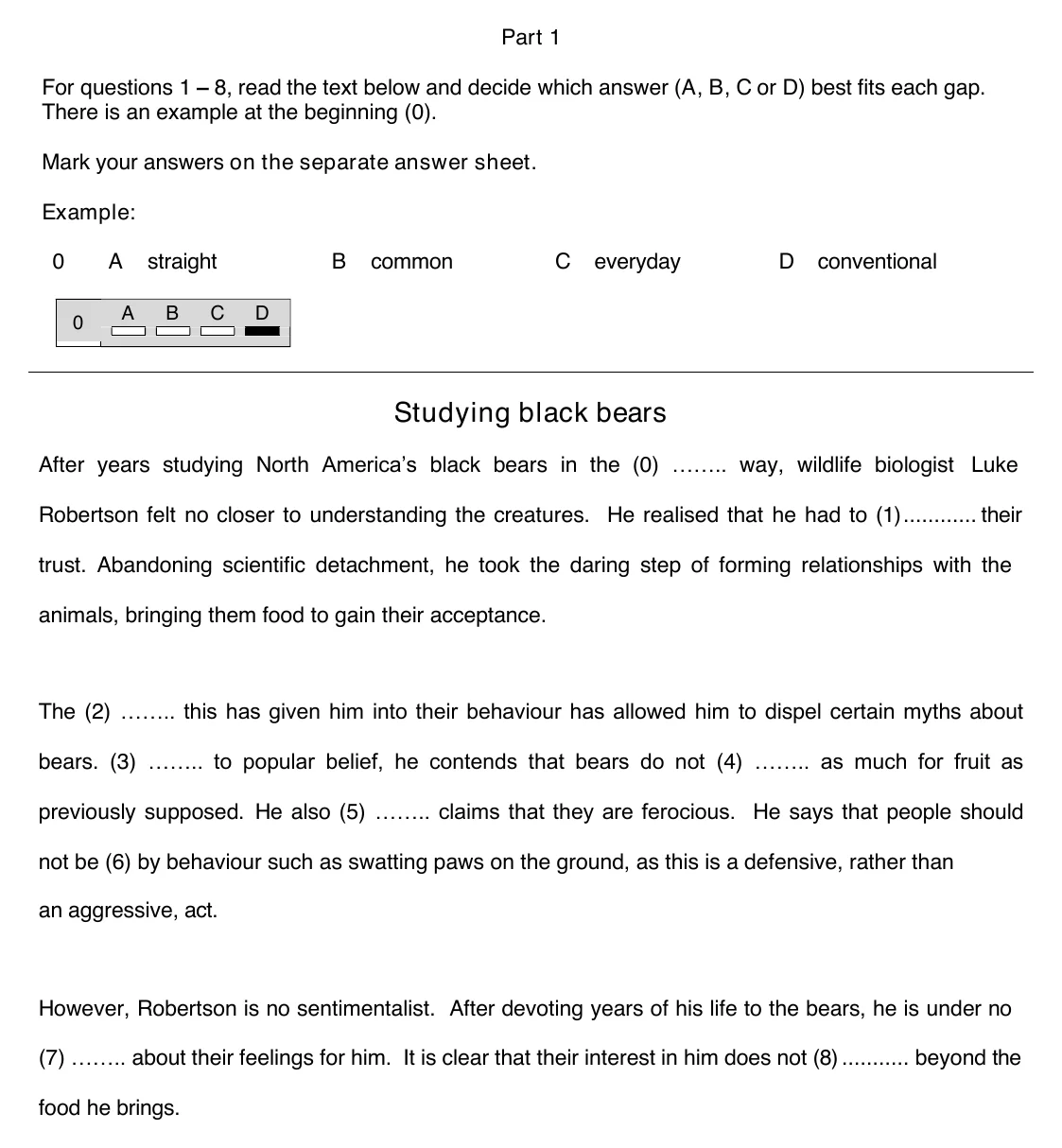
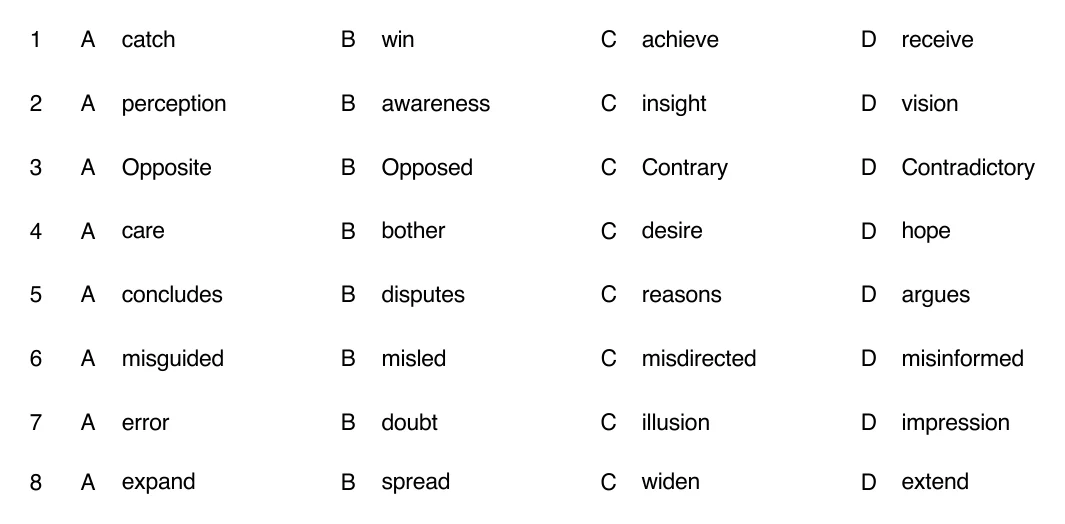
Click on a page to see it full size. Official C1 Advanced sample paper (Sample Paper 1, Reading and Use of English). © Cambridge University Press & Assessment. Text: Suzanne Goldenberg, © Guardian News & Media Ltd 2009.
The example already shows the logic of this part: After years studying North America’s black bears in the (0) …… way, with the options straight, common, everyday and conventional. All four have to do with what’s normal or usual, but the one that combines with way to describe a method of working is in the conventional way. The answer is D.
First paragraph: question 1
1. Answer: B, win. He realised that he had to (1) …… their trust. This is a pure collocation: in English we say win someone’s trust, just like gain someone’s trust. Achieve means to succeed in doing something, but it goes with goals (achieve a goal), not with someone’s trust. Catch and receive don’t combine with trust.
Second paragraph: questions 2 to 6
2. Answer: C, insight. The (2) …… this has given him into their behaviour. Two clues decide this one: the verb given and the preposition into that follows. Give someone an insight into something means to give them a deep understanding of it. Perception and awareness go with of, and vision doesn’t have that meaning. It’s the typical C1 set of near-synonyms.
3. Answer: C, Contrary. (3) …… to popular belief, he contends that… This is a fixed phrase: contrary to popular belief. Opposite, Opposed and Contradictory belong to the same family of meaning, but none of them forms this phrase. If you know it, it’s a free mark; if you don’t, it’s almost impossible to work out.
4. Answer: A, care. Bears do not (4) …… as much for fruit as previously supposed. The clue is for: care for something means to like it (especially in negative sentences: I don’t care much for jazz). Bother goes with about or with, desire takes no preposition, and hope for exists, but it means wanting something to happen, not liking it. Notice that the preposition alone isn’t enough here: you need to understand what the sentence says.
5. Answer: B, disputes. He also (5) …… claims that they are ferocious. This one is decided by the meaning of the paragraph: the biologist is dispelling myths, so what he does with these claims is challenge them. Dispute a claim means to say it isn’t true. Argues is the trap: it sounds right, but argue is followed by that (he argues that…), and argue claims doesn’t work. Concludes and reasons don’t take claims as an object either.
6. Answer: B, misled. People should not be (6) …… by behaviour such as swatting paws on the ground. All four options start with mis-, another very Cambridge-style set. Be misled by something means to be given the wrong idea by it. Misguided is an adjective (misguided ideas), misinformed means having been given false information (misinformed about) and misdirected is used for letters, efforts or resources that go to the wrong place.
Third paragraph: questions 7 and 8
7. Answer: C, illusion. He is under no (7) …… about their feelings for him. Another fixed phrase: be under no illusion(s) about something means to be completely realistic about it. Impression is the trap, because be under the impression that… exists, but under no impression about doesn’t. Error and doubt don’t form the phrase.
8. Answer: D, extend. Their interest in him does not (8) …… beyond the food he brings. Extend beyond something means to go further than it, in a figurative sense. Expand, spread and widen are about growing or getting bigger, but they don’t combine with beyond to express this limit.
Answers, in case you’ve been keeping track: 1B, 2C, 3C, 4A, 5B, 6B, 7C, 8D.
What decided each answer
If we put the eight questions side by side, it’s very clear where you need to look in this part:
| Question | Answer | The clue | Question type |
|---|---|---|---|
| 1 | win | the object, their trust | Collocation |
| 2 | insight | given before and into after | Precise meaning and preposition |
| 3 | Contrary | to popular belief | Fixed phrase |
| 4 | care | for after and the meaning of the sentence | Preposition and meaning |
| 5 | disputes | the meaning of the paragraph (dispelling myths) | Precise meaning |
| 6 | misled | be … by | Precise meaning |
| 7 | illusion | under no … about | Fixed phrase |
| 8 | extend | beyond after | Preposition and collocation |
Notice that in six of the eight questions the clue came after the gap, and in two you had to understand the meaning of the sentence or the paragraph. That’s C1 Part 1 in a nutshell: vocabulary, but always in context.
Typical traps in C1 Use of English Part 1
- The near-synonym with the wrong preposition. Perception and awareness mean something similar to insight, but they go with of, not into. Question 2.
- The word that fits the meaning but not the pattern. Argue seems perfect for challenging a claim, but it’s followed by that. Question 5.
- The word family where only one forms the phrase. Opposite, Opposed, Contrary and Contradictory share a meaning, but there’s only one contrary to popular belief. Question 3.
- The phrase that exists, but in another form. Under the impression exists; under no impression about doesn’t. Question 7.
- Four words with the same prefix. Four mis- or four over- words force you to know exactly how each one is used. Question 6.
Most common mistakes in C1 Use of English Part 1
- Choosing by translation. If the four options translate in a similar way into your language, translation won’t help. What decides the answer is how the word combines in English.
- Reading only up to the gap. This is the mistake that costs the most marks: the clue comes after the gap in almost half the questions.
- Picking the most “difficult” word. At C1, people tend to assume that the most sophisticated-looking option is the right one. It isn’t: Cambridge puts words of a similar level in all four options.
- Getting stuck on one gap. If a fixed phrase doesn’t ring a bell, mark the most likely option and move on. Wrong answers don’t lose marks, and your time is better spent on Parts 5 to 8.
- Learning lists of single words. Knowing what insight means isn’t much use if you don’t know that it goes with into and with give or gain.
How to prepare for C1 Advanced Part 1
- Learn vocabulary in chunks. Don’t write down dispute; write down dispute a claim. Don’t write down illusion; write down be under no illusion about. It’s the most effective way to study for this part.
- Read the press and popular science in English. Part 1 texts are articles of that kind, and that’s where these collocations come up again and again. When you see one you don’t know, note it down with its context.
- Work on sets of near-synonyms. Insight / perception / awareness, dispute / argue / challenge… Look for examples of each one and notice which words go with them.
- Revise the prepositions that go with each word. They’re a huge part of this task, and they’ll also help you with Part 2 and with Writing.
- Do full timed tests. That way you’ll see how long Part 1 takes you within the hour and a half of the paper.
C1 Use of English Part 1 exercises
Here are four original Part 1 exercises in the same format as the exam: a text with an example (0) and eight gaps. Do them first without looking at the answers, then check them: each one comes with an explanation.
Exercise 1: Talking across ravines
For questions 1–8, read the text below and decide which answer (A, B, C or D) best fits each gap. There is an example at the beginning (0).
Talking across ravines
For centuries, shepherds on La Gomera, in the Canary Islands, have been able to make themselves (0) ………… across deep ravines. Their method, Silbo Gomero, is not a code of agreed signals but a whistled (1) ………… of Spanish, in which words become rising and falling notes. Its range is thought to (2) ………… much to pitch: a high whistle (3) ………… through the rumble of wind and water, and loses far less (4) ………… over distance than a shout.
Similar systems have been documented elsewhere, notably in a village in north-east Turkey. Researchers believe they arise where rugged terrain separates scattered homes, and there whistling (5) ………… a very practical need, from warning of danger to arranging the day’s work.
Mobile phones, however, have (6) ………… whistling of much of its usefulness. On La Gomera, making Silbo compulsory in primary schools in 1999 has given it a new (7) ………… of life, and UNESCO now recognises it as part of humanity’s cultural heritage. Yet with a phone in every pocket, few pupils may ever need to (8) ………… it.
| 0 | A heard | B listened | C sounded | D spoken |
| 1 | A account | B version | C transcript | D replica |
| 2 | A contribute | B attribute | C lend | D owe |
| 3 | A cuts | B sweeps | C slips | D runs |
| 4 | A transparency | B visibility | C clarity | D lucidity |
| 5 | A solved | B responded | C answered | D reacted |
| 6 | A robbed | B stolen | C relieved | D removed |
| 7 | A loan | B rent | C hire | D lease |
| 8 | A come round to | B fall back on | C go in for | D face up to |
Show answers
- 1. B (version): ‘A whistled version of Spanish’ means Spanish itself in another form, which is the point of the contrast with ‘not a code of agreed signals’. An ‘account’ is a description of events, a ‘transcript’ is a written record of what was said, which clashes with ‘whistled’, and a ‘replica’ is an exact copy of an object, so none of them describes a language carried in another medium.
- 2. D (owe): ‘Its range is thought to owe much to pitch’ uses ‘owe much to sth’, be largely the result of it, and the colon then explains how pitch does this. ‘Contribute’ and ‘lend’ also take ‘much to’ but point the other way (the range would be adding something to pitch), and ‘attribute’ needs a person as its subject (people attribute a result to a cause), so none of them fits the text.
- 3. A (cuts): ‘A high whistle cuts through the rumble of wind and water’ is the collocation ‘cut through noise’, be heard clearly in spite of it. ‘Sweeps through’ means spreads quickly across a place, ‘slips through’ means passes unnoticed, the opposite of what is meant, and ‘runs through’ means is present all through something, as a theme runs through a book.
- 4. C (clarity): ‘Loses far less clarity over distance than a shout’ means the sound stays clear and easy to make out. All four are ‘clear’ nouns, but ‘transparency’ is used for glass or for openness, ‘visibility’ for how well something can be seen, and ‘lucidity’ for clear thinking or writing, so only ‘clarity’ describes the quality of a sound.
- 5. C (answered): ‘Whistling answered a very practical need’ is the collocation ‘answer a need’, meet it. ‘Solved’ takes a direct object too, but you solve a problem, not a need, and ‘responded’ and ‘reacted’ are close in meaning but need ‘to’ (responded to a need).
- 6. A (robbed): ‘Have robbed whistling of much of its usefulness’ uses the pattern ‘rob sb/sth of sth’, take away something valuable. ‘Relieved’ also takes ‘of’, but you are relieved of something unwanted, such as a burden or a duty, not of usefulness; ‘stolen’ and ‘removed’ take the thing lost as their object and use ‘from’, so they don’t fit ‘whistling of’.
- 7. D (lease): ‘Has given it a new lease of life’ is the fixed phrase for something that makes a thing active, useful or popular again. ‘Loan’, ‘rent’ and ‘hire’ are also words for using something that belongs to someone else for a period, but none of them forms the phrase with ‘a new … of life’.
- 8. B (fall back on): ‘Few pupils may ever need to fall back on it’ means use it only when nothing else is available, which is the point of ‘with a phone in every pocket’. ‘Come round to’ means accept an idea you first disliked, ‘go in for’ means enjoy or enter (go in for a competition), and ‘face up to’ means accept something unpleasant; none of them matches a skill kept for when the phone fails.
Exercise 2: Engineers of the riverbank
For questions 1–8, read the text below and decide which answer (A, B, C or D) best fits each gap. There is an example at the beginning (0).
Engineers of the riverbank
Beavers were (0) ………… to extinction in Britain several centuries ago, prized for their fur and for an oil from their scent glands. Lately, however, they have (1) ………… a quiet comeback, mostly through licensed releases, although some are thought to have escaped from enclosures or been freed by enthusiasts (2) ………… with the slow pace of official decisions.
Their dams of branches and mud turn a fast stream into a chain of ponds and marshes, and after heavy rain the excess water has to (3) ………… over the top instead of rushing down the valley. Researchers believe this may lower flood peaks in towns downstream, although the (4) ………… is still out on how much difference it makes on larger rivers.
Not everyone is delighted, however. Farmers on low-lying land complain that dams flood (5) ………… farmland and block drainage ditches, and that beavers are remarkably (6) …………: a dam that is removed is often rebuilt within days. Some landowners suspect the benefits have been (7) ………… by campaigners, and many (8) ………… animals being released nearby without their being consulted.
| 0 | A chased | B hunted | C tracked | D followed |
| 1 | A assembled | B erected | C mounted | D raised |
| 2 | A impatient | B intolerant | C anxious | D eager |
| 3 | A leak | B drip | C seep | D spill |
| 4 | A judge | B jury | C court | D verdict |
| 5 | A prime | B paramount | C supreme | D foremost |
| 6 | A assertive | B insistent | C persistent | D demanding |
| 7 | A played down | B played up | C played out | D played off |
| 8 | A object | B complain | C disapprove | D resent |
Show answers
- 1. C (mounted): ‘They have mounted a quiet comeback’ is the collocation mount a comeback, begin a determined effort to return after a long absence. ‘Assembled’, ‘erected’ and ‘raised’ also mean putting something together or up, but none of them combines with ‘a comeback’.
- 2. A (impatient): ‘Freed by enthusiasts impatient with the slow pace of official decisions’ uses the pattern impatient with sth, annoyed because it takes too long. ‘Intolerant’ is close in meaning but takes ‘of’, while ‘eager’ (for, to) and ‘anxious’ (about, for, to) take other prepositions and mean wanting something rather than being annoyed by delay, so none of them fits ‘with the slow pace’.
- 3. D (spill): ‘The excess water has to spill over the top’ means it overflows the edge of the dam once the pond is full. ‘Leak’ and ‘seep’ describe water escaping through small gaps or a surface, not over the top of something, and ‘drip’ means fall in single drops, which does not describe water overflowing after heavy rain.
- 4. B (jury): ‘The jury is still out on how much difference it makes’ is the fixed phrase for a question that has not yet been decided. ‘Judge’, ‘court’ and ‘verdict’ belong to the same legal family, and ‘verdict’ is close in meaning, but only ‘jury’ forms the phrase with ‘is still out’.
- 5. A (prime): ‘Dams flood prime farmland’ is the collocation prime farmland, land of the best quality for growing crops. ‘Paramount’, ‘supreme’ and ‘foremost’ also mean highest or most important, but they describe rank or importance, not the quality of land, and none collocates with ‘farmland’.
- 6. C (persistent): ‘Beavers are remarkably persistent: a dam that is removed is often rebuilt within days’ means they keep doing the same thing despite setbacks, which the sentence after the colon illustrates. ‘Insistent’ means demanding something firmly, usually in words, ‘assertive’ means confident in stating your views, and ‘demanding’ means needing a lot of effort or attention; none is shown by rebuilding a dam.
- 7. B (played up): ‘Landowners suspect the benefits have been played up by campaigners’ means made to seem greater than they are, which is what a sceptical landowner would suspect of people who support the animals. ‘Played down’ means the opposite, made to seem less important, which campaigners would not do to benefits; ‘played out’ means happened or became exhausted, and ‘played off’ means set people against each other.
- 8. D (resent): ‘Many resent animals being released nearby’ uses the pattern resent sb doing sth, with the -ing clause as a direct object. ‘Object’, ‘complain’ and ‘disapprove’ are close in meaning but need a preposition (‘object to’, ‘complain about’, ‘disapprove of’), so none fits ‘animals being released’ directly.
Exercise 3: Forty winks after lunch
For questions 1–8, read the text below and decide which answer (A, B, C or D) best fits each gap. There is an example at the beginning (0).
Forty winks after lunch
Most of us are (0) ………… with the heavy-eyed feeling that tends to arrive in the early afternoon, and lunch is the usual suspect. Researchers believe, however, that our body clock causes drowsiness to (1) ………… at that time whether or not we have eaten. This natural lull may also help to (2) ………… light on the lasting appeal of the siesta in warmer countries.
Length matters, though. A nap of 10 to 20 minutes tends to (3) ………… people feeling refreshed, as they wake before slipping into deep sleep. Sleep much longer, and you may be woken from that deeper stage, bringing on the grogginess and (4) ………… known as sleep inertia, which can last up to half an hour.
Employers are (5) ………… aware that tired staff make costly mistakes. Napping on the job, long seen as a sign of laziness, is slowly losing its (6) …………, and some firms have installed ‘nap pods’ in a (7) ………… to get more out of well-rested workers. Elsewhere, anyone caught dozing at their desk still risks being (8) ………… of not pulling their weight.
| 0 | A familiar | B accustomed | C used | D aware |
| 1 | A break in | B fall in | C draw in | D creep in |
| 2 | A emit | B shed | C release | D spread |
| 3 | A make | B render | C leave | D help |
| 4 | A confusion | B turmoil | C distraction | D chaos |
| 5 | A sorely | B badly | C gravely | D painfully |
| 6 | A stigma | B disgrace | C scandal | D discredit |
| 7 | A try | B bid | C pursuit | D venture |
| 8 | A charged | B blamed | C accused | D criticised |
Show answers
- 1. D (creep in): ‘Causes drowsiness to creep in’ uses creep in, begin to appear gradually and almost unnoticed, as tiredness or mistakes do. ‘Draw in’ is used of evenings getting darker earlier, ‘break in’ means enter by force or interrupt, and ‘fall in’ means collapse or line up; none of them describes a feeling that slowly takes hold.
- 2. B (shed): ‘Help to shed light on the lasting appeal of the siesta’ is the collocation shed light on sth, help to explain it. ‘Emit’ and ‘release’ describe sending out light or energy, and ‘spread’ describes something reaching a wider area, but none of them combines with ‘light on’ to mean explain.
- 3. C (leave): ‘Tends to leave people feeling refreshed’ is the pattern leave sb + -ing, which describes the state someone is in after something. ‘Make’ and ‘help’ are followed by a bare infinitive (make people feel), and ‘render’ by an adjective (render sb helpless), so none of them fits ‘feeling’.
- 4. A (confusion): ‘The grogginess and confusion known as sleep inertia’ describes a mind that cannot think clearly just after waking. ‘Turmoil’ is a state of agitation or upheaval and ‘chaos’ complete disorder in a situation, while ‘distraction’ is attention pulled away by something else, so none of them describes the muddled thinking of someone half awake.
- 5. D (painfully): ‘Are painfully aware that tired staff make costly mistakes’ is the collocation painfully aware, know something unpleasant all too well. ‘Sorely’ goes with ‘missed’ or ‘tempted’, ‘badly’ with ‘needed’ or ‘damaged’, and ‘gravely’ with ‘ill’ or ‘concerned’; none of them combines with ‘aware’.
- 6. A (stigma): ‘Is slowly losing its stigma’ means that the disapproval attached to napping, ‘long seen as a sign of laziness’, is fading, which is why firms now install nap pods. ‘Disgrace’, ‘scandal’ and ‘discredit’ are also negative, but they name the shame or damage caused by a particular act, not a lasting bad reputation attached to an activity, and none of them is something an activity ‘loses’.
- 7. B (bid): ‘In a bid to get more out of well-rested workers’ is the fixed phrase in a bid to + infinitive, in an attempt to. ‘Try’ is close in meaning but does not form the phrase, ‘pursuit’ forms ‘in pursuit of’, and a ‘venture’ is a risky business project, so none of them fits ‘in a … to’.
- 8. C (accused): ‘Risks being accused of not pulling their weight’ is the pattern accuse sb of (doing) sth. ‘Charged’ has a similar meaning but takes ‘with’, and ‘blamed’ and ‘criticised’ take ‘for’, so none of them fits ‘of’.
Exercise 4: Why audiences clap
For questions 1–8, read the text below and decide which answer (A, B, C or D) best fits each gap. There is an example at the beginning (0).
Why audiences clap
Applause may well be one of the oldest ways in which a crowd can (0) ………… its approval. In ancient Rome, it seems, the reaction of an audience (1) ………… such weight that one emperor kept a troop of young men paid to make each of his performances an (2) ………… success. Nineteenth-century Paris went further: its opera houses hired professional clappers known as the claque, a trade that (3) ………… on the nerves of anxious singers. A star who refused to pay its leader could find his men sitting on their (4) ………….
Recent research suggests that the claque understood crowds well. Filming students at short talks, one team found that the (5) ………… of the applause seemed to bear little (6) ………… to how good each talk had been. Its length, the researchers concluded, (7) ………… less to the speaker than to a kind of social contagion. Clapping spread through the room once two or three people began, and once a few stopped, it would usually (8) ………… within seconds.
| 0 | A show | B bear | C hold | D keep |
| 1 | A carried | B put | C lent | D threw |
| 2 | A unlimited | B unconditional | C unqualified | D unrestricted |
| 3 | A benefited | B thrived | C expanded | D succeeded |
| 4 | A toes | B heels | C thumbs | D hands |
| 5 | A interval | B duration | C spell | D term |
| 6 | A resemblance | B reference | C regard | D relation |
| 7 | A derived | B amounted | C owed | D stemmed |
| 8 | A tail off | B wear off | C run out | D break up |
Show answers
- 1. A (carried): ‘The reaction of an audience carried such weight’ is the collocation carry weight, meaning be important or influential. ‘Put’ (put on weight, get heavier), ‘lent’ (lend weight to sth, needs ‘to’) and ‘threw’ (throw your weight around, use power aggressively) also go with ‘weight’, but none of them means having influence here.
- 2. C (unqualified): ‘An unqualified success’ is the collocation for a complete success, with no reservations at all. ‘Unlimited’, ‘unconditional’ and ‘unrestricted’ also mean ‘without limits or conditions’, but they go with words such as ‘access’, ‘love’ or ‘use’, not with ‘success’.
- 3. B (thrived): ‘A trade that thrived on the nerves of anxious singers’ uses the pattern thrive on sth, do well because of it. ‘Benefited’ is close in meaning but takes ‘from’, ‘expanded on’ means talk about sth in more detail, and ‘succeeded’ takes ‘in’, not ‘on’.
- 4. D (hands): ‘Could find his men sitting on their hands’ is the fixed phrase sit on your hands, do nothing, here literally refusing to clap. ‘Toes’ (be on your toes, be alert), ‘heels’ (kick your heels, wait) and ‘thumbs’ (twiddle your thumbs) belong to other phrases, and none of them forms a phrase with ‘sit on’.
- 5. B (duration): ‘The duration of the applause’ means how long it lasted, which the following sentence calls its ‘length’. An ‘interval’ is a gap between two events, a ‘spell’ is a period of a certain kind of weather or activity (‘a spell of rain’), and a ‘term’ is a fixed period such as a school term; none of them means the length of the applause.
- 6. D (relation): ‘Seemed to bear little relation to how good each talk had been’ means there was hardly any connection between the two: bear (little/no) relation to sth. ‘Resemblance’ also follows ‘bear little … to’, but it means similarity in appearance or character, and a length of time cannot look like the quality of a talk; ‘reference’ and ‘regard’ don’t form the phrase with ‘bear’.
- 7. C (owed): ‘Its length … owed less to the speaker than to a kind of social contagion’ uses owe sth to sth, be caused by it, and the second ‘to’ confirms the pattern. ‘Derived’ and ‘stemmed’ are close in meaning but take ‘from’, and ‘amounted to’ means added up to or was equal to, which makes no sense with ‘the speaker’.
- 8. A (tail off): ‘It would usually tail off within seconds’ means the clapping became gradually quieter and less frequent until it stopped. ‘Wear off’ is used for an effect or feeling that fades, ‘run out’ for a supply that is used up, and ‘break up’ for a meeting or crowd that ends and leaves; none of them describes applause fading.
Frequently asked questions about C1 Use of English Part 1
How many questions are there in C1 Advanced Use of English Part 1?
Eight questions (numbered 1 to 8), plus a solved example at the beginning in the paper-based exam. Each one has four options and is worth one mark.
Can there be more than one correct answer?
No. There’s always only one answer. Sometimes another option looks possible, but it fails for a specific reason: it doesn’t take the preposition that follows, it doesn’t form the phrase, or it doesn’t have the exact meaning the sentence needs.
Do wrong answers lose marks?
No. Wrong answers simply don’t score. That’s why you should never leave a gap blank.
How much time should I spend on it?
Cambridge doesn’t set a time for each part: you have 1 hour 30 minutes for all eight parts of Reading and Use of English. As Part 1 is short, 8 to 10 minutes is usually enough, which leaves you more time for the long texts in Parts 5 to 8.
Is it the same on paper and on computer?
The task is the same. The only difference is how you answer: on paper you mark the letter on the answer sheet, and on computer the options appear when you click on each gap. In the computer-based exam, the example (0) isn’t shown either.
Use of English C1: 10 Use of English Tests for C1 Advanced (CAE)
If you’d like to practise with full tests, have a look at my book Use of English C1: 10 Use of English Tests for C1 Advanced (CAE). Inside, you’ll find:
- 10 practice tests with Parts 1 to 4 of Reading and Use of English.
- A photocopiable answer sheet for each test.
- Instructions to work out your own score.
- The answer key for every test.
You can download a free sample with the whole of Test 1 to see what it’s like before you buy it. And if you want more, there’s also volume 2, with another ten tests.
Keep preparing for C1 Use of English
This guide is part of the series on C1 Advanced Use of English. To see how this part fits into the whole exam, go back to the C1 Advanced main page or try the C1 score calculator. And since many questions depend on linkers and register, you might also want to go over the C1 linkers.
Did you find this guide useful? Share it with other students and teachers preparing for the CAE. And if you have any questions about any of the items, leave them in the comments: I read every single one.
See you in Part 2. Until then, don’t forget to keep smiling! 🙂
