
Table of contents
C1 Advanced Use of English Part 2, the open cloze, is the part of the exam where you’re given nothing at all: no options, as in Part 1, and no word to start from, as in Part 3. Just a text with eight gaps and the instruction to write one word in each. It’s a little daunting, but it has one huge advantage: the missing word is hardly ever a «difficult» word. It’s a preposition, a linker, a pronoun or the piece that completes a fixed phrase.
In this guide I’ll explain how the C1 open cloze works, what kind of words are missing according to Cambridge’s official tasks, how it differs from B2, a method for tackling it and the official sample test solved gap by gap. At the end there are four original exercises for you to practise with, with every accepted answer listed and explained. Let’s get started!
What C1 Advanced Use of English Part 2 looks like
| Feature | C1 Use of English Part 2 |
|---|---|
| What you have to do | Read a text with 8 gaps and write the missing word in each one, with no options |
| Number of questions | 8 (numbered 9 to 16), plus a solved example (0) |
| What you write | One word per gap; if you write two, you don’t get the mark |
| Contractions | Not accepted: you must write the full form (would, not ‘d) |
| Spelling | It must be correct; in the paper-based exam, answers go in CAPITAL LETTERS |
| Marks | 1 mark per gap; sometimes Cambridge accepts more than one word |
| What it tests | Grammar (prepositions, pronouns, relatives, auxiliaries, articles) and lexico-grammar (linkers, fixed phrases, phrasal verbs) |
Unlike Part 1, which officially counts as Reading, Part 2 does count towards your Use of English score, together with Parts 3 and 4. They’re all part of the Reading and Use of English paper: 1 hour 30 minutes, eight parts and 56 questions.
What kind of words are missing in the C1 open cloze?
To prepare this guide, I analysed ten official Cambridge Part 2 tasks at C1 (80 gaps), from the sample papers and the official practice test books. This is roughly how they break down:
| Type of word | How often | Examples |
|---|---|---|
| Prepositions (dependent or in phrases) | 1 in 5 | opt for, faced with, between … and, in isolation |
| Words in fixed phrases | 1 in 5 | in other words, at least, as far as, no longer, if nothing else |
| Linkers | 1 in 7 | despite, because (of), rather than, otherwise, even |
| Pronouns | 1 in 10 | anyone, myself, something, it, one |
| Phrasal verbs and collocation verbs | A little over 1 in 10 | come up with, stand out, make use of, take responsibility |
| Relatives | A few | which, whose, what, where |
| Auxiliaries and verb forms | A few | having, being, did |
| So/such, modals, determiners, comparison | 1 in 10 | such … that, may well, the majority of |
The practical conclusion: almost every answer is a short grammar word, the kind you’ve known for years. What makes C1 difficult isn’t the word itself, but seeing which piece the sentence is missing.
Sometimes more than one answer is correct
In more than 1 in 5 gaps in the official tasks, Cambridge accepts two or more words: anybody or anyone, must or should, it or this. If you’re torn between two words that mean the same and both fit the sentence, chances are both are accepted. Just make sure you write only one: if you write two, the gap counts as wrong.
How it differs from B2 First Part 2
The format is the same as B2 Use of English Part 2, but three things change at C1:
- More linkers and fixed phrases. At B2, articles, auxiliaries and pronouns carry more weight. At C1 you’ll see more gaps like despite, rather, in other words or if nothing else.
- At least one gap that depends on the text. Almost every task has one or two gaps you can’t solve by looking at the sentence alone, but only by reading the previous one or the whole paragraph: a contrast linker, a this that refers back to something.
- Texts that argue. At C1 the texts don’t just inform: they put forward an idea, discuss it and reach a conclusion. That’s why linkers matter more.
The three-step method
- Read the whole text before writing anything. You need to follow the argument: if a paragraph says the opposite of the previous one, the gap at its start probably needs a contrast linker.
- For each gap, ask yourself what the sentence is missing. Is there a verb without a subject? An adjective that needs a preposition? Something to join two clauses? The missing word of a phrase you recognise (in … words, if … else)? Always look at what comes before and after.
- Write the word and reread the whole sentence. It has to be grammatically perfect and make sense with the rest of the text. Check the spelling and make sure it’s a single word.
The sample test, solved gap by gap
This is the Part 2 text from Cambridge’s official C1 Advanced sample paper, about the origin of language. Try it before reading the explanations:
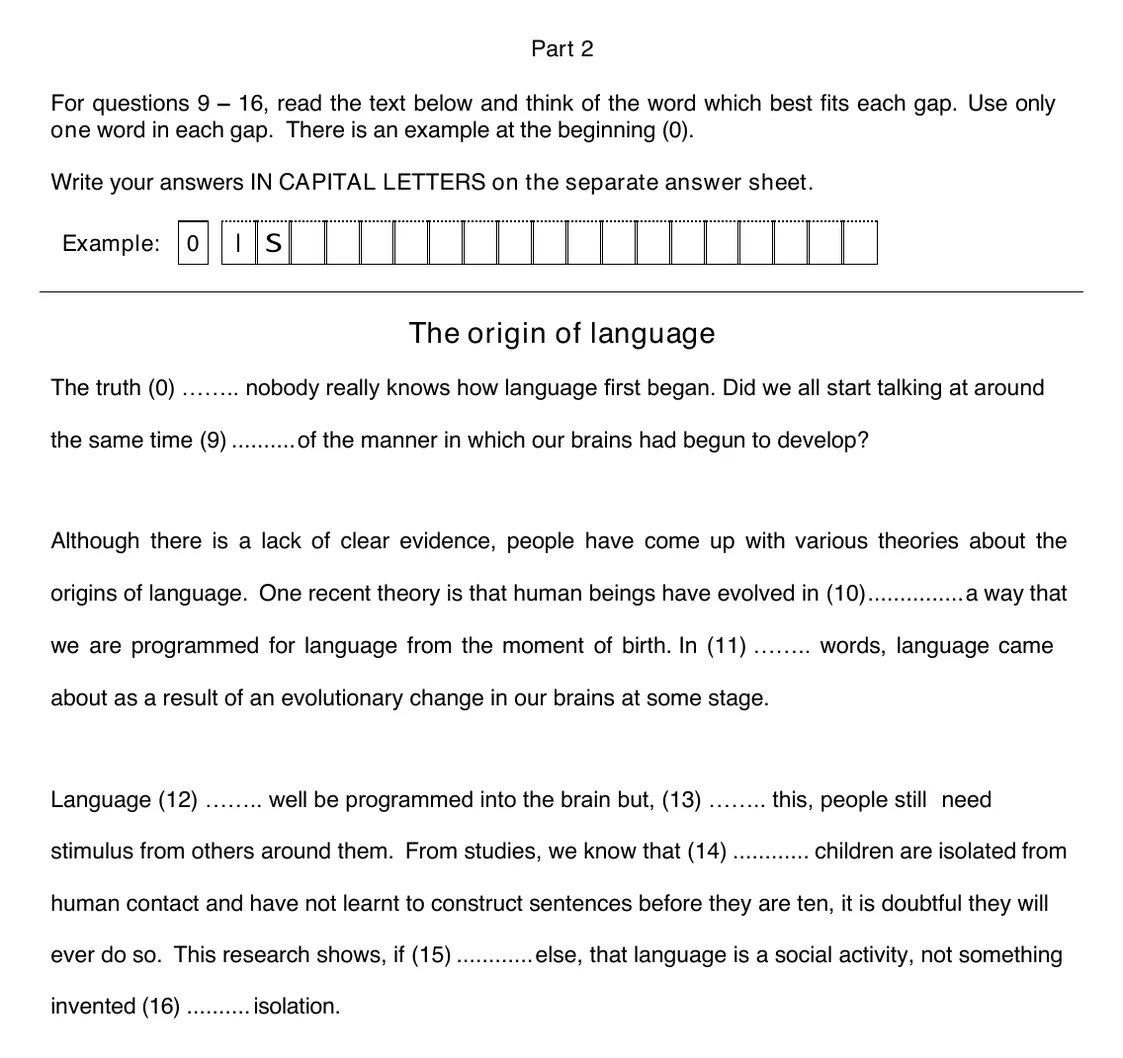
Click on the image to see it full size. Official C1 Advanced sample paper (Sample Paper 1, Reading and Use of English). © Cambridge University Press & Assessment.
The example already shows you the kind of word you’re looking for: The truth (0) …… nobody really knows how language first began. The answer is is: the truth is (that)… is a very common way of introducing what’s really the case. A short grammar word that comes not from the meaning but from how the sentence is built.
First paragraph: gap 9
9. because. Did we all start talking at around the same time (9) …… of the manner in which our brains had begun to develop? The gap is followed by of and a noun, and the sentence suggests a cause: we started talking because of the way the brain developed. It’s a two-word cause linker, and the exam asks you for the first word.
Second paragraph: gaps 10 and 11
10. such. Human beings have evolved in (10) …… a way that we are programmed for language. The structure is such + a + noun + that + result: in such a way that. So doesn’t work here, because it goes with adjectives and adverbs (so quickly that), not with a way.
11. other. In (11) …… words, language came about as a result of an evolutionary change. A fixed phrase: in other words, which signals that the next sentence rephrases the previous one. If you see In … words at the start of a sentence, there isn’t much to think about.
Third paragraph: gaps 12 to 16
12. could, may or might. Language (12) …… well be programmed into the brain but… The clue is well right after the gap: may well, might well and could well say that something is quite likely. The but that follows confirms that the writer is conceding a point before qualifying it. Cambridge accepts all three modals.
13. despite. …but, (13) …… this, people still need stimulus from others around them. This is the gap decided at text level. This refers to what has just been said (that language may be programmed into the brain), and still signals contrast: in spite of that, we still need other people. In spite means the same, but it would need of and would be two words.
14. if, when or whenever. We know that (14) …… children are isolated from human contact and have not learnt to construct sentences before they are ten, it is doubtful they will ever do so. The sentence has two halves: a condition and a consequence (it is doubtful…). You need a conjunction to introduce the condition, and if, when and whenever all work here.
15. nothing or little. This research shows, if (15) …… else, that language is a social activity. A fixed phrase: if nothing else (even if it shows nothing more). Cambridge also accepts little (if little else).
16. in. …not something invented (16) …… isolation. A preposition in a phrase: in isolation. It picks up the idea of isolated children from two sentences earlier.
Answers, in case you’ve been keeping track: 9 because, 10 such, 11 other, 12 could/may/might, 13 despite, 14 if/when/whenever, 15 nothing/little, 16 in.
What each gap was missing
| Gap | Answer | Type of word | The clue |
|---|---|---|---|
| 9 | because | Cause linker | of after and the idea of cause |
| 10 | such | So/such | a way that |
| 11 | other | Fixed phrase | In … words |
| 12 | could / may / might | Modal | well after |
| 13 | despite | Contrast linker | this and still: the previous sentence |
| 14 | if / when / whenever | Conjunction | condition + it is doubtful… |
| 15 | nothing / little | Fixed phrase | if … else |
| 16 | in | Preposition | … isolation |
Notice that there isn’t a single noun, adjective or verb with its own meaning. And four of the eight gaps accept more than one answer.
Most common mistakes in the C1 open cloze
- Writing two words. In spite, even though or as well are two words and don’t score. If the word you think of has two parts, look for a one-word version (despite, although, too).
- Using contractions. Won’t, ‘d or isn’t aren’t accepted. Always write the full form.
- Misspelling the word. Spelling counts in this part. Wich, thier or untill score nothing, even if you chose the right word.
- Reading only the sentence with the gap. Contrast linkers and pronouns referring back to something only become clear when you read the previous sentence.
- Translating from your own language. Depend of, interested on or married with come from translating. Dependent prepositions have to be learnt in English.
- Leaving gaps blank. Wrong answers don’t lose marks. If you’re not sure, write the most likely word.
How to prepare for C1 Advanced Part 2
- Revise fixed phrases with a word missing. In other words, at least, as far as, by no means, if nothing else, all but… Note them down with one word covered and practise completing them.
- Work on one-word linkers. Despite, whereas, otherwise, unless, rather, even. Notice which ones take a noun and which take a clause. Going over the C1 linkers will help.
- Learn prepositions together with their word. Don’t write down opt; write down opt for. Don’t write down isolation; write down in isolation.
- Revise so and such, relatives and structures with it. They’re open cloze classics at every level, and at C1 they come in longer structures.
- Practise with whole texts, against the clock. About 8 to 10 minutes per task is a good target.
C1 Use of English Part 2 exercises
Here are four original Part 2 exercises in the same format as the exam: a text with an example (0) and eight gaps. Do them first without looking at the answers, then check them: each gap lists every accepted answer with an explanation.
Exercise 1: Worth knowing by heart
For questions 1–8, read the text below and think of the word which best fits each gap. Use only one word in each gap. There is an example at the beginning (0).
Worth knowing by heart
There was (0) a time when schoolchildren were expected to learn poems by heart. Today the practice looks absurd: any line of verse can be retrieved (1) ………… demand, so why store what a phone already remembers for us?
Its defenders reply that memorising gives you (2) ………… no search can. To learn a poem, you have to weigh (3) ………… word and notice how the lines are built, a kind of attention we rarely give a screen. Once learnt, it stays with you, its rhythm quietly shaping how you hear language. A quick search demands no effort of this kind. (4) ………… does it leave anything behind once the screen goes dark.
(5) ………… so, schools gave up recitation long ago. Teachers, having (6) ………… told for decades that rote learning was the enemy of understanding, let it go, and they had a point: a poem chanted without thought is by (7) ………… means a poem known. Still, now that the habit has all (8) ………… disappeared, a few poems learnt slowly, and for pleasure, may be worth carrying.
Example: (0) a
Show answers
- 1. on (also: upon): ‘On demand’ (formal ‘upon demand’) means whenever someone asks for it: any line can be retrieved at once, at any moment. ‘By demand’ or ‘at demand’ do not exist.
- 2. what (also: something, things): The verb ‘gives’ needs an object, which the gap and ‘no search can’ supply: ‘what’ (= the thing that) or ‘something’ that no search can give. ‘That’ or ‘which’ need a noun before them.
- 3. every (also: each): ‘Every’ or ‘each’ + singular noun means all the words, one by one, which is the close attention the sentence describes. ‘All’ would need a plural (‘all the words’), and ‘the’ or ‘a’ would mean one particular word.
- 4. nor (also: neither): The previous sentence is negative (‘demands no effort of this kind’), and ‘Nor’ or ‘Neither’ adds a second negative point, with the inverted ‘does it leave’. ‘So does it’ would add a positive point, and ‘Also’ cannot introduce an inversion.
- 5. even: ‘Even so’ (= in spite of that) contrasts the advantages set out in the second paragraph with what schools actually did. ‘And so’ would make giving up recitation a result of those advantages, which makes no sense.
- 6. been: The perfect participle passive ‘having been told’ shows that the teachers were told this before they let the practice go. ‘Having told’ would make the teachers the ones who did the telling.
- 7. no: ‘By no means’ is a fixed phrase meaning certainly not: a poem chanted without thought is not really known. ‘By all means’ means ‘of course, please do’, and ‘by any means’ needs a negative earlier in the sentence.
- 8. but: ‘All but’ before a verb or adjective means almost: the habit has almost completely disappeared. ‘All’ alone does not fit: with a singular subject, ‘the habit has all disappeared’ is not English.
Exercise 2: A language nobody speaks
For questions 1–8, read the text below and think of the word which best fits each gap. Use only one word in each gap. There is an example at the beginning (0).
A language nobody speaks
Latin has not been anyone’s first language for (0) more than a thousand years. Why, then, do schools still find a place (1) ………… it on the timetable? Supporters note that around half of English words come from Latin. (2) ………… is why a student who knows the roots can often make sense of words (3) ………… meaning they were never taught. Some even see Latin’s strength in its no longer (4) ………… spoken: the grammar stays still while you examine it.
Critics remain unconvinced. Pupils have only so many hours, and those should go on a language they might use. As it (5) …………, many leave school able to read Caesar but unable to ask for directions abroad. Besides, most Latin roots can be picked up through English itself, so pupils could do (6) ………… the detour through ancient Rome.
Both sides have a point. To a pupil who enjoys puzzles, though, translating a passage can be (7) ………… a satisfying challenge as to make the hours feel well spent. For (8) ………… the frustration it causes, Latin teaches the patience every language demands, living or dead.
Example: (0) more
Show answers
- 1. for: ‘Find a place for something’ means make room for it: schools still give Latin time on the timetable. ‘Find a place to it’ or ‘in it’ is not possible.
- 2. this (also: that): ‘This/That is why’ refers back to the previous sentence: because so many English words come from Latin, knowing the roots helps. ‘It is why’ is not natural, and ‘Which is why’ cannot start a new sentence here.
- 3. whose: ‘Whose’ is the possessive relative: words whose meaning they were never taught (= the meaning of the words). ‘Which’ or ‘that’ cannot go before a noun in this way.
- 4. being: After the preposition ‘in’ (with the possessive ‘its’), the passive needs the -ing form: its no longer being spoken. ‘Be’ or ‘is’ cannot follow a preposition.
- 5. is (also: stands): ‘As it is’ (or ‘as it stands’) means ‘in the present situation’ and contrasts with the previous sentence: the hours should go on a useful language, but in reality many pupils leave school unable to ask for directions. ‘As it happens’ (= by chance, in fact) does not give this contrast.
- 6. without: ‘Do without something’ means manage without needing it: English itself is enough, so the detour through Latin is unnecessary. ‘Do with’ means need or want, the opposite.
- 7. such: ‘Such + a + adjective + noun + as to + infinitive’ expresses a result: the challenge is so satisfying that the hours feel well spent. ‘So’ cannot go before ‘a’ + adjective + noun, and ‘quite’ does not combine with ‘as to’.
- 8. all: ‘For all + noun’ is a fixed phrase meaning ‘despite’: although Latin can be frustrating, it teaches patience. No other word completes ‘For … the frustration’ with this meaning.
Exercise 3: Just listen to this
For questions 1–8, read the text below and think of the word which best fits each gap. Use only one word in each gap. There is an example at the beginning (0).
Just listen to this
As recently (0) as the 1990s, leaving someone a spoken message meant waiting for an answering machine to beep. Today, millions have switched (1) ………… typing to voice notes, and the appeal is obvious: speaking is quicker, and many find it easier to make (2) ………… understood when warmth or irony can be heard.
(3) ………… so for the listener. A text can be skimmed in seconds; a recording cannot, (4) ………… is why it often sits unheard until a quiet moment, when it may no longer matter. Once played, it takes far longer to get through than the text it replaces (5) ………… have done.
All this raises the question of who a message is really for. Typing makes the sender shape a thought first; a voice note hands that job over to the listener. (6) ………… dealt with the matter in a minute, the sender feels efficient, but the time saved comes (7) ………… the listener’s expense. Before pressing record, it is worth asking whether the listener would (8) ………… read three lines than sit through a minute of thinking aloud.
Example: (0) as
Show answers
- 1. from: ‘Switch from A to B’: millions have stopped typing and now send voice notes instead. ‘To’ already follows ‘typing’, so the gap needs the starting point, ‘from’.
- 2. themselves: ‘Make yourself understood’ is a fixed phrase meaning ‘get others to understand you’; with the subject ‘many’ (people) the reflexive is ‘themselves’. ‘Them’ would mean other people, and ‘it’ has nothing to refer to.
- 3. Not (also: Less): ‘Not so for the listener’ is a short reply to the first paragraph: what is true for the sender (the appeal is obvious) is not true for the listener, as the next sentences show. ‘Less so’ also works; ‘Even so’, ‘Equally so’ or ‘More so’ would say the listener likes voice notes too, which the rest of the paragraph contradicts.
- 4. which: ‘Which is why’ refers back to the whole previous clause (a recording cannot be skimmed) and gives its result. After a comma, ‘that’ or ‘this’ would need a new sentence (‘This is why …’).
- 5. would (also: might, could): ‘Would/might/could have done’ talks about what the text message would have taken if it had been sent instead: it takes far longer to get through than the text it replaces would have done. ‘Did’ or ‘has’ do not work, because the text was never actually sent.
- 6. Having: The perfect participle clause ‘Having dealt with the matter in a minute’ shows an action completed before the main clause, with the same subject (the sender). ‘Being’ or ‘Once’ cannot be followed directly by ‘dealt with’ and an object.
- 7. at: ‘At someone’s expense’ is a fixed phrase meaning that someone else pays the cost: the sender saves time, the listener loses it. ‘For’ or ‘on’ the listener’s expense are not used.
- 8. rather (also: sooner): ‘Would rather/sooner + bare infinitive … than’ expresses preference, and ‘than sit through a minute’ later in the sentence requires it. ‘Would prefer’ needs ‘to’ (‘would prefer to read’) and does not take ‘than’ with a bare infinitive.
Exercise 4: Same time next year
For questions 1–8, read the text below and think of the word which best fits each gap. Use only one word in each gap. There is an example at the beginning (0).
Same time next year
Every January, millions of people make (0) the same promise: this will be the year they finally change. Not (1) ………… are most of these vows forgotten within weeks, but the most determined tend to give up by February too.
Why do they fail so reliably? Vague goals are one reason: ‘get fit’ gives no clue as (2) ………… what to do on a wet Tuesday. Ambition is another, since faced (3) ………… six changes at once, few manage any. Then there is willpower, which we expect to carry us through. Yet after a long day at work, there is often very (4) ………… of it left. A habit must become automatic before that happens; (5) …………, the old routine quietly returns.
So should we stop bothering? Not necessarily. A failed resolution still makes us ask (6) ………… we actually want from the year ahead. (7) ………… the outcome, that pause is worth having, and a goal abandoned in February can be rewritten, smaller, in March. The ritual is (8) ………… from pointless; it simply works better as a first draft than as a promise.
Example: (0) the
Show answers
- 1. only (also: merely, just): ‘Not only … but … too’ adds a second, stronger point, and after ‘Not only’ the verb comes before the subject: Not only are most of these vows forgotten … but the most determined tend to give up by February too. ‘Not merely’ works the same way; the inversion ‘are most …’ and the ‘but … too’ in the second half rule out other words.
- 2. to: ‘As to’ means ‘about, concerning’ and is followed here by a wh- clause: no clue as to what to do. After ‘as’ no other preposition fits (‘as about’ does not exist).
- 3. with (also: by): ‘Faced with’ (or ‘faced by’) something difficult means having to deal with it: when people try six changes at once, few manage any. ‘Faced to’ or ‘faced at’ are not used.
- 4. little: ‘Very little of it’ means almost none of the willpower is left: ‘it’ (willpower) is uncountable, so ‘few’ is impossible, and ‘Yet’ shows the amount is small, which rules out ‘much’.
- 5. otherwise: ‘Otherwise’ means ‘if this does not happen’ and refers back to the clause before: if the habit does not become automatic before willpower runs out, the old routine returns. ‘Unless’ and ‘although’ need a clause after them.
- 6. what: ‘What’ means ‘the thing(s) that’ and is the object of ‘want’: ask what we actually want. ‘Which’ or ‘that’ would need a noun before them, and ‘whether’ leaves ‘want’ without an object.
- 7. Whatever: ‘Whatever the outcome’ means ‘no matter what the outcome is’: the pause is worth having whether the resolution succeeds or fails. ‘Despite the outcome’ would suggest the outcome is bad, which the text does not say.
- 8. far: ‘Far from’ + adjective is a fixed phrase meaning ‘not at all’: the ritual is not pointless, it just works better as a first draft. No other single word fits before ‘from’ here (‘a long way from’ needs four words).
Frequently asked questions about C1 Use of English Part 2
How many questions are there in C1 Advanced Use of English Part 2?
Eight gaps (numbered 9 to 16), plus a solved example at the beginning. Each gap is worth one mark.
Can there be more than one correct answer?
Yes. In the official tasks, more than 1 in 5 gaps accepts two or more words. But write only one: if you write two, you won’t get the mark.
Are contractions accepted?
No. Cambridge only accepts full forms, so write would or not, never ‘d or n’t.
Does spelling count?
Yes. A misspelt word doesn’t score, even if it’s the right one. Punctuation, on the other hand, isn’t taken into account.
Is Part 2 Use of English or Reading?
Use of English. Together with Parts 3 and 4, it makes up your C1 Advanced Use of English score. The part that officially counts as Reading is Part 1.
Use of English C1: 10 Use of English Tests for C1 Advanced (CAE)
If you’d like to practise with full tests, have a look at my book Use of English C1: 10 Use of English Tests for C1 Advanced (CAE). Inside, you’ll find:
- 10 practice tests with Parts 1 to 4 of Reading and Use of English.
- A photocopiable answer sheet for each test.
- Instructions to work out your own score.
- The answer key for every test.
You can download a free sample with the whole of Test 1 to see what it’s like before you buy it. And if you want more, there’s also volume 2, with another ten tests.
Keep preparing for C1 Use of English
This guide is part of the series on C1 Advanced Use of English. If you haven’t seen it yet, start with Part 1, the multiple-choice cloze. And once you’ve mastered this one, move on to Part 3, word formation. And to see how it all fits into the exam, go back to the C1 Advanced main page or try the C1 score calculator.
Did you find this guide useful? Share it with other students and teachers preparing for the CAE. And if you have any questions about any of the gaps, leave them in the comments: I read every single one.
See you in Part 3. Until then, don’t forget to keep smiling! 🙂
