

Tabla de contenidos
La Parte 8 del Reading del C1 Advanced es la última del examen, y llega cuando ya llevas más de una hora leyendo. Tienes diez afirmaciones y un texto dividido en secciones, o varios textos cortos de distintas personas, y tienes que decidir en qué sección aparece cada idea. No hace falta entender cada palabra del texto: hace falta saber buscar. Y, sobre todo, no dejarse engañar por las secciones que dicen algo parecido, pero no exactamente lo mismo.
En esta guía te explico cómo es el C1 Reading Part 8 (el multiple matching), qué tipo de afirmaciones salen según las tareas oficiales de Cambridge, en qué se diferencia de la del B2, un método para resolverla rápido y bien y el examen de muestra oficial resuelto pregunta por pregunta. Al final tienes dos ejercicios originales para practicar, con las respuestas explicadas. ¡Vamos allá!
Cómo es la Parte 8 del Reading del C1 Advanced
| Dato | C1 Reading Part 8 |
|---|---|
| Qué tienes que hacer | Leer diez afirmaciones y decidir en qué sección del texto (A, B, C…) aparece cada una |
| Número de preguntas | 10 (numeradas del 47 al 56) |
| Puntuación | 1 punto por respuesta correcta (10 en total); los fallos no restan |
| Longitud del texto | Unas 650 palabras, divididas en entre 4 y 6 secciones |
| Tipo de texto | Un artículo dividido en secciones o varios textos cortos de distintas personas (expertos, profesionales, lectores…) |
| Letras | Cada sección puede ser la respuesta de varias preguntas |
| Qué mide | Localizar información concreta, opiniones y actitudes, y distinguirlas de ideas parecidas |
Todo esto forma parte del examen de Reading and Use of English, que dura 1 hora y 30 minutos y tiene ocho partes y 56 preguntas. Fíjate en la puntuación: a diferencia de las Partes 5, 6 y 7, aquí cada pregunta vale 1 punto. Son diez preguntas, pero suman lo mismo que cinco de la Parte 7. Unos 10 o 12 minutos deberían bastarte.
Tienes la visión completa de las Partes 1 y 5 a 8 en mi guía del Reading del C1 Advanced.
Qué tipo de afirmaciones salen en el C1 Reading Part 8
Las preguntas van antes del texto, y no es casualidad: Cambridge quiere que las leas primero y luego busques. En las tareas oficiales que he analizado hay dos estilos de afirmación, según el tipo de texto:
| Tipo de texto | Cómo son las afirmaciones | Ejemplo |
|---|---|---|
| Varias personas (consultores, expertos, lectores) | Un consejo u opinión, parafraseado como una frase completa | Stay optimistic in spite of setbacks. |
| Un artículo dividido en secciones | Lo que hace el autor en esa sección | refers to someone who…, cites a study that…, uses a comparison to…, criticises someone for failing to… |
En los dos casos, la afirmación nunca repite las palabras del texto: lo parafrasea. Y hay un dato curioso de las tareas oficiales: cuando una palabra de la afirmación aparece también en el texto, es más probable que esté en una sección equivocada que en la correcta. Buscar palabras sueltas es la forma más rápida de fallar.
En qué se diferencia de la del B2 First
El formato es el mismo que en la Parte 7 del Reading del B2. La diferencia está en las afirmaciones. En el C1 son más abstractas: muchas hablan de lo que hace el autor (criticises, cites, explains) o de una actitud, no de un dato. Y hay más afirmaciones con dos partes, que solo encajan con una sección si se cumplen las dos.
El método en cuatro pasos
- Lee las diez afirmaciones primero y subraya la idea clave. No las palabras sueltas, sino lo que de verdad te piden: un consejo, una crítica, un estudio, una comparación. Si una afirmación tiene dos partes, subraya las dos.
- Lee el texto sección por sección. Después de cada una, repasa las afirmaciones y marca las que podrían ir ahí. Es más rápido que leer el texto entero diez veces buscando cada afirmación.
- Comprueba la afirmación entera. Antes de dar una respuesta por buena, busca en la sección la frase que dice lo mismo. Si solo encaja una parte de la afirmación, sigue buscando.
- Mira si otra sección dice algo parecido. En la Parte 8 casi siempre hay una sección «trampa» que habla del mismo tema. Compara las dos y quédate con la que dice exactamente lo que pide la afirmación.
El examen de muestra, resuelto pregunta por pregunta
Este es el texto de la Parte 8 del examen de muestra oficial de Cambridge para el C1 Advanced: un artículo en el que cinco consultores de orientación profesional dan consejos a recién graduados que empiezan su carrera. Intenta resolverlo antes de leer las explicaciones:
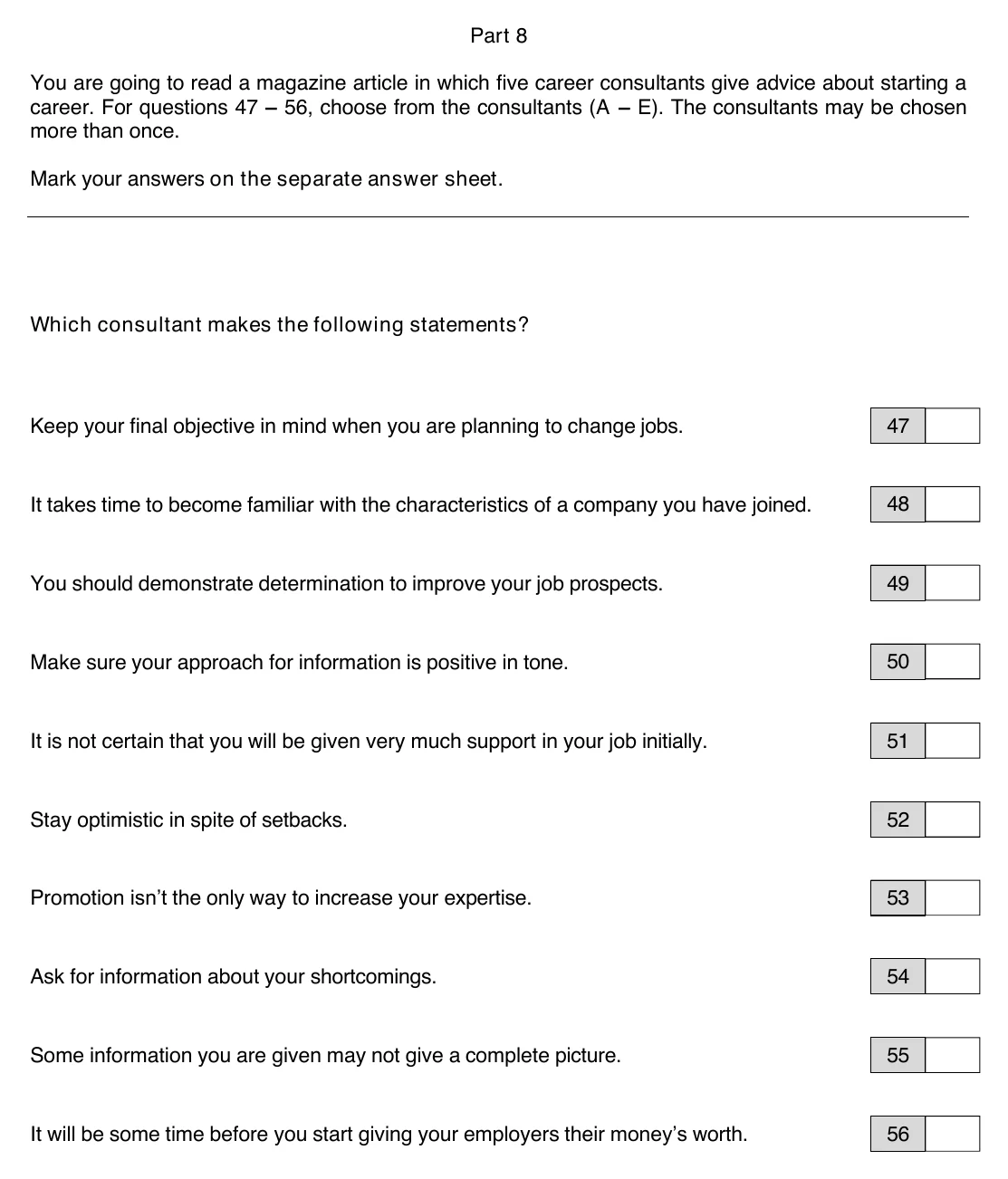
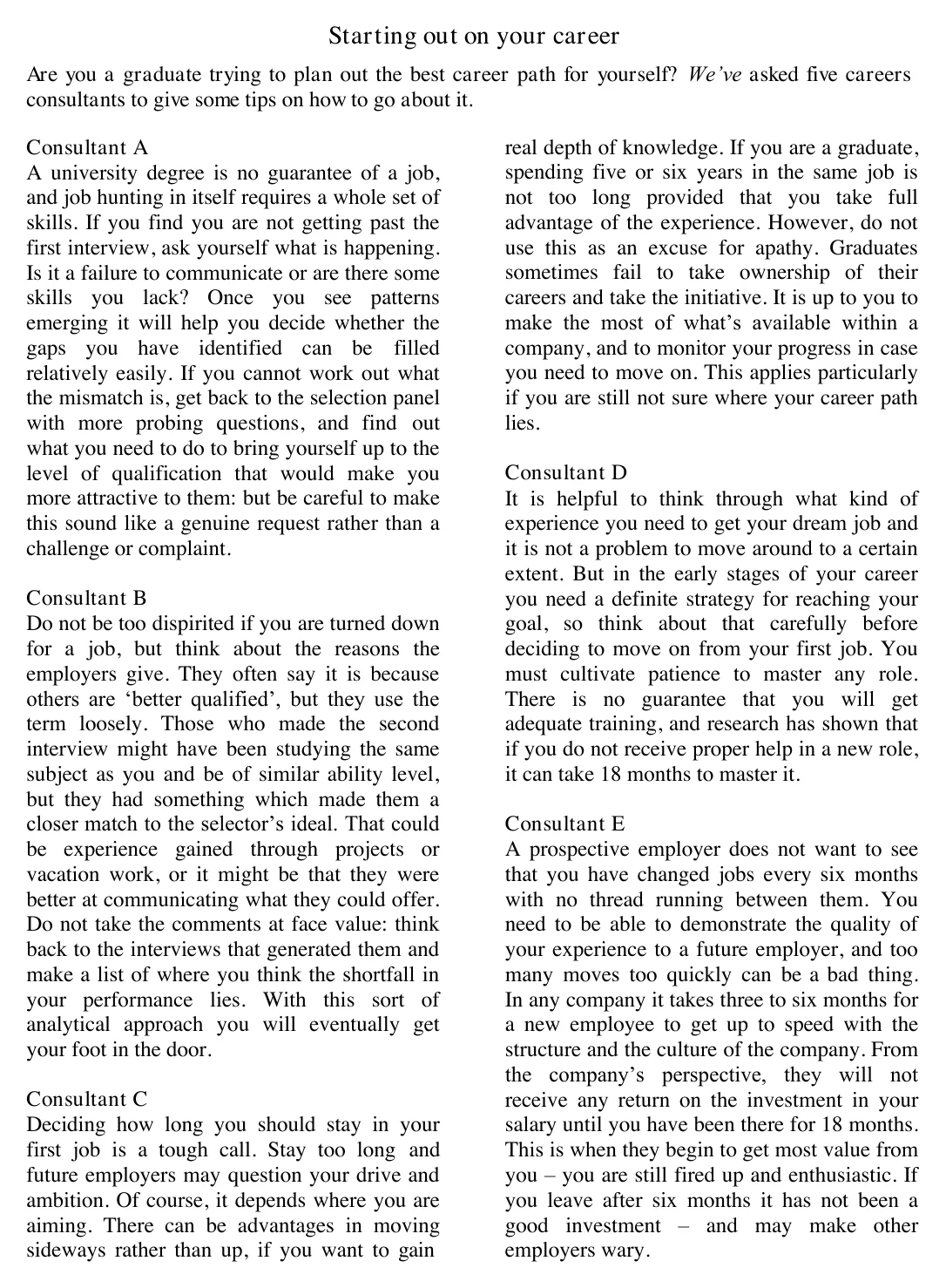
Pulsa en una página para verla a tamaño completo. Examen de muestra oficial del C1 Advanced (Sample Paper 1, Reading and Use of English). © Cambridge University Press & Assessment.
47. Respuesta: D. Keep your final objective in mind when you are planning to change jobs. D dice que al principio de tu carrera necesitas a definite strategy for reaching your goal, y que lo pienses bien before deciding to move on from your first job. E también habla de cambiar de trabajo, pero para decir que no conviene hacerlo demasiado a menudo, no para hablar de tu objetivo final.
48. Respuesta: E. It takes time to become familiar with the characteristics of a company you have joined. E dice que en cualquier empresa it takes three to six months for a new employee to get up to speed with the structure and the culture of the company. The structure and the culture son esas characteristics.
49. Respuesta: C. You should demonstrate determination to improve your job prospects. C avisa de que no uses la experiencia en un mismo puesto as an excuse for apathy, y pide a los graduados que take ownership of their careers and take the initiative. Esa iniciativa es la determination de la afirmación.
50. Respuesta: A. Make sure your approach for information is positive in tone. A aconseja volver a hablar con el tribunal de selección con más preguntas, but be careful to make this sound like a genuine request rather than a challenge or complaint. Que suene como una petición, no como una queja: eso es un tono positivo.
51. Respuesta: D. It is not certain that you will be given very much support in your job initially. D dice: There is no guarantee that you will get adequate training. No guarantee es not certain, y adequate training es very much support.
52. Respuesta: B. Stay optimistic in spite of setbacks. B empieza con Do not be too dispirited if you are turned down for a job. Que te rechacen es el contratiempo, y no desanimarte es mantener el optimismo.
53. Respuesta: C. Promotion isn’t the only way to increase your expertise. C dice que There can be advantages in moving sideways rather than up, if you want to gain real depth of knowledge. Moverse «hacia arriba» es el ascenso, y depth of knowledge es la expertise.
54. Respuesta: A. Ask for information about your shortcomings. A aconseja volver al tribunal de selección with more probing questions para averiguar what you need to do to bring yourself up to the level of qualification que buscan. Es decir, preguntar qué te falta. Ojo con B: también habla de the shortfall in your performance, pero B te pide que lo analices tú, no que preguntes.
55. Respuesta: B. Some information you are given may not give a complete picture. B explica que los empleadores suelen decir que otros candidatos estaban better qualified, pero que they use the term loosely, y añade: Do not take the comments at face value. Lo que te dicen no cuenta toda la historia.
56. Respuesta: E. It will be some time before you start giving your employers their money’s worth. E dice que la empresa will not receive any return on the investment in your salary until you have been there for 18 months. Aquí está la trampa más clara de la tarea: D también menciona 18 months, pero para decir lo que se tarda en dominar un puesto, no cuándo empieza a rentarle tu sueldo a la empresa.
Respuestas, por si has ido apuntando: 47D, 48E, 49C, 50A, 51D, 52B, 53C, 54A, 55B, 56E.
Qué decidía cada respuesta
Si ponemos cada afirmación junto a la frase del texto que la responde, se ve muy bien cómo parafrasea Cambridge:
| Pregunta | Respuesta | La afirmación dice… | …y el texto lo dice así |
|---|---|---|---|
| 47 | D | final objective | a definite strategy for reaching your goal |
| 48 | E | the characteristics of a company | the structure and the culture of the company |
| 49 | C | demonstrate determination | take ownership… take the initiative |
| 50 | A | positive in tone | a genuine request rather than a challenge or complaint |
| 51 | D | not certain… very much support | no guarantee… adequate training |
| 52 | B | stay optimistic in spite of setbacks | do not be too dispirited if you are turned down |
| 53 | C | promotion isn’t the only way | moving sideways rather than up |
| 54 | A | ask for information about your shortcomings | get back to the selection panel with more probing questions |
| 55 | B | may not give a complete picture | do not take the comments at face value |
| 56 | E | their money’s worth | any return on the investment in your salary |
Fíjate en dos cosas. Las afirmaciones casi nunca repiten las palabras clave del texto: dicen lo mismo con otras. Y cada consultor es la respuesta de exactamente dos preguntas: es habitual, pero no siempre es así, así que no lo uses para decidir.
Las trampas típicas de la Parte 8 del C1 Reading
- La palabra o el dato que se repite. El mismo número, nombre o palabra aparece en dos secciones, y solo una dice lo que pide la afirmación. Los 18 months de D y E en la pregunta 56.
- El mismo tema, otra idea. Dos secciones hablan de lo mismo, pero dicen cosas distintas. A y B hablan de los fallos del candidato, pero solo A dice que preguntes por ellos. Pregunta 54.
- La afirmación con dos partes. El handbook pone un ejemplo: si la afirmación habla de la sorpresa del autor ante una situación difícil, no basta con encontrar la situación difícil; tiene que estar también la sorpresa. Una sección que cumple solo la mitad es una trampa.
- La sección que dice lo contrario. A veces otra sección habla de lo mismo con la opinión opuesta. Si la afirmación es un consejo, comprueba que la sección aconseja eso y no lo desaconseja.
Errores más comunes en la Parte 8 del Reading del C1
- Buscar palabras en vez de ideas. Es el error número uno, y el handbook insiste en él. En el examen de muestra, casi todas las afirmaciones dicen la idea del texto con otras palabras.
- Leerse el texto entero para cada pregunta. Con diez preguntas, es imposible hacerlo a tiempo. Lee sección por sección y ve marcando las afirmaciones que encajan.
- Dejar la Parte 8 para el final sin tiempo. Como es la última del examen, es la que más gente hace con prisas. Si vas mal de tiempo, recuerda que las preguntas de la Parte 7 valen el doble.
- Pensar que todas las letras tienen que salir igual. En el examen de muestra salen dos veces cada una, pero no es una regla. No cambies una respuesta solo para que cuadren las letras.
- Dejar preguntas en blanco. Los fallos no restan. Si al final te quedan dudas, elige la sección más probable.
Cómo preparar la Parte 8 del C1 Advanced
- Practica la lectura rápida. Coge un artículo largo y una lista de cosas que buscar, y ponte un tiempo. Es la habilidad que más se nota en esta parte.
- Lee secciones de consejos y opiniones de varias personas. Revistas, periódicos y webs que preguntan lo mismo a cinco expertos son exactamente el tipo de texto que sale.
- Entrena la paráfrasis. Cuando leas algo, intenta decir lo mismo con otras palabras. Cuanto más rápido reconozcas que no guarantee es not certain, más rápido harás esta parte.
- Aprende los verbos que describen lo que hace un autor. Cite, criticise, concede, illustrate, dismiss… Salen mucho en las afirmaciones del C1.
- Haz tests completos con tiempo. Llegar a la Parte 8 con el tiempo justo es lo normal. Practica con tests enteros para saber cuántos minutos te quedan de verdad.
Ejercicios del Reading C1 Part 8
Aquí tienes dos ejercicios originales de la Parte 8, con el mismo formato que el examen: diez afirmaciones, numeradas del 47 al 56 como en el examen real, y un texto en secciones. El primero son las opiniones de varias personas, y el segundo, un artículo dividido en secciones. Hazlos primero sin mirar las respuestas y, cuando termines, compruébalas: cada una lleva su explicación.
Ejercicio 1: Speaking for others
You are going to read an article in which five interpreters talk about how they work in very different settings. For questions 47–56, choose from the interpreters (A–E). The interpreters may be chosen more than once.
Which interpreter …
47 would rather admit not understanding than pretend to?
48 believes their position hangs on one person’s confidence in them?
49 discovered that overdoing the groundwork could distract from what was being said?
50 criticises those hiring them for not sharing documents in time?
51 argues that economising can stop vital information reaching the person it concerns?
52 finds technology a help beforehand but not once speakers improvise?
53 feels entitled to tone down what is said, provided everyone has been warned?
54 finds the emotional strain worse than the language but can shake it off?
55 regrets having once watered down a remark to protect someone?
56 values an earlier career and urges students not to rush into the profession?
Speaking for others
Five interpreters describe how they started, how they prepare and what the job asks of them.
A Lysander Hargreave, conference interpreter
I never meant to work in a booth. I was translating shipping reports when a colleague lost her voice on the morning of a fisheries summit, and I was pushed in, untrained, with no warning, yet nothing that mattered seemed to get lost. For years I gave up whole weekends to glossaries, until I noticed I was clinging to my lists and no longer hearing the delegate in front of me. Software saves me hours the night before, but no program I know copes, in real time, with a delegate who abandons the script to tell a joke. My worst moment was turning fifty million into fifteen in front of a minister. To students I say: read a newspaper in both languages daily, because your mother tongue fails you before your French does.
B Ignatius Feltham, court interpreter
I came to the courts through a police station, where I was the only Romanian speaker on the volunteer list. For fairness, I rarely see the case documents before the hearing, so I study legal vocabulary in general, mostly on a phone app. When a witness uses a village word I don’t recognise, I tell the bench and ask for it to be explained. A confident guess in that room could cost someone their liberty. I may not add, soften or tidy anything, even when a defendant insults the judge. The terminology I can learn from books; what wears me down is repeating, in the first person, a shopkeeper’s account of the night her premises burned. I walk home along the canal, and by the lock gates the courtroom has usually stopped following me. Students should sit in a public gallery and listen.
C Evander Scarrow, hospital interpreter
I spent eleven years as a nurse, and as the ward’s only Polish speaker I was forever being called away to explain diagnoses. I may get ten minutes’ notice, so I carry a notebook of terms and read up on the commonest conditions. Hospitals still hand the job to a patient’s teenage son to save money, and I once watched a boy leave out the word ‘tumour’ because he couldn’t say it to his mother. The hardest part is not the vocabulary but the faces, and that emotional weight comes home with me. Once a patient begged me to hide something from the doctor, and I had to refuse. My advice to anyone doing a languages degree is to spend a few years in another job first; no course taught me as much as the ward did.
D Ptolemy Ruddiforth, football club interpreter
A knee injury ended my time in the club’s youth team at nineteen, but my Portuguese got me kept on to help new signings settle. My job lasts exactly as long as the head coach thinks I am giving his words straight; the day he doubts it, I am finished. Before every match I read the opposition’s papers and learn the dressing-room slang. After one defeat he called the referee a clown on camera, and to keep him out of trouble with the league I turned it into disappointment with some decisions. Two Portuguese-speaking reporters printed the original, I looked dishonest, and I would never do it again. At press conferences you can’t ask for a word to be repeated, so you keep going and correct yourself afterwards. Students shouldn’t wait for the perfect qualification: get into any booth, any training ground, as young as possible.
E Sebastiaan Vantongeren, business interpreter
I drifted into interpreting from export sales, when I realised I enjoyed the talking more than the selling. Clients promise the slides and the contract, then send them at midnight, if at all, and wonder why I hesitate over the name of their new product. Once a week’s groundwork on a catalogue gave me three useful words, and I would do it again. When a Dutch buyer says flatly that a price is ridiculous, I render it in a form my Japanese clients can hear without losing face. I tell both parties at the start that I will be working this way. Smaller firms often let a bilingual salesperson do the job, which for a factory tour, where nothing crucial is said, is perfectly sensible. I also suspect technology will take over routine meetings within a decade. Students should learn to read a balance sheet, because nobody has confidence in an interpreter who doesn’t understand the deal.
Ver respuestas
- 47. B: Cuando un testigo usa una palabra que no conoce, ‘I tell the bench and ask for it to be explained’, porque ‘A confident guess in that room could cost someone their liberty’. D es la trampa: en las ruedas de prensa no puede parar a preguntar, así que ‘you keep going and correct yourself afterwards’. Nunca admite que no ha entendido.
- 48. D: ‘My job lasts exactly as long as the head coach thinks I am giving his words straight; the day he doubts it, I am finished.’ Su puesto depende de la confianza de una sola persona, el entrenador. E también habla de confianza, pero en general (‘nobody has confidence in an interpreter who doesn’t understand the deal’), no de la de una persona concreta.
- 49. A: Dedicaba ‘whole weekends to glossaries, until I noticed I was clinging to my lists and no longer hearing the delegate in front of me’: prepararse demasiado le impedía escuchar al orador. E también se preparó de más (‘a week’s groundwork on a catalogue gave me three useful words’), pero eso le hizo perder tiempo, no le distrajo, y además ‘I would do it again’.
- 50. E: ‘Clients promise the slides and the contract, then send them at midnight, if at all, and wonder why I hesitate’: critica a los clientes por mandar los documentos tarde. B tampoco suele ver los documentos antes del juicio, pero lo acepta ‘For fairness’ y no critica a nadie.
- 51. C: Los hospitales dejan la interpretación ‘to a patient’s teenage son to save money’, y vio a un chico omitir ‘the word ‘tumour’ because he couldn’t say it to his mother’: por ahorrar, la información importante no llegó a la paciente. E habla de un ahorro parecido (un vendedor bilingüe), pero le parece ‘perfectly sensible’ cuando ‘nothing crucial is said’. Y a A lo pusieron a interpretar sin formación, ‘yet nothing that mattered seemed to get lost’.
- 52. A: ‘Software saves me hours the night before, but no program I know copes, in real time, with a delegate who abandons the script to tell a joke’: la tecnología le ayuda a prepararse, pero no cuando el orador improvisa. B también se prepara con una app, pero no dice nada de sus límites. Y E cree que la tecnología ‘will take over routine meetings within a decade’.
- 53. E: Suaviza lo que dice un comprador holandés ‘in a form my Japanese clients can hear without losing face’, y ‘I tell both parties at the start that I will be working this way’: lo hace porque ha avisado antes a todos. D también suavizó un comentario, pero sin avisar a nadie y ‘would never do it again’. Y B ‘may not add, soften or tidy anything’.
- 54. B: ‘The terminology I can learn from books; what wears me down is repeating, in the first person, a shopkeeper’s account’, y de vuelta a casa, junto a las esclusas, ‘the courtroom has usually stopped following me’: lo emocional le cuesta más que la lengua, pero consigue desconectar. C solo cumple la primera mitad: las caras le cuestan más que el vocabulario, pero ‘that emotional weight comes home with me’.
- 55. D: Para que el entrenador no tuviera problemas con la liga, convirtió ‘a clown’ en ‘disappointment with some decisions’. Luego ‘looked dishonest, and I would never do it again’: se arrepiente. El peor momento de A, convertir cincuenta millones en quince, fue un error, no un cambio hecho a propósito para proteger a nadie.
- 56. C: A los estudiantes de idiomas les aconseja ‘to spend a few years in another job first’, porque ‘no course taught me as much as the ward did’: valora su carrera anterior y pide no tener prisa. D también tuvo otra carrera antes, en el fútbol, pero aconseja lo contrario: empezar ‘as young as possible’.
Ejercicio 2: Living with the mountain
You are going to read an article about four communities that live beside active volcanoes. For questions 47–56, choose from the sections (A–D). The sections may be chosen more than once.
In which section does the writer …
47 cite findings that people’s livelihoods affect how they rate the risk?
48 explain how a precaution was undermined by its own regularity?
49 criticise the authorities for tolerating breaches of a restriction on land use?
50 explain why an arrangement proved unrealistic once it was finally tested?
51 report that a gesture towards openness at first caused needless alarm?
52 report an expert’s high opinion of data gathered by amateurs?
53 compare how seriously long-settled households and newcomers take the risk?
54 contrast what local people worry about with what has actually hurt them?
55 describe a scheme that relies on the young to teach their elders?
56 object to the way the danger is played down for tourists?
Living with the mountain
Four communities live within sight of an active volcano, and each has found its own way of watching it, farming beside it and getting ready to leave.
A
Valdrenna’s vineyards climb almost to the rim of the crater, as high as a 1960 bylaw allows. Growers swear that ash soil gives their wine a mineral edge no lowland grape can match. Ask anyone over sixty and they will tell you the mountain gives more than it takes; their grandchildren are less sure. In 2011 a university team installed six seismometers on its flanks and, in the name of transparency, put a live feed of the readings on a screen in the main square. Every jagged line brought anxious calls to the mayor’s office, most of them about lorries rumbling past a sensor. The screen now shows a single coloured light. Held on the same Sunday every May, the evacuation drill slowly turned into a social occasion, with stalls selling sausages, and few people still treated it as a rehearsal. Drills now come without warning. The tasting rooms sell coach parties on a ‘sleeping giant’, a phrase no volcanologist would use about a mountain that last erupted in 1958.
B
On Kessarin the volcano is the island, and the only way off it is by sea. The evacuation plan, drawn up in 1979, assumed that the town could be emptied in four hours. When it was at last rehearsed in 2019, two of the three ferries were away on summer routes. The remaining one could carry barely 400 people a trip, so the operation took more than nine. Islanders talk about lava, but lava has not reached the town for three centuries. What has done the damage is ash: in 1994 a night of rain turned it into something like wet cement, and the roofs of the school and forty houses gave way. Every household now keeps a stiff broom by the attic hatch. The observatory publishes its readings on a free phone app, which fewer than one islander in ten has downloaded. Lemon groves on the lower slopes earn more than fishing, and the hot springs, advertised as ‘the mountain’s gift’, fill the hotels with visitors. Yet the young still leave for the mainland, for want of jobs rather than fear of the mountain.
C
Mirtavel’s coffee farms, on a shelf below a crater lake, owe three harvests a year to the soil the mountain has laid down. Every Monday twelve farmers check the temperature of the springs above the town and send the figures to the observatory. Its director says their notebooks have proved no less dependable than its sensors. A survey by a regional university found that farming households put the chance of an eruption at half the figure given by neighbours who work in shops and offices. Children rehearse the route to the football ground on the first Friday of every term. Their teachers then set homework that requires them to walk it again with whoever they live with, and that, rather than any leaflet, is how most parents and grandparents learnt it. Guided walks to the crater rim, led mostly by former farm labourers, now earn the town more than coffee does. Every walk opens with a frank talk about the gas that collects in hollows near the top, a danger few visitors have heard of.
D
Sorvanne lies beneath a mountain that has been quiet since 1944. The national agency only began to measure its gases closely in 2008; until then it had nothing but shepherds’ reports to go on. Families whose grandparents remember the ash of 1944 still keep a bag packed by the door. Most of those who have moved out from the city in the last decade could not say when the mountain last stirred. Tomatoes are the town’s fortune, and the greenhouses have crept uphill towards the richest soil. Rules drawn up in 1987 bar cultivation above 600 metres. Yet research by a geography department has found plastic roofs 140 metres higher, and the regional government has not issued a single fine. That is hard to excuse, since the evacuation plan, never once rehearsed, relies on one road through those slopes. In 2015 a swarm of small earthquakes set off rumours on social media that spread alarm faster than any official notice. The mayor now broadcasts a radio bulletin every evening when the ground is restless. Pupils at the primary school hold an exercise each spring, which parents are invited to watch.
Ver respuestas
- 47. C: ‘A survey by a regional university found that farming households put the chance of an eruption at half the figure given by neighbours who work in shops and offices’: un estudio muestra que el trabajo de cada uno cambia cómo ve el riesgo. D también compara dos grupos, pero los divide por cuándo llegaron al pueblo, no por su trabajo. Y en A, los mayores y sus nietos se diferencian por la edad.
- 48. A: El simulacro, ‘Held on the same Sunday every May’, se convirtió poco a poco en una fiesta, y ‘few people still treated it as a rehearsal’: hacerlo siempre el mismo día le quitó su sentido. En C y en D también hay ejercicios en fechas fijas, pero nada indica que eso los haya estropeado.
- 49. D: Las normas de 1987 prohíben cultivar por encima de 600 metros, pero hay invernaderos ‘140 metres higher, and the regional government has not issued a single fine. That is hard to excuse’: el autor critica a las autoridades por consentirlo. En A también hay un límite para plantar, pero las viñas llegan ‘as high as a 1960 bylaw allows’, así que no se incumple nada.
- 50. B: El plan ‘assumed that the town could be emptied in four hours’, pero cuando por fin se ensayó, en 2019, dos de los tres ferris no estaban y ‘the operation took more than nine’. El plan de D también parece débil, pero ‘never once rehearsed’, y el simulacro de A falló porque la gente dejó de tomárselo en serio, no porque fuera imposible.
- 51. A: ‘In the name of transparency’, el equipo puso los datos en directo en una pantalla de la plaza, y cada pico ‘brought anxious calls to the mayor’s office, most of them about lorries rumbling past a sensor’: un gesto de transparencia que provocó alarmas innecesarias. En B el observatorio también publica sus datos, pero casi nadie se ha descargado la app. Y en D la alarma vino de ‘rumours on social media’, no de los datos oficiales.
- 52. C: Los agricultores miden los manantiales y mandan los datos al observatorio, y ‘Its director says their notebooks have proved no less dependable than its sensors’: un experto valora mucho los datos de aficionados. En D, la agencia también dependía de los pastores, pero solo ‘until then’, lo que sugiere que esos datos no bastaban.
- 53. D: ‘Families whose grandparents remember the ash of 1944 still keep a bag packed by the door. Most of those who have moved out from the city in the last decade could not say when the mountain last stirred’: compara a las familias de siempre con los recién llegados. A compara a los mayores con sus nietos, pero todos son de familias del pueblo, y C divide a la gente por su trabajo.
- 54. B: ‘Islanders talk about lava, but lava has not reached the town for three centuries. What has done the damage is ash’: lo que preocupa a la gente no es lo que de verdad les ha hecho daño. En C, los guías advierten del gas, ‘a danger few visitors have heard of’, pero son los turistas, no los vecinos, quienes no lo conocen, y nada dice que el gas haya hecho daño a nadie.
- 55. C: Los profesores ponen deberes que obligan a los niños a repetir la ruta ‘with whoever they live with’, y así es como ‘most parents and grandparents learnt it’: son los niños quienes enseñan a los mayores. En D los padres solo están ‘invited to watch’ el ejercicio, y mirar no es aprender la ruta.
- 56. A: Las bodegas venden a los turistas un ‘sleeping giant’, ‘a phrase no volcanologist would use about a mountain that last erupted in 1958’: el autor critica que se le quite importancia al peligro. En B los manantiales también se venden como ‘the mountain’s gift’, pero el autor no lo critica. Y en C los guías hacen justo lo contrario: empiezan con ‘a frank talk about the gas’.
Preguntas frecuentes sobre la Parte 8 del Reading del C1
¿Cuántas preguntas tiene la Parte 8 del Reading del C1 Advanced?
Diez preguntas, numeradas del 47 al 56. Cada una vale 1 punto, así que la Parte 8 suma 10 puntos.
¿Se puede repetir una letra?
Sí. Cada sección puede ser la respuesta de varias preguntas, y no tienen por qué salir todas el mismo número de veces.
¿Leo primero el texto o las afirmaciones?
Las afirmaciones. Por eso Cambridge las pone antes del texto: así sabes qué buscar. Luego lee el texto sección por sección y ve marcando las afirmaciones que encajan en cada una.
¿Cuánto tiempo debo dedicarle?
Cambridge no fija tiempos por parte: tienes 1 hora y 30 minutos para las ocho partes. Unos 10 o 12 minutos suelen bastar para la Parte 8, si buscas ideas y no palabras.
¿Es igual en papel y en ordenador?
La tarea es la misma. En el examen por ordenador respondes en la pantalla y puedes resaltar partes del texto, algo muy útil para marcar dónde está cada idea.
Sigue preparando el Reading del C1
Esta guía forma parte de la serie sobre el Reading del C1 Advanced, y con ella ya tienes todas las partes. Si vienes de la anterior, la tienes en mi guía de la Parte 7, el gapped text. Si quieres ver cómo encaja todo en el examen completo, vuelve a la página principal del C1 Advanced o echa un vistazo a la calculadora de nota del C1. Y si buscas material para practicar, aquí tienes mi selección de los mejores libros para preparar el C1 Advanced.
¿Te ha resultado útil esta guía? Compártela con otros estudiantes y profesores que estén preparando el CAE. Y si te queda alguna duda con alguna pregunta, déjamela en los comentarios, que las leo todas.
Hasta la próxima, don’t forget to keep smiling! 🙂
