

Table of contents
C1 Advanced Reading Part 8 is the last part of the paper, and it comes when you’ve already been reading for over an hour. You get ten statements and a text divided into sections, or several short texts by different people, and you have to decide which section each idea appears in. You don’t need to understand every word of the text: you need to know how to search. And, above all, not to be fooled by the sections that say something similar, but not quite the same.
In this guide I explain how CAE Reading Part 8 (the multiple matching task) works, what kinds of statements come up according to Cambridge’s official tasks, how it differs from B2, a method for tackling it quickly and accurately and the official sample paper worked through question by question. At the end there are two original exercises to practise with, with the answers explained. Let’s go!
What C1 Advanced Reading Part 8 looks like
| Fact | C1 Reading Part 8 |
|---|---|
| What you have to do | Read ten statements and decide which section of the text (A, B, C…) each one appears in |
| Number of questions | 10 (numbered 47 to 56) |
| Marks | 1 mark per correct answer (10 in total); wrong answers don’t lose marks |
| Length of the text | About 650 words, divided into 4 to 6 sections |
| Type of text | An article divided into sections, or several short texts by different people (experts, professionals, readers…) |
| Letters | Each section can be the answer to several questions |
| What it tests | Finding specific information, opinions and attitudes, and telling them apart from similar ideas |
All of this is part of the Reading and Use of English paper, which lasts 1 hour 30 minutes and has eight parts and 56 questions. Look at the marks: unlike Parts 5, 6 and 7, each question here is worth 1 mark. There are ten questions, but they’re worth the same as five in Part 7. About 10 to 12 minutes should be enough.
You’ll find the full picture of Parts 1 and 5 to 8 in my C1 Advanced Reading guide.
What kinds of statements come up in C1 Reading Part 8
The questions come before the text, and that’s no accident: Cambridge wants you to read them first and then search. In the official tasks I analysed there are two styles of statement, depending on the type of text:
| Type of text | What the statements are like | Example |
|---|---|---|
| Several people (consultants, experts, readers) | A piece of advice or an opinion, paraphrased as a full sentence | Stay optimistic in spite of setbacks. |
| An article divided into sections | What the writer does in that section | refers to someone who…, cites a study that…, uses a comparison to…, criticises someone for failing to… |
Either way, the statement hardly ever repeats the words of the text: it paraphrases it. And here’s a curious fact from the official tasks: when a word from the statement does appear in the text, it’s more likely to be in a wrong section than in the right one. Hunting for single words is the quickest way to go wrong.
How it differs from B2 First
The format is the same as in B2 First Reading Part 7. The difference is in the statements. At C1 they’re more abstract: many are about what the writer does (criticises, cites, explains) or about an attitude, not a fact. And there are more statements with two parts, which only match a section if both parts are there.
The four-step method
- Read the ten statements first and underline the key idea. Not single words, but what you’re really being asked for: a piece of advice, a criticism, a study, a comparison. If a statement has two parts, underline both.
- Read the text section by section. After each one, go back over the statements and mark the ones that could go there. It’s quicker than reading the whole text ten times looking for each statement.
- Check the whole statement. Before you settle on an answer, find the sentence in the section that says the same thing. If only part of the statement matches, keep looking.
- See whether another section says something similar. In Part 8 there’s almost always a «trap» section on the same subject. Compare the two and choose the one that says exactly what the statement asks for.
The sample paper, worked through question by question
This is the Part 8 text from Cambridge’s official C1 Advanced sample paper: an article in which five careers consultants give advice to graduates starting out on their careers. Try it before you read the explanations:
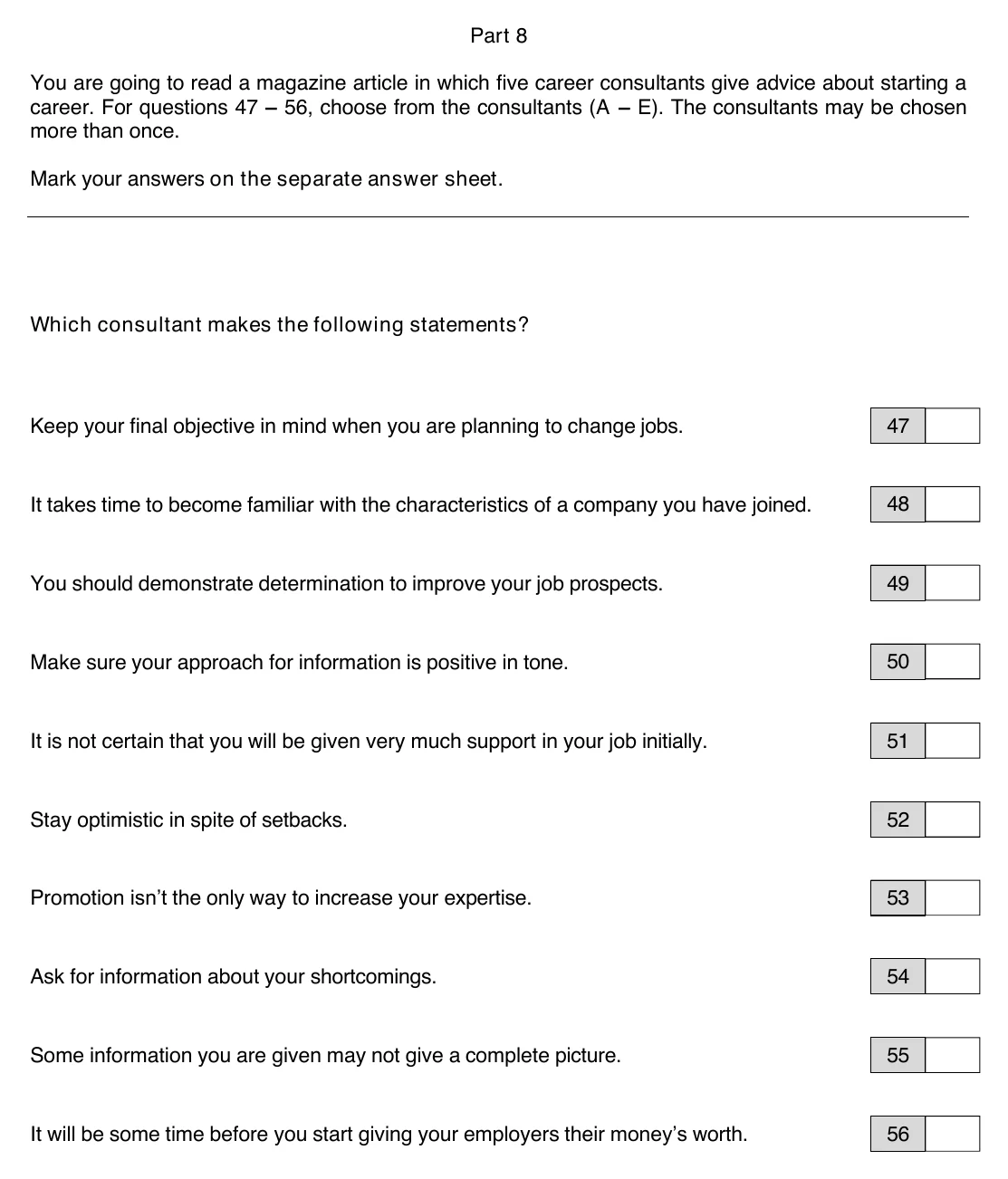
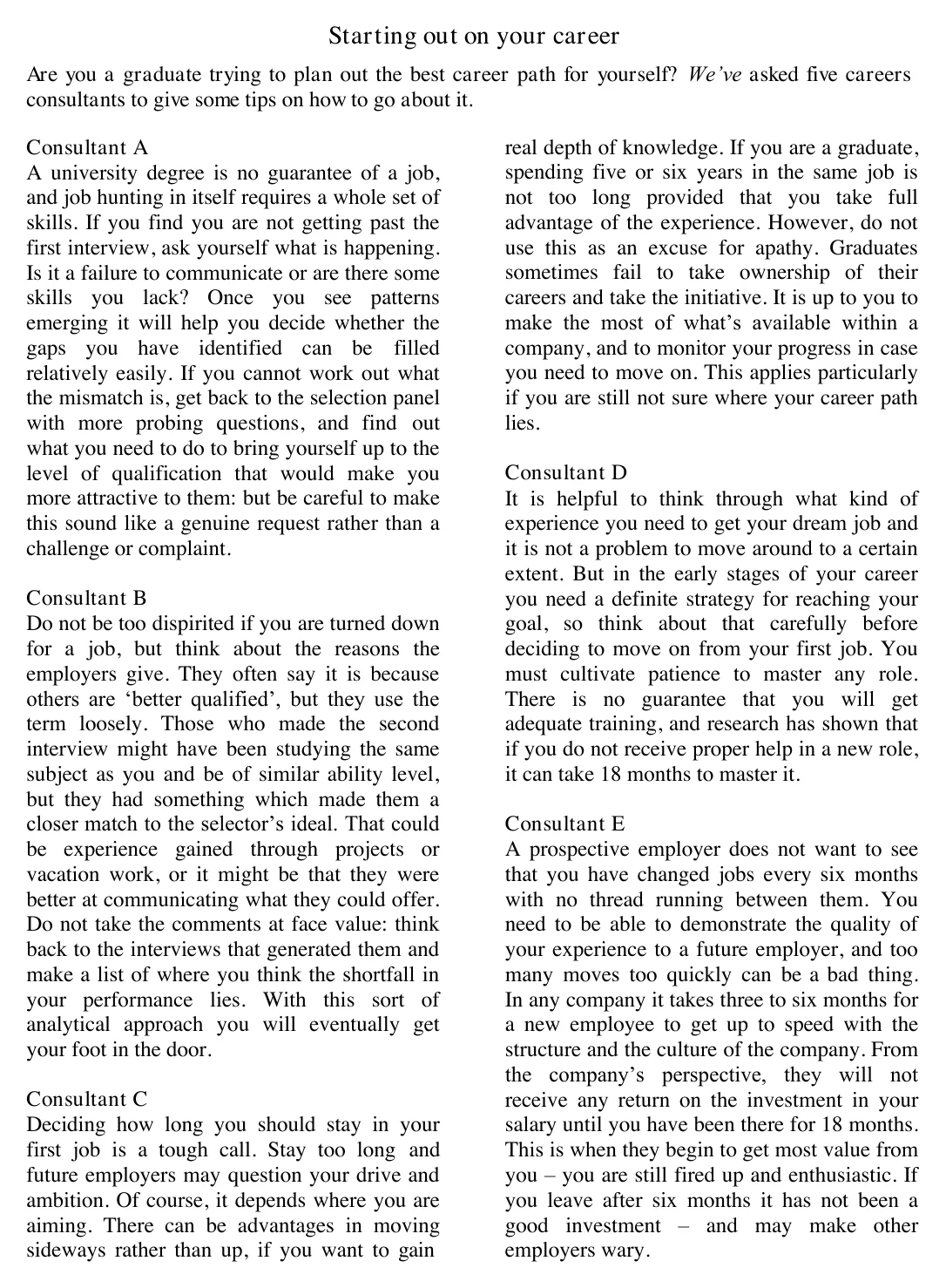
Click on a page to see it full size. Official C1 Advanced sample paper (Sample Paper 1, Reading and Use of English). © Cambridge University Press & Assessment.
47. Answer: D. Keep your final objective in mind when you are planning to change jobs. D says that early in your career you need a definite strategy for reaching your goal, and to think about it carefully before deciding to move on from your first job. E also talks about changing jobs, but to say you shouldn’t do it too often, not about your final goal.
48. Answer: E. It takes time to become familiar with the characteristics of a company you have joined. E says that in any company it takes three to six months for a new employee to get up to speed with the structure and the culture of the company. The structure and the culture are those characteristics.
49. Answer: C. You should demonstrate determination to improve your job prospects. C warns against using experience in the same job as an excuse for apathy, and asks graduates to take ownership of their careers and take the initiative. That initiative is the determination in the statement.
50. Answer: A. Make sure your approach for information is positive in tone. A advises going back to the selection panel with more questions, but be careful to make this sound like a genuine request rather than a challenge or complaint. Sounding like a request, not a complaint: that’s a positive tone.
51. Answer: D. It is not certain that you will be given very much support in your job initially. D says: There is no guarantee that you will get adequate training. No guarantee is not certain, and adequate training is very much support.
52. Answer: B. Stay optimistic in spite of setbacks. B starts with Do not be too dispirited if you are turned down for a job. Being turned down is the setback, and not getting dispirited is staying optimistic.
53. Answer: C. Promotion isn’t the only way to increase your expertise. C says There can be advantages in moving sideways rather than up, if you want to gain real depth of knowledge. Moving «up» is promotion, and depth of knowledge is expertise.
54. Answer: A. Ask for information about your shortcomings. A advises going back to the selection panel with more probing questions to find out what you need to do to bring yourself up to the level of qualification they want. In other words, asking what you’re missing. Watch out for B: it also mentions the shortfall in your performance, but B asks you to work that out yourself, not to ask.
55. Answer: B. Some information you are given may not give a complete picture. B explains that employers often say other candidates were better qualified, but that they use the term loosely, and adds: Do not take the comments at face value. What you’re told doesn’t tell the whole story.
56. Answer: E. It will be some time before you start giving your employers their money’s worth. E says the company will not receive any return on the investment in your salary until you have been there for 18 months. Here’s the clearest trap in the task: D also mentions 18 months, but to say how long it takes to master a role, not when your salary starts paying off for the company.
The answers, in case you’ve been keeping track: 47D, 48E, 49C, 50A, 51D, 52B, 53C, 54A, 55B, 56E.
What decided each answer
Put each statement next to the sentence in the text that answers it and you can see very clearly how Cambridge paraphrases:
| Question | Answer | The statement says… | …and the text says it like this |
|---|---|---|---|
| 47 | D | final objective | a definite strategy for reaching your goal |
| 48 | E | the characteristics of a company | the structure and the culture of the company |
| 49 | C | demonstrate determination | take ownership… take the initiative |
| 50 | A | positive in tone | a genuine request rather than a challenge or complaint |
| 51 | D | not certain… very much support | no guarantee… adequate training |
| 52 | B | stay optimistic in spite of setbacks | do not be too dispirited if you are turned down |
| 53 | C | promotion isn’t the only way | moving sideways rather than up |
| 54 | A | ask for information about your shortcomings | get back to the selection panel with more probing questions |
| 55 | B | may not give a complete picture | do not take the comments at face value |
| 56 | E | their money’s worth | any return on the investment in your salary |
Notice two things. The statements hardly ever repeat the key words of the text: they say the same thing in other words. And each consultant is the answer to exactly two questions: that’s common, but it isn’t always the case, so don’t use it to decide.
The typical traps in C1 Reading Part 8
- The repeated word or figure. The same number, name or word appears in two sections, and only one says what the statement asks for. The 18 months in D and E in question 56.
- Same subject, different idea. Two sections talk about the same thing but say different things. A and B both talk about the candidate’s weaknesses, but only A says you should ask about them. Question 54.
- The two-part statement. The handbook gives an example: if the statement is about the writer’s surprise at a difficult situation, finding the difficult situation isn’t enough; the surprise has to be there too. A section that matches only half is a trap.
- The section that says the opposite. Sometimes another section deals with the same subject from the opposite point of view. If the statement is a piece of advice, check that the section recommends it and doesn’t warn against it.
The most common mistakes in C1 Reading Part 8
- Looking for words instead of ideas. This is mistake number one, and the handbook keeps coming back to it. In the sample paper, almost every statement expresses the idea of the text in other words.
- Reading the whole text for each question. With ten questions, you can’t do that in time. Read section by section and mark the statements that fit as you go.
- Leaving Part 8 until the end with no time left. As it’s the last part, it’s the one most people rush. If you’re short of time, remember that Part 7 questions are worth twice as much.
- Thinking every letter has to come up equally. In the sample paper each one comes up twice, but that isn’t a rule. Don’t change an answer just to make the letters even.
- Leaving questions blank. Wrong answers don’t lose marks. If you’re still unsure at the end, choose the most likely section.
How to prepare for C1 Advanced Part 8
- Practise reading quickly. Take a long article and a list of things to find, and time yourself. It’s the skill that shows most in this part.
- Read advice and opinion pieces from several people. Magazines, newspapers and websites that ask five experts the same question are exactly the kind of text that comes up.
- Train your paraphrasing. When you read something, try to say the same thing in other words. The faster you recognise that no guarantee means not certain, the faster you’ll do this part.
- Learn the verbs that describe what a writer does. Cite, criticise, concede, illustrate, dismiss… They come up a lot in C1 statements.
- Do full tests against the clock. Getting to Part 8 with little time left is normal. Practise with complete tests so you know how many minutes you really have.
C1 Reading Part 8 exercises
Here are two original Part 8 exercises, in the same format as the exam: ten statements, numbered 47 to 56 as in the real exam, and a text in sections. The first gives the views of several people, and the second is an article divided into sections. Do them first without looking at the answers and, when you’ve finished, check them: each answer comes with an explanation.
Exercise 1: Speaking for others
You are going to read an article in which five interpreters talk about how they work in very different settings. For questions 47–56, choose from the interpreters (A–E). The interpreters may be chosen more than once.
Which interpreter …
47 would rather admit not understanding than pretend to?
48 believes their position hangs on one person’s confidence in them?
49 discovered that overdoing the groundwork could distract from what was being said?
50 criticises those hiring them for not sharing documents in time?
51 argues that economising can stop vital information reaching the person it concerns?
52 finds technology a help beforehand but not once speakers improvise?
53 feels entitled to tone down what is said, provided everyone has been warned?
54 finds the emotional strain worse than the language but can shake it off?
55 regrets having once watered down a remark to protect someone?
56 values an earlier career and urges students not to rush into the profession?
Speaking for others
Five interpreters describe how they started, how they prepare and what the job asks of them.
A Lysander Hargreave, conference interpreter
I never meant to work in a booth. I was translating shipping reports when a colleague lost her voice on the morning of a fisheries summit, and I was pushed in, untrained, with no warning, yet nothing that mattered seemed to get lost. For years I gave up whole weekends to glossaries, until I noticed I was clinging to my lists and no longer hearing the delegate in front of me. Software saves me hours the night before, but no program I know copes, in real time, with a delegate who abandons the script to tell a joke. My worst moment was turning fifty million into fifteen in front of a minister. To students I say: read a newspaper in both languages daily, because your mother tongue fails you before your French does.
B Ignatius Feltham, court interpreter
I came to the courts through a police station, where I was the only Romanian speaker on the volunteer list. For fairness, I rarely see the case documents before the hearing, so I study legal vocabulary in general, mostly on a phone app. When a witness uses a village word I don’t recognise, I tell the bench and ask for it to be explained. A confident guess in that room could cost someone their liberty. I may not add, soften or tidy anything, even when a defendant insults the judge. The terminology I can learn from books; what wears me down is repeating, in the first person, a shopkeeper’s account of the night her premises burned. I walk home along the canal, and by the lock gates the courtroom has usually stopped following me. Students should sit in a public gallery and listen.
C Evander Scarrow, hospital interpreter
I spent eleven years as a nurse, and as the ward’s only Polish speaker I was forever being called away to explain diagnoses. I may get ten minutes’ notice, so I carry a notebook of terms and read up on the commonest conditions. Hospitals still hand the job to a patient’s teenage son to save money, and I once watched a boy leave out the word ‘tumour’ because he couldn’t say it to his mother. The hardest part is not the vocabulary but the faces, and that emotional weight comes home with me. Once a patient begged me to hide something from the doctor, and I had to refuse. My advice to anyone doing a languages degree is to spend a few years in another job first; no course taught me as much as the ward did.
D Ptolemy Ruddiforth, football club interpreter
A knee injury ended my time in the club’s youth team at nineteen, but my Portuguese got me kept on to help new signings settle. My job lasts exactly as long as the head coach thinks I am giving his words straight; the day he doubts it, I am finished. Before every match I read the opposition’s papers and learn the dressing-room slang. After one defeat he called the referee a clown on camera, and to keep him out of trouble with the league I turned it into disappointment with some decisions. Two Portuguese-speaking reporters printed the original, I looked dishonest, and I would never do it again. At press conferences you can’t ask for a word to be repeated, so you keep going and correct yourself afterwards. Students shouldn’t wait for the perfect qualification: get into any booth, any training ground, as young as possible.
E Sebastiaan Vantongeren, business interpreter
I drifted into interpreting from export sales, when I realised I enjoyed the talking more than the selling. Clients promise the slides and the contract, then send them at midnight, if at all, and wonder why I hesitate over the name of their new product. Once a week’s groundwork on a catalogue gave me three useful words, and I would do it again. When a Dutch buyer says flatly that a price is ridiculous, I render it in a form my Japanese clients can hear without losing face. I tell both parties at the start that I will be working this way. Smaller firms often let a bilingual salesperson do the job, which for a factory tour, where nothing crucial is said, is perfectly sensible. I also suspect technology will take over routine meetings within a decade. Students should learn to read a balance sheet, because nobody has confidence in an interpreter who doesn’t understand the deal.
Show answers
- 47. B: When a witness uses a word he doesn’t know, ‘I tell the bench and ask for it to be explained’, because ‘A confident guess in that room could cost someone their liberty’. D is the lure: at press conferences he cannot stop to ask, so ‘you keep going and correct yourself afterwards’, which corrects a slip but never admits not understanding.
- 48. D: ‘My job lasts exactly as long as the head coach thinks I am giving his words straight; the day he doubts it, I am finished.’ E also mentions confidence, but in general terms: ‘nobody has confidence in an interpreter who doesn’t understand the deal’, not one individual’s.
- 49. A: He gave up ‘whole weekends to glossaries, until I noticed I was clinging to my lists and no longer hearing the delegate in front of me’. E also over-prepared (‘a week’s groundwork on a catalogue gave me three useful words’), but it wasted effort rather than distracting him, and ‘I would do it again’.
- 50. E: ‘Clients promise the slides and the contract, then send them at midnight, if at all, and wonder why I hesitate’. B also rarely sees ‘the case documents before the hearing’, but accepts this ‘For fairness’ and criticises no one.
- 51. C: Hospitals ‘hand the job to a patient’s teenage son to save money’, and he watched a boy ‘leave out the word ‘tumour’ because he couldn’t say it to his mother’. E describes a similar saving, ‘a bilingual salesperson’, but finds it ‘perfectly sensible’ where ‘nothing crucial is said’; A was pushed in ‘untrained’ himself, ‘yet nothing that mattered seemed to get lost’.
- 52. A: ‘Software saves me hours the night before, but no program I know copes, in real time, with a delegate who abandons the script to tell a joke.’ B also prepares with technology (‘on a phone app’) but says nothing about its limits; E thinks ‘technology will take over routine meetings within a decade’.
- 53. E: He renders a Dutch buyer’s flat remark ‘in a form my Japanese clients can hear without losing face’, and ‘I tell both parties at the start that I will be working this way.’ D also toned down a remark (‘a clown’ became ‘disappointment with some decisions’), but told no one and ‘would never do it again’; B ‘may not add, soften or tidy anything’.
- 54. B: ‘The terminology I can learn from books; what wears me down is repeating, in the first person, a shopkeeper’s account’, and by the lock gates on the walk home ‘the courtroom has usually stopped following me’. C matches only the first part: the faces are harder than the vocabulary, but ‘that emotional weight comes home with me’.
- 55. D: To keep the coach ‘out of trouble with the league’ he turned ‘a clown’ into ‘disappointment with some decisions’, then ‘looked dishonest, and I would never do it again’. A’s worst moment, ‘fifty million into fifteen’, was a slip, not a deliberate change to help anyone.
- 56. C: He tells language students ‘to spend a few years in another job first’, since ‘no course taught me as much as the ward did’. D also had an earlier career in football, but advises the opposite: get in ‘as young as possible’.
Exercise 2: Living with the mountain
You are going to read an article about four communities that live beside active volcanoes. For questions 47–56, choose from the sections (A–D). The sections may be chosen more than once.
In which section does the writer …
47 cite findings that people’s livelihoods affect how they rate the risk?
48 explain how a precaution was undermined by its own regularity?
49 criticise the authorities for tolerating breaches of a restriction on land use?
50 explain why an arrangement proved unrealistic once it was finally tested?
51 report that a gesture towards openness at first caused needless alarm?
52 report an expert’s high opinion of data gathered by amateurs?
53 compare how seriously long-settled households and newcomers take the risk?
54 contrast what local people worry about with what has actually hurt them?
55 describe a scheme that relies on the young to teach their elders?
56 object to the way the danger is played down for tourists?
Living with the mountain
Four communities live within sight of an active volcano, and each has found its own way of watching it, farming beside it and getting ready to leave.
A
Valdrenna’s vineyards climb almost to the rim of the crater, as high as a 1960 bylaw allows. Growers swear that ash soil gives their wine a mineral edge no lowland grape can match. Ask anyone over sixty and they will tell you the mountain gives more than it takes; their grandchildren are less sure. In 2011 a university team installed six seismometers on its flanks and, in the name of transparency, put a live feed of the readings on a screen in the main square. Every jagged line brought anxious calls to the mayor’s office, most of them about lorries rumbling past a sensor. The screen now shows a single coloured light. Held on the same Sunday every May, the evacuation drill slowly turned into a social occasion, with stalls selling sausages, and few people still treated it as a rehearsal. Drills now come without warning. The tasting rooms sell coach parties on a ‘sleeping giant’, a phrase no volcanologist would use about a mountain that last erupted in 1958.
B
On Kessarin the volcano is the island, and the only way off it is by sea. The evacuation plan, drawn up in 1979, assumed that the town could be emptied in four hours. When it was at last rehearsed in 2019, two of the three ferries were away on summer routes. The remaining one could carry barely 400 people a trip, so the operation took more than nine. Islanders talk about lava, but lava has not reached the town for three centuries. What has done the damage is ash: in 1994 a night of rain turned it into something like wet cement, and the roofs of the school and forty houses gave way. Every household now keeps a stiff broom by the attic hatch. The observatory publishes its readings on a free phone app, which fewer than one islander in ten has downloaded. Lemon groves on the lower slopes earn more than fishing, and the hot springs, advertised as ‘the mountain’s gift’, fill the hotels with visitors. Yet the young still leave for the mainland, for want of jobs rather than fear of the mountain.
C
Mirtavel’s coffee farms, on a shelf below a crater lake, owe three harvests a year to the soil the mountain has laid down. Every Monday twelve farmers check the temperature of the springs above the town and send the figures to the observatory. Its director says their notebooks have proved no less dependable than its sensors. A survey by a regional university found that farming households put the chance of an eruption at half the figure given by neighbours who work in shops and offices. Children rehearse the route to the football ground on the first Friday of every term. Their teachers then set homework that requires them to walk it again with whoever they live with, and that, rather than any leaflet, is how most parents and grandparents learnt it. Guided walks to the crater rim, led mostly by former farm labourers, now earn the town more than coffee does. Every walk opens with a frank talk about the gas that collects in hollows near the top, a danger few visitors have heard of.
D
Sorvanne lies beneath a mountain that has been quiet since 1944. The national agency only began to measure its gases closely in 2008; until then it had nothing but shepherds’ reports to go on. Families whose grandparents remember the ash of 1944 still keep a bag packed by the door. Most of those who have moved out from the city in the last decade could not say when the mountain last stirred. Tomatoes are the town’s fortune, and the greenhouses have crept uphill towards the richest soil. Rules drawn up in 1987 bar cultivation above 600 metres. Yet research by a geography department has found plastic roofs 140 metres higher, and the regional government has not issued a single fine. That is hard to excuse, since the evacuation plan, never once rehearsed, relies on one road through those slopes. In 2015 a swarm of small earthquakes set off rumours on social media that spread alarm faster than any official notice. The mayor now broadcasts a radio bulletin every evening when the ground is restless. Pupils at the primary school hold an exercise each spring, which parents are invited to watch.
Show answers
- 47. C: ‘A survey by a regional university found that farming households put the chance of an eruption at half the figure given by neighbours who work in shops and offices.’ D also sets two groups’ views of the risk side by side, but they differ by when they arrived, not by their work, and its ‘research by a geography department’ is about where greenhouses stand; A’s ‘anyone over sixty’ and ‘their grandchildren’ differ by age.
- 48. A: ‘Held on the same Sunday every May, the evacuation drill slowly turned into a social occasion … and few people still treated it as a rehearsal.’ C’s children also rehearse ‘on the first Friday of every term’ and D’s pupils ‘hold an exercise each spring’, but nothing suggests these fixed dates have spoilt them.
- 49. D: ‘Rules drawn up in 1987 bar cultivation above 600 metres’, yet there are ‘plastic roofs 140 metres higher, and the regional government has not issued a single fine. That is hard to excuse’. A also has a limit on planting, but its vineyards go ‘as high as a 1960 bylaw allows’, so nothing is broken and nobody is blamed.
- 50. B: The plan ‘assumed that the town could be emptied in four hours’, but ‘When it was at last rehearsed in 2019, two of the three ferries were away on summer routes’ and ‘the operation took more than nine’. D’s plan also looks weak, since it ‘relies on one road through those slopes’, but it has been ‘never once rehearsed’; A’s drill went wrong because people stopped taking it seriously, not because it could not work.
- 51. A: Acting ‘in the name of transparency’, the team ‘put a live feed of the readings on a screen in the main square’, and ‘Every jagged line brought anxious calls to the mayor’s office, most of them about lorries rumbling past a sensor’. B’s observatory also ‘publishes its readings on a free phone app’, but hardly anyone has downloaded it; in D the alarm came from ‘rumours on social media’, not from published readings.
- 52. C: Farmers check the springs and send their figures to the observatory, and ‘Its director says their notebooks have proved no less dependable than its sensors’. D’s agency also once depended on ordinary people, but ‘it had nothing but shepherds’ reports to go on’ until it ‘began to measure its gases closely in 2008’, which suggests those reports were not enough.
- 53. D: ‘Families whose grandparents remember the ash of 1944 still keep a bag packed by the door. Most of those who have moved out from the city in the last decade could not say when the mountain last stirred.’ A contrasts ‘anyone over sixty’ with ‘their grandchildren’, but both belong to the town’s old families; C’s survey divides people by their work.
- 54. B: ‘Islanders talk about lava, but lava has not reached the town for three centuries. What has done the damage is ash’. C’s guides warn of the gas, ‘a danger few visitors have heard of’, but it is visitors, not locals, who are unaware of it, and nothing says the gas has harmed anyone.
- 55. C: Teachers ‘set homework that requires them to walk it again with whoever they live with, and that, rather than any leaflet, is how most parents and grandparents learnt it’. In D pupils ‘hold an exercise each spring, which parents are invited to watch’, but watching is not being taught the route.
- 56. A: The tasting rooms ‘sell coach parties on a ‘sleeping giant’, a phrase no volcanologist would use about a mountain that last erupted in 1958’. B’s springs are also sold to visitors as ‘the mountain’s gift’, but the writer does not question the slogan; C’s guides do the opposite, opening with ‘a frank talk about the gas’.
Frequently asked questions about C1 Reading Part 8
How many questions are there in C1 Advanced Reading Part 8?
Ten questions, numbered 47 to 56. Each one is worth 1 mark, so Part 8 is worth 10 marks.
Can a letter be used more than once?
Yes. Each section can be the answer to several questions, and they don’t all have to come up the same number of times.
Should I read the text or the statements first?
The statements. That’s why Cambridge puts them before the text: so you know what to look for. Then read the text section by section and mark the statements that fit each one.
How long should I spend on it?
Cambridge doesn’t set times for each part: you have 1 hour 30 minutes for all eight. About 10 to 12 minutes is usually enough for Part 8, if you look for ideas rather than words.
Is it the same on paper and on computer?
The task is the same. In the computer-based exam you answer on screen and can highlight parts of the text, which is very useful for marking where each idea is.
Keep preparing for C1 Reading
This guide is part of the series on C1 Advanced Reading, and with it you now have every part. If you’re coming from the previous one, you’ll find it in my guide to Part 7, the gapped text. If you want to see how it all fits into the full exam, go back to the C1 Advanced main page or have a look at the C1 score calculator. And if you’re looking for practice material, here’s my selection of the best books to prepare for C1 Advanced.
Did you find this guide useful? Share it with other students and teachers preparing for CAE. And if you have any questions about a particular answer, leave me a comment, I read them all.
See you soon, and don’t forget to keep smiling! 🙂
