

Table of contents
C1 Advanced Reading Part 7 is a puzzle: a long article with six paragraphs taken out, which appear jumbled at the end together with a seventh that doesn’t go anywhere. Your job is to put each paragraph back in its gap. Many people find it the hardest part of the Reading paper, and it’s easy to see why: if you get one paragraph wrong, you can easily get another one wrong too, because it’s no longer available for its own gap. But it’s also the part that responds best to a good method.
In this guide I explain how CAE Reading Part 7 (the gapped text) works, which clues Cambridge uses to link each paragraph to the text, how it differs from B2, a method for tackling it and the official sample paper worked through gap by gap. At the end there are two original exercises to practise with, with the answers explained. Let’s go!
What C1 Advanced Reading Part 7 looks like
| Fact | C1 Reading Part 7 |
|---|---|
| What you have to do | Read a text with six gaps and choose, for each one, the missing paragraph from seven options (A to G) |
| Number of questions | 6 (numbered 41 to 46) |
| Marks | 2 marks per correct answer (12 in total); wrong answers don’t lose marks |
| Length of the text | About 750 words in total, including the missing paragraphs |
| Type of text | Usually non-fiction: reportage and magazine articles, often in the first person |
| Paragraphs | Each paragraph is used only once, and there’s one you don’t need |
| What it tests | Understanding how a text is organised: cohesion, coherence and the development of ideas |
All of this is part of the Reading and Use of English paper, which lasts 1 hour 30 minutes and has eight parts and 56 questions. As in Parts 5 and 6, each question is worth 2 marks, so Part 7 is worth 12 marks. If you’re short of time, don’t leave it unfinished. About 15 minutes is a good guide.
You’ll find the full picture of Parts 1 and 5 to 8 in my C1 Advanced Reading guide.
The clues that link each paragraph to the text
Part 7 isn’t solved by topic. Almost all the paragraphs are about the same thing, so what tells you where each one goes are the language links between the end of the text before, the paragraph itself and the start of the text after. According to Cambridge’s handbook and the official tasks I analysed, these are the clues that come up most:
| Clue | Example | What it tells you |
|---|---|---|
| Pronouns and demonstratives | It is a typical image…, This is what makes…, They probably used… | The paragraph needs something just before it to refer to. It’s the most common clue: half of the official paragraphs start this way |
| A noun with the that picks something up | The results, which are expected shortly… | Those results must have been mentioned before (here, some research) |
| Contrast linkers | However, though, but | What comes before and what comes after have to contrast |
| Time and sequence | during the nineteenth century, later, as the animals emerge | The order of events has to make sense |
| Ideas picked up in other words | persecution before, a nuisance after | The next part of the text continues the paragraph’s idea in different words |
And there’s a golden rule the handbook keeps repeating: every gap is «locked» on both sides. The right paragraph fits what comes before and what comes after. Lots of paragraphs fit one side; only one fits both.
How it differs from B2 First
In B2 First Reading Part 6 you also have a gapped text, but what’s missing is sentences. At C1, whole paragraphs are missing, of between 30 and 50 words each. That changes the task a lot: it’s no longer enough to look at the sentence before and the sentence after, you have to follow how the ideas develop across the whole text. The vocabulary is also quite a bit less frequent than at B2.
The five-step method
- Read the whole base text, without the paragraphs. Notice the title and how it develops: what each part tells you, whether there’s a story in chronological order, whether the writer changes topic. Don’t try to fill gaps yet.
- Read the seven paragraphs and underline their clues. In each one, mark how it starts (a pronoun, a the, a linker) and how it ends. A paragraph that starts with They or This needs a very clear referent just before it.
- Start with the easiest gaps. You don’t have to go in order. Some gaps have very clear clues (a However right after, a name that’s picked up) and others are more open. Solve the clear ones first: that leaves fewer options for the hard ones.
- Always check both sides of the gap. The handbook is very clear about this: the most common mistake is choosing a paragraph that fits the text before without checking that the text after follows on naturally.
- At the end, read the whole text with your answers. It should read like a normal article. And look at the paragraph you have left over: it should fail on something specific in every gap.
The sample paper, worked through gap by gap
This is the Part 7 text from Cambridge’s official C1 Advanced sample paper: a magazine article about the Scottish wildcat. Try it before you read the explanations:
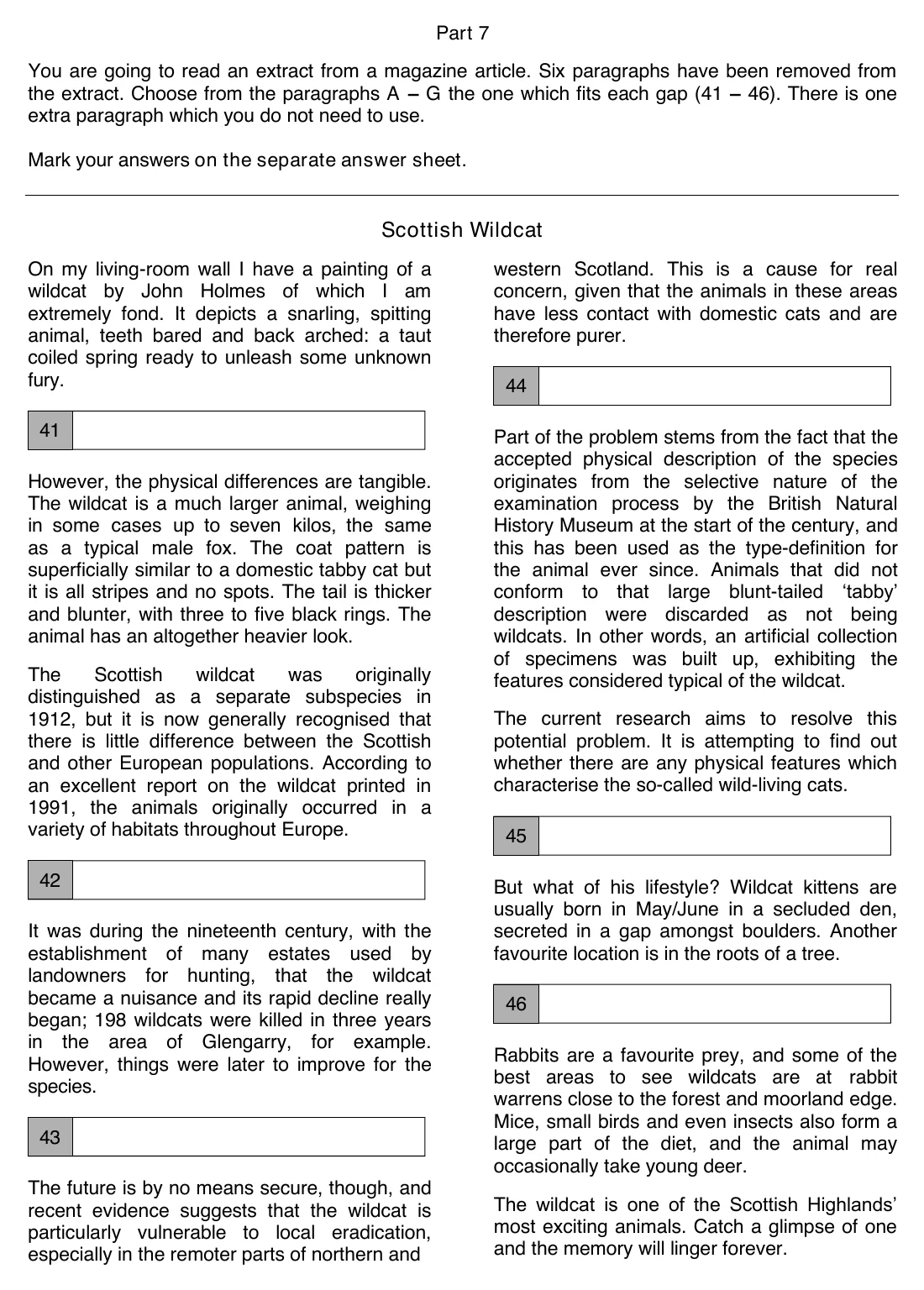
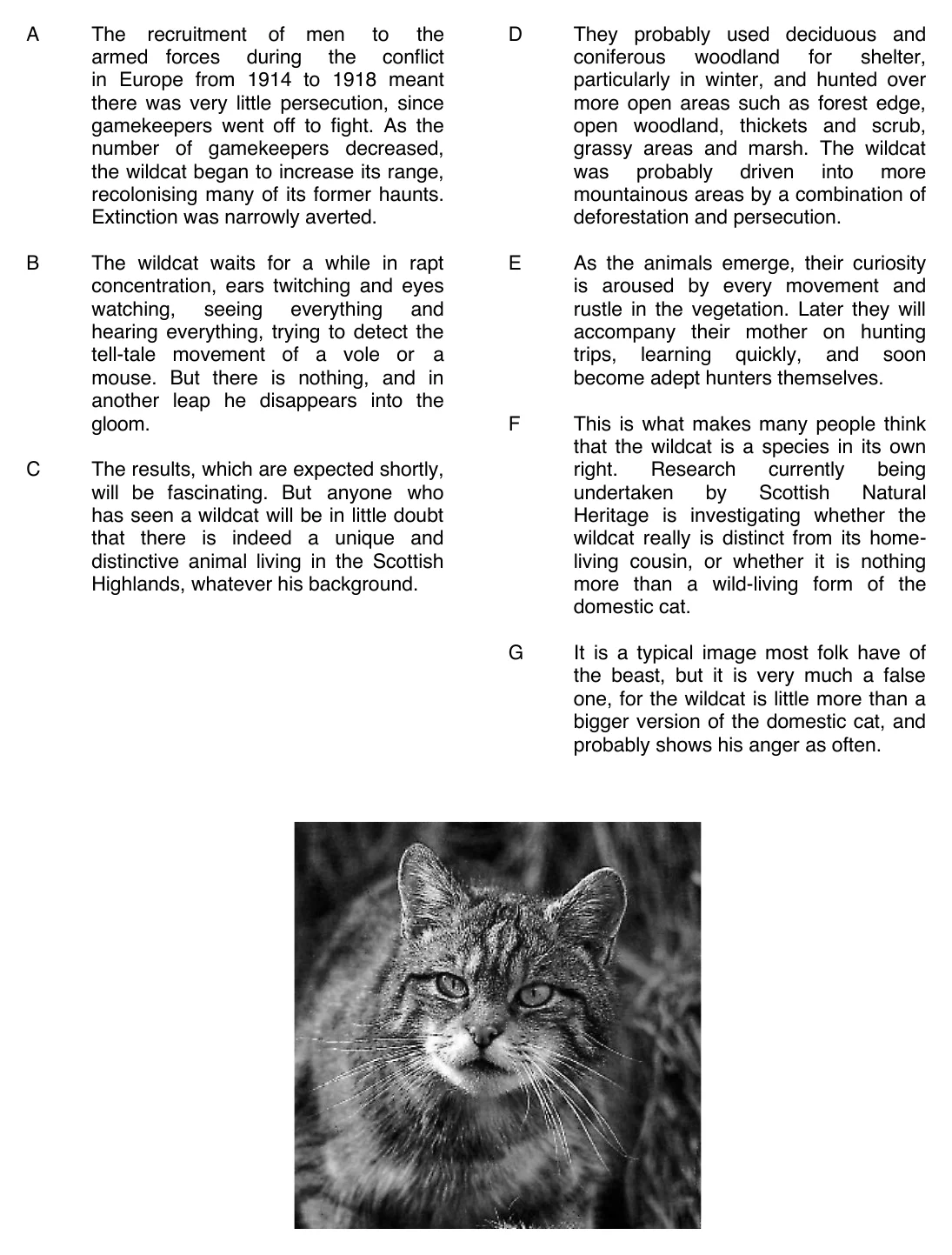
Click on a page to see it full size. Official C1 Advanced sample paper (Sample Paper 1, Reading and Use of English). © Cambridge University Press & Assessment.
41. Answer: G. Before the gap, the writer describes a painting of a furious wildcat, a taut coiled spring ready to unleash some unknown fury. G starts with It is a typical image most folk have of the beast: that image is the painting. And G says it’s a false image, because the wildcat is little more than a bigger version of the domestic cat. After the gap: However, the physical differences are tangible. The However contrasts with exactly that idea that it’s very like a domestic cat. It fits on both sides.
42. Answer: D. Before the gap: wildcats lived in a variety of habitats throughout Europe. D starts with They probably used deciduous and coniferous woodland: They are those cats, and D describes those habitats. D ends by saying they were driven into the mountains by deforestation and persecution, and after the gap the text carries on with that persecution: in the nineteenth century the wildcat became a nuisance to landowners and its decline began.
43. Answer: A. Before the gap: However, things were later to improve for the species. A explains how they improved: during the First World War gamekeepers went off to fight and the wildcat regained ground. Extinction was narrowly averted. After the gap: The future is by no means secure, though. That though contrasts with A’s good news: it escaped extinction, but its future still isn’t safe.
44. Answer: F. Before the gap: cats in the remotest areas have less contact with domestic cats and are therefore purer. F starts with This is what makes many people think that the wildcat is a species in its own right: that This is the purity of those animals. F introduces research into whether the wildcat really is distinct from the domestic cat, and after the gap the text explains Part of the problem: why it isn’t so clear.
45. Answer: C. Before the gap: The current research aims to resolve this potential problem. C starts with The results, which are expected shortly: the results of that research. And C ends by referring to the animal as he (whatever his background), which sets up the next sentence: But what of his lifestyle? With that question, the text moves from the animal’s identity to the way it lives.
46. Answer: E. Before the gap: the kittens are born in May or June in a hidden den. E follows the sequence: As the animals emerge (when they come out of the den), they later go with their mother on hunting trips and become adept hunters. After the gap, the text talks about their favourite prey: Rabbits are a favourite prey. From hunting to what they hunt.
The extra paragraph: B. B describes a wildcat hunting, in the present tense, and ends with in another leap he disappears into the gloom. It’s tempting in gap 46, because that’s where hunting comes up. But another leap needs a first leap to have been mentioned earlier, and there isn’t one in the text. And gap 46 has to carry on from the newborn kittens, which B says nothing about.
The answers, in case you’ve been keeping track: 41G, 42D, 43A, 44F, 45C, 46E. B is the extra one.
What decided each answer
Put the six answers together and you can see very clearly which kind of clue locks each gap:
| Gap | Paragraph | Link in (before) | Link out (after) |
|---|---|---|---|
| 41 | G | It is a typical image → the painting | However contrasts with «it’s almost a domestic cat» |
| 42 | D | They → the cats and their habitats | persecution → a nuisance, the decline |
| 43 | A | How things improved | though contrasts with Extinction was narrowly averted |
| 44 | F | This → being purer | Part of the problem → the research |
| 45 | C | The results → the research | his background → his lifestyle |
| 46 | E | The kittens leave the den | From hunting to prey |
Notice that no answer is decided by topic alone. In every case there’s a specific word that links the paragraph to what comes before and another that links it to what comes after.
The typical traps in C1 Reading Part 7
- The paragraph that fits only one side. This is the main trap in this part. A paragraph can follow the text before perfectly and have nothing to do with the text after. Always check both sides.
- The extra paragraph in its «natural» gap. The extra paragraph is usually about the same topic as one of the gaps, but fails on a link. B is about hunting, like gap 46, but its another leap has nothing to refer to.
- Repeated names and dates. The handbook warns about this: the task isn’t about finding the same words, names or dates in the text and the paragraph. A paragraph that mentions a date close to another doesn’t necessarily go there.
- Pronouns with two possible referents. A They or a This can seem to refer to something earlier, but check that it agrees in number and in meaning.
- The domino effect. If you put a paragraph in the wrong gap, it isn’t available for its own. That’s why it’s so important to leave the doubtful gaps until last.
The most common mistakes in C1 Reading Part 7
- Filling gaps before reading the whole text. Without a clear idea of how the text develops, every gap seems to have three or four possible answers.
- Always going in order. There’s no need. Start with the gaps that have the clearest clues and leave the doubtful ones until last.
- Looking only at the topic. All the paragraphs are about the same topic. What decides it are the pronouns, linkers, verb tenses and words that get picked up.
- Not rereading the whole text at the end. It’s the best way to spot a gap that doesn’t work: when you read it straight through, you notice at once.
- Leaving Part 7 until the end of the exam. It’s worth 12 marks. If you’re short of time, it’s better to do it before, say, Part 8, which is worth 1 mark per question.
How to prepare for C1 Advanced Part 7
- Read long reportage and feature articles in English. That’s the kind of text that comes up: non-fiction, often with a first-person narrator who tells an experience and mixes it with information.
- Notice how paragraphs start and end. When you read an article, look at which word at the start of each paragraph links it to the one before. That’s exactly the skill this part tests.
- Do the exercise in reverse. Take an article, cut out the paragraphs and mix them up. Try to rebuild it the next day. It works much better than you’d think.
- Revise linkers and pronouns. Contrast, cause and sequence linkers, and demonstratives (this, these, such), are the pieces that hold paragraphs together.
- Do full tests against the clock. That way you can see whether 15 minutes is enough within the hour and a half of the paper.
C1 Reading Part 7 exercises
Here are two original Part 7 exercises, in the same format as the exam: a text with six gaps and seven paragraphs, one of which you don’t need. The gaps are numbered 41 to 46, as in the real exam. Do them first without looking at the answers and, when you’ve finished, check them: each answer comes with an explanation of the links between the paragraph and the text, and at the end you’ll see which paragraph is the extra one.
Exercise 1: Small rings, long journeys
You are going to read a magazine article about a morning spent with volunteer bird ringers at a coastal observatory. Six paragraphs have been removed from the article. Choose from the paragraphs A–G the one which fits each gap (41–46). There is one extra paragraph which you do not need to use.
Small rings, long journeys
Science writer Corisande Prendle spends an October morning with the volunteer ringers of a tiny headland observatory, and finds out what a scrap of metal on a bird’s leg can reveal.
At half past five, Hallowick Ness is a darker shadow between a black sea and a slate-grey sky. I stumble after the torch of Agathe Dulverton, warden of the headland’s bird observatory, through sea buckthorn and willow that barely reach our shoulders. Every so often she halts while a volunteer jogs to the far side of a gap in the scrub, and between two aluminium poles they unroll what looks in the dark like a long strip of black gauze. By the time the gulls start to grumble, eleven of these stretch across the bushes, all but invisible from a few paces away.
41 ……………………….
Agathe makes that trip every half-hour, more often in rain or sun, because a small bird left too long soon grows cold or frantic. Her first round yields a robin, two wrens and a blackcap. She removes them so quickly, feet first, then wings, then head, that I barely see how. Each goes into a cotton bag, and the bags dangle from her fingers like strange fruit on the way back to the ringing hut, where Albin Seldon, a retired postman, waits at a bench crowded with pliers, notebooks and a mug of cold tea.
42 ……………………….
Every pencilled figure, he tells me as the bird flies off into the buckthorn, belongs to the observatory’s real harvest. Most of it will lie untouched in a national database, because the great majority of birds that leave this bench are never handled again. What makes the effort worthwhile is the small minority that are.
43 ……………………….
A century ago, nobody could prove that small birds travelled anywhere at all. Respectable naturalists held that swallows spent the cold months asleep in the mud of ponds, until numbered rings, first tried by a Danish schoolteacher in the 1890s, finished off such theories within a generation. Meanwhile the bags keep arriving, and by eight o’clock Agathe decides that I have watched for long enough.
44 ……………………….
Agathe lets me struggle for perhaps another minute, then reaches in and unpicks the whole muddle with two flicks of a fingernail. Nobody, she assures me, gets it right first time. As the sun climbs, the catch thins out. Albin, between customers, lifts from a cupboard the battered ledgers in which every season’s totals have been entered by hand since 1983.
45 ……………………….
Whether warmer winters, vanishing insects or drought south of the Sahara lie behind such changes, Agathe admits, nobody can yet say. What the ledgers provide is a baseline, the only way of showing that anything has shifted at all. She is explaining why the observatory’s funding never stretches beyond a single year when a shout carries up from the furthest net.
46 ……………………….
Albin copies the serial number out twice, his pencil not quite steady. Somewhere across the North Sea, a stranger once held this same bird, and within weeks, if the paperwork behaves, we will learn when and where. By midday the nets are rolled up. I drive home with a scratch on one finger, courtesy of the wren, and a new habit of glancing at the legs of every bird I pass.
A A chiffchaff ringed here four autumns ago was caught by a Spanish volunteer eighteen days later near Cádiz, two thousand kilometres south. A sanderling from the beach below the hut had its ring read through a telescope in Namibia that winter, and was back on the same sand the following August.
B Goldcrests leaving the headland now carry less fuel than a generation ago, and willow warblers, once trapped here by the hundred each August, have become a rarity worth calling the others over to see. No single morning could reveal either trend; it takes over forty years of pages, read decade by decade.
C Mist nets, as ringers call them, are spun from nylon finer than hair and hung in four slack horizontal pockets known as shelves. A warbler blundering into one tumbles into the fold below and lies there, trussed but unharmed, until someone trained to release it comes along.
D My bird is a wren, a brown thimble of fury wound into the mesh as though knitted in. I follow her instructions, or think I do, and soon have one leg free and the other worse snarled than ever, while the wren scolds me at a volume out of all proportion to its size.
E Under Agathe’s gaze, I ease my first bird, a dunnock, out of its pocket in well under a minute, and she gives a nod I choose to take as praise. The secret, it seems, is to free the feet first and let the bird do half the work.
F Within a minute the robin wears an aluminium band round its right leg, stamped with a serial number and a return address. Its wing is then laid along a steel rule and it is weighed head-down in a plastic tube, before Albin blows on its breast to read the yellowish fat beneath.
G Upside down in the mesh hangs a redwing, a Scandinavian thrush with a cream eyebrow and rusty flanks, and around its leg is a band none of us recognises. The lettering, when Agathe tilts it towards the light, gives the address of a museum in Stavanger.
Show answers
- 41. C: The writer sees the volunteers unroll ‘what looks in the dark like a long strip of black gauze’, ‘all but invisible’, without saying what it is. C names and explains the device: ‘Mist nets … are spun from nylon finer than hair’, and a bird ‘lies there … until someone trained to release it comes along’. The next paragraph refers to that visit: ‘Agathe makes that trip every half-hour’, ‘because a small bird left too long soon grows cold or frantic’.
- 42. F: The base text lists the first catch (‘a robin, two wrens and a blackcap’) and leaves Albin Seldon waiting at his bench, so the next step is what happens there. F follows by meaning: ‘the robin’, the first bird of the round, gets ‘an aluminium band’, ‘Its wing is then laid along a steel rule’ and it is ‘weighed head-down in a plastic tube’. The next paragraph sums up these measurements as ‘Every pencilled figure’ and continues with ‘he’, Albin, as ‘the bird flies off’.
- 43. A: The text says that most ringed birds ‘are never handled again’ and that the value lies in ‘the small minority that are’. A gives two examples of such birds, with no reference word: a chiffchaff ‘caught by a Spanish volunteer eighteen days later near Cádiz’ and a sanderling whose ring was ‘read through a telescope in Namibia’. The next paragraph sets these long journeys against the past, when ‘nobody could prove that small birds travelled anywhere at all’. B, also about what the observatory’s records show, cannot go here: it is about changes over decades, not birds found far away, and it says nothing about travel. G cannot go here either: its bird hangs ‘in the mesh’, while the writer is at Albin’s bench, and only G explains the shout from ‘the furthest net’ and the serial number Albin copies after gap 6.
- 44. D: The text says that ‘by eight o’clock Agathe decides that I have watched for long enough’, so the writer now has a go herself. D describes that attempt by meaning, with no reference word: ‘My bird is a wren’, and she ends with ‘one leg free and the other worse snarled than ever’. The next paragraph follows on: ‘Agathe lets me struggle for perhaps another minute, then … unpicks the whole muddle’. The extra paragraph E is most tempting here, as it also describes the writer’s first bird; but it says she freed it ‘in well under a minute’ and won a nod of praise, which ‘lets me struggle’ and ‘the whole muddle’ contradict, and the end of the article confirms her bird was ‘the wren’, not a dunnock. E fits no other gap either: before gap 4 the writer has only watched, and after it the text moves to the ledgers, the recoveries and the Norwegian ring, none of which E prepares.
- 45. B: Albin takes out ‘the battered ledgers in which every season’s totals have been entered by hand since 1983’. B opens with no reference word and gives what those books show: goldcrests now ‘carry less fuel than a generation ago’ and willow warblers ‘have become a rarity’, trends that ‘No single morning could reveal’ and that take ‘over forty years of pages, read decade by decade’ to see. The next paragraph asks what lies ‘behind such changes’, which only B has described, and returns to ‘the ledgers’.
- 46. G: The text ends with ‘a shout carries up from the furthest net’. G shows what caused the shout: ‘Upside down in the mesh’, the mesh of that net, ‘hangs a redwing’ wearing ‘a band none of us recognises’, from ‘a museum in Stavanger’. The next paragraph reacts to the foreign ring: Albin copies ‘the serial number out twice’, and ‘Somewhere across the North Sea, a stranger once held this same bird’. D, the other paragraph set in the mesh, cannot go here: the writer’s own bird is caught earlier and nobody needs to copy its number.
The extra paragraph is E.
Exercise 2: Why some halls sing
You are going to read a magazine article about how concert halls are designed to sound good and how one disappointing new hall was put right. Six paragraphs have been removed from the article. Choose from the paragraphs A–G the one which fits each gap (41–46). There is one extra paragraph which you do not need to use.
Why some halls sing
A new concert hall can dazzle the eye and still disappoint the ear. A science writer explains what acousticians listen for, and how one city put an expensive mistake right.
When the Ketterby Hall opened in Dunmarrow four years ago, critics ran short of adjectives for its looks. Its balconies curled round the stage like the inside of a seashell, and its walls glowed with pale, finely grooved oak. About the sound they were more guarded. Players complained that they could scarcely hear colleagues across the platform, and in the rear stalls the strings seemed to arrive through a heavy blanket. Before the first season was out, the council that had paid for the building had called in an acoustician, Annick Vandeleur, to explain why.
41 ……………………….
For a lecture or a string quartet, that would have been perfectly adequate. A full symphony orchestra needs nearer two seconds: long enough for each chord to bloom and merge with the next, though not so long that rapid passages smear into a wash. Worse, Dr Vandeleur’s readings had been taken with every seat unoccupied, and a packed house always shortens the decay.
42 ……………………….
Designers therefore fit upholstery that absorbs about as much as a body does, so that a morning rehearsal in an empty auditorium sounds much as the evening concert will. The Ketterby’s cushions had been chosen with care, and Dr Vandeleur soon cleared them. Her suspicion fell instead on the timber the critics had so admired.
43 ……………………….
Replacing the lining would have cost almost as much as the building itself, and Dr Vandeleur doubted that it would be enough. The deeper fault lay in the plan. To give everyone an uninterrupted view, its architects, Fanshawe Partners, had spread the seats in a broad fan, its side walls splaying outwards from the platform. It is a layout that looks generous on paper and has a poor record in performance.
44 ……………………….
Sound from the flanks matters because each ear catches it a fraction of a second apart, and the brain reads the mismatch as being wrapped in music. Without it, an orchestra seems remote, however near the seat. Rebuilding the walls, though, was out of the question: Dunmarrow had borrowed heavily to put them up.
45 ……………………….
Heavy and rigid, the new panels also gave back the low notes the oak had been swallowing. What they could not do was lengthen the reverberation enough for Bruckner without making the place far too boomy for the jazz, folk and comedy that pay many of its bills. The answer was to let the room change its character from one night to the next.
46 ……………………….
Fitting all this took nine months and cost about a twelfth of a rebuild. When the hall reopened, Grete Sorrell, who leads the resident orchestra’s first violins, said she could hear the bassoons from her chair for the first time. With a full house, Dr Vandeleur’s pistol test now gives just over two seconds. Critics have started writing about the sound, and few of them have noticed the plaster screens, which is, she says, exactly as it should be.
A Clothed human bodies are remarkably efficient sound absorbers. A single listener soaks up roughly as much as half a square metre of open window, the acoustician’s yardstick for total loss, and two thousand of them can strip a room of much of its ring.
B Above the upper balcony, storerooms were knocked through into chambers of bare concrete, sealed off by motorised doors. Opened, they lend a symphony extra air and resonance; shut, with heavy banners lowered in front of them, they leave a drier space for a comedian or an amplified band.
C The trouble comes down to direction. In the narrow, rectangular ‘shoebox’ halls of the nineteenth century, parallel side walls bounce sound back at listeners from left and right. Splayed walls steer that energy towards the rear instead, so most of what reaches a seat arrives from straight ahead.
D The standard test needs nothing grander than a starting pistol. Fired on an empty stage, its crack ricochets round the room and fades, and the time it takes to sink to a millionth of its original intensity is called the reverberation time. In the Ketterby, the figure came out at barely a second and a half.
E Unable to move the masonry, Dr Vandeleur proposed a room within the room. Along each side of the stalls, a row of tilted plaster screens would stand a few metres out from the side walls, angled to return sound across the audience while leaving every sightline intact.
F Wood has a reputation for warmth that physics does not entirely support. Thick, solid timber reflects well, but thin boards fixed over hollow frames flex when sound strikes them, soaking up the lower notes that give an orchestra its body. The Ketterby’s elegant grooves concealed exactly that.
G The obvious remedy was to hang thick velvet along the side walls and lay deep carpet in the aisles, taming hard surfaces that sent sound careering around the room. Within weeks the worst of the clatter had gone, and the players could at last hear themselves think.
Show answers
- 41. D: The council ‘had called in an acoustician, Annick Vandeleur, to explain why’, and D begins her diagnosis by meaning, with no linking or pointing word: ‘The standard test needs nothing grander than a starting pistol’. It ends with the result, ‘In the Ketterby, the figure came out at barely a second and a half’, and the next paragraph judges that figure: ‘For a lecture or a string quartet, that would have been perfectly adequate’, whereas an orchestra ‘needs nearer two seconds’.
- 42. A: The text says that ‘a packed house always shortens the decay’ without saying why. A gives the cause by meaning: ‘Clothed human bodies are remarkably efficient sound absorbers’, and ‘two thousand of them can strip a room of much of its ring’. The next paragraph draws the consequence: ‘Designers therefore fit upholstery that absorbs about as much as a body does’.
- 43. F: Dr Vandeleur’s ‘suspicion fell instead on the timber the critics had so admired’. F takes up that suspicion through a lexical link, ‘Wood has a reputation for warmth that physics does not entirely support’, and explains that ‘thin boards fixed over hollow frames’ soak up ‘the lower notes’; ‘The Ketterby’s elegant grooves concealed exactly that’. The next paragraph calls this construction ‘the lining’: ‘Replacing the lining would have cost almost as much as the building itself’.
- 44. C: The fan layout ‘looks generous on paper and has a poor record in performance’, and C explains that record by meaning: ‘The trouble comes down to direction’, because ‘Splayed walls steer that energy towards the rear instead’. The next paragraph says why the lost side reflections matter: ‘Sound from the flanks matters because each ear catches it a fraction of a second apart’. E is tempting as a response to the layout, but ‘Unable to move the masonry’ assumes that rebuilding has already been ruled out, which the text only says later: ‘Rebuilding the walls, though, was out of the question’.
- 45. E: Rebuilding the walls ‘was out of the question’, and E picks this up by meaning: ‘Unable to move the masonry, Dr Vandeleur proposed a room within the room’, screens ‘a few metres out from the side walls’, ‘angled to return sound across the audience while leaving every sightline intact’, which restores the sound from the flanks that the previous paragraph says matters. The next paragraph names the screens with a lexical link: ‘Heavy and rigid, the new panels also gave back the low notes the oak had been swallowing’. The extra paragraph G is most tempting here, since ‘The obvious remedy’ also follows a ruled-out option; but velvet and carpet would absorb even more sound in a hall whose reverberation was already too short, the ‘clatter’ it cures is a problem the hall never had, and fabric is neither heavy nor rigid.
- 46. B: The plan was ‘to let the room change its character from one night to the next’, and B shows how by meaning: chambers ‘sealed off by motorised doors’ which, ‘Opened’, ‘lend a symphony extra air and resonance’ and, ‘shut’, ‘leave a drier space for a comedian or an amplified band’. The next paragraph sums up the screens and chambers together: ‘Fitting all this took nine months’. G fails here too: it describes one permanent treatment, not a room that changes, and ‘Within weeks’ contradicts the nine months.
The extra paragraph is G.
Frequently asked questions about C1 Reading Part 7
How many questions are there in C1 Advanced Reading Part 7?
Six gaps, numbered 41 to 46, and seven paragraphs to choose from. Each correct answer is worth 2 marks, so Part 7 is worth 12 marks.
Can a paragraph be used twice?
No. Each paragraph goes in one gap only, and one of the seven is left over. If you find a paragraph fits two gaps, one of them is wrong: check the clues on both sides again.
What if a gap doesn’t fit any paragraph?
Leave it until last and do the others. Once you’ve placed the clear paragraphs, you’ll have two or three options left, and it’ll be much easier. And never leave it blank: wrong answers don’t lose marks.
How long should I spend on it?
Cambridge doesn’t set times for each part: you have 1 hour 30 minutes for all eight. About 15 minutes is a good guide for Part 7, because the text is long and you need to read it all before you start.
Is it the same on paper and on computer?
The task is the same. In the computer-based exam you answer on screen and can change your answers as many times as you like before you finish, so don’t be afraid to place the clear paragraphs first and review the rest at the end.
Keep preparing for C1 Reading
This guide is part of the series on C1 Advanced Reading. If you’re coming from the previous part, you’ll find it in my guide to Part 6, the cross-text multiple matching task. If you want to see how it all fits into the full exam, go back to the C1 Advanced main page or have a look at the C1 score calculator. And if you’re looking for practice material, here’s my selection of the best books to prepare for C1 Advanced.
Did you find this guide useful? Share it with other students and teachers preparing for CAE. And if you have any questions about a particular gap, leave me a comment, I read them all.
See you soon, and don’t forget to keep smiling! 🙂
