

Table of contents
C1 Advanced Reading Part 6 is the part that most puzzles people coming from B2, because there’s nothing like it there. You read four short texts by four different writers on the same topic and answer just four questions. That doesn’t sound like much, but every question makes you read across all four texts at once, compare opinions and work out who agrees with whom. And, to make things a little harder, the questions never tell you the opinion: only the subject.
In this guide I explain how CAE Reading Part 6 (the cross-text multiple matching task) works, what kinds of question come up according to Cambridge’s official tasks, a method for tackling it without getting lost among the four texts and the official sample paper worked through question by question. At the end there are two original exercises to practise with, with the answers explained. Let’s go!
What C1 Advanced Reading Part 6 looks like
| Fact | C1 Reading Part 6 |
|---|---|
| What you have to do | Read four texts (A, B, C and D) and decide, for each question, which text agrees with another, disagrees with another or differs from the rest |
| Number of questions | 4 (numbered 37 to 40) |
| Marks | 2 marks per correct answer (8 in total); wrong answers don’t lose marks |
| Length of the texts | About 600 words in total, around 150 per text |
| Type of text | Four reviews of the same book, four experts or academics giving their views on a question, four critics on an exhibition… |
| Letters | A letter can be the answer to more than one question, and one text may not be the answer to any |
| What it tests | Understanding opinions and attitudes, and comparing where the writers agree and disagree |
All of this is part of the Reading and Use of English paper, which lasts 1 hour 30 minutes and has eight parts and 56 questions. As in Parts 5 and 7, each question is worth 2 marks, twice as much as in Parts 1, 2, 3 and 8. There are only four questions, but they’re worth 8 marks, and about 10 minutes should be enough.
You’ll find the full picture of Parts 1 and 5 to 8 in my C1 Advanced Reading guide.
What kinds of questions come up in C1 Reading Part 6
The first thing you need to know is that the questions only give you the subject, never the opinion. They don’t ask «which writer thinks the book is original?», but «which writer has a different view to C on the originality of the book?». You have to find the opinion yourself. According to Cambridge’s handbook and the official tasks I analysed, the questions always come in three types:
| Type of question | How it usually appears | What you need to do |
|---|---|---|
| The one who agrees | Which writer shares reviewer A’s opinion on…? / expresses a similar view to B regarding… | Find what the named writer thinks and look for the other one who thinks the same |
| The one who disagrees | Which writer has a different view to C on…? | Find what the named writer thinks and look for the one who thinks the opposite |
| The odd one out | Which writer has a different opinion from the others on…? | See what all four think and find the only one who doesn’t fit |
In every official task I analysed there’s exactly one odd-one-out question, and the other three are about agreeing or disagreeing with a particular writer. In the odd-one-out question all four texts deal with the subject. In the others, not always: sometimes only two or three writers mention it, and the rest say nothing.
How it differs from Part 8
Both are multiple matching, but they’re not that similar. In Part 8 you have ten questions and look for specific information in several texts or sections: who mentions something, who says such and such. In Part 6 you have only four questions, but finding a piece of information isn’t enough: you have to understand each writer’s opinion and compare it with the others’. That’s why each Part 6 question is worth twice as much.
The four-step method
- Read the four questions before the texts. That way you know which subjects you’ll be asked about (the book’s originality, the writer’s confidence, its usefulness for professionals…). Underline the subject of each question, not the writer.
- Read each text and note its writer’s opinion on each subject. One word or a symbol is enough: + for in favour, − for against, ? if they say nothing. With four texts and three or four subjects, this little table saves you rereading everything every time.
- In questions that name a writer, start with that writer. Find exactly what they think about the subject and underline it. Only then look through the other three texts for the one who thinks the same or the opposite.
- Check against the text, not your table. Before you settle on an answer, reread the two sentences you’re comparing. Two writers can use the same words and say opposite things, or say the same thing in completely different words.
The sample paper, worked through question by question
This is the Part 6 task from Cambridge’s official C1 Advanced sample paper: four reviews of The Architecture of Happiness, a book by the philosopher Alain de Botton about how architecture affects our emotions. Try it before you read the explanations:
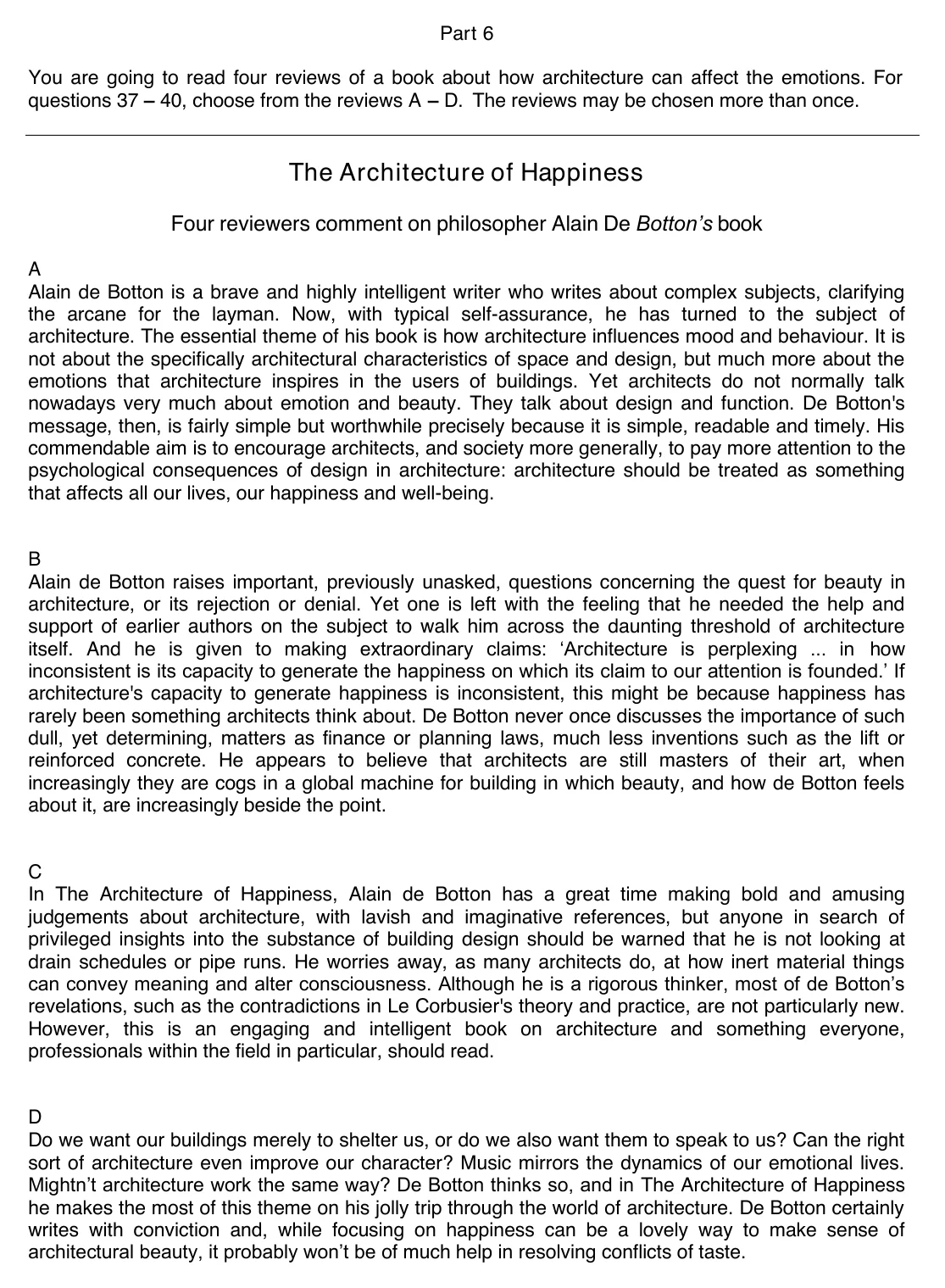
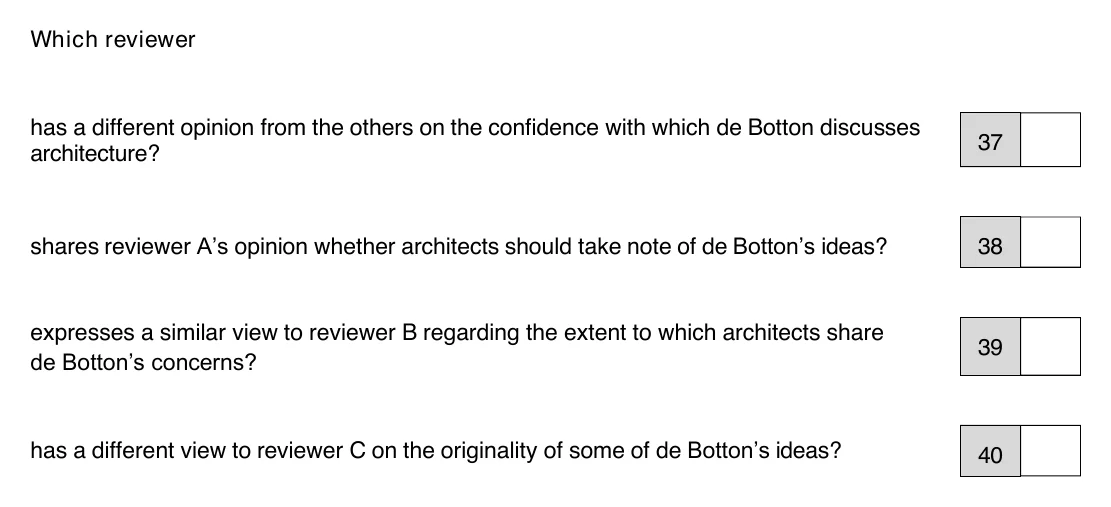
Click on a page to see it full size. Official C1 Advanced sample paper (Sample Paper 1, Reading and Use of English). © Cambridge University Press & Assessment.
Before you start on the questions, notice which subjects come up: how confidently de Botton writes, whether architects should read the book, whether architects share his concerns and whether his ideas are original. They’re exactly the four subjects of the questions.
37. Answer: B. Which reviewer has a different opinion from the others on the confidence with which de Botton discusses architecture? This is the odd-one-out question, so you need to look at all four texts. A mentions his typical self-assurance, C says he makes bold and amusing judgements and D that he writes with conviction: all three see him as very confident. B is the only one with doubts: this reviewer thinks de Botton needed the help and support of earlier authors to cross the daunting threshold of architecture, in other words, that the subject was a bit beyond him.
38. Answer: C. Which reviewer shares reviewer A’s opinion whether architects should take note of de Botton’s ideas? First, what A thinks: the book’s aim is to encourage architects, and society more generally, to pay more attention, and A finds it commendable. A believes architects should listen. Now look for who thinks the same: C says it’s a book that everyone, professionals within the field in particular, should read. Those professionals within the field are architects, even though C doesn’t use the word. It’s a perfect example of how Cambridge paraphrases.
39. Answer: A. Which reviewer expresses a similar view to reviewer B regarding the extent to which architects share de Botton’s concerns? B says happiness has rarely been something architects think about: architects don’t share de Botton’s concerns. A says the same in other words: architects do not normally talk nowadays very much about emotion and beauty. They talk about design and function. Here’s the clearest trap in the task: C also talks about architects, but says de Botton worries about these questions as many architects do. In other words, architects do share them. Same subject, opposite opinion.
40. Answer: B. Which reviewer has a different view to reviewer C on the originality of some of de Botton’s ideas? C says most of his revelations are not particularly new. Look for the one who thinks the opposite: B says de Botton raises important, previously unasked, questions. That previously unasked is the key: these are questions nobody had asked before. Notice that B is very critical of the book overall, and yet it’s the reviewer who finds it original. A writer’s overall opinion tells you nothing about what they think of each subject.
The answers, in case you’ve been keeping track: 37B, 38C, 39A, 40B.
What decided each answer
Put the opinion table from step 2 together for this paper and you can see very clearly how the task works:
| Subject | A | B | C | D | Answer |
|---|---|---|---|---|---|
| De Botton’s confidence (37) | very confident | out of his depth | very confident | very confident | B, the odd one out |
| Should architects read it? (38) | yes | doesn’t say | yes | doesn’t say | C, same as A |
| Do architects share his concerns? (39) | no | no | yes | doesn’t say | A, same as B |
| Are his ideas original? (40) | doesn’t say | yes | no | doesn’t say | B, opposite to C |
Notice three things. B is the answer to two questions, and D isn’t the answer to any: that’s normal in this part. In three of the four subjects, at least one writer says nothing. And in question 39, the writer who mentions architects most clearly (C) is exactly the wrong one.
The typical traps in C1 Reading Part 6
- Same subject, opposite opinion. Two writers talk about the same thing, even in the same words, but think the opposite. If you only look for the subject, you’ll choose wrongly. Question 39.
- Same opinion, different words. The writer who agrees hardly ever uses the other’s words. Architects in A, professionals within the field in C. Question 38.
- The overall opinion is misleading. A writer can be very critical of the book and still praise one particular aspect. B is the most negative of the four, and yet it’s B who finds the ideas original. Question 40.
- Concessions within the same text. Many writers say one thing and then qualify it (Although…, However…, Yet…). C says the ideas aren’t new, but that it’s a book everyone should read. You need to know what they think about each subject, not just how the text ends.
- The writer who says nothing. In agree/disagree questions, one or two writers sometimes don’t mention the subject at all. Don’t try to guess what they’d think.
The most common mistakes in C1 Reading Part 6
- Reading the question the wrong way round. In Which reviewer shares reviewer A’s opinion…?, the answer can never be A. It sounds obvious, but with exam nerves it happens more than you’d think.
- Not starting with the named writer. If the question names C, you first need to be completely clear about what C thinks. Going straight to the other three texts wastes time and leads to mistakes.
- Going on your overall impression. «B likes the book and C doesn’t» is no use at all. What you need is what each one thinks about each particular subject.
- Rereading all four texts for every question. That’s what eats up the most time. A quick table of each writer’s opinion saves you from it.
- Thinking every letter has to come up. A letter can be repeated and another may never appear. Don’t change an answer just to «share out» the letters.
How to prepare for C1 Advanced Part 6
- Read several reviews of the same book, film or album. That’s exactly what you’ll find in the exam. When you’ve read them, try to say where they agree and where they don’t.
- Read expert debates. Opinion sections where several specialists answer the same question are the other typical format for this part.
- Practise the opinion table. With any opinion piece, write down in one line what the writer thinks about two or three aspects. It gets you used to separating subjects from opinions.
- Learn the language of evaluation. Commendable, daunting, not particularly new, given to making extraordinary claims… These are the words that tell you whether a writer is for or against, and at C1 they’re rarely as obvious as good or bad.
- Do full tests against the clock. That way you can check whether 10 minutes is enough within the hour and a half of the paper.
C1 Reading Part 6 exercises
Here are two original Part 6 exercises, in the same format as the exam: four texts and four questions, numbered 37 to 40 as in the real exam. The first is four reviews of the same book, and the second is four experts giving their views on the same question. Do them first without looking at the answers and, when you’ve finished, check them: each answer comes with an explanation.
Exercise 1: The Tamed Leaf
You are going to read four reviews of a history of houseplants and how they changed the way people saw nature. For questions 37–40, choose from the reviews A–D. The reviews may be chosen more than once.
The Tamed Leaf
Four reviewers comment on Aurelia Pennicott’s history of the houseplant.
A
Few readers will finish Aurelia Pennicott’s book doubting that she has done her homework. Shop catalogues, household guides and the diaries of anxious Victorian beginners are quoted with care, and each is placed in its own time rather than used as decoration. All this work supports a claim that the cover calls new: that the potted fern taught the middle classes to treat the wild as something to be owned and looked after. Cultural historians have been making that point since the 1970s, and Pennicott’s version adds detail rather than direction. More troubling are the passages in which she recalls her grandmother’s conservatory and the windows of her childhood home. They break into the analysis just as it gathers speed, and they add little that the documents have not already shown. Nevertheless, the closing chapters on the modern fashion for ‘urban jungles’ are sharp, although they arrive too late to rescue a book that promises more than it delivers.
B
There is no shortage of scholarship here. Pennicott has worked through the account books of commercial growers, the letters of plant collectors and the advice columns of early women’s magazines, and her notes repay attention as often as her chapters. Readers prepared to wade through paragraphs in which clause is piled upon clause, and Latin names go unexplained, will finally reach the argument: that moving plants indoors altered how ordinary people pictured the natural world. It is announced with some ceremony, as though nobody had thought of it, yet anyone who knows the earlier studies of the nineteenth-century home will recognise most of it. Even so, her final chapter, on why lonely city dwellers now spend so heavily on plants for their homes, is timely and kind. Taken as a whole, this is one of the most rewarding studies of domestic life to appear in recent years.
C
Pennicott’s great gift is clarity. Even the most complicated episodes, such as the quarrel between rival growers over the first tropical flowers on sale, are told with a lightness that never loses accuracy, and her chapters move with the ease of a good novel. The research beneath that easy surface is impressive. Records of what furnished ordinary sitting rooms, sales figures from flower markets and accounts given by servants who watered their employers’ ferns are all examined closely, and she is honest about what each source can and cannot prove. She writes warmly, too, about nursing a dying rubber tree through a hard winter in her first rented room, although one closes those pages knowing more about Pennicott than about the households her book sets out to describe. It is a fault, but a minor one in a study that changes how one looks at a pot on a kitchen shelf.
D
Here, at last, is a history of home gardening with a genuinely bold idea at its core. Pennicott proposes that the parlour palm and the humble geranium did as much to reshape modern attitudes to the wild as any landscape painter or explorer. She argues the case with conviction. Her occasional memories, of a grandmother’s warm, damp greenhouse and of her own first clumsy attempts at growing new plants from old ones, give the book a warmth that purely academic histories seldom achieve. If a single diary entry or a cheerful advertisement is sometimes asked to speak for the habits of an entire class, and the many complaints about plants dying in gas-lit rooms are mentioned only to be set aside, that is perhaps the price of an argument made with such energy. This is a stimulating, generous book that deserves a wide readership.
37 Which reviewer expresses a similar opinion to reviewer A on the use Pennicott makes of episodes from her own life
38 Which reviewer has a different opinion from the others on how well Pennicott handles the historical sources she relies on
39 Which reviewer has a different view from reviewer C about the quality of Pennicott’s prose style
40 Which reviewer shares reviewer B’s opinion on how original the book’s central argument is
Show answers
- 37. C: A finds the personal material unhelpful: the passages recalling her grandmother’s conservatory ‘break into the analysis just as it gathers speed’ and ‘add little that the documents have not already shown’. C agrees, though more gently: the rubber-tree story is told ‘warmly’, but ‘one closes those pages knowing more about Pennicott than about the households her book sets out to describe’, and C calls this ‘a fault’. D is the lure with the opposite view: her memories ‘give the book a warmth that purely academic histories seldom achieve’. B says nothing about this.
- 38. D: A: catalogues, guides and diaries ‘are quoted with care’ and each ‘is placed in its own time’. B: ‘There is no shortage of scholarship here’ and ‘her notes repay attention’. C: her sources ‘are all examined closely’ and ‘she is honest about what each source can and cannot prove’. D differs: ‘a single diary entry or a cheerful advertisement is sometimes asked to speak for the habits of an entire class’ and inconvenient complaints ‘are mentioned only to be set aside’. D excuses this as ‘the price of an argument made with such energy’ and is warm overall, but on this point it alone is critical.
- 39. B: C praises the writing: ‘Pennicott’s great gift is clarity’, and her chapters ‘move with the ease of a good novel’. B disagrees: only ‘Readers prepared to wade through paragraphs in which clause is piled upon clause, and Latin names go unexplained’ will reach the argument. A, the most critical review overall, is the lure, but its complaints concern the originality of the argument and the personal passages, not the writing. D only says she ‘argues the case with conviction’, which is about the force of the argument, not its style.
- 40. A: B thinks the argument is not new: it is ‘announced with some ceremony, as though nobody had thought of it’, yet readers of ‘the earlier studies of the nineteenth-century home’ ‘will recognise most of it’. A agrees: the claim ‘the cover calls new’ is one that ‘Cultural historians have been making … since the 1970s’, and Pennicott ‘adds detail rather than direction’. D is the lure with the opposite view: the book has ‘a genuinely bold idea at its core’. C only says the study ‘changes how one looks at a pot on a kitchen shelf’, which is about its effect on the reader, not about its originality.
Exercise 2: Lectures on demand: progress or loss?
You are going to read four extracts from articles in which academics give their views on whether universities should replace live lectures with recorded video. For questions 37–40, choose from the experts A–D. The experts may be chosen more than once.
Lectures on demand: progress or loss?
Four academics consider whether universities should replace live lectures with recorded video.
A Lucasta Brennand, professor of history
Those who would abolish the live lecture usually point to the evidence, and the published research does find that end-of-term marks barely shift when a course moves on to video. For the undergraduate who stacks supermarket shelves at night or spends two hours each way on a rural bus, a recording may well be the only lecture she attends at all. What such findings tend to overlook, however, is the discipline imposed by a fixed hour in a fixed room. A lecture that can be watched at any time is, in practice, a lecture postponed, and the backlog grows quietly until the week before the examination. There is also a loss that no marking scheme captures, since the corridor outside a lecture theatre is where strangers studying quite unrelated subjects first fall into conversation. My preference, therefore, would be to record everything but to replace nothing.
B Augustin Tregenza, senior lecturer in physics
It is often said that lecture halls are where students make their friends. Three hundred people facing the same direction in silence is hardly a recipe for intimacy, and the friendships my own students describe began in laboratories, residences and sports clubs, none of which would vanish with the lectern. My objection lies elsewhere. When an awkward idea is explained, the room reveals at once whether it has landed, through a ripple of frowns or a question called out from the back. A camera offers no such signal, so a muddled explanation simply goes unrepaired. As for the argument that video opens university to those with jobs or long commutes, a recording is better than nothing, I suppose. Yet a student watching at midnight after an eight-hour shift has been handed a file, not a fair chance, and what such students need is a timetable built around their lives.
C Isaura Dunstall, lecturer in sociology
Advocates of recorded teaching like to point out that grades hold steady when teaching switches to recordings, and so they do. Grades, however, reward what can be reproduced on the day, and studies that test comprehension months later tell a less comfortable story. Students who rely on video tend to play it at double speed and skip the passages that look difficult, coming away with notes that are fuller but understanding that is noticeably thinner. I am equally uneasy about what disappears socially, since a shared hour in a crowded theatre gives first-year students who know nobody a reason to sit beside someone and, eventually, to speak. Lecturers will miss the faces, no doubt, but the notion that they depend on a live audience seems rather sentimental: most would happily be spared delivering the identical hour to a new cohort every autumn. Universities should also admit that filming, captioning and editing good recordings add to budgets already under strain.
D Emeric Coldicott, professor of linguistics
For a growing share of students, the nine o’clock lecture is simply out of reach: they are parents, carers or employees, or live so far from campus that attending would swallow most of the day. Recorded teaching allows them to study whenever their obligations permit, and to my mind that alone justifies making it the norm. Fears about standards seem misplaced, too, since comparisons of cohorts taught each way generally reveal similar grades. A lecturer who once knew from the shuffling in row three when to slow down or abandon an example will learn it now, if at all, from a comment typed beneath the video days later. Nor is student life unaffected: a crowded hall is one of the few settings in which newcomers mix at all. Seminars, rather than lectures, are where universities ought now to concentrate their efforts.
37 Which expert has a different opinion from the others on the part that lectures play in students’ social lives
38 Which expert has a different view from Brennand on what research shows about how much students learn from recordings
39 Which expert shares Coldicott’s view on the extent to which recordings help students who have jobs or live far from campus
40 Which expert expresses a similar opinion to Tregenza about the effect on lecturers of teaching to a camera rather than a room
Show answers
- 37. B: A: the corridor outside a lecture theatre ‘is where strangers studying quite unrelated subjects first fall into conversation’. C: a shared hour ‘gives first-year students who know nobody a reason to sit beside someone’. D: a crowded hall is one of the few settings ‘in which newcomers mix at all’. B differs: three hundred people in silence ‘is hardly a recipe for intimacy’, and friendships ‘began in laboratories, residences and sports clubs’. D, the only expert in favour of recordings, is the polarity lure, but here D agrees with A and C.
- 38. C: Brennand (A) accepts that research finds ‘end-of-term marks barely shift when a course moves on to video’. Dunstall (C) admits grades ‘hold steady’, but argues that ‘studies that test comprehension months later tell a less comfortable story’, with understanding ‘noticeably thinner’. Coldicott (D) is the lure, as the only supporter of recordings, but he agrees with Brennand: comparisons ‘generally reveal similar grades’. Tregenza (B) does not discuss research.
- 39. A: Coldicott (D) says recorded teaching ‘allows them to study whenever their obligations permit’, which ‘alone justifies making it the norm’. Brennand (A), although she opposes replacing lectures, implies the same: for a student with a night job or a long bus journey, ‘a recording may well be the only lecture she attends at all’. Tregenza (B) is the lure: a recording ‘is better than nothing’, but such a student ‘has been handed a file, not a fair chance’. Dunstall (C) does not discuss students with jobs or long journeys.
- 40. D: Tregenza (B) says the room reveals ‘whether it has landed’ and that a camera ‘offers no such signal’. Coldicott (D), though he favours recordings, agrees: a lecturer who knew ‘when to slow down or abandon an example’ will now learn it ‘if at all, from a comment typed beneath the video days later’. Dunstall (C), wary of recordings like Tregenza, is the lure: lecturers ‘will miss the faces’, but the idea that they depend on a live audience ‘seems rather sentimental’. Brennand (A) says nothing about lecturers.
Frequently asked questions about C1 Reading Part 6
How many questions are there in C1 Advanced Reading Part 6?
Four questions, numbered 37 to 40. Each one is worth 2 marks, so Part 6 is worth 8 marks in total.
Can a letter be used more than once?
Yes. The instructions say so: The reviews may be chosen more than once. It’s very common for one text to be the answer to two questions and for another not to be the answer to any.
Is there a Part 6 like this in B2 First?
No. Cross-text multiple matching is only in C1 Advanced. B2 has a multiple matching task, but it’s closer to C1 Part 8: finding information, not comparing opinions.
How long should I spend on it?
Cambridge doesn’t set times for each part: you have 1 hour 30 minutes for all eight. As there are only about 600 words and four questions, around 10 minutes is usually enough if you read with an opinion table.
Is it the same on paper and on computer?
The task is the same. In the computer-based exam you can highlight parts of the texts, which is very useful here for marking each writer’s opinion on each subject.
Keep preparing for C1 Reading
This guide is part of the series on C1 Advanced Reading. If you’re coming from the previous part, you’ll find it in my guide to Part 5, the multiple-choice task. If you want to see how it all fits into the full exam, go back to the C1 Advanced main page or have a look at the C1 score calculator. And if you’re looking for practice material, here’s my selection of the best books to prepare for C1 Advanced.
Did you find this guide useful? Share it with other students and teachers preparing for CAE. And if you have any questions about a particular answer, leave me a comment, I read them all.
See you soon, and don’t forget to keep smiling! 🙂
