

Table of contents
C1 Advanced Reading Part 5 is the first of the four long reading tasks in the exam: a text of around 750 words and six questions with four options each. It looks like the most traditional task of all, the kind you’ve done a hundred times, but at C1 there’s a catch. You’re hardly ever asked for a fact you can simply find in the text. You’re asked what the writer thinks, why they mention an example or what a word means in that particular context. And the wrong options are designed to look right if you only skim.
In this guide I explain how CAE Reading Part 5 (the multiple-choice task) works, what kinds of questions come up according to Cambridge’s official tasks, how it differs from B2, a method for tackling it and the official sample paper worked through question by question. At the end there are two original exercises to practise with, with the answers explained. Let’s go!
What C1 Advanced Reading Part 5 looks like
| Fact | C1 Reading Part 5 |
|---|---|
| What you have to do | Read a long text and answer six questions, choosing the correct option from four (A, B, C or D) for each one |
| Number of questions | 6 (numbered 31 to 36) |
| Marks | 2 marks per correct answer (12 in total); wrong answers don’t lose marks |
| Length of the text | About 750 words, usually in five to seven paragraphs |
| Type of text | Opinion articles, book introductions, reviews, popular science and, sometimes, fiction |
| Order of the questions | They follow the order of the text; the last one may be about the text as a whole |
| What it tests | Detailed understanding: the writer’s opinion and attitude, inference, purpose, meaning in context, reference and text organisation |
All of this is part of the Reading and Use of English paper, which lasts 1 hour 30 minutes and has eight parts and 56 questions. Look at the marks: each Part 5 question is worth twice as much as a question in Parts 1, 2 or 3. That’s 12 marks for six questions, so it’s worth giving it the time it needs. Cambridge recommends spending no more than about 15 minutes on it.
You’ll find the full picture of Parts 1 and 5 to 8 in my C1 Advanced Reading guide.
What kinds of questions come up in C1 Reading Part 5
To write this guide I analysed Cambridge’s official C1 Part 5 tasks (the ones in the sample papers and in the self-access materials). This is what they ask:
| Type of question | What you need to do | How it usually appears |
|---|---|---|
| Detail | Understand exactly what a part of the text says | According to the writer, … |
| Main idea of a paragraph | Sum up the problem, reason or argument a paragraph sets out | What problem does the writer explain in the first paragraph? |
| Purpose | Know why the writer mentions an example, a comparison or a study | The writer refers to … in order to |
| Inference | Work out what the writer suggests without saying it directly | What does the writer suggest about …? |
| Attitude and opinion | Know what the writer thinks, concedes and rejects | What is the writer’s view of …? |
| Meaning in context | Understand what a word or phrase means in that paragraph | In the fourth paragraph, the word ‘…’ refers to |
| Reference | Know what a pronoun or a phrase like the rest refers to | What does ‘…’ refer to? |
| Whole text | Identify an idea that recurs or the overall purpose | An idea recurring in the text is that … |
Three patterns come up in every official task, and they’re worth knowing:
- The first question is about the first paragraph, and the rest follow the order of the text. You don’t have to search the whole text.
- In more than half of the questions, the question tells you the paragraph (In the fourth paragraph…). Use it.
- The last question usually looks at the whole text or the final paragraphs: a recurring idea or the writer’s purpose.
How it differs from B2 First Part 5
The format is the same as in B2 First Reading Part 5, but C1 raises the bar in three ways:
- Longer, denser texts. At B2 the text is about 640 words, with sentences of around 15 words on average. At C1 it’s about 750 words, with sentences of around 24 words and plenty of subordinate clauses.
- More argument, less narrative. B2 has lots of stories and questions about how a character feels. In the official C1 tasks I analysed, the texts are argumentative and there isn’t a single question about a character’s feelings: it’s all about what the writer thinks, concedes or rejects.
- Finer options. The wrong options aren’t absurd. Many say something that is in the text but doesn’t answer the question, or say almost the same as the text, but go a little too far or not far enough.
The four-step method
- Read the whole text quickly, without looking at the options. Notice the title and the standfirst, if there is one, and get the topic, the writer’s position and what each paragraph does. Don’t stop at words you don’t know.
- Read the question, not the options. Underline the key words and find the part of the text it refers to. As the questions follow the order of the text, the answer to 33 will come after the answer to 32.
- Answer it yourself before you look at the options. Read that part carefully and put the answer in your own words. That way the trap options fool you far less often.
- Compare all four options with the text, whole sentence. Choose the one that says the same as the text in different words, and rule out the others for a specific reason. When the question is an incomplete sentence, the complete sentence has to match the text, not just the option.
The sample paper, worked through question by question
This is the Part 5 text from Cambridge’s official C1 Advanced sample paper: the introduction to a book about the history of colour. It’s a fairly dense academic text, so take your time. Try it before you read the explanations:
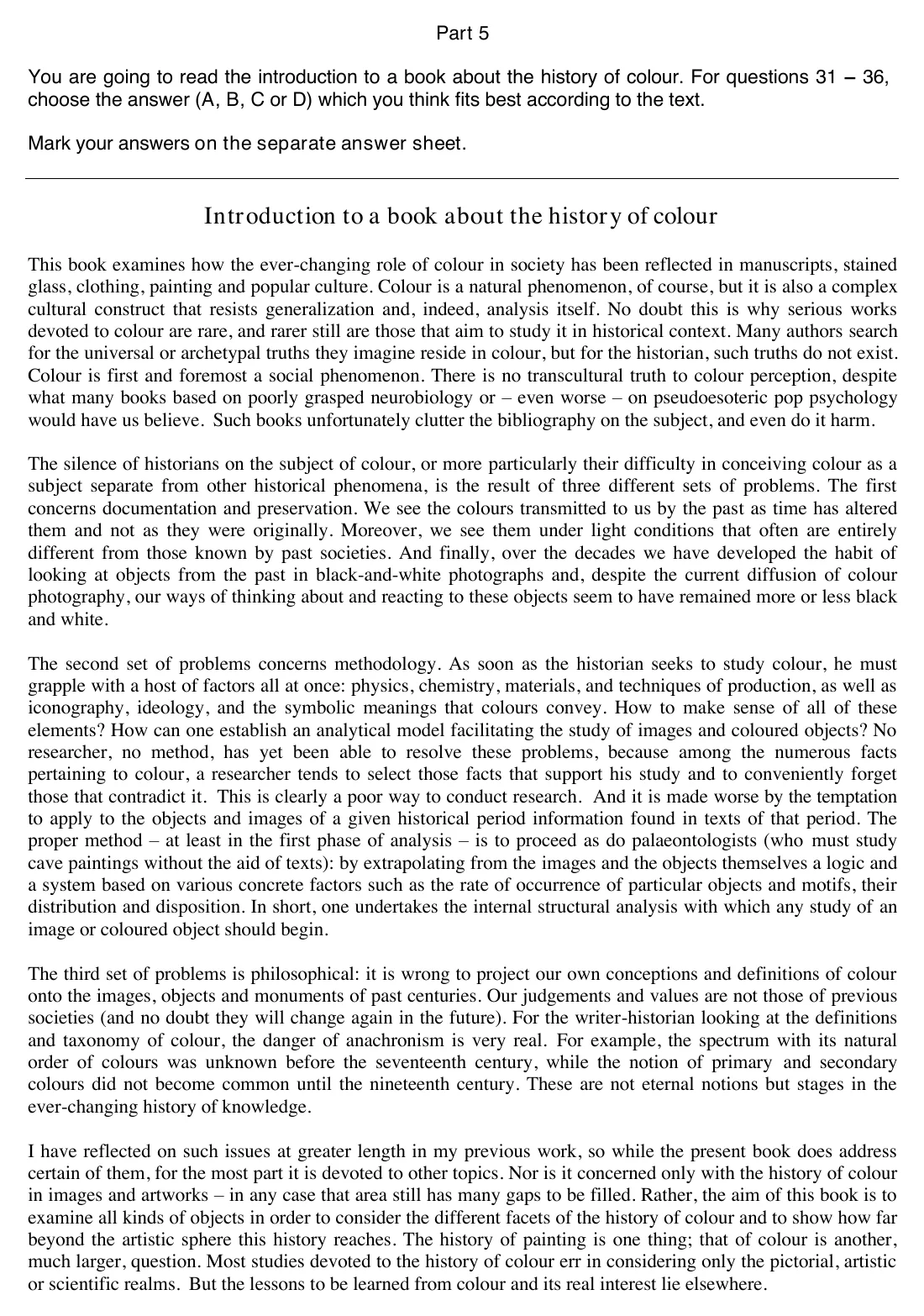
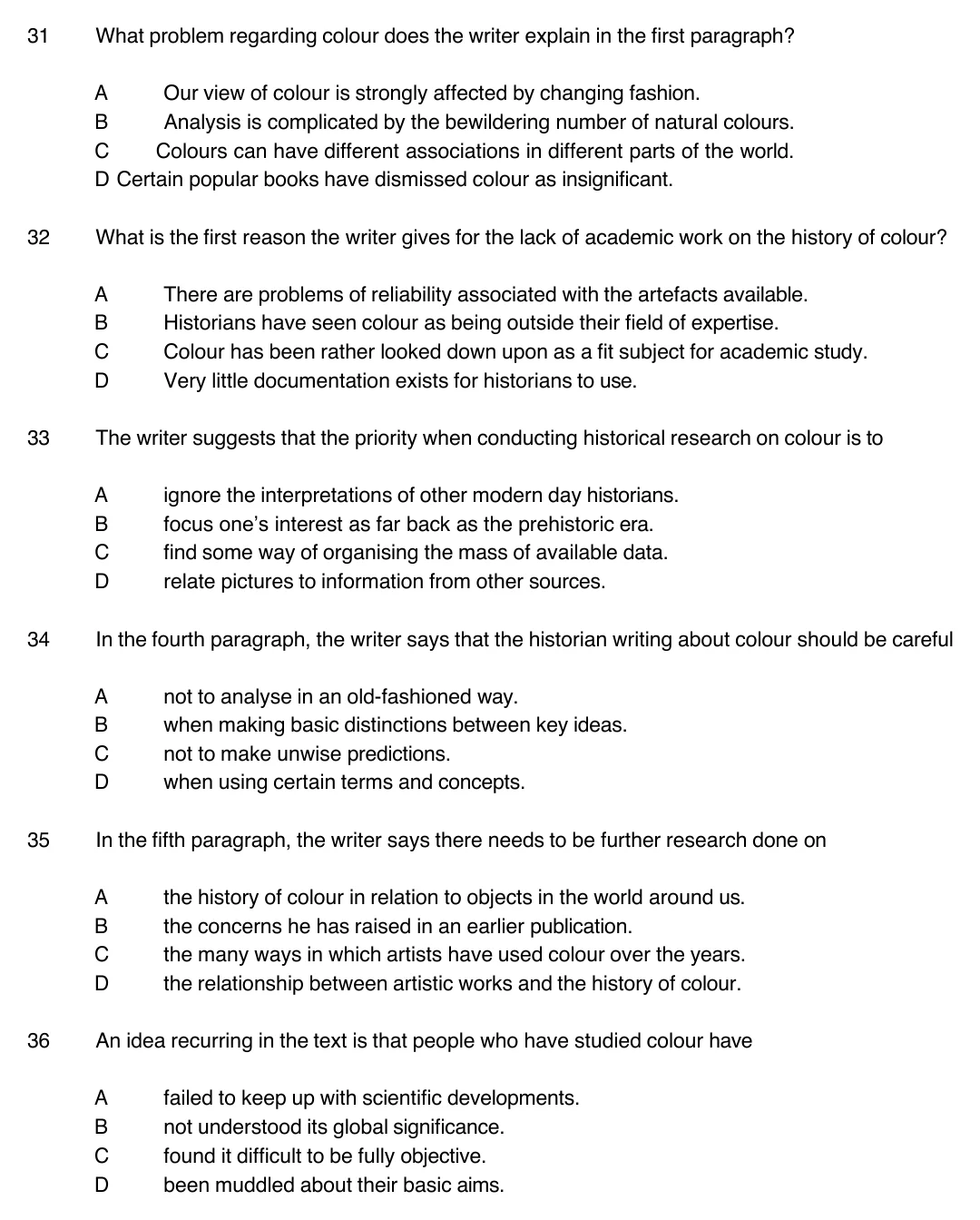
Click on a page to see it full size. Official C1 Advanced sample paper (Sample Paper 1, Reading and Use of English). © Cambridge University Press & Assessment.
First and second paragraphs: questions 31 and 32
31. Answer: C. What problem regarding colour does the writer explain in the first paragraph? The writer says colour is first and foremost a social phenomenon and that there is no transcultural truth to colour perception: there’s no truth about colour that holds for every culture. In other words, each society gives it its own meanings, which is what C says. B is the repeated-word trap: the text says colour is a natural phenomenon, but it says nothing about the number of colours. A isn’t in the text: ever-changing role is about history, not fashion. And D turns the text round: those popular books don’t dismiss colour, they look for universal truths in it that don’t exist.
32. Answer: A. What is the first reason the writer gives for the lack of academic work on the history of colour? The first set of problems concerns documentation and preservation: we see the colours of the past altered by time, in different light and, on top of that, through years of black-and-white photographs. All of that is a problem with the reliability of the objects we have, which is A. D is the repeated word again: documentation appears, but the text doesn’t say there’s little of it. B and C may sound reasonable, but the text doesn’t give them as reasons.
Third and fourth paragraphs: questions 33 and 34
33. Answer: C. The writer suggests that the priority when conducting historical research on colour is to… The paragraph opens with a long list of factors at once (physics, chemistry, techniques, symbolism…) and asks How to make sense of all of these elements? The proper method, the writer says, is to extract a logic and a system from concrete facts: how often each object appears, how it’s distributed and so on. That’s organising the mass of available data. There are two very typical Cambridge traps here. B takes the comparison with palaeontologists literally: the writer isn’t suggesting studying prehistory, but working the way they do, without texts. And D is exactly the method the writer rejects: applying information from texts of the period to the images.
34. Answer: D. In the fourth paragraph, the writer says that the historian writing about colour should be careful… The danger is anachronism in dealing with the definitions and taxonomy of colour, and the examples make it clear: the spectrum and the idea of primary and secondary colours didn’t exist a few centuries ago. You have to be careful with certain terms and concepts, D. A turns it round: the problem isn’t analysing in an old-fashioned way, but applying modern ideas to the past. B plays on primary and secondary colours, and C on they will change again in the future, but the writer isn’t talking about making predictions.
Fifth paragraph and the whole text: questions 35 and 36
35. Answer: D. In the fifth paragraph, the writer says there needs to be further research done on… The key is in an aside: the book isn’t only about the history of colour in images and artworks, and in any case that area still has many gaps to be filled. That area, the relationship between artworks and the history of colour, is the one that needs more research. A is what this book does, not what’s still to be researched. B refers to the writer’s earlier work, where he has already dealt with those issues. And C is about how artists use colour, which is something different.
36. Answer: C. An idea recurring in the text is that people who have studied colour have… Recurring-idea questions need something that appears in several paragraphs. Here the writer keeps coming back to the same point: authors looking for truths they imagine reside in colour (first paragraph), researchers who pick the facts that suit them and forget the rest (third) and historians who project their own ideas onto the past (fourth). They all struggle to be objective. A appears only once (poorly grasped neurobiology), and B and D aren’t in the text.
The answers, in case you’ve been keeping track: 31C, 32A, 33C, 34D, 35D, 36C.
What decided each answer
Put the six questions together and you can see very clearly what this part asks of you and where the traps are:
| Question | Answer | Type of question | The main trap |
|---|---|---|---|
| 31 | C | Main idea of a paragraph | Repeated word: natural |
| 32 | A | Detail | Repeated word: documentation |
| 33 | C | Writer’s opinion | The comparison taken literally and the method the writer rejects |
| 34 | D | Detail | The opposite of what the text says |
| 35 | D | Detail | What the book does, not what’s still to be done |
| 36 | C | Whole text | An idea that appears only once |
Notice that none of the correct answers repeats the words of the text: they all paraphrase it. Several wrong options, on the other hand, take a word from the text and put it into a different idea. That’s the key to Part 5.
The typical traps in C1 Reading Part 5
Cambridge uses the same kinds of wrong option in every task. Once you know them, ruling options out gets much easier:
- The repeated word. The option uses a word from the text but puts it into an idea the text doesn’t express. Documentation in question 32. If an option repeats words from the text exactly, be suspicious.
- The opposite. The option says exactly the opposite of the text, often with a small change that’s easy to miss if you read fast. Question 34.
- The comparison taken literally. The writer compares something to something else, like the palaeontologists in the sample paper, and the option talks about that other thing literally. Question 33.
- The view the writer rejects. The text mentions an idea in order to dismiss it, and the option presents it as the writer’s view. Question 33.
- True, but not the answer. The option says something that is in the text, but it doesn’t answer the question. Question 35.
- Nearly, but too strong. The option says almost the same as the text, but goes too far (all instead of some, more important instead of part of).
- The reasonable assumption. The option is logical and could be true, but the text doesn’t say it. It’s the trap that catches the most strong candidates.
The most common mistakes in C1 Reading Part 5
- Choosing the option you agree with. The answer isn’t what you think, or what would be logical to think: it’s what the writer says. Cambridge’s handbook points this out as one of the most frequent mistakes.
- Only skimming the text when you answer. Many candidates find the right area of the text and pick the option that sounds right without rereading that part carefully. At C1, the differences between the options are in the details.
- Checking only half of the sentence. When the question is an incomplete sentence, an option can match the text in one part and fail in the other.
- Ignoring the contrasts. Yet, but, I accept this, at the time I put this down to…: words like these tell you what the writer concedes, what they reject and what they really think.
- Getting stuck on a word you don’t know. There’ll always be some in a C1 text. Keep reading and work it out from the context, which hardly ever depends on that one word.
- Spending too long on it. If a question won’t give, mark the most likely option and move on. You still have three long texts to go.
How to prepare for C1 Advanced Part 5
- Read opinion pieces in English. Newspaper columns, book reviews, introductions to popular non-fiction. That’s the kind of text that comes up, and it gets you used to following an argument full of concessions and nuances.
- Sum up each paragraph in one sentence. It’s the best way to practise main ideas and to see how a text is organised. Cambridge suggests this same exercise in its preparation materials.
- Always ask yourself what the writer thinks. For, against or somewhere in between? What do they concede? What do they reject? Underline the words that give it away.
- Justify every answer. When you check an exercise, don’t stop at whether you got it right. Find the sentence in the text that proves it and the reason why each wrong option fails. That’s how you learn to spot the traps.
- Do full tests against the clock. The 15 minutes for Part 5 have to fit into the hour and a half of the paper, with three more long texts after it.
C1 Reading Part 5 exercises
Here are two original Part 5 exercises, in the same format as the exam: a text of about 750 words and six questions, numbered 31 to 36 as in the real exam. The first is an opinion article, like most exam texts, and the second is an extract from a novel. Do them first without looking at the answers and, when you’ve finished, check them: each answer comes with an explanation, including why the other options are wrong.
Exercise 1: Leave the spoons alone
You are going to read an article about the pressure to turn hobbies into businesses. For questions 31–36, choose the answer (A, B, C or D) which you think fits best according to the text.
Leave the spoons alone
We are urged to make every pastime earn its keep, but something worth having disappears the moment it does.
For eleven years Petronel Gostelow carved wooden spoons in a shed at the end of her garden. She gave most of them away and kept the failures, of which there were many, on a shelf she called the museum. When friends began telling her she ought to sell them, she resisted for a while and then, flattered and a little curious, opened a small online shop. It did rather better than she had dared to hope. Within a year, however, she was carving to a schedule, choosing her timber by what had sold the month before and spending her evenings photographing spoons rather than making them. What struck me was not that she had stopped enjoying the work, which she readily admitted, but that she could not say when it had happened: there had been no single bad week and no order she had resented, only a slow change in the light by which she saw her own shed.
Her story is hardly unusual, and the pressure behind it is everywhere. Scarcely a pastime now exists that is not discussed somewhere as an untapped asset. The question Petronel’s friends put to her – had she thought of selling them? – is asked so routinely that it has become a form of praise. It is meant kindly, and I do not doubt the kindness. But it is a compliment of a curious sort, since it implies that the spoons were not quite proved good until a stranger had paid for one, as though the pleasure of the woman who made them, and of the friends who received them, had been a provisional verdict awaiting confirmation by the market.
What is lost when a pastime has to pay is not, I think, the pleasure as such, which can survive a good deal of commerce, but something less obvious: the right to do a thing badly. A hobby is perhaps the one corner of adult life in which failure costs nothing, in which one may abandon a project halfway through, spend a winter on a technique that leads nowhere or simply repeat, for the hundredth time, a piece one already knows. This is what the word amateur meant before it came to mean ‘not quite good enough’: a person who does something for love, and who is therefore answerable to no one for the way it turns out. The moment a customer appears, that freedom quietly goes, because a customer, however friendly, is someone to whom the results are owed.
The difference is easy to dismiss as sentimental, so consider an analogy. Suppose you invited friends to dinner and, at the end of the evening, handed each of them a modest bill. The food would be exactly as good as it would otherwise have been; the conversation might even be livelier, since guests who had paid would feel entitled to enjoy themselves. Yet nobody would call it the same evening, because what made it a dinner among friends was never the food but the fact that nothing was being exchanged for it. Selling what one makes in one’s spare time no more ruins the object than the bill ruins the soup – it changes what kind of occasion the making is.
I should concede that for some people the arrangement works perfectly well. A man I know, Leofric Rudgley, made furniture at weekends for twenty years before leaving his office job to do it full time, and he has never once looked back. But it would be a mistake to treat his case as proof that the rest of us are merely timid. For Leofric the workshop had never been a refuge from anything; it was the career he had been unable to afford, and those weekends were less a pastime than a long rehearsal for it. What he gained by charging for his tables was not a reward for his hobby but permission, at last, to stop pretending that he had one.
None of this is an argument against selling things, still less against people who need the money and look for it wherever they can. It is an argument for noticing what we are being asked to give up, which the advice rarely mentions, and for treating the suggestion that a pastime should earn its keep as a question to be weighed rather than a compliment to be accepted. Petronel has since closed her shop. She still carves, more slowly and rather less well than she did at her busiest, and the museum, she tells me, is filling up again.
31 In the first paragraph, what does the writer suggest about Petronel’s experience of running her shop?
- A Her pleasure in the work ended with an order she had not wanted to take.
- B Her pleasure in the work faded at a point she was unable to identify.
- C Her pleasure in the work faded, though she would not admit that it had.
- D Her pleasure in the work faded once the shop began earning less than hoped.
32 In the second paragraph, what is the writer’s view of the question Petronel’s friends asked her?
- A It has been repeated so often that it no longer works as praise.
- B It praises the spoons while showing little real interest in how they are made.
- C It confuses the pleasure of making a thing with the skill of selling it.
- D It treats the judgement of the maker and her friends as not yet final.
33 The writer uses the word ‘amateur’ to refer to someone who
- A owes nobody any particular result from the work they choose to do.
- B does the work for love and so takes less care over the result.
- C would rather repeat familiar pieces than risk trying something new.
- D judges their work by the effort it took rather than by the result.
34 Why does the writer describe charging friends for dinner?
- A to show that people enjoy an occasion more once they have paid for it
- B to show that charging for something tends to lower the quality of what is offered
- C to show that charging changes the meaning of an event, not its contents
- D to illustrate how commercial habits have spread into private life
35 What does the writer imply about Leofric Rudgley in the fifth paragraph?
- A His weekends had really been preparation for the work he hoped to do.
- B His case proves a hobby can become a living without losing its appeal.
- C He left his office job only after the furniture had paid its way.
- D He had always used the workshop as an escape from office life.
36 Throughout the article, the writer’s attitude to turning a hobby into a business is
- A resigned, since the pressure to do it has become too widespread to resist.
- B uneasy, since it tends to take the pleasure out of the activity itself.
- C supportive, provided that the person has a genuine talent for the work.
- D wary, since what it costs a person is seldom taken into account.
Show answers
- 31. B: She ‘could not say when it had happened’: there had been ‘no single bad week and no order she had resented, only a slow change’. A is a word match on ‘order’ and an inversion: there was ‘no order she had resented’. C is an inversion: she had stopped enjoying the work, ‘which she readily admitted’. D is a plausible assumption the text rules out: the shop ‘did rather better than she had dared to hope’.
- 32. D: The question ‘implies that the spoons were not quite proved good until a stranger had paid for one’, as though the pleasure of the maker and of her friends ‘had been a provisional verdict awaiting confirmation by the market’. A is a word match and an inversion: it is ‘asked so routinely that it has become a form of praise’. B is a plausible assumption: the writer never says the askers are uninterested in the making. C is a plausible assumption: the writer never mentions the skill of selling.
- 33. A: The amateur is ‘answerable to no one for the way it turns out’, until a customer appears, ‘someone to whom the results are owed’. B is a word match on ‘for love’ and a plausible assumption: being answerable to no one is not the same as caring less. C is a word match on ‘repeat, for the hundredth time, a piece one already knows’: this is one freedom among several, not a preference. D is a plausible assumption: the writer never says the amateur measures the work by effort.
- 34. C: ‘The food would be exactly as good’, yet ‘nobody would call it the same evening’; selling ‘no more ruins the object than the bill ruins the soup – it changes what kind of occasion the making is’. A is true but not the answer: the conversation ‘might even be livelier’, but the writer concedes this only to make the point that follows. B is an inversion: ‘the food would be exactly as good as it would otherwise have been’. D is a plausible assumption about the theme: the dinner is imagined, not an example of a trend.
- 35. A: For Leofric the workshop ‘was the career he had been unable to afford’, and the weekends were ‘less a pastime than a long rehearsal for it’. B is the view the writer rejects: ‘it would be a mistake to treat his case as proof’. C is a plausible assumption: the writer never says when or why he could afford to leave. D is a word match on ‘office job’ and an inversion: ‘the workshop had never been a refuge from anything’.
- 36. D: The writer argues that a paid pastime loses ‘the right to do a thing badly’ and asks readers to notice ‘what we are being asked to give up, which the advice rarely mentions’. A is a word match on ‘the pressure behind it is everywhere’: the writer treats the suggestion ‘as a question to be weighed’, not as something to give in to. B is the view the writer rejects: what is lost ‘is not, I think, the pleasure as such’. C is a near-miss: Leofric succeeds because it was ‘the career he had been unable to afford’, not because of talent.
Exercise 2: Out of season
You are going to read an extract from a novel. For questions 31–36, choose the answer (A, B, C or D) which you think fits best according to the text.
Out of season
The advertisement had asked for someone reliable, practical and comfortable with their own company, and Lucan Haverley, who had lately been told by two employers that he was neither of the first two, decided that one out of three would have to do. Saltholme Sands Holiday Park was closed from the end of October until Easter, and in between, Mr Tolputt explained, it needed someone to check the padlocks, drain the pipes before a frost and see that the sea took no more than its share. ‘The quiet gets to some people,’ he added. Lucan, who at twenty-four had spent a year sharing a flat with four others, heard this as the most persuasive part of the offer, and said so.
He had expected the emptiness to be restful, and for the first fortnight it was nothing of the sort: the park produced noises at night that he could not account for, which he went out to investigate with a torch and a growing sense of absurdity. By the third week he could tell one sound from another, and something in him that seemed to have been waiting all his life for instructions began to settle. The rounds at eight and four, far from confining him, gave the day a shape he had never succeeded in giving it himself. It was not, he would have said if asked, a career; but nobody asked, and he had stopped minding.
The only other light in the park belonged to chalet 31, where a Mr Ashkettle had lived all year round since before Mr Tolputt’s time. Mr Tolputt referred to him as one of the fixtures, in the tone he used for the septic tank. Lucan, who had read a certain number of novels, knew at once what a solitary old man in an empty park must be, and resolved to be kind. He took him a newspaper on Tuesdays, and it reappeared on the step the next morning with the crossword completed in ink. Mr Ashkettle walked the tideline every morning at seven, and on the rare occasions he spoke at any length it was about the tides. Lucan took all this as loneliness bravely borne, and went on with the newspapers.
In December he began to notice the things he had not done. A stopcock he had meant to turn off was already off; a shutter he had been putting off with a vague intention of finding a ladder had been wired shut with a neatness that was not his. When he raised the matter, as casually as he could, Mr Ashkettle admitted without the least embarrassment that he had been going round behind the caretakers for eleven winters. ‘You’re the fifth of my visitors,’ he said. ‘The others went back to town about February. I don’t hold it against them. I just like to know the place will still be standing in April.’
The storm came at the end of January, on a night so loud that Lucan gave up on sleep and went out at two with the torch. He found Mr Ashkettle already in the second row, lashing down the awning of a caravan bent on leaving for the dunes. They worked for an hour with hardly a word, Mr Ashkettle saying ‘here’ and ‘now’ and ‘leave that one, it’ll hold’, and Lucan, who had always found being told what to do faintly humiliating, minded it not at all, and began to suspect that what he had minded all along was being told by people who were guessing. Afterwards, drinking tea in chalet 31, he took in shelves of old tide tables, a barometer tapped so often that its glass had worn pale, and a single armchair, with nowhere that a second person was ever expected to sit.
In February Mr Tolputt rang to ask whether Lucan would be seeing the winter out. Lucan said he would, and then, to his own surprise, asked whether the post would need filling again in October. He stopped taking the newspaper to chalet 31; it had come to him that it had been accepted much as he himself had been, as a small intrusion it would have been unkind to refuse. Instead he took his morning round along the tideline at seven, and most days the two of them passed with a nod and a word about the wind. It was not friendship, or not the kind Lucan had read about; but he looked for the figure on the sand each morning, and on the days when the fog hid it, the round seemed longer.
31 In the first paragraph, why does the writer mention what Lucan’s previous employers had told him?
- A to explain why he was keen to escape a crowded shared flat
- B to suggest that he applied with little hope of being chosen
- C to show that he was not easily discouraged by criticism
- D to indicate that he was unsure he would be comfortable alone
32 What does the second paragraph suggest about the effect of the routine on Lucan?
- A It met a need in him that he had not known he had.
- B It kept him too busy to dwell on his lack of a proper career.
- C It made the solitude easier to bear than he had feared.
- D It felt restrictive at first, though he gradually grew used to it.
33 What does the writer suggest about Lucan’s view of Mr Ashkettle?
- A It was coloured by the dismissive way Mr Tolputt had described him.
- B It reflected a fear of ending up alone himself.
- C It changed when he learnt how the old man spent his mornings.
- D It owed more to his reading than to anything he had observed.
34 What does Mr Ashkettle’s use of the word ‘visitors’ suggest about the caretakers?
- A They had rarely come to see him at his chalet uninvited.
- B They had come and gone without the place ever becoming theirs.
- C They had resented the way he went round checking their work.
- D They had been glad of the help that he quietly gave them.
35 What does the writer suggest about Lucan during the storm?
- A He was more capable than the old man had assumed.
- B What he had resented was not orders as such but the people who gave them.
- C He saw that the old man’s curt manner concealed a wish for company.
- D He would rather share his rounds with someone than work alone.
36 In the final paragraph, the narrator suggests that Lucan
- A had come to value a tie that asked little of either man.
- B had at last broken through the solitary old man’s natural reserve.
- C was quietly disappointed that the friendship had gone no further.
- D took care to hide how much their brief meetings meant to him.
Show answers
- 31. C: Told ‘that he was neither of the first two’ (reliable and practical), Lucan simply ‘decided that one out of three would have to do’ and applied: the criticism does not put him off. A is a word match on ‘sharing a flat’, which explains why the quiet appealed to him, not what his employers said. B is a plausible assumption: nothing suggests he expected to be turned down. D is an inversion: he heard the warning about the quiet ‘as the most persuasive part of the offer’.
- 32. A: Something in him ‘that seemed to have been waiting all his life for instructions began to settle’, and the rounds ‘gave the day a shape he had never succeeded in giving it himself’: the routine answers a lack he only now recognises. B is a word match on ‘a career’: he ‘stopped minding’, but not because he was busy, since the rounds took place only twice a day. C is an inversion: he never feared the solitude; he ‘had expected the emptiness to be restful’. D is an inversion: the rounds were ‘far from confining him’; what troubled him at first was the noise at night.
- 33. D: Lucan, ‘who had read a certain number of novels, knew at once what a solitary old man in an empty park must be’, before he had seen anything of him. A is a word match on ‘one of the fixtures’ and an inversion: Mr Tolputt was dismissive, but Lucan ‘resolved to be kind’. B is a plausible assumption: nothing suggests such a fear, and he heard the warning about the quiet ‘as the most persuasive part of the offer’. C is the wrong time: he saw the morning walks and still ‘took all this as loneliness bravely borne’.
- 34. B: Mr Ashkettle has lived there ‘all year round’ and gone round ‘for eleven winters’, while ‘The others went back to town about February’: to him the caretakers come and go like the summer families, and the place is his to keep ‘standing in April’. A is the dictionary sense of the word: nothing is said about the caretakers calling on him. C and D are plausible assumptions: he went round ‘behind’ them, so nothing suggests they knew of his help, let alone resented it or were grateful; he says only ‘I don’t hold it against them’.
- 35. B: Lucan, ‘who had always found being told what to do faintly humiliating, minded it not at all’ when Mr Ashkettle gave the orders, ‘and began to suspect that what he had minded all along was being told by people who were guessing’. A is a plausible assumption: Mr Ashkettle gives the instructions, and nothing is said about his opinion of Lucan. C is the expected story the paragraph rules out: the single armchair, with nowhere ‘a second person was ever expected to sit’, shows a man content alone. D is a plausible assumption: they ‘worked for an hour with hardly a word’, and what changes is how Lucan feels about instructions, not about company.
- 36. A: He stops the newspapers, which had been ‘a small intrusion’, and settles for passing ‘with a nod and a word about the wind’; yet he ‘looked for the figure on the sand each morning’ and the round ‘seemed longer’ without it. B is the stock ending the text rules out: ‘It was not friendship’, and Lucan realises he himself had only been tolerated, ‘a small intrusion it would have been unkind to refuse’. C is a word match on ‘friendship’ and an inversion: the ‘but’ that follows shows he values what there is. D is a plausible assumption: nothing suggests he conceals anything; the change is in what he asks of the old man, not in what he shows.
Frequently asked questions about C1 Reading Part 5
How many questions are there in C1 Advanced Reading Part 5?
Six questions, numbered 31 to 36. Each one has four options and is worth 2 marks, so Part 5 is worth 12 marks in total.
Should I read the text or the questions first?
I recommend reading the whole text first, quickly, to get the topic and the writer’s position. Then go question by question: read the question, find the relevant part and read it carefully before you look at the options. That’s what Cambridge itself suggests.
Can more than one answer be correct?
No. There’s always just one. Sometimes another option looks possible, but it fails for a specific reason: the text doesn’t say it, says the opposite or says it about something else.
How long should I spend on it?
Cambridge recommends no more than about 15 minutes. You have 1 hour 30 minutes for all eight parts of Reading and Use of English, and three more long texts come after Part 5.
Can the text be fiction?
Yes. The handbook says the text can come from a range of sources, including fiction, although all the official tasks I analysed were non-fiction. That’s why one of the exercises on this page is an extract from a novel.
Is it the same on paper and on computer?
The task is the same. In the computer-based exam you see the text and the questions on screen at the same time, and you can highlight parts of the text and make notes, which is very useful for this part.
Keep preparing for C1 Reading
This guide is part of the series on C1 Advanced Reading. If you haven’t seen it yet, Part 1 is covered in my guide to C1 Use of English Part 1, because you prepare it the same way as Use of English. If you want to see how it all fits into the full exam, go back to the C1 Advanced main page or have a look at the C1 score calculator. And if you’re looking for practice material, here’s my selection of the best books to prepare for C1 Advanced.
Did you find this guide useful? Share it with other students and teachers preparing for CAE. And if you have any questions about a particular answer, leave me a comment, I read them all.
See you soon, and don’t forget to keep smiling! 🙂
