

Tabla de contenidos
La Parte 5 del Reading del C1 Advanced es la primera de las cuatro tareas largas de comprensión lectora del examen: un texto de unas 750 palabras y seis preguntas de cuatro opciones. Parece la tarea más clásica de todas, la de toda la vida, pero en el C1 tiene truco. Casi nunca te preguntan un dato que puedas localizar sin más: te preguntan qué opina el autor, por qué menciona un ejemplo o qué significa una palabra en ese contexto concreto. Y las opciones incorrectas están pensadas para parecer correctas si lees por encima.
En esta guía te explico cómo es el C1 Reading Part 5 (el multiple choice), qué tipo de preguntas salen según las tareas oficiales de Cambridge, en qué se diferencia de la del B2, un método para resolverla y el examen de muestra oficial resuelto pregunta por pregunta. Al final tienes dos ejercicios originales para practicar, con las respuestas explicadas. ¡Vamos allá!
Cómo es la Parte 5 del Reading del C1 Advanced
| Dato | C1 Reading Part 5 |
|---|---|
| Qué tienes que hacer | Leer un texto largo y responder seis preguntas eligiendo, en cada una, la opción correcta de entre 4 (A, B, C o D) |
| Número de preguntas | 6 (numeradas del 31 al 36) |
| Puntuación | 2 puntos por respuesta correcta (12 en total); los fallos no restan |
| Longitud del texto | Unas 750 palabras, normalmente en cinco a siete párrafos |
| Tipo de texto | Artículos de opinión, introducciones de libros, reseñas, textos de divulgación y, a veces, ficción |
| Orden de las preguntas | Siguen el orden del texto; la última puede referirse al texto entero |
| Qué mide | Comprensión detallada: opinión y actitud del autor, inferencia, propósito, significado en contexto, referencia y organización del texto |
Todo esto forma parte del examen de Reading and Use of English, que dura 1 hora y 30 minutos y tiene ocho partes y 56 preguntas. Fíjate en la puntuación: cada pregunta de la Parte 5 vale el doble que una de las Partes 1, 2 o 3. Son 12 puntos en seis preguntas, así que merece la pena dedicarle el tiempo que pide. Cambridge recomienda no pasar de unos 15 minutos.
Tienes la visión completa de las Partes 1 y 5 a 8 en mi guía del Reading del C1 Advanced.
Qué tipo de preguntas salen en el C1 Reading Part 5
Para preparar esta guía he analizado las tareas oficiales de Cambridge de la Parte 5 del C1 (las de los exámenes de muestra y la de los materiales de autoaprendizaje). Este es el reparto de lo que se pregunta:
| Tipo de pregunta | Qué te piden | Cómo suele aparecer |
|---|---|---|
| Detalle | Entender con precisión lo que dice una parte del texto | According to the writer, … |
| Idea principal de un párrafo | Resumir qué problema, razón o argumento plantea un párrafo | What problem does the writer explain in the first paragraph? |
| Propósito | Saber para qué menciona el autor un ejemplo, una comparación o un estudio | The writer refers to … in order to |
| Inferencia | Deducir lo que el autor sugiere sin decirlo directamente | What does the writer suggest about …? |
| Actitud y opinión | Saber qué piensa el autor, qué concede y qué rechaza | What is the writer’s view of …? |
| Significado en contexto | Entender qué quiere decir una palabra o expresión en ese párrafo | In the fourth paragraph, the word ‘…’ refers to |
| Referencia | Saber a qué se refiere un pronombre o una expresión como the rest | What does ‘…’ refer to? |
| Texto completo | Identificar una idea que se repite o el propósito general | An idea recurring in the text is that … |
Hay tres patrones que se repiten en todas las tareas oficiales y que te conviene conocer:
- La primera pregunta va sobre el primer párrafo, y las demás siguen el orden del texto. No tienes que buscar por todo el texto.
- En más de la mitad de las preguntas, el enunciado te dice el párrafo (In the fourth paragraph…). Aprovéchalo.
- La última pregunta suele mirar el texto entero o los últimos párrafos: una idea que se repite o el propósito del autor.
En qué se diferencia de la Parte 5 del B2 First
El formato es el mismo que en la Parte 5 del Reading del B2, pero el C1 sube el nivel en tres cosas:
- Textos más largos y densos. En el B2 el texto tiene unas 640 palabras y frases de unas 15 palabras de media. En el C1 son unas 750 palabras y frases de unas 24 palabras, con muchas oraciones subordinadas.
- Más argumentación y menos narración. En el B2 abundan los relatos y las preguntas sobre cómo se siente un personaje. En las tareas oficiales del C1 que he analizado, los textos son argumentativos y no hay ni una pregunta sobre sentimientos de personajes: todo va de lo que el autor piensa, concede o rechaza.
- Opciones más finas. Las opciones incorrectas no son absurdas: muchas dicen algo que aparece en el texto, pero no responde a la pregunta, o dicen casi lo mismo que el texto, pero con un matiz de más o de menos.
El método en cuatro pasos
- Lee el texto entero rápido, sin mirar las opciones. Fíjate en el título y en la entradilla, si la hay, y quédate con el tema, la postura del autor y lo que hace cada párrafo. No te pares en las palabras que no conozcas.
- Lee el enunciado de la pregunta, no las opciones. Subraya las palabras clave y localiza el fragmento del texto al que se refiere. Como las preguntas siguen el orden del texto, la respuesta de la 33 estará después de la de la 32.
- Responde tú antes de mirar las opciones. Lee el fragmento con atención y formula la respuesta con tus palabras. Así las opciones trampa te engañan mucho menos.
- Compara las cuatro opciones con el texto, frase entera. Elige la que dice lo mismo que el texto con otras palabras y descarta las demás por un motivo concreto. Cuando la pregunta es una frase incompleta, la frase completa tiene que coincidir con el texto, no solo la parte de la opción.
El examen de muestra, resuelto pregunta por pregunta
Este es el texto de la Parte 5 del examen de muestra oficial de Cambridge para el C1 Advanced: la introducción a un libro sobre la historia del color. Es un texto académico bastante denso, así que tómate tu tiempo. Intenta resolverlo antes de leer las explicaciones:
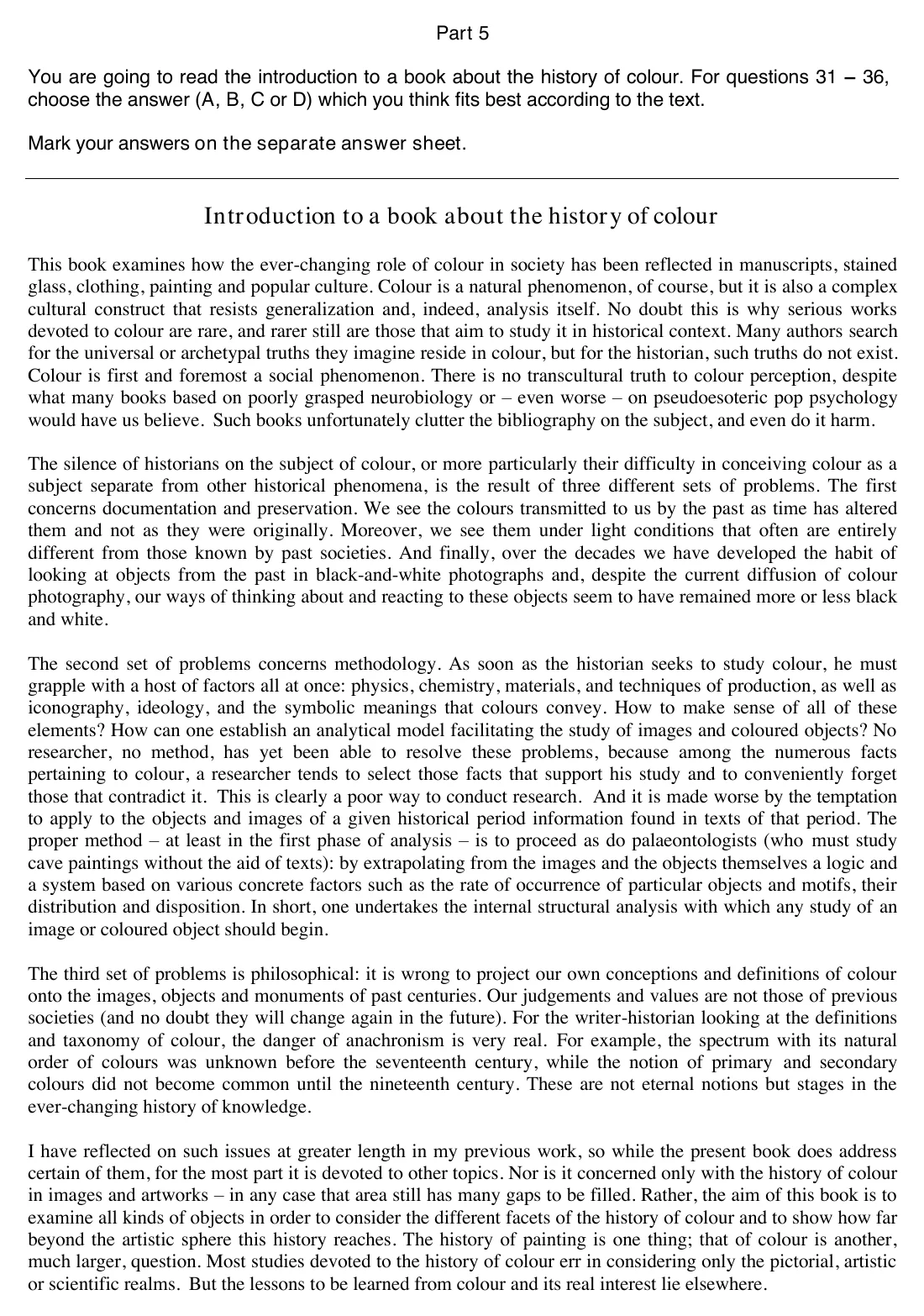
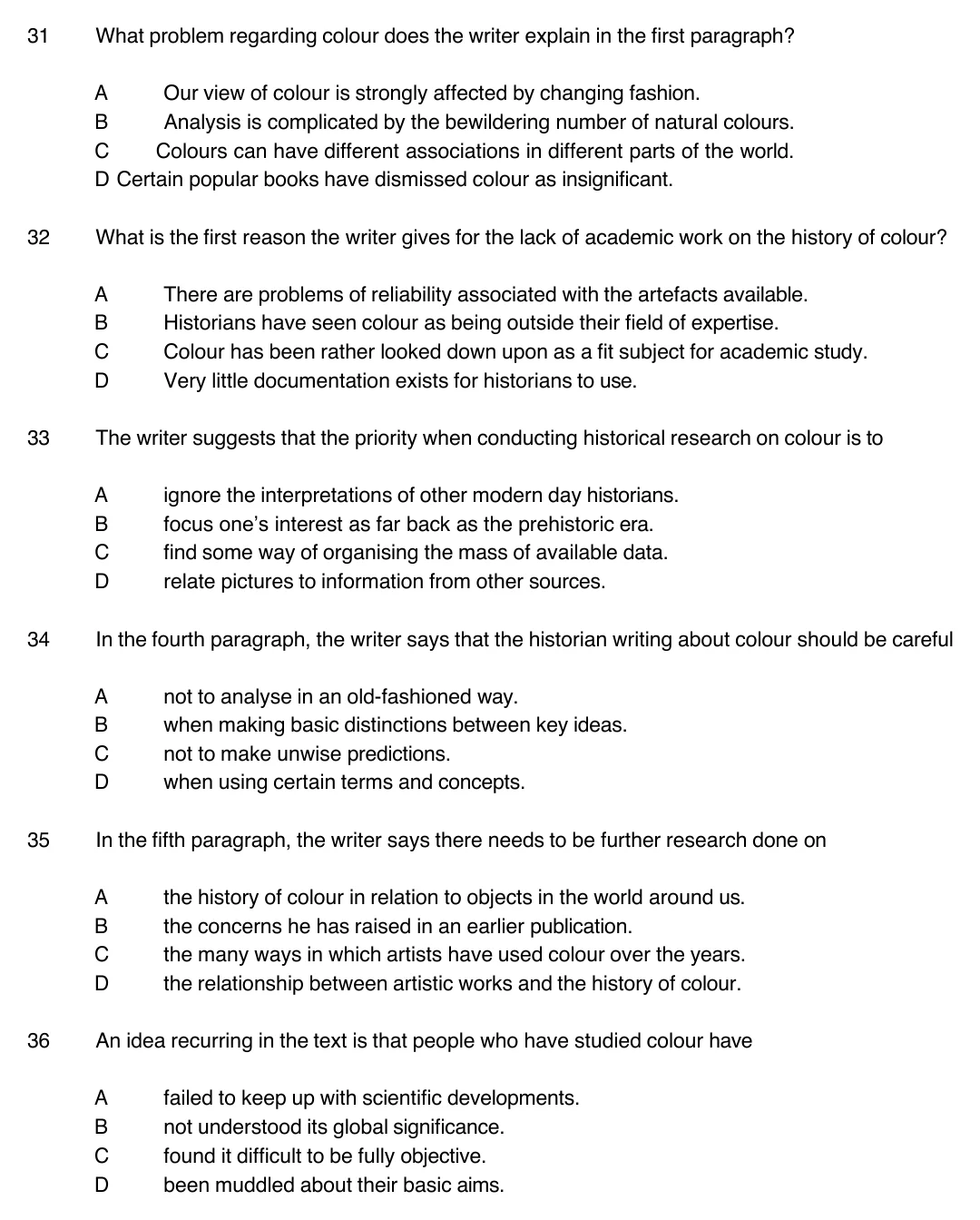
Pulsa en una página para verla a tamaño completo. Examen de muestra oficial del C1 Advanced (Sample Paper 1, Reading and Use of English). © Cambridge University Press & Assessment.
Primer y segundo párrafo: preguntas 31 y 32
31. Respuesta: C. What problem regarding colour does the writer explain in the first paragraph? El autor dice que el color es first and foremost a social phenomenon y que there is no transcultural truth to colour perception: no hay una verdad sobre el color que valga para todas las culturas. Es decir, cada sociedad le da sus propios significados, que es lo que dice la C. La B es la trampa de la palabra repetida: el texto dice que el color es a natural phenomenon, pero no habla del número de colores. La A no aparece: ever-changing role se refiere a la historia, no a la moda. Y la D le da la vuelta al texto: esos libros populares no desprecian el color, sino que le buscan verdades universales que no existen.
32. Respuesta: A. What is the first reason the writer gives for the lack of academic work on the history of colour? El primer grupo de problemas concerns documentation and preservation: vemos los colores del pasado alterados por el tiempo, con una luz distinta y, encima, acostumbrados a las fotos en blanco y negro. Todo eso es un problema de fiabilidad de los objetos que tenemos, la A. La D es otra vez la palabra repetida: aparece documentation, pero el texto no dice que haya poca. La B y la C pueden sonar razonables, pero el texto no las menciona como motivo.
Tercer y cuarto párrafo: preguntas 33 y 34
33. Respuesta: C. The writer suggests that the priority when conducting historical research on colour is to… El párrafo empieza con un montón de factores a la vez (física, química, técnicas, simbolismo…) y la pregunta How to make sense of all of these elements? El método correcto, dice el autor, es extraer a logic and a system a partir de datos concretos: con qué frecuencia aparece cada objeto, cómo se distribuye… Eso es organizar la enorme cantidad de datos disponibles. Aquí hay dos trampas muy de Cambridge. La B toma al pie de la letra la comparación con los paleontólogos: el autor no propone estudiar la prehistoria, sino trabajar como ellos, sin textos. Y la D es justo el método que el autor rechaza: aplicar a las imágenes la información de los textos de la época.
34. Respuesta: D. In the fourth paragraph, the writer says that the historian writing about colour should be careful… El peligro es el anacronismo al tratar the definitions and taxonomy of colour, y los ejemplos lo dejan claro: el espectro o la idea de colores primarios y secundarios no existían hace unos siglos. Hay que tener cuidado con ciertos términos y conceptos, la D. La A le da la vuelta: el problema no es analizar de forma anticuada, sino aplicar ideas modernas al pasado. La B juega con primary and secondary colours, y la C con they will change again in the future, pero el autor no habla de hacer predicciones.
Quinto párrafo y texto completo: preguntas 35 y 36
35. Respuesta: D. In the fifth paragraph, the writer says there needs to be further research done on… La clave está en un inciso: el libro no trata solo la historia del color en las imágenes y las obras de arte, in any case that area still has many gaps to be filled. Ese campo, la relación entre las obras de arte y la historia del color, es el que necesita más investigación. La A es lo que hace este libro, no lo que falta por investigar. La B se refiere a la obra anterior del autor, donde ya trató esas cuestiones. Y la C se queda en cómo usan el color los artistas, que es algo distinto.
36. Respuesta: C. An idea recurring in the text is that people who have studied colour have… Las preguntas de idea recurrente piden algo que aparezca en varios párrafos. Aquí, el autor vuelve una y otra vez a lo mismo: hay autores que buscan las verdades que they imagine reside in colour (primer párrafo), investigadores que eligen los datos que les convienen y olvidan los que no (tercero) e historiadores que proyectan sus propias ideas sobre el pasado (cuarto). Todos tienen problemas para ser objetivos. La A aparece una sola vez (poorly grasped neurobiology), y la B y la D no se dicen en el texto.
Respuestas, por si has ido apuntando: 31C, 32A, 33C, 34D, 35D, 36C.
Qué decidía cada respuesta
Si ponemos las seis preguntas juntas, se ve muy bien qué te pide esta parte y dónde están las trampas:
| Pregunta | Respuesta | Tipo de pregunta | La trampa principal |
|---|---|---|---|
| 31 | C | Idea principal de un párrafo | Palabra repetida: natural |
| 32 | A | Detalle | Palabra repetida: documentation |
| 33 | C | Opinión del autor | La comparación tomada al pie de la letra y el método que el autor rechaza |
| 34 | D | Detalle | Al revés de lo que dice el texto |
| 35 | D | Detalle | Lo que hace el libro, no lo que falta por hacer |
| 36 | C | Texto completo | Una idea que aparece una sola vez |
Fíjate en que ninguna respuesta correcta repite las palabras del texto: todas lo parafrasean. En cambio, varias opciones incorrectas cogen una palabra del texto y la meten en una idea distinta. Esa es la clave de la Parte 5.
Las trampas típicas de la Parte 5 del C1 Reading
Cambridge repite los mismos tipos de opción incorrecta en todas las tareas. Si los conoces, descartar es mucho más fácil:
- La palabra repetida. La opción usa una palabra del texto, pero la mete en una idea que el texto no dice. Documentation en la pregunta 32. Si una opción repite palabras del texto tal cual, sospecha.
- Lo contrario. La opción dice justo lo opuesto de lo que dice el texto, a menudo con un pequeño cambio que se escapa si lees rápido. Pregunta 34.
- La comparación tomada al pie de la letra. El autor compara algo con otra cosa, como los paleontólogos del examen de muestra, y la opción habla de la otra cosa en sentido literal. Pregunta 33.
- La opinión que el autor rechaza. El texto menciona una idea para descartarla, y la opción la presenta como si fuera la del autor. Pregunta 33.
- Verdad, pero no es la respuesta. La opción dice algo que aparece en el texto, pero no responde a lo que pregunta el enunciado. Pregunta 35.
- Casi, pero con un matiz de más. La opción dice casi lo mismo que el texto, pero exagera (all en vez de some, more important en vez de part of).
- La suposición razonable. La opción es lógica y podría ser verdad, pero el texto no lo dice. Es la trampa que más pilla a los candidatos con buen nivel.
Errores más comunes en la Parte 5 del Reading del C1
- Elegir la opción con la que estás de acuerdo. La respuesta no es lo que tú piensas, ni lo que sería lógico pensar: es lo que dice el autor. El handbook de Cambridge lo señala como uno de los errores más frecuentes.
- Leer el texto solo por encima al responder. Muchos candidatos localizan la zona del texto y eligen la opción que suena bien sin volver a leer el fragmento con calma. En el C1, las diferencias entre opciones están en los detalles.
- Comprobar solo la mitad de la frase. Cuando el enunciado es una frase incompleta, la opción puede coincidir con el texto en una parte y fallar en la otra.
- No fijarse en los contrastes. Yet, but, I accept this, at the time I put this down to…: estas palabras te dicen qué concede el autor, qué rechaza y qué piensa de verdad.
- Atascarse en una palabra que no conoces. En un texto de C1 siempre habrá alguna. Sigue leyendo y deduce por el contexto, que casi nunca depende de esa palabra.
- Dedicarle demasiado tiempo. Si una pregunta se te resiste, marca la opción más probable y sigue. Te quedan tres textos largos más.
Cómo preparar la Parte 5 del C1 Advanced
- Lee textos de opinión en inglés. Columnas de prensa, reseñas de libros, introducciones de ensayos de divulgación. Es el tipo de texto que sale, y te acostumbra a seguir un argumento con concesiones y matices.
- Resume cada párrafo en una frase. Es la mejor manera de entrenar la idea principal y de ver cómo está organizado un texto. Cambridge propone este mismo ejercicio en sus materiales de preparación.
- Pregúntate siempre qué piensa el autor. ¿Está a favor, en contra o en un punto intermedio? ¿Qué concede? ¿Qué rechaza? Subraya las palabras que te dan la pista.
- Justifica cada respuesta. Cuando corrijas un ejercicio, no te quedes en si has acertado. Busca la frase del texto que lo demuestra y el motivo por el que cada opción incorrecta falla. Así aprendes a reconocer las trampas.
- Haz tests completos con tiempo. Los 15 minutos de la Parte 5 tienen que encajar en la hora y media del examen, con otros tres textos largos detrás.
Ejercicios del Reading C1 Part 5
Aquí tienes dos ejercicios originales de la Parte 5, con el mismo formato que el examen: un texto de unas 750 palabras y seis preguntas, numeradas del 31 al 36 como en el examen real. El primero es un artículo de opinión, como la mayoría de los textos del examen, y el segundo, un fragmento de novela. Hazlos primero sin mirar las respuestas y, cuando termines, compruébalas: cada una lleva su explicación, con el motivo por el que fallan las otras opciones.
Ejercicio 1: Leave the spoons alone
You are going to read an article about the pressure to turn hobbies into businesses. For questions 31–36, choose the answer (A, B, C or D) which you think fits best according to the text.
Leave the spoons alone
We are urged to make every pastime earn its keep, but something worth having disappears the moment it does.
For eleven years Petronel Gostelow carved wooden spoons in a shed at the end of her garden. She gave most of them away and kept the failures, of which there were many, on a shelf she called the museum. When friends began telling her she ought to sell them, she resisted for a while and then, flattered and a little curious, opened a small online shop. It did rather better than she had dared to hope. Within a year, however, she was carving to a schedule, choosing her timber by what had sold the month before and spending her evenings photographing spoons rather than making them. What struck me was not that she had stopped enjoying the work, which she readily admitted, but that she could not say when it had happened: there had been no single bad week and no order she had resented, only a slow change in the light by which she saw her own shed.
Her story is hardly unusual, and the pressure behind it is everywhere. Scarcely a pastime now exists that is not discussed somewhere as an untapped asset. The question Petronel’s friends put to her – had she thought of selling them? – is asked so routinely that it has become a form of praise. It is meant kindly, and I do not doubt the kindness. But it is a compliment of a curious sort, since it implies that the spoons were not quite proved good until a stranger had paid for one, as though the pleasure of the woman who made them, and of the friends who received them, had been a provisional verdict awaiting confirmation by the market.
What is lost when a pastime has to pay is not, I think, the pleasure as such, which can survive a good deal of commerce, but something less obvious: the right to do a thing badly. A hobby is perhaps the one corner of adult life in which failure costs nothing, in which one may abandon a project halfway through, spend a winter on a technique that leads nowhere or simply repeat, for the hundredth time, a piece one already knows. This is what the word amateur meant before it came to mean ‘not quite good enough’: a person who does something for love, and who is therefore answerable to no one for the way it turns out. The moment a customer appears, that freedom quietly goes, because a customer, however friendly, is someone to whom the results are owed.
The difference is easy to dismiss as sentimental, so consider an analogy. Suppose you invited friends to dinner and, at the end of the evening, handed each of them a modest bill. The food would be exactly as good as it would otherwise have been; the conversation might even be livelier, since guests who had paid would feel entitled to enjoy themselves. Yet nobody would call it the same evening, because what made it a dinner among friends was never the food but the fact that nothing was being exchanged for it. Selling what one makes in one’s spare time no more ruins the object than the bill ruins the soup – it changes what kind of occasion the making is.
I should concede that for some people the arrangement works perfectly well. A man I know, Leofric Rudgley, made furniture at weekends for twenty years before leaving his office job to do it full time, and he has never once looked back. But it would be a mistake to treat his case as proof that the rest of us are merely timid. For Leofric the workshop had never been a refuge from anything; it was the career he had been unable to afford, and those weekends were less a pastime than a long rehearsal for it. What he gained by charging for his tables was not a reward for his hobby but permission, at last, to stop pretending that he had one.
None of this is an argument against selling things, still less against people who need the money and look for it wherever they can. It is an argument for noticing what we are being asked to give up, which the advice rarely mentions, and for treating the suggestion that a pastime should earn its keep as a question to be weighed rather than a compliment to be accepted. Petronel has since closed her shop. She still carves, more slowly and rather less well than she did at her busiest, and the museum, she tells me, is filling up again.
31 In the first paragraph, what does the writer suggest about Petronel’s experience of running her shop?
- A Her pleasure in the work ended with an order she had not wanted to take.
- B Her pleasure in the work faded at a point she was unable to identify.
- C Her pleasure in the work faded, though she would not admit that it had.
- D Her pleasure in the work faded once the shop began earning less than hoped.
32 In the second paragraph, what is the writer’s view of the question Petronel’s friends asked her?
- A It has been repeated so often that it no longer works as praise.
- B It praises the spoons while showing little real interest in how they are made.
- C It confuses the pleasure of making a thing with the skill of selling it.
- D It treats the judgement of the maker and her friends as not yet final.
33 The writer uses the word ‘amateur’ to refer to someone who
- A owes nobody any particular result from the work they choose to do.
- B does the work for love and so takes less care over the result.
- C would rather repeat familiar pieces than risk trying something new.
- D judges their work by the effort it took rather than by the result.
34 Why does the writer describe charging friends for dinner?
- A to show that people enjoy an occasion more once they have paid for it
- B to show that charging for something tends to lower the quality of what is offered
- C to show that charging changes the meaning of an event, not its contents
- D to illustrate how commercial habits have spread into private life
35 What does the writer imply about Leofric Rudgley in the fifth paragraph?
- A His weekends had really been preparation for the work he hoped to do.
- B His case proves a hobby can become a living without losing its appeal.
- C He left his office job only after the furniture had paid its way.
- D He had always used the workshop as an escape from office life.
36 Throughout the article, the writer’s attitude to turning a hobby into a business is
- A resigned, since the pressure to do it has become too widespread to resist.
- B uneasy, since it tends to take the pleasure out of the activity itself.
- C supportive, provided that the person has a genuine talent for the work.
- D wary, since what it costs a person is seldom taken into account.
Ver respuestas
- 31. B: Petronel ‘could not say when it had happened’: no hubo ‘no single bad week and no order she had resented, only a slow change’. Dejó de disfrutar en un momento que no sabe señalar. La A juega con ‘order’ y le da la vuelta al texto: no hubo ningún pedido que le molestara. La C también le da la vuelta: lo reconocía sin problema (‘which she readily admitted’). La D es una suposición que el texto descarta: la tienda ‘did rather better than she had dared to hope’.
- 32. D: Para el autor, la pregunta ‘implies that the spoons were not quite proved good until a stranger had paid for one’, como si el placer de quien los hacía y de sus amigos fuera ‘a provisional verdict awaiting confirmation by the market’: un juicio que todavía no es definitivo. La A juega con ‘so routinely’ y le da la vuelta: se pregunta tanto que se ha convertido en un elogio. La B y la C son suposiciones: el autor no dice que a los amigos no les interese cómo se hacen ni habla de saber vender.
- 33. A: El amateur es alguien ‘answerable to no one for the way it turns out’, hasta que aparece un cliente, ‘someone to whom the results are owed’: no le debe ningún resultado a nadie. La B juega con ‘for love’, pero no tener que rendir cuentas no es lo mismo que poner menos cuidado. La C juega con repetir ‘a piece one already knows’, que es solo una de las libertades del aficionado, no una preferencia. La D es una suposición: el texto no habla de medir el trabajo por el esfuerzo.
- 34. C: La comida ‘would be exactly as good’, pero ‘nobody would call it the same evening’. Y el autor lo aplica a las aficiones: vender lo que haces no estropea el objeto, igual que la cuenta no estropea la sopa, sino que ‘changes what kind of occasion the making is’. Cambia el sentido, no el contenido. La A es verdad en el texto (la conversación ‘might even be livelier’), pero no es para lo que sirve la comparación. La B le da la vuelta: la comida sería igual de buena. La D es una suposición: la cena es imaginaria, no un ejemplo de una tendencia.
- 35. A: Para Leofric, el taller ‘was the career he had been unable to afford’, y los fines de semana eran ‘less a pastime than a long rehearsal for it’: un ensayo para el trabajo que quería hacer. La B es justo lo que el autor rechaza: ‘it would be a mistake to treat his case as proof’. La C es una suposición: no se dice cuándo ni cómo pudo dejar la oficina. La D juega con ‘office job’ y le da la vuelta: el taller ‘had never been a refuge from anything’.
- 36. D: El autor defiende que una afición que tiene que dar dinero pierde ‘the right to do a thing badly’, y pide que nos fijemos en ‘what we are being asked to give up, which the advice rarely mentions’. Es una actitud de cautela: lo que cuesta casi nunca se tiene en cuenta. La A juega con ‘the pressure behind it is everywhere’, pero el autor no se resigna: lo trata como ‘a question to be weighed’. La B es la idea que el autor descarta: lo que se pierde ‘is not, I think, the pleasure as such’. La C casi acierta, pero Leofric no triunfa por su talento, sino porque aquello era la carrera que no se había podido permitir.
Ejercicio 2: Out of season
You are going to read an extract from a novel. For questions 31–36, choose the answer (A, B, C or D) which you think fits best according to the text.
Out of season
The advertisement had asked for someone reliable, practical and comfortable with their own company, and Lucan Haverley, who had lately been told by two employers that he was neither of the first two, decided that one out of three would have to do. Saltholme Sands Holiday Park was closed from the end of October until Easter, and in between, Mr Tolputt explained, it needed someone to check the padlocks, drain the pipes before a frost and see that the sea took no more than its share. ‘The quiet gets to some people,’ he added. Lucan, who at twenty-four had spent a year sharing a flat with four others, heard this as the most persuasive part of the offer, and said so.
He had expected the emptiness to be restful, and for the first fortnight it was nothing of the sort: the park produced noises at night that he could not account for, which he went out to investigate with a torch and a growing sense of absurdity. By the third week he could tell one sound from another, and something in him that seemed to have been waiting all his life for instructions began to settle. The rounds at eight and four, far from confining him, gave the day a shape he had never succeeded in giving it himself. It was not, he would have said if asked, a career; but nobody asked, and he had stopped minding.
The only other light in the park belonged to chalet 31, where a Mr Ashkettle had lived all year round since before Mr Tolputt’s time. Mr Tolputt referred to him as one of the fixtures, in the tone he used for the septic tank. Lucan, who had read a certain number of novels, knew at once what a solitary old man in an empty park must be, and resolved to be kind. He took him a newspaper on Tuesdays, and it reappeared on the step the next morning with the crossword completed in ink. Mr Ashkettle walked the tideline every morning at seven, and on the rare occasions he spoke at any length it was about the tides. Lucan took all this as loneliness bravely borne, and went on with the newspapers.
In December he began to notice the things he had not done. A stopcock he had meant to turn off was already off; a shutter he had been putting off with a vague intention of finding a ladder had been wired shut with a neatness that was not his. When he raised the matter, as casually as he could, Mr Ashkettle admitted without the least embarrassment that he had been going round behind the caretakers for eleven winters. ‘You’re the fifth of my visitors,’ he said. ‘The others went back to town about February. I don’t hold it against them. I just like to know the place will still be standing in April.’
The storm came at the end of January, on a night so loud that Lucan gave up on sleep and went out at two with the torch. He found Mr Ashkettle already in the second row, lashing down the awning of a caravan bent on leaving for the dunes. They worked for an hour with hardly a word, Mr Ashkettle saying ‘here’ and ‘now’ and ‘leave that one, it’ll hold’, and Lucan, who had always found being told what to do faintly humiliating, minded it not at all, and began to suspect that what he had minded all along was being told by people who were guessing. Afterwards, drinking tea in chalet 31, he took in shelves of old tide tables, a barometer tapped so often that its glass had worn pale, and a single armchair, with nowhere that a second person was ever expected to sit.
In February Mr Tolputt rang to ask whether Lucan would be seeing the winter out. Lucan said he would, and then, to his own surprise, asked whether the post would need filling again in October. He stopped taking the newspaper to chalet 31; it had come to him that it had been accepted much as he himself had been, as a small intrusion it would have been unkind to refuse. Instead he took his morning round along the tideline at seven, and most days the two of them passed with a nod and a word about the wind. It was not friendship, or not the kind Lucan had read about; but he looked for the figure on the sand each morning, and on the days when the fog hid it, the round seemed longer.
31 In the first paragraph, why does the writer mention what Lucan’s previous employers had told him?
- A to explain why he was keen to escape a crowded shared flat
- B to suggest that he applied with little hope of being chosen
- C to show that he was not easily discouraged by criticism
- D to indicate that he was unsure he would be comfortable alone
32 What does the second paragraph suggest about the effect of the routine on Lucan?
- A It met a need in him that he had not known he had.
- B It kept him too busy to dwell on his lack of a proper career.
- C It made the solitude easier to bear than he had feared.
- D It felt restrictive at first, though he gradually grew used to it.
33 What does the writer suggest about Lucan’s view of Mr Ashkettle?
- A It was coloured by the dismissive way Mr Tolputt had described him.
- B It reflected a fear of ending up alone himself.
- C It changed when he learnt how the old man spent his mornings.
- D It owed more to his reading than to anything he had observed.
34 What does Mr Ashkettle’s use of the word ‘visitors’ suggest about the caretakers?
- A They had rarely come to see him at his chalet uninvited.
- B They had come and gone without the place ever becoming theirs.
- C They had resented the way he went round checking their work.
- D They had been glad of the help that he quietly gave them.
35 What does the writer suggest about Lucan during the storm?
- A He was more capable than the old man had assumed.
- B What he had resented was not orders as such but the people who gave them.
- C He saw that the old man’s curt manner concealed a wish for company.
- D He would rather share his rounds with someone than work alone.
36 In the final paragraph, the narrator suggests that Lucan
- A had come to value a tie that asked little of either man.
- B had at last broken through the solitary old man’s natural reserve.
- C was quietly disappointed that the friendship had gone no further.
- D took care to hide how much their brief meetings meant to him.
Ver respuestas
- 31. C: Le habían dicho que no era ‘reliable’ ni ‘practical’, y Lucan simplemente ‘decided that one out of three would have to do’ y se presentó al puesto: las críticas no le desaniman. La A juega con ‘sharing a flat’, que explica por qué le atraía la tranquilidad, no lo que le dijeron sus jefes. La B es una suposición: nada indica que esperara que lo rechazaran. La D le da la vuelta: la advertencia sobre la soledad le pareció ‘the most persuasive part of the offer’.
- 32. A: Algo en él ‘that seemed to have been waiting all his life for instructions began to settle’, y las rondas ‘gave the day a shape he had never succeeded in giving it himself’: la rutina cubre una necesidad que no sabía que tenía. La B juega con ‘a career’: deja de importarle, pero no porque esté ocupado (las rondas son solo dos al día). La C le da la vuelta: nunca temió la soledad, ‘had expected the emptiness to be restful’. La D también: las rondas, ‘far from confining him’; lo que le molestaba al principio eran los ruidos de la noche.
- 33. D: Lucan, ‘who had read a certain number of novels, knew at once what a solitary old man in an empty park must be’, antes de saber nada de él: su idea viene de las novelas, no de lo que ha visto. La A juega con ‘one of the fixtures’ y le da la vuelta: el señor Tolputt habla de él con desdén, pero Lucan ‘resolved to be kind’. La B es una suposición: no hay ningún miedo a quedarse solo. La C falla en el momento: ve los paseos de cada mañana y sigue pensando lo mismo (‘took all this as loneliness bravely borne’).
- 34. B: El señor Ashkettle vive allí todo el año y lleva once inviernos revisando el parque, mientras que los demás cuidadores ‘went back to town about February’: para él son como los veraneantes, gente que viene y se va sin que el sitio llegue a ser suyo. La A es el significado de diccionario de ‘visitors’: no se dice nada de que lo visitaran. La C y la D son suposiciones: él iba ‘behind’ ellos, así que no hay nada que indique que lo supieran, ni que les molestara ni que se lo agradecieran.
- 35. B: Lucan, ‘who had always found being told what to do faintly humiliating, minded it not at all’, y empieza a sospechar ‘that what he had minded all along was being told by people who were guessing’: no le molestaban las órdenes en sí, sino quién se las daba. La A es una suposición: no se dice qué pensaba el señor Ashkettle de él. La C es la historia esperada que el texto descarta: el único sillón, sin sitio para nadie más, muestra a un hombre a gusto solo. La D es otra suposición: casi no hablan, y lo que cambia es lo que siente Lucan ante las órdenes, no ante la compañía.
- 36. A: Deja de llevarle el periódico, que había sido ‘a small intrusion’, y se conforma con cruzarse con él ‘with a nod and a word about the wind’; aun así, ‘looked for the figure on the sand each morning’, y los días sin él la ronda ‘seemed longer’. Valora un vínculo que no le pide casi nada a ninguno de los dos. La B es el final típico que el texto descarta: ‘It was not friendship’. La C juega con ‘friendship’ y le da la vuelta: el ‘but’ que sigue muestra que valora lo que hay. La D es una suposición: no oculta nada; lo que cambia es lo que le pide al anciano.
Preguntas frecuentes sobre la Parte 5 del Reading del C1
¿Cuántas preguntas tiene la Parte 5 del Reading del C1 Advanced?
Seis preguntas, numeradas del 31 al 36. Cada una tiene cuatro opciones y vale 2 puntos, así que la Parte 5 suma 12 puntos en total.
¿Leo primero el texto o las preguntas?
Te recomiendo leer primero el texto entero, rápido, para entender el tema y la postura del autor. Después, ve pregunta por pregunta: lee el enunciado, localiza el fragmento y léelo con atención antes de mirar las opciones. Es lo que propone el propio Cambridge.
¿Puede haber más de una respuesta correcta?
No. Siempre hay una sola. A veces otra opción parece posible, pero falla por algo concreto: el texto no lo dice, dice lo contrario o lo dice en otro contexto.
¿Cuánto tiempo debo dedicarle?
Cambridge recomienda no pasar de unos 15 minutos. Tienes 1 hora y 30 minutos para las ocho partes del Reading and Use of English, y detrás de la Parte 5 vienen otros tres textos largos.
¿Puede salir un texto de ficción?
Sí. El handbook dice que el texto puede venir de distintas fuentes, incluida la ficción, aunque en las tareas oficiales que he analizado todos los textos eran de no ficción. Por eso uno de los ejercicios de esta página es un fragmento de novela.
¿Es igual en papel y en ordenador?
La tarea es la misma. En el examen por ordenador ves el texto y las preguntas a la vez en la pantalla, y puedes resaltar partes del texto y tomar notas, algo muy útil para esta parte.
Sigue preparando el Reading del C1
Esta guía forma parte de la serie sobre el Reading del C1 Advanced. Si todavía no la has visto, la Parte 1 la tienes en mi guía de la Parte 1 del Use of English del C1, porque se prepara igual que el Use of English. Si quieres ver cómo encaja todo en el examen completo, vuelve a la página principal del C1 Advanced o echa un vistazo a la calculadora de nota del C1. Y si buscas material para practicar, aquí tienes mi selección de los mejores libros para preparar el C1 Advanced.
¿Te ha resultado útil esta guía? Compártela con otros estudiantes y profesores que estén preparando el CAE. Y si te queda alguna duda con alguna pregunta, déjamela en los comentarios, que las leo todas.
Hasta la próxima, don’t forget to keep smiling! 🙂
