


Tabla de contenidos
La Parte 7 del Reading del C1 Advanced es un puzle: un artículo largo al que le han quitado seis párrafos, que aparecen desordenados al final junto con un séptimo que no va en ningún sitio. Tu trabajo es devolver cada párrafo a su hueco. Mucha gente la considera la parte más difícil del Reading, y es comprensible: si fallas un párrafo, es muy fácil que falles también otro, porque ya no está disponible para su hueco. Pero también es la parte que mejor responde a un buen método.
En esta guía te explico cómo es el C1 Reading Part 7 (el gapped text), qué pistas usa Cambridge para unir cada párrafo con el texto, en qué se diferencia de la del B2, un método para resolverla y el examen de muestra oficial resuelto hueco por hueco. Al final tienes dos ejercicios originales para practicar, con las respuestas explicadas. ¡Vamos allá!
Cómo es la Parte 7 del Reading del C1 Advanced
| Dato | C1 Reading Part 7 |
|---|---|
| Qué tienes que hacer | Leer un texto con seis huecos y elegir, para cada uno, el párrafo que falta de entre siete (A a G) |
| Número de preguntas | 6 (numeradas del 41 al 46) |
| Puntuación | 2 puntos por respuesta correcta (12 en total); los fallos no restan |
| Longitud del texto | Unas 750 palabras en total, contando los párrafos que faltan |
| Tipo de texto | Normalmente no ficción: reportajes, artículos de revista, a menudo en primera persona |
| Párrafos | Cada párrafo se usa una sola vez, y hay uno que sobra |
| Qué mide | Entender cómo está organizado un texto: cohesión, coherencia y desarrollo de las ideas |
Todo esto forma parte del examen de Reading and Use of English, que dura 1 hora y 30 minutos y tiene ocho partes y 56 preguntas. Como en las Partes 5 y 6, cada pregunta vale 2 puntos, así que la Parte 7 suma 12 puntos. Si vas mal de tiempo, que no se te quede sin hacer. Unos 15 minutos es una buena referencia.
Tienes la visión completa de las Partes 1 y 5 a 8 en mi guía del Reading del C1 Advanced.
Las pistas que unen cada párrafo con el texto
La Parte 7 no se resuelve por el tema. Casi todos los párrafos hablan de lo mismo, así que lo que te dice dónde va cada uno son las conexiones de lengua entre el final del texto anterior, el párrafo y el principio del texto siguiente. Según el handbook de Cambridge y las tareas oficiales que he analizado, estas son las pistas que más se repiten:
| Pista | Ejemplo | Qué te dice |
|---|---|---|
| Pronombres y demostrativos | It is a typical image…, This is what makes…, They probably used… | El párrafo necesita algo justo antes a lo que se refiera. Es la pista más frecuente: la mitad de los párrafos oficiales empiezan así |
| Un sustantivo con the que retoma algo | The results, which are expected shortly… | Esos resultados tienen que haberse mencionado antes (aquí, una investigación) |
| Conectores de contraste | However, though, but | Lo que va antes y lo que va después tienen que oponerse |
| Tiempo y secuencia | during the nineteenth century, later, as the animals emerge | El orden de los hechos tiene que ser lógico |
| Palabras que se retoman con otras | persecution antes, a nuisance después | El texto siguiente continúa la idea del párrafo con otras palabras |
Y hay una regla de oro que el handbook repite: cada hueco está «cerrado» por los dos lados. El párrafo correcto encaja con lo que va antes y con lo que va después. Muchos párrafos encajan con uno de los dos lados; solo uno encaja con los dos.
En qué se diferencia de la del B2 First
En la Parte 6 del Reading del B2 también tienes un gapped text, pero lo que falta son frases. En el C1 faltan párrafos enteros, de entre 30 y 50 palabras cada uno. Eso cambia mucho la tarea: ya no basta con mirar la frase de antes y la de después, tienes que seguir cómo avanzan las ideas a lo largo de todo el texto. Además, el vocabulario es bastante menos frecuente que en el B2.
El método en cinco pasos
- Lee el texto base entero, sin los párrafos. Fíjate en el título y en cómo avanza: qué cuenta cada parte, si hay una historia en orden cronológico, si el autor cambia de tema. No intentes rellenar huecos todavía.
- Lee los siete párrafos y subraya sus pistas. En cada uno, marca cómo empieza (un pronombre, un the, un conector) y cómo termina. Un párrafo que empieza por They o This necesita un antecedente muy claro justo antes.
- Empieza por los huecos más fáciles. No tienes que ir en orden. Hay huecos con pistas muy claras (un However justo después, un nombre que se retoma) y otros más abiertos. Resuelve primero los claros: así te quedan menos opciones para los difíciles.
- Comprueba siempre los dos lados del hueco. El handbook lo dice muy claro: el error más común es elegir un párrafo que encaja con el texto de antes sin comprobar que el de después sigue con naturalidad.
- Al final, lee el texto completo con tus respuestas. Tiene que leerse como un artículo normal. Y mira el párrafo que te ha sobrado: debería fallar en algo concreto en todos los huecos.
El examen de muestra, resuelto hueco por hueco
Este es el texto de la Parte 7 del examen de muestra oficial de Cambridge para el C1 Advanced: un artículo de revista sobre el gato montés escocés (Scottish Wildcat). Intenta resolverlo antes de leer las explicaciones:
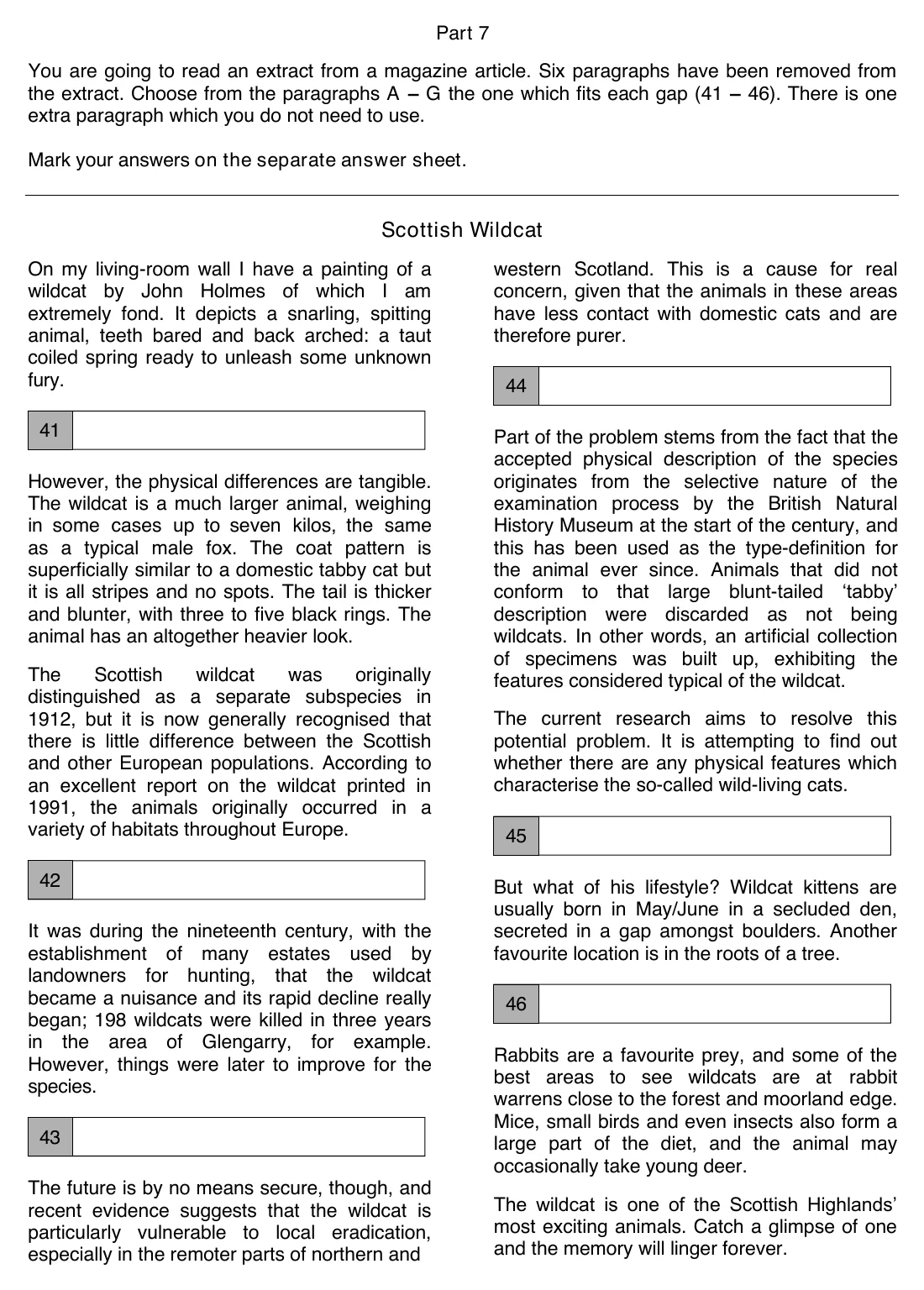
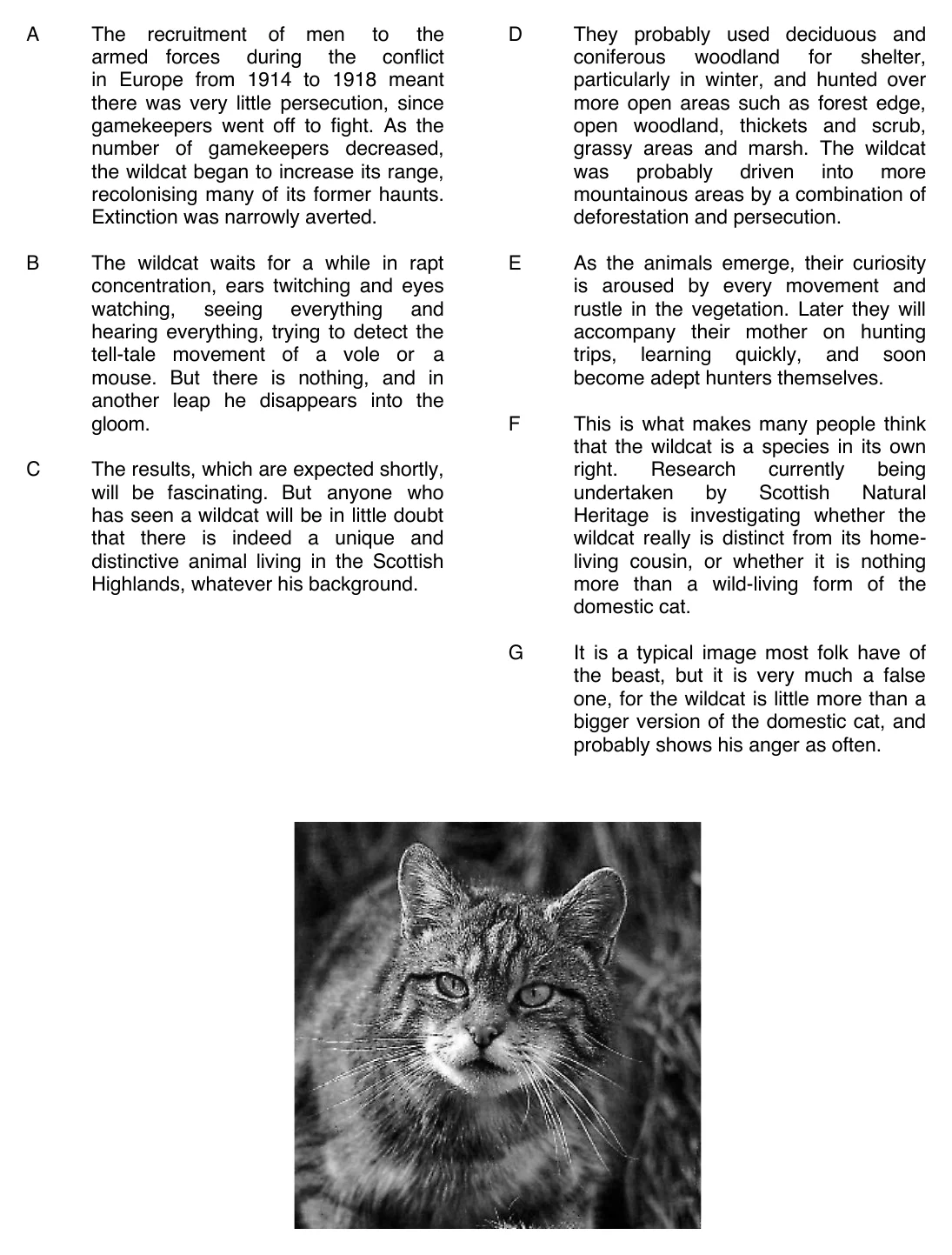
Pulsa en una página para verla a tamaño completo. Examen de muestra oficial del C1 Advanced (Sample Paper 1, Reading and Use of English). © Cambridge University Press & Assessment.
41. Respuesta: G. Antes del hueco, el autor describe un cuadro de un gato montés furioso, a taut coiled spring ready to unleash some unknown fury. G empieza con It is a typical image most folk have of the beast: ese image es el cuadro. Y G dice que es una imagen falsa, porque el gato montés es little more than a bigger version of the domestic cat. Después del hueco: However, the physical differences are tangible. El However contrasta justo con esa idea de que se parece mucho al gato doméstico. Encaja por los dos lados.
42. Respuesta: D. Antes del hueco: los gatos monteses vivían en a variety of habitats throughout Europe. D empieza con They probably used deciduous and coniferous woodland: el They son esos gatos, y D detalla esos hábitats. D termina diciendo que se refugiaron en las montañas por la deforestación y persecution, y después del hueco el texto sigue con esa persecución: en el siglo XIX el gato montés became a nuisance para los terratenientes y empezó su declive.
43. Respuesta: A. Antes del hueco: However, things were later to improve for the species. A explica cómo mejoraron: durante la Primera Guerra Mundial, los guardas se fueron a combatir y el gato montés recuperó terreno. Extinction was narrowly averted. Después del hueco: The future is by no means secure, though. Ese though contrasta con la buena noticia de A: se libró de la extinción, pero su futuro sigue sin estar asegurado.
44. Respuesta: F. Antes del hueco: los gatos de las zonas más remotas tienen menos contacto con los gatos domésticos y are therefore purer. F empieza con This is what makes many people think that the wildcat is a species in its own right: ese This es la pureza de esos animales. F presenta una investigación que estudia si el gato montés es realmente distinto del doméstico, y después del hueco el texto explica Part of the problem: por qué no está tan claro.
45. Respuesta: C. Antes del hueco: The current research aims to resolve this potential problem. C empieza con The results, which are expected shortly: los resultados de esa investigación. Y C termina hablando del animal como he (whatever his background), lo que prepara la frase siguiente: But what of his lifestyle? Con esa pregunta, el texto pasa de la identidad del animal a su forma de vida.
46. Respuesta: E. Antes del hueco: las crías nacen en mayo o junio en una madriguera escondida. E sigue la secuencia: As the animals emerge (cuando salen de la madriguera), luego acompañan a su madre on hunting trips y se convierten en adept hunters. Después del hueco, el texto habla de sus presas favoritas: Rabbits are a favourite prey. De la caza a lo que cazan.
El párrafo que sobra: B. B describe a un gato montés cazando, en presente, y termina con in another leap he disappears into the gloom. Es tentador en el hueco 46, porque allí se habla de caza. Pero another leap exige que antes se haya mencionado un primer salto, y no hay ninguno en el texto. Además, el hueco 46 necesita seguir con las crías que acaban de nacer, y B no dice nada de ellas.
Respuestas, por si has ido apuntando: 41G, 42D, 43A, 44F, 45C, 46E. Sobra la B.
Qué decidía cada respuesta
Si ponemos las seis respuestas juntas, se ve muy bien qué tipo de pista cierra cada hueco:
| Hueco | Párrafo | Pista de entrada (antes) | Pista de salida (después) |
|---|---|---|---|
| 41 | G | It is a typical image → el cuadro | However contrasta con «es casi un gato doméstico» |
| 42 | D | They → los gatos y sus hábitats | persecution → a nuisance, el declive |
| 43 | A | Cómo mejoraron las cosas | though contrasta con Extinction was narrowly averted |
| 44 | F | This → que sean más puros | Part of the problem → la investigación |
| 45 | C | The results → la investigación | his background → his lifestyle |
| 46 | E | Las crías salen de la madriguera | De la caza a las presas |
Fíjate en que ninguna respuesta se decide solo por el tema. En todas hay una palabra concreta que conecta el párrafo con lo de antes y otra que lo conecta con lo de después.
Las trampas típicas de la Parte 7 del C1 Reading
- El párrafo que encaja con un solo lado. Es la trampa principal de esta parte. Un párrafo puede seguir perfectamente al texto anterior y no tener nada que ver con el siguiente. Compruébalo siempre por los dos lados.
- El párrafo que sobra, en su hueco «natural». El párrafo extra suele tratar el mismo tema que algún hueco, pero falla en una conexión. La B habla de caza, como el hueco 46, pero su another leap no tiene a qué referirse.
- Los nombres y las fechas que se repiten. El handbook avisa: no se trata de buscar en el texto las mismas palabras, nombres o fechas que aparecen en el párrafo. Que un párrafo mencione una fecha cercana a otra no significa que vaya ahí.
- Los pronombres con dos posibles antecedentes. Un They o un This puede parecer que se refiere a algo de antes, pero comprueba que concuerda en número y en sentido.
- El efecto dominó. Si pones un párrafo en el hueco equivocado, no está disponible para el suyo. Por eso es tan importante dejar para el final los huecos dudosos.
Errores más comunes en la Parte 7 del Reading del C1
- Empezar a rellenar huecos sin haber leído el texto entero. Sin una idea clara de cómo avanza el texto, cada hueco parece tener tres o cuatro opciones posibles.
- Ir siempre en orden. No hace falta. Empieza por los huecos con pistas más claras y deja los dudosos para el final.
- Fijarse solo en el tema. Todos los párrafos hablan del mismo tema. Lo que decide son los pronombres, los conectores, los tiempos verbales y las palabras que se retoman.
- No releer el texto completo al final. Es la mejor forma de detectar un hueco que no encaja: al leerlo seguido, se nota enseguida.
- Dejar la Parte 7 para el final del examen. Son 12 puntos. Si vas justo de tiempo, es mejor hacerla antes que, por ejemplo, la Parte 8, que vale 1 punto por pregunta.
Cómo preparar la Parte 7 del C1 Advanced
- Lee reportajes y artículos largos en inglés. Es el tipo de texto que sale: no ficción, a menudo con un narrador en primera persona que cuenta una experiencia y la mezcla con información.
- Fíjate en cómo empiezan y terminan los párrafos. Cuando leas un artículo, mira qué palabra del principio de cada párrafo lo une con el anterior. Es exactamente la habilidad que mide esta parte.
- Haz el ejercicio al revés. Coge un artículo, recorta los párrafos y desordénalos. Intenta reconstruirlo al día siguiente. Funciona mucho mejor de lo que parece.
- Repasa los conectores y los pronombres. Los conectores de contraste, de causa y de secuencia, y los demostrativos (this, these, such) son las piezas que unen los párrafos.
- Haz tests completos con tiempo. Así ves si los 15 minutos te bastan dentro de la hora y media del examen.
Ejercicios del Reading C1 Part 7
Aquí tienes dos ejercicios originales de la Parte 7, con el mismo formato que el examen: un texto con seis huecos y siete párrafos, de los que sobra uno. Los huecos van numerados del 41 al 46, como en el examen real. Hazlos primero sin mirar las respuestas y, cuando termines, compruébalas: cada respuesta lleva su explicación, con las pistas que unen el párrafo con el texto, y al final tienes cuál es el párrafo que sobra.
Ejercicio 1: Small rings, long journeys
You are going to read a magazine article about a morning spent with volunteer bird ringers at a coastal observatory. Six paragraphs have been removed from the article. Choose from the paragraphs A–G the one which fits each gap (41–46). There is one extra paragraph which you do not need to use.
Small rings, long journeys
Science writer Corisande Prendle spends an October morning with the volunteer ringers of a tiny headland observatory, and finds out what a scrap of metal on a bird’s leg can reveal.
At half past five, Hallowick Ness is a darker shadow between a black sea and a slate-grey sky. I stumble after the torch of Agathe Dulverton, warden of the headland’s bird observatory, through sea buckthorn and willow that barely reach our shoulders. Every so often she halts while a volunteer jogs to the far side of a gap in the scrub, and between two aluminium poles they unroll what looks in the dark like a long strip of black gauze. By the time the gulls start to grumble, eleven of these stretch across the bushes, all but invisible from a few paces away.
41 ……………………….
Agathe makes that trip every half-hour, more often in rain or sun, because a small bird left too long soon grows cold or frantic. Her first round yields a robin, two wrens and a blackcap. She removes them so quickly, feet first, then wings, then head, that I barely see how. Each goes into a cotton bag, and the bags dangle from her fingers like strange fruit on the way back to the ringing hut, where Albin Seldon, a retired postman, waits at a bench crowded with pliers, notebooks and a mug of cold tea.
42 ……………………….
Every pencilled figure, he tells me as the bird flies off into the buckthorn, belongs to the observatory’s real harvest. Most of it will lie untouched in a national database, because the great majority of birds that leave this bench are never handled again. What makes the effort worthwhile is the small minority that are.
43 ……………………….
A century ago, nobody could prove that small birds travelled anywhere at all. Respectable naturalists held that swallows spent the cold months asleep in the mud of ponds, until numbered rings, first tried by a Danish schoolteacher in the 1890s, finished off such theories within a generation. Meanwhile the bags keep arriving, and by eight o’clock Agathe decides that I have watched for long enough.
44 ……………………….
Agathe lets me struggle for perhaps another minute, then reaches in and unpicks the whole muddle with two flicks of a fingernail. Nobody, she assures me, gets it right first time. As the sun climbs, the catch thins out. Albin, between customers, lifts from a cupboard the battered ledgers in which every season’s totals have been entered by hand since 1983.
45 ……………………….
Whether warmer winters, vanishing insects or drought south of the Sahara lie behind such changes, Agathe admits, nobody can yet say. What the ledgers provide is a baseline, the only way of showing that anything has shifted at all. She is explaining why the observatory’s funding never stretches beyond a single year when a shout carries up from the furthest net.
46 ……………………….
Albin copies the serial number out twice, his pencil not quite steady. Somewhere across the North Sea, a stranger once held this same bird, and within weeks, if the paperwork behaves, we will learn when and where. By midday the nets are rolled up. I drive home with a scratch on one finger, courtesy of the wren, and a new habit of glancing at the legs of every bird I pass.
A A chiffchaff ringed here four autumns ago was caught by a Spanish volunteer eighteen days later near Cádiz, two thousand kilometres south. A sanderling from the beach below the hut had its ring read through a telescope in Namibia that winter, and was back on the same sand the following August.
B Goldcrests leaving the headland now carry less fuel than a generation ago, and willow warblers, once trapped here by the hundred each August, have become a rarity worth calling the others over to see. No single morning could reveal either trend; it takes over forty years of pages, read decade by decade.
C Mist nets, as ringers call them, are spun from nylon finer than hair and hung in four slack horizontal pockets known as shelves. A warbler blundering into one tumbles into the fold below and lies there, trussed but unharmed, until someone trained to release it comes along.
D My bird is a wren, a brown thimble of fury wound into the mesh as though knitted in. I follow her instructions, or think I do, and soon have one leg free and the other worse snarled than ever, while the wren scolds me at a volume out of all proportion to its size.
E Under Agathe’s gaze, I ease my first bird, a dunnock, out of its pocket in well under a minute, and she gives a nod I choose to take as praise. The secret, it seems, is to free the feet first and let the bird do half the work.
F Within a minute the robin wears an aluminium band round its right leg, stamped with a serial number and a return address. Its wing is then laid along a steel rule and it is weighed head-down in a plastic tube, before Albin blows on its breast to read the yellowish fat beneath.
G Upside down in the mesh hangs a redwing, a Scandinavian thrush with a cream eyebrow and rusty flanks, and around its leg is a band none of us recognises. The lettering, when Agathe tilts it towards the light, gives the address of a museum in Stavanger.
Ver respuestas
- 41. C: El texto describe algo que parece ‘a long strip of black gauze’, ‘all but invisible’, pero no dice qué es. C lo explica: ‘Mist nets … are spun from nylon finer than hair’, y un pájaro se queda atrapado ‘until someone trained to release it comes along’. El párrafo siguiente retoma esa visita: ‘Agathe makes that trip every half-hour’, porque un pájaro que pasa demasiado tiempo en la red ‘soon grows cold or frantic’.
- 42. F: Antes del hueco tenemos la primera captura (‘a robin, two wrens and a blackcap’) y a Albin esperando en su mesa, así que lo siguiente es lo que pasa allí. F sigue por el sentido: ‘the robin’, el primer pájaro de la ronda, recibe ‘an aluminium band’, le miden el ala y lo pesan. Después del hueco, todas esas medidas se resumen en ‘Every pencilled figure’, y el texto sigue con ‘he’, Albin, mientras ‘the bird flies off’.
- 43. A: El texto dice que la mayoría de los pájaros anillados ‘are never handled again’ y que lo valioso es ‘the small minority that are’. A da dos ejemplos de esa minoría: un mosquitero capturado ‘eighteen days later near Cádiz’ y un correlimos cuyo anillo se leyó ‘in Namibia’. Después del hueco, el texto contrasta esos viajes con el pasado, cuando ‘nobody could prove that small birds travelled anywhere at all’. La B no va aquí: habla de cambios a lo largo de décadas, no de viajes. Y la G tampoco: su pájaro está ‘in the mesh’, y es la única que explica el grito del hueco 46.
- 44. D: Antes del hueco: ‘by eight o’clock Agathe decides that I have watched for long enough’, así que ahora le toca a la autora. D cuenta ese primer intento: ‘My bird is a wren’, y acaba con ‘one leg free and the other worse snarled than ever’. Después del hueco: ‘Agathe lets me struggle for perhaps another minute, then … unpicks the whole muddle’. El párrafo que sobra, la E, tienta mucho aquí, porque también cuenta el primer pájaro de la autora. Pero dice que lo sacó ‘in well under a minute’ y con un gesto de aprobación, lo que contradicen ‘lets me struggle’ y ‘the whole muddle’. Además, al final del artículo sabemos que su pájaro fue ‘the wren’, no un acentor.
- 45. B: Albin saca los libros de registro ‘in which every season’s totals have been entered by hand since 1983’. B cuenta lo que muestran: los reyezuelos ‘carry less fuel than a generation ago’ y los mosquiteros musicales ‘have become a rarity’, tendencias que solo se ven en ‘over forty years of pages’. Después del hueco, el texto pregunta qué hay ‘behind such changes’, unos cambios que solo describe la B, y vuelve a ‘the ledgers’.
- 46. G: Antes del hueco: ‘a shout carries up from the furthest net’. G explica el grito: ‘Upside down in the mesh’ cuelga un zorzal alirrojo con ‘a band none of us recognises’, de un museo de Stavanger. Después del hueco, todos reaccionan al anillo extranjero: Albin copia ‘the serial number out twice’, y ‘Somewhere across the North Sea, a stranger once held this same bird’. La D, el otro párrafo con un pájaro en la red, no puede ir aquí: el pájaro de la autora aparece antes y nadie necesita copiar su número.
Sobra el párrafo E.
Ejercicio 2: Why some halls sing
You are going to read a magazine article about how concert halls are designed to sound good and how one disappointing new hall was put right. Six paragraphs have been removed from the article. Choose from the paragraphs A–G the one which fits each gap (41–46). There is one extra paragraph which you do not need to use.
Why some halls sing
A new concert hall can dazzle the eye and still disappoint the ear. A science writer explains what acousticians listen for, and how one city put an expensive mistake right.
When the Ketterby Hall opened in Dunmarrow four years ago, critics ran short of adjectives for its looks. Its balconies curled round the stage like the inside of a seashell, and its walls glowed with pale, finely grooved oak. About the sound they were more guarded. Players complained that they could scarcely hear colleagues across the platform, and in the rear stalls the strings seemed to arrive through a heavy blanket. Before the first season was out, the council that had paid for the building had called in an acoustician, Annick Vandeleur, to explain why.
41 ……………………….
For a lecture or a string quartet, that would have been perfectly adequate. A full symphony orchestra needs nearer two seconds: long enough for each chord to bloom and merge with the next, though not so long that rapid passages smear into a wash. Worse, Dr Vandeleur’s readings had been taken with every seat unoccupied, and a packed house always shortens the decay.
42 ……………………….
Designers therefore fit upholstery that absorbs about as much as a body does, so that a morning rehearsal in an empty auditorium sounds much as the evening concert will. The Ketterby’s cushions had been chosen with care, and Dr Vandeleur soon cleared them. Her suspicion fell instead on the timber the critics had so admired.
43 ……………………….
Replacing the lining would have cost almost as much as the building itself, and Dr Vandeleur doubted that it would be enough. The deeper fault lay in the plan. To give everyone an uninterrupted view, its architects, Fanshawe Partners, had spread the seats in a broad fan, its side walls splaying outwards from the platform. It is a layout that looks generous on paper and has a poor record in performance.
44 ……………………….
Sound from the flanks matters because each ear catches it a fraction of a second apart, and the brain reads the mismatch as being wrapped in music. Without it, an orchestra seems remote, however near the seat. Rebuilding the walls, though, was out of the question: Dunmarrow had borrowed heavily to put them up.
45 ……………………….
Heavy and rigid, the new panels also gave back the low notes the oak had been swallowing. What they could not do was lengthen the reverberation enough for Bruckner without making the place far too boomy for the jazz, folk and comedy that pay many of its bills. The answer was to let the room change its character from one night to the next.
46 ……………………….
Fitting all this took nine months and cost about a twelfth of a rebuild. When the hall reopened, Grete Sorrell, who leads the resident orchestra’s first violins, said she could hear the bassoons from her chair for the first time. With a full house, Dr Vandeleur’s pistol test now gives just over two seconds. Critics have started writing about the sound, and few of them have noticed the plaster screens, which is, she says, exactly as it should be.
A Clothed human bodies are remarkably efficient sound absorbers. A single listener soaks up roughly as much as half a square metre of open window, the acoustician’s yardstick for total loss, and two thousand of them can strip a room of much of its ring.
B Above the upper balcony, storerooms were knocked through into chambers of bare concrete, sealed off by motorised doors. Opened, they lend a symphony extra air and resonance; shut, with heavy banners lowered in front of them, they leave a drier space for a comedian or an amplified band.
C The trouble comes down to direction. In the narrow, rectangular ‘shoebox’ halls of the nineteenth century, parallel side walls bounce sound back at listeners from left and right. Splayed walls steer that energy towards the rear instead, so most of what reaches a seat arrives from straight ahead.
D The standard test needs nothing grander than a starting pistol. Fired on an empty stage, its crack ricochets round the room and fades, and the time it takes to sink to a millionth of its original intensity is called the reverberation time. In the Ketterby, the figure came out at barely a second and a half.
E Unable to move the masonry, Dr Vandeleur proposed a room within the room. Along each side of the stalls, a row of tilted plaster screens would stand a few metres out from the side walls, angled to return sound across the audience while leaving every sightline intact.
F Wood has a reputation for warmth that physics does not entirely support. Thick, solid timber reflects well, but thin boards fixed over hollow frames flex when sound strikes them, soaking up the lower notes that give an orchestra its body. The Ketterby’s elegant grooves concealed exactly that.
G The obvious remedy was to hang thick velvet along the side walls and lay deep carpet in the aisles, taming hard surfaces that sent sound careering around the room. Within weeks the worst of the clatter had gone, and the players could at last hear themselves think.
Ver respuestas
- 41. D: El ayuntamiento llama a la acústica Annick Vandeleur ‘to explain why’. D empieza su diagnóstico: ‘The standard test needs nothing grander than a starting pistol’, y termina con el resultado: ‘In the Ketterby, the figure came out at barely a second and a half’. El párrafo siguiente valora esa cifra: ‘For a lecture or a string quartet, that would have been perfectly adequate’, pero una orquesta ‘needs nearer two seconds’.
- 42. A: El texto dice que ‘a packed house always shortens the decay’, pero no explica por qué. A da la causa: ‘Clothed human bodies are remarkably efficient sound absorbers’, y dos mil personas ‘can strip a room of much of its ring’. El párrafo siguiente saca la consecuencia: ‘Designers therefore fit upholstery that absorbs about as much as a body does’.
- 43. F: Antes del hueco, las sospechas recaen en ‘the timber the critics had so admired’. F retoma esa sospecha: ‘Wood has a reputation for warmth that physics does not entirely support’, y explica que las tablas finas sobre marcos huecos se tragan ‘the lower notes’; ‘The Ketterby’s elegant grooves concealed exactly that’. Después del hueco, el texto llama a ese revestimiento ‘the lining’: ‘Replacing the lining would have cost almost as much as the building itself’.
- 44. C: La distribución en abanico ‘looks generous on paper and has a poor record in performance’, y C explica ese mal resultado: ‘The trouble comes down to direction’, porque ‘Splayed walls steer that energy towards the rear instead’. El párrafo siguiente dice por qué importa el sonido lateral que se pierde: ‘Sound from the flanks matters because…’. La E tienta como solución al problema, pero ‘Unable to move the masonry’ da por hecho que ya se ha descartado reconstruir los muros, y eso el texto no lo dice hasta después.
- 45. E: Antes del hueco: reconstruir los muros ‘was out of the question’. E lo retoma: ‘Unable to move the masonry, Dr Vandeleur proposed a room within the room’, unas pantallas separadas de los muros que devuelven el sonido hacia el público. Después del hueco, el texto las llama ‘the new panels’: ‘Heavy and rigid, the new panels also gave back the low notes’. El párrafo que sobra, la G, tienta aquí, porque ‘The obvious remedy’ también sigue a una opción descartada. Pero el terciopelo y la moqueta absorberían todavía más sonido en una sala que ya tenía poca reverberación, la ‘clatter’ que soluciona es un problema que la sala no tenía y la tela no es ‘heavy and rigid’.
- 46. B: El plan era ‘to let the room change its character from one night to the next’, y B explica cómo: unas cámaras con puertas motorizadas que, abiertas, ‘lend a symphony extra air and resonance’ y, cerradas, ‘leave a drier space for a comedian or an amplified band’. El párrafo siguiente resume las pantallas y las cámaras juntas: ‘Fitting all this took nine months’. La G tampoco va aquí: describe una solución fija, no una sala que cambia, y su ‘Within weeks’ contradice los nueve meses.
Sobra el párrafo G.
Preguntas frecuentes sobre la Parte 7 del Reading del C1
¿Cuántas preguntas tiene la Parte 7 del Reading del C1 Advanced?
Seis huecos, numerados del 41 al 46, y siete párrafos para elegir. Cada respuesta correcta vale 2 puntos, así que la Parte 7 suma 12 puntos.
¿Se puede usar un párrafo dos veces?
No. Cada párrafo va en un solo hueco, y uno de los siete sobra. Si ves que un párrafo te encaja en dos huecos, uno de los dos está mal: vuelve a comprobar las pistas de los dos lados.
¿Qué hago si un hueco no me encaja con ningún párrafo?
Déjalo para el final y resuelve los demás. Cuando hayas colocado los párrafos claros, te quedarán dos o tres opciones, y será mucho más fácil. Y nunca lo dejes en blanco: los fallos no restan.
¿Cuánto tiempo debo dedicarle?
Cambridge no fija tiempos por parte: tienes 1 hora y 30 minutos para las ocho partes. Unos 15 minutos es una buena referencia para la Parte 7, porque el texto es largo y hay que leerlo entero antes de empezar.
¿Es igual en papel y en ordenador?
La tarea es la misma. En el examen por ordenador respondes en la pantalla y puedes cambiar tus respuestas tantas veces como quieras antes de terminar, así que no tengas miedo de colocar primero los párrafos claros y revisar el resto al final.
Sigue preparando el Reading del C1
Esta guía forma parte de la serie sobre el Reading del C1 Advanced. Si vienes de la parte anterior, la tienes en mi guía de la Parte 6, el cross-text multiple matching. Si quieres ver cómo encaja todo en el examen completo, vuelve a la página principal del C1 Advanced o echa un vistazo a la calculadora de nota del C1. Y si buscas material para practicar, aquí tienes mi selección de los mejores libros para preparar el C1 Advanced.
¿Te ha resultado útil esta guía? Compártela con otros estudiantes y profesores que estén preparando el CAE. Y si te queda alguna duda con algún hueco, déjamela en los comentarios, que las leo todas.
Hasta la próxima, don’t forget to keep smiling! 🙂
