
Tabla de contenidos
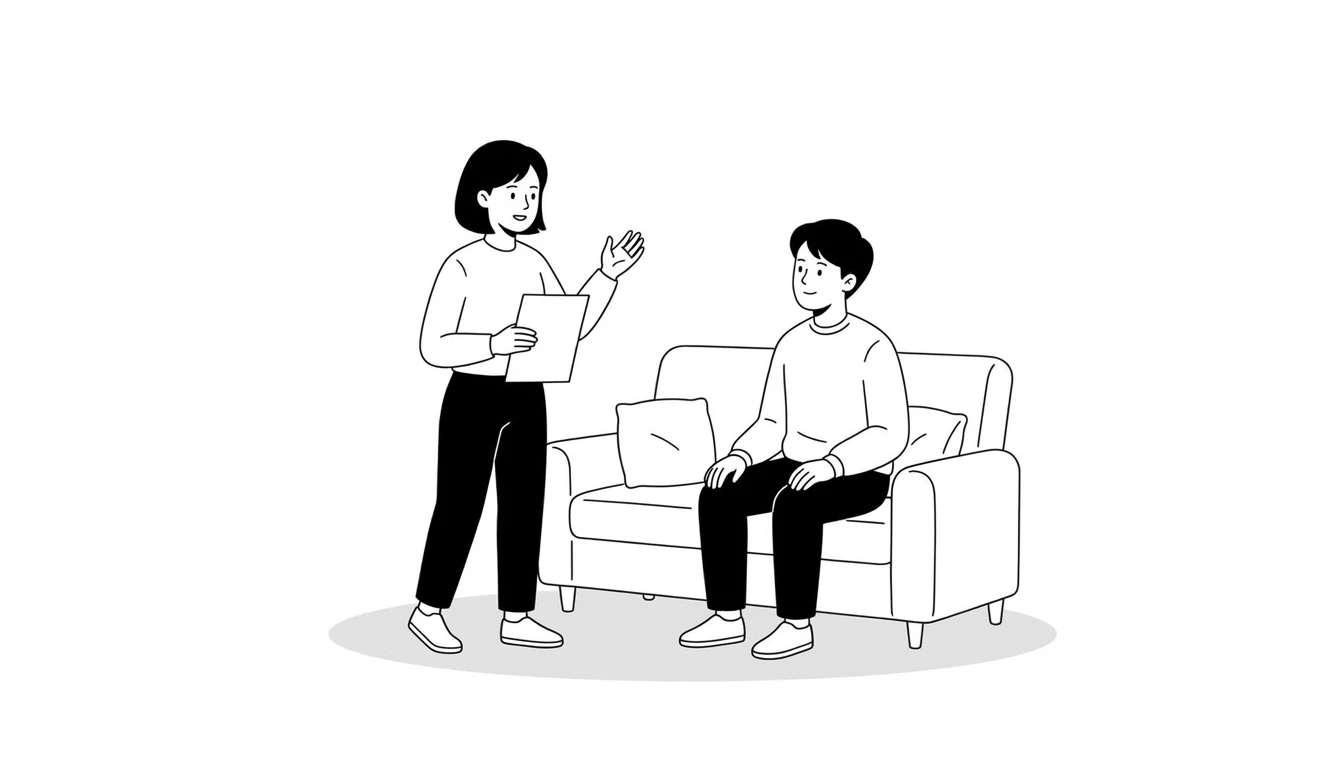
La mediación oral del C1 de la EOI tiene algo de prueba de reflejos: lees un texto, a menudo en español, tienes cinco minutos para prepararlo y luego se lo cuentas en inglés a alguien que lo necesita, normalmente durante dos o tres minutos. En el C1 no te piden hablar más tiempo que en el B2; te piden hacerlo con más cabeza: elegir lo que le sirve a tu oyente, aplicarlo a su caso y no limitarte a repetir el texto.
Te cuento los tiempos y el tipo de texto que te darán según dónde te examines, las tareas que se repiten en los exámenes de C1, en qué se fijan los correctores y, para terminar, tres ejemplos resueltos: la tarjeta, lo que apuntarías mientras preparas y la respuesta transcrita. ¡Empezamos! 🙂
La mediación escrita, que es otra tarea, la tienes en su propia guía: mediación escrita C1 EOI. Para ver el examen entero, pásate por mi guía del C1 de la EOI.
Formato de la mediación oral C1 según la comunidad
Hay mediación oral en inglés en quince de las dieciocho comunidades y ciudades autónomas, casi siempre como una tarea individual dentro de la sesión oral. Lo que cambia es el tiempo, la lengua del texto y, en algún caso, la tarea entera:
| Comunidad | Preparación · tiempo de habla | Texto de partida |
|---|---|---|
| Andalucía | 20 min para todas las tareas orales · 2-2,5 min | Infografía o imagen en inglés |
| Aragón | 4 min · 3 min | Texto en español de hasta unas 400 palabras |
| Asturias | Hasta 4 min · hasta 3,5 min, para dos tareas | Texto en español; la segunda tarea es explicar una expresión |
| Baleares | No hay mediación oral | |
| Canarias | 5 min · 4-5 min, grabado | Texto en inglés de unas 160-180 palabras |
| Cantabria | Unos 10 min compartidos con el Speaking · 2,5 min | Texto de hasta 450 palabras, o audio o vídeo; en español o en inglés |
| Castilla-La Mancha | Hasta 5 min · 2,5-3 min | Texto de hasta 270 palabras |
| Castilla y León | 5 min · hasta 3 min | Inglés o español, a elegir; hasta 300 palabras |
| Cataluña | Unos 5-7 min, en pareja | Sin texto: comentar una imagen artística con tu compañero |
| Comunidad Valenciana | Compartida con el Speaking · 2-2,5 min | Infografía, imagen o tiras cómicas en inglés |
| Extremadura | No hay mediación oral en inglés | |
| Galicia | 4 min compartidos con el Speaking · 1-2 min | Uno o varios textos |
| La Rioja | 5 min · hasta 3 min | Texto en español (infografía, web, artículo, anuncio) |
| Madrid | 5 min · 2-3 min, grabado | Texto en español de 200-250 palabras |
| Murcia | 5 min · 4 min | Cartel o texto en español en la muestra |
| Navarra | 10 min en otra aula · 3-4 min | Uno o dos textos en inglés, hasta 500 palabras |
| País Vasco | 20 min compartidos con el monólogo · unos 2 min | Audio, texto o infografía en inglés |
Respecto al B2, en la mitad de las comunidades la diferencia es pequeña: un minuto más para preparar, medio minuto más para hablar y un texto algo más largo. Lo que sí cambia es el tipo de texto (más artículos de opinión y documentos administrativos) y lo que tienes que hacer con él.
EOI C1: tipos de tareas de mediación oral
En los modelos oficiales de C1 aparecen estos tipos de tarea, del más frecuente al menos:
- Explicar algo de aquí a un extranjero (un servicio, unas normas, una costumbre) a partir de un texto en español: Madrid, Asturias, La Rioja, Murcia y Aragón.
- Pasar los consejos o la información de una infografía o un folleto: también es el tipo dominante en las fichas de Andalucía.
- Resumir uno o varios artículos de opinión, recogiendo los argumentos: Castilla y León, Galicia y Navarra.
- Explicar unos requisitos y aplicarlos al caso de tu oyente: Canarias y Madrid. Es nuevo respecto al B2.
- Explicar el sentido de una palabra o una expresión: Castilla-La Mancha y la segunda tarea de Asturias.
- Convencer a un público o interpretar un cómic: la Comunidad Valenciana.
- Comentar una imagen artística en pareja: Cataluña, que llama así a su mediación oral del C1.
Qué valora el tribunal en la mediación oral C1
Las escalas valoran que transmitas la información relevante, que la adaptes a quien te escucha, que tu discurso esté organizado y que el inglés sea de nivel C1. Además, en el C1 aparecen tres exigencias que conviene tener muy presentes:
- Matices e implicaciones culturales. No basta con decir qué pone el texto: hay que explicar lo que tu oyente no entendería por no vivir aquí.
- Lenguaje accesible para quien no es especialista. Si el texto es técnico o administrativo, tu trabajo es hacerlo comprensible.
- Cuidado con la opinión personal. En Galicia (nuevo en el C1), el País Vasco y Castilla y León se penaliza. En Navarra y Madrid, en cambio, se pide reflejar las opiniones y argumentos de los textos, que no es lo mismo que dar la tuya.
Aprovecha bien tus 5 minutos
- Lee primero la tarjeta, no el texto. Saber quién es tu oyente y qué necesita te dice qué buscar al leer.
- Subraya poco y anota menos. Cinco o seis palabras clave, ordenadas como las vas a contar, no como aparecen en el texto.
- Decide el principio y el final. Una primera frase que sitúe a tu oyente y una última que le diga qué hacer o qué recordar.
- Busca el «para ti». El momento en el que aplicas la información a su caso es lo que más diferencia un C1 de un B2.
- Ten listas un par de fórmulas para explicar lo cultural: it’s a bit like…, here in Spain that means…, what they call … is basically…
Mediación oral C1 de la EOI: tres ejemplos con respuesta modelo
Las tarjetas y los textos los he escrito yo para esta guía, imitando los de los exámenes. Las respuestas están transcritas tal como las diría un buen candidato de C1, con sus muletillas naturales y sin sonar a texto leído.
Ejemplo 1: explicar un trámite y aplicarlo a su caso
El formato estrella del C1: te dan un documento en español sobre la vida aquí (un trámite, un servicio, unas normas) y un amigo extranjero que lo necesita. Es lo que sale en Madrid, Asturias, La Rioja o Murcia. El salto respecto al B2 está en que ya no basta con explicar: tienes que aplicar las condiciones a su situación concreta.
La tarjeta:
A plot of your own
Your Irish friend Fiona moved to Arroyoblanco, the town where you live, last January, and registered at the town hall in February. She works from home three days a week and would love to grow her own vegetables. She has seen this notice about the town allotments, but her Spanish isn’t good enough to follow the details. She doesn’t have a Spanish digital certificate, she shares a flat with her friend Lucía, who is also interested, and she always spends the whole of July in Ireland with her family.
Explain to Fiona what the scheme offers, whether she can apply and what she would have to do, taking her situation into account. Make sure you mention any sociocultural or administrative aspects she may not be familiar with.
Preparation: 5 minutes (you can underline and take notes). Speaking: 2.5 to 3 minutes.
Huertos urbanos municipales: abierto el plazo de solicitud
El Ayuntamiento de Arroyoblanco abre el plazo para solicitar una de las 80 parcelas del Huerto Municipal de La Vega, junto al parque fluvial. Cada parcela mide 50 m² e incluye toma de agua con riego por goteo, una caseta compartida para guardar herramientas y acceso a la zona de compostaje.
Quién puede solicitarla. Personas mayores de edad empadronadas en el municipio con una antigüedad mínima de seis meses en la fecha en que termina el plazo. Solo se admite una solicitud por vivienda, y no pueden participar quienes hayan perdido una parcela por abandono en los últimos tres años.
Plazo y forma de presentación. Del 2 al 27 de noviembre, en la sede electrónica municipal (con certificado digital o Cl@ve) o de manera presencial en la Oficina de Atención Ciudadana, con cita previa en el 010. No es necesario aportar el volante de empadronamiento: el Ayuntamiento lo comprueba de oficio.
Adjudicación. Las parcelas se asignarán mediante sorteo público el 14 de diciembre en el salón de plenos. El 20 % se reserva a personas mayores de 65 años y cuatro parcelas, a colegios y asociaciones del municipio. Las solicitudes sin parcela formarán una lista de espera.
Cuota y duración. 60 euros al año, que se abonan en enero. Las personas desempleadas y las pensionistas pagan la mitad. La cesión dura dos años y no se renueva automáticamente: al terminar, hay que volver a participar en el sorteo.
Obligaciones. Antes de recibir la parcela es obligatorio asistir a un curso de iniciación de cuatro horas (sábado 16 de enero, de 10 a 14 h). Solo se permite el cultivo ecológico: quedan prohibidos los pesticidas y los abonos químicos. Lo que se cultiva es para consumo propio y no se puede vender. La parcela no puede quedar sin atender más de cuatro semanas seguidas; en caso de ausencia prolongada, hay que comunicar al Ayuntamiento el nombre de una persona autorizada para cuidarla. El abandono supone la pérdida de la parcela, sin devolución de la cuota.
Concejalía de Medio Ambiente · Información: 010
Lo que apunté en los minutos de preparación:
<strong>Fiona:</strong> padrón feb → 9 meses en nov ✔ (<em>min 6 months</em>)
80 plots, 50 m² (<em>small flat</em>) · <em>drip irrigation, shed, compost</em>
1 solicitud por vivienda → <em>Lucía OR Fiona</em>
plazo 27/11 · sin certificado → en persona, <em>ring 010, appointment</em> · Cl@ve = <em>online ID</em>
<em>public draw</em> 14/12 (no por orden) · lista de espera · 60 €/año (½ parados: no), 2 años
curso 16/1 · ecológico · no vender · julio = +4 semanas → <em>authorised person: me?</em>
Respuesta modelo (387 palabras, unos 3 minutos):
Hi Fiona! So, I've had a proper look at that notice about the allotments, and the good news is that, as far as I can tell, you can apply. Let me go through it bit by bit.
The town hall has eighty plots down by the river, in La Vega. Each one's about fifty square metres, roughly the size of a small flat, and they come with drip irrigation, a shared shed for your tools and a compost area, so you wouldn't need to buy much.
Now, who can apply. You need to have been on the padrón here for at least six months by the deadline. The padrón is basically the town's register of residents, the thing you signed up for at the town hall in February, so by then you'll have had nine months. You don't even need a certificate to prove it, because they check it themselves. One catch, though: it's one application per home, so you and Lucía can't both apply. One of you will have to do it.
The deadline's the twenty-seventh of November. You can apply online, but you'd need a digital certificate or something called Cl@ve, which is the government's online ID, and you've got neither, so the easiest thing is to go in person. Bear in mind you can't just turn up, though: you have to ring 010, the town hall's information line, and book an appointment first. That's very typical here.
And this is important: the plots aren't first come, first served. There's a public draw on the fourteenth of December, so it's literally a lottery. If you don't get one, you go on a waiting list.
It's sixty euros a year. Unemployed people and pensioners pay half, but that doesn't apply to you. It lasts two years, and then you have to enter the draw again.
There are a few rules, too. You have to do a four-hour course on Saturday the sixteenth of January, everything has to be organic, and you can't sell what you grow. The tricky bit for you is July: you can't leave the plot for more than four weeks, so you'd have to give the town hall the name of someone who'll look after it. I'm happy to be that person, if you like! Anyway, shall I ring 010 with you tomorrow?
Qué la convierte en una mediación de C1:
- Aplica cada condición al caso de Fiona. No se limita a decir que hacen falta seis meses de padrón: hace la cuenta por ella (by then you’ll have had nine months). Lo mismo con la cuota (that doesn’t apply to you), con Lucía y con julio. Esto es justo lo que piden Madrid o Canarias en C1: no transmitir requisitos, sino decirle a la persona si le afectan y cómo.
- Explica lo administrativo que un extranjero no conoce. El padrón (basically the town’s register of residents), Cl@ve (the government’s online ID), el 010 y la cita previa (you can’t just turn up), y que el sorteo no va por orden de llegada (the plots aren’t first come, first served). Son los «sociocultural factors» que pide la tarjeta, y no están explicados en el texto: los añade quien media.
- Selecciona y deja fuera lo que no le sirve. El cupo para mayores de 65, las parcelas de colegios y asociaciones o la regla de quien perdió una parcela por abandono no tienen nada que ver con Fiona, así que no salen. Tampoco el horario del curso ni el salón de plenos. Mejor tres minutos útiles que una lista completa.
- Reformula y hace concreto lo abstracto. Los 50 m² se convierten en algo que se puede imaginar (roughly the size of a small flat), y «no puede quedar sin atender más de cuatro semanas» pasa a you can’t leave the plot for more than four weeks. Nada traducido palabra por palabra.
- Organiza para quien escucha y cierra con un paso siguiente. Empieza por la respuesta que Fiona quiere oír (the good news is that, as far as I can tell, you can apply), avisa de lo importante (And this is important, The tricky bit for you is July) y termina ofreciendo ayuda real (shall I ring 010 with you tomorrow?).
Expresiones para tu repertorio:
- As far as I can tell, you can apply.
- Let me go through it bit by bit.
- One catch, though: it's one application per home.
- Bear in mind you can't just turn up, though.
- That's very typical here.
- The plots aren't first come, first served.
- That doesn't apply to you.
- The tricky bit for you is July.
Ejemplo 2: transmitir los argumentos de un debate sin opinar
En Castilla y León, Galicia y Navarra la fuente puede ser un artículo de opinión, o dos textos con posturas opuestas, y tienes que explicar qué defiende cada uno a alguien que tiene que decidir. Aquí hay una trampa: en Galicia, el País Vasco y Castilla y León dar tu opinión se penaliza.
La tarjeta:
Should museums be free?
Your classmate Joanna missed last week’s English class. Next week everyone has to write an opinion essay on whether public museums should charge for entry, and the teacher handed out these two articles to prepare it. Joanna has asked you what they say.
Summarise the two positions and the main arguments behind each one, so that she can make up her own mind. Do not give your own opinion or add any ideas that are not in the texts.
Preparation: 5 minutes. Speaking: 3 minutes maximum.
Open doors, open minds by Helen Marsh, head of learning at Larkford Museums
When the city of Larkford scrapped admission fees at its three public museums in 2019, visitor numbers rose by almost half within two years. More importantly, the profile of visitors changed. Families on lower incomes and teenagers, groups who had rarely crossed the threshold before, began to drop in, often for just twenty minutes on the way home from school. That is precisely the point. A collection paid for by taxpayers belongs to everyone, and a ticket costing fifteen pounds sends a clear message about who is welcome. Free entry also encourages repeat visits: people who don’t feel obliged to get their money’s worth come back, and gradually start to feel at home among the exhibits. Critics argue that museums lose income, but much of it is recovered through cafés, shops and donations, which tend to rise when visitors feel goodwill rather than obligation. Culture should not be a luxury.
Free is never free by Daniel Okafor, cultural economist
Nobody disputes that museums should be accessible. The question is who pays. Every pound that isn’t collected at the door has to come from somewhere, and in practice that means either larger public subsidies or cuts to conservation, research and staff. In Larkford, the headline figures hide an awkward detail: most of the extra visits came from people who were already regular museum-goers, many of them tourists, who simply came more often. Free entry, in other words, largely subsidises those who could afford a ticket. A fairer model would be to charge adult visitors from outside the region while letting local residents, students and anyone on benefits in at no cost. Charging also has a less obvious advantage. When people pay, they tend to value what they see, and overcrowded galleries, which harm both the artworks and the experience, become easier to manage. Generosity should be targeted, not universal.
Lo que apunté en los minutos de preparación:
<strong>Tema:</strong> museos públicos, ¿gratis o de pago? · 2 posturas opuestas
<strong>Marsh</strong> (educación, <em>in favour</em>): Larkford 2019 → +50 % en 2 años
lo clave: <em>who</em> (familias pobres, adolescentes) · <em>taxpayers' money = ours</em> · 15 £ = <em>not wanted</em>
repiten · objeción: ingresos → café, tienda, donativos
<strong>Okafor</strong> (economista): <em>who pays?</em> → subsidios o recortes · Larkford: <em>already regular + tourists</em>
propuesta: <em>mixed system</em> (pagan adultos de fuera) · <em>value it more</em> · <em>crowds</em> · cierre: <em>fairness for all vs targeted help</em>
Respuesta modelo (387 palabras, unos 3 minutos):
Hi Joanna! Right, so both articles deal with the same question: whether public museums should be free or whether people should pay to get in. And the two writers take pretty much opposite views, so I'll go through them one at a time.
The first one's by Helen Marsh, who works in museum education, and she's in favour of free entry. Her starting point is a city called Larkford, which stopped charging for entry to its three public museums back in 2019. Within two years, almost fifty per cent more people were visiting. But what she really stresses isn't so much the number as who the new visitors were: poorer families and teenagers, people who'd hardly ever gone before, some just popping in for twenty minutes after school. Her main argument is that these collections are funded by taxpayers, so they belong to all of us, and a fifteen-pound ticket makes some people feel they're not wanted. She also says that when it's free, people keep coming back and get used to being there. And she answers the obvious objection, the lost income, by saying that a lot of that money comes back through the café, the shop and donations.
The second writer, Daniel Okafor, is an economist, and he sees it quite differently. He agrees that museums should be open to everyone, but for him the real issue is who foots the bill. If the money doesn't come from tickets, it has to come from public funds, or else it's taken from things like conservation and staff. He also reads the Larkford figures another way: according to him, the extra visitors were mostly people who already went to museums regularly, including lots of tourists. So, in his view, free entry mainly benefits people who could pay anyway. What he proposes instead is a mixed system, where adults from outside the area pay and locals, students and people on benefits get in for nothing. And he adds that people appreciate things more when they've paid for them, and that charging makes it easier to control crowds, which are bad for the artworks.
So basically, one sees free entry as a question of fairness for everyone, and the other thinks the help should go only to those who need it. That should give you plenty for the essay!
Qué la convierte en una mediación de C1:
- Refleja las dos posturas sin tomar partido. No hay ni un «I think» ni un «I agree»: todo va atribuido al autor (Her main argument is that, for him the real issue is, in his view, according to him). En Galicia, País Vasco y Castilla y León dar tu opinión se penaliza, y Navarra pide justo esto: trasladar los argumentos de los textos, no los tuyos.
- Ordena las ideas para quien tiene que escribir. Primero el tema y que las posturas son opuestas, luego cada autor por separado (I’ll go through them one at a time) y al final una frase que resume el contraste (one sees free entry as a question of fairness for everyone, and the other thinks the help should go only to those who need it). A Joanna eso le da la estructura de su redacción.
- Muestra cómo dialogan los textos. El segundo autor usa el mismo dato que el primero para decir lo contrario, y la respuesta lo hace visible (He also reads the Larkford figures another way). También recoge cómo Marsh se adelanta a las críticas (she answers the obvious objection). Eso es mediar argumentos, no solo resumir.
- Reformula todo. «Crossed the threshold» pasa a people who’d hardly ever gone before, «who pays» a who foots the bill, y «those who could afford a ticket» a people who could pay anyway. Ninguna frase del texto se repite tal cual: es lo que pide el C1.
- Selecciona. Se queda con los datos que sostienen cada argumento (casi un 50 % más de visitas, la entrada de quince libras) y deja fuera las frases finales de cada artículo, que son eslóganes y no añaden ideas nuevas.
Expresiones para tu repertorio:
- Both articles deal with the same question.
- The two writers take pretty much opposite views.
- What she really stresses isn't so much the number as who the new visitors were.
- She answers the obvious objection by saying that…
- He sees it quite differently.
- For him the real issue is who foots the bill.
- He also reads the figures another way.
- One sees it as…, and the other thinks…
Ejemplo 3: hablar ante un grupo para informar y convencer
En la Comunidad Valenciana y en Andalucía el destinatario puede ser un público: tus compañeros de trabajo, los socios de un club, una clase. Es otra forma de mediar: seleccionas lo que le importa a ese grupo, ajustas el tono y terminas animando a hacer algo.
La tarjeta:
Give blood at work
You work for Brisalia Software, a company in Málaga with staff from many different countries. You have volunteered to coordinate next month’s visit of a mobile blood donation unit. At Monday’s staff meeting there will be about forty colleagues: many of them have never given blood, a few have told you they are scared of needles, and HR has confirmed that people can donate during working hours.
Using the information in the leaflet, give a short talk to your colleagues to tell them about the visit and encourage them to take part. Select what matters most to them.
Preparation: 5 minutes. Speaking: 2.5 to 3 minutes.
THE COSTA REGIONAL BLOOD CENTRE IS COMING TO YOUR WORKPLACE
Brisalia Software, car park B · Tuesday 9 and Wednesday 10 March · 9.00 to 14.00 and 15.30 to 19.00
- Why it matters. Hospitals in our region need around 900 donations every day, but only about 4% of the people who are eligible actually give blood. Each donation is separated into red cells, plasma and platelets, so one visit can help up to three patients.
- Can I donate? You need to be aged 18 to 65, weigh 50 kg or more and be in good health. If you have had a cold or taken antibiotics in the last two weeks, please come another time.
- How long does it take? Allow 30 to 45 minutes in total. A short health questionnaire and a finger-prick test to check your iron levels come first; the donation itself lasts only 8 to 10 minutes.
- Before you come. Eat as usual and drink plenty of water. Please don’t come on an empty stomach, and remember to bring an identity document.
- Afterwards. Rest for ten minutes and enjoy the snack we offer. Avoid intense exercise for the rest of the day.
- Nervous about needles? Let our nurses know: they will help you stay relaxed. Most first-time donors say it was easier than they expected.
- Follow your blood. A few weeks after your donation, a text message tells you which hospital received it.
- Booking. Reserve a 15-minute slot on your company intranet, or simply walk in.
Last year, 61 Brisalia employees donated. This year’s target: 100.
Lo que apunté en los minutos de preparación:
<strong>Público:</strong> 40 compañeros, muchos nunca, miedo a agujas · HR: en horario ✔
abrir: 9 y 10 marzo, <em>car park</em> · <em>give it a go</em>
¿por qué? 900/día, solo 4 de cada 100 · 1 donación = 3 pacientes
¿puedo? 18-65, +50 kg, bien · resfriado/antibióticos → <em>next visit</em> · <1 h, aguja 10 min máx.
agujas: <em>you're not alone</em>, enfermeras · más fácil de lo que creen · tips: comer antes, agua, DNI, no gym · SMS hospital
cerrar: 61 → 100 · <em>intranet or drop by</em> · <em>come and find me</em>
Respuesta modelo (365 palabras, unos 3 minutos):
Morning, everyone! Thanks for giving me a few minutes before we get on with the agenda. I'll keep it short, I promise. As some of you know, a mobile blood unit is coming to our car park on the ninth and tenth of March, and I'd love as many of us as possible to give it a go.
Let me start with why. Hospitals around here need about nine hundred donations a day, and yet only four in every hundred people who could donate actually do it. And here's the bit I find amazing: each donation gets split into three parts, so one bag of blood can end up helping three different patients.
Now, I know what some of you are thinking: I've never done it, I don't even know if I'm allowed to. Basically, if you're between eighteen and sixty-five, you weigh at least fifty kilos and you're feeling well, you're almost certainly fine. If you've had a cold or been on antibiotics in the past fortnight, just wait for the next visit.
As for time, the whole thing takes less than an hour, and the needle part is ten minutes at most. And HR has confirmed you can do it during working hours, so you don't have to give up your lunch break.
To those of you who've told me you're terrified of needles: honestly, you're not alone. Just tell the nurses. They do this all day, every day, and they're brilliant at putting people at ease. Apparently most people who try it for the first time say it was much easier than they'd imagined.
A couple of practical tips: have something to eat first, drink lots of water, don't forget your ID, and take it easy afterwards, so maybe skip the gym that evening. Oh, and here's a lovely touch: a few weeks later you get a text telling you which hospital your blood went to.
Last year, sixty-one of us donated. This year the target's a hundred, and I really think we can beat it. You can book a slot on the intranet, or just drop by on the day. If you've got any questions, come and find me. Thanks, everyone!
Qué la convierte en una mediación de C1:
- Adapta el tono a un público, no a una persona. Saluda al grupo, pide su atención y promete ser breve (Thanks for giving me a few minutes before we get on with the agenda. I’ll keep it short, I promise.), y se despide de todos. Es una charla en una reunión, no un mensaje de voz a un amigo: es lo que piden las tarjetas de C1 de la Comunidad Valenciana y Andalucía.
- Se adelanta a lo que piensa el público. La tarjeta dice que muchos no han donado nunca y que algunos tienen miedo a las agujas, y la respuesta va a por esas dudas (I know what some of you are thinking, To those of you who’ve told me you’re terrified of needles: honestly, you’re not alone). Así se anima de verdad, no con un «you should donate».
- Selecciona lo que le importa a ese público. Usa el dato de Recursos Humanos, que no está en el folleto (so you don’t have to give up your lunch break), y el objetivo de la empresa para cerrar (This year the target’s a hundred, and I really think we can beat it). Deja fuera los nombres de los componentes de la sangre, el horario exacto y el tentempié: no convencen a nadie.
- Convierte los datos en algo que se entiende al oído. El 4 % pasa a only four in every hundred people, la donación de 8 a 10 minutos a the needle part is ten minutes at most, y los 30 a 45 minutos a less than an hour. En oral, una cifra redonda se recuerda mejor que un intervalo.
- Tiene una estructura de charla persuasiva. Por qué importa, quién puede, cuánto se tarda, el miedo, consejos prácticos y un cierre con objetivo y llamada a la acción (You can book a slot on the intranet, or just drop by on the day). Los marcadores (Let me start with why, As for time, A couple of practical tips) ayudan a que el público te siga sin ver el folleto.
Expresiones para tu repertorio:
- Thanks for giving me a few minutes before we get on with the agenda.
- I'd love as many of us as possible to give it a go.
- Let me start with why.
- Here's the bit I find amazing.
- I know what some of you are thinking.
- Honestly, you're not alone.
- Here's a lovely touch.
- I really think we can beat it.
Lo que más penaliza en la mediación oral C1
- Leer las notas. El tribunal quiere oírte hablar con tu oyente, no recitar.
- Ir párrafo a párrafo. Si sigues el orden del texto, lo más probable es que estés resumiendo en lugar de mediar.
- Traducir literalmente lo cultural. «Empadronarse» o «la ITV» no se entienden traducidos; hay que explicarlos.
- Opinar cuando no te lo piden. Y en algunas comunidades, aunque te parezca natural, resta.
- Quedarte corto de tiempo. Dos minutos y medio pasan muy rápido; si terminas al minuto y medio, seguramente te has dejado lo que aplicaba la información al caso.
- Olvidarte de quién te escucha. Hablar como en una conferencia cuando la tarjeta dice que es un amigo, o al revés.
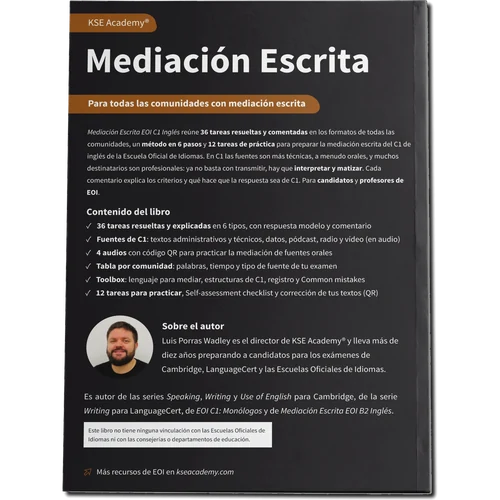
Si además estás preparando la mediación escrita, en mi libro Mediación Escrita EOI C1 Inglés tienes 36 tareas resueltas y un método de seis pasos que también te sirve para organizar la oral.
¿Te ha sido útil? Compártela con quien esté preparando el C1. Y si quieres más contenido como este, suscríbete a mi newsletter y sígueme en Facebook, Twitter, Pinterest, Instagram y YouTube.
¡Mucho ánimo con el oral y, hasta la próxima, don’t forget to keep smiling! 🙂
