
Table of contents
Spoken mediation in the EOI C1 exam is a bit of a reflex test: you read a text, often in Spanish, you get about five minutes to prepare and then you explain it in English to someone who needs it, usually for two or three minutes. At C1 you’re not asked to speak for longer than at B2; you’re asked to think harder about it: choose what’s useful to your listener, apply it to their situation and avoid just repeating the text.
I’ll walk you through the timing and the kind of text you’ll get depending on where you sit the exam, the tasks that keep coming up at C1, what the examiners focus on and, to finish, three worked examples: the card, what you’d jot down while preparing and the transcribed answer. Let’s begin! 🙂
Written mediation is a separate task with its own guide: EOI C1 written mediation. For the exam as a whole, have a look at my EOI C1 guide.
C1 spoken mediation format by region
Fifteen of the eighteen regions and autonomous cities have spoken mediation in English, almost always as an individual task within the speaking session. What changes is the timing, the language of the source and, in a couple of cases, the whole task:
| Region | Preparation · speaking time | Source |
|---|---|---|
| Andalusia | 20 min for all the speaking tasks · 2-2.5 min | An infographic or image in English |
| Aragon | 4 min · 3 min | A Spanish text of up to about 400 words |
| Asturias | Up to 4 min · up to 3.5 min, for two tasks | A Spanish text; the second task is explaining an expression |
| Balearic Islands | No spoken mediation | |
| Canary Islands | 5 min · 4-5 min, recorded | An English text of about 160-180 words |
| Cantabria | About 10 min shared with speaking · 2.5 min | A text of up to 450 words, or audio or video; in Spanish or English |
| Castile-La Mancha | Up to 5 min · 2.5-3 min | A text of up to 270 words |
| Castile and León | 5 min · up to 3 min | English or Spanish, your choice; up to 300 words |
| Catalonia | About 5-7 min, in pairs | No text: discussing a work of art with your partner |
| Valencian Community | Shared with speaking · 2-2.5 min | An infographic, image or comic strip in English |
| Extremadura | No spoken mediation in English | |
| Galicia | 4 min shared with speaking · 1-2 min | One or more texts |
| La Rioja | 5 min · up to 3 min | A Spanish text (infographic, website, article, advert) |
| Madrid | 5 min · 2-3 min, recorded | A Spanish text of 200-250 words |
| Murcia | 5 min · 4 min | A poster or text in Spanish in the sample |
| Navarre | 10 min in another room · 3-4 min | One or two English texts, up to 500 words |
| Basque Country | 20 min shared with the monologue · about 2 min | Audio, a text or an infographic in English |
Compared with B2, in half the regions the difference is small: a minute more to prepare, half a minute more to speak and a slightly longer text. What really changes is the kind of text (more opinion pieces and official documents) and what you have to do with it.
EOI C1: types of spoken mediation task
These are the task types in the official C1 sample tests, from most to least frequent:
- Explaining something local to someone from abroad (a service, some rules, a custom) from a Spanish text: Madrid, Asturias, La Rioja, Murcia and Aragon.
- Passing on the advice or information in an infographic or a leaflet: also the dominant type in Andalusia’s task cards.
- Summarising one or more opinion pieces, conveying the arguments: Castile and León, Galicia and Navarre.
- Explaining some requirements and applying them to your listener’s case: the Canary Islands and Madrid. New compared with B2.
- Explaining what a word or an expression means: Castile-La Mancha and the second task in Asturias.
- Persuading an audience or interpreting a comic strip: the Valencian Community.
- Discussing a work of art with your partner: Catalonia, which calls this its C1 spoken mediation.
What the examiners reward in C1 spoken mediation
The scales reward passing on the relevant information, adapting it to your listener, organising what you say and using C1-level English. On top of that, three demands appear at C1 that are well worth keeping in mind:
- Nuance and cultural implications. Saying what the text says isn’t enough: you have to explain what your listener wouldn’t understand because they don’t live here.
- Language a non-specialist can follow. If the text is technical or official, your job is to make it understandable.
- Be careful with your own opinion. In Galicia (new at C1), the Basque Country and Castile and León it loses you marks. In Navarre and Madrid, on the other hand, you’re asked to reflect the opinions and arguments in the texts, which isn’t the same as giving yours.
Make the most of your 5 minutes
- Read the card first, not the text. Knowing who your listener is and what they need tells you what to look for.
- Underline a little and note down even less. Five or six key words, in the order you’ll use them, not the order they appear in the text.
- Decide how you’ll start and finish. An opening that puts your listener in the picture and a closing line that tells them what to do or remember.
- Look for the “for you” moment. Applying the information to their case is what most clearly separates C1 from B2.
- Have a couple of phrases ready for cultural points: it’s a bit like…, here in Spain that means…, what they call … is basically…
EOI C1 spoken mediation: three examples with model answers
I wrote the cards and texts for this guide, modelled on the real ones. The answers are transcribed the way a strong C1 candidate would say them, with natural fillers and without sounding read out.
Example 1: explaining a procedure and applying it to their case
The star format at C1: you get a Spanish document about life here (a procedure, a service, some rules) and a friend from abroad who needs it. It’s what you get in Madrid, Asturias, La Rioja or Murcia. The step up from B2 is that explaining isn’t enough: you have to apply the conditions to their particular situation.
The card:
A plot of your own
Your Irish friend Fiona moved to Arroyoblanco, the town where you live, last January, and registered at the town hall in February. She works from home three days a week and would love to grow her own vegetables. She has seen this notice about the town allotments, but her Spanish isn’t good enough to follow the details. She doesn’t have a Spanish digital certificate, she shares a flat with her friend Lucía, who is also interested, and she always spends the whole of July in Ireland with her family.
Explain to Fiona what the scheme offers, whether she can apply and what she would have to do, taking her situation into account. Make sure you mention any sociocultural or administrative aspects she may not be familiar with.
Preparation: 5 minutes (you can underline and take notes). Speaking: 2.5 to 3 minutes.
Huertos urbanos municipales: abierto el plazo de solicitud
El Ayuntamiento de Arroyoblanco abre el plazo para solicitar una de las 80 parcelas del Huerto Municipal de La Vega, junto al parque fluvial. Cada parcela mide 50 m² e incluye toma de agua con riego por goteo, una caseta compartida para guardar herramientas y acceso a la zona de compostaje.
Quién puede solicitarla. Personas mayores de edad empadronadas en el municipio con una antigüedad mínima de seis meses en la fecha en que termina el plazo. Solo se admite una solicitud por vivienda, y no pueden participar quienes hayan perdido una parcela por abandono en los últimos tres años.
Plazo y forma de presentación. Del 2 al 27 de noviembre, en la sede electrónica municipal (con certificado digital o Cl@ve) o de manera presencial en la Oficina de Atención Ciudadana, con cita previa en el 010. No es necesario aportar el volante de empadronamiento: el Ayuntamiento lo comprueba de oficio.
Adjudicación. Las parcelas se asignarán mediante sorteo público el 14 de diciembre en el salón de plenos. El 20 % se reserva a personas mayores de 65 años y cuatro parcelas, a colegios y asociaciones del municipio. Las solicitudes sin parcela formarán una lista de espera.
Cuota y duración. 60 euros al año, que se abonan en enero. Las personas desempleadas y las pensionistas pagan la mitad. La cesión dura dos años y no se renueva automáticamente: al terminar, hay que volver a participar en el sorteo.
Obligaciones. Antes de recibir la parcela es obligatorio asistir a un curso de iniciación de cuatro horas (sábado 16 de enero, de 10 a 14 h). Solo se permite el cultivo ecológico: quedan prohibidos los pesticidas y los abonos químicos. Lo que se cultiva es para consumo propio y no se puede vender. La parcela no puede quedar sin atender más de cuatro semanas seguidas; en caso de ausencia prolongada, hay que comunicar al Ayuntamiento el nombre de una persona autorizada para cuidarla. El abandono supone la pérdida de la parcela, sin devolución de la cuota.
Concejalía de Medio Ambiente · Información: 010
What I jotted down while preparing:
<strong>Fiona:</strong> padrón Feb → 9 months by Nov ✔ (min 6 months)
80 plots, 50 m² (small flat) · drip irrigation, shed, compost
1 application per home → Lucía OR Fiona
deadline 27/11 · no certificate → in person, ring 010, appointment · Cl@ve = online ID
public draw 14/12 (not first come) · waiting list · €60/year (half if unemployed: no), 2 years
course 16/1 · organic · no selling · July = 4+ weeks → authorised person: me?
Model answer (387 words, about 3 minutes):
Hi Fiona! So, I've had a proper look at that notice about the allotments, and the good news is that, as far as I can tell, you can apply. Let me go through it bit by bit.
The town hall has eighty plots down by the river, in La Vega. Each one's about fifty square metres, roughly the size of a small flat, and they come with drip irrigation, a shared shed for your tools and a compost area, so you wouldn't need to buy much.
Now, who can apply. You need to have been on the padrón here for at least six months by the deadline. The padrón is basically the town's register of residents, the thing you signed up for at the town hall in February, so by then you'll have had nine months. You don't even need a certificate to prove it, because they check it themselves. One catch, though: it's one application per home, so you and Lucía can't both apply. One of you will have to do it.
The deadline's the twenty-seventh of November. You can apply online, but you'd need a digital certificate or something called Cl@ve, which is the government's online ID, and you've got neither, so the easiest thing is to go in person. Bear in mind you can't just turn up, though: you have to ring 010, the town hall's information line, and book an appointment first. That's very typical here.
And this is important: the plots aren't first come, first served. There's a public draw on the fourteenth of December, so it's literally a lottery. If you don't get one, you go on a waiting list.
It's sixty euros a year. Unemployed people and pensioners pay half, but that doesn't apply to you. It lasts two years, and then you have to enter the draw again.
There are a few rules, too. You have to do a four-hour course on Saturday the sixteenth of January, everything has to be organic, and you can't sell what you grow. The tricky bit for you is July: you can't leave the plot for more than four weeks, so you'd have to give the town hall the name of someone who'll look after it. I'm happy to be that person, if you like! Anyway, shall I ring 010 with you tomorrow?
What makes it C1 mediation:
- It applies each condition to Fiona’s case. Rather than just saying that six months on the padrón are needed, it does the maths for her (by then you’ll have had nine months). The same goes for the fee (that doesn’t apply to you), for Lucía and for July. This is exactly what Madrid and Canarias ask for at C1: not passing on requirements, but telling the person whether they affect them and how.
- It explains the admin a foreigner wouldn’t know. The padrón (basically the town’s register of residents), Cl@ve (the government’s online ID), 010 and the need for an appointment (you can’t just turn up), and the fact that it’s a draw (the plots aren’t first come, first served). These are the sociocultural factors the card asks for, and the text doesn’t explain them: the mediator adds them.
- It selects, and leaves out what’s irrelevant. The quota for over-65s, the plots for schools and associations and the rule about people who lost a plot through neglect have nothing to do with Fiona, so they don’t come up. Neither do the course times or the council chamber. Three useful minutes beat a complete list.
- It reformulates and makes the abstract concrete. The 50 m² become something you can picture (roughly the size of a small flat), and the formal rule about leaving the plot unattended becomes you can’t leave the plot for more than four weeks. Nothing is translated word for word.
- It’s organised for the listener and ends with a next step. It opens with the answer Fiona wants to hear (the good news is that, as far as I can tell, you can apply), flags what matters (And this is important, The tricky bit for you is July) and finishes with a real offer of help (shall I ring 010 with you tomorrow?).
Expressions for your repertoire:
- As far as I can tell, you can apply.
- Let me go through it bit by bit.
- One catch, though: it's one application per home.
- Bear in mind you can't just turn up, though.
- That's very typical here.
- The plots aren't first come, first served.
- That doesn't apply to you.
- The tricky bit for you is July.
Example 2: passing on the arguments in a debate without giving your view
In Castile and León, Galicia and Navarre the source may be an opinion piece, or two texts with opposing views, and you have to explain what each one argues to someone who has to decide. There’s a catch: in Galicia, the Basque Country and Castile and León giving your own opinion loses you marks.
The card:
Should museums be free?
Your classmate Joanna missed last week’s English class. Next week everyone has to write an opinion essay on whether public museums should charge for entry, and the teacher handed out these two articles to prepare it. Joanna has asked you what they say.
Summarise the two positions and the main arguments behind each one, so that she can make up her own mind. Do not give your own opinion or add any ideas that are not in the texts.
Preparation: 5 minutes. Speaking: 3 minutes maximum.
Open doors, open minds by Helen Marsh, head of learning at Larkford Museums
When the city of Larkford scrapped admission fees at its three public museums in 2019, visitor numbers rose by almost half within two years. More importantly, the profile of visitors changed. Families on lower incomes and teenagers, groups who had rarely crossed the threshold before, began to drop in, often for just twenty minutes on the way home from school. That is precisely the point. A collection paid for by taxpayers belongs to everyone, and a ticket costing fifteen pounds sends a clear message about who is welcome. Free entry also encourages repeat visits: people who don’t feel obliged to get their money’s worth come back, and gradually start to feel at home among the exhibits. Critics argue that museums lose income, but much of it is recovered through cafés, shops and donations, which tend to rise when visitors feel goodwill rather than obligation. Culture should not be a luxury.
Free is never free by Daniel Okafor, cultural economist
Nobody disputes that museums should be accessible. The question is who pays. Every pound that isn’t collected at the door has to come from somewhere, and in practice that means either larger public subsidies or cuts to conservation, research and staff. In Larkford, the headline figures hide an awkward detail: most of the extra visits came from people who were already regular museum-goers, many of them tourists, who simply came more often. Free entry, in other words, largely subsidises those who could afford a ticket. A fairer model would be to charge adult visitors from outside the region while letting local residents, students and anyone on benefits in at no cost. Charging also has a less obvious advantage. When people pay, they tend to value what they see, and overcrowded galleries, which harm both the artworks and the experience, become easier to manage. Generosity should be targeted, not universal.
What I jotted down while preparing:
<strong>Topic:</strong> public museums, free or paid? · 2 opposite views
<strong>Marsh</strong> (education, in favour): Larkford 2019 → +50% in 2 years
key point: who (poorer families, teens) · taxpayers' money = ours · £15 = not wanted
repeat visits · objection: income → café, shop, donations
<strong>Okafor</strong> (economist): who pays? → subsidies or cuts · Larkford: already regular + tourists
proposal: mixed system (adults from outside pay) · value it more · crowds · close: fairness for all vs targeted help
Model answer (387 words, about 3 minutes):
Hi Joanna! Right, so both articles deal with the same question: whether public museums should be free or whether people should pay to get in. And the two writers take pretty much opposite views, so I'll go through them one at a time.
The first one's by Helen Marsh, who works in museum education, and she's in favour of free entry. Her starting point is a city called Larkford, which stopped charging for entry to its three public museums back in 2019. Within two years, almost fifty per cent more people were visiting. But what she really stresses isn't so much the number as who the new visitors were: poorer families and teenagers, people who'd hardly ever gone before, some just popping in for twenty minutes after school. Her main argument is that these collections are funded by taxpayers, so they belong to all of us, and a fifteen-pound ticket makes some people feel they're not wanted. She also says that when it's free, people keep coming back and get used to being there. And she answers the obvious objection, the lost income, by saying that a lot of that money comes back through the café, the shop and donations.
The second writer, Daniel Okafor, is an economist, and he sees it quite differently. He agrees that museums should be open to everyone, but for him the real issue is who foots the bill. If the money doesn't come from tickets, it has to come from public funds, or else it's taken from things like conservation and staff. He also reads the Larkford figures another way: according to him, the extra visitors were mostly people who already went to museums regularly, including lots of tourists. So, in his view, free entry mainly benefits people who could pay anyway. What he proposes instead is a mixed system, where adults from outside the area pay and locals, students and people on benefits get in for nothing. And he adds that people appreciate things more when they've paid for them, and that charging makes it easier to control crowds, which are bad for the artworks.
So basically, one sees free entry as a question of fairness for everyone, and the other thinks the help should go only to those who need it. That should give you plenty for the essay!
What makes it C1 mediation:
- It reflects both positions without taking sides. There isn’t a single «I think» or «I agree»: everything is attributed to the writer (Her main argument is that, for him the real issue is, in his view, according to him). In Galicia, the Basque Country and Castilla y León giving your own opinion is penalised, and Navarra asks for exactly this: passing on the texts’ arguments, not yours.
- It organises the ideas for someone who has to write. First the topic and the fact that the views are opposed, then each writer separately (I’ll go through them one at a time), and finally one sentence that sums up the contrast (one sees free entry as a question of fairness for everyone, and the other thinks the help should go only to those who need it). That gives Joanna the structure of her essay.
- It shows how the texts answer each other. The second writer uses the first writer’s figures to argue the opposite, and the answer makes that visible (He also reads the Larkford figures another way). It also picks up how Marsh anticipates criticism (she answers the obvious objection). That’s mediating arguments, not just summarising.
- It reformulates everything. «Crossed the threshold» becomes people who’d hardly ever gone before, «who pays» becomes who foots the bill, and «those who could afford a ticket» becomes people who could pay anyway. No sentence from the text is repeated as it stands, which is what C1 asks for.
- It selects. It keeps the figures that support each argument (nearly fifty per cent more visitors, the fifteen-pound ticket) and leaves out the closing line of each article, which is a slogan and adds no new idea.
Expressions for your repertoire:
- Both articles deal with the same question.
- The two writers take pretty much opposite views.
- What she really stresses isn't so much the number as who the new visitors were.
- She answers the obvious objection by saying that…
- He sees it quite differently.
- For him the real issue is who foots the bill.
- He also reads the figures another way.
- One sees it as…, and the other thinks…
Example 3: speaking to a group to inform and persuade
In the Valencian Community and Andalusia your listener may be an audience: your colleagues, the members of a club, a class. It’s another way of mediating: you pick out what matters to that group, adjust your tone and finish by encouraging them to do something.
The card:
Give blood at work
You work for Brisalia Software, a company in Málaga with staff from many different countries. You have volunteered to coordinate next month’s visit of a mobile blood donation unit. At Monday’s staff meeting there will be about forty colleagues: many of them have never given blood, a few have told you they are scared of needles, and HR has confirmed that people can donate during working hours.
Using the information in the leaflet, give a short talk to your colleagues to tell them about the visit and encourage them to take part. Select what matters most to them.
Preparation: 5 minutes. Speaking: 2.5 to 3 minutes.
THE COSTA REGIONAL BLOOD CENTRE IS COMING TO YOUR WORKPLACE
Brisalia Software, car park B · Tuesday 9 and Wednesday 10 March · 9.00 to 14.00 and 15.30 to 19.00
- Why it matters. Hospitals in our region need around 900 donations every day, but only about 4% of the people who are eligible actually give blood. Each donation is separated into red cells, plasma and platelets, so one visit can help up to three patients.
- Can I donate? You need to be aged 18 to 65, weigh 50 kg or more and be in good health. If you have had a cold or taken antibiotics in the last two weeks, please come another time.
- How long does it take? Allow 30 to 45 minutes in total. A short health questionnaire and a finger-prick test to check your iron levels come first; the donation itself lasts only 8 to 10 minutes.
- Before you come. Eat as usual and drink plenty of water. Please don’t come on an empty stomach, and remember to bring an identity document.
- Afterwards. Rest for ten minutes and enjoy the snack we offer. Avoid intense exercise for the rest of the day.
- Nervous about needles? Let our nurses know: they will help you stay relaxed. Most first-time donors say it was easier than they expected.
- Follow your blood. A few weeks after your donation, a text message tells you which hospital received it.
- Booking. Reserve a 15-minute slot on your company intranet, or simply walk in.
Last year, 61 Brisalia employees donated. This year’s target: 100.
What I jotted down while preparing:
<strong>Audience:</strong> 40 colleagues, many never, scared of needles · HR: work hours ✔
open: 9 and 10 March, car park · give it a go
why? 900/day, only 4 in 100 · 1 donation = 3 patients
can I? 18-65, 50 kg+, well · cold/antibiotics → next visit · under 1 h, needle 10 min max
needles: you're not alone, nurses · easier than expected · tips: eat first, water, ID, no gym · text: hospital
close: 61 → 100 · intranet or drop by · come and find me
Model answer (365 words, about 3 minutes):
Morning, everyone! Thanks for giving me a few minutes before we get on with the agenda. I'll keep it short, I promise. As some of you know, a mobile blood unit is coming to our car park on the ninth and tenth of March, and I'd love as many of us as possible to give it a go.
Let me start with why. Hospitals around here need about nine hundred donations a day, and yet only four in every hundred people who could donate actually do it. And here's the bit I find amazing: each donation gets split into three parts, so one bag of blood can end up helping three different patients.
Now, I know what some of you are thinking: I've never done it, I don't even know if I'm allowed to. Basically, if you're between eighteen and sixty-five, you weigh at least fifty kilos and you're feeling well, you're almost certainly fine. If you've had a cold or been on antibiotics in the past fortnight, just wait for the next visit.
As for time, the whole thing takes less than an hour, and the needle part is ten minutes at most. And HR has confirmed you can do it during working hours, so you don't have to give up your lunch break.
To those of you who've told me you're terrified of needles: honestly, you're not alone. Just tell the nurses. They do this all day, every day, and they're brilliant at putting people at ease. Apparently most people who try it for the first time say it was much easier than they'd imagined.
A couple of practical tips: have something to eat first, drink lots of water, don't forget your ID, and take it easy afterwards, so maybe skip the gym that evening. Oh, and here's a lovely touch: a few weeks later you get a text telling you which hospital your blood went to.
Last year, sixty-one of us donated. This year the target's a hundred, and I really think we can beat it. You can book a slot on the intranet, or just drop by on the day. If you've got any questions, come and find me. Thanks, everyone!
What makes it C1 mediation:
- It adapts the tone to an audience, not a single person. It greets the group, asks for their time and promises to be brief (Thanks for giving me a few minutes before we get on with the agenda. I’ll keep it short, I promise.), and thanks everyone at the end. It’s a talk at a meeting, not a voice message to a friend, which is what the C1 cards in the Valencian Community and Andalusia ask for.
- It anticipates what the audience is thinking. The card says many have never given blood and some are scared of needles, and the answer tackles exactly those doubts (I know what some of you are thinking, To those of you who’ve told me you’re terrified of needles: honestly, you’re not alone). That’s how you really encourage people, not with a bare «you should donate».
- It selects what matters to this audience. It uses the HR information, which isn’t in the leaflet (so you don’t have to give up your lunch break), and the company target to finish (This year the target’s a hundred, and I really think we can beat it). It leaves out the names of the blood components, the exact opening times and the snack: none of them persuade anyone.
- It turns data into something easy to follow by ear. The 4% becomes only four in every hundred people, the 8 to 10 minute donation becomes the needle part is ten minutes at most, and the 30 to 45 minutes become less than an hour. When you’re listening, a round figure sticks better than a range.
- It has the structure of a persuasive talk. Why it matters, who can give, how long it takes, the fear factor, practical tips and a close with a target and a call to action (You can book a slot on the intranet, or just drop by on the day). The signposts (Let me start with why, As for time, A couple of practical tips) help the audience follow you without seeing the leaflet.
Expressions for your repertoire:
- Thanks for giving me a few minutes before we get on with the agenda.
- I'd love as many of us as possible to give it a go.
- Let me start with why.
- Here's the bit I find amazing.
- I know what some of you are thinking.
- Honestly, you're not alone.
- Here's a lovely touch.
- I really think we can beat it.
What loses you marks in C1 spoken mediation
- Reading out your notes. The examiners want to hear you talk to your listener, not recite.
- Going paragraph by paragraph. If you follow the order of the text, you’re most likely summarising rather than mediating.
- Translating cultural terms literally. Things like empadronarse or la ITV mean nothing in translation; you have to explain them.
- Giving your opinion when nobody asked. And in some regions, however natural it feels, it costs you marks.
- Running out of things to say. Two and a half minutes go by fast; if you finish after a minute and a half, you’ve probably left out the part that applies the information to their case.
- Forgetting who’s listening. Talking as if you were giving a lecture when the card says it’s a friend, or the other way round.
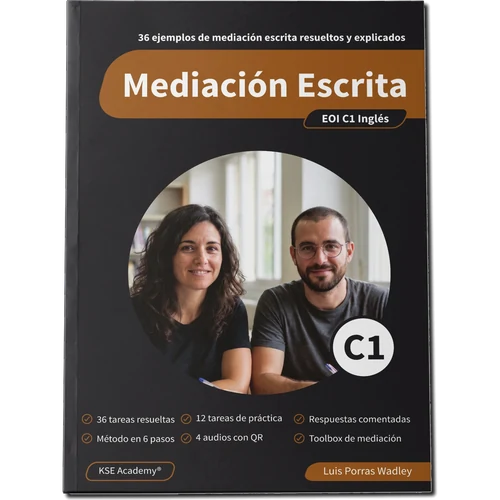
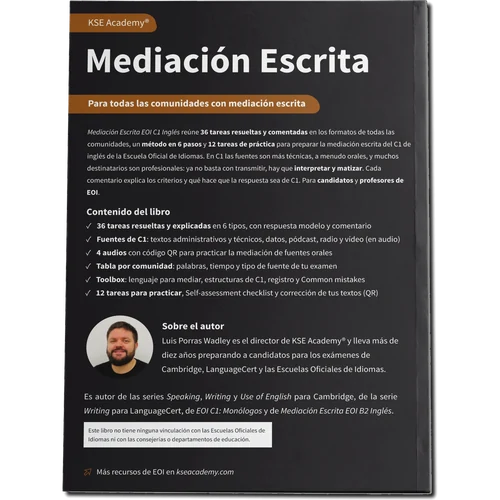
If you’re also preparing written mediation, my book Mediación Escrita EOI C1 Inglés has 36 worked tasks and a six-step method that also helps you organise the spoken one.
Found this useful? Share it with anyone preparing for C1. And if you’d like more content like this, subscribe to my newsletter and follow me on Facebook, Twitter, Pinterest, Instagram and YouTube.
Good luck with the speaking test and, until next time, don’t forget to keep smiling! 🙂
