

Table of contents
If you’ve already got B2 and you’re thinking about the EOI C1 exam, here’s something I say a lot in class: C1 isn’t «B2 with longer texts». The jump isn’t so much about how much you understand as how you say things: adding nuance, sounding natural, adapting your register to each situation and defending an idea without falling back on the same four structures every time.
The good news is that the exam itself holds no surprises. It has the same five parts as B2, the same pass rules and fairly similar formats all over Spain. So this guide sticks to the practical side: what the EOI C1 exam is like, what each part asks of you, what changes depending on your region and how to prepare on your own without wasting months. Let’s get into it! 🙂
If you’re not sure yet how the certification exams work in general, start with my guide to the EOI English exam.
What having C1 really means (and how it shows)
In the Common European Framework, C1 is the level of someone who uses the language fluently and precisely in almost any context: at work, at university or in a chat over a drink about a tricky subject. Nobody expects perfect English, but it should be obvious that you choose your words rather than settling for the first ones that come out.
In practice, that comes down to some very concrete things:
- You follow long texts and recordings even when the ideas aren’t spelled out: you pick up irony, attitude and what’s only hinted at.
- You write well-organised texts in which you argue, compare and concede (while it is true that…, admittedly…) instead of just giving your opinion.
- You speak for several minutes without getting stuck, and when a word escapes you, you talk your way round it without making a fuss.
- You adapt what you say to your listener: you don’t talk to your boss the way you talk to a friend, and that’s assessed.
If you’re reading this and thinking «I get by, but I’m not quite there», don’t worry: that’s exactly the gap between B2 and C1, and well-aimed practice closes it.
The five parts of the EOI C1 exam
As at every other level, the C1 exam has five parts of equal weight, 20% each. They’re split over two days: the written session (reading, listening, writing and written mediation) and the speaking session (speaking and spoken mediation). These are the most common formats in the 2025 and 2026 specifications:
| Part | Most common C1 format | Time |
|---|---|---|
| Reading (comprensión de textos escritos) | 3 tasks, about 25 items, between 2,000 and 2,500 words of text | 60-75 min |
| Listening (comprensión de textos orales) | 3 tasks, about 25 items, recordings of up to 5 or 6 minutes heard twice | About 45 min |
| Writing (producción y coproducción escrita) | 2 texts: an interactive one (an email or a letter) and a more developed one (an opinion article, a report, a review) | 75-100 min |
| Speaking (producción y coproducción oral) | A 3 to 5-minute monologue and a conversation with another candidate | About 15-20 min per pair |
| Mediation (written and spoken) | Passing on what matters in a text, a recording or an infographic to someone who needs it, adapted to their needs | Varies |
Reading and listening at C1
The number of questions hardly changes from B2: it’s still three tasks and about 25 items. What goes up is the amount of text and how demanding it is. Reading texts are longer and denser (opinion pieces, features, extracts from essays) and in many regions the task of putting sentences or paragraphs back into a text becomes more common, which means following how an argument is built. In the listening, recordings get a bit longer and, in Aragon for instance, the specifications now talk about «normal or fast» speed.
C1 writing
You write two texts, and the total length varies a lot by region: from about 280 words in Castile-La Mancha to 450-500 in Extremadura, though 350-400 is the most common. One task is usually interactive, such as a formal complaint, an application or a reply on a forum, and the other more argumentative: an opinion article, a report, a critical review or an essay. Being understood is no longer enough: what counts is a range of structures, precise vocabulary and a register that suits the reader.
C1 speaking
The speaking test is normally done in pairs, in front of a panel. First you give a monologue of about 3 to 5 minutes, based on a card with a topic and some questions, a quotation or some photos, after a short preparation time (between 1 and 5 minutes depending on the region). Then comes the conversation with your partner, where how you react, qualify what you say and keep things moving matters as much as what you say. There are some curious cases, such as Catalonia, where you choose and prepare the monologue topic yourself before the exam.
C1 mediation
This is the part that most sets the EOI apart from other exams. In written mediation you read (or listen to) a text and write an email or a message for someone who needs that information. In spoken mediation you do the same thing out loud: about 4 or 5 minutes to prepare and about two and a half or three minutes to explain it. At C1 the source texts are longer and more complex, and you’re often asked to do more than summarise: apply the information to the other person’s situation, explain cultural points or pass on the arguments of an opinion piece.
How you pass EOI C1
To get the C1 certificate you have to clear two bars, and one on its own isn’t enough:
- No part below 50%: all five count separately.
- An average of 65% or more across all of them.
In other words, a 9 in listening won’t rescue a 4 in mediation, and five scraped passes with a 5 won’t reach the average either. What works best is arriving with no weak part and two or three where you’re comfortably above the line.
If one part falls below 50%, in several regions you can retake it in the resit session of the same academic year and keep the parts you passed. The conditions vary by region and depend on whether you’re an enrolled student or an external candidate, so always check your region’s guide.
Where C1 changes most from region to region
Although they all follow the same national decree, each region designs its own exam, and at C1 there are differences worth knowing before you start practising:
- Writing length. From about 280 words in total in Castile-La Mancha to 450-500 in Extremadura. Practising with your region’s word count is essential to get your timing right.
- How many times you hear each recording. Twice is normal, but in Asturias it’s three times and in Madrid one of the C1 tasks is heard only once.
- Reading time. Usually 60 to 75 minutes, but in Murcia you get 90.
- Which mediation tasks there are. In Asturias there’s only spoken mediation, while the Balearic Islands and Extremadura’s English exam only have the written one. In Catalonia, C1 spoken mediation means discussing an image with your partner, with no source text.
- Where the mediation source comes from. In Madrid, Aragon, Asturias or La Rioja it’s usually in Spanish; in the Canary Islands, the Valencian Community, Navarre or the Basque Country, in English. And it isn’t always a text: in La Rioja the source for written mediation is a podcast, and in Catalonia a video you watch only once.
- Preparation time for spoken mediation. Most regions give you 4 or 5 minutes, but Navarre gives you 10, in a separate room.
- Tasks that look like Cambridge. The Balearic reading paper includes use of English tasks such as key word transformations.
How to prepare for EOI C1 on your own
First, measure the gap
Before you buy anything, do a full sample exam from your region against the clock. Not to pass it, but to see where you stand: which parts you’ve nearly got and which ones will take work. That tells you how much time you need and saves you weeks practising what you already know.
Read and listen to things that stretch you
Series in English with subtitles won’t get you to C1 on their own. You need opinion writing (newspaper columns, short essays, long reviews) and recordings at a natural pace: podcasts, interviews, debates. Notice how ideas are linked, because that’s exactly what the missing-sentence tasks and the inference questions test.
Write with nuance, not just accuracy
The step up in C1 writing is about style: conceding before you argue back, qualifying a claim, varying the way you start sentences, using inversion or emphatic structures where they make sense. Write regularly, to your region’s word count, and check your texts for repetition: the same linker three times is the first thing that pulls the mark down.
Speak out loud, and record yourself
Build up a set of common topics (technology, work, the environment, education, city and country life…) and practise timed monologues of 3 or 4 minutes. Recording yourself is awkward, but it’s the quickest way to spot fillers, long pauses and sentences you always start the same way.
Train mediation as a task in its own right
A lot of people leave it until the end, which is a mistake: it’s 20% of the mark. The key at C1 is selecting: not everything in the text matters to your reader. Practise with real texts from around you (a council leaflet, a service’s website, an article) and explain them in English to an imaginary person with a specific need.
The last month
Do at least two full mock exams in the same conditions as the real day, go over your most frequent mistakes and stop learning new things in the final week: it’s time to consolidate, not to panic.
Books and resources for EOI C1
For the two parts that are hardest to prepare on your own, I have two books designed for the EOI C1 exam:
- EOI C1 Monólogos: 30 complete C1 monologues, each with its own audio and video, so you can see how a good talk is put together, and plenty of topic cards to practise with.
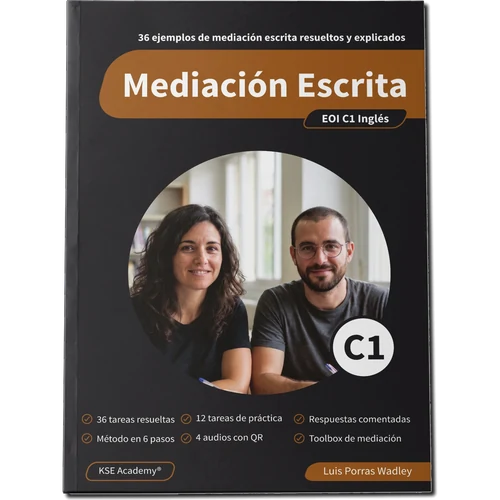
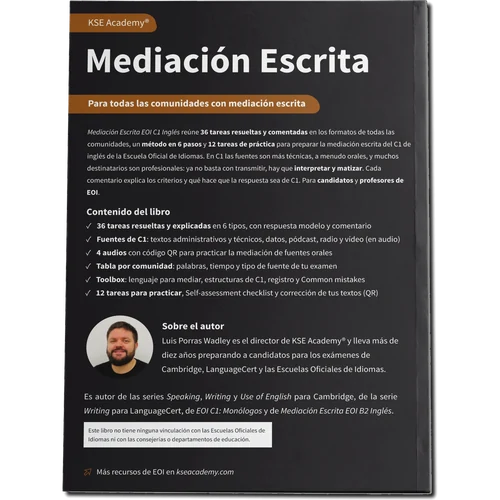
- Mediación Escrita EOI C1 Inglés: 36 written mediation tasks in each region’s format, worked through and explained step by step.
And for your own texts, there’s the C1 writing correction service: you send me your texts and I send you back a report with the mark they’d get and what you need to improve.
EOI C1 FAQs
Do I need B2 to sit C1?
No. As an external candidate you can go straight to C1 without having passed B2. Bear in mind, though, that you can only register for one level per language in each exam session, so choose carefully.
How long does the exam take?
The written session is long: in Madrid, for example, it starts at 4 pm and finishes at 8.25 pm, with two breaks. The speaking session is on another day and is much shorter, about 15 or 20 minutes per pair plus preparation time.
Is it harder than Cambridge C1 Advanced?
It’s different rather than harder. Cambridge has a very demanding Use of English paper and no mediation; the EOI has mediation and makes you pass each part separately. Cambridge is better known outside Spain; the EOI certificate is official, much cheaper and accepted for many purposes here. For a detailed comparison, have a look at my guide to C1 Advanced.
How long does it take to go from B2 to C1?
It depends a lot on where you’re starting from, but if you’ve just passed B2, think of an academic year of steady work. If you haven’t practised for years, do a sample exam first and decide based on the results.
Found this useful? Share it with anyone thinking about taking the leap to C1. And if you’d like more content like this, subscribe to my newsletter and follow me on Facebook, Twitter, Pinterest, Instagram and YouTube.
Good luck with C1 and, until next time, don’t forget to keep smiling! 🙂
