
Table of contents
I’ll tell you from experience: written mediation in the EOI C1 exam is where lots of people with good English lose marks. Not because they write badly, but because they do what they did at B2: summarise the source text in other words. And at C1 that falls short.
Here I’ll show you how the task changes from one region to another, which mediations turn up in the official C1 sample tests (including some that didn’t exist at B2), what the examiners look for and three worked examples with all the reasoning: what I picked from the text, what I left out and why. Let’s dive in! 🙂
If you’d like to see how mediation fits into the rest of the exam, there’s my general guide to EOI C1.
C1 written mediation, region by region
The idea is always the same: someone needs the information in a text (or a recording, or a video) and you pass it on in writing, adapted to what they need. But the formats vary a lot. In some regions you write 80 words and in others 200; in some the source is in Spanish and in others in English; and in a few it isn’t a text at all:
| Region | Words · time | Source |
|---|---|---|
| Andalusia | 150-175, within the 90 minutes of the writing paper | An email plus an infographic or leaflet in English; the task also counts as the interaction task |
| Aragon | 125-150 · 35 min | English, up to 400 words, sometimes several short texts |
| Asturias | No written mediation | Spoken mediation only |
| Balearic Islands | About 200 over two tasks · 45 min | English, up to 250 words, administrative register |
| Canary Islands | 80-90 · 35 min | English, 160-180 words, more technical than at B2 |
| Cantabria | 120-140 · 30 min | Spanish or English: a text of up to 450 words, or 2-3 min of audio or video |
| Castile-La Mancha | 100-110 · 15 min, plus the video | A video in Spanish of about 3 min, watched twice |
| Castile and León | Up to 150 · 30 min | English, up to 300 words, full of data |
| Catalonia | About 175 · 30 min, plus the video | A video in English of about 5 min, watched only once |
| Valencian Community | 190-220 · 50 min | An infographic in English, sometimes with an image |
| Extremadura | Two tasks of 100-120 · 60 min | English or Spanish: a text of up to 250 words or up to 5 min of audio |
| Galicia | 80-100 · 20 min | One or more texts |
| La Rioja | Up to 150 · 40 min | A podcast in Spanish, heard twice, plus an email in English |
| Madrid | 180-200 · 45 min | Spanish, 500-600 words |
| Murcia | 100-150 · 20 min | Spanish: an administrative text, infographic, leaflet or a personal message |
| Navarre | 140-170 · 30 min | English, up to 400 words, below C1 level |
| Basque Country | 70-90 · 25 min | A radio clip in English, heard twice, with a table for notes |
Notice two things. First, the length hardly goes up from B2, usually by 20 to 30 words. Second, there are more spoken sources (podcasts, radio, video) and more formal readers, such as a manager, a committee or the families at a school.
Types of written mediation in EOI C1
I’ve classified the tasks in every region’s official C1 sample tests. These are the types, from most to least frequent:
- Telling someone from abroad what a Spanish text says, according to their profile and situation: by far the most common (Madrid, Murcia, Cantabria).
- Giving advice or information to someone you know based on an English text (Andalusia, the Canary Islands, Castile and León, Navarre, Aragon).
- Writing a public or professional text: a news item for a website, an institutional email, a proposal (Andalusia, the Balearic Islands, the Valencian Community).
- Summarising a text, a recording or a video for other people (the Canary Islands, Castile-La Mancha, Catalonia, La Rioja).
- Mediating for a decision: comparing options and requirements and recommending one to whoever decides (Andalusia, the Canary Islands, Aragon). New at C1.
- Rewriting for another reader: simplifying a technical text or changing its register (the Canary Islands, the Balearic Islands, Cantabria).
- Explaining graphs or data (Cantabria, the Valencian Community, Madrid).
- Passing on a delicate message tactfully, softening the tone without losing the content (Murcia). New at C1.
- Listening, taking notes and writing a different kind of text, such as a newspaper piece (the Basque Country). New at C1.
What examiners look for at C1
Marking scales differ from region to region, but at C1 they agree on asking for more of the same and, above all, doing it better:
- Really selecting. A 500-word text won’t fit into 180 words, and it doesn’t have to: only what your reader needs.
- Rewording, not copying. C1 scales penalise following the original’s structure or reusing its sentences. It has to sound like your own text.
- Interpreting. Applying the information to the reader’s situation, spelling out what’s implicit or cultural, drawing a conclusion.
- Getting the register right. You don’t write to a friend the way you write to your manager or to a hundred families.
- Leaving your opinion out unless the task asks for it. Mediating isn’t commenting on the text.
Three EOI C1 written mediation examples, solved and explained
I’ve chosen one example of the most frequent type and two of the types people find hardest coming from B2. The tasks and texts are original, in the exam format, and different from the ones in my book.
Example 1: helping a friend from abroad who’s moving out
This is by far the most frequent task in the official C1 sample tests (twelve out of 44), especially in Madrid, Murcia and Cantabria. You’re given a Spanish text about a service or a rule in your town, and someone from abroad who needs it. At C1, passing on the key points isn’t enough: you have to apply them to their particular case and clear up whatever they won’t understand because they don’t live here.
The task:
Write an email to Aino (180-200 words) following the instructions given.
Your Finnish friend Aino has been living in your town for a year, renting a flat in her own name, and she is moving back to Helsinki at the end of next month. She has to empty the flat before she hands back the keys on the 28th. She wants to get rid of an old sofa bed, a mattress and a wardrobe, a bookcase that is still in very good condition, a microwave that no longer works and some half-empty tins of paint. She does not have a car, and her building has a concierge. She has found this page on the council website, but the Spanish is too much for her.
Send her an email explaining the information that is relevant to her situation and what you would advise her to do. Mention any cultural details about life in Spain that she might not be aware of.
Recogida de muebles y enseres: cómo deshacerse de lo que ya no se usa
Ayuntamiento de Torrealba, Servicio de Limpieza Urbana (web ficticia)
Recogida a domicilio. El Ayuntamiento retira gratuitamente muebles, colchones y enseres voluminosos de los domicilios particulares, hasta un máximo de cinco piezas por servicio y dos servicios al año por vivienda. Debe solicitarse con al menos 48 horas de antelación en esta web o en el teléfono 010.
Cómo y cuándo sacarlos. Los objetos se depositarán en la acera, junto al portal del edificio, la noche anterior al día asignado, entre las 21:00 y las 23:00. En ningún caso deben dejarse junto a los contenedores ni en zonas ajardinadas. En los edificios con conserje, se recomienda informarle con antelación.
Electrodomésticos. Al comprar un aparato nuevo, el establecimiento está obligado a retirar sin coste el antiguo de tipo equivalente en el momento de la entrega, aunque no se adquiriera allí. Solicítelo al formalizar la compra.
Residuos excluidos. Este servicio no recoge restos de obras, que requieren un saco o contenedor autorizado, ni pinturas, disolventes, baterías, aceite usado o pequeños aparatos eléctricos y electrónicos, que deben llevarse al Punto Limpio.
Punto Limpio. El Punto Limpio fijo (Camino de las Eras, s/n) abre de martes a sábado de 9:00 a 20:00 y los domingos de 9:00 a 14:00. El Punto Limpio móvil recorre los barrios según el calendario publicado en esta web. Para usar cualquiera de los dos es necesario acreditar la residencia en el municipio (DNI, NIE o recibo de un suministro a su nombre).
Reutilización. Los muebles en buen estado pueden donarse a la asociación Segunda Casa, que los recoge sin coste y los entrega a familias con pocos recursos. Cita previa en su web.
Sanciones. Abandonar muebles o residuos en la vía pública fuera del horario establecido o sin solicitud previa constituye una infracción sancionable con multas de hasta 750 euros.
Model answer (199 words):
Hi Aino,
Clearing the flat is easier than you feared, as long as you get the timing right.
The sofa bed, the mattress and the wardrobe can go in one free collection, as the limit is five items per visit. Book it online or by ringing 010 at least two days ahead; I'd aim for the 25th, which leaves you some leeway before the 28th. The night before, take everything down to the pavement by your door between nine and eleven. Whatever you do, don't put it out earlier or beside the bins: you could be fined up to €750.
It'd be a shame to throw the bookcase away. A charity called Segunda Casa picks up decent furniture for free and passes it on to families in need.
The paint and the microwave must go to the recycling centre. Since you haven't got a car, wait for the mobile unit to visit your area (the dates are online) and bring your NIE.
Oh, and tell your concierge beforehand, as that's what people do here. And don't be surprised if the sofa vanishes before the lorry turns up: neighbours often help themselves to furniture left out at night!
Love,
Lucía
What I selected and why: I kept only what Aino will actually use: the free collection (the item limit, how far ahead to book, when to take things down and the fine), the charity for the bookcase, and the mobile recycling unit, with her NIE, for the paint and the microwave. I left out the rule about old appliances (she is leaving the country, not buying anything), building rubble, the opening hours of the main recycling centre (useless without a car) and the limit of two collections a year, which does not affect her as she only needs one.
Why it works as C1 mediation:
- It applies the information to Aino’s case instead of translating it: rather than stating the five-item limit, it says The sofa bed, the mattress and the wardrobe can go in one free collection, and suggests a date that suits her: I’d aim for the 25th, which leaves you some leeway before the 28th.
- It interprets what the page only implies. Aino has no car, so the main recycling centre is out: Since you haven’t got a car, wait for the mobile unit to visit your area. This kind of reasoning is exactly what the C1 scales reward.
- It turns legal Spanish into friendly English: the formal warning about fines becomes Whatever you do, don’t put it out earlier or beside the bins: you could be fined up to €750.
- It adds the cultural points a Finnish reader would miss: telling the concierge (as that’s what people do here) and the habit of taking furniture from the street (neighbours often help themselves to furniture left out at night!).
- The language is clearly C1 but never stiff: conditionals, Whatever you do, It’d be a shame to, and phrasal verbs such as picks up, passes it on and turns up, all in a warm, informal tone.
Expressions for your repertoire:
- as long as you get the timing right
- which leaves you some leeway
- Whatever you do, don't…
- It'd be a shame to throw the bookcase away.
- passes it on to families in need
- Since you haven't got a car, …
- as that's what people do here
- don't be surprised if…
Example 2: mediating for a decision
This one only appears from C1 upwards: instead of telling a friend about something, you match the information in the source against a need and recommend an option to someone who has to decide, usually a manager. It appears in Andalusia, the Canary Islands and Aragon, and it forces you to select carefully and argue in a formal register.
The task:
You work for Cerámica Albaida, a small tile manufacturer near Valencia (a fictional company). Your manager, Ms Henriksen, who is Danish, wants to start sending free tile samples to interior designers in the UK, about 40 parcels a month, and has asked you to compare the courier services in the guide below. Her conditions are:
Sending fragile goods to the UK: four courier services compared
From ShipSense, an independent guide for small exporters (fictional), updated October
Prices are for one parcel of up to 5 kg from mainland Spain to Great Britain. Since Brexit, every parcel needs a customs declaration and a commercial invoice, so who prepares them makes a real difference to your workload.
- Rapidex Europa: €14.50 per parcel. Delivery in 4 to 6 working days. Free collection from your premises if booked before noon. Customs forms are completed by the sender on the Rapidex website. Insurance up to €100 included, but breakages are only covered if goods travel in Rapidex approved boxes (€3 each).
- Correo Azul Business: €11.90 per parcel. Delivery in 5 to 8 working days. Parcels must be dropped off at a post office. The sender fills in an online customs form, then prints it and attaches it to the parcel. Basic insurance up to €50; no cover for fragile items. Tracking stops once the parcel leaves Spain.
- Northline Express: €21.80 per parcel, with a 10% discount for customers sending more than 30 parcels a month. Delivery in 2 to 3 working days. Collection every weekday. Its customs team prepares all the paperwork from your product list, and import duties and VAT can be billed to the sender, so recipients are never charged on delivery. Fragile goods insured up to €300 at no extra cost. Minimum contract: 12 months.
- ParcelHop: €16.40 per parcel. Delivery in 3 working days. Collection on Tuesdays and Fridays only. Customs documents are generated automatically from your invoice; however, import duties and VAT are charged to the recipient on delivery, together with a £12 handling fee. Fragile cover up to €250 for an extra €1.50. No contract: pay as you go.
Average customer rating: Rapidex 3.9, Correo Azul 3.4, Northline 4.6, ParcelHop 4.1 (out of 5).
- samples must arrive within three working days, as designers need them for meetings with their clients;
- designers must never be asked to pay anything when the parcel arrives;
- the warehouse team is small and has no time to deal with customs forms;
- the budget is about €20 per parcel.
Write a formal email to Ms Henriksen (140-170 words) recommending one service, explaining your reasons and pointing out one drawback she should bear in mind.
Model answer (169 words):
Dear Ms Henriksen,
Having compared the four services, I would recommend Northline Express.
At first sight it is the most expensive, but with around forty parcels a month we would get its volume discount, which brings the price down to roughly €19.60, just within budget. More importantly, it is the only one that meets all your conditions: samples arrive in two or three days, its staff handle the customs paperwork, breakages are insured at no extra cost and we can pay any import charges ourselves, so designers would never face an unexpected bill.
ParcelHop is cheaper and nearly as quick, but designers would have to pay duties and a handling fee on delivery, which would hardly make a good first impression. The other two are simply too slow.
The main drawback is that Northline requires a twelve-month contract, so we would be tied in even if the scheme proved less successful than expected. It might be worth asking them about a shorter trial period first.
Kind regards,
Pablo Ferrer
What I selected and why: I picked what actually decides the matter: the price after the discount (since we send about 40 parcels a month), delivery time, who handles customs, who pays the duties and the cover for breakages, which matters for tile samples. For the other couriers, just enough to rule them out. I left out collection days, tracking, the Rapidex boxes and the customer ratings: the manager does not need them to decide, and including everything would turn the email into a table written out in sentences.
Why it works as C1 mediation:
- It matches the manager’s conditions against the options, which is the whole point of this task type: instead of describing all four couriers, it says which one ticks every box: it is the only one that meets all your conditions.
- It interprets the figures: the guide gives the price and the discount separately, and the answer does the maths for her: which brings the price down to roughly €19.60, just within budget.
- It rules out the alternatives with a reason, briefly: ParcelHop is cheaper and nearly as quick, but designers would have to pay duties and a handling fee on delivery; The other two are simply too slow.
- It qualifies the recommendation with an honest caveat and a way round it: so we would be tied in even if the scheme proved less successful than expected, then It might be worth asking them about a shorter trial period first.
- The register suits a manager: formal yet natural, with Having compared the four services, More importantly and would hardly make a good first impression, and no lines lifted from the guide.
Expressions for your repertoire:
- Having compared the four services, I would recommend…
- At first sight it is the most expensive, but…
- which brings the price down to roughly…
- More importantly, it is the only one that meets all your conditions
- would hardly make a good first impression
- The main drawback is that…
- we would be tied in even if…
- It might be worth asking them about…
Example 3: a public or professional text
Here your reader isn’t one person but a group: the members of an association, the families at a school, the visitors to a website. It appears in Andalusia, the Balearic Islands and the Valencian Community. The key is turning an internal or technical document into a text that’s clear, institutional and friendly all at once.
The task:
You work at the visitor centre of the Sierra de Albarda Natural Park (fictional), in Andalucía, which is very popular with walkers from the UK, Germany and the Netherlands. The park director has sent the staff the internal note below.
You have been asked to write a notice for the English version of the park’s website, explaining to visitors what is changing on the Barranco del Cuervo trail and what they need to do. Many readers will be planning their trip from abroad. Use an institutional but friendly tone. Write 130-160 words.
NOTA INTERNA
De: Dirección del Parque Natural Sierra de Albarda
Para: personal de uso público, agentes de medio ambiente y centros de visitantes
Asunto: nuevo sistema de acceso al sendero del Barranco del Cuervo
Como sabéis, el año pasado el sendero del Barranco del Cuervo recibió más de 210.000 visitas. La erosión del firme y los 37 rescates realizados, la mayoría por calzado inadecuado o falta de agua, nos obligan a cambiar el sistema de acceso. Las novedades entrarán en vigor el 1 de marzo:
1. Para recorrer el sendero será imprescindible una autorización gratuita, que se tramitará en la web del parque con un máximo de 30 días de antelación. Habrá un cupo de 300 personas al día, en dos turnos: mañana (de 8:00 a 13:00) y tarde (de 13:00 a 18:00). Los grupos de más de diez personas deberán solicitarla con al menos 15 días de antelación.
2. Del 1 de junio al 30 de septiembre, el aparcamiento de la entrada se cerrará a los vehículos particulares. Se podrá llegar en el autobús lanzadera que sale cada media hora de la plaza de Villar de Albarda (3 euros ida y vuelta; gratis para menores de 12 años).
3. Los días de riesgo extremo de incendio el sendero permanecerá cerrado. El cierre se anunciará en la web y en las redes sociales la víspera, a las 20:00.
4. Se recomienda llevar botas de montaña y al menos litro y medio de agua por persona, ya que no hay fuentes en todo el recorrido. Los perros deberán ir atados y queda prohibido el uso de drones.
En cuanto al personal: en los controles de acceso se escaneará el código QR de las autorizaciones con las tablets que se entregarán el 24 de febrero, día en que habrá una sesión de formación obligatoria a las 9:00 en el centro de visitantes. Los nuevos turnos de vigilancia se publicarán en la intranet la semana que viene.
Model answer (157 words):
<strong>Barranco del Cuervo: new access rules</strong>
To protect the gorge and keep walkers safe, access will be limited from 1 March.
You will need a free permit, bookable here up to 30 days in advance. Numbers are capped at 300 a day, split into morning and afternoon slots, so we suggest booking as soon as your dates are fixed. Groups of over ten must book at least 15 days ahead.
From June to September, the car park is closed to private cars; take the shuttle bus from the main square in Villar de Albarda (every half hour, €3 return, under-12s free).
The trail closes on days of extreme fire risk, announced here and on social media at 8 p.m. the evening before.
As there is no drinking water on the route, bring at least 1.5 litres each and wear walking boots. Dogs must be on a lead, and drones are banned.
We look forward to seeing you!
What I selected and why: I chose what visitors need to plan their walk: the free permit and when to book it, the daily limit and the two time slots, the rule for groups, the car park closure and the shuttle bus instead, fire closures and where to check them, and water, boots, dogs and drones. I left out everything aimed at staff, as well as the visitor and rescue figures: they explain the change to the team, but on a tourist website they would sound like a telling off. Saying the aim is to protect the gorge and keep people safe is enough.
Why it works as C1 mediation:
- It changes reader and purpose: the note is for staff, while the notice is for tourists planning a trip from abroad. So it opens with the reason, put positively: To protect the gorge and keep walkers safe, rather than with rescue statistics.
- It selects ruthlessly: everything aimed at staff (tablets, training, rotas) disappears, because visitors have no use for it.
- It turns rules into helpful instructions and adds advice of its own: so we suggest booking as soon as your dates are fixed. That is mediation, not translation.
- It reorganises for the visitor: the note gives the advice first and leaves the reason until the end; the notice opens with the fact visitors need in order to prepare: As there is no drinking water on the route, bring at least 1.5 litres each.
- The tone is institutional but friendly: it speaks to readers as you, uses we for the park and ends with We look forward to seeing you!, with none of the stiffness of the original.
Expressions for your repertoire:
- To protect the gorge and keep walkers safe, …
- will be limited from…
- Numbers are capped at 300 a day
- so we suggest booking as soon as…
- must book at least 15 days ahead
- announced here and on social media at 8 p.m. the evening before
- As there is no drinking water on the route, …
- We look forward to seeing you!
Common mistakes in EOI C1 written mediation
- Summarising the whole text. If your answer follows the order of the original paragraphs, you’re probably summarising rather than mediating.
- Translating whole sentences. It shows straight away and it’s exactly what C1 scales penalise.
- Forgetting the reader. If the task says your friend has two children or your manager is on a tight budget, that has to show in what you choose.
- Adding your opinion where it doesn’t belong. Recommending something when you’re asked to is fine; commenting on the text isn’t.
- A register that doesn’t fit. Too chatty for a committee, too stiff for a friend.
- Going over the word limit. Limits are usually tight in mediation, and going over normally means you haven’t selected.
A written mediation book for EOI C1
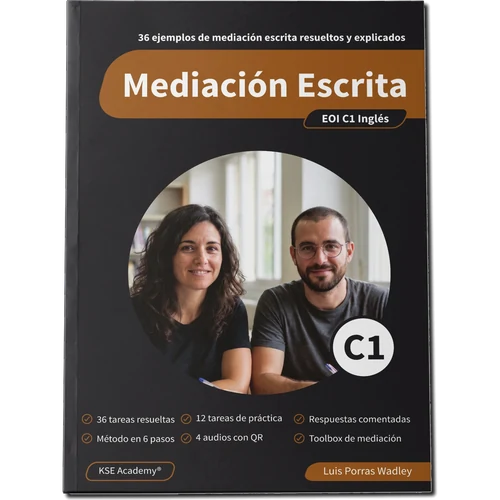
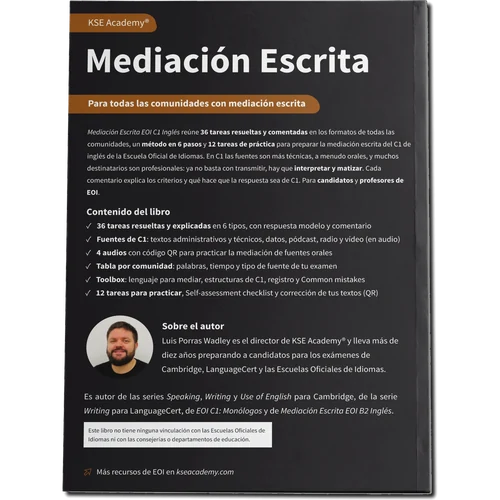
If you’d like to practise with more tasks, I have a book devoted entirely to this: Mediación Escrita EOI C1 Inglés. It has 36 written mediation tasks worked through with commentary, in every region’s format, and a six-step method for tackling any task.
And if you’d like someone to check your mediation, the C1 writing correction service covers written mediation too.
Found this useful? Share it with anyone preparing for C1. And if you’d like more content like this, subscribe to my newsletter and follow me on Facebook, Twitter, Pinterest, Instagram and YouTube.
Good luck with mediation and, until next time, don’t forget to keep smiling! 🙂
