
Table of contents
If you’re preparing for the EOI B1 exam, written mediation is probably the part that feels least familiar. It isn’t in the usual coursebooks, every region does it differently and hardly anyone shows you an answer that would pass. I get it: it’s normal to feel a bit nervous about it.
The good news is that at B1, mediation is much more manageable than it looks. You write very little, for someone close to you, about practical things: a timetable, a poster, a few tips. What’s assessed isn’t your most impressive English, but whether you can pick what that person needs and tell them clearly.
In this guide I’ll explain exactly what it is, how many words you write and how much time you have in each region, which task types come up in the official sample tests, how it’s marked and four worked examples with commentary, including everything I chose and everything I left out. Let’s dive in! 🙂
Mediation is just one of the five parts; I explain the whole exam in my EOI B1 guide, and the other half of mediation, the spoken part, in my B1 spoken mediation guide.
What is written mediation at B1?
When you mediate, you’re the bridge between a text and a person. Someone needs the information in a text and can’t understand it, either because it’s in a language they don’t speak well, because their level is low or because the text isn’t written for someone like them. You read the text and write them a message with what they need.
The easiest way to understand it is by what it isn’t:
- It isn’t a translation. If you translate sentence by sentence, you run out of words and you haven’t mediated.
- It isn’t a summary. A summary covers the main ideas of the text; mediation covers the ones that matter to your reader, even if they’re a small detail.
- It isn’t an opinion essay. Unless the task asks you to recommend something, your opinion of the text has no place in it.
And at B1 in particular, three things make it different from B2:
- The sources are short and practical: timetables, leaflets, posters, rules, adverts, lists of tips. Nothing technical or legal.
- The reader is nearly always someone close to you: in 42 of the 46 official sample tests I’ve analysed, it’s a friend, a relative, a neighbour or a colleague. Often someone with little English or little Spanish.
- The selection is very guided: the instructions tell you what that person is like and what they need, and two, three or four well-chosen points are usually enough.
B1 written mediation in each region
This is where the exam changes most. I’ve gone through every region’s official B1 guides and sample tests, and these are the figures they give:
| Region | Words · time | Source | What you write |
|---|---|---|---|
| Andalusia | 100-125 · 60 min for both writing tasks | A message from a friend plus an infographic, table or leaflet in English | An email or WhatsApp that replies to the friend and mediates at the same time |
| Aragon | 80-100 · 30 min | English, up to 250 words, below the level of the exam | Email or message to a friend: advice, rules, a poster |
| Asturias | No written mediation | Spoken mediation only | Nothing |
| Balearic Islands | Two tasks, about 140 words in all · 35 min | English, up to 150 words, or a 3-minute recording | WhatsApp to a relative; short email to your boss |
| Canary Islands | 50-60 · 35 min | English, 110-130 words | WhatsApp, email or summary |
| Cantabria | 80-100 · 20 min (the sample tests say 80 at most) | Spanish or English, up to 300 words, or 2-3 min of audio or video | Email to a friend or colleague |
| Castile-La Mancha | 60-70 · 15 min | Infographic in Spanish, up to 150 words | Message |
| Castile and León | Up to 100 · 25 min | English, up to 200 words | Email or message about a notice |
| Catalonia | 100-125 · 30 min | Infographic in English | |
| Valencian Community | 90-110 (±10 %) · 35 min | A table or short leaflets in English | Message or email that chooses an option |
| Extremadura | Two tasks of 70-90 · 40 min in all | Spanish or English, up to 150 words, or up to 3 min of audio | WhatsApp or email |
| Galicia | 60-80 · 20 min | One or more texts (in the sample test, an advert in English) | Message to a friend |
| La Rioja | Up to 100 · 30 min | Spanish: rules, recommendations or a post | Email or message with the opening and ending given |
| Madrid | 120-150 · 40 min | Spanish, 400-500 words | Email to a friend from abroad, with cultural information |
| Murcia | 75-100 · 15 min | Spanish: an email, a web page or a poster | Email or message for someone from abroad |
| Navarre | 100-120 · 30 min | English: short texts and photos | Email that compares options or gives advice |
| Basque Country | 60-80 · 20 min | English: a poster, a text of up to 240 words or 2 min of audio |
What changes most
- Andalusia puts mediation inside the interaction email: you reply to your friend and, at the same time, pass on the information from the infographic. There’s usually also a personal question that has nothing to do with the text.
- Madrid asks for the most words (120-150) from the longest text, in Spanish, and all its sample tests ask for cultural information: something about life in Spain that your friend from abroad doesn’t know.
- The Balearic Islands and Extremadura set two short tasks instead of one.
- The Canary Islands has the shortest task: 50-60 words. Every word counts there.
- Galicia asks for the same as at B2 (60-80).
- Asturias has no written mediation at B1, only spoken. And Ceuta and Melilla haven’t published the format.
- None of the official B1 sample tests uses a recording as the source, although the Balearic Islands, Cantabria, Extremadura and the Basque Country allow it. You’ll most likely get a text.
My advice: before you practise, look carefully at your region’s row. A 60-word mediation and a 150-word one are prepared differently.
The task types that come up at B1
I’ve classified the 46 official B1 written mediation sample tests published by the regions. These are the task types, from most to least frequent:
| Task type | Sample tests (of 46) | Where it appears |
|---|---|---|
| Explaining a Spanish text to someone from abroad | 17 | Madrid (7), Murcia, La Rioja, Cantabria, Castile-La Mancha, Extremadura |
| Advice or information for someone you know, from an English source | 13 | Andalusia, Aragon, Canary Islands, Balearic Islands, Catalonia, Valencian Community, Navarre, Basque Country |
| Choosing the option that fits | 4 (and 3 mixed) | Andalusia, Extremadura, Valencian Community; mixed in Madrid and Navarre |
| Summarising a text or some reviews | 5 | Canary Islands, Balearic Islands, Castile and León, La Rioja |
| Posters, notices and rules | 5 | Aragon, Cantabria, Castile and León, Galicia |
| Simplifying for someone who knows little | 1 (and 3 mixed) | Canary Islands; mixed in Andalusia, Aragon and Castile and León |
| Writing on someone else’s behalf | 1 | Murcia |
The first two types make up more than half the sample tests, so if you only have time for two, start there. But watch out for the third and the fifth: they matter much more at B1 than at B2, and each has its own trick.
How B1 written mediation is marked
Every region marks with its own scale (four criteria in Aragon, La Rioja, Madrid or Navarre; five in Cantabria or the Basque Country), but they all look at the same things:
- Whether you chose well: the information that’s useful to that person, without what doesn’t affect them or what they already know or do. In Andalusia, for example, a pass needs a minimum number of points (two or four, depending on the task).
- Whether you adapted it: the tone the situation calls for (usually informal) and English that person can understand.
- Whether you used your own words. This is where regions differ: at B1, Aragon, the Balearic Islands, the Canary Islands and the Valencian Community accept reusing words or the structure of the original, but Navarre already penalises copying. The safest option is to always reword simply, and to leave unchanged only names, prices and words with no other easy way of saying them.
- Whether the text is clear and well written: complete sentences, basic linkers, few errors that get in the way.
- Whether you keep to the length: in the Valencian Community, writing too much or too little costs you marks.
And there’s something I think you should know: the B1 scales lower the bar. They talk about “useful” information, summarising “simply” and “uncomplicated” language. In the Canary Islands, the B1 pass band is literally the lowest B2 band. Nobody expects you to write like a native speaker.
How to do a B1 written mediation step by step
- Read the instructions first, not the text. Underline who the person is, what they need and what they already know or do. That’s your filter.
- Read the text through that filter and mark only what’s useful to them. Cross out what they already know and what doesn’t affect them.
- Keep two, three or four points. If the task says “at least three”, give three or four, not eight.
- Put them in the order you would in real life: the most important thing, or what they asked you, first; then the rest.
- Write short sentences in your own words. If you don’t know how to say something, explain it: a hat for the pool works just as well as swimming cap.
- Count the words and check. Make sure the greeting, the sign-off and, if there was one, the answer to the personal question are all there.
Four EOI B1 written mediation examples, solved
I’ve chosen the four types you’re most likely to meet, each in a different region’s format. I wrote everything for this page, copying the real format: you won’t find these tasks in the official sample tests or in my book. The answers are written to pass B1, without drifting into B2.
Example 1: advice for a friend (Andalusian format)
This is the most common type with an English source: someone you know tells you about a problem and you pass on the tips from a text or an infographic that work for them. I’ve used the Andalusian format, which is the most complete one, because as well as mediating you have to reply to your friend’s email, including a personal question that has nothing to do with the source.
The task:
You have received this email from your Australian friend Zoe.
Hi!
Big news: I’ve got a job in Seville and I’m flying there next month! The problem is the journey. It’s more than 24 hours, and after long flights I always feel terrible for days. I start work two days after I arrive, so I need to feel OK quickly. I don’t drink coffee, and I’ve already bought an eye mask and some earplugs. Have you got any advice?
Oh, and what’s the best thing you’ve done this summer?
Zoe
BEAT JET LAG: 8 SIMPLE TIPS (Travel Smart magazine, fictional)
1. Change your watch to the new time as soon as you get on the plane.
2. Drink plenty of water during the flight.
3. Avoid coffee and alcohol on the plane.
4. Take an eye mask and earplugs so you can sleep.
5. Walk up and down the plane every two or three hours.
6. When you arrive, spend time outside in the daylight.
7. If you need to sleep during the day, have a short nap (20 minutes or less).
8. Eat your meals at local times from the first day.
Read the information below and write an email to Zoe (100-125 words). Answer her question and give her at least three tips from the infographic that are useful for her.
Model answer (124 words):
Hi Zoe,
Congratulations on the new job! I'm so happy you're coming to Seville.
I've read some good tips for long flights. First, set your watch to Spanish time when you're on the plane. Drink a lot of water and don't have any alcohol. When you arrive, go for a walk in the daylight, because the light helps your body get used to Spanish time. If you're tired, you can sleep in the afternoon, but only for twenty minutes. And have breakfast, lunch and dinner at Spanish times from day one. Remember that here we have lunch at about two!
The best thing I've done this summer was a trip to the mountains with my sister. It was really relaxing!
See you soon,
Noemí
What I chose and why: Zoe wants advice so she can feel OK quickly, so I keep the five tips that work for her. I leave out coffee (she doesn’t drink it) and the eye mask and earplugs (she’s already got them), because telling her what she already does wastes words. Walking up and down the plane goes too: it’s useful, but with five tips I’ve already done more than the task asks. And I answer her personal question in two lines, because in the Andalusian format that counts as well.
Why it would pass:
- It replies first and mediates afterwards: congratulations, the tips and, at the end, the personal question. That’s the natural order of an email between friends.
- It doesn’t copy the infographic. «Spend time outside in the daylight» becomes go for a walk in the daylight, and it adds the reason (because the light helps your body…), which the source doesn’t give.
- It adapts one point to Spain: «eating at local times» in Seville means lunch at two, and Zoe doesn’t know that. One sentence is enough.
- It meets the minimum comfortably: the task asks for at least three tips and I give five, but short ones.
Why it’s B1: Short sentences, imperatives (set, drink, have), one because and one if. Nothing more is needed. If you find yourself writing it is advisable to avoid, delete it: Zoe is your friend, not your patient.
Expressions to take away:
- I've read some good tips for…
- First, … / And …
- When you arrive, try to…
- If you're really tired, you can…, but only…
- Remember that here we…
Example 2: explaining a Spanish text (Murcia format)
This is the most frequent type of all at B1, especially in Madrid and Murcia: someone who has come from abroad needs to understand a Spanish text about something practical in everyday life, and you explain it. I’ve done it in the Murcia format, with the instructions in Spanish and a maximum of 100 words. At the end I’ll tell you what would change in Madrid.
The task:
Tu amiga escocesa Heather vive en tu ciudad desde enero y está empadronada. Este verano quiere ir a la piscina municipal a nadar varias tardes a la semana, cuando sale del trabajo a las cinco. Nunca ha ido a una piscina pública en España y no entiende bien la web del ayuntamiento.
Escríbele un correo en inglés (75-100 palabras) con la información que le hace falta.
Piscinas municipales de verano
Ayuntamiento de Villaverde del Río (web ficticia)
Temporada: del 15 de junio al 10 de septiembre. Horario: de 11:00 a 20:30, todos los días.
Precios: entrada de un día, 3 € (adultos) y 1,50 € (menores de 14 años y mayores de 65). Bono de 10 baños, 22 €. Abono de temporada: 45 € para personas empadronadas en el municipio y 70 € para no empadronadas. Las entradas y los bonos se compran en la taquilla o en la web municipal; el abono de temporada, solo en las oficinas del polideportivo, presentando el DNI o NIE y una fotografía.
Normas: es obligatorio el uso de gorro de baño y ducharse antes de entrar en el agua. No se permite entrar con envases de vidrio ni comer en la zona de césped junto a la piscina. Los menores de 12 años deberán ir acompañados de una persona adulta.
Calles para nadar: de lunes a viernes, de 17:00 a 19:00, se reservan dos calles de la piscina grande para nadar largos.
Model answer (98 words):
Hi Heather,
I've checked the website and the pool sounds perfect for you! It's open every day until 8.30 pm.
As you want to go often, the best option is the season ticket. It costs 45 euros, because you're registered in the town. You have to buy it at the sports centre, and you need your NIE and a photo.
From Monday to Friday, from 5 to 7, there are two lanes just for swimming lengths. And don't forget a swimming cap. Here you can't swim without one, and you have to shower first!
See you there,
Toni
What I chose and why: The key is in the instructions: Heather will go several afternoons a week, finishes work at five and is registered at the town hall. So the €45 season ticket is what suits her, and there’s no need to give her the other prices. The swimming lanes from 5 to 7 fit her timetable, and the cap and the shower are exactly what she doesn’t know, because caps aren’t usually compulsory in the UK. Left out: the season dates, the glass, the grass and the children, which don’t affect her or go without saying.
Why it would pass:
- It chooses for her: instead of a price list, it tells her which ticket suits her and why (because you’re registered in the town).
- It explains without translating: «empadronada» becomes registered in the town, and «calles para nadar largos» becomes lanes just for swimming lengths. Nobody expects the exact word.
- It adds the cultural point where it helps: Here you can’t swim without one! warns her about something that doesn’t exist in her country.
- It stays under 100 words, which in Murcia is a ceiling: people who go over have almost always translated the whole website.
Why it’s B1: Present simple, can’t, have to and a couple of linkers (as, and, because). If you don’t know the word for «gorro de baño», swimming cap or even a hat for the pool works just as well.
Expressions to take away:
- I've checked the website and…
- As you want to…, the best thing is…
- You have to… and you need…
- Don't forget…
- Here you can't… without…
And in Madrid? The idea is the same, but the Spanish text is longer (400-500 words), you write 120-150 and the instructions always ask for some cultural information, like the warning about the swimming cap. What they never ask for is your opinion.
Example 3: choosing the best option (Valencian Community format)
This type matters more at B1 than at B2: you’re given some options (courses, trains, flats, phone deals) and a friend’s requirements, and you have to recommend the one that fits. It appears in Andalusia, Extremadura and the Valencian Community, and mixed with other types in Madrid and Navarre. The good news is that there’s a right answer; the bad news is that if you choose the wrong one, it shows.
The task:
Your Canadian friend Marissa is coming to Spain in January to work as an au pair for three months. She has sent you a message: she needs a Spanish SIM card for her phone. She makes a video call to her family in Canada every evening, so she needs a lot of data (at least 30 GB a month). She won’t have a Spanish bank account, and she doesn’t want to pay for more than three months.
Look at the information below and write an email to Marissa (90-110 words). Recommend the best option for her and explain why.
Phone deals for new arrivals (fictional comparison website)
MoviPlus Basic: 10 GB, unlimited calls in Spain. €9 a month. Pay as you go: top up in any supermarket.
Onda Max: unlimited data and calls. €25 a month. 12-month contract. Payment from a Spanish bank account only.
Viva Travel: 50 GB, 100 minutes of calls. €15 a month. Pay as you go: buy online with any credit card, cancel when you want. The SIM card arrives at your address in 48 hours, or you can collect it at the airport.
Nube Mini: 30 GB, unlimited calls. €12 a month. Minimum six months.
Model answer (109 words):
Hi Marissa,
I've looked at some phone deals, and I think Viva Travel is the best one for you.
It gives you 50 GB a month, so you'll have enough data for your video calls every evening. It's €15 a month, and you can pay online with your credit card, so you don't need a Spanish bank account. You can cancel it when you go back to Canada.
The other deals aren't good for you. One only has 10 GB, and the others need a bank account or a long contract.
Buy it online and pick up the SIM card at the airport when you arrive.
Speak soon,
Maite
What I chose and why: There’s only one right answer here, and you find it by matching Marissa’s three requirements against the table. MoviPlus doesn’t give her enough data; Onda Max needs a Spanish bank account and a one-year contract; Nube Mini has a six-month minimum. That leaves Viva Travel, which meets all three. The answer says so at the start, backs it up with her needs and rules out the others in a single sentence, without going through them one by one.
Why it would pass:
- The recommendation comes in the first line. Marissa asked you a question: answer it before explaining anything.
- Each fact is tied to a need: 50 GB → the video calls; paying by card → no bank account; cancel any time → she leaves after three months.
- It rules out without listing. One only has 10 GB, and the others need… covers three options in one sentence.
- It ends with a practical detail she can use on day one: she buys it online and collects the SIM card at the airport.
Why it’s B1: I think… is the best one for you, so for the result and you don’t need. There’s no need to compare with whereas or on the other hand: the others says it all.
Expressions to take away:
- I think… is the best one for you.
- It gives you…, so you'll have enough…
- You can pay…, so you don't need…
- The other deals aren't good for you.
- You can also…
Example 4: a notice for someone with little English (Aragon format)
Posters, notices and rules: a type that appears at B1 in Aragon, Cantabria, Castile and León and Galicia. Someone doesn’t understand a notice and you tell them what affects them. I’ve used the Aragon format, which sometimes adds a very B1 condition: keep the message simple, because the reader doesn’t know much English.
The task:
You are studying in Scotland this year and you live in a student residence. Your flatmate Davide, from Italy, doesn’t speak much English. He has classes every morning from 9 to 1, and because his room is cold, he has bought a small electric heater. He has seen this notice by the lift and has asked you what it says.
Write a message to Davide (80-100 words) explaining what he needs to know. Keep the message simple, because his English is not very good.
THISTLE COURT RESIDENCE: FIRE SAFETY WEEK (fictional)
Tuesday 14 October, 10:00: fire alarm test. The alarm will ring for about five minutes. This is only a test: you do not need to leave the building.
Thursday 16 October, 9:00-13:00: room checks. Staff will enter every room, including rooms where students are out. Please make sure that:
• nothing is blocking your door or window;
• there are no candles or electric heaters in your room (these are not allowed and staff will take them away);
• there are no bikes or shoes in the corridors.
In a real fire: leave by the nearest stairs, never use the lift, and wait in the car park until a member of staff tells you it is safe. Questions? Ask at reception (open 8:00-20:00).
Model answer (96 words):
Hi Davide,
On Tuesday at 10 there's a test of the fire alarm, so don't worry if you hear it. It isn't a real fire.
On Thursday morning, people from the residence will check all the rooms, and they will go into your room while you're in class. Electric heaters are not allowed, so take yours out of your room before Thursday or they'll take it away. Also, don't leave shoes or bikes in the corridor.
If there's a real fire, use the stairs, not the lift, and wait in the car park.
See you,
Carla
What I chose and why: Out of a notice with seven points, Davide needs four: Tuesday’s test (he’ll probably be in class, but if he hears it, he shouldn’t panic), that on Thursday they’ll go into his room even while he’s at class, that his heater isn’t allowed (his real problem) and the bit about bikes and shoes. From the real-fire section I keep the essentials: the stairs, never the lift, and waiting in the car park. Left out: the exact time of the checks, candles, keeping the door and window clear, and reception.
Why it would pass:
- It applies the notice to his case: the notice says «heaters are not allowed»; the message tells him what to do with his (take yours out of your room before Thursday).
- It’s written for someone with little English: one idea per sentence, common words, no blocking or member of staff (people from the residence is easier).
- It reassures him: don’t worry if you hear it is the first thing he’ll want to know if the alarm goes off while he’s in.
- It’s a message, but with complete sentences. Informal doesn’t mean telegraphic.
Why it’s B1: Will for what’s going to happen, imperatives and so. Simplifying isn’t writing badly: it’s choosing the easiest word that says the same thing.
Expressions to take away:
- On Tuesday there's…, so don't worry if…
- … are not allowed, so…
- Also, don't…
- If there's…, use…, not…
Useful phrases for B1 mediation
You don’t need a huge repertoire. These will cover almost any task:
| To… | Phrases that work at B1 |
|---|---|
| Referring to the text | The website says that… / It says here that… / According to the poster, … |
| Recommending | I think the best one for you is… because… / If I were you, I’d… |
| Giving advice | You could… / Try to… / It’s a good idea to… |
| Rules and obligations | You have to… / You can’t… / … isn’t allowed / Don’t forget to… |
| Explaining something that doesn’t exist in their country | Here in Spain, … / It’s a kind of… / It’s like a… but… |
| Reassuring | Don’t worry, … / It’s easier than it sounds. |
| Closing | Let me know if you need anything else. / Hope this helps! |
Common mistakes in B1 written mediation
I’ve been marking mediation tasks for years, and at B1 it’s nearly always the same ones:
- Putting everything in. It’s the number one mistake. If the poster has seven points and you give all seven, you haven’t mediated: you’ve copied the poster.
- Telling them what they already do or know. If the instructions say your friend already has an eye mask, don’t advise her to take one. That’s exactly the filter you’re being assessed on.
- Copying whole sentences. Even where it’s tolerated, it shows, and in some regions it loses marks.
- Writing English that’s too hard. If the task says the person doesn’t know much English, nevertheless and it is compulsory to work against you.
- A telegraphic WhatsApp. Informal doesn’t mean “Tuesday 10 alarm, test, ok”. Complete sentences, always.
- Forgetting the other part of the task: the Andalusian personal question, the Madrid cultural point or the recommendation when you’re asked for one.
B1 written mediation FAQ
Can I use words from the original text?
Yes, sensibly. Names, prices, times and words without an easy synonym (SIM card, NIE) stay as they are. What you shouldn’t do is copy whole sentences: change the structure and use your own words, even if they’re simple.
What if I don’t know how to say something in English?
Explain it. That’s exactly what mediating is. If you can’t say “empadronado”, registered in the town or on the town’s list of residents both work. Nobody will take marks off for not knowing a word you’ve managed to explain.
Does it matter whether it’s a WhatsApp or an email?
Very little. A WhatsApp can be a bit shorter and more direct, with no Dear or long sign-off, but with the same complete sentences. An email has its greeting and sign-off. The content you choose is the same.
Can I give my opinion?
Only if the task asks you to recommend or choose something. Saying I think this one is the best for you because… is fine when you’re asked; commenting on the text or saying what you think of it isn’t. In Madrid, for example, no B1 sample test asks for your opinion.
Do I have to include all the information in the text?
No, and it’s better if you don’t. The task is designed so that there’s information left over. What’s assessed is how well you choose.
How much is mediation worth?
Mediation is one of the five parts of the exam and it’s worth the same as the others: 20 %. In nearly every region that part brings written and spoken mediation together, and since you need at least 50 % in every part, a weak written mediation means you need a very good mark in the spoken one. My EOI B1 guide explains how you pass each part.
A written mediation book for EOI B1
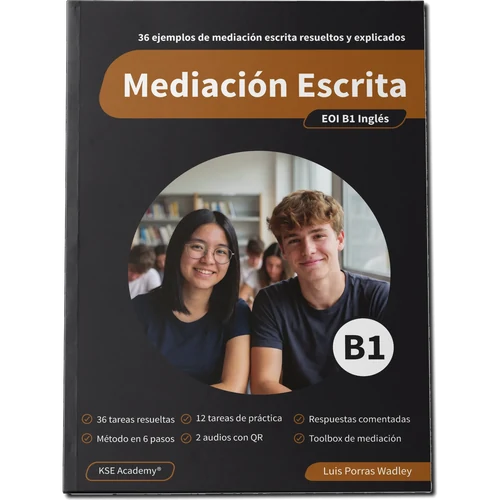
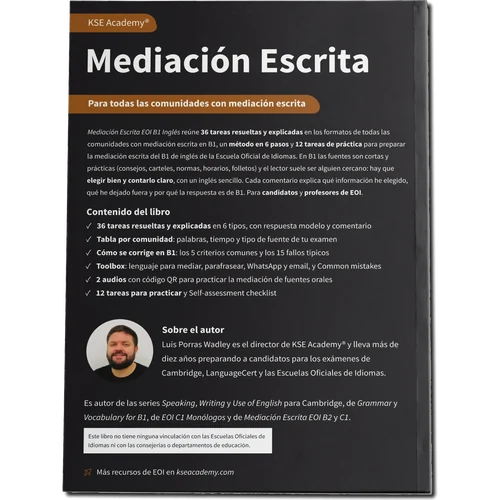
Four examples are enough to get the idea, but getting the knack takes more practice. That’s why I wrote Mediación Escrita EOI B1 Inglés. Inside there are 36 written mediation tasks, solved and explained, in every region’s format, with a step-by-step method and a toolbox of the language you need at B1. The explanations are in Spanish.
And if you’d rather I marked your mediation myself, there’s the B1 writing and written mediation correction gives you your mark against the EOI criteria and your text with comments.
Keep preparing for B1
- EOI B1: the five parts, how you pass and what changes in each region.
- EOI B1 Writing: the two tasks, word counts by region and six model answers.
- EOI B1 Speaking: the format in each region and five examples with transcripts.
Found this useful? Share it with anyone preparing for B1. And if you’d like more content like this, subscribe to my newsletter and follow me on Facebook, Twitter, Pinterest, Instagram and YouTube.
Good luck with mediation and, until next time, don’t forget to keep smiling! 🙂
