
Table of contents
For many people, spoken mediation in the EOI B1 exam is the strangest part of the test. It isn’t a monologue about yourself or a free conversation: you’re given a text, a few minutes to prepare, and you have to tell someone what they need to know. On top of that, every region does it differently.
Don’t worry, because at B1 it’s much simpler than it sounds. The texts are short and practical (a poster, a leaflet, an advert), you speak for a minute or two and the listener is usually a friend. What’s assessed is whether you choose well and explain it clearly, not whether you sound like a native speaker.
Here you’ll find what B1 spoken mediation looks like in each region, the task types, how it’s marked, what to do in the preparation time and four examples with transcripts and commentary, one of them in pairs. Let’s dive in! 🙂
If you’re looking for the other half of mediation, there’s my guide to B1 written mediation, and the whole exam is in my EOI B1 guide.
What is spoken mediation at B1?
It’s acting as a go-between, out loud. You read (or, in some regions, listen to) a text and tell someone who can’t understand it, adapted to what they need. Usually it’s a friend from abroad, a colleague or someone who has asked for your help, and sometimes you leave them a voice message.
It’s like the Speaking monologue in that you speak on your own, but the key thing changes: the content isn’t yours. You don’t talk about your experience or give your opinion; you pass on what the text says, filtered for your listener. And it isn’t reading it out in English either: if you translate sentence by sentence, you’ll run out of time and you won’t have mediated.
B1 spoken mediation in each region
I’ve gone through the B1 guides and specifications of every region. This is what they say:
| Region | Source | What you do | Preparation · speaking time |
|---|---|---|---|
| Andalusia | A document with options (language and length not published) | Choose what suits someone best and tell them; it’s part of your monologue turn | 20 min for all three speaking tasks · 2-2.5 min |
| Aragon | Spanish, about 250 words: infographic, graph, advert or leaflet | Explain it to a friend | 3 min (5 if you also prepare the monologue) · 2 min |
| Asturias | Spanish, up to 200 words, with images or photos | Two tasks: pass on the information and explain an underlined expression | 3 min · 2 min for both |
| Balearic Islands | No spoken mediation | Not applicable | Not applicable |
| Canary Islands | English, 110-130 words (an infographic in the sample test) | Voice message to a friend | 5 min · 2-3 min |
| Cantabria | A text in Spanish or English (300 words max.) or a 2-3 min recording or video | Voice message: summarise, explain or compare | About 10 min together with the dialogue · 2 min |
| Castile-La Mancha | Spanish, up to 120 words (an infographic in the example) | Tell a friend the most important points | Up to 3 min · 1:30-2 min |
| Castile and León | English or Spanish, your choice; up to 200 words | Voice message: summarise and pass on the key ideas | Up to 5 min · up to 3 min |
| Catalonia | English: a different advert for each candidate | In pairs: exchange the information and reach an agreement | Not published · about 5 min |
| Valencian Community | English: advert, poster, map or comparison table | Voice message: choose, recommend or give directions | Together with the rest of the speaking test · 1-1:30 min |
| Extremadura | No spoken mediation in English | Not applicable | Not applicable |
| Galicia | An advert or text for each candidate (in English in the sample test) | Each of you explains your card to the other and you sort out a situation together | 3 min together with the dialogue · 1-2 min |
| La Rioja | Spanish: infographic, web page, poster or advert | Explain it to a friend from abroad | 3 min · up to 2 min |
| Madrid | Spanish, 100-150 words, with graphs or images | Explain it to a friend from abroad, including cultural points | 3 min · 2-3 min |
| Murcia | Spanish, about 180 words (an article in the sample) | Explain the main points to a friend from abroad | 3 min · 2 min |
| Navarre | English: leaflet, infographic or poster; you choose between two topics | Explain it to your partner, who plays an English friend | 2 min · 2-3 min |
| Basque Country | A text of up to 175 words, 2 min of audio or an infographic (a poster in English in the sample test) | Tell a friend what matters | 5 min · 2 min |
What changes most
- The language of the text. It’s Spanish in Aragon, Asturias, Castile-La Mancha, La Rioja, Madrid and Murcia; English in the Canary Islands, Catalonia, the Valencian Community and Navarre. In Castile and León you choose before you see the task.
- Who you talk to. It’s nearly always a monologue for an imaginary friend, sometimes as a voice message. In Catalonia you talk with your partner until you agree on something, and in Galicia each of you explains your card to the other.
- The time. It ranges from a minute or a minute and a half in the Valencian Community to a maximum of 3 minutes in Castile and León.
- Asturias has no written mediation, only spoken, with two tasks: passing on the information and explaining an underlined expression.
- Andalusia puts it inside your monologue turn, and what it values most is choosing well and saying why.
- The Balearic Islands and Extremadura have no spoken mediation in English (both their mediation tasks are written), There’s no published format yet for Ceuta and Melilla.
Before you practise, look carefully at your row: preparing a one-minute voice message from an English advert isn’t the same as three minutes of explanation from a Spanish text.
Types of spoken mediation at B1
For all the differences, B1 spoken mediation tasks come down to a few types:
| Task type | Where it appears |
|---|---|
| Telling a friend from abroad what a Spanish text says | Aragon, Asturias, Castile-La Mancha, La Rioja, Madrid, Murcia; Cantabria and Castile and León if you choose Spanish |
| Passing on the tips or information in an English text to a friend, often in a voice message | Canary Islands, Castile and León, Navarre, Basque Country, Cantabria |
| Choosing the option that suits someone and recommending it | Andalusia, Valencian Community |
| Explaining an expression or a cultural detail | Asturias (task 2); Madrid always asks for cultural points |
| Exchanging information with your partner to decide something | Catalonia, Galicia |
How B1 spoken mediation is marked
Scales vary from region to region, but they all look at more or less the same things:
- Whether you pass on the information that matters: what’s useful to that person in that situation, without the rest.
- Whether you adapt it: to the listener (a friend, a colleague), to their situation and to what they already know.
- Whether you use your own words: rewording simply, without reading or translating the text sentence by sentence.
- Whether you’re easy to follow: organised speech, basic linkers and pronunciation that doesn’t make people guess.
- Whether your English suits B1: reasonable accuracy and enough vocabulary for the topic.
Notice that nobody asks for difficult vocabulary. At B1 a clear explanation in simple words is worth more than a brilliant sentence you can’t finish.
What to do in the preparation time
In most regions you get between two and five minutes to prepare. It isn’t much, so go in with a plan:
- Read the situation first, not the text. Who are you talking to? What do they need? What do they already know, or what can’t they do? That’s your filter.
- Underline only what’s useful to them. Three or four ideas are usually enough at B1.
- Note down key words in English, not sentences. If you write whole sentences, you’ll end up reading them, and it shows.
- Decide the order: what matters most to them first, then the practical details.
- Think about how you’ll explain the tricky bits: the word you can’t say or the cultural detail that doesn’t exist in their country.
- Prepare your first sentence. A good start calms the nerves.
Watch out: your notes are for glancing at, not for reading. In Asturias, reading your outline gets the task a zero.
Four B1 spoken mediation examples with transcripts
I’ve chosen four different formats: the two most frequent types and two formats specific to one region that are worth knowing. The tasks are my own, written for this page, and the transcripts are designed to pass B1: simple sentences, the odd natural filler and no B2 showing off.
Example 1: telling a friend from abroad about a Spanish poster (Madrid format)
This is the most common type: a source in Spanish about something practical and someone from abroad who needs it. That’s how it works in Madrid, Aragon, Asturias, Castile-La Mancha and La Rioja. I’ve done it in the Madrid format, which also wants you to add a cultural detail or two, the kind of thing someone from abroad wouldn’t know.
The task:
Your Welsh friend Gemma is staying with you in August. She loves looking at the night sky, but she doesn’t speak Spanish and she doesn’t have a car.
Explain to her what this poster says and anything she needs to know about life in Spain to enjoy the evening. Speak for 2-3 minutes.
Noche de las Estrellas en el Observatorio de Valdeluz (cartel ficticio)
El sábado 9 de agosto, coincidiendo con las Perseidas, el Observatorio Municipal abre sus puertas de 21:30 a 1:00.
- Charla para principiantes a las 22:00 (en español).
- Observación con telescopios a partir de las 23:00.
- Entrada gratuita. Es obligatorio reservar en la web a partir del 1 de agosto. Plazas limitadas.
- Autobús especial desde la plaza Mayor cada 30 minutos (2 €, solo efectivo). No hay aparcamiento en el observatorio.
- Traed ropa de abrigo: en la sierra la temperatura baja mucho por la noche.
- No se permiten linternas de luz blanca. Usad la luz roja del móvil.
Preparation: 3 minutes.
Transcript (223 words, about 2 minutes):
OK, Gemma, I've found something perfect for you! On Saturday the ninth of August, the observatory in Valdeluz is open at night, from half past nine until one in the morning. It's the night of the shooting stars. Here in Spain we call them "the tears of Saint Lawrence", because his day is the tenth of August.
It's free, but you have to book on their website, and you can only do it from the first of August, so we mustn't forget. There aren't many places.
There's a talk for beginners at ten, but it's in Spanish, so I think we can skip it and arrive at eleven for the telescopes. That's the best part anyway.
As you don't have a car, and you can't park there, we can take the special bus from the Plaza Mayor, the main square. There's one every half an hour and it costs two euros, but you can only pay in cash, so bring some coins.
Oh, and take a warm jumper. I know it's August, but it gets really cold in the mountains at night. And don't use a normal torch, because it isn't allowed. You can use the red light on your phone.
And don't worry about getting home late. In Spain, in summer, people stay out really late, so one o'clock is normal here!
What I kept and what I left out: Gemma has no car and doesn’t speak Spanish: that decides almost everything. The talk in Spanish goes (I tell her we’ll skip it), the bus and the cash stay, and so do the booking and the cold, because without them her plan falls apart. For the cultural part I pick two things that really help her: why they’re called «the tears of Saint Lawrence» and that coming home at one in summer is normal here.
Why it would pass:
- It starts with what interests her most: what it is, when and what time. The practical details come afterwards.
- It links each fact to her situation: As you don’t have a car…, it’s in Spanish, so…. That’s mediating, not reading the poster out in English.
- It warns her about what could go wrong: booking from 1 August, cash, the cold. Those are the facts that save her a bad night.
- The cultural part is short and useful, not a history lesson.
Why it’s B1: so, because, as, you have to, you can only and the odd Oh, and… to add something. If you can’t say «Perseids», shooting stars is enough.
Expressions to take away:
- I've found something perfect for you!
- Here in Spain we call them…
- As you don't have…, we can…
- Oh, and take…
- Don't worry about…
Example 2: a voice message recommending an option (Valencian Community format)
Choosing what suits someone and telling them comes up a lot at B1. In the Valencian Community it’s also a very short voice message, a minute to a minute and a half, based on a document in English. With so little time, what counts is getting straight to the point.
The task:
Your English friend Abigail wants to start dancing. She has never danced before, she works until 7 pm from Monday to Friday, she doesn’t have a partner and she can spend about €40 a month.
Look at the information and leave her a voice message recommending the best class for her. Speak for 1-1.5 minutes.
Studio Ritmo: new classes in January (fictional)
- Salsa for beginners: Tuesdays and Thursdays, 8-9 pm. €35 a month. No partner needed: we change partners in every class.
- Tango (intermediate): Mondays, 7-8.30 pm. €40 a month. Please come with a partner.
- Zumba: Monday to Friday, 9-10 am. €25 a month.
- Flamenco for beginners: Wednesdays, 6-7.30 pm. €45 a month. Flamenco shoes are required (€60 in our shop).
First class free. Bring water and comfortable shoes.
Preparation: not published (prepared together with the rest of the speaking test).
Transcript (148 words, about 1 minute):
Hi Abigail, it's me! I've just seen the new classes at Studio Ritmo, and I think salsa for beginners is the one for you.
It's on Tuesdays and Thursdays from eight to nine, so you can go after work with no problem. It costs thirty-five euros a month, so it's less than you wanted to spend. And you don't need a partner, because they change partners in every class. That's a good way to meet people, too!
The others aren't really for you. Tango is for people who can already dance, zumba is in the morning, and flamenco is on Wednesdays at six, when you're still at work. And with the special shoes, it's more than you want to spend.
Oh, and the first class is free, so you can try it and see. Just take some water and comfortable shoes. Let me know what you think. Bye!
What I kept and what I left out: Four classes and four requirements: a beginner, works until 7, no partner and about €40. Tango needs experience and a partner, zumba is in the morning and flamenco is at 6 and, with the shoes, far too expensive. That leaves salsa, which ticks every box. The recommendation comes in the first sentence and the others are ruled out in one go.
Why it would pass:
- It’s a voice message: a short hello, straight to the point and a goodbye. No long introductions.
- Every fact about salsa answers a requirement: time, price, partner.
- It rules out each option with one reason, in one sentence, without reading out the whole table.
- It ends with something practical: the free first class and what to bring.
Why it’s B1: I think… is the one for you, so, because and simple comparatives (less than). In a minute and a half there’s no room for more, and there’s no need.
Expressions to take away:
- Hi…, it's me!
- I think… is the one for you.
- …, so you can… with no problem.
- The others aren't really for you.
- Let me know what you think. Bye!
Example 3: passing on information and explaining an expression (Asturias format)
Asturias has a format of its own: with the same card you do two tasks in a row. First you pass on the information from a Spanish text, then you explain one of two underlined expressions in detail. It’s a very B1 way of asking you to explain something cultural.
The task:
Your German colleague Felix is working in your town until 20 December. He cooks at home, he doesn’t have a car and he works from 9 to 6, Monday to Friday. He wants to buy fresh food at the local market, but his Spanish is very basic, and he has found this notice.
Task 1: tell him the most important information for him. Task 2: explain one of the underlined expressions. Speak for about 2 minutes in total.
Mercado Central de Abastos: horario especial de diciembre (aviso ficticio)
Por el puente de la Inmaculada, el mercado permanecerá cerrado el día 8 de diciembre. El día 7 abriremos de forma excepcional, de 9:00 a 14:00.
Del 15 al 24 de diciembre ampliamos el horario: además de por la mañana (de 8:00 a 14:30), abriremos por la tarde, de 17:00 a 20:30, de lunes a sábado.
Recuerda: los encargos para la cena de Nochebuena (marisco, cordero, cochinillo) se hacen antes del 18 de diciembre en cada puesto.
Aparcamiento gratuito durante una hora con una compra mínima de 20 €.
Preparation: 3 minutes for both tasks.
Transcript (209 words, about 2 minutes):
Felix, I've read the notice from the market, and there are some changes in December that are important for you.
First, the market is closed on the eighth of December, so don't go that day. But on the seventh, if you're free, it's open in the morning, from nine to two, as a special opening.
The best news for you is that from the fifteenth, it's also open in the afternoon and evening, from five to half past eight, Monday to Saturday. In the mornings you're at the office, so now you can go after work. Perfect!
There's also some information about Christmas orders and parking, but you leave on the twentieth and you don't have a car, so you don't need to worry about that.
Now, the expression "puente". It means "bridge", but here it's a kind of long weekend. In December we have two holidays, on the sixth and the eighth. When a holiday is on a Tuesday or a Thursday, a lot of people also take the Monday or the Friday off, so they make a "bridge" to the weekend. Many people travel, the roads are really busy and some shops close. So if you want to visit another city that week, book your train early!
What I kept and what I left out: Felix works from 9 to 6, has no car and leaves on the 20th: that filters everything. What matters to him is the closure on the 8th, the special opening on the 7th and, above all, the afternoon opening from the 15th, which is when he can go. The Christmas Eve orders and parking don’t affect him, and I say so in one sentence so he knows he isn’t missing anything. For task 2 I pick «puente», because it’s more useful to him than Christmas Eve dinner: it explains why everything closes that day.
Why it would pass:
- It separates the two tasks with a clear sentence (Now, the expression…), so the examiners can see you’ve done both.
- It links the facts to his timetable: In the mornings you’re at the office, so now you can go after work.
- It explains the expression rather than translating it: «bridge» alone means nothing to him; the example of Tuesdays and Thursdays does.
- It ends with a practical tip that comes from the cultural explanation: book early if he travels that week.
Why it’s B1: It means…, a kind of…, When…, a lot of people… and so are all you need to explain an expression. No dictionary definition required.
Expressions to take away:
- I've read the notice, and there are some changes that are important for you.
- The best news for you is that…
- …, so you don't need to worry about that.
- Now, the expression…
- It means…, but here it's a kind of…
Example 4: exchanging information in pairs to reach an agreement (Catalonia format)
Catalonia is the only region where B1 spoken mediation is done in pairs: each candidate gets a different text in English, tells the other about it and together they have to decide something. It’s mediation and conversation at the same time.
The task:
You and your partner want to do a Saturday workshop together next month. Each of you has information about a different workshop.
Tell your partner about your workshop, listen to theirs and decide together which one to do. You have about 5 minutes.
Card A: First aid for everyone (fictional)
Saturday 14 March, 10 am to 2 pm. Community centre, Carrer Major. €20, including a certificate. Learn what to do if someone falls, cuts themselves or can’t breathe. Practical, with real situations. Maximum 12 people. Book online.
Card B: Bike repair for beginners (fictional)
Saturday 14 March, 11 am to 2 pm. Roda Bike Workshop, near the beach. €25, tools included. Learn to fix a flat tyre, adjust your brakes and clean your chain. No experience needed. Bring your own bike! Book by phone.
Preparation: not published.
Transcript (364 words, about 3 and a half minutes):
Jana: So, my workshop is about first aid. It's on Saturday the fourteenth of March, in the morning, from ten to two, at the community centre.
Pau: That's the same day as mine! What do you learn exactly?
Jana: Well, what to do if someone falls or cuts themselves, or if they can't breathe. It's very practical, with real situations. It costs twenty euros, and you get a certificate.
Pau: A certificate? That could be useful for a job.
Jana: Yes, I thought that too. But it's only for twelve people, so we'd have to book online soon. What about yours?
Pau: Mine's completely different. It's bike repair for beginners, on the same morning, from eleven to two, in a workshop near the beach. You learn to fix a flat tyre, adjust your brakes and clean the chain.
Jana: Oh, that sounds useful! How much is it?
Pau: Twenty-five euros, and they give you the tools. You don't need any experience, but you have to bring your own bike. And you book by phone, not online.
Jana: Bring my bike? To the beach? That's quite far from my flat.
Pau: Well, it's about twenty minutes by bike. And yours is at the community centre, right? That's in the centre, so it's easier to get to.
Jana: Hmm, my bike is in my parents' garage, but I could get it. So, which one do you prefer?
Pau: Honestly, I'd rather do the bike workshop. I ride to work every day, and I always have problems with my tyres!
Jana: I see what you mean, but I think first aid is more useful. You never know when you're going to need it. And you don't need to carry anything.
Pau: That's true, and the certificate is a good point. I'm looking for a summer job, and it could help me.
Jana: Exactly. And it's five euros cheaper. But they're at the same time, so we can't do both. What if we do first aid this time, and the bike one another time?
Pau: OK, that sounds fair. I'll phone the bike workshop and ask about their next date. And first aid on the fourteenth. Can you book it online tonight, before it gets full?
Jana: Sure, I'll do it this evening. Deal?
Pau: Deal!
What I kept and what I left out: Here each of you only sees your own card, so the first thing is to tell the other person what matters on yours: what, when, how much and any condition (places, bringing your bike). Then comes the negotiation. Notice that both give reasons, listen to each other and reach an agreement with a plan for the rest.
Why it would pass:
- Each of them mediates their own card, without reading it out: Pau doesn’t rattle off «Roda Bike Workshop, near the beach, €25, tools included», he tells it.
- They ask questions (What do you learn exactly? How much is it?): the interaction counts too.
- They give reasons and give way: Pau prefers the bike workshop, but agrees because of the certificate.
- They finish with a clear agreement and who does what.
Why it’s B1: What about yours?, That sounds useful, I see what you mean, but…, What if we…? and Deal?. Five phrases like these and the negotiation is done.
Expressions to take away:
- What about yours?
- Mine's completely different.
- I see what you mean, but…
- What if we…?
- OK, that sounds fair.
In the exam you have up to 5 minutes, so it’s fine if your conversation runs a bit longer than this one. What mustn’t be missing is the exchange of information from both cards and a final agreement.
Useful phrases for B1 spoken mediation
You don’t need many. These will get you out of trouble whatever the task:
| To… | What you can say |
|---|---|
| Starting | OK, so I’ve had a look at… / Right, let me tell you about… |
| Referring to the text | It says that… / According to the poster, … / There’s a bit about… |
| Adapting to the person | As you…, the best thing is… / For you, the important thing is… |
| Explaining something cultural | In Spain, people usually… / It’s similar to…, but… / We call it…, which means… |
| Buying time | Let me see… / What else? Oh yes, … |
| Correcting yourself | Sorry, I mean… / No, wait, it’s on Tuesday, not Thursday. |
| Finishing | So, that’s it. / I hope that helps! / Let me know if you have any questions. |
Common mistakes in B1 spoken mediation
- Reading the text out in English. Translating aloud sentence by sentence isn’t mediating, and you won’t have time anyway.
- Telling them everything. If the poster has eight facts and your friend needs three, the other five cost you time and clarity.
- Forgetting who’s listening. If the task says they have no car, parking doesn’t matter to them; the bus does.
- Giving your opinion when it isn’t asked for. Recommending an option when you’re asked to is fine; saying whether you find the text interesting isn’t.
- Freezing because of one word. If a word won’t come, go round it with other words and keep going.
- Finishing after 40 seconds. If you have lots of time left, you’ve left out something useful or not explained it properly.
B1 spoken mediation FAQ
Can I use written notes while I speak?
You can take notes while you prepare in almost every region, and in several you can look at them while you speak, but nowhere can you read them out. In Aragon reading the text or your notes loses marks, and in Asturias reading your outline gets the task a zero. The safe option is to practise with a few key words in front of you, never whole sentences.
What if the text is in Spanish?
That’s normal in many regions. Then the challenge is double: choosing the information and putting it into English without translating word for word. If a word has no easy translation, explain it: it’s a kind of…, it’s like…, but…
Will the examiners interrupt me?
Usually not, except to tell you time’s up. In Asturias, if you get stuck, the examiner may ask you a question to help you carry on. That said, in La Rioja, Aragon and the Basque Country keeping to the time is part of the mark, so practise with a timer.
How much is spoken mediation worth?
Of the five parts of the exam, mediation is worth 20 %, just like any other. Except where there’s only one of the two, that mark is split between written and spoken mediation, usually half and half. How you pass each part is in my EOI B1 guide.
How can I practise at home?
Find posters, leaflets and websites from your town (or your region’s official sample tests), set a timer for your preparation time and record yourself telling an imaginary friend. Then listen with one question in mind: would what I said be useful to that person?
Keep preparing for B1
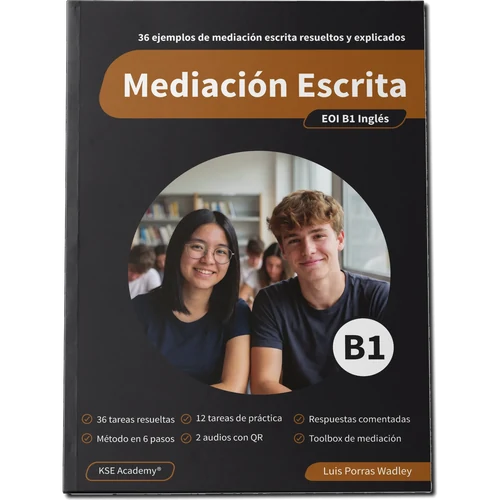
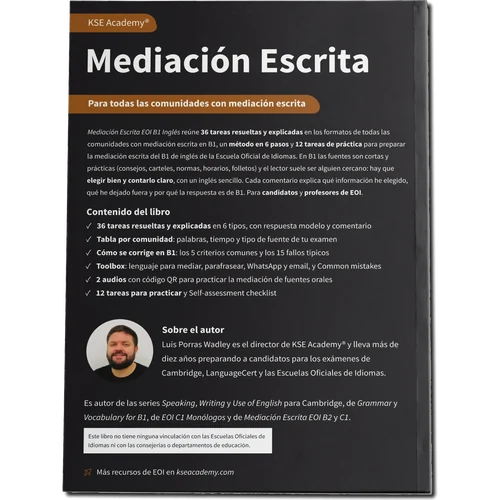
- B1 written mediation: words and time by region and four worked examples, plus my B1 written mediation book.
- EOI B1 Speaking: the monologue and dialogue by region and five examples with transcripts.
- EOI B1 Writing: six solved tasks, from emails to articles.
- EOI B1: what the parts are and what you need to pass.
Found this useful? Share it with anyone preparing for B1. And if you’d like more content like this, subscribe to my newsletter and follow me on Facebook, Twitter, Pinterest, Instagram and YouTube.
Good luck with mediation and, until next time, don’t forget to keep smiling! 🙂
