
Table of contents
For a lot of people, the EOI B1 (officially, Nivel Intermedio B1) is their first English certificate. Some need it to graduate, some for a job or a public-sector exam, and some just want a piece of paper that finally says what they can already do.
And nearly all of them turn up with the same question: «Is it hard?». Here’s the short answer: not if you know what’s coming. B1 isn’t looking for brilliant English, it’s looking for English that works. In this guide I’ll walk you through the exam, how it differs from B2, what changes depending on the region you sit it in and where to find the official sample papers. Grab a coffee and let’s get going 🙂
If you’d like the big picture first (what the EOI is, who can register as an external candidate, how you pass), the EOI English exam guide covers all of that.
What the EOI B1 certificate is good for
The certificate is issued by your region’s education department and it’s an official qualification recognised all over Spain. These are the most common reasons people take it:
- Finishing a degree. Many Spanish universities ask for a B1 in a foreign language before they’ll issue your degree, and the EOI certificate is one of the ones they accept. Check your university’s rules to be sure.
- Public-sector exams and job lists. In some calls it’s a requirement and in others it earns you extra points. Always read the rules of yours.
- Exchanges and grants. B1 is the minimum for many study-abroad programmes, although each university and destination sets its own conditions.
- A step towards B2. If you study at the school, passing B1 lets you move up a year. And if you prepare on your own, it gives you a very real idea of how far you are from B2.
One thing to keep in mind: the EOI B1 is not Cambridge B1 Preliminary. Both certify the same level of the Common European Framework, but they’re different exams with different formats. If you’re torn between the two, I explain the differences in Cambridge vs EOI.
What you need to be able to do in English at B1
B1 is the level of the independent user: you no longer need people to speak slowly and in textbook sentences for you to follow. In practice, with a B1 you can:
- Understand the gist of a simple article, an email, a leaflet or a conversation about everyday topics, even if the odd word escapes you.
- Tell someone about something that happened to you, describe your plans and explain why you prefer one thing to another.
- Write a clear email or message to a friend or a company, with paragraphs and basic linking words.
- Hold your own in a conversation: suggest, accept, turn down and reach an agreement.
- Pass on information from a text to someone else in your own words, which is exactly what mediation assesses.
Nobody expects perfect accuracy. A B1 examiner will put up with mistakes as long as they don’t get in the way of understanding. Having said that, if every past tense goes missing or every text is a single ten-line sentence, it does count against you.
The B1 exam at a glance
The structure is the one set by the national decree for every level from B1 upwards: five parts of equal value, 20 % each. What changes from region to region is the timing, the word counts and the task types. This is what’s typical at B1:
| Part | What you get at B1 | Usually |
|---|---|---|
| Reading (comprensión de textos escritos) | Three or four tasks: matching headings to paragraphs, choosing the right answer, putting sentences back into a text or filling gaps with words from a list. | About 25 items; 45 to 60 minutes. |
| Listening (comprensión de textos orales) | Three tasks with short recordings: announcements, conversations, interviews or short talks. | About 25 items; you nearly always hear each recording twice. |
| Writing (producción y coproducción escrita) | Two texts: a reply (an email, a message, a forum post) and a piece of your own (a blog post, a story, a simple article). | Between 200 and 280 words in total. |
| Speaking (producción y coproducción oral) | You talk on your own about a topic, then chat with another candidate to sort out a situation. | Monologue of 2 to 3 minutes; dialogue of 3 to 5. |
| Mediation | Passing on to someone else what a poster, a leaflet, an advert or a short text says, in writing and out loud. | Short, practical texts; often you have to pick the best option for someone. |
The pass mark works like this: at least 50 % in every part and a 65 % average. Both at once: a top mark in Reading won’t rescue a failed Speaking. In most regions, if you pass some parts in June, in September you only retake the ones you failed.
B1 vs B2: what goes down and what stays the same
People who’ve already seen a B2 paper often ask me if B1 is «the same, only shorter». Well, partly, yes. I’ve compared the specifications of all 17 regions and this is the summary:
| B1 | B2 | |
|---|---|---|
| Structure and pass mark | The same: five parts worth 20 % each, 50 % in each one and a 65 % average. | |
| Writing | 200-280 words in total, personal and informal texts | About 300-350 words, with more formal and opinion texts |
| Monologue | 2-3 minutes | 3-4 minutes |
| Reading and Listening | About 25 items per part, reading texts of about 1,000-1,400 words in total | About 25 items per part, reading texts of 1,500-2,000 words |
| Reading task types | More matching, true or false and gaps with a word list | More multiple choice on long texts |
| Mediation | Shorter source texts; lots of «choose and recommend» tasks | Longer source texts; more summarising and explaining |
The practical takeaway: B1 is shorter and closer to everyday life, but it isn’t «easier to pass» if you walk in unprepared. The 50 % rule for each part is exactly the same, and that’s what catches most people out.
The EOI B1 region by region
This is the part you won’t find in many places. I’ve gone through the official B1 documents of each region (specifications, guides and calls for 2025-26 or 2026-27) and picked out the figures that will shape the way you prepare:
| Region | Writing (total words) | Monologue | Spoken mediation: source text |
|---|---|---|---|
| Andalusia | 225-275 | Not published | Not published |
| Aragon | 220-260 | About 2 min | In Spanish |
| Asturias | 230-270 | Max. 2:30 min | In Spanish (no written mediation) |
| Balearic Islands | 210-250 | 2-3 min | No spoken mediation |
| Canary Islands | 220-270 | 3 min | In English |
| Cantabria | 200-300 | 2-2:30 min | In Spanish or English |
| Castilla-La Mancha | 170-190 | 2:30-3 min | In Spanish |
| Castilla y León | Max. 250 | Max. 3 min | Your choice: English or Spanish |
| Catalonia | About 250 | Photo and personal experience | In English, in pairs |
| Valencian Community | 200-250 | 2-2:30 min | In English |
| Extremadura | 200-250 | 3-3:30 min | No spoken mediation in English |
| Galicia | 220-280 | 2-3 min | Not specified (the sample is in English) |
| La Rioja | 250 | 2:30-3 min | In Spanish |
| Madrid | 230-270 | 2-3 min | In Spanish |
| Murcia | 200-250 | About 3 min | In Spanish |
| Navarre | 210-250 | 3-4 min | In English |
| Basque Country | 220-260 | 3 min | Not specified |
Three things in this table caught my eye, and they’re worth bearing in mind:
- Spoken mediation varies wildly. In some regions you read a text in Spanish and explain it in English, in others it’s all in English, in Castilla y León you choose, and in the Balearic Islands and Extremadura there isn’t one at all. Practising the wrong format is wasted time, so check your region’s row carefully.
- In Asturias you hear each recording three times, when almost everywhere else it’s twice (Cantabria lets each task say whether it’s two or three). Lovely, yes, but don’t get complacent: the questions are written with that in mind.
- Catalonia does the B1 speaking test in pairs (at B2, in groups of three), and its spoken mediation is a conversation with your partner to reach an agreement, not a monologue.
Ceuta and Melilla depend on the Ministry and share one exam, but at the moment they publish no B1 specifications or sample papers, so I couldn’t include them.
Where to find the official B1 sample papers
The million-dollar question: «Where can I find EOI papers with the answers?». On each region’s official website, with answer keys and, nearly always, the audio. Here’s the direct link for each one, so you don’t have to battle with the education departments’ search boxes (we all know what they’re like 😅):
| Region | Latest B1 sample | Where to find it |
|---|---|---|
| Andalusia | 2026 (and earlier, from 2020) | Junta de Andalucía |
| Aragon | 2026 | EOIs de Aragón |
| Asturias | 2025 | Educastur |
| Balearic Islands | 2026 sample | EOI de Balears |
| Canary Islands | 2024/25 | Gobierno de Canarias |
| Cantabria | 2021 | Educantabria |
| Castilla-La Mancha | 2026 (Reading and Listening) | Educación Castilla-La Mancha |
| Castilla y León | 2022 | Portal de Educación de la Junta |
| Catalonia | Undated sample | Generalitat de Catalunya |
| Valencian Community | Two undated samples | EOI GVA |
| Extremadura | Samples from 2021 to 2024 | Educarex |
| Galicia | 2020 | Xunta de Galicia |
| La Rioja | 2025 (and 2023-2024) | EOI de Haro |
| Madrid | 2026 | Comunidad de Madrid |
| Murcia | 2026 | Región de Murcia |
| Navarre | Undated sample | Educación Navarra |
| Basque Country | Undated sample | Euskadi.eus |
My advice: start with your own region’s papers, but don’t stop there. Reading and Listening tasks from other regions are just as useful for practice, because the task types come up again and again. Where you really should stick to your region is Writing, Speaking and mediation, because that’s where the timing, the word counts and even the language of the source text change.
What you won’t find on almost any official site is model answers for Writing. You get the task, but not an example of a text that would pass. That’s what the B1 Writing guide in this section will be for.
A 12-week plan to prepare for B1 on your own
If you’re starting from a strong A2 or a «rusty» B1, three well-used months can take you a long way. This is how I’d organise it for a student who told me they had 5 or 6 hours a week:
| Weeks | What to focus on |
|---|---|
| 1-2 | Do a full sample paper from your region, timed and without a dictionary. It isn’t about the mark, it’s about knowing where you’re starting from. Write down which part was hardest. |
| 3-6 | A bit of B1 grammar and vocabulary every day (verb tenses, comparatives, basic conditionals, linking words) and one Reading or Listening task a day. Start writing one text a week. |
| 7-9 | Go all in on production: two texts a week at your region’s word count, and 2-3 minute monologues recorded on your phone. Yes, listening to yourself is cringeworthy. Do it anyway. |
| 10-11 | Mediation: practise with posters, leaflets and adverts, in writing and out loud, in your region’s format. Find a partner to rehearse the dialogue with. |
| 12 | Another full paper under exam conditions and a review of your most frequent mistakes. No new material in the last week. |
The mistakes I see most in B1 candidates
I’ve spent many years marking B1 texts and listening to B1 monologues, and some things come up year after year:
- Only practising what you enjoy. Lots of Reading and Listening, which feels comfortable, and very little Speaking, which feels awkward. And the marks missing for that 50 % are usually right there.
- Writing too little (or too much). In some regions going outside the word count costs you a specific penalty, and in others a text that’s too short can score zero. Always count your words when you practise.
- Memorising whole monologues. Examiners spot it within ten seconds, and the moment they ask you a question your mind goes blank. Memorise structures and expressions, not texts.
- Translating the mediation word for word. Mediating isn’t translating. It’s choosing what matters to the person in front of you and telling them in your own words.
- Forgetting about the other person in the dialogue. The interaction also assesses how you react to what your partner says. If each of you just delivers your bit and waits, that isn’t a conversation.
Materials for the EOI B1
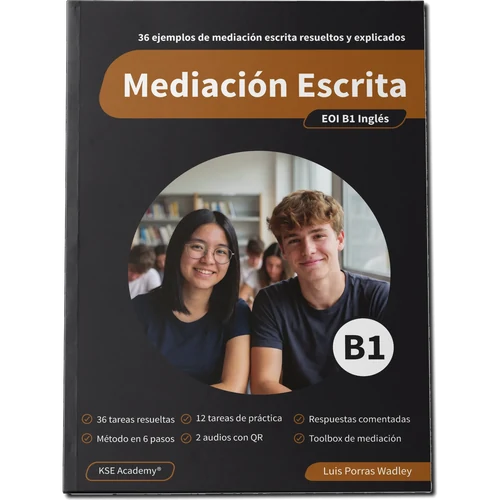
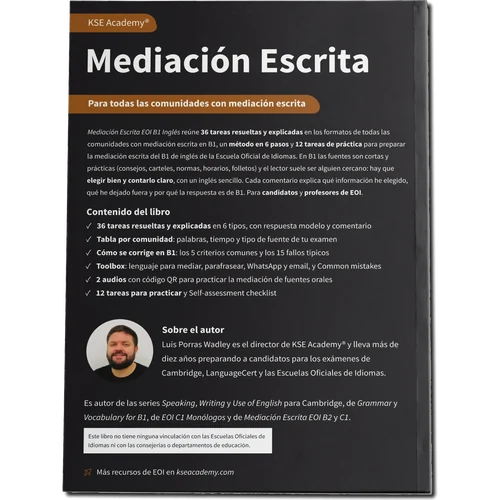
For written mediation there’s my book EOI B1 English Written Mediation, designed for every region with written mediation at B1. At this level the source texts are short and practical (tips, posters, rules, timetables), and the book is organised around exactly those task types:
- 36 worked tasks in six units, each with a commentary explaining what information I chose, what I left out and why the answer is B1.
- A 6-step method that works for any task.
- 12 more tasks for you to practise on your own.
And if what you need is someone to tell you what’s going wrong in your writing, there’s the EOI B1 Writing and mediation correction: send me one or three tasks and, within three days at most, you get your mark against the EOI criteria in a PDF report and your text annotated in Google Docs.
EOI B1 FAQs
How old do I have to be to take B1 as an external candidate?
In nearly every region, you must turn 16 in the year of the exam. Some lower the age if the language isn’t the first foreign language you study at secondary school, but with English that hardly ever happens. Catalonia is the exception: you can sit it from 15 if you’ve passed 2.º de ESO. Several regions also run their own B1 calls for students in 4.º de ESO or bilingual programmes.
When is the B1 exam?
The main session falls between late May and mid-June, depending on the region, and the resit is nearly always in early September. There are some odd exceptions: in Catalonia the resit for external candidates is in February, and in Murcia external candidates only have the June session. The speaking test is usually on a different day.
Is the EOI B1 easier than Cambridge’s?
Neither easier nor harder: they’re the same level, but you pass them differently. The EOI makes you reach 50 % in every part separately and includes mediation; at Cambridge, strong skills can make up for weaker ones. If you’re great at Reading and Listening but shaky at Speaking, that matters quite a lot.
Can I practise with papers from another region?
For Reading and Listening, yes, absolutely. For the rest, use them carefully: the word count, the length of the monologue and, above all, the spoken mediation format all change. Check the table above before you start practising with a paper that isn’t yours.
Did you find this guide useful? Pass it on to whoever is preparing for B1 with you. And if you want more content like this, subscribe to my newsletter and follow me on Facebook, Twitter, Pinterest, Instagram and YouTube.
Good luck with your B1 and, until next time, don’t forget to keep smiling! 🙂
