
Table of contents
Here’s a marker’s secret: when I open a B1 piece of writing, the first thing I look at isn’t the grammar. I check whether the person has done what they were asked to do. Have they answered their friend’s three questions? Have they written an email and not an essay? Have they kept to the word count? If the answer is yes, that text is already halfway to a pass.
So this guide gets straight to the point. I explain what EOI B1 Writing is like, how many words each region asks for, which texts tend to come up and how they’re marked. Above all, there are six worked examples, each with the task and an answer written for a genuine B1: not a borderline A2 and not a B2 in disguise. Right, pen at the ready 🙂
For an overview of the whole exam, head to the EOI B1 guide.
What a B1 text is expected to be
A B1 text has to be clear, well organised and accurate enough to be understood without effort. Nobody’s asking you to impress anyone. The regions’ marking scales put it in different words, but it boils down to this:
- You do the task: you cover every point, for the reader you’re given, in the text type you’re asked for.
- The text has a structure: a greeting and a sign-off if it’s an email, paragraphs, and simple linkers (and, but, because, so, first, then, in the end).
- You handle the basic tenses well: present, past simple and continuous, present perfect, future with will and going to, and the most common modals.
- Your vocabulary covers everyday topics: travel, work, studies, free time, shopping, health, home…
Mistakes are fine as long as the reader can still follow the message. That said, a slip with a preposition is one thing; forgetting the past tense in a text about something that happened yesterday is quite another.
The two B1 Writing tasks
In practically every region you write two texts:
- An interaction task (coproducción), where you reply to someone: nearly always an email or a message, and in most official papers an informal one (to a friend or a relative). Formal or semi-formal ones are less common: a complaint, an enquiry to a school or a reply to an advert.
- A production task (producción), where you write a text of your own: a blog post, a short story or a personal experience, or a simple article for a magazine or a website. Pure opinion writing, the queen of B2, only turns up now and then at B1.
Andalusia has one quirk: the interaction task includes the written mediation, so that email is marked twice, once as writing and once as mediation.
Word counts and timing for B1 Writing in each region
The norm is between 200 and 280 words across the two tasks, but the split varies quite a lot. Check your region’s row before you start practising, because a 50-word email is a very different thing from a 120-word one:
| Region | Interaction task (words) | Production task (words) | Time | Choice of task? |
|---|---|---|---|---|
| Andalusia | 100-125 | 125-150 | 60 min | Not stated |
| Aragon | 100-140 | 120-160 | 60 min | Not stated |
| Asturias | 100-120 | 130-150 | 75 min | Not stated |
| Balearic Islands | 80-100 | 130-150 | 60 min | Yes, in the production task |
| Canary Islands | 90-110 | 130-160 | 75 min | Not stated |
| Cantabria | 200-300 in total | 70 min | Not stated | |
| Castilla-La Mancha | 50-60 | 120-130 | 45 min | Yes, in the production task |
| Castilla y León | max. 250 in total | 60 min | No | |
| Catalonia | about 125 | about 125 | 75 min | No |
| Valencian Community | 80-100 | 120-150 | 80 min | Yes, in the production task |
| Extremadura | 200-250 in total | 60 min | No | |
| Galicia | 100-130 | 120-150 | 70 min | Not stated |
| La Rioja | 250 in total | 70 min | Not stated | |
| Madrid | 100-120 | 130-150 | 60 min | Yes, in the production task |
| Murcia | 100-125 | 100-125 | 60 min | Not stated |
| Navarre | 80-100 | 130-150 | 60 min | Not stated |
| Basque Country | 60-80 | 160-180 | 70 min | Not stated |
Figures from the official specifications and guides for 2025-26 and 2026-27. Where a region only gives the total, that’s what I show, and for Catalonia and La Rioja the figures come from their sample papers.
Does the word count really matter?
More than people think. In the Valencian Community there’s a 10 % margin either way, and outside it you lose marks. In Extremadura, if you’re 25 % or more away from the target, that task scores zero; and Asturias does the same when you write less than half of what’s required. Everywhere else, length is part of the mark for «task achievement» or «communicative effectiveness». Bottom line: always practise with your region’s word count, and count.
Six worked B1 Writing examples
These are the six text types that come up most in the official B1 papers. The tasks are original, with the usual format and length (100-120 words for the interaction task and 130-150 for the production task, which is the most common; adjust it to your region). The answers are deliberately written at B1 level: simple, accurate and complete.
Informal email: replying to a friend
This is the most common B1 task: it appears in the sample papers of thirteen regions. A friend writes to you with questions or some news, and you reply. It looks easy, and it is, as long as you answer everything they ask.
The task:
You have received this email from your English friend Sam. Write a reply. In your email, answer all Sam’s questions.
Hi!
Great news: I’m coming to your town for a long weekend next month! Where do you think I should stay? What can we do together? Oh, and what’s the weather usually like at that time of year?
Write soon!
Sam
Write between 100 and 120 words.
Model answer: (111 words)
Hi Sam,
That's fantastic news! I'm so happy you're coming.
You don't need to look for a hotel, because you can stay at my flat. It isn't very big, but the sofa bed is really comfortable and my flat is very close to the old town.
There are lots of things we can do together. On Saturday morning we could go to the market and try some local food, and in the afternoon I'd love to take you on a boat trip on the river.
Next month it's usually warm during the day, but it gets cold at night, so bring a jacket.
I can't wait to see you!
Love,
Marta
Why it works at B1:
- It answers all three of Sam’s questions, one per paragraph and in the same order: where to stay, what to do and what the weather is like. In the interaction task, leaving a question unanswered costs you more marks than anything else.
- A natural, informal register: contractions (I’m, it’s, can’t), exclamations and a friendly sign-off (Love,).
- B1 structures used well: could to suggest plans, I’d love to, because and so for reasons and results.
- Why it isn’t B2: there are no complex structures or unusual words, and there don’t need to be. A clear, accurate text like this scores very well at B1.
Phrases you can take away:
- That's fantastic news!
- You don't need to…, because…
- It isn't very big, but…
- There are lots of things we can do together.
- We could…
- I'd love to take you…
- It gets cold at night, so bring a jacket.
- I can't wait to see you!
Blog post: telling an experience
The favourite production task in Andalusia (five of its last six papers) and a regular in other regions. You’re writing for readers you don’t know, but in a personal tone, as if you were telling a friend.
The task:
You write a blog about your everyday life. Write a post about a day that did not go as you had planned. Say:
- what you had planned to do
- what went wrong
- how the day ended.
Write between 130 and 150 words.
Model answer: (147 words)
The picnic that never happened
Last Sunday was supposed to be a perfect day. My friends and I had planned a picnic by the lake, and I got up early to make sandwiches and a big chocolate cake.
Everything started to go wrong on the way there. First, we got lost because my phone's battery died and nobody remembered the way. Then, just when we finally found the lake, it started to rain. And it wasn't just a bit of rain. It was a storm! We ran back to the car, completely wet, with the food in our arms.
In the end, we went back to my flat, put on dry clothes and had our picnic on the living room floor. We played cards and laughed all afternoon. It wasn't the day we had expected, but it was one of the best days I've had this year.
Why it works at B1:
- It follows the three points of the task in three paragraphs: the plan, what went wrong and how the day ended.
- Past tenses combined well: past simple for the events, had planned for what was arranged earlier, and was supposed to be, which works really well at B1.
- Sequencing linkers that keep the story in order: First, Then, just when, In the end.
- A blog tone: friendly, with an exclamation and a personal comment at the end (one of the best days I’ve had this year), which also uses the present perfect correctly.
Phrases you can take away:
- … was supposed to be a perfect day.
- We had planned…
- Everything started to go wrong…
- just when we finally…
- And it wasn't just a bit of rain. It was a storm!
- In the end, we…
- It wasn't the day we had expected, but…
- one of the best days I've had this year
Story from a given sentence
Narrating is one of the B1 objectives, and several regions ask for it directly: Catalonia, Castilla y León and Galicia, among others. Sometimes you get the first sentence and sometimes just the topic. What matters is telling the story in order and using past tenses well.
The task:
A website for learners of English is looking for short stories. Your story must begin with this sentence:
It was the first time I had travelled alone.
Write between 130 and 150 words.
Model answer: (136 words)
It was the first time I had travelled alone. I was nineteen and I was flying to London to visit my cousin. I was so nervous that I checked my passport about twenty times on the way to the airport.
The flight was fine, but when I arrived, my cousin wasn't there. I waited for an hour and called her, but she didn't answer. I started to panic. An old woman who was sitting next to me saw that I was worried and asked me if I needed help. She helped me find my cousin's address and showed me which train to take.
When I finally got to my cousin's house, she opened the door and said, "But you're coming tomorrow!" She had written the wrong date in her diary. Now we always laugh about it.
Why it works at B1:
- It begins with the exact sentence in the task, without changing a word. If you don’t, you haven’t done the task.
- A simple story with a problem and a twist at the end: you don’t need anything spectacular, just events told in order.
- Past simple and past continuous for the events and the background (who was sitting next to me), and a past perfect at the end to explain the misunderstanding (She had written the wrong date).
- Direct speech at the key moment, and so… that for emphasis. These are B1 tools that bring the text to life without making it complicated.
Phrases you can take away:
- I was so nervous that…
- The flight was fine, but when I arrived…
- I started to panic.
- … saw that I was worried and asked me if I needed help.
- When I finally got to…
- She had written the wrong date.
- Now we always laugh about it.
Formal email of complaint
Formal writing comes up less at B1 than at B2, but it does come up: Asturias, for example, set a complaint to an online shop in its 2025 paper. Nobody expects office English here, just a clear, polite email with no contractions.
The task:
Two weeks ago you bought something from an online shop, but there was a problem with your order. Write an email to the shop. Say:
- what you bought and when
- what the problem is
- what you want the shop to do.
SoundUp Store
Order 48213
Wireless headphones, black: £59.99
Free delivery in 3 days
Write between 100 and 120 words.
Model answer: (112 words)
Dear Sir or Madam,
I am writing to complain about an order I made on your website on 3 May (order number 48213).
I bought a pair of black wireless headphones for £59.99. Your website said that delivery would take three days, but the parcel arrived eleven days later. Also, the headphones are white, not black, and the left side does not work.
I am very disappointed because they were a birthday present for my brother.
I would like you to send me a new pair in the right colour as soon as possible or give me a full refund.
I look forward to hearing from you.
Yours faithfully,
Daniel Ortega
Why it works at B1:
- A simple formal register: Dear Sir or Madam, no contractions and Yours faithfully at the end, because the writer doesn’t know the person’s name.
- One paragraph for each point: what was bought and when, what the problem is (three of them here: the delay, the colour and the side that doesn’t work) and what the shop should do.
- Specific details from the task (order number, price, delivery time), in the writer’s own words.
- A clear request: I would like you to…, with two options. At B1 nobody expects more diplomacy than this; polite and direct is enough.
Phrases you can take away:
- I am writing to complain about…
- Your website said that…
- but the parcel arrived eleven days later
- Also, …
- I am very disappointed because…
- I would like you to… or…
- as soon as possible
- I look forward to hearing from you.
Email asking for information
Replying to an advert to ask for information is another typical task (Madrid and Murcia both set one in 2026). It’s a semi-formal email: polite, with indirect questions, but without the complicated phrases of an official letter.
The task:
You have seen this advertisement and you want to do the course. Write an email to the school to ask for more information. Ask about:
- the dates and times of the classes
- accommodation
- prices.
Cook like a local in Cornwall!
Two-week summer cooking courses for adults. Small groups and friendly teachers. Accommodation available.
For more information, write to Jenny Holt, course coordinator.
Write between 100 and 120 words.
Model answer: (112 words)
Dear Ms Holt,
I saw your advertisement for summer cooking courses and I am very interested in doing one. I would be grateful if you could send me some more information.
Firstly, could you tell me the dates of the courses in July? I can only travel in the summer holidays. I would also like to know if the classes are in the morning or in the afternoon.
Secondly, could you tell me where students stay? Is it with a family or in a hotel?
Finally, how much does the course cost, and is the accommodation included in the price?
Thank you in advance for your help.
Yours sincerely,
Laura Méndez
Why it works at B1:
- It says why the writer is writing in the first sentence: they’ve seen the advert and want more information.
- Polite, indirect questions, typical of a semi-formal email: I would be grateful if you could…, could you tell me…?, I would also like to know if…
- The three things in the task, in order, with simple linkers (Firstly, Secondly, Finally), so the coordinator can find each question straight away.
- Matching greeting and sign-off: Dear Ms Holt with Yours sincerely, because the writer knows the name.
Phrases you can take away:
- I saw your advertisement for… and I am very interested in…
- I would be grateful if you could send me some more information.
- Firstly, could you tell me…?
- I would also like to know if…
- Secondly, …
- Finally, how much does… cost?
- Thank you in advance for your help.
Simple magazine article
A B1 article isn’t the opinion piece you get at B2: it’s usually a description or a recommendation for a school magazine or a website. The idea is to make readers want to keep reading, so a good title and a good opening go a long way.
The task:
An international magazine for students has asked its readers to send in articles with the title below. Write your article. Say:
- where the place is
- what people can do there
- why you recommend it.
A place in my town that visitors shouldn’t miss
Write between 130 and 150 words.
Model answer: (131 words)
A place in my town that visitors shouldn't miss
If you ever visit my town, there is one place you must see: the old market. It is in the centre, just behind the main square, and it opens every day except Sunday.
The building is more than a hundred years old and it is really beautiful, with big windows and a glass roof. Inside, there are about fifty stalls that sell fruit, fish, cheese and bread. Upstairs, there are some small cafés where you can have lunch for a very good price.
I recommend it because it is the best way to see how local people live. Go early in the morning, when the market is full of noise and colour, and try the fried fish. You won't be disappointed!
Why it works at B1:
- A title and an opening that hook the reader: it speaks directly to them (If you ever visit my town…) and says straight away which place it’s about.
- The three points of the task, one per paragraph: where it is, what people can do there and why the writer recommends it.
- Simple but varied description: there is / there are, relative clauses (stalls that sell…, cafés where you can…) and concrete adjectives.
- An ending with advice in the imperative (Go early, try the fried fish) and a line that rounds the text off nicely.
Phrases you can take away:
- If you ever visit…, there is one place you must see:
- It is in the centre, just behind…
- It is more than a hundred years old.
- stalls that sell…
- cafés where you can have lunch for a very good price
- I recommend it because…
- It is the best way to see how local people live.
- You won't be disappointed!
How B1 Writing is marked
The marking scale is different in every region, with four or five criteria under different names, but they all assess the same things. Here’s what each one means in a B1 text:
| What’s assessed | What it means in practice |
|---|---|
| Task achievement (communicative effectiveness, appropriacy) | You cover every point, in the right register and at the right length. If you don’t do the task, in several regions the mark is 0. |
| Organisation (coherence and cohesion) | Each idea in its own paragraph, in a logical order, with simple but varied linkers. A text in one single paragraph loses a lot. |
| Range (richness or repertoire) | Some variety: not repeating very, nice and good in every sentence, mixing simple sentences with the odd relative clause or because, when, if. |
| Accuracy (grammar, vocabulary, spelling) | Mistakes are tolerated if they don’t make the text hard to follow. The ones that weigh most at B1: verb tenses, word order and the third person singular. |
An interesting detail: in the Basque Country the second task is worth three times as much as the first (15 points against 5), so that’s where most of your time should go.
How to split your time
With 60 minutes for both tasks, which is the most common, this is how I’d do it:
| Minutes | What you do |
|---|---|
| 0-5 | Read both tasks, underline the points you have to cover and decide the register for each text. |
| 5-10 | A quick plan for each: what goes in each paragraph. Two minutes of planning saves you ten of crossing out. |
| 10-50 | Write. Start with the one you find easier, to get into your stride, and give a bit more time to the longer one. |
| 50-60 | Check: the points in the task (are they all there?), verbs, third person, capital letters and the word count. |
If your region gives you 70, 75 or 80 minutes, the plan is the same: you just have a bit more time to check, and that’s gold.
Five things a B1 marker appreciates
- Visible paragraphs. Leave a blank line between them. It sounds silly, but a well-presented text gets read more kindly.
- A register that doesn’t change halfway through. If you start with Dear Sir or Madam, no Hugs! at the end. And the other way round: you don’t write I look forward to hearing from you to a friend.
- Short, clear sentences. At B1 you lose more marks with endless sentences that get tangled than with simple ones.
- Not copying the task. Reusing the odd word is fine, but whole sentences lifted from the instructions don’t count as your own.
- Legible handwriting. If the marker can’t read a word, it counts as misspelt. Simple as that.
B1 Writing correction
Reading examples helps, but what really makes you improve is knowing what’s going wrong in your texts. With the EOI B1 Writing correction, you send me one or three tasks (production or written mediation) and I send them back marked against the EOI criteria, with your mark and comments on what you do well and what you should change.
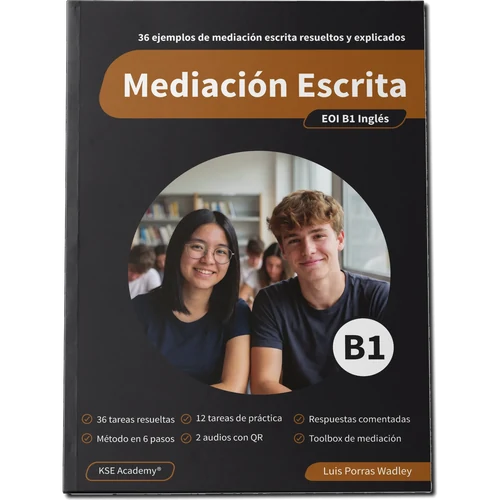
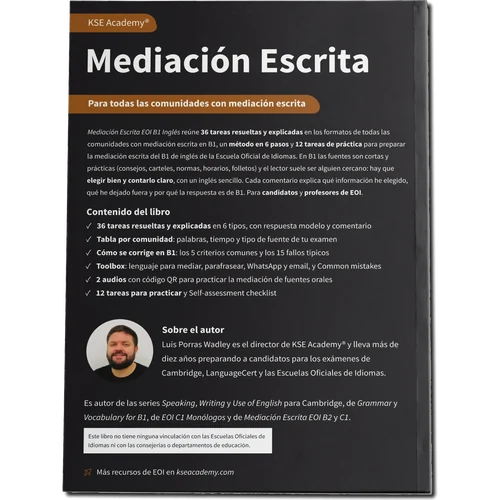
And since written mediation is done in the same session, have a look at my book EOI B1 English Written Mediation too, with 36 worked tasks designed for every region.
Was this useful? Share it with whoever is preparing for B1. And if you want more content like this, subscribe to my newsletter and follow me on Facebook, Twitter, Pinterest, Instagram and YouTube.
Happy writing and, until next time, don’t forget to keep smiling! 🙂
