
Table of contents
Every June I see the same thing: people who read well, write well and follow the recordings, but who turn up to the B1 speaking test convinced their mind is going to go blank. It hardly ever happens. EOI B1 Speaking isn’t a test where you have to show off: it’s a conversation with very clear rules, and if you know them, you’ve done half the work already.
In this guide I explain what the B1 speaking test is like (officially, producción y coproducción de textos orales), how it varies from one region to another, which topics have come up in the official sample papers and how it’s marked. And there are five complete examples with transcripts: three monologues and two dialogues at the real level of someone who passes B1, not a native speaker. At the end there’s a section for teachers who want to run a mock test in class. Let’s get started 🙂
If you haven’t seen the whole exam yet, start with my EOI B1 guide.
What a B1 speaker has to show
B1 is the level where you can manage on your own. When you speak, the examiners want to see that you can:
- Talk about your life and everyday topics (home, work, studies, travel, free time, health, shopping) for two or three minutes without losing the thread.
- Describe and narrate: a place, a person, something that happened to you, a plan you have.
- Give your opinion with a simple reason (I think… because…) and compare two options.
- Hold a conversation with someone else: suggest, ask, agree or disagree and reach a decision.
And here’s the reassuring part: mistakes are accepted as long as people can still understand you. There’ll be pauses, the odd word that won’t come and sentences you rephrase halfway through. That’s what B1 sounds like. What really costs you is going silent, not answering what the card asks or talking without listening to your partner.
What EOI B1 Speaking looks like
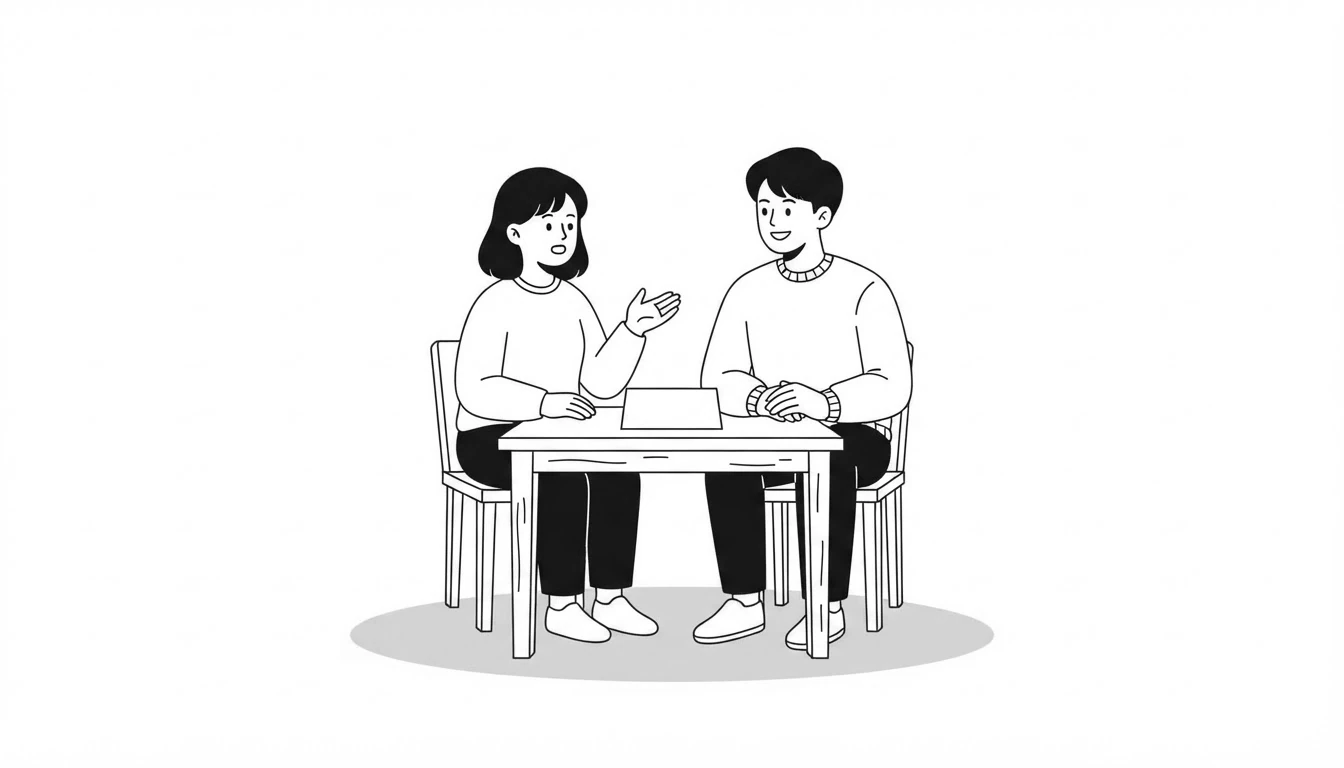
The speaking test takes place in a separate session from the written papers, usually on another day. You’re assessed in pairs (three at a time when the numbers don’t work out) in front of a panel of examiners, and there are two tasks:
- Monologue (production): you talk without interruption about the topic on the card, usually for 2 to 3 minutes. Beforehand you get some time to prepare, nearly always with notes.
- Interaction (coproduction): you talk with your partner for 3 to 5 minutes, generally to agree on a plan or, in some regions, to exchange opinions.
In most regions, spoken mediation is done in the same session, but it counts as a separate part. It’ll get a guide of its own.
B1 Speaking timing and format in each region
The structure is the same everywhere, but the details change a lot: how long you get to prepare, whether the card has photos or just questions, and what kind of dialogue you’ll have. Find your row before you start practising:
| Region | Monologue | What’s on the card | Interaction |
|---|---|---|---|
| Andalusia | 20 min to prepare all the speaking tasks; no separate B1 timing given | A topic with three questions; may include pictures | In pairs, about 5 min (7 for three): situations, questions and interviews |
| Aragon | 2 min to prepare; about 2 min | A title and six guiding questions, no photos | In pairs, 3 min (5 for three), 2 min to prepare; agree on something |
| Asturias | 2 min to prepare; 2 and a half min at most | Choice of two cards: title, two photos (not to be described) and three points | In pairs, 3-4 min (5-6 for three), 1 min to prepare; reach an agreement |
| Balearic Islands | 2-3 min to prepare; 2-3 min (2026 sample: 4 and about 2) | One general topic for both tasks; three ideas, at least two | In pairs, 5-6 min; reach an agreement (annex) or opinion questions with photos (sample) |
| Canary Islands | 3 min to prepare; 3 min | A picture, a situation and two ideas | In pairs, 4-5 min (5-6 for three), 3 min to prepare; pros and cons of two options |
| Cantabria | About 10 min, together with spoken mediation; 2 to 2 and a half min | A card with instructions (no published speaking samples) | In pairs or threes, 4 to 8 min, talking to each other |
| Castile-La Mancha | Up to 3 min to prepare; 2 and a half to 3 min | A short text, a picture and four questions; answer at least two | In pairs, 3 to 3 and a half min, 1 min to prepare; a situation with four points, at least two |
| Castilla y León | 5 min to prepare monologue and dialogue; 3 min at most | A topic with three questions and a picture | In pairs, 3-4 min (4-5 for three); reach an agreement |
| Catalonia | 2 min to prepare; part 1 lasts 15 min at most, with questions | Describe a photo and tell an experience; then questions from your partner and the examiner | In pairs, 5 min at most, 1 min to prepare; give opinions on one or more of three statements |
| Valencian Community | Shared preparation for the three tasks (length not stated); 2 to 2 and a half min | Topic, situation and four ideas; use at least three. No photos | In pairs, 3 and a half to 4 and a half min; negotiate and decide |
| Extremadura | About 10 min (the guide says up to 15); 3 min (the guide, 3 to 3 and a half) | Choice of two cards: two photos that aren’t described and guiding points | In pairs, about 4 min, no preparation; reach an agreement |
| Galicia | 3 min, together with mediation; 2 to 3 min | Solve a problem based on a text on the card | In pairs, 4-5 min (6-7 for three), 1 min to read; choose together |
| La Rioja | 2 min to prepare; 2 and a half to 3 min | Choice of two topics: title and three questions, no photos | Conversation between candidates on the monologue topics, 2 min per topic |
| Madrid | 2 min to prepare, with notes; 2 to 3 min | Choose one of three topics: title, photo and two points | In pairs, 3-4 min (5-6 for three), 1 min to prepare with no notes; plan something together |
| Murcia | 5 min to prepare; about 3 min | A picture card of your choice | In pairs, about 3 min, 1 min with no notes; make a decision |
| Navarre | 1 min to prepare; 3 to 4 min | Choice of two: an A4 sheet with two photos and four questions | In pairs, 4-5 min (6-8 for three), 1 min to prepare; reach an agreement |
| Basque Country | 10 min to prepare; 3 min | A topic with a short text or a photo and guiding ideas | In pairs, 4 min, 1 min to prepare; decide together |
Figures from the official B1 guides and specifications for 2025-26 and 2026-27, checked against each region’s PDFs. Ceuta and Melilla don’t publish B1 specifications, so they aren’t included. If your guide says something different, your guide wins: always check it before the exam.
What changes most from region to region
- Photos. In some regions the card only has questions; in others, photos that lead you into the topic (in Asturias and Extremadura the instructions say explicitly that you don’t describe them); and in Catalonia, a photo you do have to describe. Practising the wrong format is wasted time.
- Preparation time. It ranges from 1 minute in Navarre to the 20 minutes Andalusia gives for all the speaking tasks together. With little time, jot down key words only; with plenty, plan your mediation too.
- The type of dialogue. Nearly always you have to plan something and reach an agreement, but in Catalonia you exchange opinions about three statements, in the Canary Islands you discuss pros and cons and in La Rioja you talk about the monologue topics. They’re different conversations and you prepare them differently.
Topics that come up in B1 Speaking
I’ve gone through the B1 speaking samples the regions publish (Andalusia and Cantabria don’t publish any), and these are the topics that come up most, by number of regions:
- Travel, holidays and trips (7 regions): planning a trip, a school outing or an end-of-year trip.
- Food, health and sport (5): eating habits, healthy living, getting fit.
- Work (5): work today, the hardest job, a colleague who’s always late.
- Free time and hobbies (5): after-school activities, leisure then and now.
- People and relationships (5): family, friendship, your teenage years, describing someone you know.
- Housing (4): buying or renting a home, sharing a flat.
- Studies and languages (4): school, learning a language, education.
- Technology, reading and media (4): video games, paper books or e-books, social media.
- And, a little less often, shopping and money, celebrations and presents and transport and the city.
If you’re sitting the exam in Asturias, you’re in luck: its guide publishes the 15 monologue topics and the 15 interaction situations the cards are based on. And in the interaction, almost everywhere, the task is the same in a different costume: plan something together (a picnic, a present, a party, a trip) and decide.
Five B1 Speaking examples with transcripts
The cards are original, using the formats that come up most in the official papers. The transcripts are meant to sound like a candidate who passes B1 comfortably: short sentences, the odd filler (Well, Hmm) and even a self-correction. Don’t try to learn them by heart; keep the structure and the phrases.
Monologue with guiding questions: a place in your town
This is the easiest card to read and the most common one: a title and a few questions that work as your outline. Andalusia, Aragon, La Rioja and the Valencian Community, among others, use it (Valencia gives four ideas instead of questions, and you have to use at least three). The questions aren’t a questionnaire: they’re the order of your talk.
The card:
A place I love in my town
- Where is it and what is it like?
- How often do you go there, and who with?
- Why is it special for you?
Speak for 2 or 3 minutes.
Transcript: (281 words, about two and a half minutes)
OK, I'm going to talk about a place I love in my town. It's the old market, in the centre, near the main square.
It's a big building from the nineteenth century, I think, with a very high roof and lots of small shops inside. There are fruit and vegetable stalls, a fish shop, a bakery and, at the back, three or four little bars where you can have a coffee or some tapas. It's always busy and a bit noisy, but I like that. It smells of fresh bread and coffee, and the people who work there are really friendly.
I go there almost every Saturday morning. Usually I go with my mother, because she does the shopping for the week there. She knows everybody! While she buys fish, I go to the bakery and get some croissants for breakfast. Sometimes I meet my friends at the bars there for lunch, because it's cheaper than a restaurant.
Why is it special for me? Well, first, because I've been going there since I was a child. My grandfather used to take me there, and he always bought me an orange juice at the same stall. The man who sold it is retired now, but his son has the stall, and he still remembers my grandfather. Second, because it's a place where you can see real life in my town. There are old people, young families, tourists… everybody.
Some small shops have closed in the last few years, and I really hope the market doesn't disappear, because for me it's the heart of the town. So, if you visit my town one day, you have to go there on a Saturday morning!
Why it would pass:
- One question, one block. First where it is and what it’s like, then who you go with and, finally, why it matters to you. The examiners don’t have to guess anything.
- It describes with concrete details (a very high roof, it smells of fresh bread) instead of empty adjectives like nice or beautiful.
- It mixes tenses without overdoing it: present for routines, used to for childhood and I’ve been going for something that started years ago and still goes on.
- B1 linkers, the good old ones: because, while, first, second, so.
- It ends with a sentence that sounds like an ending (So, if you visit my town one day…). That way you don’t go quiet waiting for someone to stop you.
Phrases to take away:
- OK, I'm going to talk about…
- It's a big / small place with…
- I go there almost every…
- My grandfather used to…
- Why is it special for me? Well, first, because…
- For me, it's the heart of…
- So, if you visit… one day, you have to…
Monologue from a photo and two points
Madrid, Asturias, Navarre and Extremadura, for example, put photos on the monologue card. Be careful here, because this is the classic trap: the photo is there to help you into the topic, and in Asturias and Extremadura the instructions say explicitly that you don’t describe it. What gets marked is how you deal with the points on the card.
The card:
Keeping fit
Photo: a group of people of different ages doing an exercise class in a park on a sunny morning.
Many people say they want to do more exercise, but they never find the time.
- Talk about what you do to keep fit.
- Give your opinion: is it easier to do sport alone or with other people?
Use the photo as a starting point. Speak for 2 or 3 minutes.
Transcript: (313 words, about two and a half to three minutes)
In the photo there are people doing exercise together in a park, and that's what I want to talk about: keeping fit.
To be honest, I'm not a very sporty person, but I try to do something every week. I go to work by bike when the weather is good, so that's about forty minutes a day, there and back. A lot of people say they don't have time for sport, but cycling to work doesn't take any extra time. On Tuesdays and Thursdays I go swimming after work. I started last year because I had problems with my back, and the doctor said swimming was the best sport for me. Now I feel much better, and I sleep better too.
Is it easier to do sport alone or with other people? I think it depends on the person, but for me it's easier with other people. When I go swimming alone, sometimes I look for excuses, like "I'm too tired" or "I have to work". But when I go with my friend Ana, I can't say no, because she's waiting for me at the pool! Also, it's more fun, and the time goes faster. That's why I think classes like the one in the photo are a great idea. You meet new people and you don't need to plan anything.
On the other hand, doing sport alone has some advantages. You can go when you want, you don't have to wait for anybody, and you can go at your own pace. For example, my brother runs alone every morning at seven, before work, and he says it's the only quiet moment of his day.
So, in my opinion, the best thing is to find an activity you enjoy, because if you don't like it, you'll stop after two weeks. And if you're like me, find a friend to do it with you!
Why it would pass:
- It mentions the photo in the first sentence and goes straight to the topic. One line is enough to connect with the card.
- It covers both points in order: first what the speaker does to keep fit, then the opinion question.
- It also picks up the context sentence on the card (people who never find the time). Those are free ideas.
- It gives both sides (On the other hand…) and finishes with a clear opinion. At B1 you don’t need more than that.
- Simple personal examples (a friend called Ana, a brother) that make the talk longer without effort and sound natural.
Phrases to take away:
- In the photo there are…, and that's what I want to talk about.
- To be honest, I'm not a very… person, but…
- I started last year because…
- I think it depends on the person, but for me…
- That's why I think…
- On the other hand, … has some advantages.
- So, in my opinion, the best thing is to…
Describing a photo and telling an experience
This time you do describe the photo. It’s the Catalan format: each candidate gets a different photo on the same topic, describes it, tells a related experience and then answers a couple of questions. Describing and narrating are two things B1 asks for explicitly, so even if your region doesn’t do it this way, it’s good practice.
The card:
Celebrations
Photo: a big family having lunch at a long table in a garden. There are balloons and a birthday cake on the table.
- Describe the photo.
- Then talk about a celebration you remember: what was it, who was there and what happened?
Speak for about 2 minutes. Then your partner will ask you a couple of questions.
Transcript: (236 words, about two minutes)
In this photo I can see a big family having lunch in a garden. I think it's a birthday party, because there's a cake on the table and some balloons. There are about ten people: there are grandparents, parents and three or four children. On the left, an old man is laughing, and next to him a woman is cutting the cake. It's a sunny day and everybody looks very happy.
This photo reminds me of my grandmother's eightieth birthday, two years ago. We organised a surprise party for her at my uncle's house in the village. My cousins came from Barcelona and from London, so the whole family was together for the first time in five years. My grandmother thought she was going to have a normal lunch with my parents. When she arrived and saw everybody, she started to cry. She was very, very happy.
We had lunch in the garden, like in the photo. My aunt made paella for everybody, and I made the cake. Well, I tried to make the cake… It wasn't very pretty, but it tasted good! After lunch, my cousin played the guitar and we sang some old songs that my grandmother loves.
It was a really special day, and I think it was the best present for her. Now we want to have a family party every summer, but it's not easy, because everybody lives in different places.
Why it would pass:
- It describes from general to specific: what it is, how many people there are, what each one is doing (On the left…, next to him…).
- It uses the present continuous for the photo (is laughing, is cutting) and the past for the story. That switch of tense is exactly what’s being assessed.
- It moves from the photo to the story with a bridge sentence: This photo reminds me of…
- It tells the story in order (When she arrived…, After lunch…) and adds a touch of humour (I tried to make the cake…). Examiners are human too.
- It guesses carefully about what isn’t certain: I think it’s a birthday party, because…
Phrases to take away:
- In this photo I can see…
- On the left / On the right / In the middle…
- I think it's…, because…
- Everybody looks…
- This photo reminds me of…
- When she arrived and saw everybody, …
- It was a really special day.
Dialogue to reach an agreement
This is the star B1 interaction: you get a situation and several options, and you have to talk it over and decide something together. It comes up in Aragon, Asturias, Castilla y León, Extremadura, Galicia, Murcia, Navarre and the Basque Country, among others, and in Madrid and the Valencian Community you plan something together. There’s no right answer: what counts is how you get there.
The card:
End-of-course day out
Your English class wants to do something together to celebrate the end of the course. Each student can pay about 20 euros. Talk to your partner about the options and decide what to do.
- a cooking class
- a picnic and games in the park
- a boat trip on the river
- your own idea
Talk together for 3 or 4 minutes and try to reach an agreement.
Transcript: (363 words, about three and a half minutes)
Elena: So, we have to choose what to do at the end of the course. What do you think about the cooking class?
Dani: Hmm, it sounds fun, but I think it's a bit expensive. Cooking classes usually cost more than twenty euros, don't they?
Elena: Yes, you're probably right. And there are about fifteen of us, so maybe it's difficult to find a class for so many.
Dani: Exactly. What about the picnic in the park? It's cheap, and everybody can bring something to eat.
Elena: I like that idea. We could play some games, like volleyball or cards. But what happens if it rains?
Dani: Good question. The course finishes in June, so the weather is usually good. But we can't be sure.
Elena: And the boat trip? I think it's a nice option, because it's something different. Most of us have never been on a boat trip on the river.
Dani: That's true, I've never done it. How long is the trip?
Elena: About an hour and a half, and it costs fifteen euros, I think. We could go in the morning, when it's cooler.
Dani: OK, so we would have five euros left. Why don't we do both? First the boat trip, and then a picnic in the park next to the river.
Elena: That's a great idea! With five euros each, we can buy drinks and some food at the supermarket.
Dani: And if it rains, we can go to a café near the river instead of the park.
Elena: Yes, but if it rains a lot, the boat probably won't go either.
Dani: True. Then we can move the day out to the next weekend. Most people are free then, I think.
Elena: Perfect, so we have a plan B. Should we invite the teacher too?
Dani: Of course! She has been really nice with us. Sorry, I mean nice to us.
Elena: But her ticket is fifteen euros too. Who pays for it?
Dani: We can all pay a bit. With fifteen people, it's only one euro each.
Elena: Ha, yes. OK, so we agree: the boat trip in the morning, a picnic after that, and the café if the weather is bad.
Dani: Yes, I agree. I'll tell the others in the WhatsApp group tonight.
Why it would pass:
- Nobody hogs the conversation. The turns are short and both speakers suggest, ask and answer.
- They turn options down with a reason (it’s a bit expensive, what happens if it rains?), never with a flat «no».
- They combine two options into an idea of their own, which is exactly what the last point on the card asks for.
- They do the maths and solve problems: the budget, a plan B if it rains, who pays for the teacher’s ticket.
- They finish by summing up the agreement (OK, so we agree…). If you run out of time, at least make it clear what you’ve decided.
- And notice Dani’s self-correction (nice with us… I mean nice to us): correcting yourself as you go doesn’t cost you marks, it shows control.
Phrases to take away:
- What do you think about…?
- It sounds fun, but…
- What about…? It's cheap, and…
- I like that idea. But what happens if…?
- Why don't we do both?
- That's a great idea!
- OK, so we agree: …
Dialogue to exchange opinions
The other big format: you don’t have to decide anything, just discuss a topic with your partner. That’s what Catalonia does, with three statements for you to pick one or more; in the Canary Islands you discuss the pros and cons of two options, and the Balearic Islands’ 2026 sample paper also asks opinion questions. The risk here is turning it into two monologues back to back. What’s assessed is that you actually talk to each other.
The card:
Life with mobile phones
Read the three sentences. Choose one or more and tell your partner what you think. Ask for your partner’s opinion and react to it.
- Children under twelve shouldn't have their own mobile phone.
- We spend too much time looking at screens.
- Mobile phones have made our lives easier.
Talk together for 3 or 4 minutes.
Transcript: (340 words, about three and a half minutes)
Sergio: Shall we start with the first sentence? I think children under twelve shouldn't have their own phone. What do you think?
Nuria: I'm not sure. My son is ten and he has a phone, because he goes to school alone and I want to be able to call him.
Sergio: I understand, but he could have a simple phone, only for calls. I mean, without internet.
Nuria: That's a good point. The problem is that all his friends have smartphones, and he doesn't want to be different.
Sergio: Yes, I know. It's the same with my niece. She's eleven and she spends hours on social media. Her parents are very worried.
Nuria: That's the second sentence, isn't it? We spend too much time looking at screens. I agree with that one, and that includes me. I look at my phone before I go to sleep, and it's a bad habit.
Sergio: Me too! And at work I'm in front of a computer for eight hours. Sometimes my eyes hurt at the end of the day.
Nuria: So what can we do? Do you have any ideas?
Sergio: Well, I've stopped using my phone at dinner. I leave it in another room. It was difficult at first, but now I like it.
Nuria: That's a good idea. Maybe I'll try it. But I also think the third sentence is true. Phones have made our lives easier in many ways.
Sergio: For example?
Nuria: For example, I pay with my phone, I buy train tickets, I talk to my sister in Germany every week… Before, all that was much more complicated.
Sergio: You're right. And with Google Maps you never get lost! So, in the end, I think phones are good, but we have to use them in a better way.
Nuria: Exactly. The phone isn't the problem. The problem is how many hours we spend on it.
Sergio: So maybe the answer for children is the same. A phone, yes, but with some rules at home.
Nuria: Yes, I think we agree on that. No phones at dinner and no phones in the bedroom at night.
Why it would pass:
- They react to what the other person says before giving their own view (I understand, but…, That’s a good point., Me too!).
- They don’t agree on everything, and that’s great: a polite disagreement gives you plenty to talk about.
- They move from one statement to the next naturally (That’s the second sentence, isn’t it?) instead of reading them out like a list.
- They ask open questions (So what can we do?, For example?) that make the other person talk.
- They reach a shared conclusion even though the card doesn’t ask for one. It’s a neat way to finish.
Phrases to take away:
- Shall we start with the first sentence?
- I'm not sure.
- I understand, but…
- That's a good point.
- I agree with that one.
- So what can we do? Do you have any ideas?
- You're right. So, in the end, I think…
Rescue phrases for when your mind goes blank
It will happen: a word that won’t come, a question you didn’t catch or a partner who’s gone quiet. That’s what these phrases are for. Learn them by heart, because in that moment you won’t have time to think:
| Situation | What to say |
|---|---|
| A word won’t come | I don’t know the word in English, but it’s a thing you use to… / It’s a kind of… |
| You need a few seconds | Let me think… / That’s a good question. / How can I explain this? |
| You didn’t understand | Sorry, could you say that again, please? / Do you mean…? |
| You made a mistake | Sorry, I mean… / What I wanted to say is… |
| Your partner isn’t talking | What do you think? / Do you agree? / What would you prefer? |
| Your partner won’t stop talking | Sorry, can I say something? / That’s interesting, but what about…? |
| You run out of ideas in the monologue | Another thing I’d like to say is… / For example, last year… |
| You want to finish | So, to sum up, … / That’s all, thank you. |
Look at the first row: if you don’t know a word, describe it. Rephrasing is a strategy the B1 scales reward, and it sounds far better than a silence or a word in Spanish.
How B1 Speaking is marked
Each region has its own scale, but the most common set-up is four criteria with the same weight (that’s how Aragon, the Balearic Islands, La Rioja, Madrid, Navarre and the Basque Country do it, for example). Under different names, they assess this:
| What’s assessed | What it means at B1 |
|---|---|
| Communicative effectiveness (task achievement, appropriacy) | You do what the card asks, stay on topic and fill the time. If you go off topic or don’t do the task, some regions (Murcia, Extremadura or the Valencian Community) give that task zero. |
| Organisation and fluency (or interaction, in the dialogue) | In the monologue, a clear order and simple linkers. In the dialogue, balanced turns, reacting to your partner and asking them questions. Pauses to think are normal; long silences aren’t. |
| Range (richness, repertoire) | Enough vocabulary for the topic and some variety in grammar: past, future, comparatives, the odd conditional. |
| Accuracy (often including pronunciation) | Mistakes are tolerated if you can be understood. What costs most at B1: verb tenses, the third person and pronunciation that makes people guess. |
There are variations: Andalusia, the Canary Islands, Cantabria and the Valencian Community use five criteria (pronunciation usually goes on its own), Asturias uses six and Murcia marks B1 with a single overall scale, without separate criteria.
How to prepare for B1 Speaking at home
You prepare for speaking by speaking, not by reading about it. This is the routine I suggest to my students, and twenty minutes a day is enough:
- Always use a timer. Two or three minutes sound short until you’re talking on your own. Prepare with the same time your region gives you.
- Record yourself on your phone and listen the next day. You’ll spot your fillers, the verbs you get wrong and the moments you repeat yourself.
- One card a day. Make up questions on the topics in the list or use your region’s official papers. Do the same topic twice: the second go is always better.
- Find a partner for the dialogue. A classmate, a friend or a relative with some English. If you have nobody, play both parts out loud; it feels odd, but it works.
- Revise vocabulary by topic: ten useful words for home, ten for work, ten for travel. In the exam there’s no time to go looking for them.
For teachers: how to run a mock speaking test in class
If you’re preparing a group for B1, a mock test in the last few weeks is worth more than any explanation. This is how I organise it:
- Copy your region’s format: same preparation times, same type of card and same instructions. Use the official papers if there are any.
- Pair up students who don’t know each other well. In the exam you often don’t know your partner, and it’s worth practising that.
- One student keeps time and another observes with a simple checklist: did they cover all the points? Did they react to what the other person said? Did they go silent at any point?
- Record it, with permission, and then give each student one or two comments, not twenty. A B1 learner gets more from one concrete tip than from a list of mistakes.
- Always finish with something they did well. Speaking is largely about confidence, and confidence can be trained too.
B1 Speaking FAQs
Can I take notes?
For the monologue, in nearly every region that says so, yes: brief notes on the paper they give you, as an outline. What you can’t do is read them out; in Murcia, for example, just reading can cost you the pass, and in Extremadura they can’t go beyond 50 single words. The interaction is different: Madrid and Murcia don’t allow notes, and in Extremadura there’s no preparation time. My advice: key words and three or four arrows, never sentences.
Do I have to talk about every point on the card?
It depends on the card, and the card tells you. In Castile-La Mancha two out of four points is enough, in the Valencian Community three out of four ideas and in the Balearic sample paper two out of three; in Navarre, on the other hand, you have to answer all four questions. If the card doesn’t say, cover them all.
Will I be recorded?
Most likely, yes: recording appears in the guides of eleven regions, because it’s used to review your mark if you appeal. In Aragon you can ask not to be recorded. Having a recorder in the room changes nothing: talk to your partner and to the examiners, not to the machine.
What happens if my partner doesn’t turn up?
You still get your exam. In Cantabria, Extremadura and Navarre an examiner acts as your partner, and in Murcia they first look for a volunteer from the previous slot. Elsewhere, the panel decides. Do arrive in good time, though: in Aragon, anyone who isn’t there 15 minutes beforehand loses the right to the speaking test in that session.
What if my partner’s level is much higher than mine, or much lower?
You’re marked individually, not as a pair. Each candidate gets their own mark, so don’t worry if the other person speaks better. What does count is how you interact: if they talk a lot, politely ask for your turn; if they say little, ask them questions. Helping your partner is part of interacting well.
Does it matter if I finish early?
A few seconds short is no problem. But a monologue that stops after one minute doesn’t show what’s being asked for. If you can see you’re running short, bring in a personal example or a point on the card you haven’t used yet. And if you go over, the examiners will stop you kindly: finish your sentence and that’s it.
Keep preparing for B1
If speaking worries you, writing probably does too: in my EOI B1 Writing guide you’ll find six annotated model texts. And for written mediation, which is also a fifth of the exam, there’s my book EOI B1 English Written Mediation, with 36 worked tasks for every region.
Has this guide helped? Send it to your speaking partner, I’m sure they’ll appreciate it too. And if you want more content like this, subscribe to my newsletter and follow me on Facebook, Twitter, Pinterest, Instagram and YouTube.
Best of luck with the speaking test, and remember: don’t forget to keep smiling! 🙂
