

Tabla de contenidos
Cuando alguien me enseña un writing que «está bien pero no llega al C1», casi nunca el problema es la gramática. Suele ser otra cosa: el texto dice lo que tiene que decir, pero lo dice de una forma plana, con los mismos conectores de siempre y sin ningún matiz. Y eso, en el Writing C1 de la EOI, se nota muchísimo.
En esta guía te cuento cómo es esta parte del examen en cada comunidad, cuántas palabras tienes que escribir, qué tipos de texto te pueden caer y, sobre todo, tienes seis ejemplos resueltos de nivel C1, con su tarea, una respuesta modelo y lo que hace que esa respuesta sea de C1 y no de B2. ¡Vamos a ello! 🙂
El resto de las partes te las explico en la guía general del C1 de la EOI, por si quieres tener antes la foto completa.
Del B2 al C1: qué cambia en el Writing
En el B2 te piden que el texto se entienda, que esté organizado y que cumpla la tarea. En el C1 se da todo eso por hecho y se mira cómo escribes. Si comparas las escalas de corrección de las comunidades, los descriptores del C1 insisten en lo mismo:
- Estructuras complejas de forma constante, no una inversión suelta en el último párrafo para quedar bien.
- Vocabulario preciso y algo de lenguaje idiomático, bien usado y sin forzarlo.
- Matizar y contraponer puntos de vista: reconocer lo que tiene de razonable la postura contraria antes de rebatirla.
- Un registro que encaje con el lector, desde un correo de queja a una empresa hasta un artículo para una revista.
Además, cambian los textos. El relato y la descripción, que eran habituales en el B2, casi desaparecen, y en su lugar llegan el informe, la reseña crítica, la solicitud o la carta de motivación.
Cómo es el Writing C1 de la EOI
En todas las comunidades son dos tareas:
- Una de coproducción: escribes a alguien que espera una respuesta. Casi siempre es un correo o una carta formal (una queja, una solicitud, una carta al director), aunque en algunas comunidades también puede ser un mensaje en un foro.
- Una de producción: un texto más largo y elaborado, normalmente un artículo de opinión, un ensayo o un informe.
Se hace en la sesión escrita, después de la comprensión, y tienes entre 60 y 105 minutos según la comunidad para las dos tareas. Solo en unas pocas (Baleares, Castilla-La Mancha, la Comunidad Valenciana, Madrid y el País Vasco) puedes elegir entre dos opciones en la tarea de producción; en el resto, lo que te toca es lo que hay.
¿Cuántas palabras hay que escribir en el Writing C1?
Aquí las diferencias son grandes: entre Castilla-La Mancha y Extremadura hay casi el doble de palabras. Lo habitual ronda las 350-400 palabras en total. Estas son las cifras de las especificaciones más recientes:
| Comunidad | Coproducción (palabras) | Producción (palabras) | Tiempo total |
|---|---|---|---|
| Andalucía | 150-175 | 175-200 | 90 min |
| Aragón | 150-180 | 200-250 | 90 min |
| Asturias | 160-190 | 190-220 | 100 min |
| Baleares | 130-150 | 220-240 | 85 min |
| Canarias | 120-150 | 250-300 | 95 min |
| Cantabria | 350-400 entre las dos | 90 min | |
| Castilla-La Mancha | 90-100 | 180-190 | 60 min |
| Castilla y León | hasta 350 entre las dos | 75 min | |
| Cataluña | unas 175 | unas 250 | 90 min |
| Comunidad Valenciana | 140-160 | 210-240 | 100 min |
| Extremadura | 450-500 entre las dos | 90 min | |
| Galicia | 120-150 | 180-210 | 80 min |
| La Rioja | unas 370 entre las dos | 90 min | |
| Madrid | 130-150 | 200-220 | 75 min |
| Murcia | 350-400 entre las dos | 90 min | |
| Navarra | 120-150 | 250-280 | 105 min |
| País Vasco | 120-140 | 250-280 | 100 min |
¿Qué pasa si te pasas o te quedas corto?
Depende de la comunidad, y en algunas se toman la extensión muy en serio. En la Comunidad Valenciana, desviarte entre un 11 y un 25 % te resta 5 puntos de 50, y a partir de un 26 %, 10. En Extremadura, un desvío del 25 % o más deja la tarea con un 0, y en Asturias también es un 0 si no llegas a la mitad de las palabras. Mi consejo es sencillo: escribe dentro del margen y cuenta las palabras en tus prácticas hasta que sepas, a ojo, cuánto ocupa un texto de 200 palabras en tu letra.
Y una cosa que se repite en casi todas las guías: si el texto no responde a la tarea que te piden, no se corrige o vale un 0, por muy bien escrito que esté.
Los textos que más salen en el Writing C1
He revisado los modelos oficiales de C1 de 17 comunidades (34 exámenes y 74 tareas), y estos son los tipos de texto que más se repiten:
| Tipo de texto | En cuántas comunidades | Suele ser |
|---|---|---|
| Artículo de opinión | 11 | Producción |
| Ensayo (a favor y en contra, ventajas e inconvenientes, opinión) | 6-7 | Producción |
| Correo o carta formal de queja | 9 | Coproducción |
| Mensaje en un foro, un blog o redes | 5 | Coproducción |
| Informe | 5 | Producción |
| Solicitud o petición | 4 | Coproducción |
| Carta al director | 3 | Coproducción |
| Reseña | 3 | Producción |
Hay también casos que salen en una sola comunidad: la carta de motivación (Murcia), la propuesta (Navarra), el comentario de un gráfico (Cataluña) o la petición en línea (Comunidad Valenciana). Y en Andalucía la tarea de coproducción es un correo que integra una mediación, de modo que se corrige dos veces.
Ejemplos de Writing C1 de la EOI resueltos
He elegido los seis tipos de texto que más rentabilidad te dan: con ellos se pueden hacer todas las tareas de los modelos oficiales en once de las diecisiete comunidades. Las tareas son originales, con el formato de los exámenes, y las respuestas están escritas para un C1, no para un C2: están ahí para que veas lo que te piden, no para impresionar.
Artículo de opinión
Es el texto estrella del C1: sale en once comunidades, siempre como tarea de producción. Te dan un tema polémico y una publicación (una revista, una web, un blog) y tienes que posicionarte sin sonar a redacción escolar.
La tarea:
An English-language magazine for people living in Spain is running a series called Life after the office. Readers have been invited to send in articles answering the question below. Write an article for the magazine. Mention:
- how remote working has changed the place where you live
- who has benefited and who has lost out
- what local authorities should do in the coming years.
Has remote working changed our towns and cities for the better?
Write between 230 and 260 words.
Respuesta modelo: (255 palabras)
Remote working: better towns, or just busier ones?
Five years ago, the café opposite my flat was empty by ten o'clock. Today, it is packed with laptops from breakfast until lunchtime. Multiply that scene by thousands of towns and you get a sense of how profoundly remote working has reshaped the places we live in. But has the change really been for the better?
In many ways, it has. Small towns that were steadily losing their young people have been given a second chance. Not only have newcomers brought money into local shops, but they have also filled schools that were on the verge of closing. Freed from the daily commute, people spend more time, and more money, in their own neighbourhoods.
That said, the picture is far from perfect. What newcomers regard as affordable, locals often find out of reach: in popular areas, rents have soared, pricing out the very people who kept these towns alive. City centres, meanwhile, have lost much of their weekday buzz, and the businesses that relied on office workers are struggling to stay afloat.
It would be naive, then, to treat remote working as either a blessing or a curse. Local authorities should invest in housing for long-term residents and turn empty offices into homes or community spaces, rather than simply waiting for the market to sort things out.
On balance, I would say that remote working has made our towns livelier, though not necessarily fairer. Whether it ends up improving them for everyone is still up to us.
Por qué es un C1:
- Una entrada que engancha: empieza con una escena concreta (el café lleno de portátiles) y termina con una pregunta, en lugar de con In this article I will…
- Inversión para dar fuerza al argumento: Not only have newcomers brought money into local shops, but they have also filled schools… Úsala una vez, bien colocada, y el corrector la verá.
- Matiz y punto de vista contrario en un párrafo propio (That said, the picture is far from perfect), con una frase que contrapone dos puntos de vista: What newcomers regard as affordable, locals often find out of reach.
- Expresiones idiomáticas naturales, sin abusar: on the verge of, pricing out, struggling to stay afloat, either a blessing or a curse, sort things out.
- Conclusión matizada que no dice «sí» o «no»: livelier, though not necessarily fairer. Ese «pero» final es muy de C1.
Expresiones que te puedes llevar:
- Multiply that scene by… and you get a sense of how…
- Not only have…, but they have also…
- Freed from…, people…
- That said, the picture is far from perfect.
- …, pricing out the very people who…
- It would be naive, then, to treat… as either a blessing or a curse.
- rather than simply waiting for… to sort things out
- On balance, I would say that…, though not necessarily…
Correo formal de queja
La coproducción más repetida: nueve comunidades la han puesto en sus modelos. En C1 no basta con contar qué ha ido mal; tienes que quejarte con firmeza y educación a la vez, y pedir una solución concreta.
La tarea:
You recently attended a four-week intensive English course at a language school in Ireland. The course did not match what the school advertised on its website. Write an email to the director of the school. Mention:
- what was advertised and what you actually received
- how this affected you
- what you expect the school to do.
Harbourview English Institute, Kilbrannan
Intensive Advanced Course (4 weeks)
25 hours of lessons a week
Maximum 8 students per class
Teachers specialising in C1 and C2 exam preparation
Free mock exam every Friday
Director: Ms Niamh Hartigan
Write between 160 and 190 words.
Respuesta modelo: (185 palabras)
Dear Ms Hartigan,
I am writing to express my dissatisfaction with the Intensive Advanced Course I attended at your school in July.
Your website promises 25 hours of lessons a week in classes of no more than eight students. In reality, I was placed in a group of fourteen, several of whom were clearly at intermediate level, and lessons were cancelled at short notice so often that we rarely had more than 18 hours a week. Nor was there any sign of the Friday mock exams, which were the main reason I chose your school.
Having taken four weeks of unpaid leave to attend the course, I returned home hardly better prepared for my exam than when I left.
I appreciate that staff shortages can occur in the summer. However, I paid for a specific service, and a significant part of it was simply not delivered. I would therefore ask you to refund 40% of the course fee, which reflects the lessons and exams I did not receive, within the next fourteen days.
I look forward to your prompt reply.
Yours sincerely,
Lucía Ferrer
Por qué es un C1:
- Primer párrafo con el motivo y una expresión más precisa que complain: I am writing to express my dissatisfaction with…
- Contraste entre lo prometido y lo recibido con datos concretos (Your website promises… In reality, …), que es lo que da peso a una queja.
- Estructuras de C1: inversión con Nor was there any sign of…, una oración de participio (Having taken four weeks of unpaid leave…) y so often that…
- Tono firme pero cortés: concede algo (I appreciate that staff shortages can occur) antes de exigir, que es justo la diplomacia que piden las escalas de C1.
- Petición concreta y razonada: no pide «una solución», sino un 40 % del precio, en un plazo y explicando por qué.
Expresiones que te puedes llevar:
- I am writing to express my dissatisfaction with…
- Your website promises… In reality, …
- …, several of whom were…
- Nor was there any sign of…
- Having taken…, I returned home hardly better… than when I left.
- I appreciate that… However, …
- a significant part of it was simply not delivered
- I would therefore ask you to…, which reflects…
Ensayo
Sale en seis o siete comunidades, con variantes: a favor y en contra, ventajas e inconvenientes o de opinión. Lo que se valora es que presentes las dos caras con argumentos de peso antes de llegar a tu conclusión.
La tarea:
Your English class has been discussing the internet and the law. Your teacher has asked you to write an essay with the title below. Discuss both sides of the question and give your own opinion at the end. Mention:
- the protection of people who are harmed online
- freedom of expression
- whether the idea would work in practice.
Social media companies should be legally responsible for what their users post. Discuss.
Write between 230 and 260 words.
Respuesta modelo: (256 palabras)
Social media companies should be legally responsible for what their users post
Every minute, millions of posts appear on social media, and a small but significant share of them are abusive, false or illegal. Whether the companies that host this content should be held legally responsible for it is one of the most hotly debated questions of our time.
Those in favour argue that victims have little protection. When someone is harassed online, it is often impossible to identify the person behind an anonymous account, whereas the platform is easy to find and well able to pay. Moreover, these companies make money from engagement, and controversial content tends to generate the most of it. If they profit from harmful posts, the argument goes, they should also bear the consequences.
Critics, on the other hand, warn that such a law could threaten freedom of expression. Faced with the risk of heavy fines, companies would be likely to remove anything remotely controversial, including legitimate criticism and satire. It is also worth bearing in mind that billions of posts are published every day, so expecting firms to check each one before it appears is hardly realistic.
Having weighed up both sides, I believe that full legal responsibility would do more harm than good. What is needed instead is a clear duty to act: platforms should be obliged to remove illegal content quickly once it has been reported, and fined if they fail to do so. Only in this way can victims be protected without turning private companies into censors.
Por qué es un C1:
- Introducción que plantea el debate sin opinar todavía, con una oración que empieza por Whether: Whether the companies… should be held legally responsible for it is one of the most hotly debated questions of our time.
- Un párrafo para cada postura, presentadas con distancia (Those in favour argue that…, Critics, on the other hand, warn that…, the argument goes), que es como se contraponen puntos de vista en C1.
- Hedging para no sonar categórico: would be likely to, tends to, hardly realistic.
- Opinión solo al final, con una oración de participio (Having weighed up both sides), una cleft sentence (What is needed instead is…) y una inversión (Only in this way can victims be protected).
- Cubre los tres puntos de la tarea: las víctimas, la libertad de expresión y si funcionaría en la práctica (miles de millones de publicaciones al día).
Expresiones que te puedes llevar:
- Whether… is one of the most hotly debated questions of our time.
- Those in favour argue that…
- If they profit from…, the argument goes, they should also bear the consequences.
- Critics, on the other hand, warn that…
- Faced with the risk of…, companies would be likely to…
- It is also worth bearing in mind that…
- Having weighed up both sides, I believe that… would do more harm than good.
- Only in this way can…
Informe
El informe es una de las novedades del C1 respecto al B2 (sale en cinco comunidades). Es un texto práctico: alguien te pide datos y recomendaciones, y tú se los das ordenados, con apartados y en un registro neutro.
La tarea:
You belong to a cultural association in your town. Most of its members are over fifty, and the committee has asked you to find out how to attract younger people. You have carried out a short survey. Write a report for the committee presenting your findings and making recommendations.
Alvar Cultural Association: survey of 60 residents aged 18 to 35
Had heard of the association: 38%
Main reasons for not joining: activities at inconvenient times (55%), activities not appealing (48%), annual fee too high (30%)
Would consider joining if there were: evening and weekend events, practical workshops, a student discount
Write between 220 and 250 words.
Respuesta modelo: (246 palabras)
Attracting younger members to the Alvar Cultural Association
Introduction
The purpose of this report is to examine why so few young people belong to the association and to suggest ways of changing this. It is based on a short survey of sixty local residents aged between 18 and 35, carried out in October.
Awareness of the association
Perhaps the most striking finding is that only 38% of respondents had even heard of us. Those who knew the association often described it as 'a club for retired people', which suggests that our image may be as serious an obstacle as our programme.
Reasons for not joining
Among those who knew about us, the most common complaint was timing: over half said that our activities take place on weekday mornings, when they are at work or university. Almost as many found the activities unappealing, while nearly a third considered the annual fee too high for students.
Recommendations
In view of these results, I would recommend three measures. Firstly, the committee should move at least some activities to evenings and weekends. Secondly, introducing practical workshops, such as photography or music production, would broaden the appeal of our programme. Finally, a reduced fee for under-25s, combined with a stronger presence on social media, would help us reach people who currently do not know we exist.
Conclusion
None of these changes would require a large budget. Provided that they are introduced together, they could make a real difference within a year.
Por qué es un C1:
- Título y subtítulos informativos: no solo Findings, sino Awareness of the association o Reasons for not joining, que ya dicen de qué va cada apartado.
- Datos de la encuesta reformulados, sin copiar los porcentajes en lista: over half said, Almost as many, nearly a third.
- Interpretación prudente de los datos: Perhaps the most striking finding is…, which suggests that our image may be as serious an obstacle as our programme
- Recomendaciones ordenadas y variadas: I would recommend three measures, the committee should…, un gerundio como sujeto (introducing practical workshops… would…) y combined with…
- Registro formal y objetivo y una conclusión con condición (Provided that they are introduced together…).
Expresiones que te puedes llevar:
- The purpose of this report is to examine why… and to suggest ways of…
- It is based on a short survey of…
- Perhaps the most striking finding is that…
- …, which suggests that… may be as serious an obstacle as…
- Among those who…, the most common complaint was…
- In view of these results, I would recommend…
- …, combined with…, would help us…
- Provided that…, they could make a real difference.
Solicitud o carta de motivación
Otra tarea propia del C1: escribes para conseguir algo (un puesto, una beca, una plaza de voluntario) y tienes que venderte sin parecer arrogante. Aparece como solicitud en cuatro comunidades y como carta de motivación en Murcia.
La tarea:
You have seen this advertisement on the website of an international film festival. Write a letter of application.
Ribera International Film Festival: volunteer coordinators wanted
Every October, more than 200 volunteers help us welcome film-makers and audiences from all over the world. We are looking for volunteer coordinators to organise and support teams of volunteers during festival week.
Tell us about your relevant experience, why you would like to join us and what qualities you would bring to the role. A good level of English is essential.
Please write to Daniel Okafor, Volunteer Manager.
Write between 160 and 190 words.
Respuesta modelo: (186 palabras)
Dear Mr Okafor,
I am writing to apply for the position of volunteer coordinator at this year's Ribera International Film Festival, which I saw advertised on your website.
I have been a keen follower of the festival for years, and last October I volunteered as an usher at the main venue. It was there that I realised how much a well-run team shapes the audience's experience. In my current job as an events assistant at a conference centre, I draw up staff rotas, brief teams every morning and deal with whatever problems arise during the day, so I am used to working under pressure without losing sight of the details. This role would combine my love of cinema with my professional skills.
Beyond my experience, I would bring patience, a good sense of humour and fluent English and French, which would prove particularly useful when looking after international guests.
I am available for the whole of festival week and would be happy to attend any training beforehand. I would welcome the opportunity to discuss my application with you in more detail.
Yours sincerely,
Irene Montalbán
Por qué es un C1:
- Primer párrafo con el puesto y dónde lo has visto, como en cualquier carta de solicitud formal.
- Experiencia relevante y concreta, no una lista de virtudes: voluntaria en la última edición y un trabajo en el que organiza equipos (draw up staff rotas, brief teams).
- Cleft sentence para destacar lo que aprendió: It was there that I realised how much a well-run team shapes the audience’s experience.
- Colocaciones precisas, que es lo que más se nota en una carta así: a keen follower of, working under pressure, without losing sight of the details, prove particularly useful.
- Cierre formal y proactivo: disponibilidad, formación y I would welcome the opportunity to…
Expresiones que te puedes llevar:
- I am writing to apply for the position of…, which I saw advertised on…
- I have been a keen follower of… for years.
- It was there that I realised how much…
- I am used to working under pressure without losing sight of the details.
- deal with whatever problems arise
- Beyond my experience, I would bring…
- …, which would prove particularly useful when…
- I would welcome the opportunity to discuss my application with you in more detail.
Respuesta a una opinión (foro o carta al director)
Reúno aquí dos tareas que funcionan igual: contestar a un mensaje en un foro (cinco comunidades) y escribir una carta al director de un periódico (tres). En las dos reaccionas a lo que ha dicho otra persona, y lo difícil es estar de acuerdo solo en parte.
La tarea:
You have read this extract from an article in an English-language newspaper. Write a letter to the editor giving your reaction to the article. Say which points you agree with and which you disagree with, and give reasons.
The last page: why young people have stopped reading
Get on any train and you will see the same scene: teenagers glued to their phones. Reading, once a normal part of growing up, has become a minority hobby. School libraries stand empty and, frankly, a generation raised on fifteen-second videos no longer has the patience for anything longer than a caption.
Martin Hale, The Coastal Courier
Write between 160 and 190 words.
Respuesta modelo: (174 palabras)
Dear Editor,
I read Martin Hale's article on young people and reading with great interest, and while I share some of his concerns, I believe his conclusions are rather too sweeping.
He is right that smartphones compete fiercely for young people's attention. As a secondary school teacher, I see every day how hard many students find it to concentrate on a long text, and I share his concern about empty school libraries: schools should do more to protect time for reading.
However, to claim that young people no longer read is simply inaccurate. What has changed is not whether they read, but what and how they read. Many of my students devour fantasy series, manga and fan fiction, often in English, and online book clubs have turned reading into a social activity for them. Far from lacking patience, some of them get through several novels a month.
Rather than mourning a generation that has supposedly given up on books, perhaps we should take their tastes seriously and build on them.
Yours faithfully,
Javier Lozano
Por qué es un C1:
- Primer párrafo con tu postura global: de acuerdo en parte, en desacuerdo en parte (while I share some of his concerns, I believe his conclusions are rather too sweeping).
- Primero lo que concedes (He is right that…, I share his concern about…) y después lo que rebates (However, to claim that… is simply inaccurate), cada parte en su párrafo y con una razón.
- Cleft sentence para corregir la idea del artículo: What has changed is not whether they read, but what and how they read.
- Ejemplos de tu experiencia (quien escribe es profesor) que apoyan la opinión, y un Far from lacking patience que da la vuelta al argumento del autor.
- Tono crítico pero respetuoso, propio de una carta al director: rather too sweeping, supposedly, perhaps we should.
Expresiones que te puedes llevar:
- I read… with great interest, and while I share some of his concerns, I believe…
- His conclusions are rather too sweeping.
- He is right that…
- I see every day how hard many… find it to…
- However, to claim that… is simply inaccurate.
- What has changed is not whether…, but…
- Far from lacking…, some of them…
- Rather than mourning…, perhaps we should…
Cómo se corrige el Writing C1
Cada comunidad tiene su escala, pero todas miran cuatro cosas, con unos u otros nombres:
- Adecuación y cumplimiento de la tarea: que respondas a todo lo que se pide, al lector que se indica y con el registro adecuado.
- Organización y cohesión: párrafos con sentido, ideas que avanzan y conectores variados, no siempre los mismos.
- Alcance: la variedad de vocabulario y de estructuras. Aquí es donde más se separa un C1 de un B2.
- Corrección: los errores no te hunden si no impiden entender, pero en C1 se espera que sean pocos y menores.
En el País Vasco, ojo, la tarea de producción vale el doble que la de coproducción (20 puntos frente a 10), así que conviene repartir el tiempo en consecuencia.
Errores que te dejan en un B2
- Un texto correcto pero plano. Si todas tus frases siguen el esquema sujeto, verbo y complemento, el corrector no tiene dónde ver el C1.
- Las estructuras de manual metidas a calzador. Una inversión en cada párrafo suena tan artificial como no poner ninguna.
- No adaptar el registro. Un artículo para una revista puede ser cercano; un correo a una empresa, no.
- Dar la razón a medias sin decirlo. Matizar es una habilidad que se puntúa: while I accept that…, that said…, up to a point.
- Repetir la consigna. Copiar las palabras de la tarea en tu primer párrafo te gasta palabras y no demuestra nada.
- Olvidarte de un punto de la tarea. Es lo que más puntos cuesta y lo más fácil de evitar: márcalos y táchalos al revisar.
¿Quieres que corrija tus textos?
Si quieres saber qué nota sacarían tus writings y qué te separa del C1, el servicio de corrección de Writing C1 es para eso: los corrijo con los criterios de la EOI y te explico, punto por punto, qué te falta para el C1.
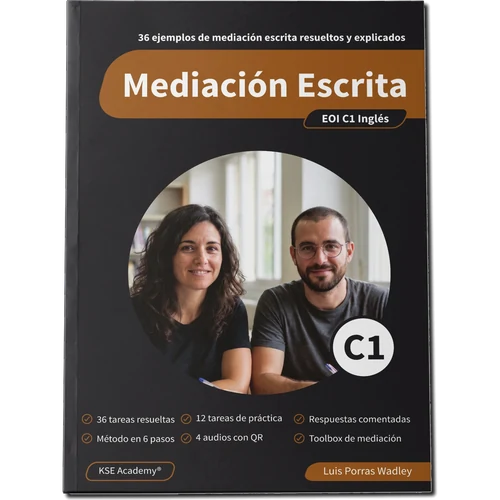
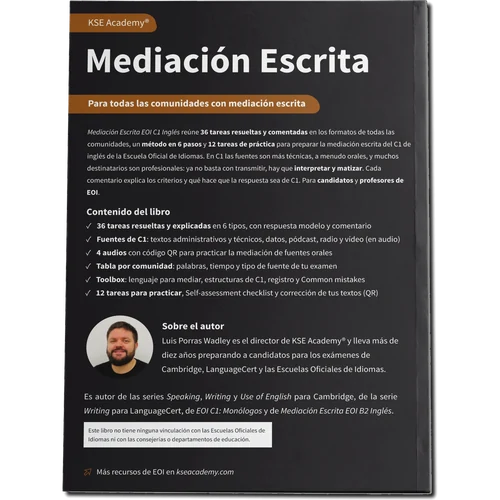
Y si te preparas también la mediación escrita, que se hace en la misma sesión, tienes mi libro Mediación Escrita EOI C1 Inglés, con 36 tareas resueltas con el formato de cada comunidad.
¿Te ha servido? Compártela con quien esté preparando el C1. Y si quieres más contenido como este, suscríbete a mi newsletter y sígueme en Facebook, Twitter, Pinterest, Instagram y YouTube.
¡Mucho ánimo con el C1 y, hasta la próxima, don’t forget to keep smiling! 🙂
