

Table of contents
When someone shows me a piece of writing that’s «fine but not quite C1», the problem is hardly ever the grammar. It’s usually something else: the text says what it has to say, but in a flat way, with the same old linkers and no nuance at all. And in EOI C1 Writing, that really shows.
In this guide I explain what this part of the exam is like in each region, how many words you have to write, which text types you might get and, above all, there are six worked C1 examples, each with the task, a model answer and what makes that answer C1 rather than B2. Here we go! 🙂
The other parts of the exam are covered in my general guide to EOI C1, in case you want the full picture first.
From B2 to C1: what changes in writing
At B2 you’re asked to write a text that’s clear, organised and does the task. At C1 all of that is taken for granted and the examiners look at how you write. If you compare the regions’ marking scales, the C1 descriptors keep coming back to the same points:
- Complex structures used consistently, not a single inversion in the last paragraph to show off.
- Precise vocabulary and some idiomatic language, used well and without forcing it.
- Qualifying and contrasting points of view: recognising what’s reasonable about the other side before arguing against it.
- A register that suits the reader, from a complaint to a company to an article for a magazine.
The texts change too. Stories and descriptions, which were common at B2, almost disappear, and in come reports, critical reviews, applications and cover letters.
What EOI C1 Writing is like
In every region there are two tasks:
- An interaction task (coproducción): you write to someone who expects a reply. It’s almost always a formal email or letter (a complaint, an application, a letter to the editor), although in some regions it can also be a forum post.
- A production task (producción): a longer, more developed text, usually an opinion article, an essay or a report.
It’s part of the written session, after reading and listening, and you get between 60 and 105 minutes for both tasks depending on the region. Only a few regions (the Balearic Islands, Castile-La Mancha, the Valencian Community, Madrid and the Basque Country) let you choose between two options in the production task; everywhere else, you write what you’re given.
How many words do you have to write in C1 Writing?
The differences here are big: Extremadura asks for almost twice as many words as Castile-La Mancha. The usual figure is around 350-400 words in total. These are the numbers in the most recent specifications:
| Region | Interaction task (words) | Production task (words) | Total time |
|---|---|---|---|
| Andalusia | 150-175 | 175-200 | 90 min |
| Aragon | 150-180 | 200-250 | 90 min |
| Asturias | 160-190 | 190-220 | 100 min |
| Balearic Islands | 130-150 | 220-240 | 85 min |
| Canary Islands | 120-150 | 250-300 | 95 min |
| Cantabria | 350-400 in total | 90 min | |
| Castile-La Mancha | 90-100 | 180-190 | 60 min |
| Castile and León | up to 350 in total | 75 min | |
| Catalonia | about 175 | about 250 | 90 min |
| Valencian Community | 140-160 | 210-240 | 100 min |
| Extremadura | 450-500 in total | 90 min | |
| Galicia | 120-150 | 180-210 | 80 min |
| La Rioja | about 370 in total | 90 min | |
| Madrid | 130-150 | 200-220 | 75 min |
| Murcia | 350-400 in total | 90 min | |
| Navarre | 120-150 | 250-280 | 105 min |
| Basque Country | 120-140 | 250-280 | 100 min |
What happens if you write too much or too little?
It depends on the region, and some take length very seriously. In the Valencian Community, being 11 to 25% off costs you 5 points out of 50, and 26% or more costs you 10. In Extremadura, being 25% or more off gives the task a 0, and in Asturias it’s also a 0 if you don’t reach half the words. My advice is simple: stay within the range and count your words when you practise until you know, at a glance, how much space 200 words take up in your handwriting.
And one thing almost every guide repeats: if your text doesn’t answer the task you were set, it isn’t marked or gets a 0, however well written it is.
The texts that come up most in C1 Writing
I’ve gone through the official C1 sample tests of 17 regions (34 exams and 74 tasks), and these are the text types that come up most often:
| Text type | In how many regions | Usually |
|---|---|---|
| Opinion article | 11 | Production |
| Essay (for and against, advantages and disadvantages, opinion) | 6-7 | Production |
| Formal email or letter of complaint | 9 | Interaction |
| Forum, blog or social media post | 5 | Interaction |
| Report | 5 | Production |
| Application or request | 4 | Interaction |
| Letter to the editor | 3 | Interaction |
| Review | 3 | Production |
Some text types appear in just one region: the cover letter (Murcia), the proposal (Navarre), commenting on a graph (Catalonia) or the online petition (Valencian Community). And in Andalusia the interaction task is an email that includes a mediation task, so it’s marked twice.
Worked EOI C1 Writing examples
I’ve chosen the six text types that give you the best return: with them you could write every task in the official sample tests of eleven of the seventeen regions. The tasks are original, in the exam format, and the answers are written for C1, not C2: they’re there to show you what’s expected, not to impress.
Opinion article
This is the star text at C1: it appears in eleven regions, always as the production task. You get a controversial topic and a publication (a magazine, a website, a blog) and you have to take a stand without sounding like a school composition.
The task:
An English-language magazine for people living in Spain is running a series called Life after the office. Readers have been invited to send in articles answering the question below. Write an article for the magazine. Mention:
- how remote working has changed the place where you live
- who has benefited and who has lost out
- what local authorities should do in the coming years.
Has remote working changed our towns and cities for the better?
Write between 230 and 260 words.
Model answer: (255 words)
Remote working: better towns, or just busier ones?
Five years ago, the café opposite my flat was empty by ten o'clock. Today, it is packed with laptops from breakfast until lunchtime. Multiply that scene by thousands of towns and you get a sense of how profoundly remote working has reshaped the places we live in. But has the change really been for the better?
In many ways, it has. Small towns that were steadily losing their young people have been given a second chance. Not only have newcomers brought money into local shops, but they have also filled schools that were on the verge of closing. Freed from the daily commute, people spend more time, and more money, in their own neighbourhoods.
That said, the picture is far from perfect. What newcomers regard as affordable, locals often find out of reach: in popular areas, rents have soared, pricing out the very people who kept these towns alive. City centres, meanwhile, have lost much of their weekday buzz, and the businesses that relied on office workers are struggling to stay afloat.
It would be naive, then, to treat remote working as either a blessing or a curse. Local authorities should invest in housing for long-term residents and turn empty offices into homes or community spaces, rather than simply waiting for the market to sort things out.
On balance, I would say that remote working has made our towns livelier, though not necessarily fairer. Whether it ends up improving them for everyone is still up to us.
Why it’s C1:
- A hook rather than an announcement: the article opens with a concrete scene and a question instead of In this article I will…
- Inversion for emphasis: Not only have newcomers brought money into local shops, but they have also filled schools… Once, in the right place, is enough.
- The other side in its own paragraph, introduced with That said, the picture is far from perfect, and a neat contrast: What newcomers regard as affordable, locals often find out of reach.
- Idiomatic language used naturally: on the verge of, pricing out, struggling to stay afloat, either a blessing or a curse.
- A nuanced conclusion that refuses a simple yes or no: livelier, though not necessarily fairer.
Expressions you can reuse:
- Multiply that scene by… and you get a sense of how…
- Not only have…, but they have also…
- Freed from…, people…
- That said, the picture is far from perfect.
- …, pricing out the very people who…
- It would be naive, then, to treat… as either a blessing or a curse.
- rather than simply waiting for… to sort things out
- On balance, I would say that…, though not necessarily…
Formal email of complaint
The most repeated interaction task: nine regions have used it in their sample tests. At C1 it isn’t enough to say what went wrong; you have to complain firmly and politely at the same time, and ask for a specific remedy.
The task:
You recently attended a four-week intensive English course at a language school in Ireland. The course did not match what the school advertised on its website. Write an email to the director of the school. Mention:
- what was advertised and what you actually received
- how this affected you
- what you expect the school to do.
Harbourview English Institute, Kilbrannan
Intensive Advanced Course (4 weeks)
25 hours of lessons a week
Maximum 8 students per class
Teachers specialising in C1 and C2 exam preparation
Free mock exam every Friday
Director: Ms Niamh Hartigan
Write between 160 and 190 words.
Model answer: (185 words)
Dear Ms Hartigan,
I am writing to express my dissatisfaction with the Intensive Advanced Course I attended at your school in July.
Your website promises 25 hours of lessons a week in classes of no more than eight students. In reality, I was placed in a group of fourteen, several of whom were clearly at intermediate level, and lessons were cancelled at short notice so often that we rarely had more than 18 hours a week. Nor was there any sign of the Friday mock exams, which were the main reason I chose your school.
Having taken four weeks of unpaid leave to attend the course, I returned home hardly better prepared for my exam than when I left.
I appreciate that staff shortages can occur in the summer. However, I paid for a specific service, and a significant part of it was simply not delivered. I would therefore ask you to refund 40% of the course fee, which reflects the lessons and exams I did not receive, within the next fourteen days.
I look forward to your prompt reply.
Yours sincerely,
Lucía Ferrer
Why it’s C1:
- The reason for writing comes first, with a more precise verb phrase than complain: I am writing to express my dissatisfaction with…
- Promise versus reality, backed up with figures: Your website promises… In reality, …
- C1 structures: negative inversion (Nor was there any sign of…), a participle clause (Having taken four weeks of unpaid leave…) and so often that…
- Firm but polite: it concedes a point (I appreciate that staff shortages can occur) before making its demand.
- A specific remedy: a 40% refund, with a deadline and a reason, rather than a vague request for a solution.
Expressions you can reuse:
- I am writing to express my dissatisfaction with…
- Your website promises… In reality, …
- …, several of whom were…
- Nor was there any sign of…
- Having taken…, I returned home hardly better… than when I left.
- I appreciate that… However, …
- a significant part of it was simply not delivered
- I would therefore ask you to…, which reflects…
Essay
It appears in six or seven regions, in several versions: for and against, advantages and disadvantages, or opinion. What counts is presenting both sides with solid arguments before you reach your conclusion.
The task:
Your English class has been discussing the internet and the law. Your teacher has asked you to write an essay with the title below. Discuss both sides of the question and give your own opinion at the end. Mention:
- the protection of people who are harmed online
- freedom of expression
- whether the idea would work in practice.
Social media companies should be legally responsible for what their users post. Discuss.
Write between 230 and 260 words.
Model answer: (256 words)
Social media companies should be legally responsible for what their users post
Every minute, millions of posts appear on social media, and a small but significant share of them are abusive, false or illegal. Whether the companies that host this content should be held legally responsible for it is one of the most hotly debated questions of our time.
Those in favour argue that victims have little protection. When someone is harassed online, it is often impossible to identify the person behind an anonymous account, whereas the platform is easy to find and well able to pay. Moreover, these companies make money from engagement, and controversial content tends to generate the most of it. If they profit from harmful posts, the argument goes, they should also bear the consequences.
Critics, on the other hand, warn that such a law could threaten freedom of expression. Faced with the risk of heavy fines, companies would be likely to remove anything remotely controversial, including legitimate criticism and satire. It is also worth bearing in mind that billions of posts are published every day, so expecting firms to check each one before it appears is hardly realistic.
Having weighed up both sides, I believe that full legal responsibility would do more harm than good. What is needed instead is a clear duty to act: platforms should be obliged to remove illegal content quickly once it has been reported, and fined if they fail to do so. Only in this way can victims be protected without turning private companies into censors.
Why it’s C1:
- An introduction that frames the debate without taking sides, built around a Whether clause as subject.
- One paragraph per side, reported with some distance: Those in favour argue that…, Critics, on the other hand, warn that…, the argument goes.
- Hedging to avoid sounding absolute: would be likely to, tends to, hardly realistic.
- The writer’s view comes last, with a participle clause (Having weighed up both sides), a cleft sentence (What is needed instead is…) and an inversion (Only in this way can victims be protected).
- All three bullet points are covered: victims, freedom of expression and whether the idea would work in practice.
Expressions you can reuse:
- Whether… is one of the most hotly debated questions of our time.
- Those in favour argue that…
- If they profit from…, the argument goes, they should also bear the consequences.
- Critics, on the other hand, warn that…
- Faced with the risk of…, companies would be likely to…
- It is also worth bearing in mind that…
- Having weighed up both sides, I believe that… would do more harm than good.
- Only in this way can…
Report
The report is one of the new arrivals at C1 compared with B2 (it appears in five regions). It’s a practical text: someone asks you for information and recommendations, and you give them in order, with headings and in a neutral register.
The task:
You belong to a cultural association in your town. Most of its members are over fifty, and the committee has asked you to find out how to attract younger people. You have carried out a short survey. Write a report for the committee presenting your findings and making recommendations.
Alvar Cultural Association: survey of 60 residents aged 18 to 35
Had heard of the association: 38%
Main reasons for not joining: activities at inconvenient times (55%), activities not appealing (48%), annual fee too high (30%)
Would consider joining if there were: evening and weekend events, practical workshops, a student discount
Write between 220 and 250 words.
Model answer: (246 words)
Attracting younger members to the Alvar Cultural Association
Introduction
The purpose of this report is to examine why so few young people belong to the association and to suggest ways of changing this. It is based on a short survey of sixty local residents aged between 18 and 35, carried out in October.
Awareness of the association
Perhaps the most striking finding is that only 38% of respondents had even heard of us. Those who knew the association often described it as 'a club for retired people', which suggests that our image may be as serious an obstacle as our programme.
Reasons for not joining
Among those who knew about us, the most common complaint was timing: over half said that our activities take place on weekday mornings, when they are at work or university. Almost as many found the activities unappealing, while nearly a third considered the annual fee too high for students.
Recommendations
In view of these results, I would recommend three measures. Firstly, the committee should move at least some activities to evenings and weekends. Secondly, introducing practical workshops, such as photography or music production, would broaden the appeal of our programme. Finally, a reduced fee for under-25s, combined with a stronger presence on social media, would help us reach people who currently do not know we exist.
Conclusion
None of these changes would require a large budget. Provided that they are introduced together, they could make a real difference within a year.
Why it’s C1:
- Informative headings: not just Findings, but Awareness of the association and Reasons for not joining.
- Survey data reworded rather than copied: over half said, Almost as many, nearly a third.
- Careful interpretation: Perhaps the most striking finding is…, which suggests that our image may be as serious an obstacle as our programme
- Clear, varied recommendations: I would recommend three measures, the committee should…, a gerund subject (introducing practical workshops… would…).
- A formal, objective register and a conditional conclusion: Provided that they are introduced together…
Expressions you can reuse:
- The purpose of this report is to examine why… and to suggest ways of…
- It is based on a short survey of…
- Perhaps the most striking finding is that…
- …, which suggests that… may be as serious an obstacle as…
- Among those who…, the most common complaint was…
- In view of these results, I would recommend…
- …, combined with…, would help us…
- Provided that…, they could make a real difference.
Application or cover letter
Another task typical of C1: you write to get something (a job, a grant, a volunteer place) and you have to sell yourself without sounding arrogant. It appears as an application in four regions and as a cover letter in Murcia.
The task:
You have seen this advertisement on the website of an international film festival. Write a letter of application.
Ribera International Film Festival: volunteer coordinators wanted
Every October, more than 200 volunteers help us welcome film-makers and audiences from all over the world. We are looking for volunteer coordinators to organise and support teams of volunteers during festival week.
Tell us about your relevant experience, why you would like to join us and what qualities you would bring to the role. A good level of English is essential.
Please write to Daniel Okafor, Volunteer Manager.
Write between 160 and 190 words.
Model answer: (186 words)
Dear Mr Okafor,
I am writing to apply for the position of volunteer coordinator at this year's Ribera International Film Festival, which I saw advertised on your website.
I have been a keen follower of the festival for years, and last October I volunteered as an usher at the main venue. It was there that I realised how much a well-run team shapes the audience's experience. In my current job as an events assistant at a conference centre, I draw up staff rotas, brief teams every morning and deal with whatever problems arise during the day, so I am used to working under pressure without losing sight of the details. This role would combine my love of cinema with my professional skills.
Beyond my experience, I would bring patience, a good sense of humour and fluent English and French, which would prove particularly useful when looking after international guests.
I am available for the whole of festival week and would be happy to attend any training beforehand. I would welcome the opportunity to discuss my application with you in more detail.
Yours sincerely,
Irene Montalbán
Why it’s C1:
- The opening states the position and where you saw it advertised, as in any formal application.
- Relevant, concrete experience rather than a list of qualities: last year’s volunteering and a job that involves running teams.
- A cleft sentence to highlight a key moment: It was there that I realised how much a well-run team shapes the audience’s experience.
- Precise collocations: a keen follower of, working under pressure, without losing sight of the details, prove particularly useful.
- A formal, proactive close: availability, training and I would welcome the opportunity to…
Expressions you can reuse:
- I am writing to apply for the position of…, which I saw advertised on…
- I have been a keen follower of… for years.
- It was there that I realised how much…
- I am used to working under pressure without losing sight of the details.
- deal with whatever problems arise
- Beyond my experience, I would bring…
- …, which would prove particularly useful when…
- I would welcome the opportunity to discuss my application with you in more detail.
Reacting to an opinion (forum post or letter to the editor)
I’ve grouped two tasks here because they work in the same way: replying to a forum post (five regions) and writing a letter to the editor of a newspaper (three). In both you react to what someone else has said, and the hard part is agreeing only in part.
The task:
You have read this extract from an article in an English-language newspaper. Write a letter to the editor giving your reaction to the article. Say which points you agree with and which you disagree with, and give reasons.
The last page: why young people have stopped reading
Get on any train and you will see the same scene: teenagers glued to their phones. Reading, once a normal part of growing up, has become a minority hobby. School libraries stand empty and, frankly, a generation raised on fifteen-second videos no longer has the patience for anything longer than a caption.
Martin Hale, The Coastal Courier
Write between 160 and 190 words.
Model answer: (174 words)
Dear Editor,
I read Martin Hale's article on young people and reading with great interest, and while I share some of his concerns, I believe his conclusions are rather too sweeping.
He is right that smartphones compete fiercely for young people's attention. As a secondary school teacher, I see every day how hard many students find it to concentrate on a long text, and I share his concern about empty school libraries: schools should do more to protect time for reading.
However, to claim that young people no longer read is simply inaccurate. What has changed is not whether they read, but what and how they read. Many of my students devour fantasy series, manga and fan fiction, often in English, and online book clubs have turned reading into a social activity for them. Far from lacking patience, some of them get through several novels a month.
Rather than mourning a generation that has supposedly given up on books, perhaps we should take their tastes seriously and build on them.
Yours faithfully,
Javier Lozano
Why it’s C1:
- The overall position comes first: partly agreeing, partly disagreeing (while I share some of his concerns, I believe his conclusions are rather too sweeping).
- Concession first, then disagreement: He is right that…, then However, to claim that… is simply inaccurate, each in its own paragraph with a reason.
- A cleft sentence to correct the article’s idea: What has changed is not whether they read, but what and how they read.
- Evidence from personal experience, and Far from lacking patience to turn the writer’s argument on its head.
- Critical but respectful, as a letter to the editor should be: rather too sweeping, supposedly, perhaps we should.
Expressions you can reuse:
- I read… with great interest, and while I share some of his concerns, I believe…
- His conclusions are rather too sweeping.
- He is right that…
- I see every day how hard many… find it to…
- However, to claim that… is simply inaccurate.
- What has changed is not whether…, but…
- Far from lacking…, some of them…
- Rather than mourning…, perhaps we should…
How C1 Writing is marked
Each region has its own scale, but they all look at four things, under one name or another:
- Task achievement: answering everything you’re asked, for the reader you’re given and in the right register.
- Organisation and cohesion: paragraphs that make sense, ideas that move forward and a range of linkers rather than the same ones every time.
- Range: how varied your vocabulary and structures are. This is where C1 and B2 part company.
- Accuracy: mistakes won’t sink you if they don’t get in the way of understanding, but at C1 they should be few and minor.
In the Basque Country, watch out: the production task is worth twice as much as the interaction task (20 points against 10), so plan your time accordingly.
Mistakes that keep you at B2
- A correct but flat text. If every sentence is subject, verb, object, the examiner has nowhere to see the C1.
- Textbook structures shoehorned in. An inversion in every paragraph sounds as artificial as none at all.
- Not adapting the register. A magazine article can be friendly; an email to a company can’t.
- Half agreeing without saying so. Qualifying is a skill that earns marks: while I accept that…, that said…, up to a point.
- Repeating the task. Copying the words of the prompt in your first paragraph wastes words and proves nothing.
- Forgetting one of the points. It costs the most marks and is the easiest to avoid: tick them off as you check.
Would you like me to mark your writing?
If you’re wondering what mark your texts would get and what’s standing between you and C1, that’s what the C1 writing correction service is for: I mark them against the EOI criteria and explain, point by point, what you still need for C1.
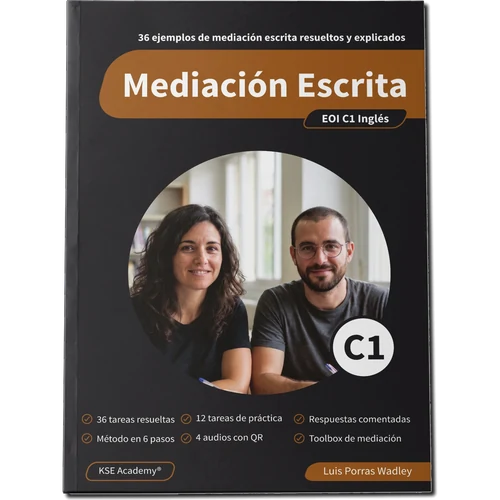
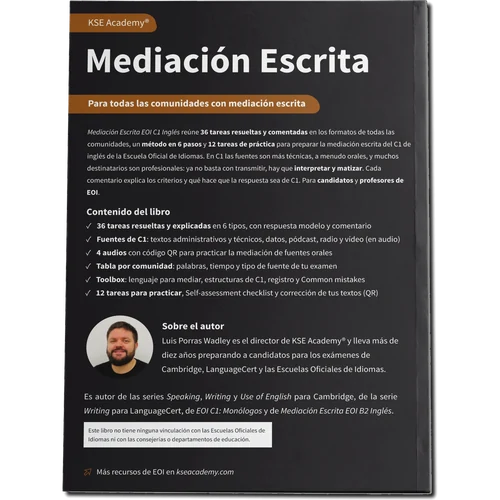
And if you’re also preparing written mediation, which takes place in the same session, there’s my book Mediación Escrita EOI C1 Inglés, with 36 tasks worked through in each region’s format.
Found this useful? Share it with anyone preparing for C1. And if you’d like more content like this, subscribe to my newsletter and follow me on Facebook, Twitter, Pinterest, Instagram and YouTube.
Good luck with C1 and, until next time, don’t forget to keep smiling! 🙂
