
Table of contents
If you’ve already passed B2, EOI C1 Reading will feel familiar: the same tasks, the same marking, the same example item 0. The difference is in the small print. The texts are longer and denser, the options are much closer to each other and the right answer is almost never written out word for word: you have to work it out from the tone, a bit of irony or a shade of meaning.
Here’s what you need to prepare for it: which tasks each region sets in the C1 reading paper, how long you get, how it’s marked and four complete tasks written for this guide, with every answer explained. Get a timer ready and off you go. 🙂
Missing the big picture? Start with my guide to EOI C1, where you’ll see how this part fits into the exam.
What C1 reading asks of you
The C1 curriculum talks about understanding long, complex texts, including ones outside your field, and picking up what isn’t said explicitly: the writer’s stance, a double meaning, the intention behind a sentence. In practice that means opinion pieces, long features, reviews, popular science essays and the odd short story.
It also means more reading. At B2 you were looking at around 1,500 or 2,000 words; at C1 it’s around 2,000 to 2,500, and up to 3,000 in Andalusia. That’s why almost every region gives you more time: 60 to 75 minutes is typical.
EOI C1 Reading: the format in each region
The national rules set a minimum of three tasks of different types and 25 items, and nearly every region sticks to that. To pass the paper you need 50%. This table sums up the specifications and the most recent official sample for each region (Ceuta and Melilla don’t publish a C1 sample):
| Region | Tasks and items | Time | What the latest sample has |
|---|---|---|---|
| Andalusia | 3 tasks, 26 items | 75 min | matching statements with sections, missing fragments and multiple choice |
| Aragon | 3 tasks, 26 items | 60 min | missing fragments, multiple choice and a three-option cloze |
| Asturias | 3 tasks, 25 items | 65 min | multiple choice, gaps with a word bank and matching sentences with news items |
| Balearic Islands | 5 tasks, 35 items | 80 min | multiple choice and four use of English tasks |
| Canary Islands | 3 tasks, 25 items | 80 min | headlines, gaps with a word bank and true or false |
| Cantabria | 3 tasks, 25 items | 60 min | a four-option cloze, missing sentences and an open cloze |
| Castile-La Mancha | 3 tasks, 25 items | 55 min | multiple choice, missing sentences and matching questions with paragraphs |
| Castile and León | 3 tasks, 25 items | 60 min | matching reviews, four-option multiple choice and missing sentences |
| Catalonia | 3 tasks, 25 items | 60 min | multiple choice only, on three texts |
| Valencian Community | 3 tasks, 26 items | 70 min | missing paragraphs, matching statements with reviews and an open cloze |
| Extremadura | 3 tasks, 25 items | 60 min | headings, missing sentences and multiple choice |
| Galicia | 3 tasks, 25 items | 60 min | headings, true or false with a quote as proof and multiple choice |
| La Rioja | 3 tasks, 25 items | 65 min | gaps with a word bank, multiple choice and missing fragments |
| Madrid | 3 tasks, 25 items | 75 min | missing fragments, multiple choice and a four-option cloze |
| Murcia | 3 tasks, 26 items | 90 min | a four-option cloze, missing lines and choosing the true statements |
| Navarre | 4 tasks, 26 items | 75 min | multiple choice, matching, missing sentences and a three-option cloze |
| Basque Country | 4 tasks, 30 items | 75 min | missing clauses, multiple choice, a four-option cloze and an open cloze |
Look at the last column: no two regions are the same, but the same four tasks keep coming back. Those are the ones we’re going to practise.
Four EOI C1 Reading tasks, with answers
I wrote them for this page following the official samples, so you won’t find them in any past paper. Do them in real conditions: about 18 minutes for each of the first two and about 10 for the other two.
1. Multiple choice on a long article
This is the most widespread task: it appears in 13 of the 17 regions. A text of 800 words or more and questions with three options that follow the order of the text (Castile and León uses four). At C1 many questions aren’t about facts but about attitude: what the writer thinks, why they tell an anecdote, what they mean by an expression.
Read the article and choose the correct answer (a, b or c). Question 0 is an example.
Something in the jar
Fermenting food at home has gone from a grandmother’s habit to a lifestyle. I spent a month among the bubbling jars to find out why.
There is a jar of cabbage on my windowsill that has been quietly doing something I do not entirely understand. Every morning I lift the lid, release a sigh of gas that smells faintly of a school changing room, and press the leaves back under their brine with the solemnity of a priest. When my editor suggested I spend a month learning to ferment, I assumed I would be writing a gentle mockery of a fad that had drifted from a few fashionable cafés into the cupboards of people who had read one article too many. The cabbage, I am slightly embarrassed to report, has had other ideas.
My guide was Leocadia Gaskarth, who runs fermentation workshops from a converted bakery in Kelsborough and has taught thousands of people to let vegetables go off on purpose. She is brisk, and has little patience with talk of tradition. «People talk as if fermentation disappeared,» she told me, «when what really disappeared was any need for it. Fridges saw to that. My students aren’t keeping anything alive except the cabbage.» Her students include retired engineers, a hospital porter and a woman whose grandmother made sauerkraut in a tin bath.
Ask them why they come and the first answers are practical. Fermented food tastes of something; a spoonful of kimchi can rescue a plate of plain rice, and a sourdough starter costs little more than flour and water to keep alive. Yet the longer I listened, the more these reasons seemed to stand in for something harder to say. Aurelian Dunphy, a software tester, explained that at work everything was measured and could always be made faster, whereas a crock of miso took the best part of a year and ignored everything he did to it. «It’s the only thing in my life,» he said, «that I’m not allowed to optimise.» Others were blunter: several had begun during a lean winter, when a cheap cabbage could become weeks of decent meals.
Hardly a jar is sold without some promise about the «microbiome», a word that has travelled from the laboratory to the supermarket label with remarkable speed and very little luggage. Scientists are interested in how gut microbes affect our health, and some fermented foods do contain live bacteria. But the honest summary of the evidence is that it is promising, patchy and a long way from the confident claims printed on a six-pound bottle of kombucha. Leocadia refuses to make any of them. «I tell people it’s food,» she said. «If you want medicine, see a doctor.»
If the health claims irritate me, the photographs are harder to stay cross with. Fermentation has acquired a look: amber jars, a hand-thrown crock, a sprig of dill arranged as though it had fallen there by accident. It is hard to keep a straight face at the sight of a process whose whole point is slow, invisible change being sold through images designed to be admired in under a second. Leocadia is more forgiving than I am. The pictures, she pointed out, are how half her students found her, and nobody ever learnt to make sauerkraut by looking at a crock. Even so, the jars on her own shelves were mismatched, unlabelled and, in one case, held together with tape.
Where she is far less forgiving is online advice and its cheerful message that fermentation is ancient and therefore foolproof. The first hour of every workshop is spent on what can go wrong. Salt is weighed, never guessed; anything that smells wrong, grows fur or makes you hesitate goes in the bin. Students who want to cut the salt get a lecture, however many jars they have behind them, and fish and meat she leaves to people with laboratories. The most useful thing her students take home is not a recipe but a sense of when to stop trusting one.
Restaurants have noticed. At the Brinewell, Kelsborough’s most ambitious kitchen, the chef, Benedikta Hallissey, keeps a walk-in cupboard of jars, each dated and logged like a patient’s notes, and she is cheerfully unsentimental about why: ferments turn the cheapest vegetables of the season into something a diner will pay for, and they give a menu a story. Yet her kitchen, she says, is a machine built for speed, and the cupboard is «the one part of the restaurant that nobody can rush, including me». When service has gone badly, she goes there simply to stand among things that are taking their time.
So what does the revival say about the way we cook? Not, I think, that we are rediscovering the wisdom of our great-grandparents, who would have been bewildered by a workshop charging forty pounds to teach it. Nor that we have all become more careful about what we eat: the Friday-night queues outside Kelsborough’s takeaways suggest otherwise. What it suggests to me is that cooking has become less something we must do than somewhere to put what has nowhere else to go: impatience, a longing to be good at something, the sense that everything else is out of our hands. That is rather less than the labels promise. My cabbage tastes sharp, salty and alive, and, to my considerable irritation, I have already started another jar.
0 What does the writer suggest in the first paragraph? (example)
- a The writer had tried fermenting at home before the editor’s suggestion.
- b The writer finds the daily care of the jar more tiresome than expected.
- c The writer expected the trend to be rather silly.
1 What does the second paragraph tell us about Leocadia?
- a She sees fermenting today as a choice rather than a necessity.
- b She regrets that fridges made the old methods unnecessary.
- c She is a little uneasy about how fashionable fermenting has become.
2 What does Aurelian value about making miso?
- a It rewards the same careful attention he gives his job.
- b It is the one thing his efforts cannot improve.
- c It got him through a winter when money was short.
3 The phrase ‘very little luggage’ suggests that, on its way to the label, the word ‘microbiome’ has
- a lost the negative associations it once had
- b become too technical for most shoppers to follow
- c arrived without the caution scientists still attach to it
4 How does the writer feel about the way fermentation is presented in photographs?
- a irritated by the health promises the images seem to make
- b amused by how little the images reflect the process
- c untroubled, since the images bring new students to classes
5 What do we learn about Leocadia’s workshops in the sixth paragraph?
- a Certain kinds of ferment are kept out of them altogether.
- b They rely more on traditional recipes than on online advice.
- c Experienced students learn to judge the salt by eye.
6 What does the writer tell us about Benedikta in the seventh paragraph?
- a She prefers to keep the story behind her ferments off the menu.
- b She lets the cupboard set the pace for the rest of the kitchen.
- c She is open about the part money plays in her ferments.
7 In the final paragraph, what does the writer conclude about the revival?
- a It meets needs that people struggle to satisfy anywhere else in their lives.
- b It shows a longing for the certainty earlier generations seemed to have.
- c It reflects a wish to control what goes into our bodies.
8 Which best describes the writer’s attitude by the end of the article?
- a as sceptical as ever, and still reluctant to take part
- b more caught up in the practice than the writer would like
- c won over by the practice, and pleased to have been proved wrong
Show answers
- 0. c (example): The writer ‘assumed I would be writing a gentle mockery of a fad that had drifted from a few fashionable cafés into the cupboards of people who had read one article too many’: the trend looked silly from the outside. a is not stated: the writer began only ‘When my editor suggested I spend a month learning to ferment’. b misreads the tone: the daily routine is described with humour (‘with the solemnity of a priest’), and the writer never complains about it.
- 1. a: ‘what really disappeared was any need for it. Fridges saw to that.’: nobody needs to ferment any more, so her students do it because they want to, not to keep a tradition going (‘My students aren’t keeping anything alive except the cabbage’). b is partly true: fridges did end the need, but nothing suggests she regrets it; she ‘has little patience with talk of tradition’. c is a plausible assumption: her impatience is with talk of the past, not with fashion, and later she is ‘more forgiving’ than the writer about the photographs, which ‘are how half her students found her’.
- 2. b: At work everything ‘could always be made faster’, whereas miso ‘ignored everything he did to it’, and it is ‘the only thing in my life … that I’m not allowed to optimise’. a is the opposite: the miso does not respond to what he does at all. c is a word match on the next sentence: the ‘lean winter’ belongs to ‘Others’, not to Aurelian.
- 3. c: On the label the word carries none of the scientists’ reservations: the evidence ‘is promising, patchy and a long way from the confident claims printed on a six-pound bottle of kombucha’. a reads the phrase as the everyday idea of emotional baggage, but nothing suggests the word ever had negative associations. b is the reverse of the image: a word with ‘very little luggage’ travels light, and nothing in the text says shoppers find it hard to follow.
- 4. b: ‘It is hard to keep a straight face at the sight of a process whose whole point is slow, invisible change being sold through images designed to be admired in under a second.’ a is a word match: it is ‘the health claims’ that ‘irritate’ the writer, whereas the photographs ‘are harder to stay cross with’, and nothing suggests they make any promises. c is Leocadia’s view, and her reason: ‘Leocadia is more forgiving than I am. The pictures, she pointed out, are how half her students found her’.
- 5. a: ‘fish and meat she leaves to people with laboratories’: she does not teach them at all. b is a plausible assumption the text rules out: she rejects the idea that what is ‘ancient’ is ‘foolproof’, and students learn ‘when to stop trusting’ a recipe. c is contradicted: ‘Salt is weighed, never guessed’, and students who want to change it ‘get a lecture, however many jars they have behind them’.
- 6. c: She ‘is cheerfully unsentimental about why: ferments turn the cheapest vegetables of the season into something a diner will pay for’. a is contradicted: one of her reasons is that ferments ‘give a menu a story’. b is the opposite of what she says: her kitchen ‘is a machine built for speed’, and the cupboard is ‘the one part of the restaurant that nobody can rush, including me’.
- 7. a: Cooking has become ‘somewhere to put what has nowhere else to go: impatience, a longing to be good at something, the sense that everything else is out of our hands’. b is the view the writer rejects: ‘Not, I think, that we are rediscovering the wisdom of our great-grandparents’, who ‘would have been bewildered’ by the workshops; the ‘longing’ in the text is ‘to be good at something’. c is partly true, since people feel ‘everything else is out of our hands’, but the writer rejects the idea that it is about diet: ‘Nor that we have all become more careful about what we eat: the Friday-night queues outside Kelsborough’s takeaways suggest otherwise.’
- 8. b: ‘to my considerable irritation, I have already started another jar’: the writer is hooked, and not pleased about it. a is contradicted: the plan to write ‘a gentle mockery of a fad’ has given way, and the writer keeps fermenting. c is half right: the writer has been won over, but is far from pleased about it (‘to my considerable irritation’, ‘slightly embarrassed to report’).
The key: before you choose, find the sentence in the text that backs up your answer. If you can’t find it, it’s not the right one. And watch out for the option that sounds sensible but that the text never actually says: it’s the favourite trap at this level.
2. Missing sentences or fragments
At C1 this has become almost as common as multiple choice: 12 regions set it. Sentences are taken out (sometimes only part of a sentence, and whole paragraphs in the Valencian Community) and you have to put them back. One or two are left over.
Read the article. Choose the sentence (A-J) that best fits each gap (1-7). There are two sentences you do not need. Gap 0 is an example.
Wanted: neighbours, rent negotiable
A Welsh hill village tried to stop itself emptying by renting cheap houses to strangers; three years on, the strangers have stayed, and so have some of the problems.
Cwm Tawelan does not look like a village that needs to advertise. Its forty-odd stone houses sit in a fold of green hills, the chapel is freshly painted and a buzzard is circling lazily above the post box. (0) ______ It was that last detail, rather than the dark windows, that persuaded Branwen Gwatkin that someone had to act, and that the someone would probably be her.
A former housing officer born in the village, Branwen spent eighteen months persuading the council, a housing association and two reluctant holiday-cottage owners to part with eleven properties. (1) ______ The only other condition was that applicants had to bring either a job they could do remotely or a child of school age, preferably both.
The advert, placed on a property website one wet February, promised ‘fast broadband, slow living and neighbours who will notice if you are ill’. Branwen expected fifty replies and received over three thousand. (2) ______ Sifting them took all summer, and her panel, which included the chapel secretary and a sheep farmer, rejected any letter that used the word ‘idyllic’ more than once.
The first eight households arrived the following spring. Peregrine Eastaugh, a software tester, came from the south of England with his partner and two small sons, expecting ‘a long, quiet sabbatical with better views’. (3) ______ Within six weeks he had been enlisted for the community council, the chapel roof appeal and a rota for clearing the lane after storms, none of which he recalls volunteering for.
For Hortensia Kerrigan, a translator who arrived from the north of England with her daughter, the surprise was linguistic. She had known, in the abstract, that Welsh was spoken in the area. (4) ______ Her daughter, now nine, corrects her pronunciation over breakfast; Hortensia, on her third evening course, now understands jokes about ten seconds after everyone else stops laughing.
Most long-standing residents welcomed the newcomers, some with casseroles, a few with suspicion. Dilwyn Rhydderch, who has farmed above the village for half a century and still does most of his business in Welsh, points out that his grandson, a creamery worker in Llanbedwen, can afford neither to buy nor to rent at market rates and was never offered one of the cheap houses. (5) ______ Branwen does not entirely disagree: since last year, two in every five houses have been kept for local families.
The school is the clearest success. Five years ago Ysgol Tawelan had eleven pupils and a council letter warning that it would close if numbers fell below ten. (6) ______ Three of the extra pupils arrived with no Welsh, yet by the end of their first year, says the headteacher, Hywel Penlan, he could no longer tell which ones they were.
The shop has been a gentler lesson in the gap between what people say and do. Mererid Hopcyn, who has run it since 1998, was assured at every public meeting that the newcomers would ‘support local business’. (7) ______ Their weekly shop, meanwhile, arrives in a supermarket van every Thursday, and Mererid’s takings are almost exactly what they were before anyone moved in.
So has it worked? That depends on what you count. Seven of the first eight households are still here, the school is safe for now, and the chapel has a christening booked for the spring. On the other hand, houses for sale in the valley now cost a quarter more, partly, a local estate agent admits, because of articles like this one. Branwen is unrepentant. ‘I never promised to save the village,’ she says. ‘I only promised it some neighbours.’
A Most, she admits, came from people who seemed to have confused a hill village with an extended holiday.
B This autumn new desks had to be ordered for the first time in decades, and the staff can now field a football team that occasionally wins.
C It had not occurred to her that it would be the language of the school gate, the shop counter and most arguments in the pub.
D Many of them have since left, defeated by the winters rather than by the neighbours.
E Yet five years ago a third of those houses stood empty, and the most recent baby christened in the chapel was already in her twenties.
F They do, after a fashion: they buy stamps, the odd loaf and, at Christmas, an impressive number of cards.
G His quarrel is not with the incomers, whom he calls, a little grudgingly, ‘decent enough’, but with a scheme that seems to reward people for coming from elsewhere.
H The deal she struck was simple: the houses would be renovated with public money and let at a third of the market rent to anyone who would live in them all year round.
I The council, for its part, had already drawn up plans to sell the building.
J Solitude turned out to be the one thing Cwm Tawelan was unable to supply.
Show answers
- 0. E (example): E opens with ‘Yet’, turning against the first sentence: the village ‘does not look like a village that needs to advertise’, yet ‘a third of those houses stood empty’. After the gap, ‘that last detail’ points to the baby ‘already in her twenties’, and ‘the dark windows’ paraphrases the houses that ‘stood empty’.
- 1. H: Before the gap, Branwen spent eighteen months persuading several parties ‘to part with eleven properties’; H says what she got in return: ‘The deal she struck’. Its last words, ‘to anyone who would live in them all year round’, are a condition, which is why the next sentence can begin ‘The only other condition’. I is tempting because ‘the council’ has just been mentioned, but ‘the building’ has nothing to refer to among ‘eleven properties’, and I contains no condition for ‘The only other condition’ to add to.
- 2. A: ‘Most’ refers to the ‘over three thousand’ replies, and ‘she admits’ fits Branwen, who ‘expected fifty’. After the gap, the panel ‘rejected any letter that used the word ‘idyllic’ more than once’, which only makes sense once we know that many applicants ‘seemed to have confused a hill village with an extended holiday’. D is tempting because ‘Many of them’ could seem to point to the replies, but people who had only written letters cannot ‘have since left’, and ‘Sifting them’ would then refer to people who are gone.
- 3. J: Peregrine expected ‘a long, quiet sabbatical’; J turns this round with no linking word at all: ‘Solitude’ paraphrases ‘quiet’, and the village ‘was unable to supply’ it, which the evidence after the gap confirms. After the gap, the evidence follows without any linking word: ‘Within six weeks he had been enlisted for the community council, the chapel roof appeal and a rota’. D is tempting because ‘Many of them’ could refer to ‘The first eight households’, but the last paragraph says ‘Seven of the first eight households are still here’, so D contradicts the text.
- 4. C: Before the gap, Hortensia ‘had known, in the abstract, that Welsh was spoken in the area’; C gives the other half of that contrast: ‘It had not occurred to her’. Knowing something only ‘in the abstract’ leads to a practical surprise, and the next sentence gives it in daily life: ‘Her daughter, now nine, corrects her pronunciation’ and Hortensia is ‘on her third evening course’.
- 5. G: Dilwyn’s grandson ‘was never offered one of the cheap houses’; G states the complaint behind that example in general terms: ‘a scheme that seems to reward people for coming from elsewhere’. After the gap, ‘Branwen does not entirely disagree’ needs an opinion to agree with, and her answer, houses ‘kept for local families’, answers exactly G’s point. I does not fit: it says nothing that Branwen could agree or disagree with.
- 6. B: B never mentions pupils, but its details show that numbers have risen: ‘new desks had to be ordered for the first time in decades’, and there are now enough children to ‘field a football team’. That is the evidence for ‘The school is the clearest success’ after a warning that it ‘would close if numbers fell below ten’. After the gap, ‘the extra pupils’ only makes sense once B has shown that numbers rose. I is tempting because ‘the building’ could seem to be the school and ‘the council’ has just been mentioned, but plans ‘to sell the building’ contradict ‘the clearest success’, and they give ‘the extra pupils’ nothing to refer to.
- 7. F: Before the gap, Mererid was assured that the newcomers would ‘support local business’; F answers with a concession: ‘They do, after a fashion’, and lists small purchases: ‘stamps, the odd loaf’. After the gap, ‘meanwhile’ sets the big purchases against these small ones: ‘Their weekly shop … arrives in a supermarket van’, so her ‘takings are almost exactly what they were’. D is tempting because ‘Many of them’ seems to point to ‘the newcomers’, but the last paragraph says ‘Seven of the first eight households are still here’, and ‘Their weekly shop’ would then belong to people who have left.
The key: at this level the link isn’t always a pronoun. Often it’s a relationship between ideas: a cause and its effect, a concession, an example of what has just been said. Ask yourself what the missing sentence does (does it qualify, contradict, illustrate?) and look for the option that does that.
3. Multiple-choice cloze
This is the big change from B2: a short text with gaps and four options per gap in Cantabria, Madrid, Murcia and the Basque Country (three in Aragon and Navarre). The four options usually mean something similar, so what decides it is collocation, the preposition a word needs or the register.
Read the text and choose the correct answer (a, b, c or d) for each gap. Gap 0 is an example.
The soundtrack we never outgrow
Ask people in their sixties to name the songs, films and public events that mean most to them, and their choices tend to (0) ______ around a surprisingly narrow stretch of life: roughly the years between ten and thirty. Psychologists call this the reminiscence bump, and the pattern has (1) ______ in studies across many countries and generations with striking consistency. Few would claim that more actually happens to us at nineteen than at forty-five, or that those years were always happier ones. (2) ______, researchers look for the reasons in the way those years are lived and later recalled.
One explanation (3) ______ on identity. In adolescence and early adulthood we are working out who we are, and the experiences of that period become the raw material for a sense of self. A song heard at seventeen is rarely just a song; it becomes a kind of (4) ______ for a first love, a circle of friends or a decision about the future, which may be why it can still (5) ______ a chord with us decades later.
A second account points to novelty. Many of life’s firsts, from leaving home to starting a first job, fall within these years, and experiences that are new and distinctive seem to be remembered in richer detail than the (6) ______ routines of middle age, which tend to blur into one another. A third view looks to biology. Some researchers suggest that the brain is especially (7) ______ to forming lasting memories in early adulthood, although how much of the bump this (8) ______ for is still debated, not least because the stories of those years are also the ones we tend to retell most often.
Whatever the balance between these explanations, together they suggest why those years (9) ______ so large when we look back, and why nostalgia returns to them so often. Seen in this light, nostalgia is (10) ______ from a mere escape into the past. Putting on an old record may be one of the ways we remind ourselves who we are, and who we once hoped to become.
0 (example) a bunch · b cluster · c heap · d pile
1 a caught on · b set off · c turned out · d shown up
2 a Instead · b Otherwise · c Likewise · d Besides
3 a revolves · b touches · c centres · d borders
4 a summary · b shorthand · c pretext · d recipe
5 a strike · b sound · c play · d ring
6 a notorious · b unusual · c memorable · d familiar
7 a attached · b capable · c geared · d opposed
8 a argues · b accounts · c calls · d provides
9 a stand · b tower · c rise · d loom
10 a far · b away · c apart · d aside
Show answers
- 0. b (cluster) (example): ‘Their choices tend to cluster around a surprisingly narrow stretch of life’ uses ‘cluster around’, gather closely around one point, here a period of time. ‘Bunch’ is used with ‘up’ or ‘together’ for people or things pressed close (the runners bunched up), and ‘heap’ and ‘pile’ mean put things one on top of another, so none of them can describe answers grouped around certain years.
- 1. d (shown up): ‘The pattern has shown up in studies’ means it has appeared in the results, and ‘with striking consistency’ says it appears again and again. ‘Caught on’ means become popular (a fashion catches on), which a pattern in research data cannot do; ‘set off’ means start a journey or cause something (set off an alarm); and ‘turned out’ needs a complement (it turned out to be true), so ‘has turned out in studies’ is not complete.
- 2. a (Instead): The sentence before rejects one explanation (that more happens to us at nineteen), and ‘Instead’ introduces what researchers do in its place: they look at how those years are lived and recalled. ‘Otherwise’ means ‘if not’ or ‘in other respects’, ‘Likewise’ adds something similar, and ‘Besides’ adds a further argument for the same point; none of them marks the change from the rejected idea to the real line of research.
- 3. c (centres): ‘One explanation centres on identity’ uses ‘centre on sth’, have it as its main subject, the idea the rest of the paragraph develops. ‘Touches on’ also takes ‘on’ but means mention briefly, while the whole paragraph is built on identity; ‘borders on’ means come close to being something (borders on rude); and ‘revolves’ has the right idea but takes ‘around’ (an argument revolves around a question).
- 4. b (shorthand): ‘It becomes a kind of shorthand for a first love’ means the song stands for that whole experience and calls it up in a moment, the idea of the next clause. ‘Recipe for’ and ‘pretext for’ take ‘for’ too, but a ‘recipe for’ something is a way of producing it (a recipe for disaster) and a ‘pretext for’ it is a false reason given to hide the real one; a ‘summary’ is a shorter version of a text and takes ‘of’ (a summary of the report).
- 5. a (strike): ‘Can still strike a chord with us’ is the fixed collocation for something that makes us feel emotion or sympathy. All four verbs belong to music or sound, but you ‘play a chord’ on an instrument, not ‘with’ a person, ‘sound’ goes with an alarm or a warning, and ‘ring’ forms the different idiom ‘ring a bell’, seem familiar.
- 6. d (familiar): ‘The familiar routines of middle age’ are the ones we know so well that they no longer catch our attention: the contrast with experiences that are ‘new and distinctive’ and the reason they ‘blur into one another’. ‘Memorable’ and ‘unusual’ say the opposite of what the sentence needs, and ‘notorious’ means famous for something bad, not well known to ourselves.
- 7. c (geared): ‘The brain is especially geared to forming lasting memories’ uses ‘be geared to (doing) sth’, be organised or suited for it, and here ‘to’ is a preposition followed by -ing. ‘Attached to’ and ‘opposed to’ also take -ing, but they describe feelings (being fond of something, being against it), which makes no sense for the brain here; ‘capable’ takes ‘of’ (capable of forming).
- 8. b (accounts): ‘How much of the bump this accounts for’ uses ‘account for sth’, explain it, or be the cause of part of it, which is what researchers still debate about the brain. All four verbs take ‘for’, but ‘argue for’ means support a view or a course of action (argue for a change), not explain part of a pattern, ‘call for’ means demand or need, and ‘provide for’ means support someone with money or prepare for a future event.
- 9. d (loom): ‘Why those years loom so large when we look back’ is the fixed phrase ‘loom large’, seem very important and take up much of our attention. ‘Stand’, ‘tower’ and ‘rise’ also describe something tall or prominent, but none of them forms the phrase with ‘large’: we say ‘tower over’ or ‘stand out’, never ‘tower large’ or ‘stand large’.
- 10. a (far): ‘Nostalgia is far from a mere escape into the past’ uses ‘far from’, not at all, and the next sentence gives the positive view (a way to remind ourselves who we are). ‘Apart from’ and ‘aside from’ mean ‘except for’ or ‘as well as’, which make no sense after ‘is’, and ‘away from’ describes a real distance from a place.
The key: read the whole sentence, not just the words around the gap. Lots of options fit the meaning, but only one sounds right in English with what follows. If you’re torn between two, think of combinations you’ve read: make a point, not do a point.
4. Which text says what?
Several people or short texts (five reviews, five personal accounts, five news items) and a list of statements to match with each one. The letters can be used more than once. Asturias, Castile-La Mancha, Castile and León, the Valencian Community and Navarre all set it, in different versions.
Read the texts and answer the questions. For each question, choose a person (A-E). You can choose a person more than once. Question 0 is an example.
The family language, second time round
Five adults describe what it was like to learn, or relearn, the language their family grew up with.
A Jadwiga Wrzosek, Polish (UK)
At a cousin’s wedding in my father’s home village I spent six hours smiling and nodding, and somewhere on the drive back to the airport I decided that was the last time. My parents, juggling two jobs and three children, never sent me to Saturday school. Now, at thirty-four, I practise my cases on strangers in the queue at the Polish deli; with my mother, every slip earns a wince that lands harder than any teacher’s red pen. She also finds my accent hilarious, which doesn’t help. The real surprise has been my father. In English he was always the quiet one at school concerts; in Polish he turns out to be a born storyteller with a wicked sense of humour.
B Nisha Thakrar, Gujarati (Canada)
The script took me weeks; the kitchen vocabulary, oddly, I already had from years of half-listening to my aunts. My grandmother picked up her English in her forties, on the night shift of a hospital laundry where she worked for three decades. As her memory began to fade, that was the first thing to go, and by the end of one long winter she addressed every one of us in Gujarati alone. I signed up for a community class that spring. I got there in time, just: we’ve had a handful of proper conversations about the house she grew up in. What I hadn’t bargained for came afterwards. These days it’s me the aunts ring when an official letter arrives or a doctor needs something explaining, and I’m not sure I ever agreed to that.
C Aisling Tuohy, Irish (Ireland)
My grandmother grew up in a Gaeltacht village in the west, and half the words she used appear in no textbook I own. I had thirteen years of the standard drilled into me at school and walked out after my final exams swearing I’d never open another Irish book. Then my daughter started at an Irish-medium primary, came home with homework I couldn’t make sense of, and I sat at the kitchen table feeling a complete fool. That was four years ago. A summer course in my grandmother’s part of the country gave me back the sounds she used to make. Last March I volunteered to run the raffle at the school’s Irish-language week and loved every minute. These days it’s my daughter who corrects my grammar, never the other way round, which is humbling and a little wonderful.
D Warrick Mah, Taishanese (Australia)
At the community club the old men would listen to my efforts and switch to English, kindly but firmly. Grandad had come to Australia from a village where people spoke Taishanese, which is related to Hong Kong Cantonese but sounds so different that speakers of the two often struggle to follow each other. I searched for months, but every course within reach taught Mandarin or standard Cantonese, so I pieced it together from cassettes he’d recorded for relatives in the eighties, a dictionary compiled by an enthusiast, and a lot of guesswork. He died eight months into all this, when I could still only manage food and the weather. Fifteen years ago he would have heard me ask how he was.
E Rosaria Sciortino, Sicilian and Italian (US)
When my grandfather’s letters came to me after the funeral, I assumed two years of evening classes would let me read them. They didn’t, quite: the course taught the Italian of newsreaders, and his was Sicilian, a different animal that I never thought to look for a class in. Even so, the letters showed me a young man I’d never pictured, cheeky and homesick. On my first trip over, my cousins couldn’t stop laughing because I sounded, they said, like a government announcement at a railway station. Three summers of long lunches in their courtyard loosened me up and gave me their slang. Now I use it with my two boys at breakfast, clumsily, and they mostly reply in English, but they reply.
Which person
0 took up the language again in order to support a child’s education? (example): C
1 amused relatives by speaking in an overly official way? ______
2 would prefer to make errors among people they have never met than in front of a relative? ______
3 could not find any classes in the variety their family used? ______
4 started after an older relative could no longer manage in their second language? ______
5 was made to study the language when young and came to hate it? ______
6 has seen a parent’s character in a completely new light? ______
7 is now handing the language down to the next generation? ______
8 has been given tasks by relatives that they never asked for? ______
9 wishes they had made a start years earlier? ______
Show answers
- 0. C (example): Her daughter ‘started at an Irish-medium primary, came home with homework I couldn’t make sense of’, and she had already had ‘thirteen years of the standard’ at school, so this is a second start. E also mentions children, ‘my two boys’, but she speaks to them at home; it is not about their schooling.
- 1. E: ‘my cousins couldn’t stop laughing because I sounded, they said, like a government announcement at a railway station.’ A is the lure: her mother ‘finds my accent hilarious’, but it is her accent that amuses, not a formal style.
- 2. A: She practises ‘on strangers in the queue at the Polish deli’, while ‘with my mother, every slip earns a wince that lands harder than any teacher’s red pen’. D also tried speaking to people outside the family, ‘the old men’ at the club, but they ‘switch to English’; he says nothing about preferring it.
- 3. D: ‘I searched for months, but every course within reach taught Mandarin or standard Cantonese’, so he used his grandfather’s cassettes instead. E’s course also taught a different variety, ‘the Italian of newsreaders’, but she ‘never thought to look for a class’ in Sicilian; C found ‘A summer course in my grandmother’s part of the country’.
- 4. B: Her grandmother ‘picked up her English in her forties’; ‘As her memory began to fade, that was the first thing to go’, and she spoke ‘in Gujarati alone’. The class came ‘that spring’. D’s grandfather also matters to him, but nothing in D says he lost a language; he simply died before D could talk to him.
- 5. C: ‘I had thirteen years of the standard drilled into me at school and walked out after my final exams swearing I’d never open another Irish book.’ A is the lure: she mentions ‘Saturday school’, but her parents ‘never sent me’, so she was never made to go.
- 6. A: ‘In English he was always the quiet one at school concerts; in Polish he turns out to be a born storyteller with a wicked sense of humour’. E also discovers someone new, ‘a young man I’d never pictured, cheeky and homesick’, but that is her grandfather in his letters, not a parent.
- 7. E: ‘Now I use it with my two boys at breakfast, clumsily, and they mostly reply in English, but they reply.’ C is the lure: her daughter speaks Irish, but she learns it at school, and ‘it’s my daughter who corrects my grammar, never the other way round’.
- 8. B: ‘These days it’s me the aunts ring when an official letter arrives or a doctor needs something explaining, and I’m not sure I ever agreed to that.’ C also took on a job, but she ‘volunteered to run the raffle’ at the school and ‘loved every minute’.
- 9. D: ‘He died eight months into all this’, and ‘Fifteen years ago he would have heard me ask how he was.’ B is the lure: she also learnt for a grandparent, but ‘I got there in time, just’. A never went to Saturday school, but she expresses no regret about it.
The key: the statements never use the words of the text, so don’t hunt for matches. Read all the texts first so you know what each person says, then go statement by statement. There are nearly always two people talking about the same thing, and only one of them says exactly what the statement asks for.
Other tasks you might get
The four above cover most papers, but some regions have surprises:
- Open cloze: gaps with no options, one word per gap. It comes up in Cantabria, the Valencian Community, the Basque Country and the Balearic Islands.
- Cambridge-style use of English in the Balearic Islands: word formation, verb forms and key word transformations.
- True or false in the Canary Islands and Galicia; in Galicia you also have to copy the start of the sentence in the text that proves it.
- Picking out which statements in a long list are true, only in Murcia.
- Headings or headlines for paragraphs in Andalusia, the Canary Islands, Extremadura and Galicia.
How C1 Reading is marked
There’s one right answer per item and, almost everywhere, every item is worth the same and wrong answers don’t lose marks. The exceptions worth knowing:
- Andalusia takes off a point for every extra answer (the 2026 booklets say so on the cover).
- In the Valencian Community, a multiple-choice or matching item counts double compared with a gap.
- In Aragon each cloze gap is worth half a point, and in the Balearic Islands each multiple-choice question is worth two.
- The Basque Country marks out of 30 and the pass mark is 15.
How to split your time
With 60 or 75 minutes and around 2,000 words, time is tight if you get stuck. What works best:
- Start with the task you’re best at. You don’t have to follow the order of the booklet.
- Leave the gap tasks for when you’re more tired: they’re shorter and you can do them bit by bit.
- Give each question a limit. If one won’t come in two minutes, mark the likeliest option and move on; you can come back to it.
- Keep five minutes at the end to check and, if there’s an answer sheet, to copy your answers onto it.
What goes wrong most in C1 Reading
- Answering with what you know about the topic instead of what the text says. C1 topics are general on purpose: the option that sounds true is often the trap.
- Choosing by matching words. If an option repeats a word from the paragraph, check it twice.
- Doing the cloze gap by gap, without looking at the whole sentence or paragraph.
- Not rereading the text with the sentences in place in the missing-sentence task: one mistake usually drags another along.
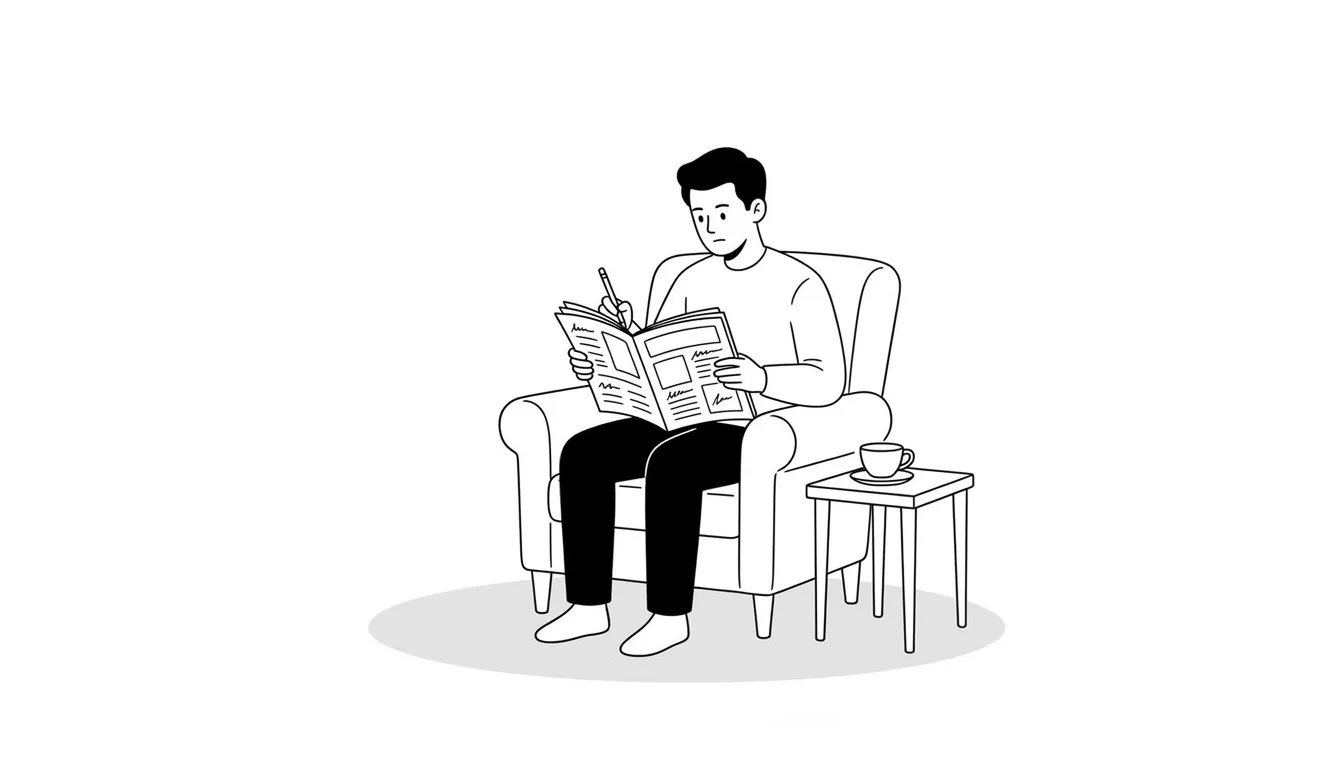
- Reading too little in English while you prepare. There’s no shortcut at this level: newspapers, magazines and essays, every day, even if it’s ten minutes.
Moving on to the rest of the exam? There are my guides to C1 Writing, C1 Speaking, C1 written mediation and C1 spoken mediation.
Material for EOI C1
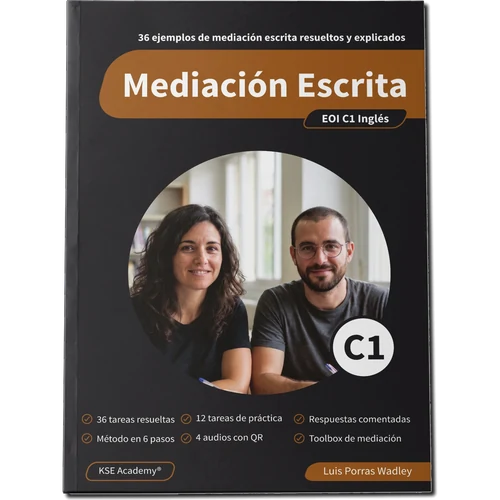
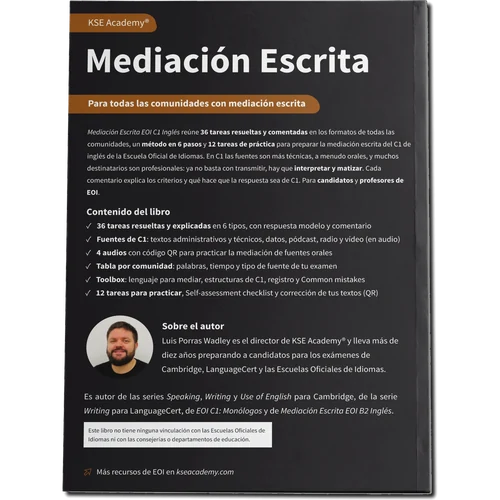
If you’re preparing C1 on your own, I’ve got two books for the parts people find hardest: Mediación Escrita EOI C1 Inglés, with 36 worked tasks in each region’s format, and EOI C1 Monólogos, for speaking.
If this guide helped, pass it on to someone who’s working towards C1. And so you don’t miss what’s next, subscribe to my newsletter and follow me on Facebook, Twitter, Pinterest, Instagram and YouTube.
Go and get that C1 and, until next time, don’t forget to keep smiling! 🙂
