
Table of contents
If you’ve ever been to the UK, you’ll know that talking about the weather is practically a national sport there. You get on a bus, walk into a shop or bump into a neighbour, and the first thing you hear is «Lovely day, isn’t it?» or «Bit chilly today!». And if you don’t know what to say back, the conversation ends right there.
On top of that, weather vocabulary in English hides a few traps: you can’t say it makes cold, weather never takes a, and many languages use one word where English uses three. Don’t worry: by the end of this post it’ll all be clear.
You’ll learn how to ask about and describe the weather, the key vocabulary with its pronunciation, the temperature scale (from boiling to freezing), the language of the weather forecast, how to do small talk like a Brit, how all this comes up in the Cambridge exams and, at the end, exercises with answers.
Let’s get started! 🙂
Weather, climate, time or tense?
Before we start, a quick clarification that prevents a lot of mistakes. In Spanish, and in many other languages, one word (tiempo) covers three different ideas that English keeps apart:
| 🇬🇧 English | Pronunciation | 🇪🇸 Spanish | Example |
|---|---|---|---|
| weather | /ˈweðə/ | el tiempo (meteorológico) | The weather is lovely today. |
| time | /taɪm/ | el tiempo (que pasa) | I don’t have time. |
| tense | /tens/ | el tiempo verbal | The past simple is a tense. |
Then there’s climate /ˈklaɪmət/: the typical weather of a place over many years. Spain has a warm climate, but the weather is awful today. Weather is what you get today; climate is what you expect in general.
Watch the pronunciation too: weather sounds exactly like whether, and it has nothing to do with water. 😉
How to ask about the weather
These are the questions you’ll hear and use most:
| 🇬🇧 English | 🇪🇸 Spanish |
|---|---|
| What’s the weather like (today)? | ¿Qué tiempo hace (hoy)? |
| How’s the weather? | ¿Qué tal el tiempo? |
| What’s it like outside? | ¿Qué tal se está fuera? |
| What’s the weather going to be like at the weekend? | ¿Qué tiempo va a hacer el fin de semana? |
| What’s the forecast for tomorrow? | ¿Qué dice la previsión para mañana? |
| What’s the temperature? | ¿Qué temperatura hace? |
A very common mistake: mixing the first two and saying How is the weather like? ❌. Use either What… like? or How…?, never both. In What’s the weather like?, like doesn’t mean «enjoy»; it means «how is it, what is it similar to».
How to describe the weather: It’s…
This is the key to the whole topic. Many languages describe the weather with a verb like «make» or «do», or with no subject at all. In English we almost always start with It’s, because every English sentence needs a subject, even one that means nothing:
- It’s + adjective to describe the weather: It’s cold. It’s sunny. It’s windy.
- It’s + -ing verb for what’s happening right now: It’s raining. It’s snowing.
- It + present simple for what usually happens: It rains a lot in Galicia. It never snows in Seville.
So it’s It’s cold, never It makes cold ❌ or Is cold ❌. It may look obvious, but it’s probably the number one mistake learners make with this topic.
Noun, adjective and verb
Many weather words come in three forms, and it’s important not to mix them up. Notice that the adjective is usually made by adding -y to the noun:
| 🇬🇧 Noun | Adjective | Verb | 🇪🇸 Spanish |
|---|---|---|---|
| sun /sʌn/ | sunny | shine (the sun is shining) | sol / soleado |
| rain /reɪn/ | rainy | rain (it’s raining) | lluvia / lluvioso / llover |
| snow /snəʊ/ | snowy | snow (it’s snowing) | nieve / nevado / nevar |
| cloud /klaʊd/ | cloudy | cloud over | nube / nublado / nublarse |
| wind /wɪnd/ | windy | blow (the wind is blowing) | viento / ventoso / soplar |
| fog /fɒɡ/ | foggy | – | niebla / con niebla |
| mist /mɪst/ | misty | – | neblina / con neblina |
| storm /stɔːm/ | stormy | – | tormenta / tormentoso |
| ice /aɪs/ | icy | freeze | hielo / helado / helar |
| frost /frɒst/ | frosty | – | escarcha / con escarcha |
Notice the double consonant in sunny and foggy, and that ice loses its «e»: icy.
Weather vocabulary in English
Now for the rest of the vocabulary you’ll need to talk about the weather with confidence.
| 🇬🇧 English | Pronunciation | 🇪🇸 Spanish |
|---|---|---|
| shower | /ˈʃaʊə/ | chubasco |
| drizzle | /ˈdrɪzl/ | llovizna |
| downpour | /ˈdaʊnpɔː/ | aguacero, chaparrón |
| thunder | /ˈθʌndə/ | trueno |
| lightning | /ˈlaɪtnɪŋ/ | relámpago, rayo |
| hail | /heɪl/ | granizo |
| breeze | /briːz/ | brisa |
| rainbow | /ˈreɪnbəʊ/ | arcoíris |
| heatwave | /ˈhiːtweɪv/ | ola de calor |
| flood | /flʌd/ | inundación |
| sunshine | /ˈsʌnʃaɪn/ | sol, luz del sol |
| humid | /ˈhjuːmɪd/ | húmedo (calor pegajoso) |
| dry | /draɪ/ | seco |
| clear | /klɪə/ | despejado |
| overcast | /ˌəʊvəˈkɑːst/ | cubierto, encapotado |
Two spelling and pronunciation points: lightning (the flash in a storm) has no «e», unlike lightening (making lighter); and thunder starts with the /θ/ sound of think. If that sound is tricky for you, have a look at my post on TH pronunciation.
Temperature: from boiling to freezing
English has a fairly precise scale for talking about temperature. From hottest to coldest:
| 🇬🇧 English | Pronunciation | 🇪🇸 Spanish |
|---|---|---|
| boiling (hot) | /ˈbɔɪlɪŋ/ | hace un calor horrible |
| hot | /hɒt/ | hace calor |
| warm | /wɔːm/ | hace buena temperatura, calorcito |
| mild | /maɪld/ | templado, suave |
| cool | /kuːl/ | fresco |
| chilly | /ˈtʃɪli/ | fresquito, hace algo de frío |
| cold | /kəʊld/ | hace frío |
| freezing (cold) | /ˈfriːzɪŋ/ | hace un frío que pela |
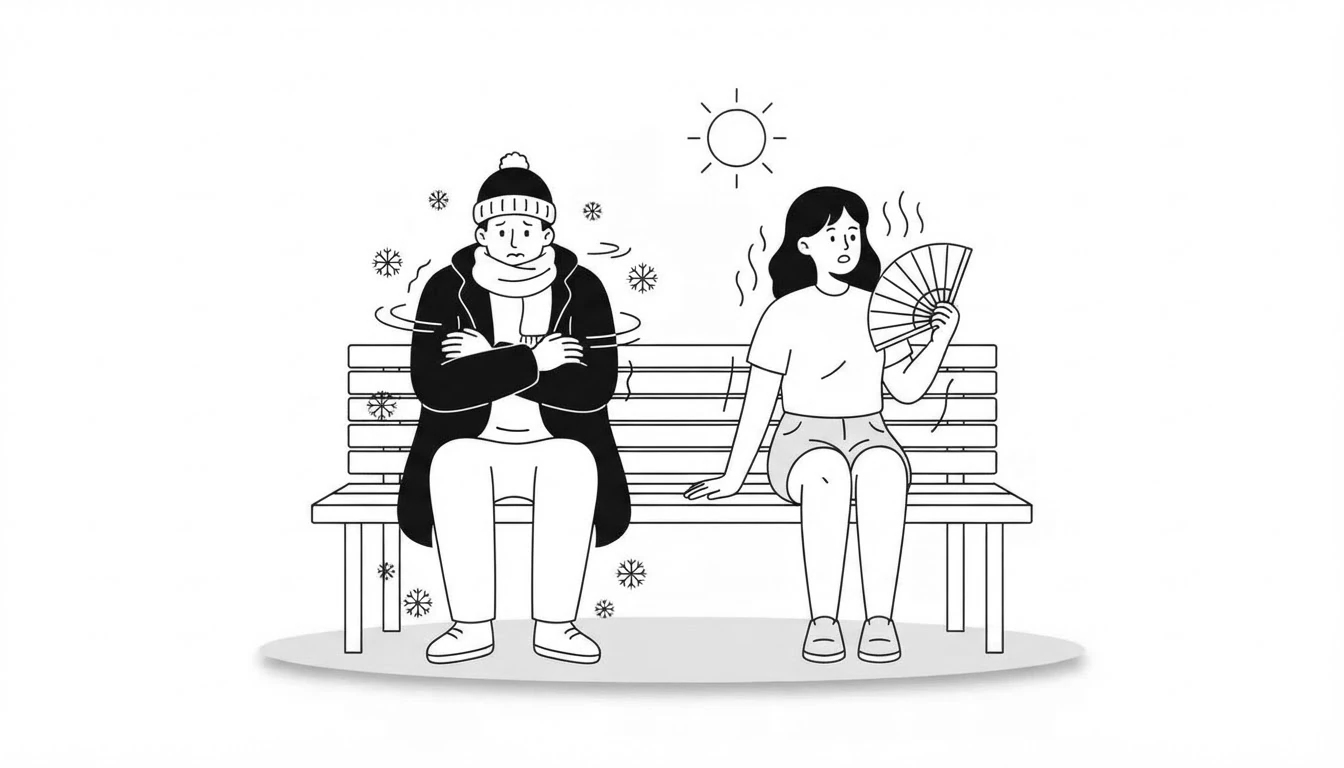
The hardest distinctions are hot vs warm and cold vs cool. Warm is a pleasant heat (positive); hot is real heat, sometimes too much. The same goes for the cold: cool is pleasantly fresh, cold is uncomfortable. My trick: if you’d wear a light jacket, it’s chilly; if you need your coat, it’s cold; and if you don’t want to leave the house, it’s freezing. For more colourful ways to grumble about it, I have a whole post of expressions to complain about cold weather.
How to say degrees
- It’s 25 degrees. Always degrees, never grades ❌.
- It’s minus five. / It’s five below zero.
- It’s going to reach 40 degrees.
The UK uses degrees Celsius (also called centigrade), but the US uses Fahrenheit. So if an American tells you it’ll be 90 degrees tomorrow, don’t panic: that’s about 32 °C. 😅
Weather is uncountable
This is one of the most common grammar traps. Weather is an uncountable noun: it has no plural and never takes the article a.
- ✅ What lovely weather! ❌ What a lovely weather!
- ✅ We had good weather in Italy. ❌ We had good weathers in Italy.
- ✅ The weather is terrible this week. ❌ The weather are terrible this week.
If you want to talk about a particular day, use day: What a lovely day! That one does take a, because day is countable.
Expressions for bad weather
And since English speakers talk a lot about bad weather (there must be a reason), here are the most natural expressions:
| 🇬🇧 English | 🇪🇸 Spanish |
|---|---|
| It’s pouring (down). | Está diluviando. |
| It’s spitting. (UK) | Están cayendo cuatro gotas. |
| I got caught in the rain. | Me pilló la lluvia. |
| I’m soaked! / I’m soaking wet! | ¡Estoy empapado! |
| It’s clouding over. | Se está nublando. |
| It’s going to clear up later. | Va a despejar más tarde. |
| The sun has come out. | Ha salido el sol. |
| It’s blowing a gale. | Hace un viento tremendo. |
And if you fancy something more idiomatic, like it’s raining cats and dogs or under the weather, I explain them in my 10 weather idioms.
The weather forecast in English
If you watch the weather forecast on the BBC or check a weather app in English, you’ll come across slightly more technical language:
- sunny spells: short periods of sunshine
- scattered showers: showers in some places but not others
- outbreaks of rain: periods of rain
- highs of 22 / lows of 8: maximum and minimum temperatures
- a 60% chance of rain: the probability of rain
- a cold front: a mass of cold air moving in
To talk about the forecast we normally use the future: It will be cloudy in the morning, It’s going to rain later or, when it’s less certain, It might snow tonight. If you’re unsure about will and going to, I have a post on the difference between will and going to.

Small talk: talking about the weather like a Brit
For the British, the weather isn’t just information: it’s the easiest way to start a conversation with anyone. The classic formula is a comment with a question tag, and the other person replies with another comment:
- A: Lovely day, isn’t it? B: Gorgeous! Let’s hope it lasts.
- A: Bit chilly today, isn’t it? B: Freezing! I should’ve brought a coat.
- A: Horrible weather, isn’t it? B: Awful. Typical British summer!
You don’t need a long answer: just agree and add something small, and you’re part of the conversation. And if you want to sound even more natural, learn to say typical! with a sigh. It’s very British. 🙂
Common mistakes
| Mistake | ❌ Wrong | ✅ Right |
|---|---|---|
| Translating «make» or «do» literally | It makes cold | It’s cold |
| Leaving out the subject | Is very hot | It’s very hot |
| Putting a before weather | What a horrible weather! | What horrible weather! |
| Using the present simple for right now | Look, it rains! | Look, it’s raining! |
| Mixing up noun and adjective | It’s very sun | It’s very sunny |
| Combining how and like | How is the weather like? | What’s the weather like? |
| Saying grades for temperature | 30 grades | 30 degrees |
The weather in the Cambridge exams
The weather is one of those all-purpose topics that turn up at every level:
- Speaking Part 1 (A2 Key, B1 Preliminary, B2 First): questions like What’s the weather like where you live?, What kind of weather do you like best? or What do you like doing when it’s sunny? are very common.
- Writing: in an email or postcard telling a friend about your holiday, describing the weather is almost compulsory. And in a story, a storm or a foggy day is great for creating atmosphere.
- Listening: it’s not unusual to hear a weather forecast or someone deciding on a plan depending on the weather.
To show you how you might answer in the Speaking, here’s a sample answer to What kind of weather do you like best?, written to simulate a B1 level, without reaching B2:
I really like warm weather, but not when it’s too hot. In my city it’s boiling in August, so I prefer spring, when it’s sunny and about 20 degrees. Then I can go for a walk or have lunch outside with my friends. I don’t like rainy days very much because I have to stay at home.
Look at what makes it work: contrast with but (warm, but not too hot), a reason with because and so, the temperature scale used accurately (warm, hot, boiling), a concrete detail (about 20 degrees) and a personal example. It’s simple, but complete and well connected, which is exactly what B1 asks for.
Weather exercises in English
Time to practise. Below you have three interactive exercises that mark themselves, so you’ll know straight away how you’ve done. Try to do them without looking back at the post.
And if you prefer a version in text that you can copy and paste, you have it down here 👇
Exercise 1. Choose the correct option
Choose the correct word or expression in each sentence.
- What’s the weather (like / as) in Madrid today?
- It’s (raining / rains) at the moment, so take an umbrella.
- We had (a lovely weather / lovely weather) on holiday.
- It isn’t cold, but it’s a bit (freezing / chilly). Take a jacket.
- Spring here is (warm / boiling): about 20 degrees, perfect for a walk.
- Turn the heating on, it’s (cool / freezing) in here!
- Look at those dark clouds. I think there’s going to be a (breeze / storm).
- The (weather / forecast) says it will snow tomorrow.
- It’s very (fog / foggy) this morning, so drive carefully.
- I can’t believe it’s 25 (grades / degrees) in November!
Show answers
- like
- raining
- lovely weather
- chilly
- warm
- freezing
- storm
- forecast
- foggy
- degrees
Exercise 2. Make the adjective
Complete each sentence with the adjective formed from the word in brackets.
- It’s very _______________ (wind) today. My umbrella broke!
- Take your sunglasses, it’s really _______________ (sun).
- The sky is grey and _______________ (cloud), but it isn’t raining.
- Be careful, the roads are _______________ (ice) this morning.
- It was a cold, _______________ (frost) morning and all the cars were white.
- I hate _______________ (rain) days. I just want to stay at home.
- The sea was very rough because the weather was _______________ (storm).
- We couldn’t see the mountains because it was so _______________ (fog).
- In winter the north of the country is quite _______________ (snow).
- It was a _______________ (mist) morning by the lake.
Show answers
- windy
- sunny
- cloudy
- icy
- frosty
- rainy
- stormy
- foggy
- snowy
- misty
Exercise 3. Correct the mistake
Each sentence has one mistake. Write it correctly.
- Today makes very cold.
- What a horrible weather!
- Look, it rains!
- Yesterday was very sun.
- Is very hot in August.
- How is the weather like?
- It’s 30 grades today.
- It was a lot of fog this morning.
- We had good weathers in Italy.
- The weather are terrible this week.
Show answers
- It’s very cold today.
- What horrible weather!
- Look, it’s raining!
- Yesterday was very sunny.
- It’s very hot in August.
- What’s the weather like?
- It’s 30 degrees today.
- There was a lot of fog this morning.
- We had good weather in Italy.
- The weather is terrible this week.
Conclusion
To sum up: to talk about the weather in English, start with It’s (It’s cold, It’s raining), remember that weather is uncountable, keep weather, time and tense apart, and use the temperature scale accurately: warm isn’t the same as hot, and cool isn’t the same as cold. That way, next time someone says Lovely day, isn’t it?, you’ll know exactly what to say.
If you’d like to keep going with related topics, have a look at my post on the days of the week, months and seasons in English.
Did you find this post useful? Share it with other English students and teachers. And if you’d like more content like this, subscribe to my newsletter and follow me on Facebook, Twitter, Pinterest, Instagram and YouTube.
See you in the next post. Until then, don’t forget to keep smiling! 🙂
