
Table of contents
If you’ve already got your B2 and you’re preparing for C1 Advanced, you’ll have noticed that phrasal verbs move up a league. It’s no longer enough to know that give up means «stop trying» or that look forward to takes -ing. At C1 you’ll come across things like the plan fell through, this accounts for the rise in prices or the police have ruled out foul play, and if you don’t know them, half the sentence slips away from you. I see it every year in my Advanced classes: students who cope well at B2 get stuck right here.
Don’t worry, there’s a way round it. In this post I’ve put together the 60 most useful C1 phrasal verbs, organised by topic, each with its meaning in Spanish and an example. They’re different from the ones in my list of B2 phrasal verbs, so if you’re coming from there, this is your next step. I also explain the nouns that come from them (outbreak, setback, breakthrough), their formal equivalents for Writing, the typical mistakes, how they come up in each part of the Cambridge exam, and you’ve got thirty sentences of exercises with answers. Let’s get started! 🙂
What changes with C1 phrasal verbs?
At B2 you’re expected to handle everyday phrasal verbs and the ones that come up most in the exam: put off, turn down, come up with, run out of. At C1, the jump comes in four areas:
- More abstract topics: you’re no longer just talking about your plans or your family, but about causes, consequences, social change or arguments. That’s where bring about (cause), stem from (originate in) and boil down to (come down to) appear.
- A more neutral, written register: many C1 phrasal verbs are used in newspapers, reports and academic texts, not just in conversation. Carry out research or draw up a plan are perfect in a report.
- The nouns that come from them: break out gives outbreak, set back gives setback. They come up a lot in Use of English Part 3.
- Precision: at C1 the difference between fall through (a plan that doesn’t happen) and fall apart (something that collapses), or between rule out (exclude) and call off (cancel), really shows.
If you’re still unsure about the theory (separable, inseparable, three-part verbs), go over my guide to phrasal verbs in English first. Here we’ll take the basics as read and go for top marks.
One rule that doesn’t change: the pronoun goes in the middle
Even as you move up a level, the most common mistake is still the same one. With separable phrasal verbs, if the object is a pronoun, it goes in the middle: They laid them off, never They laid off them. In the tables I mark with sb (somebody) or sth (something) where the object goes when the verb can be separated.
C1 phrasal verbs by topic
Just like at B2, learning them by topic works much better than memorising an alphabetical list, because you link them to what you’ll have to talk about in Writing and Speaking. These are the six topics that come up most in Advanced.
Work and projects
| 🇬🇧 Phrasal verb | 🇪🇸 Spanish | Example |
|---|---|---|
| carry sth out | llevar a cabo, realizar | The survey was carried out by an independent company. |
| draw sth up | redactar, elaborar (un plan, un contrato) | Our lawyer drew up the contract in a week. |
| take over (sth) | hacerse cargo, tomar el control | She took over the department when her boss retired. |
| step down | dimitir, dejar un cargo | The director stepped down after the scandal. |
| lay sb off | despedir (por falta de trabajo) | The factory laid off two hundred workers. |
| phase sth out | retirar poco a poco | Plastic bags are being phased out in most supermarkets. |
| follow sth up | hacer seguimiento de | I’ll follow up the interview with an email. |
| iron sth out | limar, resolver (detalles, problemas) | We still need to iron out a few problems. |
| see sth through | llevar hasta el final | It won’t be easy, but I’m going to see this project through. |
| wind sth down | ir cerrando, reducir la actividad | The company is winding down its operations in Asia. |
Look at carry out: it’s probably the most useful phrasal verb in the whole of C1 for Writing. Carry out research, a survey, an experiment, a plan. And in the passive it’s even better: A study was carried out to find out… If the passive with phrasal verbs gives you trouble, it’s all explained in my post on the passive voice in English.
Ideas and arguments
| 🇬🇧 Phrasal verb | 🇪🇸 Spanish | Example |
|---|---|---|
| account for | explicar, justificar; representar (un porcentaje) | Tourism accounts for 12% of the country’s income. |
| bear sth out | confirmar, corroborar | The results bear out our original theory. |
| rule sth out | descartar | The doctors have ruled out a serious infection. |
| get sth across | transmitir, hacer entender | He’s clever, but he struggles to get his ideas across. |
| spell sth out | explicar con todo detalle | Do I have to spell it out for you? |
| stem from | tener su origen en, derivarse de | Most of her problems stem from a lack of confidence. |
| touch on | mencionar, tocar (un tema) por encima | The talk only touched on the issue of cost. |
| weigh sth up | sopesar | You need to weigh up the pros and cons before you decide. |
| boil down to | reducirse a, resumirse en | In the end, it all boils down to money. |
| hinge on | depender de | Everything hinges on the result of the vote. |
This group is gold for the essay. This can be accounted for by…, The figures bear this out or It all boils down to… sound natural and very C1. Combine them with the advanced linkers in my post on C1 linkers and your arguments will improve enormously.
Change and problems
| 🇬🇧 Phrasal verb | 🇪🇸 Spanish | Example |
|---|---|---|
| bring sth about | provocar, ocasionar | The internet has brought about huge changes in education. |
| come about | ocurrir, producirse | How did the misunderstanding come about? |
| crop up | surgir (de forma inesperada) | A few problems cropped up during the move. |
| come up against | toparse con, enfrentarse a | The project came up against strong opposition. |
| set sb/sth back | retrasar, hacer retroceder | The injury set her back several months. |
| fall through | fracasar, no llegar a realizarse (un plan) | The deal fell through at the last minute. |
| get round sth | sortear, esquivar (un problema, una norma) | There’s always a way to get round the rules. |
| do away with | abolir, eliminar | The school has done away with uniforms. |
| pan out | salir, resultar | Let’s see how things pan out before we decide. |
| scale sth back | reducir (planes, gastos) | The council has scaled back its plans for the new park. |
Be careful with the pair bring about / come about, which people mix up a lot. Bring about takes an object and means «cause» (The crisis brought about many changes). Come about has no object and means «happen» (How did these changes come about?). It’s the same idea as «cause» versus «occur».
Relationships and people
| 🇬🇧 Phrasal verb | 🇪🇸 Spanish | Example |
|---|---|---|
| stand by sb | apoyar, no abandonar | Her family stood by her through the whole trial. |
| stick up for | defender, dar la cara por | Thanks for sticking up for me in the meeting. |
| fall for | enamorarse de; tragarse (un engaño) | He fell for her the moment they met. / I can’t believe I fell for that trick. |
| drift apart | distanciarse | We were close at school, but we drifted apart. |
| look down on | menospreciar, mirar por encima del hombro | She looks down on anyone who didn’t go to university. |
| talk down to | hablar con condescendencia | I hate it when doctors talk down to their patients. |
| open up | abrirse, sincerarse | It took him a long time to open up about his past. |
| warm to | coger cariño, empezar a simpatizar con | I didn’t like her at first, but I soon warmed to her. |
| live up to | estar a la altura de | The film didn’t live up to my expectations. |
| come round | cambiar de opinión, acabar aceptando | My dad hated the idea, but he came round in the end. |
If you learnt look up to (admire) at B2, here’s its opposite: look down on. Learning them together is the best way not to mix them up. And live up to is a regular in reviews: The hotel didn’t live up to the hype is a textbook C1 sentence.
Emotions and reactions
| 🇬🇧 Phrasal verb | 🇪🇸 Spanish | Example |
|---|---|---|
| dwell on | darle vueltas a, recrearse en | Don’t dwell on the past. Focus on what you can change. |
| bottle sth up | reprimir, guardarse (los sentimientos) | It’s not healthy to bottle up your anger. |
| lash out (at) | arremeter contra, atacar (física o verbalmente) | When he’s stressed, he lashes out at everyone. |
| flare up | estallar, recrudecerse (una discusión, un dolor) | Tempers flared up during the debate. |
| get sb down | deprimir, desanimar | This rainy weather is really getting me down. |
| snap out of it | salir de (un estado de ánimo), espabilar | Come on, snap out of it! It’s only an exam. |
| pluck up (the courage) | armarse de valor | I finally plucked up the courage to ask her out. |
| shrug sth off | quitar importancia a | He shrugged off the criticism and carried on. |
| wind sb up | sacar de quicio; tomar el pelo | Stop winding your sister up! |
| well up | saltarse las lágrimas | Tears welled up in her eyes when she read the letter. |
These bring a story or an article to life, and they help in Speaking too when you have to talk about personal experiences. Just bear in mind that wind sb up is very British and informal: perfect when talking to a friend, not so much for a report. 😄
Society and the news
| 🇬🇧 Phrasal verb | 🇪🇸 Spanish | Example |
|---|---|---|
| break out | estallar (una guerra, un incendio, una epidemia) | A fire broke out in the early hours of the morning. |
| crack down on | tomar medidas duras contra | The police are cracking down on drink-driving. |
| step sth up | intensificar, aumentar | The government has stepped up security at airports. |
| die out | extinguirse, desaparecer | Many traditional crafts are dying out. |
| spring up | surgir de repente, brotar | New cafés have sprung up all over the city. |
| stand out | destacar | Her CV really stood out from the rest. |
| speak out (against) | alzar la voz (contra), denunciar públicamente | Several doctors have spoken out against the new law. |
| cover sth up | encubrir, ocultar | The company tried to cover up the mistake. |
| own up (to) | confesar, reconocer (una culpa) | Nobody owned up to breaking the window. |
| usher sth in | marcar el comienzo de | The smartphone ushered in a new era of communication. |
This is the vocabulary of the news, which is why it comes up so often in Advanced Reading and Use of English, as they use newspaper texts. If you read a British newspaper for a week, you’ll find break out, crack down on and speak out almost every day.
Phrasal verbs that become nouns
Here’s one of the secrets of C1. Many phrasal verbs have a related noun, and sometimes the particle moves. These are the ones you’ll see most in the exam, especially in Use of English Part 3 (word formation):
| 🇬🇧 Phrasal verb | 🇬🇧 Noun | 🇪🇸 Spanish |
|---|---|---|
| break out | outbreak | brote, estallido |
| break through | breakthrough | avance, descubrimiento importante |
| set back | setback | revés, contratiempo |
| turn out | turnout | participación, asistencia |
| bring up | upbringing | educación, crianza |
| take over | takeover | adquisición, toma de control |
| cover up | cover-up | encubrimiento |
| follow up | follow-up | seguimiento |
| lay off | layoff | despido (colectivo) |
| draw back | drawback | inconveniente, desventaja |
Notice that in outbreak and upbringing the particle moves to the front. So in Part 3, when the word you’re given is BREAK and the gap needs a noun after an, think of outbreak: There has been an outbreak of flu in the city. And drawback is almost compulsory in an essay about advantages and disadvantages: The main drawback of this proposal is…
Phrasal verbs and their formal equivalents
At C1, being able to adapt your register really counts. An email to a friend allows almost any phrasal verb, but in an essay, a report or a proposal a formal one-word verb sometimes works better. This table works both ways: for Writing and for the Part 4 transformations.
| 🇬🇧 Phrasal verb | 🇬🇧 Formal equivalent | 🇪🇸 Spanish |
|---|---|---|
| carry out | conduct | realizar |
| bring about | cause / bring | provocar |
| come about | arise / occur | producirse |
| rule out | exclude / dismiss | descartar |
| do away with | abolish | abolir |
| account for | explain / represent | explicar; representar |
| set back | delay | retrasar |
| step down | resign | dimitir |
| draw up | draft | redactar |
| step up | increase / intensify | intensificar |
That said, don’t fall into the trap of thinking they’re banned from formal writing. Carry out, account for, bring about and rule out are completely neutral and appear in scientific articles. What you should avoid in an essay are the informal ones: pan out, wind sb up or snap out of it.
Typical mistakes with C1 phrasal verbs
These are the mistakes I correct most often in my Advanced students’ Writing. Almost all of them come from translating from Spanish or forgetting a particle:
| ❌ Incorrect | ✅ Correct | Why |
|---|---|---|
| The war broke up in 1939. | The war broke out in 1939. | Break up means end a relationship or split up. |
| This accounts the increase. | This accounts for the increase. | Without for it makes no sense. |
| Her fear stems of her childhood. | Her fear stems from her childhood. | A calque of the Spanish «deriva de»: it’s from. |
| The hotel didn’t live up our expectations. | The hotel didn’t live up to our expectations. | It’s a three-part phrasal verb. |
| They did away the old law. | They did away with the old law. | The third particle is missing. |
| A survey was carried. | A survey was carried out. | The particle stays in the passive. |
| They laid off them. | They laid them off. | With a pronoun, the object goes in the middle. |
| We ruled out the meeting. (if there won’t be a meeting) | We called off the meeting. | Rule out means exclude a possibility; call off means cancel. |
Phrasal verbs in C1 Advanced
Phrasal verbs are everywhere in Advanced, but there are four places in Use of English and Writing where you’re sure to find them.
Use of English Part 1 and Part 2
In Part 1 (multiple-choice cloze) you’re often asked for the right verb in a phrasal verb, and all four options look possible if you don’t know it:
- The new law is expected to ______ about major changes. A) take B) bring C) put D) make → bring
In Part 2 (open cloze), on the other hand, the gap is usually the particle:
- Nobody knows exactly how the fire broke ______. → out
- The success of the plan hinges ______ the support of local people. → on
Use of English Part 3: word formation
This is where the nouns in the table above come in. You’re given the base word and you have to transform it:
- Scientists have made an important ______ in cancer research. (BREAK) → breakthrough
- The ______ in the elections was lower than expected. (TURN) → turnout
Use of English Part 4: key word transformations
In C1 Part 4 (key word transformation) you have to write between three and six words, and swapping a formal verb for a phrasal verb (or the other way round) is one of the most common tricks:
- The plan failed because of a lack of money. THROUGH → The plan fell through because of a lack of money.
- The police have excluded the possibility of murder. RULED → The police have ruled out the possibility of murder.
- I’m sure the hotel will meet your expectations. LIVE → I’m sure the hotel will live up to your expectations.
Notice that the transformation often combines the phrasal verb with something else: a passive, a noun or an extra preposition. That’s exactly what the exercises at the end are designed to practise.
Writing and Speaking
In C1 Writing, examiners reward «less common» vocabulary used accurately. An A study was carried out or a This can largely be accounted for by… in your essay says a lot about your level. In Speaking, the ones about emotions and relationships (we drifted apart, it really gets me down, I finally plucked up the courage) help you sound natural without forcing it. Just one rule: use them when they fit, not to fill space.
Tips for learning C1 phrasal verbs
- Learn them in families of meaning. Bring about, come about, stem from and account for are all about causes and consequences: together they’re much easier to remember.
- Always with their collocations. Don’t just write down carry out, but carry out research / a survey / an experiment. At C1, collocation is half the job.
- Note down the noun if there is one. Set back → setback, break out → outbreak. It’ll save you plenty of marks in Part 3.
- Read the news in English. It’s the number one source of these phrasal verbs. Ten minutes of news a day is worth more than a whole list.
- Review with spacing. What you see once gets forgotten. I explain how to organise it in my post on how to memorise English vocabulary.
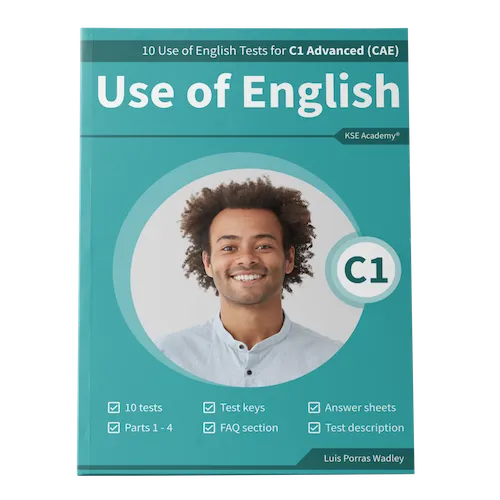
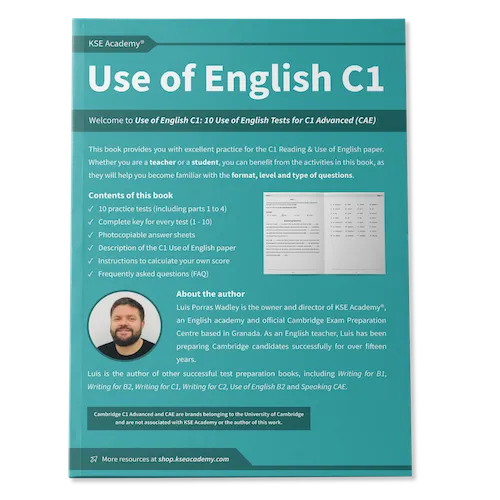
And if you want to see all this in action in real exam tasks, my book Use of English C1 has ten complete Advanced Use of English tests, with every part of the exam, answers and explanations. It’s the best way to check whether these phrasal verbs now come to you naturally. 👉🏻 See the book
Frequently asked questions about C1 phrasal verbs
How many phrasal verbs do you need for C1?
Cambridge doesn’t publish an official list, but I reckon that with the 150 to 200 most frequent ones (the basics, the ones on my B2 list and the ones here) you’re very well prepared for Advanced. From there, what makes the difference is using them accurately and with their collocations.
What’s the difference between B2 and C1 phrasal verbs?
B2 ones are mainly everyday and conversational (put off, turn down, run out of). C1 ones are more abstract and frequent in written texts (bring about, account for, stem from), have more related nouns and require you to tell apart similar verbs.
Can you use phrasal verbs in a formal essay?
Yes. The neutral ones (carry out, account for, bring about, rule out) are perfect even in academic writing. What you should avoid are the informal ones, like pan out or wind sb up, which you’d keep for an informal email.
Are there phrasal verbs in C2?
Loads, and even more idiomatic ones. But this is the foundation: if you master the ones on this list, the jump to C2 Proficiency is much more manageable. To keep expanding, you’ve got my 200 phrasal verbs with examples in English and Spanish and my phrasal verbs dictionary.
Is there a C1 phrasal verbs list in PDF?
Yes: you can download this post as a PDF with the download button, with all the tables and exercises included, so you can print it or review it wherever you like.
C1 phrasal verbs exercises
Thirty sentences to check you’ve got it. Below you have three interactive exercises that mark themselves, so you’ll know straight away how you’ve done.
And if you’d like these exercises as text to copy, paste or adapt for your classes, here they are below with the answers 👇
Exercise 1: choose the correct particle
Choose the correct option to complete each phrasal verb.
- War broke (out / up / off) in 1939.
- The rise in prices can be partly accounted (for / to / with) by the cost of energy.
- The police have ruled (out / off / down) the possibility of murder.
- The deal fell (through / out / off) at the last minute, so we had to start again.
- Many of his problems stem (from / of / out) his childhood.
- The new system failed to live up (to / with / for) our expectations.
- The government is cracking (down / up / out) on tax fraud.
- She finally plucked (up / out / on) the courage to ask for a pay rise.
- Try not to dwell (on / in / at) your mistakes. Learn from them and move on.
- It took months to iron (out / off / up) all the details of the contract.
Show answers
- out
- for
- out
- through
- from
- to
- down
- up
- on
- out
Exercise 2: complete with the phrasal verbs in the box
Complete each sentence with the correct form of a phrasal verb from the box: bottle up, bring about, come about, die out, drift apart, lay off, set back, stand out, step down, weigh up.
- The minister was forced to _______________ after the scandal.
- Hundreds of workers were _______________ when the factory closed.
- Nobody knows exactly how the misunderstanding _______________.
- Last year’s reform _______________ major changes in the education system.
- The strike has _______________ the project by several weeks.
- Before deciding, she carefully _______________ the pros and cons.
- We were best friends at school, but we _______________ after university.
- Many local languages are _______________ because young people no longer speak them.
- It isn’t healthy to _______________ your feelings like that. Talk to someone.
- Her application _______________ from all the others, so we invited her for an interview.
Show answers
- step down
- laid off
- came about
- brought about
- set back
- weighed up
- drifted apart
- dying out
- bottle up
- stood out
Exercise 3: key word transformations
Complete the second sentence so that it has a similar meaning to the first sentence, using the word given in capitals. Use between three and six words, including the word given.
- The company decided to stop selling the old model gradually. (PHASE)
The company decided _______________ the old model. - The project failed because of a lack of funding. (THROUGH)
The project _______________ a lack of funding. - Nobody can explain the sudden drop in sales. (ACCOUNT)
Nobody _______________ the sudden drop in sales. - The police have excluded the possibility of an accident. (RULED)
The police have _______________ of an accident. - I’m sure the hotel will meet your expectations. (LIVE)
I’m sure the hotel will _______________ expectations. - The president resigned after the scandal. (STEPPED)
The president _______________ the scandal. - What caused all these changes? (BROUGHT)
What _______________ changes? - The government is going to deal very severely with drink-driving. (CRACK)
The government is going to _______________ drink-driving. - She found the courage to tell him the truth. (PLUCKED)
She _______________ to tell him the truth. - The problem was caused by poor communication. (STEMMED)
The problem _______________ communication.
Show answers
- to phase out
- fell through because of
- can account for
- ruled out the possibility
- live up to your
- stepped down after
- brought about all these
- crack down on
- plucked up the courage
- stemmed from poor
Conclusion
C1 phrasal verbs are more daunting than B2 ones, but with these 60 well practised you’ve got exactly what Advanced will ask of you. Remember the three keys: learn them by topic and with their collocations, note down the noun when there is one (setback, outbreak, breakthrough) and link each one to its formal equivalent for Writing and Part 4.
If you want to go back over the basics, return to my list of B2 phrasal verbs or to the posts on the verbs with the most combinations: GET, TAKE, COME and BREAK. Have you got questions about any of them? Write to me and I’ll help.
Did you find this post useful? Share it with other English students and teachers. And if you want more content like this, subscribe to my newsletter and follow me on Facebook, Twitter, Pinterest, Instagram and YouTube.
See you in the next post. Until then, don’t forget to keep smiling! 🙂
