

Table of contents
By the time you reach C1 Advanced Speaking Part 4, you’ve already been in the exam room for ten minutes: you’ve introduced yourself, compared photos and just finished a discussion with your partner in Part 3. Then, just as you think it’s all over, the examiner takes the booklet back and starts asking questions about much deeper topics. If you’re worried about running out of things to say, don’t be, because there’s a knack to this part, and in this guide I’m going to show you what it is.
I’ll explain exactly how CAE Speaking Part 4 works, what kind of questions you’ll be asked, a complete sample with C1-level answers taken from my Speaking book, the method I use with my students to develop every answer, the useful phrases that really make a difference, and a bank of questions to practise with. Let’s get started!
What is C1 Advanced Speaking Part 4?
Part 4 is the final discussion of the C1 Advanced (CAE) Speaking test. The examiner asks you questions related to the Part 3 topic, and you need to answer, justify your opinion and, quite often, discuss it with your partner. Here are the key facts:
| Feature | C1 Speaking Part 4 |
|---|---|
| Official name | Discussion |
| Length | 5 minutes (8 for a group of three) |
| Format | Spoken questions from the examiner, with no pictures or booklet |
| Topic | The same as Part 3, but taken to a more general, abstract level |
| Who you talk to | The examiner and your partner |
| What you need to show | That you can express and justify opinions, agree or disagree and speculate |
There’s one detail many candidates overlook: at 5 minutes, Part 4 is the longest part of the Speaking test. The whole test lasts 15 minutes per pair, so you’ll spend a third of that time here, in a conversation with nothing written in front of you.
| Part | What you do | Length (pairs) |
|---|---|---|
| Part 1 | Interview with personal questions | 2 minutes |
| Part 2 | Long turn comparing photos | 4 minutes |
| Part 3 | Collaborative task with a final decision | 4 minutes |
| Part 4 | Discussion on the Part 3 topic | 5 minutes |
What the examiner does in Part 4
As soon as Part 3 finishes, the examiner (the interlocutor, the one who speaks to you) asks for the booklet and goes straight into Part 4. They have a list of about six questions and ask them in order, depending on how the conversation develops. This has a few practical consequences:
- You won’t be asked every question. If you develop your answers well, there may only be time for three or four. Skipping questions isn’t a bad sign: time usually runs out first.
- Some questions are for you and some are for both of you. Sometimes the examiner asks you directly (“Candidate A, do you think…?”) and then passes the question to your partner. At other times they put the question to both of you and invite you to discuss it together, often with a hand gesture.
- The examiner always uses the same prompts. To bring the other candidate in, the examiner can only use three phrases: What do you think?, Do you agree? and How about you? When you hear any of them, it’s your turn to react to what your partner has just said, not to start from scratch.
- You may be asked to justify yourself. Many questions are followed by “Why? / Why not?”. If you just give an opinion, the examiner will ask, so you might as well get in first.
By the way, the Speaking test is always face to face, with two examiners, whether you take the rest of the C1 on paper or on a computer. The one who talks to you is the interlocutor; the other one, the assessor, just listens and gives the marks.
What kind of questions come up in C1 Speaking Part 4?
Part 4 questions come from the Part 3 topic, but they gradually broaden the focus. If in Part 3 you discussed how to protect your privacy when shopping online, in Part 4 you might be asked whether companies should be allowed to collect data, or whether governments have the right to monitor what we do online. In other words, the questions move from the specific to the general, and from the personal to the social.
Although you can’t know what you’ll be asked, you can recognise the type of question, because the same types keep coming up. These are the most common ones, with examples I’ve written on different topics:
| Question type | Example | What it asks you to do |
|---|---|---|
| Direct opinion | Do you think people spend too much time comparing themselves to others online? | Take a position and justify it |
| Someone else’s opinion | Some people say that working from home makes us less creative. What’s your opinion? | Evaluate a statement, for or against |
| Two positions | Is it better to specialise early in your career or to try different jobs first? | Compare, qualify and decide (or explain what it depends on) |
| Causes | Why do you think fewer young people read newspapers nowadays? | Explain reasons, usually more than one |
| Importance | How important is it for schools to teach practical skills like cooking? | Weigh it up and give examples |
| Responsibility | Should governments do more to encourage people to cycle? | Say who should act and how |
| Speculation and the future | Do you think shops will still exist in thirty years’ time? | Imagine scenarios and reason them out |
Notice that none of them can be answered well with a simple yes or no. They all ask you to reason, which is exactly what C1 is about.
C1 Advanced Speaking Part 4 sample with answers
To show you what a good Part 4 sounds like, here’s Test 1 from my book Speaking C1: The Ultimate CAE Speaking Guide. In Part 3, the candidates have talked about situations in which our digital privacy may be at risk (social media, online shopping, public Wi-Fi, working from home and storing photos in the cloud) and decided which one is the riskiest. These are the questions the examiner has for Part 4:
Part 4: Digital privacy
Interlocutor: Use the following questions, in order, as appropriate:
- Do you think people today are too careless about sharing their personal information online? …… (Why? / Why not?)
- Some people say that if you have nothing to hide, you shouldn’t worry about digital privacy. What’s your opinion? …… (Why? / Why not?)
- Do you think companies should be allowed to collect data about their customers’ online behaviour? …… (Why? / Why not?)
- How important do you think it is to teach children about digital privacy from an early age? …… (Why?)
- Do you think governments have the right to monitor people’s online activities for security reasons? …… (Why? / Why not?)
- Some people say that complete digital privacy is impossible in today’s world. Do you agree? …… (Why? / Why not?)
Select any of the following prompts, as appropriate: What do you think? / Do you agree? / How about you?
And this is how two candidates with a good C1 level might answer them. As you’ll see, the examiner only gets through four of the six questions:
Interlocutor: Do you think people today are too careless about sharing their personal information online?
Candidate A: To some extent, yes. Many people prioritise convenience over caution, clicking “accept” without reading anything. That said, awareness is improving, especially after high-profile breaches, but everyday habits haven’t fully caught up.
Candidate B: I agree, actually. Many people just go for convenience and don’t consider what happens to their data. Although, I’d say some groups are getting better these days, especially younger people who are more digital-savvy. Still, it feels like there’s a lot of catching up to do, doesn’t it?
Candidate A: Definitely. Even if awareness is improving, most people’s daily habits haven’t really changed much.
Interlocutor: Some people say that if you have nothing to hide, you shouldn’t worry about digital privacy. What’s your opinion?
Candidate B: I personally don’t agree with that idea at all. Just because you have nothing to hide doesn’t mean you want your information exposed. It’s about having control over your own life. Would you say the same?
Candidate A: Yes, absolutely. I think privacy is a fundamental right, even if you’re doing nothing wrong. If people give up privacy too easily, it could be abused in ways they haven’t thought of. Have you ever worried about how your own data might be used?
Candidate B: I have, especially after seeing stories about people being targeted or misrepresented by things they posted years ago. So even if you’re innocent, you’re still at risk.
Interlocutor: Do you think companies should be allowed to collect data about their customers’ online behaviour?
Candidate A: To some extent, I can see why companies collect data, because it can make services better. But it needs to be really transparent and people should have a real choice. What do you think, is it possible to find a balance?
Candidate B: That’s a good point. I agree that it can be helpful, but only if it’s well regulated. I get annoyed when it feels like there’s no option to opt out. Sometimes, I just stop using a website because of their policies. Have you ever done that?
Candidate A: Yes, I have. I think if companies respected privacy more, people would actually trust them, and their services, more.
Interlocutor: Some people say that complete digital privacy is impossible in today’s world. Do you agree?
Candidate B: Honestly, I think it’s pretty much impossible to have complete privacy now. So much information is digital and connected, you can never be fully in control. Would you agree, or do you think people can keep things private if they try hard enough?
Candidate A: I tend to agree with you. Even if you’re really careful, companies and hackers can still get hold of your data. But I do think people can reduce their risks a lot through good habits and understanding what they’re signing up for. What about you: do you try to keep your personal info private online?
Candidate B: I try, yes, but it’s not easy. There are always new threats, so you have to keep learning. I guess total privacy is a thing of the past, but we should all do what we can.
Interlocutor: Thank you. That is the end of the test.
Why this Part 4 works
- Developed answers, but not endless ones. Each turn has two or three sentences: an opinion, a reason and a nuance or an example. Nobody launches into a one-minute monologue.
- Nuanced opinions. Instead of a flat yes or no, the candidates grade their position: To some extent, yes, I tend to agree with you, pretty much impossible. Hedging like this is one of the clearest signs of a C1 level.
- Real interaction. Almost every turn ends by handing the conversation back to the partner: doesn’t it?, Would you say the same?, What do you think, is it possible to find a balance?, Have you ever done that? That way the conversation keeps going on its own and the examiner doesn’t need to step in.
- Reacting to the partner. The candidates don’t just wait for their turn: they pick up their partner’s idea (That’s a good point. I agree that it can be helpful, but only if…) and take it one step further.
- Personal experience that supports the argument. When Candidate B explains that they sometimes stop using a website because of its data policy, they aren’t going off topic: they’re using their experience to back up their view.
- Cohesion. Linkers such as That said, Although, Still, Just because… doesn’t mean…, Even if… or So even if you’re innocent… tie the ideas together without sounding rehearsed.
Useful expressions from the sample:
- prioritise convenience over caution
- haven’t fully caught up
- there’s a lot of catching up to do
- it’s about having control over your own life
- a fundamental right
- it needs to be really transparent
- only if it’s well regulated
- opt out
- get hold of your data
- a thing of the past
A note on level: these answers are written to reflect a solid C1 level, without reaching C2. Notice that the register is natural and spoken (pretty much, I get annoyed when…, contractions everywhere). The Speaking test isn’t about sounding like an academic essay; it’s about speaking fluently, accurately and with a good range of language.
How to develop an answer in Part 4: a five-step method
The biggest problem I see in my students in Part 4 isn’t a lack of opinions. It’s that they run out of reasons. They answer in one sentence, there’s a silence and the examiner has to move on to the next question. To avoid this, practise the following sequence until it becomes second nature:
- Answer the question directly. State your position in the first sentence, even if it’s a qualified one: I’d say it depends, To a large extent, yes.
- Justify it. Give at least one clear reason: mainly because…, the main reason is that…
- Back it up with an example or a consequence. Something specific you’ve seen, read or experienced: For instance…, Take…, for example.
- Add a nuance or the other side. This is what really lifts your level: That said…, Having said that…, On the other hand, it’s worth bearing in mind that…
- Hand over or round off. If the question is for both of you, finish by inviting your partner in: Would you agree?, Do you see it differently?
Look at the difference with the question Do you think people rely too much on their phones these days?
Short answer (B1)
Yes, I think so. People use their phones all the time and it isn’t good.
Developed answer (C1)
To a large extent, yes, mainly because we’ve started outsourcing things we used to do ourselves, like remembering phone numbers or finding our way around a city. Take public transport, for example: hardly anyone just sits and lets their mind wander any more. That said, I wouldn’t call it entirely negative, since phones have made life far more convenient. I suppose the real issue is when we can’t put them down, rather than how much we use them. Would you agree, or do you see it differently?
The second answer isn’t much longer, about 20 seconds, but it follows all five steps, uses precise vocabulary (outsourcing, let their mind wander, put them down) and leaves the door open for your partner to carry on. That’s exactly what the examiner is looking for in C1 Speaking Part 4.
Useful phrases for C1 Speaking Part 4
The phrases for giving opinions, agreeing and disagreeing that you saw in CAE Speaking Part 3 work just as well here. But Part 4 has its own needs: abstract questions, more time for each answer and no visual support. These are the phrases that will help you most:
To buy yourself a few seconds without going quiet
- That’s an interesting question. I’ve never really thought about it, but…
- That’s a tricky one. Let me think…
- It’s hard to say for sure, but I suppose…
- Well, it depends on what we mean by…
To give a nuanced opinion
- To some extent, I’d agree, but…
- I’m inclined to think that…
- I tend to believe that…
- I’d say it largely depends on…
- I have mixed feelings about it.
- It strikes me that…
To move from the specific to the general
- Generally speaking,…
- On the whole,…
- More often than not,…
- If you look at the bigger picture,…
- This is part of a wider trend towards…
To speculate about the future
- I can imagine a time when…
- It wouldn’t surprise me if…
- There’s a good chance that…
- I doubt that… will ever…
- In the long run,…
To pick up your partner’s idea and take it further
- Going back to what you said about…,
- Building on your point,…
- That’s a fair point, and I’d add that…
- I see where you’re coming from, but…
- You’ve got a point there, although…
To disagree politely
- I’m not entirely convinced by that.
- I see it slightly differently.
- That may be true in some cases, but…
- I’d challenge that a little, actually.
To bring your partner in
- …, wouldn’t you say? (and, in general, any question tag)
- What’s your take on this?
- Do you see it differently?
- Has that been your experience too?
And if you want your arguments to flow better, go over the C1 linkers: That said, Having said that, Even so and Not to mention will come in very handy in this part.
How CAE Speaking Part 4 is assessed
The C1 Speaking test doesn’t give a separate mark for each part. Both examiners assess you throughout the whole test, and Part 4 is your last chance to raise (or confirm) your mark. This is how the marking is shared out:
- The assessor (the examiner who doesn’t speak) marks you on five criteria: Grammatical Resource, Lexical Resource, Discourse Management, Pronunciation and Interactive Communication.
- The interlocutor (the one asking the questions) gives you an overall mark for Global Achievement.
- Each criterion is marked from 0 to 5, including half marks.
So what makes Part 4 special? It’s where two of those criteria really come into play:
- Discourse Management: Part 4 gives you time to develop long, well-organised ideas. This is your moment to show you can build an argument, not just produce isolated sentences.
- Interactive Communication: here the examiners look at how you react to what your partner says, how you link it to your own ideas and how you widen the scope of the conversation. Always answering the examiner and ignoring the other candidate will cost you marks on this criterion.
Here’s some good news: you aren’t assessed on your ideas, only on the language you use to express them. You don’t need to say anything brilliant or original. However, if you don’t say anything, the examiner has nothing to assess. If you want to work out your score from your marks, try my C1 Advanced score calculator.
Common mistakes in C1 Speaking Part 4
- Answering in one sentence. “Yes, I think so, because it’s important” gives the examiner nothing to assess. Follow the five-step method.
- Delivering a monologue. The opposite extreme. If you talk for a minute and a half without stopping, your partner can’t get a word in and you miss the chance to show you can interact.
- Only talking to the examiner. The question comes from them, but the conversation is with your partner. Look at them, react to what they say and ask them questions.
- Repeating what your partner has said. A bare “I agree with him” adds nothing. If you agree, say why or add something new.
- Interrupting too early. You can come in naturally, but let your partner finish their idea. Cutting them off mid-sentence or hogging the conversation works against you.
- Staying at a personal level. “In my case, I don’t use social media” is fine as a starting point, but Part 4 questions ask you to go wider: society, young people, the future.
- Freezing on a topic you know nothing about. Nobody expects you to be an expert on economics or environmental policy. Think aloud, say what it depends on and give an everyday example.
- Closing the conversation yourself. Phrases like “That’s all” or “I don’t have anything else to say” are unnecessary. Keep talking until the examiner stops you.
How to prepare for C1 Speaking Part 4
Since the questions depend on Part 3, you can’t memorise answers. But you can train the skill, which is what really counts. This is what I recommend to my students:
- After every Part 3, predict Part 4. When you practise a collaborative task, write five or six questions you might be asked afterwards on the same topic. You’ll soon see they always follow the same pattern: from the specific to the general.
- Practise “widening the focus”. Take any specific topic (what you had for breakfast, a news story, an app) and ask yourself what the general issue behind it is. Then talk about it for two minutes with an opinion, a reason and a nuance.
- Record yourself. Answer a question out loud for 30 or 40 seconds and listen back. Did you justify your opinion? Did you qualify it? Did you keep repeating the same words?
- Build topic vocabulary. Part 4 topics come round again and again: education, work, technology, the environment, health, cities, consumerism, culture… Keep a handful of collocations ready for each one. For instance, for technology questions, my technology vocabulary in English guide will come in handy.
- Practise with someone else. Part 4 is a conversation, so you need someone to answer you. A classmate, a friend or a teacher will help you far more than talking to yourself in the mirror.
- Do full tests. Parts 3 and 4 always go together, so practise them back to back and timed, just like on exam day.
C1 Speaking Part 4 practice questions
So that you can start practising straight away, here’s a bank of Part 4-style questions grouped by typical exam topics. I’ve written them for this guide. Pick a topic, set a 5-minute timer and answer as many as you can, ideally with a partner.
Education and learning
- Do you think schools focus too much on exams? Why? / Why not?
- Some people say that university isn’t necessary to be successful. What’s your opinion?
- How has technology changed the way young people learn?
- Should learning a foreign language be compulsory until the end of secondary school?
Work and careers
- Is job satisfaction more important than a high salary?
- Do you think people will still work five days a week in the future?
- Why do you think some people find it hard to switch off from work?
- Should employers be responsible for their staff’s mental health?
Technology and social media
- Do you think social media brings people closer together or drives them apart?
- Some people say artificial intelligence will make many jobs disappear. Do you agree?
- At what age should children be allowed to have a smartphone?
- How might technology change the way we shop in the next twenty years?
The environment and cities
- Whose responsibility is it to protect the environment: individuals, companies or governments?
- Should cars be banned from city centres? Why? / Why not?
- Do you think people are prepared to change their lifestyle to help the planet?
- What makes a city a pleasant place to live?
Health and lifestyle
- Why do you think so many people find it difficult to lead a healthy lifestyle?
- Should junk food be taxed more heavily?
- Some people say we are busier than ever. Do you agree?
- How important is it to have hobbies that have nothing to do with work or studies?
Culture, leisure and travel
- Do you think mass tourism does more harm than good?
- Should museums and galleries be free for everyone?
- Why do you think people enjoy watching other people’s lives online?
- Will people still read printed books in fifty years’ time?
C1 Advanced Speaking Part 4: frequently asked questions
How long is C1 Speaking Part 4?
5 minutes if you take the test in a pair and 8 minutes in a group of three. It’s the longest part of the Speaking test, which lasts 15 minutes in total per pair.
Do I talk to the examiner or to my partner?
Both. The examiner asks the question, and it’s natural to answer them at first, but then the conversation should flow with your partner. If the examiner puts the question to both of you or uses What do you think? or Do you agree?, look at your partner and react to what they’ve said.
How many questions will I be asked?
The examiner has a list of about six questions but often doesn’t get through all of them. It depends on how long your answers are. Between the two of you, you’ll usually be asked four to six.
Do we need to reach an agreement, like in Part 3?
No. There’s no final decision in Part 4 and you don’t need to agree. In fact, polite, well-argued disagreement gives you plenty to talk about and usually leads to a richer conversation.
Can I interrupt my partner?
You can come in naturally, as in any conversation, but don’t cut them off in the middle of an idea. If your partner talks too much, wait for a pause and come in with something like Sorry, can I just come in here? or That’s an interesting point, and…
What if I don’t know anything about the topic?
Don’t panic: you’re assessed on your English, not your knowledge. You can admit it naturally (I’ve never really thought about it, but…), say what it depends on, put yourself in someone else’s shoes or start from an everyday example. What you can’t do is go quiet.
What if my partner doesn’t talk, or talks too much?
You’re assessed on your own performance, not your partner’s. If they don’t talk, help them with simple questions (What about you? Have you ever…?). If they talk too much, look for a pause to come in. Handling these situations is also part of Interactive Communication.
Keep preparing for C1 Advanced Speaking
With this guide, you’ve now covered all four parts of C1 Advanced Speaking. If you’d like to go over the previous ones:
- C1 Speaking Part 1, the interview.
- C1 Speaking Part 2, comparing photos.
- C1 Speaking Part 3, the collaborative task, which always goes hand in hand with this part.
- What to expect on exam day.
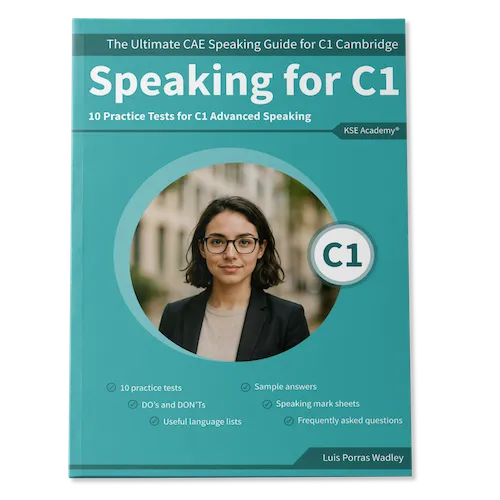
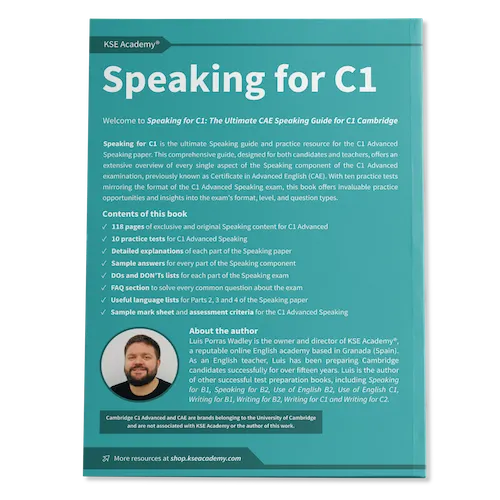
And if you’d like to practise with full tests, my book Speaking C1: The Ultimate CAE Speaking Guide for C1 Cambridge includes:
- 10 complete practice tests for C1 Advanced Speaking, with all four parts.
- Sample answers for every part, like the ones you’ve seen in this guide.
- A detailed explanation of each part, with DOs and DON’Ts lists.
- Useful language lists for Parts 2, 3 and 4.
- The mark sheet and the Speaking assessment criteria explained.
Did you find this guide useful? Share it with other students and teachers preparing for the CAE. And if you have any questions about Part 4, leave them in the comments: I read every single one.
See you in the next guide. Until then, don’t forget to keep smiling! 🙂
