
Table of contents
If you’ve ever tried to describe someone in English, tell a doctor what hurts, or work out why someone told you to break a leg right before an exam, you’ll know that body vocabulary in English comes up all the time — often without us even noticing. And no, knowing head, arm and leg simply won’t cut it. 🙂
In this guide you’ll find the vocabulary of the human body organised by area (with its pronunciation), plus the bits almost nobody teaches you: the most useful idioms with body parts, handy verbs and collocations, how to talk about aches and pains, and how to put all of this to work in your Cambridge exams. There are exercises with answers and an FAQ at the end. Let’s get started!
Parts of the body in English: the head and the face
Let’s start at the top. The head and the face are home to a huge amount of everyday vocabulary that you’ll need to describe people and to get by day to day.
| 🇬🇧 English | Pronunciation | 🇪🇸 Spanish |
|---|---|---|
| head | /hed/ | cabeza |
| face | /feɪs/ | cara |
| hair | /heə(r)/ | pelo |
| forehead | /ˈfɔːhed/ | frente |
| eye | /aɪ/ | ojo |
| eyebrow | /ˈaɪbraʊ/ | ceja |
| eyelash | /ˈaɪlæʃ/ | pestaña |
| ear | /ɪə(r)/ | oreja / oído |
| nose | /nəʊz/ | nariz |
| cheek | /tʃiːk/ | mejilla |
| mouth | /maʊθ/ | boca |
| lip | /lɪp/ | labio |
| tooth (pl. teeth) | /tuːθ/ (/tiːθ/) | diente (dientes) |
| tongue | /tʌŋ/ | lengua |
| chin | /tʃɪn/ | barbilla |
| jaw | /dʒɔː/ | mandíbula |
Watch out for a classic trap: hair is uncountable when we talk about hair in general (She has long hair), so it’s never «hairs». And remember that tooth has an irregular plural, teeth — if you enjoy these odd plurals, have a look at our post on irregular plurals in English.
The torso in English
The torso covers everything from the neck down to the waist. This vocabulary is really handy for talking about sport, health and clothes.
| 🇬🇧 English | Pronunciation | 🇪🇸 Spanish |
|---|---|---|
| neck | /nek/ | cuello |
| throat | /θrəʊt/ | garganta |
| shoulder | /ˈʃəʊldə(r)/ | hombro |
| chest | /tʃest/ | pecho |
| back | /bæk/ | espalda |
| stomach | /ˈstʌmək/ | estómago |
| belly | /ˈbeli/ | tripa, barriga |
| waist | /weɪst/ | cintura |
| hip | /hɪp/ | cadera |
Mind another common mix-up: waist (the part of your body) sounds exactly like waste (to use something badly), but the two have nothing to do with each other. 🙂
Arms and hands in English (fingers included)
Here’s some vocabulary you’ll use constantly — especially the names of the fingers, which hardly ever get taught and yet always seem to come in handy.
| 🇬🇧 English | Pronunciation | 🇪🇸 Spanish |
|---|---|---|
| arm | /ɑːm/ | brazo |
| elbow | /ˈelbəʊ/ | codo |
| wrist | /rɪst/ | muñeca |
| hand | /hænd/ | mano |
| palm | /pɑːm/ | palma |
| finger | /ˈfɪŋɡə(r)/ | dedo (de la mano) |
| thumb | /θʌm/ | pulgar |
| nail | /neɪl/ | uña |
| knuckle | /ˈnʌkl/ | nudillo |
In English, the fingers each have their own name — we don’t number them the way you might in other languages:
- thumb – pulgar
- index finger (or forefinger) – índice
- middle finger – corazón
- ring finger – anular
- little finger (or pinky) – meñique
Notice that thumb has a silent b: it’s pronounced /θʌm/, with no b at the end. It’s one of those spellings English throws in just to keep you on your toes.
Legs and feet in English
| 🇬🇧 English | Pronunciation | 🇪🇸 Spanish |
|---|---|---|
| leg | /leɡ/ | pierna |
| thigh | /θaɪ/ | muslo |
| knee | /niː/ | rodilla |
| calf (pl. calves) | /kɑːf/ (/kɑːvz/) | pantorrilla |
| ankle | /ˈæŋkl/ | tobillo |
| foot (pl. feet) | /fʊt/ (/fiːt/) | pie (pies) |
| heel | /hiːl/ | talón |
| toe | /təʊ/ | dedo del pie |
Two more with silent letters: knee (/niː/, the k is silent) and calf (/kɑːf/, where the l disappears). And yes, foot is another irregular plural: feet.
The internal organs of the human body in English
This vocabulary crops up more often than you’d think: in reading texts, in documentaries, and the moment you start talking about health.
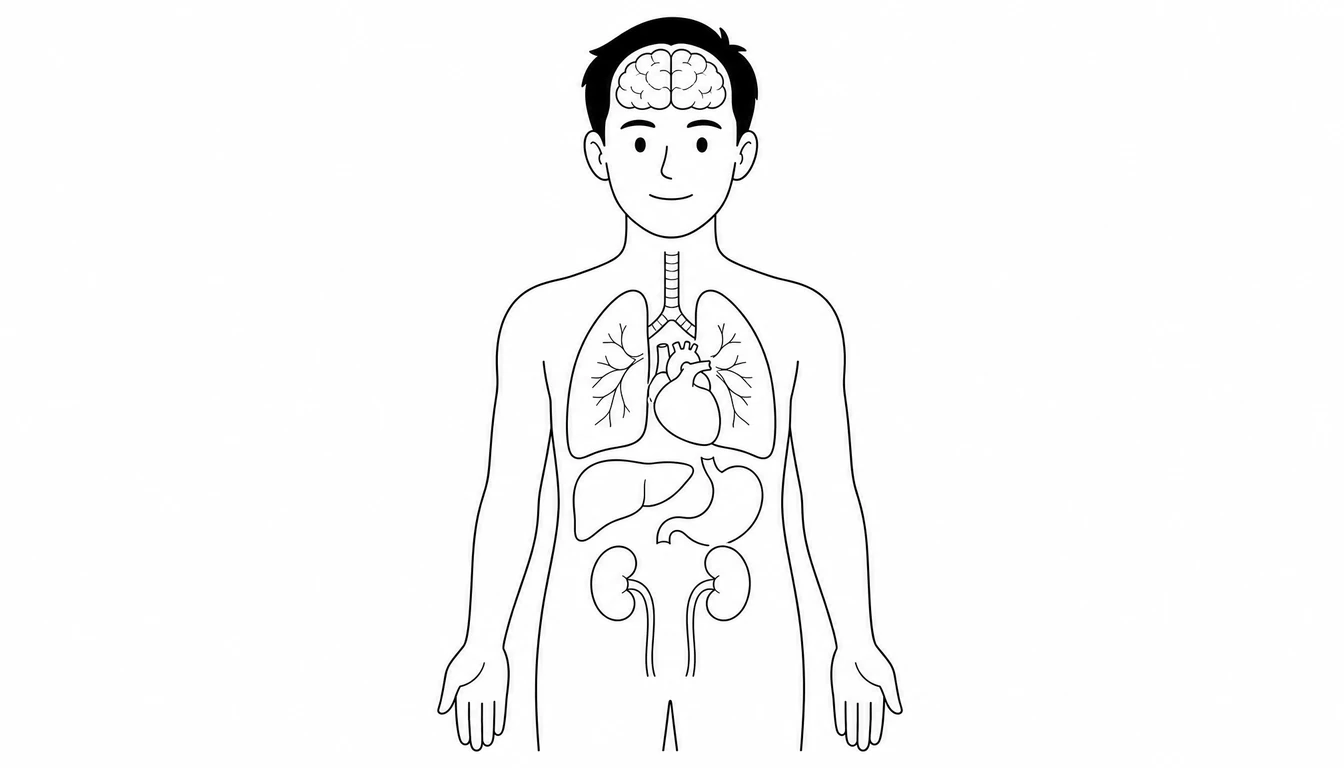
| 🇬🇧 English | Pronunciation | 🇪🇸 Spanish |
|---|---|---|
| brain | /breɪn/ | cerebro |
| heart | /hɑːt/ | corazón |
| lung | /lʌŋ/ | pulmón |
| liver | /ˈlɪvə(r)/ | hígado |
| kidney | /ˈkɪdni/ | riñón |
| stomach | /ˈstʌmək/ | estómago |
| bone | /bəʊn/ | hueso |
| muscle | /ˈmʌsl/ | músculo |
| skin | /skɪn/ | piel |
| blood | /blʌd/ | sangre |
Keep an eye on muscle /ˈmʌsl/: the c is silent. And blood is pronounced /blʌd/, to rhyme with mud, not food.
How to pronounce them: tips to avoid slip-ups
Body vocabulary is full of silent letters and sounds that don’t exist in Spanish. Hold on to these:
- Silent letters: thumb, knee, muscle, calf, wrist. Don’t pronounce them.
- The /θ/ sound (tongue between your teeth) turns up in thigh, throat, mouth, tooth and thumb. It’s not a z or a t.
- Irregular plurals: tooth → teeth, foot → feet. Don’t just add an -s.
Useful expressions and phrases with body parts
And now for the good stuff — the bit that makes the difference between sounding like a beginner and sounding natural. English is packed with expressions built around body parts, and getting to grips with them will earn you a lot of credit, especially in your Cambridge exams.
Idioms with body parts
These idioms are among the most common ones. Learn them with their meaning and an example:

| 🇬🇧 Idiom | Meaning | Example |
|---|---|---|
| to cost an arm and a leg | to be very expensive | That car cost me an arm and a leg. |
| to pull someone’s leg | to tease someone as a joke | Relax, I’m just pulling your leg! |
| break a leg | good luck! (before a performance) | You’ve got your exam today — break a leg! |
| to see eye to eye | to agree with someone | We don’t always see eye to eye, but we respect each other. |
| a pain in the neck | an annoying person or thing | Filling in these forms is a real pain in the neck. |
| to have cold feet | to get nervous and have second thoughts | He got cold feet the day before the wedding. |
| to keep an eye on | to watch or look after | Could you keep an eye on my bag for a second? |
| to be all ears | to be eager to listen | Tell me what happened — I’m all ears. |
| to get something off your chest | to share something that’s worrying you | I need to get something off my chest. |
| head over heels (in love) | completely, madly in love | She’s head over heels in love with him. |
| to have a sweet tooth | to love sugary food | I can’t say no to cake — I have a sweet tooth. |
| to give someone a hand | to help someone | Could you give me a hand with these boxes? |
Verbs and collocations with body parts
Plenty of body parts double up as verbs, too. They’re a great resource for more advanced writing:
- to face (something) – to confront it: We must face the problem.
- to shoulder (responsibility) – to take it on: She shouldered the blame.
- to head (a team / somewhere) – to lead / to go towards: He heads the department.
- to hand (something to someone) – to pass it over: Please hand me the report.
- to eye (something) – to look at it closely or longingly: The kids eyed the cake.
- to elbow (your way) – to push through: He elbowed his way through the crowd.
- to foot (the bill) – to pay for it: My company footed the bill.
Talking about aches and health (at the doctor’s)
If you travel or live in an English-speaking country, sooner or later you’ll need to explain what’s wrong. Notice how we build aches with -ache:
- I have a headache. – Me duele la cabeza.
- I have a stomachache / toothache / backache. – Me duele el estómago / una muela / la espalda.
- I have a sore throat. – Me duele la garganta.
- My leg hurts. / My arm is sore. – Me duele la pierna / el brazo.
- I feel dizzy. – Estoy mareado/a.
Body vocabulary in the Cambridge exams
As a Cambridge exam preparer, I can promise you this vocabulary turns up more than you’d expect. Let’s look at where you’ll meet it and how to make the most of it.
Describing people in the Speaking
In the Speaking — especially when you have to describe a photo — it’s very common to describe what people look like: He has short dark hair and brown eyes, She’s got broad shoulders. Pairing this vocabulary with a few personality adjectives will let you describe someone fully and naturally.
Word formation in the Use of English
In the Use of English (Part 3 at B2 and C1), many body words form word families that regularly show up in word-formation tasks:
- muscle → muscular
- health → healthy / unhealthy
- strength → strengthen
- blood → bloody / bleed
Tips for learning body vocabulary
- Label your own body. Point to each part and say the word out loud. Movement helps it stick.
- Learn in chunks, not endless lists. Study by area (face, hand, leg…) rather than 60 words in one go.
- Make idioms a priority. Learn two or three expressions a week and use them in your own sentences.
- Mind your pronunciation from the start. Pay attention to those silent letters so you don’t fossilise mistakes.
Exercises on body vocabulary in English
Put what you’ve learnt to the test. Do the exercises below and check your answers as you go. Good luck!
And if you prefer a version in text that you can copy and paste, you have it down here 👇
Exercise 1: Complete with the right body part
Complete the sentences with the correct part of the body.
- You smell with your _______________.
- You hear with your _______________.
- You bend your arm at the _______________.
- Your heart pumps _______________ around your body.
- You walk on your two _______________.
- You chew your food with your _______________.
- You wear a watch on your _______________.
- You carry a heavy rucksack on your _______________.
- You taste food with your _______________.
- You bend your leg at the _______________.
Show answers
- nose
- ears
- elbow
- blood
- feet
- teeth
- wrist
- shoulders
- tongue
- knee
Exercise 2: Complete the idiom
Complete the idioms with the correct part of the body.
- That phone cost me an arm and a _______________.
- Stop worrying, I’m just pulling your _______________.
- Tell me everything, I’m all _______________.
- They never see _______________ to _______________ on politics.
- Filling in these forms is a real pain in the _______________.
- He got cold _______________ the day before the wedding.
- I need to get something off my _______________.
- She’s _______________ over heels in love with him.
- I can’t say no to cake — I have a sweet _______________.
Show answers
- leg
- leg
- ears
- eye / eye
- neck
- feet
- chest
- head
- tooth
Frequently asked questions about body vocabulary in English
What’s the difference between finger and toe?
It’s simple: a finger is on your hand and a toe is on your foot. English always keeps the two apart.
Is hair countable or uncountable?
When we talk about hair in general it’s uncountable (She has curly hair). We only use hairs for individual strands (There’s a hair in my soup).
Why do tooth and foot change so much in the plural?
They’re irregular plurals (teeth, feet) that don’t follow the usual -s rule, so you simply have to learn them. You’ll find more of them in our post on irregular plurals in English.
Are body idioms worth learning for the exams?
Absolutely. A well-placed idiom lifts your Speaking and your Writing, and shows the kind of command of English that examiners look for at B2, C1 and C2.
Conclusion
You now have body vocabulary in English in far more depth than a plain list: organised by area, with pronunciation, idioms, verbs, health phrases and a direct line to your Cambridge exams. Now it’s over to you — pick a handful of words and expressions and start using them today.
Did you find this post useful? Share it with other English students and teachers, and subscribe to our newsletter so you don’t miss a thing. See you in the next post. Until then, don’t forget to keep smiling! 🙂
