
C1 Advanced (CAE) Speaking Part 3: Descripción, exámenes de ejemplo y frases útiles
Apréndelo todo sobre la Parte 3 del Speaking del C1 Advanced de Cambridge. Descripción, respuestas de ejemplo y todo el contenido en PDF para descargar.

Tabla de contenidos
Ya te he contado todo sobre las Partes 1 y 2 del CAE Speaking, así que en este artículo me centraré más específicamente en la Parte 3 del CAE Speaking. Al hacerlo, daré una descripción completa de esta parte, que, junto con la Parte 2 del C1 Speaking, es la parte más popular del examen. Como veremos en los próximos párrafos, ambos candidatos deben trabajar juntos para tener éxito en esta parte de la prueba.
Descripción de la Parte 3 del CAE Speaking
La Parte 3 del CAE Speaking es la principal tarea colaborativa del examen C1 Advanced. En esta parte, tú y tu compañero recibís un tema en forma de pregunta y algunas ideas relacionadas con él. A continuación, se espera que desarrolléis una discusión de dos minutos sobre el tema, utilizando las ideas proporcionadas (opcional). Cuando los dos minutos terminen, se os pedirá que toméis una decisión con respecto al tema. Tendréis un minuto más para hacerlo. [amazon box=»1913825442″ description=»Get your copy of Speaking CAE to gain access to 10 complete C1 Advanced (CAE) Speaking Tests and many more things: description of each part, sample answers, guidance for every part, mark sheet, author comments and tips, etc.»]
Tiempo de la Parte 3 del C1 Advanced Speaking
Aunque ya he mencionado el tiempo en la sección anterior, veamos una descripción más específica de cómo se lleva a cabo esta parte y cuánto tiempo se supone que dura:
- Instrucciones del examinador (total): 1 minuto
- Discusión en pareja de las opciones: 2 minutos (3 minutos para grupos de 3 candidatos)
- Llegar a una conclusión: 1 minuto
- Tiempo total: 4 minutos
Y ahora que sabemos exactamente cuánto dura, pasemos a las instrucciones de este examen, para que sepas exactamente qué esperar el día del examen. Y no hay mejor manera de hacerlo que con un ejemplo de la Parte 3 del C1 Advanced Speaking.
Ejemplo de la Parte 3 del CAE Speaking
Prueba de ejemplo de la Parte 3 del C1 Advanced Speaking: Instrucciones iniciales del examinador
– Interlocutor: Now, I’d like you to talk about something together for about two minutes.
Here are some things people think about when moving to a different country for work and a question for you to discuss. First you have some time to look at the task.
(El examinador coloca la siguiente imagen frente a vosotros y os da 15 segundos para leer la pregunta y estudiar las opciones).
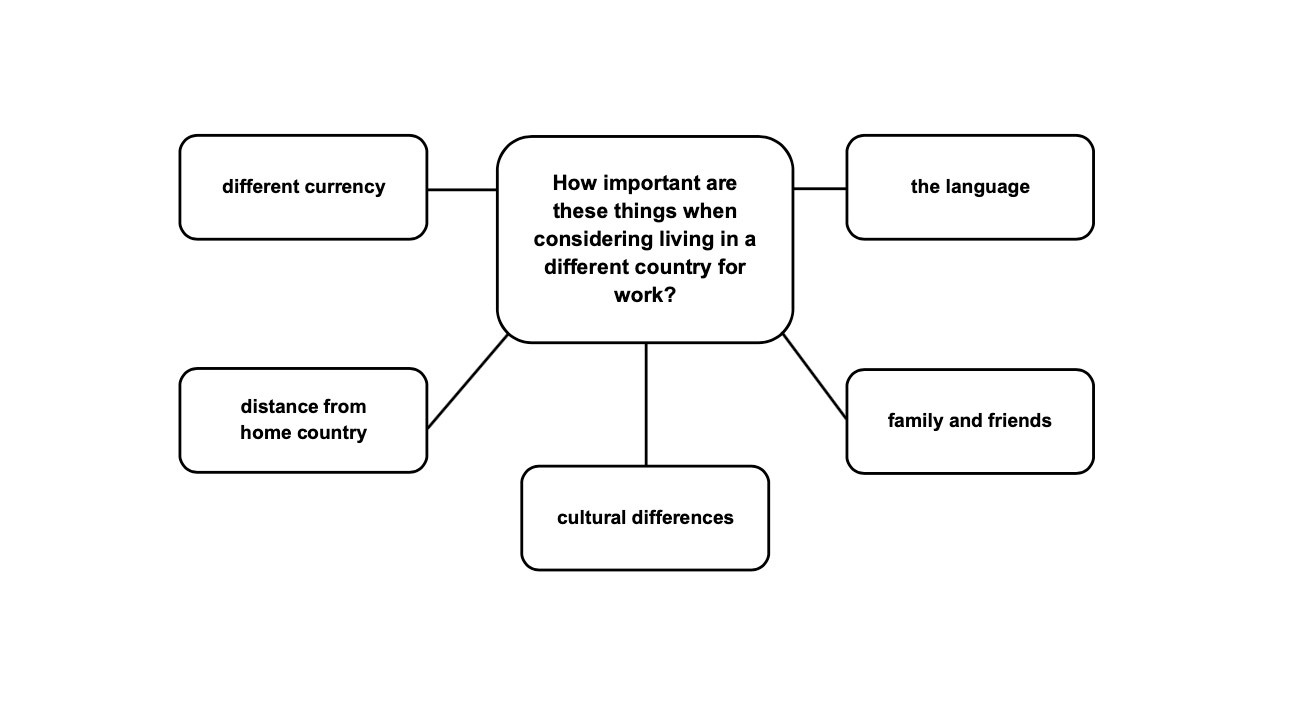
– Interlocutor: Now, talk to each other about how important these things are when considering living in a different country for work.
– Candidate A: Would you like to begin, or shall I?
– Candidate B: You can go first. Go ahead.
– Candidate A: Cheers. While moving abroad, it’s important to keep in mind the distance between your own country and the one you’re moving to. That’s gonna affect your cost to come home on vacation, as well as the time difference when you’re calling your friends and family back home. Would you agree?
– Candidate B: That’s an excellent point. You’re right, I guess I hadn’t given that much thought at first. Since you mentioned it, I think your family and friends also need to be considered. I don’t know about you, but I’m pretty sure it’s easier to move somewhere where you already know some people. What do you think?
– Candidate A: Sure, that’d make it so much easier. I know it’s hard to leave your loved ones behind. Let’s talk about the language now, as this is probably one of the most important things to bear in mind about before moving abroad. Don’t you think it would be nuts to move abroad for work if you can’t speak the language?
– Candidate B: Oh yeah, sure. Yeah. If you are moving for work, you should learn the language of the country you are moving to. What about the differences in currency and culture? Do you consider them to be important?
– Candidate A: Having to operate in another currency is not a big deal, because you can pick it up in a few days, but cultural differences… that’s another story, wouldn’t you say?
– Candidate B: Yes, definitely. Culture is such a broad concept that it takes years to get accustomed to a new one. Therefore, I think it’s worth getting to know a country’s culture before moving there. Well, that’s my philosophy anyway.
Prueba de ejemplo de la Parte 3 del C1 Advanced Speaking: Segundo conjunto de instrucciones del examinador
Cuando pasen los primeros dos minutos, el examinador interrumpirá la conversación anterior para decir:
Thank you. Now you have about a minute to decide which aspect is the least important when moving to a different country for work.
– Candidate A: Okay… what are your thoughts? Which one do you think is the least important?
– Candidate B: Well, I believe we have already discussed it. To my mind, the currency is not something you should be concerned about before moving to another country. Once you start using it, you will quickly become familiar with it; you will just need to keep it in mind before your trip so that you can exchange some money beforehand. How do you feel about that? Do you agree?
– Candidate A: Yeah, I do. It’s just one of those aspects of living abroad that you get used to very quickly. And it’s not as important as other aspects like language or cultural differences, right?
– Candidate B: Yes, exactly. So, shall we agree on this one?
– Candidate A: Yes, sure. We have an agreement.
Prueba de ejemplo de la Parte 3 del C1 Advanced Speaking: Instrucciones finales del examinador
Thank you. Can I have the booklet, please?
Observaciones básicas para la Parte 3 del C1 Advanced (CAE) Speaking
En la tarea de ejemplo anterior, notarás las siguientes características de la Parte 3 del CAE Speaking:
- En lugar de hablar solo, los candidatos deben interactuar entre sí.
- Expresar y pedir opiniones es importante, al igual que estar de acuerdo y en desacuerdo con el otro candidato y ser capaz de cambiar de tema.
- La pregunta del examinador está impresa en el cuadernillo que coloca delante de los candidatos.
- No se requiere que los candidatos discutan todas las opciones del cuadernillo, pero se les anima a hacerlo.
- Los candidatos deben compartir sus opiniones y hacer preguntas durante la discusión.
- Llegar a un acuerdo con tu compañero es aconsejable, pero no esencial ni un requisito del examen.
- Los candidatos deben demostrar al examinador que están discutiendo y trabajando para llegar a una decisión final, incluso si no se llega a un acuerdo.
[amazon box=»1913825442″ description=»Get your copy of Speaking CAE to gain access to 10 complete C1 Advanced (CAE) Speaking Tests and many more things: description of each part, sample answers, guidance for every part, mark sheet, author comments and tips, etc.»]
Parte 3 del CAE Speaking: Frases útiles para participar en una discusión
En esta sección, echaremos un vistazo a algunas frases y expresiones útiles que puedes usar en cualquier discusión como la de esta parte del C1 Speaking. Como suelo hacer, las he dividido según los diferentes usos: iniciar una discusión, expresar y pedir opiniones, estar de acuerdo, estar en desacuerdo, cambiar de tema y concluir.
Para iniciar una discusión
- Shall I start? / Yeah, go on.
- Shall I go first? / Of course, go ahead.
- Is it okay if I start? / Sure, no problem.
- Would you like to go first? / Yes, why not?
Para expresar opiniones
- I believe/think that…
- In my opinion,…
- The way I see it,…
- If you ask me,…
- I would say that…
- It seems to me that…
- In my view…
- As far as I’m concerned,…
Para pedir opinión
- statement, don’t you think/agree?
- statement, wouldn’t you say so?
- statement , wouldn’t you agree?
- statement, right?
- Do you think…?
- Do you believe that…?
- What do you think about…?
- How about…?
- What about…?
- What’s your take on…?
Para estar de acuerdo
- I (totally) agree with you.
- You’re dead right.
- That’s (absolutely) true.
- You’re (absolutely) right.
- That’s a great idea.
- I couldn’t agree more.
- Yes, I see what you mean.
- I see it that way, too.
- Yes, of course.
- I think so, too.
Para estar en desacuerdo
- I’m afraid I don’t see it the same way.
- I’m sorry but I have to disagree.
- You may be right, but I have a different view.
- That might be true, but I’m not sure I agree with you.
- I’m sorry, but I don’t agree.
Para pasar a otro tema
- As for + one of the options
- As to + one of the options
- In relation to + one of the options
- As regards + one of the options
- Regarding the question of the task,
- With regard to + paraphrased question
Para concluir la discusión
- I believe we have an agreement, don’t we?
- So, do we have an agreement?
- Shall we stick to…?
- Shall we agree on..?
[amazon box=»1913825442″ description=»Get your copy of Speaking CAE to gain access to 10 complete C1 Advanced (CAE) Speaking Tests and many more things: description of each part, sample answers, guidance for every part, mark sheet, author comments and tips, etc.»]
Los 10 mejores consejos para la Parte 3 del CAE Speaking
- Ten una discusión clara, no 2 monólogos: Muchos candidatos creen que cuanto más hablan, mejor. Sin embargo, aquí no es así. Como regla general, lo que dices es lo que cuenta, y en esta sección, deberías estar discutiendo en lugar de hablar solo.
- Justifica tus opiniones: Justificar tus opiniones es tan importante como expresarlas. Además de mostrar al examinador que eres capaz de justificar tus opiniones en inglés, también proporcionas a tu compañero material útil para el resto de la discusión. Digamos que tus justificaciones ayudan a guiar la discusión.
- Intenta hablar sobre todas las opciones: Aunque no es un requisito, si te basas exclusivamente en una opción, tendrás menos posibilidades de demostrar tu habilidad para interactuar con otros. Es por esta razón que siempre recomiendo saltar de una opción a otra, para que tengas múltiples oportunidades para estar de acuerdo, en desacuerdo y expresar tus opiniones.
- Trabaja con tu compañero: No debes ver a tu compañero como un enemigo. Es importante que lo veas como un aliado, ya que seréis evaluados por separado.
- Ayuda a tu compañero: Si tu compañero tiene dificultades para encontrar las palabras o ideas adecuadas para expresarse, puedes echarle una mano ofreciendo algunas ideas o palabras que crees que está intentando expresar. Además de ser útil para la conversación en sí misma, esto también demostrará al examinador que tienes buenas habilidades de comunicación.
- Mejora tus habilidades de interacción: Una gran parte de la puntuación en esta sección del examen oral está determinada por tu capacidad de interacción, lo que significa que necesitas pedir opiniones a tu compañero y ser capaz de estar de acuerdo o en desacuerdo con ellas. Por lo tanto, si deseas impresionar al examinador, debes familiarizarte con un conjunto de expresiones. Así que haz todo lo posible para evitar los típicos «What do you think about…?» o «I agree/disagree», y opta por algo un poco más avanzado, como «wouldn’t you agree?», o «I’m afraid I don’t hold the same opinion.»
- Mantén tus intervenciones cortas: Es importante tener en cuenta que estamos debatiendo diferentes opciones con el otro candidato, no recitando un monólogo. Si hablas durante 60 segundos continuamente, no estás interactuando, lo que indica una falta de habilidades de comunicación.
- Cíñete al tema: Asegúrate de mantenerte en el tema y responde exactamente lo que el examinador ha preguntado.
- Termina tus afirmaciones con una pregunta o una question tag: Una forma natural de mantener la conversación fluida es concluir tus afirmaciones con una pregunta, que es el propósito principal de la Parte 3 del Speaking.
- Dirígete a tu compañero: Ten en cuenta que estás teniendo una conversación con alguien, es decir, tu compañero. En otras palabras, cuando hables, presta atención a tu compañero en lugar de al examinador.
Consejo adicional
- Sé educado y sonríe: Te sorprendería lo que los humanos pueden lograr con la educación y una sonrisa. Al mantener una actitud positiva y alegre, causarás una impresión más favorable en los examinadores y en tu compañero, además de convertirte en un comunicador más eficaz.
[amazon box=»1913825442″ description=»Get your copy of Speaking CAE to gain access to 10 complete C1 Advanced (CAE) Speaking Tests and many more things: description of each part, sample answers, guidance for every part, mark sheet, author comments and tips, etc.»]
Video de una Parte 3 real del FCE Speaking
Es bueno ver una prueba real, así que aquí tienes la tercera parte del examen CAE Speaking. Pero recuerda, estos candidatos no son perfectos, ¡así que aprende de sus errores en lugar de cometer los tuyos!
Si disfrutaste de esta publicación, ¡por favor comenta y comparte! Y no olvides mantenerte al día con las últimas noticias de KSE Academy siguiéndome en Facebook, Twitter y YouTube.
And don’t forget to keep smiling!