
C1 Advanced (CAE) Speaking Part 1
Descubre todo lo que necesitas saber sobre la Parte 1 del Speaking del C1 Advanced. Lee ejemplos reales y descarga todas las respuestas en PDF.

Tabla de contenidos
En este artículo, me voy a centrar en la Parte 1 del examen oral (Speaking) del C1 Advanced (CAE). Como estoy seguro de que ya sabes, cada parte del examen C1 Advanced se divide en diferentes secciones, por lo que creo que es importante ofrecer una descripción detallada de cada una de ellas. Aquí aprenderás todo lo que necesitas saber sobre la Parte 1 del Speaking del CAE y verás algunos ejemplos y consejos para tener éxito en esta parte del examen.
Descripción de la Parte 1 del Speaking del CAE
La Parte 1 consiste en una serie de preguntas que el examinador (Interlocutor) hará a los candidatos. Estas preguntas tratan principalmente sobre los antecedentes y experiencias de los candidatos, así como sus gustos y aversiones. Aquí tienes un ejemplo de las preguntas que el examinador tiene delante para hacer a los candidatos:
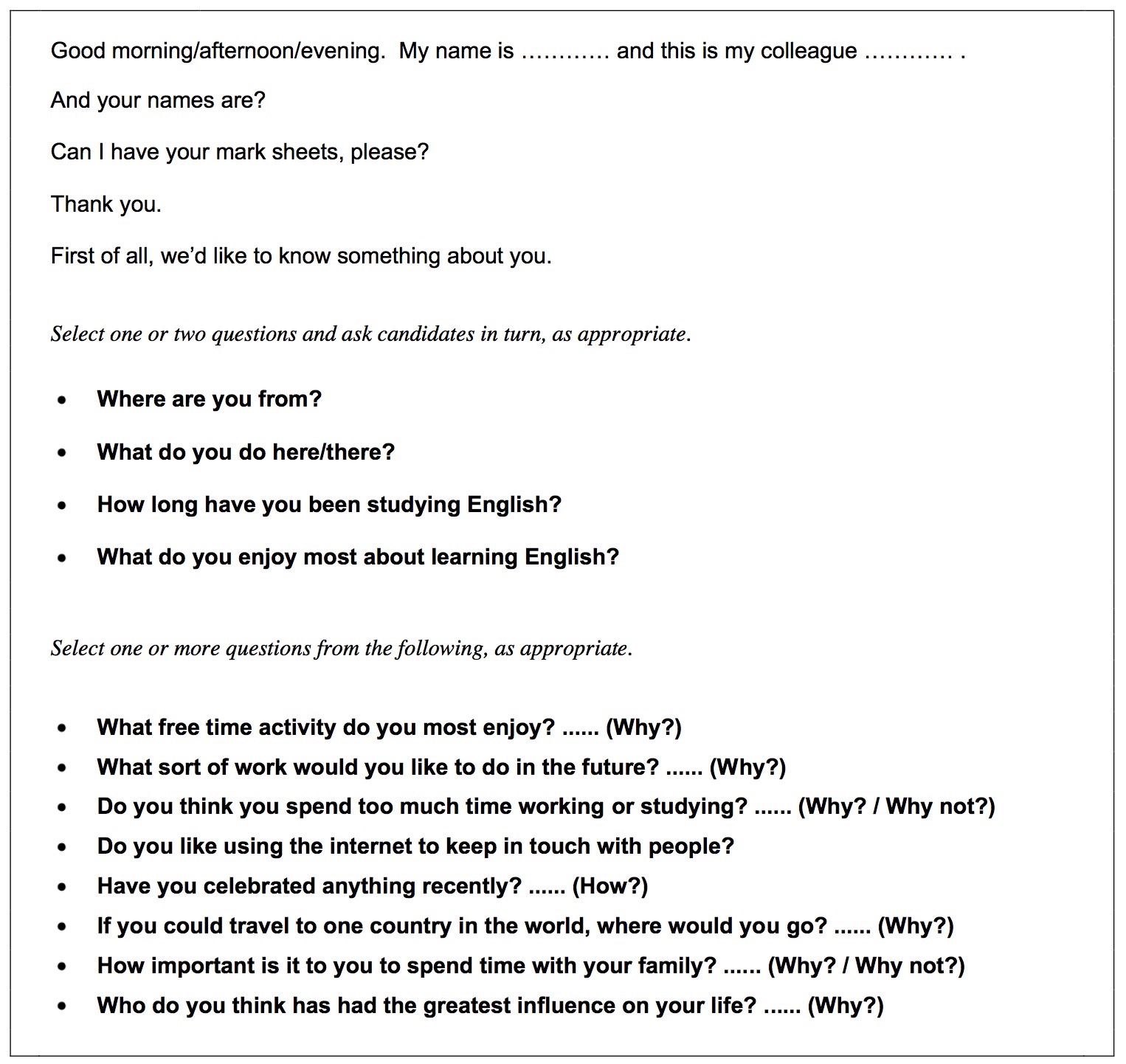
Observa lo siguiente:
- El Interlocutor comenzará presentándose, preguntará vuestros nombres y luego pedirá vuestra hoja de examen (mark sheet). Esta es un trozo de papel con vuestros datos que os entregarán al llegar al lugar del examen.
- Luego pasarán a un conjunto de cuatro preguntas básicas, de las cuales harán una o dos por candidato. Estas preguntas son siempre las mismas en cada examen.
- Finalmente, el examinador hará una o dos preguntas más del último conjunto. Estas preguntas, a diferencia de la Parte 1 del B2 First (FCE), no están divididas en categorías temáticas, sino que están mezcladas sin ningún criterio particular.
Después de esto, la prueba continuará sin interrupciones con la Parte 2 del Speaking del CAE.
[amazon box=»1913825442″ description=»Get your copy of Speaking CAE to gain access to 10 complete C1 Advanced (CAE) Speaking Tests and many more things: description of each part, sample answers, guidance for every part, mark sheet, author comments and tips, etc.»]
Tiempo
La Parte 1 del Speaking del CAE está pensada para durar alrededor de 2 minutos, lo que incluye las preguntas a ambos candidatos. Dado lo corta que es esta parte, significa que no es necesario extenderse mucho en las respuestas. Esta parte es una especie de rompehielos que sirve como introducción al resto de la prueba. Sin embargo, la habilidad que muestres en esta parte es tan importante como en el resto del examen.
Temas de la Parte 1 del Speaking del C1
Según el Marco Común Europeo de Referencia para las Lenguas (MCERL),
Puede expresarse con fluidez y espontaneidad, casi sin esfuerzo. Tiene un buen dominio de un amplio repertorio léxico que le permite superar fácilmente las lagunas con circunloquios. Hay poca búsqueda obvia de expresiones o estrategias de evitación; solo un tema conceptualmente difícil puede dificultar un flujo lingüístico natural y fluido.
Habiendo leído esto, podemos concluir que, debido a la competencia lingüística esperada en el nivel C1, cualquier tema razonable puede aparecer en una prueba de C1. Ya no estamos limitados por las restricciones de B1 o B2 a situaciones cotidianas. Aquí tienes una lista completa de temas para la Parte 1 del Speaking del C1:
- Future ambitions, plans and life goals
- Friends, family and social life
- Holidays & travel
- Habits and personalities
- Free time and leisure activities: art, sports, cooking, reading, films, TV, music, celebrations, etc.
- Animals and pets
- Countries and cities
- Culture and traditions
- School, college and university
- Careers and work
- Language learning
- The Internet and new technologies
- Etc.
Como puedes ver, hay una gama súper amplia de temas que podrían aparecer en el examen. Y eso se debe a que estamos hablando de C1, uno de los niveles más altos de competencia lingüística que existen.
Lista de Ejemplos de Preguntas de la Parte 1 del Speaking del C1
La siguiente es una lista de preguntas que podrías encontrar en la Parte 1 del C1 Advanced Speaking Test:
- How do you most enjoy spending your free time?
- How have your ambitions changed in the last few years?
- Do you still have the same friends you had when you were a child?
- Where would you like to go on your next holiday? …… (Why?)
- Do you consider yourself a risk-taker? …… (Why? / Why not?)
- Does music play an important role in your life? …… (Why? / Why not?)
- When was the last time you celebrated something important?
- Where do you see yourself in ten years’ time?
- What’s the most interesting thing you have done lately?
- Can you tell us about something you have done that you’re really proud of?
- What’s the best thing about the area where you live? …… (Why?)
- Do you prefer to go on holiday with family or with friends? …… (Why?)
- Are you an avid reader? …… (Why? / Why not?)
- How do you think learning a foreign language can help you?
- What was your favourite subject at school/college? …… (Why?)
- What person has had the greatest influence on your life? …… (Why?)
Esta lista de preguntas ha sido tomada de dos de los exámenes de mi libro, Speaking CAE, del cual estoy muy orgulloso.
[amazon box=»1913825442″ description=»Get your copy of Speaking CAE to gain access to 10 complete C1 Advanced (CAE) Speaking Tests and many more things: description of each part, sample answers, guidance for every part, mark sheet, author comments and tips, etc.»]
Preguntas y Respuestas de la Parte 1 del Speaking del C1 en PDF
Aquí tienes una lista de ejemplos de preguntas y respuestas para la Parte 1 del examen de Speaking del C1 Advanced. Siéntete libre de descargar una copia en PDF de estas preguntas aquí.
- How do you most enjoy spending your free time?
I’m a pretty avid reader, so I like to read anything that I can get my hands on. Lately, I’ve been reading the Lord of The Rings series. - How have your ambitions changed in the last few years?
When I was a kid, I really wanted to be a flight attendant like my mom. However, in the last 10 years, I’ve realized it wouldn’t be a good fit for me. At the moment, I’m trying to figure out a career that would make me happy, but I’m still not sure what that is! - Do you still have the same friends you had when you were a child?
Yes, fortunately, I’ve kept the best friends that I’ve had since I was a child. Those are the few friends that are there for me when I need them, no matter what. - Where would you like to go on your next holiday? …… (Why?)
I would love to go to South America. I’d like to visit some countries like Argentina, Peru, or Brazil. I think South America has a lot to offer in terms of cultural heritage and natural wildlife. - Do you consider yourself a risk-taker? …… (Why? / Why not?)
Well, I would consider myself an adventurous guy, yes, but maybe not a risk-taker. I always try new things and I like to learn about new places and live new experiences, but not necessarily taking risks. - Does music play an important role in your life? …… (Why? / Why not?)
Yes, it does. Music is one of the most beautiful and powerful things in this world. It can bring joy, love, sadness, and even happiness to people. And I love it! - When was the last time you celebrated something important?
A few months I completed my degree in Engineering, and that was a big day for me, so I celebrated with friends and family. - Where do you see yourself in ten years’ time?
I’m not sure, to be honest. But I hope to have a job I’m content with and, maybe, married and with kids. Who knows? - What’s the most interesting thing you have done lately?
I recently started my own company, which has been interesting and extremely challenging. - Can you tell us about something you have done that you’re really proud of?
I really take pride in my children. They’re really smart and hardworking and I like to think that I have something to do with that. - What’s the best thing about the area where you live? …… (Why?)
The best think about Granada is that it’s a very manageable city. I mean, you can walk anywhere, nothing is too far and it’s a rather inexpensive place to live in. - Do you prefer to go on holiday with family or with friends? …… (Why?)
I’d say probably with friends. My family and I don’t see eye to eye on many things, so when we’re on holiday there’s a good chance that we will quarrel about where to go and what to do. - Are you an avid reader? …… (Why? / Why not?)
Oh, yes. I think reading is one of the most entertaining activities you can do. In my case, once I open and start a good novel, I simply cannot put it down. - How do you think learning a foreign language can help you?
Well, learning a language has many advantages, but I’d say that getting to know a different culture from your own is probably the greatest thing about it. - What was your favourite subject at school? …… (Why?)
I used to enjoy math, which was strange, as most of my friends hated it. I think it felt good to understand it, solve problems and so on. - What person has had the greatest influence on your life? …… (Why?)
Probably, my dad. His unconditional support throughout every stage of my life has really had an impact on the way I see life and cope with problems nowadays. He’s the best.
Consejos Principales para Responder a las Preguntas de la Parte 1
Ahora que hemos visto exactamente lo que tienes que hacer en la Parte 1 del Speaking del CAE y algunos ejemplos de preguntas y respuestas, te daré algunos consejos para tener éxito en esta parte del examen. ¿Preparado? ¡Vamos!
- Calienta antes del examen: Si bien la Parte 1 es una especie de rompehielos para introducir el resto del examen, es tan corta que realmente no servirá como calentamiento. Por esta razón, siempre recomiendo calentar con tu compañero o con otra persona antes de entrar en la sala de examen. Probablemente sea suficiente con simplemente iniciar una conversación con tu compañero unos minutos antes de comenzar la prueba. Esto será útil de dos maneras: (1) conoces a tu compañero si aún no lo conocías, lo que siempre hará que ambos os sintáis más cómodos; y (2) entras en ambiente para hablar en inglés y reduces las posibilidades de quedarte atascado intentando pensar una palabra en el examen real.
- Practica preguntas comunes, pero no memorices respuestas: Los examinadores no son tontos y saben perfectamente cuándo alguien está soltando una respuesta preparada, lo cual, a este nivel, suena simplemente ridículo. Además de eso, tan pronto como se den cuenta, el Interlocutor probablemente te interrumpirá, lo cual puede ser un poco desagradable. Por lo tanto, sugiero encarecidamente que practiques preguntas como las proporcionadas en esta publicación, pero, por favor, no pierdas el tiempo memorizando discursos para el examen.
- Da respuestas detalladas, pero no demasiado largas: Como se mencionó anteriormente, esta parte está pensada para durar SOLO 2 minutos, por lo que no hay tiempo que perder. Mi consejo es entonces que respondas a la pregunta proporcionando algunos detalles o justificaciones, pero sin intentar hablar más de lo necesario. El Interlocutor cortará tu respuesta tan pronto como sienta que estás hablando demasiado.
- Cíñete al tema: Esto tiene que ver con el punto anterior. Si te ciñes al tema, será más fácil dar una respuesta relativamente breve a la pregunta. De lo contrario, podrías terminar hablando de cosas no relacionadas que los examinadores no quieren oír.
- Sé y suena natural: Esta parte es una simple conversación/entrevista, así que intenta relajarte, responde sinceramente y suena lo más natural posible. Los examinadores también son personas y quieren que te sientas cómodo y seas tú mismo.
- Sé educado y sonríe: ¡Sonreír puede llevarte lejos! Todo el mundo se siente más relajado a tu alrededor cuando sonríes, eso se aplica tanto a tu compañero como a los examinadores, así que asegúrate de sonreír ampliamente.
- Presta atención a tu compañero: No solo es educado, sino también útil. A veces, las respuestas de tu compañero pueden ayudarte a responder tus propias preguntas. Y suena genial cuando enlazas tus respuestas con las de tu compañero, ya que demuestra que tienes la habilidad suficiente para hacerlo.
- Termina tus respuestas: No queda bien cuando oyes a un candidato empezar con una gran respuesta y luego no saber cómo terminarla correctamente porque se le acabaron las cosas que decir o se quedó atascado con alguna palabra. Desafortunadamente, es bastante común. Así que asegúrate de terminar tu respuesta y dejar a los examinadores con una buena impresión.
Parte 1 Real del Speaking del C1 Advanced (CAE)