
Table of contents
If you’re taking the PAU in Extremadura (formerly the EBAU, or selectividad), the UEx English exam changes in 2027. You no longer choose between two texts, the open questions are gone and there’s a brand-new question: writing a dialogue or monologue based on an image, as if you were on the phone with a friend. The composition is also longer: it’s now between 140 and 180 words.
In this guide I explain what the Extremadura PAU English exam is like, based on the official 2026-2027 model exam, assessment criteria and marking criteria: what you have to do in each question, how much it’s worth, what loses you marks, how the composition is marked, how to manage your time, and a worked example of the new question. All explained from my experience preparing students for official exams. Let’s get started! 🙂
If you’re looking for an overview of the test (what the PAU is, how much English counts towards your mark or what level you need), you’ll find it in my guide to the PAU English exam.
What the Extremadura PAU English exam is like
The Lengua Extranjera II: Inglés exam lasts 90 minutes, is marked out of 10 and has one text of about 500 words and five questions, grouped into three blocks:
| Question | Marks | What you have to do |
|---|---|---|
| 1. True or false | 2 | Decide whether 4 statements are true or false and quote the part of the text that justifies your answer. |
| 2. Vocabulary | 1.5 | Find 3 words in the text: from a definition, a synonym and an antonym. |
| 3. Composition | 3 | Choose one of two topics and write between 140 and 180 words. |
| 4. Multiple choice | 2 | Complete 4 sentences by choosing the grammatically correct option. |
| 5. Dialogue or monologue | 1.5 | Write a conversation or monologue of about 70-80 words based on an image. |
Questions 1 and 2 are about understanding texts; question 3 is about producing texts; and questions 4 and 5 test your linguistic repertoire. You have to answer every question, always in English, and the only thing you choose is the composition topic. The text is usually an adapted newspaper article: in the 2027 model, a BBC report on a wildfire in Almería and climate change.
What’s changed since 2026
If you’ve seen papers from previous years, be careful, because the format is different. The new model follows the harmonisation criteria agreed by CRUE (the Spanish universities’ association) for the whole country:
| Up to 2026 | From 2027 | |
|---|---|---|
| Texts | Two, choose one | Just one |
| Open questions | Yes, 2 of 3 (2 marks) | No |
| Vocabulary | 3 words (1.5 marks) | 3 words (1.5 marks) |
| Multiple choice | 3 sentences (1.5 marks) | 4 sentences (2 marks) |
| Composition | 120-150 words | 140-180 words |
| Dialogue or monologue | No | Yes (1.5 marks) |
Old papers are still useful for practising true or false, vocabulary, multiple choice and the composition, but you’ll need to prepare question 5 separately.
Question 1: True or false (2 marks)
You get 4 statements and you have to say whether they’re true or false, quoting the part of the text that proves it. Each one is worth 0.5 marks, and the marking criteria are very specific:
- Correct TRUE or FALSE with the right quotation: 0.5 marks.
- Wrong TRUE or FALSE, but with the right quotation: 0.25 marks.
- Correct TRUE or FALSE, but with no quotation or one that doesn’t match: 0 marks.
- A quotation much longer than needed: 0 marks, because it shows you haven’t found the information.
You can simply quote the text, although the criteria also accept your own words as long as the answer is clear. Here’s an example with an extract written for this guide:
The town council has decided to shut the old swimming pool next summer. Instead, it plans to build a modern sports centre, which will open in 2028.
Statement: The new sports centre will be ready next summer.
- ✅ FALSE. «It plans to build a modern sports centre, which will open in 2028.» (0.5 marks)
- ⚠️ TRUE. «It plans to build a modern sports centre, which will open in 2028.» (right quotation, wrong answer: 0.25 marks)
- ❌ FALSE. (no quotation: 0 marks)
My tips: copy only the sentence that proves it, in inverted commas, and be wary of absolute words (all, only, never, always), which are often what makes a statement false. In the official model, for example, The victims were all Spaniards was false because the text says most of them were foreign nationals.
Question 2: Vocabulary (1.5 marks)
You have to find 3 words in the text, worth 0.5 marks each: usually one from a definition, an antonym and a synonym. The rules:
- Write a single word. If you write more than one, the answer gets 0, even if one of them is right.
- If you make an obvious copying slip (a single consonant instead of a double one) or write the word in a different form (a plural instead of a singular, another verb tense), you get 0.25.
Using the extract above:
| You’re asked for | Answer from the text |
|---|---|
| A word for this definition: the group of people who govern a town. | council |
| A synonym for close (verb). | shut |
| An antonym for old-fashioned. | modern |
The trick is to pay attention to the word class: if you’re given an adjective, look for an adjective; if the definition starts with a person who… or a period of…, look for a noun. In the official model, a prolonged period of abnormally hot weather was heatwave.
Question 3: Composition (3 marks)
You’re given two topics and you choose one. The composition must be between 140 and 180 words, and the text type depends on the task: the criteria mention letters, reports, proposals, opinion articles and short stories. In the 2027 model, the two options were these:
- What can citizens and governments do to prevent wildfires?
- Write a story that ends with the words «When Tom saw the fire truck, he felt relieved.»
One of the two topics is usually related to the text, so the reading gives you ideas and vocabulary. But be careful: don’t copy whole sentences from the text, because it’s penalised.
How the composition is marked
The mark is split into two halves of 1.5 marks:
- Coherence, cohesion and suitability to the topic and the style of text required.
- Grammatical, lexical and spelling accuracy, and presentation.
The examiner compares your text with four descriptions (3, 2, 1 and 0 marks) and can adjust the mark by adding or taking away 0.25 or 0.5:
| Mark | What the composition is like |
|---|---|
| 3 marks | Clear and coherent, with well-used linkers, enough vocabulary to develop the ideas, no serious grammar mistakes, good punctuation and paragraphs, no spelling mistakes and legible handwriting. |
| 2 marks | Clear and coherent, although some cohesion is missing or there are too many linkers. There are some mistakes, but they don’t stop you understanding the ideas and aren’t direct translations from Spanish. |
| 1 mark | Disconnected sentences with no linkers or paragraphs, not enough vocabulary, and mistakes that make it hard to understand and are often direct translations from Spanish. |
| 0 marks | Far fewer words than required, Spanish words, mistakes that make the text incomprehensible, illegible handwriting or an answer unrelated to the question. |
On top of that, there are specific penalties worth knowing:
- For length: 0.25 marks off for every 10 words too few or every 40 words too many.
- For the given sentence: if you’re given the sentence the text has to start or end with (like the story in the model) and you put it somewhere else, you lose 0.5 marks.
- For memorised phrases or long chunks copied from the text that replace your own words.
- For writing both compositions: only the first one is marked.
You’ll find worked examples of the composition types that can come up in my other guides: an opinion essay in the Andalusia guide, a formal email in the Murcia guide, a narrative in the Valencian Community guide, a problem-solution essay in the Castile and León guide and an article in the Galicia guide.
Question 4: Multiple choice (2 marks)
There are 4 sentences related to the topic of the text, worth 0.5 marks each, with four options. You have to choose only one: if you mark more than one, you get 0, even if one of them is right. And if two options were grammatically possible, the right one is the one that matches the information in the text.
They test Bachillerato grammar. The 2027 model included unless, the present perfect continuous (have been rising), a dependent preposition (suffer from) and the past perfect passive (had been caused). Here’s an example written for this guide:
I’ll lend you my bike ______ you promise to bring it back tomorrow.
a. unless b. as long as c. despite d. so that
The answer is b: as long as expresses a condition (I’ll lend it to you provided you bring it back). Unless would mean the opposite, and despite can’t go before a clause with a subject and a verb. If you want to revise these structures, have a look at my guides to conditional sentences and reported speech.
Question 5: Dialogue or monologue (1.5 marks)
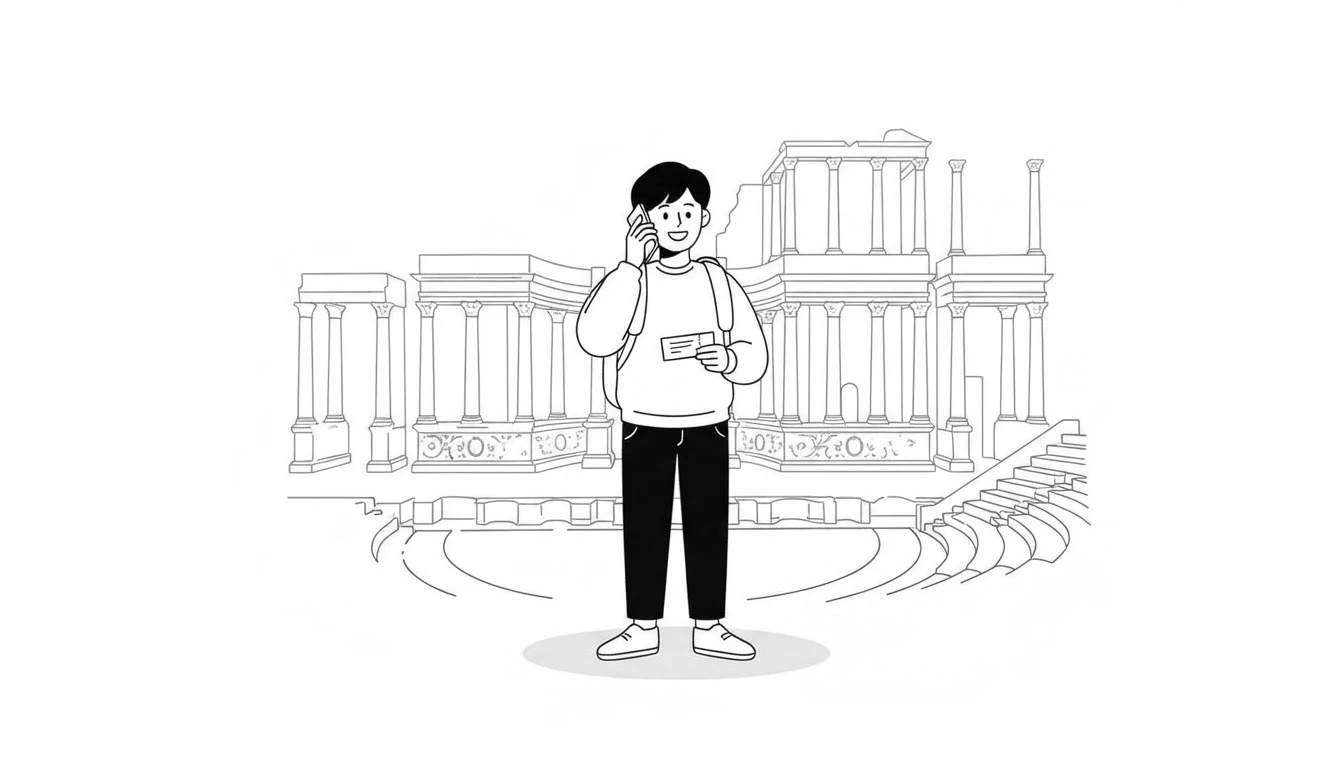
This is the big new feature for 2027. You’re given an image with information in English (a concert ticket, a hotel booking, a timetable, a map…) and a situation, and you have to write a dialogue or monologue of about 70-80 words, in direct speech. This question assesses how well you simulate spoken interaction and mediation: using the information in a document to deal with a real-life situation.
The examiners look at length, grammatical accuracy, coherence, how natural it sounds and how specific you are. And there are two rules you mustn’t forget:
- You have to use the information in the image explicitly (dates, times, prices, places…).
- Names must be obviously made up, as in the rest of the PAU: not your real name or your classmates’ names.
The UEx has published a guideline list of situations: organising an outing, making or changing an appointment, booking accommodation, asking for and giving directions, negotiating prices, giving instructions, comparing options… Practise with tickets, posters, timetables and menus.
Dialogue example with answers
Situation (written for this guide): the image is a poster for your town’s science museum, which says: Dinosaur Exhibition · Saturday · Free entry · 10:00-18:00 · Guided tour at 12:00 · Café on the top floor. The task: Write a telephone conversation with a friend in which you make plans to visit the exhibition.
A: Hi, Sara! Have you seen the poster for the science museum?
B: No, what’s on?
A: There’s a dinosaur exhibition on Saturday, and entry is free.
B: Sounds great! What time does it open?
A: At ten, but there’s a guided tour at twelve. Shall we join it?
B: Good idea. Why don’t we meet outside the entrance at half past eleven?
A: Perfect. After the tour, we could have lunch in the café on the top floor.
B: Deal. See you on Saturday!
Why it works:
- It uses all the information in the image: the day, free entry, the opening hours, the guided tour and the café.
- It resolves the situation: by the end, the two friends have agreed on a specific time and place.
- It sounds like a real conversation: short sentences, questions and answers, and typical spoken expressions (what’s on?, Sounds great!, Deal).
- It uses phrases for making plans: Shall we…?, Why don’t we…?, We could…
- It uses a made-up name and sticks to the situation.
- 77 words, not counting the letters A and B, within the range required.
How to manage the 90 minutes
With one text and five questions, this is the split I recommend:
| Part | Time |
|---|---|
| Read the whole text and questions 1 and 2 | 12 minutes |
| Question 1: true or false with quotations | 10 minutes |
| Question 2: vocabulary | 6 minutes |
| Question 4: multiple choice | 6 minutes |
| Question 5: dialogue or monologue | 14 minutes |
| Question 3: plan and write the composition | 32 minutes |
| Count your words and check the whole exam | 10 minutes |
A tip: you don’t have to answer in order. Doing the short questions first (4 and 5) leaves the rest of the time for the composition, which is worth the most.
How it differs from other regions
If you’ve seen papers from other regions (or my guides to Galicia, Castile and León and Asturias), these are the differences that affect you most:
| Extremadura | Galicia | Castile and León | Asturias | |
|---|---|---|---|---|
| Choice of text | No | No | No | Yes, one of two |
| Open questions | No | No | Yes, 2 | Yes, 4 |
| Grammar | Multiple choice | Transformations and gaps | No separate section | Rephrasing and gaps |
| Dialogue or monologue | Yes, 1.5 marks | No | No | No |
| Composition length | 140-180 | 140 (119-161) | 120-150 | 100-120 |
Papers from other regions are useful for practising reading and writing, but the mediation question is almost unique to Extremadura: practise it with real documents in English.
Common mistakes in the Extremadura PAU English exam
- Not quoting the text in the true or false, or copying a whole paragraph instead of the specific sentence.
- Writing two words «just in case» in the vocabulary question, or the word in a different form.
- Marking two options in the multiple choice.
- Forgetting the information in the image in the dialogue, or using real names.
- Writing a dialogue that doesn’t resolve the situation: if the task is to make plans, there has to be a plan at the end.
- Writing too few words or far too many in the composition: you lose 0.25 for every 10 words short or every 40 over.
- Putting the given sentence in the wrong place when the story has to start or end with it.
- Copying sentences from the text or using memorised phrases in the composition.
Frequently asked questions
When is the Extremadura PAU in 2027?
The 2027 dates haven’t been published yet. In 2026, the ordinary sitting was on 2, 3 and 4 June and the extraordinary sitting on 30 June and 1 and 2 July. As soon as the 2027 calendar comes out, I’ll add it here.
Is there a listening test in the Extremadura PAU English exam?
No. The whole exam is written. Question 5 simulates a spoken conversation, but you write it.
Can I choose between two texts?
Not from 2027. There’s only one text and you have to answer every question. The only thing you choose is the composition topic.
Can I answer the true or false in my own words?
Yes. The criteria say you can simply quote the text or express the answer in your own words, as long as it’s clear and supported by the text. Even so, the safest option is to quote the exact sentence.
What happens if I write more than 180 words?
You lose 0.25 marks for every 40 words over. Below 140 the penalty kicks in much faster: 0.25 for every 10 words short. My advice is to aim for between 150 and 170 words.
Can I take the French or Portuguese exam instead of English?
Yes. In Extremadura, the PAU Lengua Extranjera II can be English, French or Portuguese, although this guide only covers the English exam.
Did you find this guide useful? Share it with your classmates and your English teachers. And if you’d like more content like this, subscribe to my newsletter and follow me on Facebook, Twitter, Pinterest, Instagram and YouTube.
Good luck with the PAU and, until then, don’t forget to keep smiling! 🙂
