

Tabla de contenidos
Como ya habrás visto, ya te he dado un overview general del Speaking del C2 y del Speaking Part 1, así que en este artículo me centraré específicamente en la Parte 2 del C2 Proficiency Speaking. Para ello, te daré una descripción completa de esta parte, que es la parte colaborativa principal del Speaking Paper del C2 Proficiency. Como veremos en los próximos párrafos, ambos candidatos deben trabajar juntos de manera colaborativa, sofisticada y fluida para demostrar el nivel lingüístico que se espera de un candidato de C2.
C2 Speaking Part 2: Descripción, estructura y duración
La Parte 2 del C2 Proficiency Speaking es la principal tarea colaborativa del examen y se distingue por ser la única parte en la que los candidatos tienen control total de la interacción. En esta sección, el interlocutor proporciona a los candidatos un conjunto de prompts visuales (AKA fotos 😅), normalmente entre 4 y 7 imágenes, relacionados con un tema común y plantea dos tareas consecutivas que requieren discusión colaboración.
Lo que hace única a esta parte es que, una vez establecidas las tareas, el examinador se retira completamente de la conversación, dejando a los candidatos interactuar entre sí sin intervención alguna. Esto permite evaluar no solo los recursos lingüísticos individuales de cada candidato, sino también su capacidad para participar en un diálogo verdaderamente colaborativo con el grado de habilidad esperado en el nivel C2.
La duración total de esta parte es de aproximadamente 4 minutos para parejas de candidatos (aumentando a unos 6 minutos en el caso de grupos de tres). Es importante destacar que lo que se evalúa no es si los candidatos llegan a una decisión final o no, sino la calidad del lenguaje utilizado en el proceso.
Fase 1: Reacción inicial a dos imágenes (1 minuto)
En la primera fase, el interlocutor selecciona dos de las imágenes del conjunto y pide a los candidatos que hablen juntos sobre un aspecto específico relacionado con esas imágenes. Esta fase inicial dura aproximadamente 1 minuto (2 minutos para grupos de tres candidatos).
Por ejemplo, si las imágenes muestran diferentes situaciones relacionadas con la industria alimentaria, el examinador podría pedir a los candidatos que discutan «how common these situations are in your country?» o «what the people in these images might be thinking».
Esta fase sirve como calentamiento y permite a los candidatos familiarizarse con el material antes de pasar a la discusión más compleja. El interlocutor interrumpirá la conversación después de un minuto para pasar a la segunda fase, por lo que no debes preocuparte si esto ocurre.
Fase 2: Discusión colaborativa y toma de decisiones (3 minutos)
La segunda fase es el núcleo de esta parte del examen. El interlocutor pide a los candidatos que consideren todas las imágenes del conjunto y plantea una tarea más compleja que normalmente implica dos elementos:
- Discutir los diferentes aspectos, temas o cuestiones que representan las imágenes
- Decidir cuál de las opciones sería más apropiada, interesante o relevante para un propósito específico
Esta fase dura aproximadamente 3 minutos (4 minutos para grupos de tres) y es donde los candidatos deben demostrar su capacidad para mantener una conversación más compleja, desarrollar argumentos sofisticados, reaccionar a las ideas del compañero y trabajar colaborativamente hacia una conclusión razonada.
Es fundamental entender que esta no es una competición entre candidatos, sino una oportunidad para demostrar habilidades de interacción avanzadas propias del nivel C2: negociar significados, matizar opiniones, reformular ideas con precisión y mantener un discurso fluido y coherente sobre temas abstractos o complejos.
Speaking C2: The Ultimate CPE Speaking Guide
Domina el Speaking del C2 con mi guía completa, que incluye 10 simulacros completos, respuestas de ejemplo para cada parte, consejos y estrategias basadas en mi experiencia y listas de expresiones útiles diseñadas específicamente para la prueba de Speaking de C2 Proficiency.
¡Consigue ya tu ejemplar en PDF!
Ejemplo de C2 Proficiency Speaking Part 2
Veamos ahora un ejemplo completo de la Parte 2 del C2 Speaking para entender mejor cómo funciona esta sección en la práctica. Este primer ejemplo está basado en un tema relacionado con la industria alimentaria.
Instrucciones del examinador
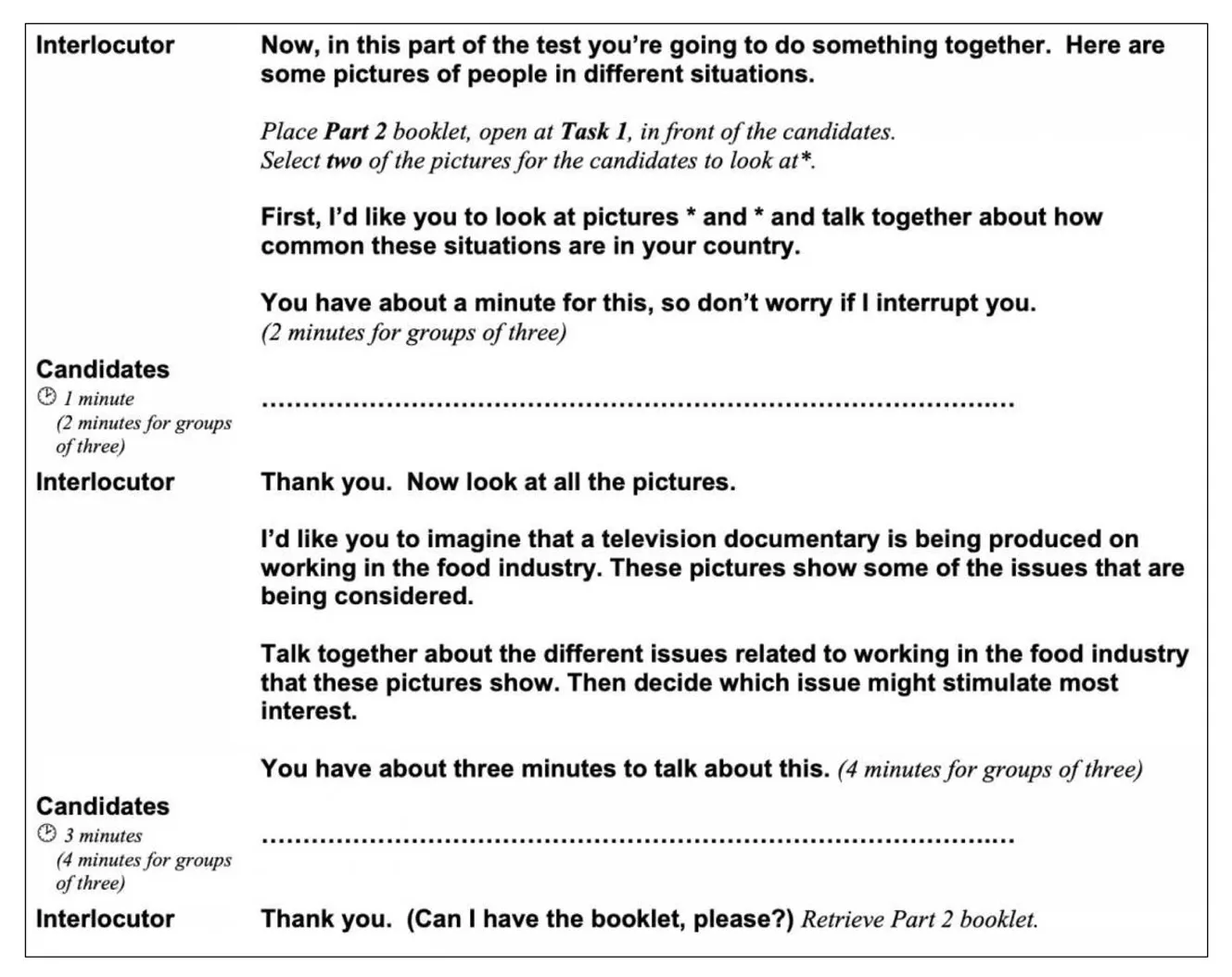
El interlocutor comenzará la tarea con las siguientes instrucciones:
Material visual: TV documentary – Working in the food industry
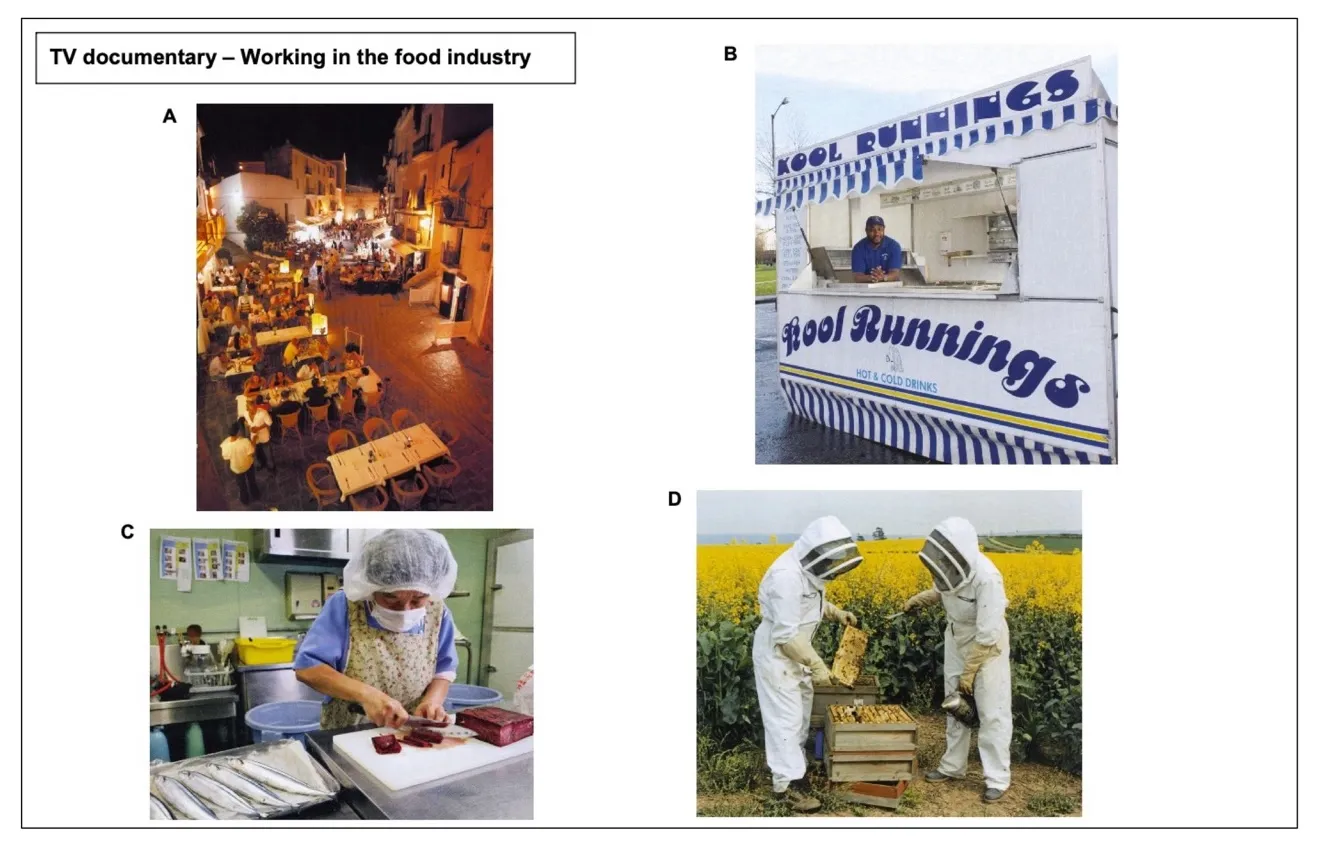
A continuación, los candidatos reciben el siguiente conjunto de imágenes:
Respuesta de ejemplo comentada
Veamos ahora cómo dos candidatos de nivel C2 podrían abordar esta tarea:
Interlocutor: Now, in this part of the test you’re going to do something together. Here are some pictures of people in different situations. First, I’d like you to look at pictures A and B and talk together about how common these situations are in your country. You have about a minute for this, so don’t worry if I interrupt you.
Candidate A: Right, so picture A shows what looks like a busy outdoor restaurant — a dining scene you’d find in any Mediterranean town, probably on a warm summer evening. I’d say that’s become increasingly common back home, actually. There’s been a real surge in outdoor dining culture over the past decade or so.
Candidate B: I’d agree with that. The hospitality sector has expanded enormously, hasn’t it? Though I think the sheer scale of what we see in picture A is perhaps more characteristic of Southern Europe than the UK or Northern Europe, where the climate doesn’t really lend itself to that. Picture B, on the other hand, feels very familiar to me. That sort of thing is absolutely everywhere now.
Candidate A: Yes, street food has exploded as a concept, hasn’t it? What used to be seen as something rather informal or even associated with lower-income areas has been completely reinvented. It’s quite mainstream now. So in that sense, picture B probably reflects a more universal trend than picture A, which might still be tied to specific cultural or geographical contexts.
Candidate B: Absolutely. And there’s also the economic dimension to consider. Running a food stall is a much lower-barrier entry point into the food industry than opening a full restaurant, so you tend to see a lot of entrepreneurial energy going into that space.
Interlocutor: Thank you. Now look at all the pictures. I’d like you to imagine that a television documentary is being produced on working in the food industry. These pictures show some of the issues that are being considered. Talk together about the different issues related to working in the food industry that these pictures show. Then decide which issue might stimulate most interest. You have about three minutes to talk about this.
Candidate A: Shall I start? So, taking all four pictures together, what strikes me is just how varied the food industry actually is. You’ve got everything from large-scale outdoor hospitality in picture A, to independent street trading in B, to what looks like food processing or preparation in a factory or industrial kitchen setting in C, and then something quite different in D — beekeeping, which I suppose represents the agricultural or primary production end of the industry. Each one raises quite distinct issues, doesn’t it?
Candidate B: It really does. If we take picture C first, the issues that spring to mind are things like health and safety, working conditions, and the often undervalued nature of that kind of labour. It’s physically demanding, repetitive, and the pay tends to be quite low despite how essential it is. There’s also a significant reliance on migrant workers in that sector in many countries, which raises broader questions about labour rights and exploitation.
Candidate A: That’s a really important point, and it connects to a wider debate about the visibility of food workers. I mean, we consume food without ever really thinking about the people involved in producing it. Picture D almost illustrates the opposite end of that spectrum. Beekeeping feels almost romantic by comparison, very artisanal, tied to ideas of sustainability and environmental awareness. But even there, you could argue it raises issues about the precariousness of small-scale food production, and, by extension, of the livelihoods of people who depend on them.
Candidate B: Yes, and I think the environmental angle is one that would genuinely resonate with a documentary audience right now. The food industry’s relationship with the natural world — whether it be sustainable farming or several well-known major ethical issues — feels like a highly relevant theme. Going back to picture A, there’s something to be said about the impact of mass tourism on local food cultures, and whether what we see there is authentic community life or a kind of commercialisation of it.
Candidate A: Mmm, that’s a very accurate observation. I hadn’t thought of it quite that way. So if we’re trying to decide which issue might generate the most interest for a documentary audience, I’m torn between the labour and working conditions angle from picture C, which feels potentially shocking for viewers who’ve never thought about it, and the sustainability and environmental dimension that cuts across several of the pictures.
Candidate B: I think I’d lean towards the working conditions issue, actually. Documentaries that put a human face on unseen labour tend to have a very powerful emotional impact. It has that combination of social justice and personal story that makes for compelling television. The environmental angle is important, but it’s arguably been covered quite extensively already.
Candidate A: That’s a fair point. Yes, I think we’re agreed then. The human and social dimension of food industry labour, as represented most vividly by picture C, would probably be the most compelling focus for a documentary.
Interlocutor: Thank you. Can I have the booklet, please?
Esta interacción ejemplifica perfectamente lo que se espera en la Parte 2 del C2 Speaking. Los candidatos van más allá de la simple descripción de las imágenes para identificar temas subyacentes, desarrollar argumentos complejos y trabajar colaborativamente hacia una conclusión razonada. El lenguaje utilizado es sofisticado, preciso y natural, con un uso fluido de expresiones idiomáticas y estructuras gramaticales complejas.
Ejemplo 2 de C2 Proficiency Speaking Part 2
Veamos ahora un segundo ejemplo completo de la Parte 2, esta vez centrado en el tema del envejecimiento en la sociedad actual.
Instrucciones del examinador
El interlocutor presenta la tarea de la siguiente manera:
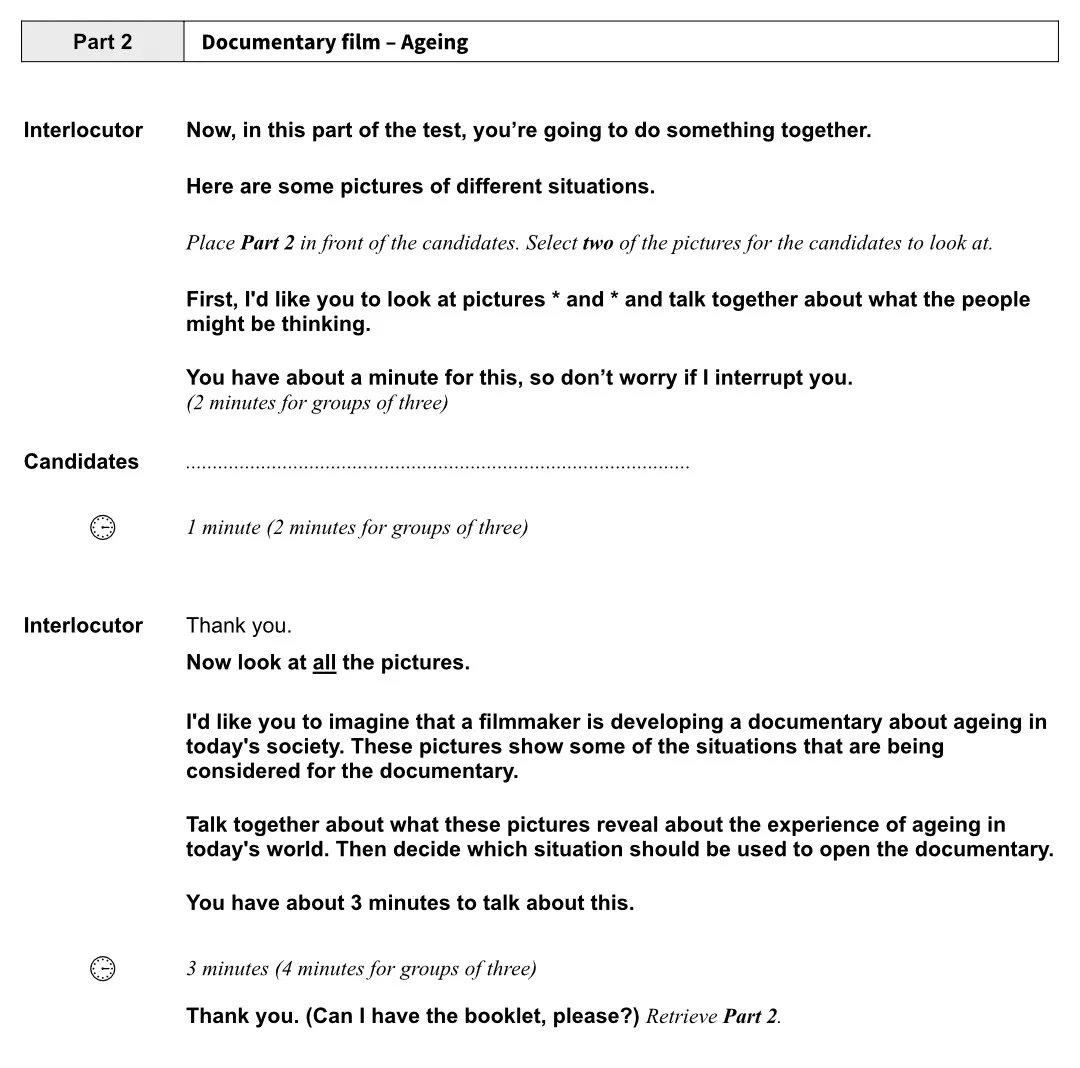
Material visual: Documentary film – Ageing
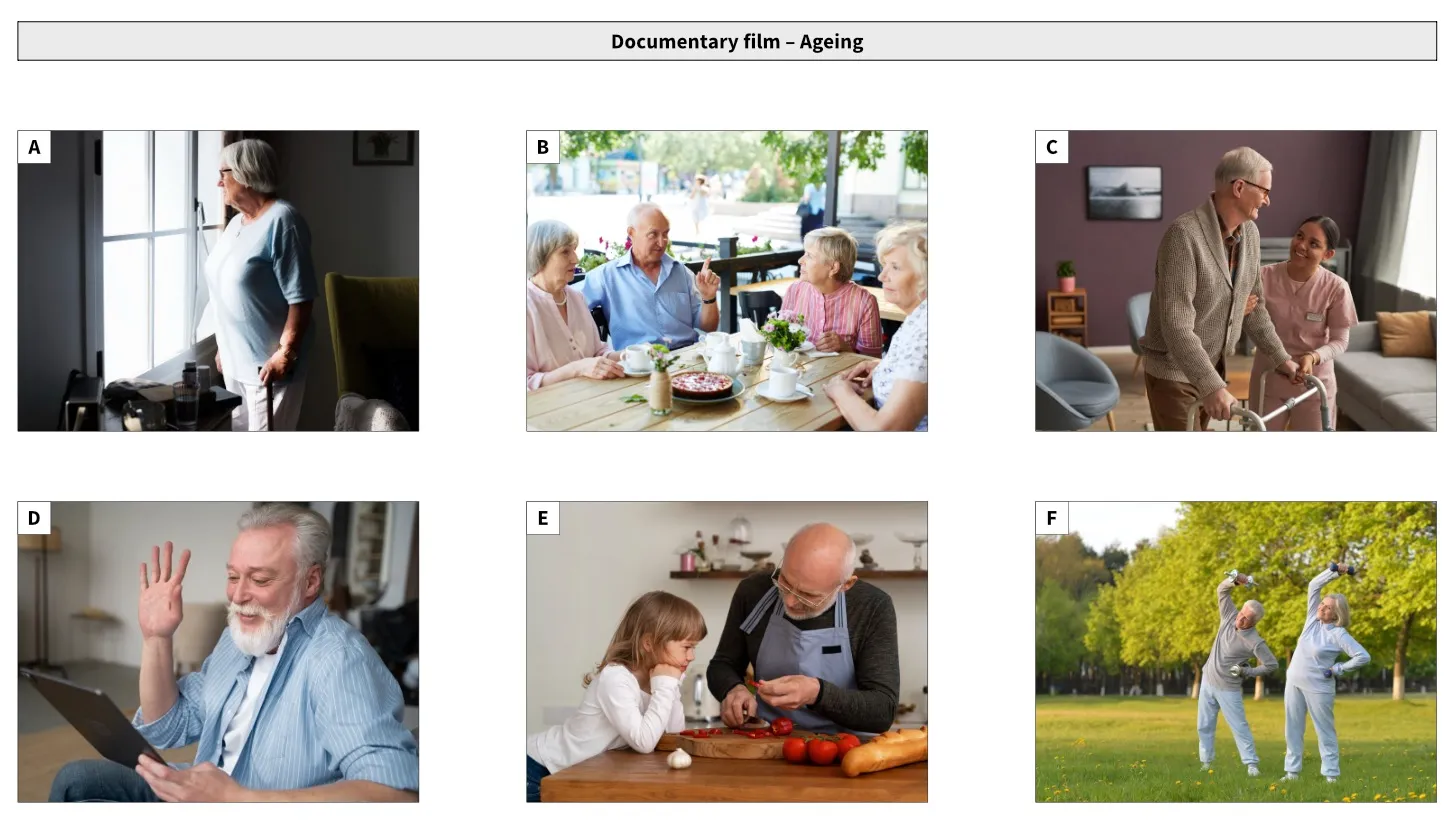
Los candidatos reciben el siguiente conjunto de imágenes relacionadas con diferentes aspectos del envejecimiento:
Respuesta de ejemplo comentada
A continuación, podemos ver cómo dos candidatos de nivel C2 abordan esta tarea con sofisticación y fluidez:
Interlocutor: Now, in this part of the test, you’re going to do something together. Here are some pictures of different situations. First, I’d like you to look at pictures A and C and talk together about what the people might be thinking. You have about a minute for this, so don’t worry if I interrupt you.
Candidate A: Looking at picture A, the elderly woman appears quite pensive, doesn’t she? She’s gazing out of the window, perhaps lost in a world of reminiscence or even feeling a certain sense of isolation. I’d imagine she’s contemplating the passage of time or perhaps just waiting for someone to visit, reflecting on her solitude.
Candidate B: I’d agree with that assessment; she does look rather wistful. Conversely, in picture C, the gentleman seems to be sharing a much more interactive, albeit physically demanding, moment with his carer. He’s likely thinking about how much he values that support, though I suspect there’s a lingering sense of frustration regarding his diminished independence and reliance on others.
Candidate A: That’s a valid point. It really highlights the stark contrast between solitary reflection and the necessity of professional care. While the woman might be dwelling on the stillness of her surroundings, the gentleman is likely focusing on the sheer physical exertion required just to move across the room, perhaps feeling a mix of gratitude and vulnerability.
Candidate B: Quite. Ultimately, both images suggest a significant degree of introspection—one born out of quietude and the other out of the struggle to maintain one’s dignity while facing physical decline. It’s a poignant look at the internal world of the elderly.
Interlocutor: Thank you. Now look at all the pictures. I’d like you to imagine that a filmmaker is developing a documentary about ageing in today’s society. These pictures show some of the situations that are being considered for the documentary. Talk together about what these pictures reveal about the experience of ageing in today’s world. Then decide which situation should open the documentary. You have about 3 minutes to talk about this.
Candidate A: When we look at the collection as a whole, it’s evident that the experience of ageing today is incredibly multifaceted. While pictures A and C capture the more traditional, sombre aspects of infirmity and solitude, others like F and D present a far more proactive and empowered narrative that we didn’t see as often in previous generations.
Candidate B: Absolutely. The couple exercising in the park in picture F suggests that vitality is now seen as something maintainable well into one’s twilight years. Similarly, the man using a tablet in picture D is a testament to how technology is bridging the digital divide, allowing seniors to remain tethered to their loved ones regardless of their physical location.
Candidate A: That’s a crucial observation. It’s no longer just about «fading away» or being relegated to the sidelines. Look at the social scene in picture B; it depicts the «third age» as a period of community engagement and leisure. We also shouldn’t overlook the intergenerational aspect in picture E, which is a beautiful depiction of the transfer of skills and wisdom.
Candidate B: I agree, but when it comes to selecting an opening image for the documentary, we need something that immediately challenges outdated stereotypes. While the grandfather cooking with his granddaughter is heart-warming, it’s perhaps a little too conventional for a film aiming to explore «today’s world» in a truly contemporary way.
Candidate A: I see your point. We need an «impact» shot that signals a modern perspective. Perhaps the video call in picture D? It’s so emblematic of our current era and how digital literacy has fundamentally redefined the way the elderly experience connection and overcome geographical isolation.
Candidate B: That’s certainly a strong contender, but I wonder if the exercise scene in picture F might be even more arresting. It’s such an active, vibrant image that it would immediately subvert the viewer’s expectations of frailty and decline. It sets a very positive, energetic tone for the film from the very first frame.
Candidate A: It is indeed a powerful image, but I still lean towards the video call in D. It encapsulates the intersection of ageing and the digital revolution, which is perhaps the most defining characteristic of the modern experience. It shows that even if one’s physical world shrinks, the virtual world remains wide open through technology.
Candidate B: You’ve made a compelling case. The technological element is undeniably the most contemporary facet of the experience and it really highlights the theme of «today’s society.» Let’s settle on picture D, the video call, as the most evocative and relevant choice to open the documentary.
Interlocutor: Thank you. Can I have the booklet, please?
Este segundo ejemplo demuestra cómo los candidatos pueden abordar un tema más abstracto y emocionalmente complejo. La conversación muestra un nivel excepcional de sofisticación lingüística, con el uso de vocabulario preciso y matizado, estructuras gramaticales complejas y una capacidad impresionante para articular ideas abstractas con claridad y fluidez.
Análisis de una buena interacción en la Parte 2
Los ejemplos anteriores representan interacciones de nivel C2 sobresaliente. Analicemos ahora qué elementos específicos hacen que estas conversaciones sean tan exitosas y qué podemos aprender de ellas para nuestra propia preparación.
Gestión del discurso e interacción
Una de las características más destacadas de estas interacciones es la gestión fluida del discurso. Los candidatos demuestran una capacidad excepcional para:
- Tomar y ceder el turno de palabra de manera natural: Utilizan expresiones como «Shall I start?», «Would you like to go first?» o «What do you make of this?» para gestionar la conversación sin que parezca forzado o ensayado.
- Construir sobre las contribuciones del compañero: En lugar de simplemente añadir información nueva, los candidatos desarrollan y expanden las ideas presentadas por su compañero, utilizando frases como «That’s a really important point, and it connects to…» o «Building on what you said…»
- Mantener la cohesión conversacional: La conversación fluye de manera orgánica, con transiciones suaves entre temas y una clara progresión lógica de ideas.
- Demostrar escucha activa: Los candidatos responden a lo que dice su compañero, reconociendo sus puntos de vista con expresiones como «I’d agree with that assessment», «That’s a valid point» o «I hadn’t thought of it quite that way».
Esta gestión sofisticada del discurso es fundamental en el nivel C2, donde se espera que los candidatos no solo hablen bien individualmente, sino que demuestren una capacidad excepcional para co-construir significado en tiempo real con otro hablante.
Argumentación sofisticada y pensamiento crítico
Los candidatos de nivel C2 no se limitan a describir lo que ven en las imágenes, sino que van mucho más allá para:
- Identificar temas subyacentes: En lugar de decir simplemente «esta imagen muestra a un apicultor», los candidatos discuten conceptos más amplios como la sostenibilidad, la precariedad de la producción alimentaria a pequeña escala y la relación de la industria alimentaria con el mundo natural.
- Desarrollar análisis multifacéticos: Los candidatos consideran múltiples dimensiones de cada tema, incluyendo aspectos económicos, sociales, culturales y éticos, demostrando una comprensión profunda y matizada.
- Mantener ideas en tensión: Los candidatos de nivel C2 son capaces de reconocer la complejidad y la ambigüedad, como cuando uno dice «I’m torn between the labour and working conditions angle… and the sustainability and environmental dimension», mostrando que pueden considerar múltiples perspectivas simultáneamente.
- Justificar opiniones con razonamientos sólidos: Cada opinión expresada viene acompañada de una justificación clara y bien articulada, como «Documentaries that put a human face on unseen labour tend to have a very powerful emotional impact. It has that combination of social justice and personal story that makes for compelling television.»
Este nivel de pensamiento crítico y argumentación sofisticada es lo que distingue una actuación de nivel C2 de niveles inferiores. No se trata solo de hablar bien, sino de pensar con profundidad y articular esos pensamientos con precisión.
Recursos lingüísticos excepcionales
El lenguaje utilizado en estas interacciones ejemplifica el nivel de maestría esperado en C2:
- Vocabulario preciso y variado: Los candidatos emplean términos específicos y sofisticados de manera natural, como «entrepreneurial energy», «precariousness», «artisanal», «commercialisation», «wistful», «multifaceted» y «emblematic».
- Expresiones idiomáticas y colocaciones naturales: Utilizan frases hechas con fluidez, como «street food has exploded as a concept», «put a human face on unseen labour», «fading away» o «relegated to the sidelines».
- Estructuras gramaticales complejas: Las interacciones incluyen una amplia gama de estructuras avanzadas: condicionales, cláusulas relativas, inversiones, estructuras pasivas complejas y subordinación múltiple, todo ello utilizado con precisión y naturalidad.
- Registro apropiado: El lenguaje es formal pero no rígido, académico pero accesible, demostrando una comprensión sofisticada del registro apropiado para una discusión intelectual entre iguales.
- Matices de significado: Los candidatos utilizan modificadores y expresiones que añaden matices sutiles, como «perhaps», «arguably», «to some extent», «I suspect» y «it might be the case that», demostrando una capacidad para expresar grados de certeza y perspectiva.
Lo más impresionante es que todos estos recursos lingüísticos se emplean de manera fluida y natural, sin que parezcan forzados o memorizados. Esta es la marca distintiva del nivel C2: la capacidad de utilizar recursos lingüísticos sofisticados con la misma naturalidad con la que un hablante nativo educado lo haría.
Speaking C2: The Ultimate CPE Speaking Guide
Domina el Speaking del C2 con mi guía completa, que incluye 10 simulacros completos, respuestas de ejemplo para cada parte, consejos y estrategias basadas en mi experiencia y listas de expresiones útiles diseñadas específicamente para la prueba de Speaking de C2 Proficiency.
¡Consigue ya tu ejemplar en PDF!
Toma de decisiones colaborativa
Uno de los aspectos más importantes de la Parte 2 es la capacidad de trabajar colaborativamente hacia una decisión. Los candidatos exitosos demuestran:
- Compromiso con el proceso: En lugar de simplemente estar de acuerdo por conveniencia, los candidatos verdaderamente exploran las opciones, pesan las alternativas y articulan sus razonamientos antes de llegar a una conclusión.
- Respeto por las perspectivas del compañero: Cuando surgen diferencias de opinión, los candidatos las gestionan con diplomacia y respeto, utilizando expresiones como «That’s certainly a strong contender, but I wonder if…» o «You’ve made a compelling case».
- Negociación sofisticada: Los candidatos no imponen su punto de vista, sino que negocian el significado a través del diálogo, presentando argumentos, considerando contraargumentos y llegando a un consenso de manera natural.
- Conclusión articulada: La decisión final no es abrupta, sino que se alcanza de manera orgánica y se articula claramente, como en «Let’s settle on picture D, the video call, as the most evocative and relevant choice to open the documentary».
Es fundamental recordar que lo que se evalúa no es si los candidatos llegan a una decisión final (aunque es deseable), sino la calidad del proceso colaborativo y el lenguaje utilizado para trabajar hacia una. Un candidato que demuestra habilidades excepcionales de negociación y colaboración, pero que se queda sin tiempo antes de alcanzar una conclusión definitiva, puede obtener una puntuación excelente.
Frases útiles para la Parte 2 del C2 Speaking
A continuación, te presento una selección de frases y expresiones útiles organizadas por función comunicativa. Estas expresiones te ayudarán a participar de manera efectiva en la Parte 2 del Speaking de C2, demostrando el nivel de sofisticación lingüística esperado en el examen.
Para describir e introducir las imágenes
- What strikes me about this image is…
- At first glance, this picture appears to depict…
- This photograph captures the essence of…
- What’s particularly noteworthy here is…
- This image seems to encapsulate…
- Looking at this picture, one gets the sense that…
- This scene is evocative of…
- What immediately draws the eye is…
Para comparar y contrastar
- In stark contrast to the first image…
- Whereas picture A focuses on…, picture B emphasizes…
- A key distinction lies in the way…
- This stands in marked contrast to…
- By comparison, this image presents a rather different…
- Unlike the previous picture, which showed…, this one illustrates…
- There’s a striking juxtaposition between…
- While both images deal with…, they approach it from quite different angles
- This represents the opposite end of the spectrum from…
Para especular e hipotetizar
- It might well be the case that…
- One could reasonably argue that this represents…
- This would seem to suggest…
- It’s conceivable that…
- I’d venture to say that…
- Perhaps this is meant to illustrate…
- It strikes me that this could be interpreted as…
- There’s a strong possibility that…
- One might infer from this that…
- This raises the question of whether…
Para dar opiniones y justificar
- From my perspective, the most compelling aspect is…
- I’m inclined to think that…
- The reason I’d lean towards this option is that…
- What makes this particularly effective, in my view, is…
- I’d argue that this would be the most appropriate choice because…
- To my mind, this stands out for several reasons…
- The way I see it, this option has the advantage of…
- I’m torn between these two, but on balance, I’d say…
- What tips the balance for me is…
Para involucrar a tu compañero
- What’s your take on this?
- How does that strike you?
- Would you see it the same way, or…?
- I’m curious to hear your thoughts on…
- Do you think that’s a fair assessment?
- How about you—which one resonates more?
- Would you agree with that interpretation?
- That’s my initial reaction, but what do you make of it?
- I’d be interested to know whether you see it differently
- Perhaps you have a different perspective on this?
Para ganar tiempo y añadir puntos
- Let me think about that for a moment…
- That’s an interesting question. I suppose…
- Building on that point…
- Another dimension worth considering is…
- On top of that, it’s worth noting that…
- What also springs to mind is…
- Having said that, we should also bear in mind…
- That ties in nicely with…
- Which brings me to another point…
- In a similar vein…
Consejos esenciales para triunfar en la Parte 2
Ahora que hemos visto ejemplos concretos y analizado qué hace que una interacción sea exitosa, veamos algunos consejos prácticos que te ayudarán a maximizar tu rendimiento en la Parte 2 del C2 Proficiency Speaking.
- Aprovecha el tiempo de observación inicial. Cuando el examinador coloca el material visual frente a ti, tienes unos 15 segundos para estudiarlo antes de comenzar a hablar. Utiliza este tiempo estratégicamente para identificar no solo lo que muestran las imágenes superficialmente, sino los temas subyacentes que representan. Pregúntate: ¿qué cuestiones más amplias ilustran estas imágenes? ¿Qué tienen en común? ¿En qué se diferencian? Esta preparación mental te permitirá comenzar con confianza y profundidad.
- Ve más allá de la descripción superficial. El error más común en esta parte es limitarse a describir lo que se ve en las imágenes: «En esta imagen hay una persona haciendo…». Los candidatos de nivel C2 identifican inmediatamente los temas abstractos que las imágenes representan y centran su discusión en esos conceptos más amplios. No digas «esta imagen muestra a alguien trabajando en una cocina»; di «this image raises questions about working conditions and health and safety in the food processing sector».
- Construye sobre las contribuciones de tu compañero. La Parte 2 no consiste en dos monólogos alternados, sino en una conversación colaborativa de verdad. Cuando tu compañero haga una observación, no te limites a añadir tu propio punto no relacionado. En su lugar, reconoce lo que ha dicho, desarróllalo, matízalo o conéctalo con otra idea. Utiliza expresiones como «That’s a really important point, and it connects to…» o «Building on what you said about…» para demostrar que estás escuchando activamente y co-construyendo significado.
- Gestiona el equilibrio entre participación y dominio. Aunque es importante contribuir sustancialmente a la discusión, también es crucial dar espacio a tu compañero. Si notas que has estado hablando durante más de 30-40 segundos sin pausa, es momento de involucrar a tu compañero con una pregunta o invitación a comentar. Por otro lado, si tu compañero está dominando la conversación, busca momentos naturales para intervenir con frases como «That’s an interesting perspective. I’d also add that…» o «May I build on that point?»
- Demuestra flexibilidad intelectual. Los candidatos de nivel C2 no se aferran rígidamente a una posición, sino que demuestran capacidad para considerar múltiples perspectivas, reconocer la complejidad y, cuando sea apropiado, modificar su punto de vista en respuesta a un argumento convincente. Expresiones como «That’s a very accurate observation. I hadn’t thought of it quite that way» o «You’ve made a compelling case» demuestran esta sofisticación intelectual.
- Prioriza la profundidad sobre la cobertura exhaustiva. No es necesario (ni deseable) discutir todas las imágenes con el mismo nivel de detalle. Es mejor desarrollar un análisis profundo y matizado de dos o tres imágenes que mencionar superficialmente todas. Los examinadores valoran la capacidad de explorar ideas en profundidad, no la capacidad de enumerar observaciones superficiales sobre cada imagen.
- Practica la toma de decisiones colaborativa. La segunda fase de la tarea casi siempre requiere que llegues a una decisión con tu compañero. Practica el proceso de: (1) explorar las opciones, (2) expresar una preferencia inicial con justificación, (3) escuchar la perspectiva de tu compañero, (4) considerar ambos puntos de vista y (5) llegar a una conclusión consensuada. Este proceso debe sentirse natural, no forzado o mecánico.
- Utiliza el lenguaje especulativo e hipotético con naturalidad. La Parte 2 a menudo requiere que especules sobre situaciones, motivos o implicaciones. Familiarízate con una gama de expresiones especulativas de nivel C2 como «it might well be the case that», «one could reasonably argue that», «it’s conceivable that» o «this would seem to suggest». Estas expresiones añaden sofisticación y matiz a tu discurso.
- Mantén un registro apropiado y consistente. El registro apropiado para esta parte es formal pero no rígido, intelectual pero accesible. Evita el lenguaje excesivamente coloquial («this pic is really cool») pero también evita sonar artificialmente académico o pomposo. Piensa en cómo discutirías estos temas con un colega educado en un contexto profesional.
- No te preocupes si el examinador interrumpe. El examinador interrumpirá después de aproximadamente un minuto en la primera fase para pasar a la segunda. Esto es completamente normal y esperado, así que no lo interpretes como una señal de que estás haciendo algo mal. Simplemente para tu frase de manera natural y prepárate para la siguiente fase de la tarea.
- Practica con una variedad de temas y tipos de imágenes. Las tareas de la Parte 2 pueden cubrir una amplia gama de temas (sociales, culturales, medioambientales, tecnológicos, etc.) y pueden presentar diferentes tipos de decisiones (qué imagen sería más apropiada, qué tema generaría más interés, qué situación debería aparecer primero, etc.). Cuanto más practiques con diferentes tipos de tareas, más cómodo te sentirás el día del examen. Mi libro de Speaking C2 en PDF incluye 10 ejemplos completos de la Parte 2 que cubren una amplia variedad de temas y formatos de tarea.
Triunfa en el Speaking del C2 con mi guía con 10 exámenes de ejemplo
Si estás preparando el examen de C2 Proficiency y quieres asegurarte de que dominas completamente la prueba de Speaking, te recomiendo mi guía completa Speaking C2: The Ultimate CPE Speaking Guide. Este libro en formato PDF de más de 120 páginas ha sido diseñado específicamente para ayudarte a alcanzar el éxito en todas las partes del examen oral de C2.
Speaking C2: The Ultimate CPE Speaking Guide
Domina el Speaking del C2 con mi guía completa, que incluye 10 simulacros completos, respuestas de ejemplo para cada parte, consejos y estrategias basadas en mi experiencia y listas de expresiones útiles diseñadas específicamente para la prueba de Speaking de C2 Proficiency.
¡Consigue ya tu ejemplar en PDF!
El libro incluye:
- 10 exámenes completos de práctica que replican fielmente el formato y el contenido del C2 Proficiency Speaking real
- Respuestas de ejemplo para cada parte con comentarios detallados que explican por qué son efectivas
- Guía detallada de cada parte del Speaking con estrategias específicas y consejos prácticos
- Listas extensas de lenguaje útil organizadas por función comunicativa y diseñadas específicamente para el nivel C2
- Criterios de evaluación y mark sheet de ejemplo para que entiendas exactamente cómo se evalúa tu actuación
- Sección de preguntas frecuentes que resuelve todas las dudas comunes sobre el examen
Ya seas un estudiante preparando el examen por tu cuenta o un profesor buscando material de calidad para tus clases, esta guía te proporcionará todo lo que necesitas para afrontar el Speaking de C2 Proficiency con confianza y competencia. Consigue ya tu ejemplar en PDF y da el primer paso hacia el dominio del examen oral de C2.
Y hasta el próximo artículo, don’t forget to keep smiling!
