

Table of contents
As you may have seen previously, I have already given you a general overview of the C2 Speaking and Speaking Part 1, so in this article I will focus specifically on C2 Proficiency Speaking Part 2. To do this, I will give you a complete description of this part, which is the main collaborative part of the C2 Proficiency Speaking paper. As we will see in the following paragraphs, both candidates must work together in a collaborative, sophisticated and fluid manner to demonstrate the linguistic level expected of a C2 candidate.
C2 Speaking Part 2: description, structure and duration
C2 Proficiency Speaking Part 2 is the main collaborative task of the exam and is distinguished by being the only part in which the candidates have full control over the interaction. In this section, the interlocutor provides the candidates with a set of visual prompts («AKA» photos 😅), usually between 4 and 7 images, related to a common theme and poses two consecutive tasks that require collaborative discussion.
What makes this part unique is that, once the tasks have been set, the examiner withdraws completely from the conversation, leaving the candidates to interact with each other without any intervention. This allows for the evaluation of not only each candidate’s individual linguistic resources but also their ability to engage in a truly collaborative dialogue with the degree of skill expected at C2 level.
The total duration of this part is approximately 4 minutes for pairs of candidates (increasing to about 6 minutes in the case of groups of three). It is important to highlight that what is evaluated is not whether the candidates reach a final decision or not, but rather the quality of the language used during the process.
Phase 1: initial reaction to two images (1 minute)
In the first phase, the interlocutor selects two of the images from the set and asks the candidates to talk together about a specific aspect related to those images. This initial phase lasts approximately 1 minute (2 minutes for groups of three candidates).
For example, if the images show different situations related to the food industry, the examiner might ask the candidates to discuss «how common these situations are in your country?» or «what the people in these images might be thinking».
This phase serves as a warm-up and allows candidates to familiarise themselves with the material before moving on to the more complex discussion. The interlocutor will interrupt the conversation after one minute to move on to the second phase, so you should not worry if this happens.
Phase 2: collaborative discussion and decision-making (3 minutes)
The second phase is the core of this part of the exam. The interlocutor asks the candidates to consider all the images in the set and poses a more complex task that normally involves two elements:
- Discussing the different aspects, themes or issues represented by the images
- Deciding which of the options would be most appropriate, interesting or relevant for a specific purpose
This phase lasts approximately 3 minutes (4 minutes for groups of three) and is where candidates must demonstrate their ability to maintain a more complex conversation, develop sophisticated arguments, react to their partner’s ideas and work collaboratively towards a reasoned conclusion.
It is fundamental to understand that this is not a competition between candidates, but an opportunity to demonstrate advanced interaction skills typical of the C2 level: negotiating meaning, qualifying opinions, reformulating ideas with precision and maintaining a fluid and coherent discourse on abstract or complex topics.
Speaking C2: The Ultimate CPE Speaking Guide
Master C2 Speaking with my complete guide, which includes 10 full mock exams, sample answers for each part, tips and strategies based on my experience, and lists of useful expressions designed specifically for the C2 Proficiency Speaking test.
Get your PDF copy now!
Example of C2 Proficiency Speaking Part 2
Let’s now look at a full example of C2 Speaking Part 2 to better understand how this section works in practice. This first example is based on a topic related to the food industry.
Examiner instructions
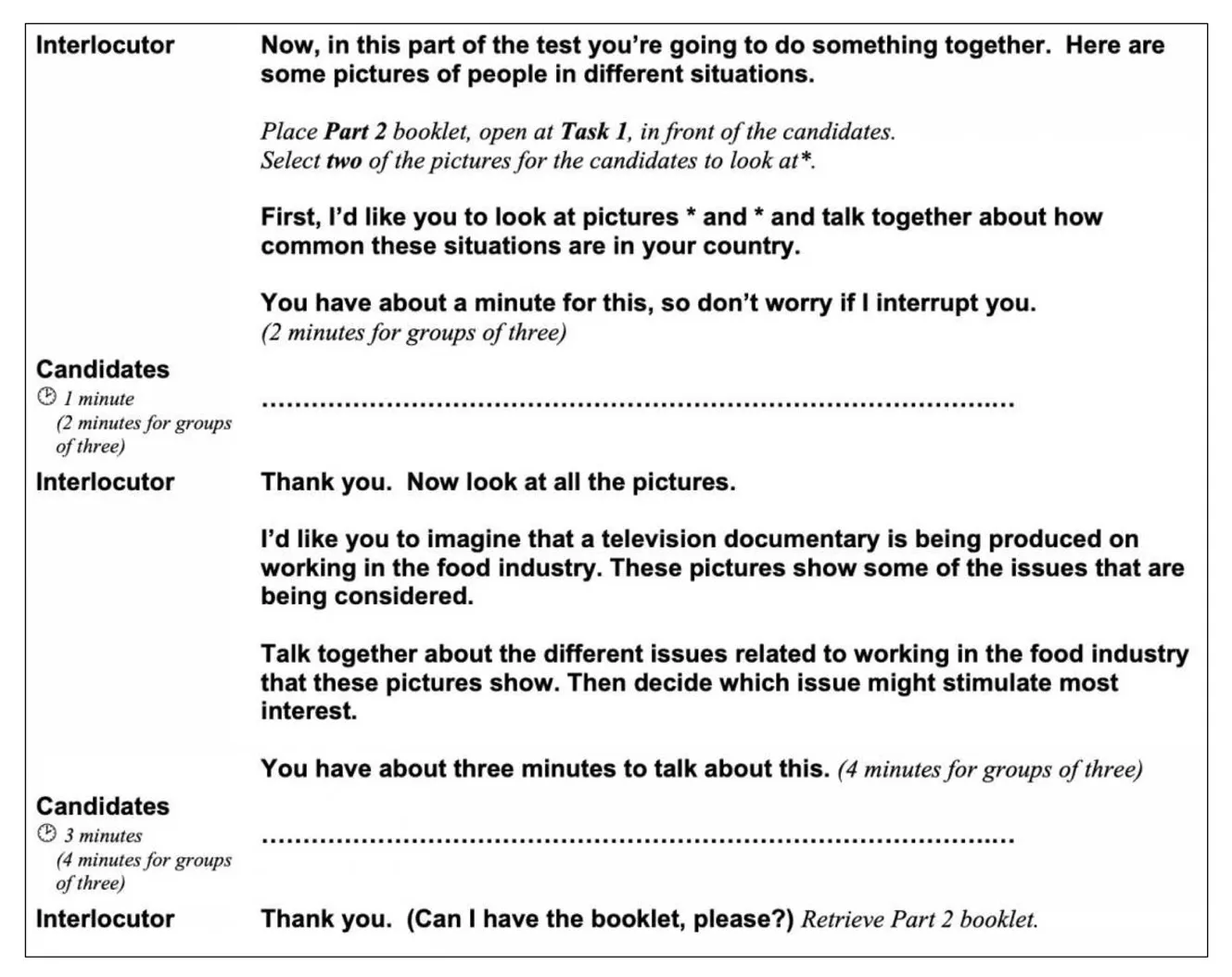
The interlocutor will begin the task with the following instructions:
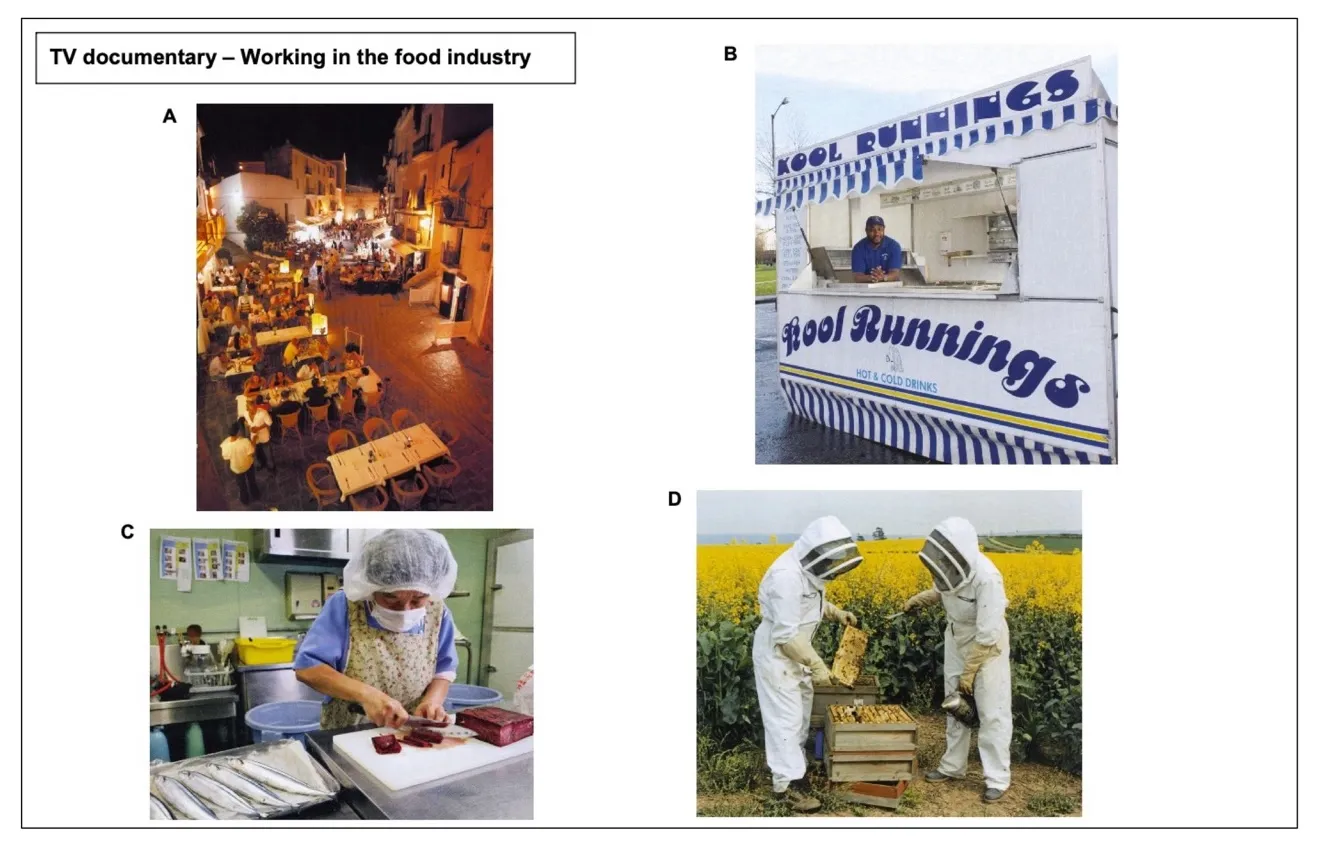
Visual material: «TV documentary – Working in the food industry»
Next, the candidates receive the following set of images:
Commented sample response
Let’s see how two C2-level candidates might approach this task:
Interlocutor: Now, in this part of the test you’re going to do something together. Here are some pictures of people in different situations. First, I’d like you to look at pictures A and B and talk together about how common these situations are in your country. You have about a minute for this, so don’t worry if I interrupt you.
Candidate A: Right, so picture A shows what looks like a busy outdoor restaurant — a dining scene you’d find in any Mediterranean town, probably on a warm summer evening. I’d say that’s become increasingly common back home, actually. There’s been a real surge in outdoor dining culture over the past decade or so.
Candidate B: I’d agree with that. The hospitality sector has expanded enormously, hasn’t it? Though I think the sheer scale of what we see in picture A is perhaps more characteristic of Southern Europe than the UK or Northern Europe, where the climate doesn’t really lend itself to that. Picture B, on the other hand, feels very familiar to me. That sort of thing is absolutely everywhere now.
Candidate A: Yes, street food has exploded as a concept, hasn’t it? What used to be seen as something rather informal or even associated with lower-income areas has been completely reinvented. It’s quite mainstream now. So in that sense, picture B probably reflects a more universal trend than picture A, which might still be tied to specific cultural or geographical contexts.
Candidate B: Absolutely. And there’s also the economic dimension to consider. Running a food stall is a much lower-barrier entry point into the food industry than opening a full restaurant, so you tend to see a lot of entrepreneurial energy going into that space.
Interlocutor: Thank you. Now look at all the pictures. I’d like you to imagine that a television documentary is being produced on working in the food industry. These pictures show some of the issues that are being considered. Talk together about the different issues related to working in the food industry that these pictures show. Then decide which issue might stimulate most interest. You have about three minutes to talk about this.
Candidate A: Shall I start? So, taking all four pictures together, what strikes me is just how varied the food industry actually is. You’ve got everything from large-scale outdoor hospitality in picture A, to independent street trading in B, to what looks like food processing or preparation in a factory or industrial kitchen setting in C, and then something quite different in D — beekeeping, which I suppose represents the agricultural or primary production end of the industry. Each one raises quite distinct issues, doesn’t it?
Candidate B: It really does. If we take picture C first, the issues that spring to mind are things like health and safety, working conditions, and the often undervalued nature of that kind of labour. It’s physically demanding, repetitive, and the pay tends to be quite low despite how essential it is. There’s also a significant reliance on migrant workers in that sector in many countries, which raises broader questions about labour rights and exploitation.
Candidate A: That’s a really important point, and it connects to a wider debate about the visibility of food workers. I mean, we consume food without ever really thinking about the people involved in producing it. Picture D almost illustrates the opposite end of that spectrum. Beekeeping feels almost romantic by comparison, very artisanal, tied to ideas of sustainability and environmental awareness. But even there, you could argue it raises issues about the precariousness of small-scale food production, and, by extension, of the livelihoods of people who depend on them.
Candidate B: Yes, and I think the environmental angle is one that would genuinely resonate with a documentary audience right now. The food industry’s relationship with the natural world — whether it be sustainable farming or several well-known major ethical issues — feels like a highly relevant theme. Going back to picture A, there’s something to be said about the impact of mass tourism on local food cultures, and whether what we see there is authentic community life or a kind of commercialisation of it.
Candidate A: Mmm, that’s a very accurate observation. I hadn’t thought of it quite that way. So if we’re trying to decide which issue might generate the most interest for a documentary audience, I’m torn between the labour and working conditions angle from picture C, which feels potentially shocking for viewers who’ve never thought about it, and the sustainability and environmental dimension that cuts across several of the pictures.
Candidate B: I think I’d lean towards the working conditions issue, actually. Documentaries that put a human face on unseen labour tend to have a very powerful emotional impact. It has that combination of social justice and personal story that makes for compelling television. The environmental angle is important, but it’s arguably been covered quite extensively already.
Candidate A: That’s a fair point. Yes, I think we’re agreed then. The human and social dimension of food industry labour, as represented most vividly by picture C, would probably be the most compelling focus for a documentary.
Interlocutor: Thank you. Can I have the booklet, please?
This interaction perfectly exemplifies what is expected in C2 Speaking Part 2. The candidates go beyond simple description of the images to identify underlying themes, develop complex arguments and work collaboratively towards a reasoned conclusion. The language used is sophisticated, precise and natural, with fluid use of idiomatic expressions and complex grammatical structures.
Example 2 of C2 Proficiency Speaking Part 2
Let’s now look at a second complete example of Part 2, this time focused on the topic of ageing in today’s society.
Examiner instructions
The interlocutor presents the task as follows:
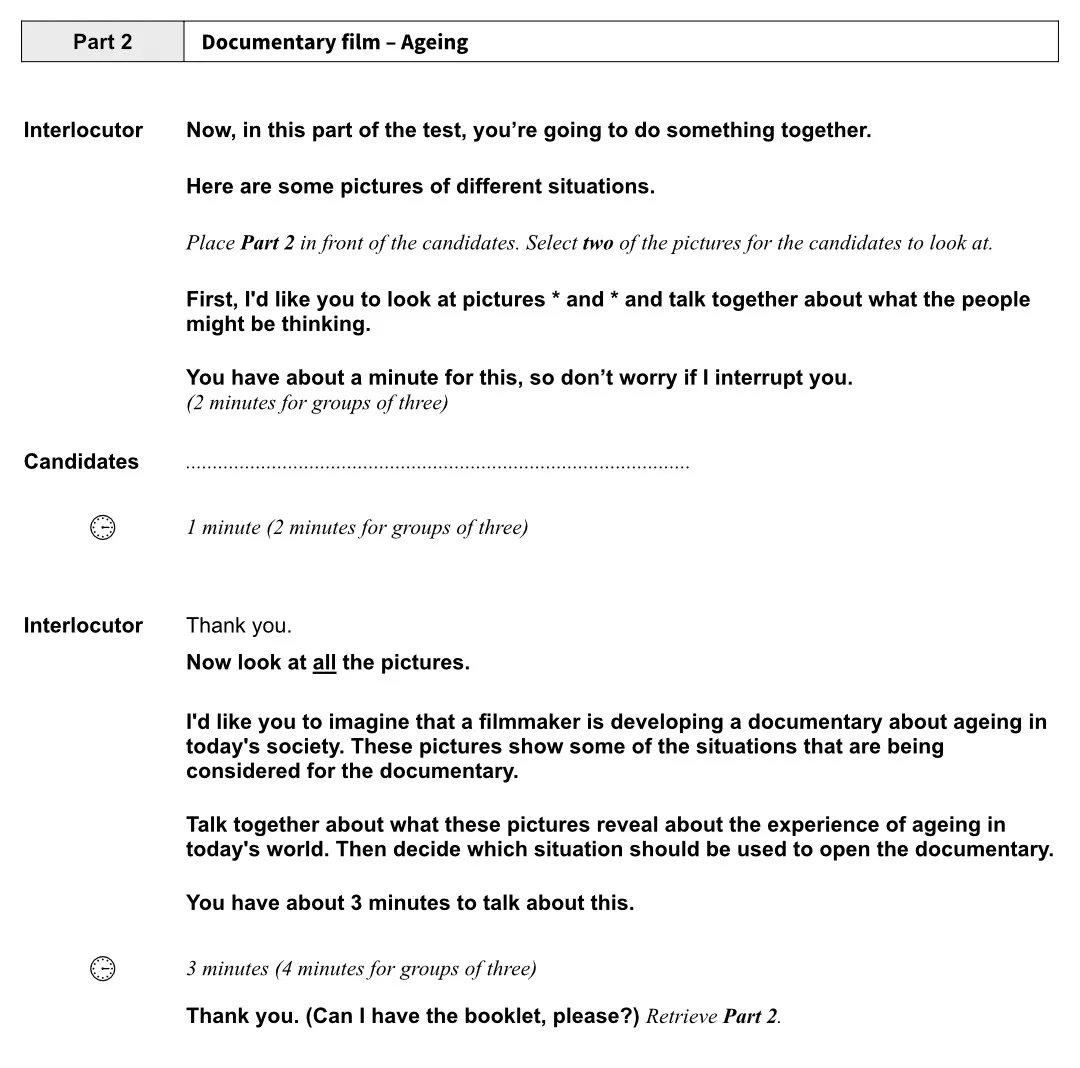
Visual material: «Documentary film – Ageing»
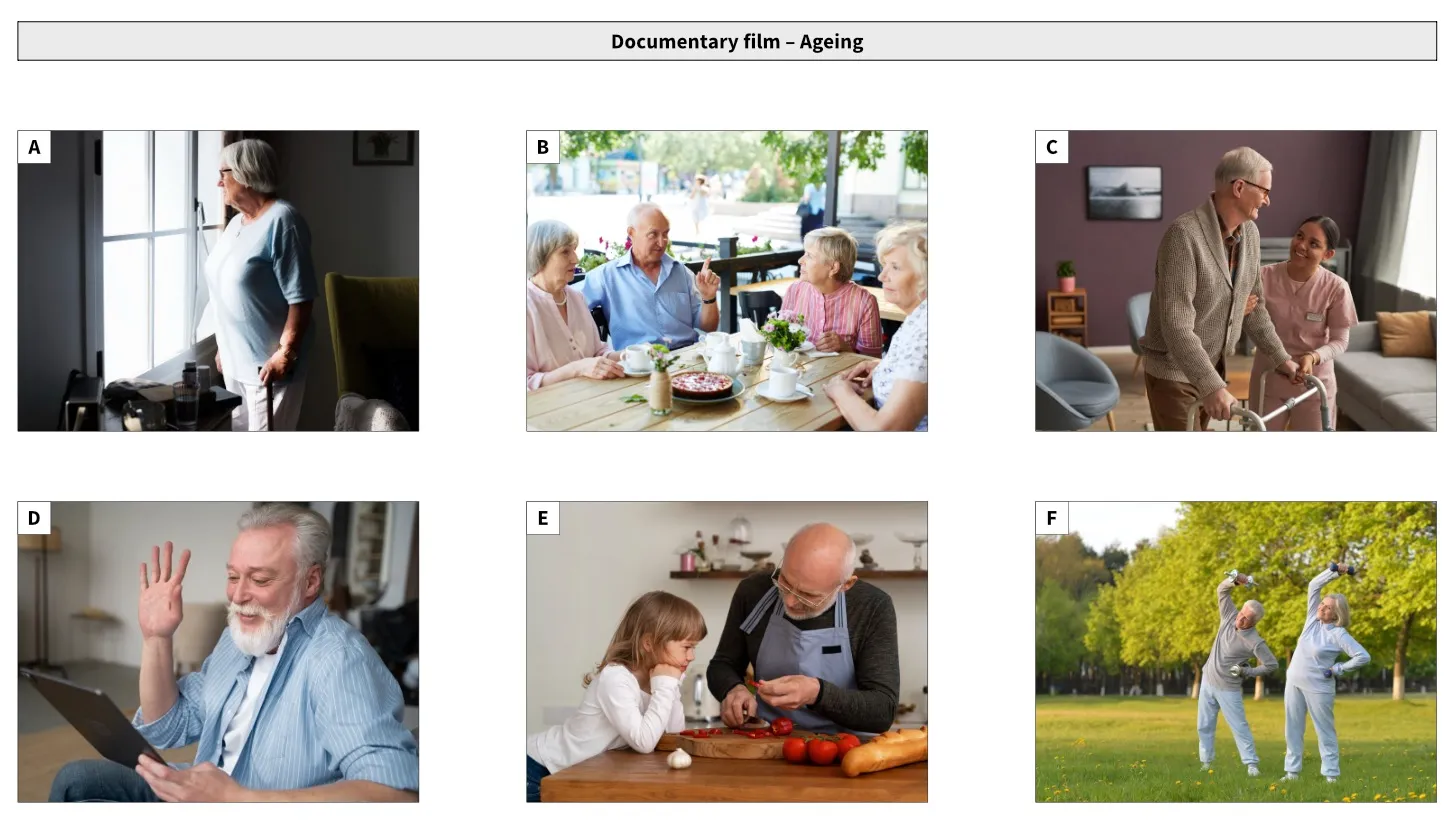
The candidates receive the following set of images related to different aspects of ageing:
Commented sample response
Below, we can see how two C2-level candidates approach this task with sophistication and fluency:
Interlocutor: Now, in this part of the test, you’re going to do something together. Here are some pictures of different situations. First, I’d like you to look at pictures A and C and talk together about what the people might be thinking. You have about a minute for this, so don’t worry if I interrupt you.
Candidate A: Looking at picture A, the elderly woman appears quite pensive, doesn’t she? She’s gazing out of the window, perhaps lost in a world of reminiscence or even feeling a certain sense of isolation. I’d imagine she’s contemplating the passage of time or perhaps just waiting for someone to visit, reflecting on her solitude.
Candidate B: I’d agree with that assessment; she does look rather wistful. Conversely, in picture C, the gentleman seems to be sharing a much more interactive, albeit physically demanding, moment with his carer. He’s likely thinking about how much he values that support, though I suspect there’s a lingering sense of frustration regarding his diminished independence and reliance on others.
Candidate A: That’s a valid point. It really highlights the stark contrast between solitary reflection and the necessity of professional care. While the woman might be dwelling on the stillness of her surroundings, the gentleman is likely focusing on the sheer physical exertion required just to move across the room, perhaps feeling a mix of gratitude and vulnerability.
Candidate B: Quite. Ultimately, both images suggest a significant degree of introspection—one born out of quietude and the other out of the struggle to maintain one’s dignity while facing physical decline. It’s a poignant look at the internal world of the elderly.
Interlocutor: Thank you. Now look at all the pictures. I’d like you to imagine that a filmmaker is developing a documentary about ageing in today’s society. These pictures show some of the situations that are being considered for the documentary. Talk together about what these pictures reveal about the experience of ageing in today’s world. Then decide which situation should open the documentary. You have about 3 minutes to talk about this.
Candidate A: When we look at the collection as a whole, it’s evident that the experience of ageing today is incredibly multifaceted. While pictures A and C capture the more traditional, sombre aspects of infirmity and solitude, others like F and D present a far more proactive and empowered narrative that we didn’t see as often in previous generations.
Candidate B: Absolutely. The couple exercising in the park in picture F suggests that vitality is now seen as something maintainable well into one’s twilight years. Similarly, the man using a tablet in picture D is a testament to how technology is bridging the digital divide, allowing seniors to remain tethered to their loved ones regardless of their physical location.
Candidate A: That’s a crucial observation. It’s no longer just about «fading away» or being relegated to the sidelines. Look at the social scene in picture B; it depicts the «third age» as a period of community engagement and leisure. We also shouldn’t overlook the intergenerational aspect in picture E, which is a beautiful depiction of the transfer of skills and wisdom.
Candidate B: I agree, but when it comes to selecting an opening image for the documentary, we need something that immediately challenges outdated stereotypes. While the grandfather cooking with his granddaughter is heart-warming, it’s perhaps a little too conventional for a film aiming to explore «today’s world» in a truly contemporary way.
Candidate A: I see your point. We need an «impact» shot that signals a modern perspective. Perhaps the video call in picture D? It’s so emblematic of our current era and how digital literacy has fundamentally redefined the way the elderly experience connection and overcome geographical isolation.
Candidate B: That’s certainly a strong contender, but I wonder if the exercise scene in picture F might be even more arresting. It’s such an active, vibrant image that it would immediately subvert the viewer’s expectations of frailty and decline. It sets a very positive, energetic tone for the film from the very first frame.
Candidate A: It is indeed a powerful image, but I still lean towards the video call in D. It encapsulates the intersection of ageing and the digital revolution, which is perhaps the most defining characteristic of the modern experience. It shows that even if one’s physical world shrinks, the virtual world remains wide open through technology.
Candidate B: You’ve made a compelling case. The technological element is undeniably the most contemporary facet of the experience and it really highlights the theme of «today’s society.» Let’s settle on picture D, the video call, as the most evocative and relevant choice to open the documentary.
Interlocutor: Thank you. Can I have the booklet, please?
This second example demonstrates how candidates can approach a more abstract and emotionally complex topic. The conversation shows an exceptional level of linguistic sophistication, with the use of precise and nuanced vocabulary, complex grammatical structures and an impressive ability to articulate abstract ideas with clarity and fluency.
Analysis of a good interaction in Part 2
The previous examples represent outstanding C2-level interactions. Let’s now analyse what specific elements make these conversations so successful and what we can learn from them for our own preparation.
Discourse management and interaction
One of the most prominent features of these interactions is the fluid management of discourse. The candidates demonstrate an exceptional ability to:
- Take and yield turns naturally: They use expressions like «Shall I start?», «Would you like to go first?» or «What do you make of this?» to manage the conversation without it seeming forced or rehearsed.
- Build on their partner’s contributions: Instead of simply adding new information, the candidates develop and expand on the ideas presented by their partner, using phrases such like «That’s a really important point, and it connects to…» or «Building on what you said…»
- Maintain conversational cohesion: The conversation flows organically, with smooth transitions between topics and a clear logical progression of ideas.
- Demonstrate active listening: The candidates respond to what their partner says, acknowledging their points of view with expressions like «I’d agree with that assessment», «That’s a valid point» or «I hadn’t thought of it quite that way».
This sophisticated discourse management is fundamental at C2 level, where candidates are expected not only to speak well individually but to demonstrate an exceptional ability to co-construct meaning in real-time with another speaker.
Sophisticated argumentation and critical thinking
C2-level candidates do not limit themselves to describing what they see in the images; they go much further to:
- Identify underlying themes: Instead of simply saying «this image shows a beekeeper», the candidates discuss broader concepts such as sustainability, the precariousness of small-scale food production and the food industry’s relationship with the natural world.
- Develop multi-faceted analyses: The candidates consider multiple dimensions of each topic, including economic, social, cultural and ethical aspects, demonstrating a deep and nuanced understanding.
- Hold ideas in tension: C2-level candidates are able to recognise complexity and ambiguity, such as when one says «I’m torn between the labour and working conditions angle… and the sustainability and environmental dimension», showing they can consider multiple perspectives simultaneously.
- Justify opinions with solid reasoning: Every opinion expressed is accompanied by a clear and well-articulated justification, such as «Documentaries that put a human face on unseen labour tend to have a very powerful emotional impact. It has that combination of social justice and personal story that makes for compelling television.»
This level of critical thinking and sophisticated argumentation is what distinguishes a C2-level performance from lower levels. It is not just about speaking well, but about thinking deeply and articulating those thoughts with precision.
Exceptional linguistic resources
The language used in these interactions exemplifies the level of mastery expected at C2:
- Precise and varied vocabulary: The candidates employ specific and sophisticated terms naturally, such as «entrepreneurial energy», «precariousness», «artisanal», «commercialisation», «wistful», «multifaceted» and «emblematic».
- Idiomatic expressions and natural collocations: They use set phrases fluently, such as «street food has exploded as a concept», «put a human face on unseen labour», «fading away» or «relegated to the sidelines».
- Complex grammatical structures: The interactions include a wide range of advanced structures: conditionals, relative clauses, inversions, complex passive structures and multiple subordination, all used with precision and naturalness.
- Appropriate register: The language is formal but not stiff, academic but accessible, demonstrating a sophisticated understanding of the appropriate register for an intellectual discussion between equals.
- Nuances of meaning: The candidates use modifiers and expressions that add subtle nuances, such as «perhaps», «arguably», «to some extent», «I suspect» and «it might be the case that», demonstrating an ability to express degrees of certainty and perspective.
The most impressive thing is that all these linguistic resources are employed in a fluid and natural way, without appearing forced or memorised. This is the hallmark of the C2 level: the ability to use sophisticated linguistic resources with the same naturalness as an educated native speaker would.
Speaking C2: The Ultimate CPE Speaking Guide
Master C2 Speaking with my complete guide, which includes 10 full mock exams, sample answers for each part, tips and strategies based on my experience, and lists of useful expressions designed specifically for the C2 Proficiency Speaking test.
Get your PDF copy now!
Collaborative decision-making
One of the most important aspects of Part 2 is the ability to work collaboratively towards a decision. Successful candidates demonstrate:
- Commitment to the process: Instead of simply agreeing for convenience, the candidates truly explore the options, weigh the alternatives and articulate their reasoning before reaching a conclusion.
- Respect for their partner’s perspectives: When differences of opinion arise, the candidates manage them with diplomacy and respect, using expressions like «That’s certainly a strong contender, but I wonder if…» or «You’ve made a compelling case».
- Sophisticated negotiation: The candidates do not impose their point of view; rather, they negotiate meaning through dialogue, presenting arguments, considering counter-arguments and reaching a consensus naturally.
- Articulated conclusion: The final decision is not abrupt but is reached organically and articulated clearly, as in «Let’s settle on picture D, the video call, as the most evocative and relevant choice to open the documentary».
It is vital to remember that what is evaluated is not whether the candidates reach a final decision (although it is desirable), but the quality of the collaborative process and the language used to work towards one. A candidate who demonstrates exceptional negotiation and collaboration skills, but who runs out of time before reaching a definitive conclusion, can still obtain an excellent score.
Useful phrases for C2 Speaking Part 2
Below, I present a selection of useful phrases and expressions organised by communicative function. These expressions will help you participate effectively in C2 Speaking Part 2, demonstrating the level of linguistic sophistication expected in the exam.
To describe and introduce the images
- What strikes me about this image is…
- At first glance, this picture appears to depict…
- This photograph captures the essence of…
- What’s particularly noteworthy here is…
- This image seems to encapsulate…
- Looking at this picture, one gets the sense that…
- This scene is evocative of…
- What immediately draws the eye is…
To compare and contrast
- In stark contrast to the first image…
- Whereas picture A focuses on…, picture B emphasizes…
- A key distinction lies in the way…
- This stands in marked contrast to…
- By comparison, this image presents a rather different…
- Unlike the previous picture, which showed…, this one illustrates…
- There’s a striking juxtaposition between…
- While both images deal with…, they approach it from quite different angles
- This represents the opposite end of the spectrum from…
To speculate and hypothesise
- It might well be the case that…
- One could reasonably argue that this represents…
- This would seem to suggest…
- It’s conceivable that…
- I’d venture to say that…
- Perhaps this is meant to illustrate…
- It strikes me that this could be interpreted as…
- There’s a strong possibility that…
- One might infer from this that…
- This raises the question of whether…
To give opinions and justify
- From my perspective, the most compelling aspect is…
- I’m inclined to think that…
- The reason I’d lean towards this option is that…
- What makes this particularly effective, in my view, is…
- I’d argue that this would be the most appropriate choice because…
- To my mind, this stands out for several reasons…
- The way I see it, this option has the advantage of…
- I’m torn between these two, but on balance, I’d say…
- What tips the balance for me is…
To involve your partner
- What’s your take on this?
- How does that strike you?
- Would you see it the same way, or…?
- I’m curious to hear your thoughts on…
- Do you think that’s a fair assessment?
- How about you—which one resonates more?
- Would you agree with that interpretation?
- That’s my initial reaction, but what do you make of it?
- I’d be interested to know whether you see it differently
- Perhaps you have a different perspective on this?
To gain time and add points
- Let me think about that for a moment…
- That’s an interesting question. I suppose…
- Building on that point…
- Another dimension worth considering is…
- On top of that, it’s worth noting that…
- What also springs to mind is…
- Having said that, we should also bear in mind…
- That ties in nicely with…
- Which brings me to another point…
- In a similar vein…
Essential tips to succeed in Part 2
Now that we have seen concrete examples and analysed what makes an interaction successful, let’s look at some practical tips that will help you maximise your performance in C2 Proficiency Speaking Part 2.
- Take advantage of the initial observation time. When the examiner places the visual material in front of you, you have about 15 seconds to study it before you start speaking. Use this time strategically to identify not only what the images show superficially, but the underlying themes they represent. Ask yourself: what broader issues do these images illustrate? What do they have in common? How do they differ? This mental preparation will allow you to start with confidence and depth.
- Go beyond superficial description. The most common mistake in this part is limiting yourself to describing what is seen in the images: «In this image there is a person doing…». C2-level candidates immediately identify the abstract themes that the images represent and focus their discussion on those broader concepts. Don’t say «this image shows someone working in a kitchen»; say «this image raises questions about working conditions and health and safety in the food processing sector».
- Build on your partner’s contributions. Part 2 does not consist of two alternating monologues but a real collaborative conversation. When your partner makes an observation, don’t just add your own unrelated point. Instead, acknowledge what they have said, develop it, qualify it or connect it with another idea. Use expressions like «That’s a really important point, and it connects to…» or «Building on what you said about…» to demonstrate that you are actively listening and co-constructing meaning.
- Manage the balance between participation and dominance. While it is important to contribute substantially to the discussion, it is also crucial to give space to your partner. If you notice that you have been talking for more than 30-40 seconds without a break, it is time to involve your partner with a question or an invitation to comment. On the other hand, if your partner is dominating the conversation, look for natural moments to intervene with phrases like «That’s an interesting perspective. I’d also add that…» or «May I build on that point?»
- Demonstrate intellectual flexibility. C2-level candidates do not cling rigidly to a position; rather, they demonstrate the ability to consider multiple perspectives, recognise complexity and, when appropriate, modify their point of view in response to a convincing argument. Expressions like «That’s a very accurate observation. I hadn’t thought of it quite that way» or «You’ve made a compelling case» demonstrate this intellectual sophistication.
- Prioritise depth over exhaustive coverage. It is not necessary (nor desirable) to discuss all the images with the same level of detail. It is better to develop a deep and nuanced analysis of two or three images than to superficially mention them all. Examiners value the ability to explore ideas in depth, not the ability to list superficial observations about each image.
- Practise collaborative decision-making. The second phase of the task almost always requires you to reach a decision with your partner. Practise the process of: (1) exploring the options, (2) expressing an initial preference with justification, (3) listening to your partner’s perspective, (4) considering both points of view and (5) reaching a consensual conclusion. This process should feel natural, not forced or mechanical.
- Use speculative and hypothetical language naturally. Part 2 often requires you to speculate about situations, motives or implications. Familiarise yourself with a range of C2-level speculative expressions such as «it might well be the case that», «one could reasonably argue that», «it’s conceivable that» or «this would seem to suggest». These expressions add sophistication and nuance to your discourse.
- Maintain an appropriate and consistent register. The appropriate register for this part is formal but not stiff, intellectual but accessible. Avoid excessively colloquial language («this pic is really cool») but also avoid sounding artificially academic or pompous. Think about how you would discuss these topics with an educated colleague in a professional context.
- Don’t worry if the examiner interrupts. The examiner will interrupt after approximately one minute in the first phase to move on to the second. This is completely normal and expected, so do not interpret it as a sign that you are doing something wrong. Simply stop your sentence naturally and prepare for the next phase of the task.
- Practise with a variety of topics and types of images. Part 2 tasks can cover a wide range of topics (social, cultural, environmental, technological, etc.) and can present different types of decisions (which image would be most appropriate, which topic would generate most interest, which situation should appear first, etc.). The more you practise with different types of tasks, the more comfortable you will feel on exam day. My Speaking C2 PDF book includes 10 full Part 2 examples covering a wide variety of topics and task formats.
Succeed in C2 Speaking with my guide featuring 10 sample exams
If you are preparing for the C2 Proficiency exam and want to ensure you completely master the Speaking test, I recommend my complete guide Speaking C2: The Ultimate CPE Speaking Guide. This PDF book of more than 120 pages has been specifically designed to help you achieve success in all parts of the C2 oral exam.
Speaking C2: The Ultimate CPE Speaking Guide
Master C2 Speaking with my complete guide, which includes 10 full mock exams, sample answers for each part, tips and strategies based on my experience, and lists of useful expressions designed specifically for the C2 Proficiency Speaking test.
Get your PDF copy now!
The book includes:
- 10 complete practice exams that faithfully replicate the format and content of the real C2 Proficiency Speaking
- Sample answers for each part with detailed comments explaining why they are effective
- Detailed guide for each part of the Speaking with specific strategies and practical tips
- Extensive lists of useful language organised by communicative function and designed specifically for C2 level
- Assessment criteria and sample mark sheet so you understand exactly how your performance is evaluated
- Frequently Asked Questions section that resolves all common doubts about the exam
Whether you are a student preparing for the exam on your own or a teacher looking for quality material for your classes, this guide will provide you with everything you need to face the C2 Proficiency Speaking with confidence and competence. Get your PDF copy now and take the first step towards mastering the C2 oral exam.
And until the next article, don’t forget to keep smiling!
