

Tabla de contenidos
El Speaking Part 1 del C2 Proficiency (CPE) es la primera toma de contacto que tendrás con los examinadores en la prueba oral. Aunque es la parte más breve del examen, no por ello deja de ser importante. En esta sección, el examinador te hará una serie de preguntas diseñadas para evaluar tu capacidad de comunicarte de forma espontánea, precisa y sofisticada sobre temas personales y abstractos.
En este artículo, te explico todo lo que necesitas saber sobre el C2 Speaking Part 1: su formato, tipos de preguntas, temas habituales, ejemplos reales y consejos clave para que puedas afrontarla con confianza y éxito. Let’s go! 👇
C2 Speaking Part 1: Descripción, formato y características
La Parte 1 del Speaking de C2 consiste en una breve entrevista en la que el examinador (Interlocutor) hace preguntas a cada uno de los candidatos de forma individual. A diferencia de otras partes del examen, aquí no interactúas con tu compañero, sino que respondes directamente al examinador. Las preguntas van más allá de simples datos biográficos y te invitan a expresar opiniones, justificar puntos de vista, reflexionar sobre experiencias personales e incluso especular sobre situaciones hipotéticas o futuras.
El objetivo de esta parte es permitir que los examinadores evalúen tu capacidad para mantener una conversación espontánea y fluida, utilizando un lenguaje preciso, variado y sofisticado, tal y como se espera de un hablante de nivel C2. Aunque es una sección breve, es una oportunidad perfecta para demostrar desde el primer momento tu dominio del inglés.
Tiempo y dinámica
El C2 Speaking Part 1 tiene una duración aproximada de 2 minutos en total, lo que incluye las preguntas dirigidas a ambos candidatos. Esto significa que cada candidato dispondrá de aproximadamente un minuto para responder a las preguntas que le formulen. Dado lo breve de esta parte, no se espera que des respuestas excesivamente largas, pero sí que sean completas, bien desarrolladas y que reflejen tu capacidad lingüística.
La dinámica es sencilla: el interlocutor se presentará, pedirá vuestras hojas de examen (mark sheets) o números de candidate (candidate numbers) y, a continuación, comenzará a hacer preguntas alternando entre ambos candidatos.
Las preguntas iniciales suelen ser más sencillas y de carácter introductorio («Where do you live?» o «Are you working or studying at the moment?»), pero rápidamente evolucionan hacia cuestiones más complejas que pueden requerir reflexión, opinión y/o justificación.
Es importante recordar que, aunque tu compañero esté presente y escuche tus respuestas, en esta parte no se espera que interactúes con él. Tu atención debe centrarse en el examinador y en responder de forma clara, natural y relevante a cada pregunta.
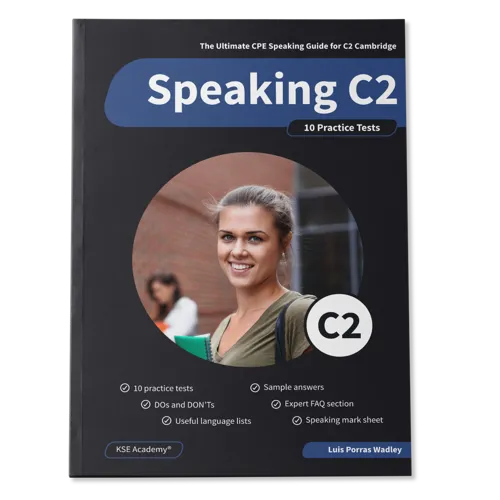
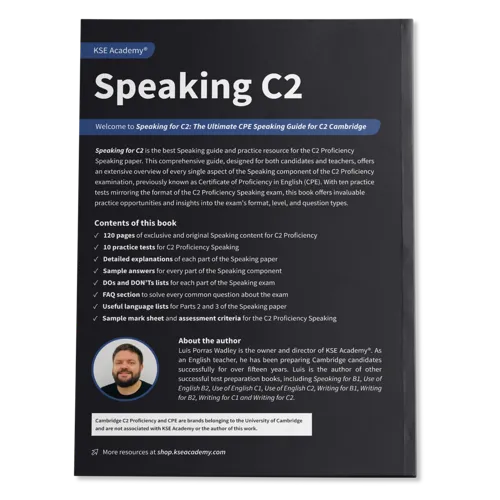
Speaking C2: The Ultimate CPE Speaking Guide
Domina el Speaking del C2 con mi guía completa, que incluye 10 simulacros completos, respuestas de ejemplo para cada parte, consejos y estrategias basadas en mi experiencia y listas de expresiones útiles diseñadas específicamente para la prueba de Speaking de C2 Proficiency.
¡Consigue ya tu ejemplar en PDF!
Tipos de preguntas
Las preguntas de la primera parte del C2 Speaking de Cambridge pueden clasificarse en varios tipos, cada uno diseñado para evaluar diferentes aspectos de tu competencia oral:
- Preguntas personales/descriptivas: Te invitan a hablar sobre tu entorno, tu vida diaria, tus intereses o tu situación actual. Por ejemplo: «Is that an interesting place to live?» o «What’s the best thing about the area where you live?»
- Preguntas de opinión: Requieren que expreses tu punto de vista sobre un tema y lo justifiques. Por ejemplo: «Would you ever consider moving abroad for work?»
- Preguntas reflexivas: Te piden que reflexiones sobre experiencias, valores o aspectos de tu personalidad. Por ejemplo: «Is there anything about yourself that you would like to change?»
- Preguntas hipotéticas o especulativas: Te invitan a imaginar situaciones futuras o alternativas. Por ejemplo: «What would your dream job be?»
- Preguntas sobre hábitos y rutinas: Evalúan tu capacidad para describir tu día a día de forma elaborada y natural. Por ejemplo: «Tell us how you usually like to spend your free time.»
A nivel C2, se espera que tus respuestas vayan más allá de lo superficial. No basta con decir «Yes, I like it» o «No, I don’t think so», sino que debes desarrollar tus ideas, aportar ejemplos, matizar tus opiniones y demostrar que eres capaz de utilizar estructuras gramaticales complejas y un vocabulario rico y preciso de forma espontánea.
Ejemplo 1 de preguntas del C2 Speaking Part 1
A continuación, te dejo dos ejemplos de la parte 1 de este examen, con respuestas también de ejemplo. Hay que tener en cuenta también que el examinador probablemente no realizará todas las preguntas, sino una o dos por candidato, según el tiempo disponible y lo que tarde en responder cada candidato.
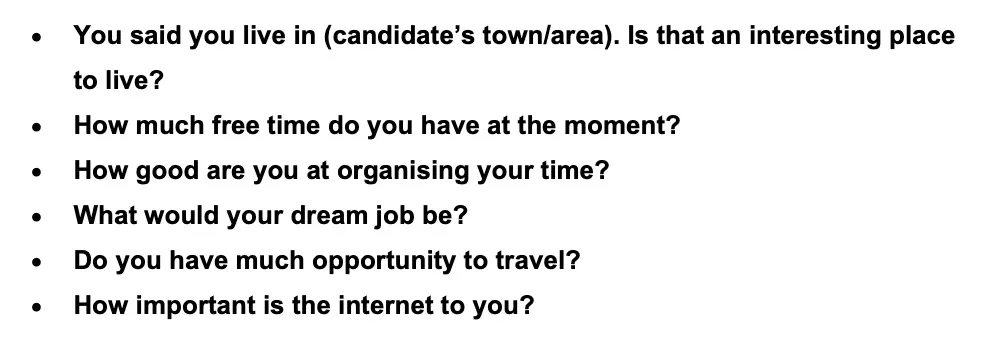
You said you live in (candidate’s town/area). Is that an interesting place to live?
Yes, absolutely. I’d say it’s a really vibrant city with a lot going on culturally. There are always exhibitions, concerts and festivals happening, which I find quite stimulating. It also has a good mix of old and new — historic architecture alongside modern developments — which gives it a unique character.
How much free time do you have at the moment?
Not as much as I’d like, to be honest. Between work and other commitments, I find myself with very little downtime during the week. I do try to carve out some time at the weekends, though, to unwind and catch up with friends or pursue hobbies.
How good are you at organising your time?
I’d say I’m reasonably good at it, though there’s always room for improvement. I tend to use digital tools like calendars and to-do lists to keep track of things, which helps me stay on top of deadlines. That said, I do sometimes underestimate how long tasks will take, which can throw things off a bit.
What would your dream job be?
That’s a tough one. I think it would be something that combines creativity with a sense of purpose — perhaps working in documentary filmmaking or environmental journalism. I’d love to be in a role where I’m constantly learning, travelling and contributing to something meaningful.
Do you have much opportunity to travel?
Not as much as I’d like, unfortunately. My work schedule can be quite demanding, so I don’t get away as often as I used to. When I do travel, though, I try to make the most of it — exploring off-the-beaten-path destinations rather than sticking to the usual tourist spots.
How important is the internet to you?
Extremely important, I’d say. It’s become so integral to almost every aspect of daily life — from work and communication to entertainment and learning. I honestly can’t imagine functioning without it at this point, though I do try to be mindful about not becoming too dependent on it.
Ejemplo 2 de preguntas del C2 Speaking Part 1
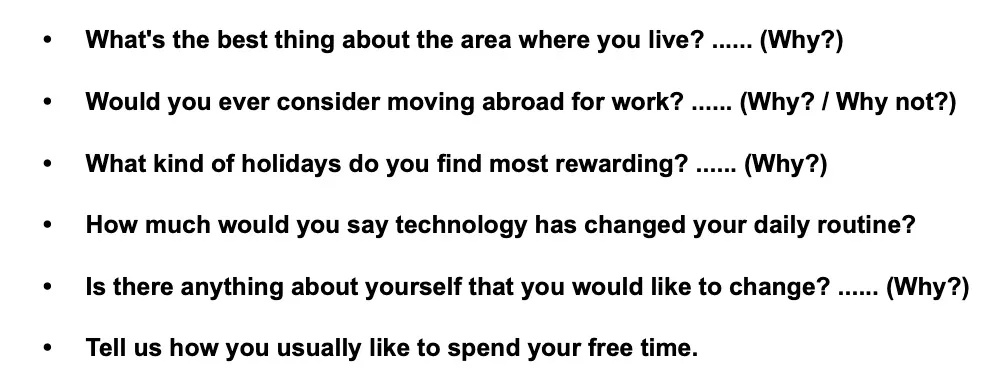
What’s the best thing about the area where you live? …… (Why?)
I think the sense of community is what I value most. People tend to know each other, and there’s a real neighbourly spirit, which is quite rare these days. It makes the place feel safe and welcoming, and I think that contributes enormously to quality of life.
Would you ever consider moving abroad for work? …… (Why? / Why not?)
Yes, I’d definitely consider it, provided the opportunity was right. I think living and working in a different country can be incredibly enriching — both professionally and personally. It broadens your perspective and challenges you in ways that staying in one place simply doesn’t.
What kind of holidays do you find most rewarding? …… (Why?)
I’d say the ones that involve some kind of cultural immersion. I’m not really one for lying on a beach for a week — I prefer exploring cities, trying local food, meeting people and learning about different ways of life. I find that kind of travel far more fulfilling and memorable.
How much would you say technology has changed your daily routine?
Quite significantly, I’d say. Everything from how I communicate to how I work and even how I relax has been shaped by technology. It’s made life more convenient in many ways, but it’s also blurred the boundaries between work and personal time, which can be a bit of a double-edged sword.
Is there anything about yourself that you would like to change? …… (Why?)
I think I’d like to be a bit more patient, particularly when things don’t go according to plan. I tend to get frustrated quite easily, which isn’t always helpful. Developing a bit more resilience and learning to take things in my stride would definitely be beneficial.
Tell us how you usually like to spend your free time.
I’m quite an avid reader, so I spend a fair amount of time with a good book. I also enjoy cooking — experimenting with new recipes is something I find quite therapeutic. And when I can, I like to get outdoors, whether that’s going for a long walk or doing a bit of cycling.
Temas habituales en el C2 Speaking Part 1
Dado que el nivel C2 representa un dominio prácticamente nativo del inglés, cualquier tema razonable puede aparecer en el examen. A diferencia de niveles inferiores como el B1 o el B2, donde las temáticas suelen estar más limitadas a situaciones cotidianas, en el C2 se espera que seas capaz de hablar con fluidez y precisión sobre una amplia gama de asuntos, incluyendo temas abstractos, complejos o de actualidad.
Aquí tienes una lista de los temas más habituales que pueden aparecer en esta parte del examen:
- Valores personales y creencias
- Vida profesional y académica
- Experiencias culturales y viajes
- Sociedad y tendencias actuales
- Tecnología e internet
- Gestión del tiempo y organización personal
- Ambiciones, planes y objetivos de vida
- Amigos, familia y vida social
- Hábitos, rutinas y personalidad
- Tiempo libre y actividades de ocio: arte, deporte, lectura, cine, música, etc.
- Lugares y entornos: ciudades, países, zonas residenciales
- Aprendizaje de idiomas
- Trabajo y carrera profesional
- Cambios y adaptación
Como puedes ver, la variedad de temas es muy amplia. Por eso es fundamental que practiques hablando sobre diferentes áreas y que te sientas cómodo expresando opiniones, reflexionando sobre experiencias y especulando sobre situaciones hipotéticas en inglés.
Consejos esenciales para triunfar en la C2 Speaking Part 1
Ahora que ya conoces el formato, los tipos de preguntas y los temas habituales de la C2 Speaking Part 1, es momento de repasar algunos consejos clave que te ayudarán a rendir al máximo en esta parte del examen:
- Escucha con atención y responde con precisión: Asegúrate de entender exactamente lo que te están preguntando antes de responder. Una respuesta irrelevante, por muy bien construida que esté, no te ayudará a demostrar tu nivel.
- Desarrolla tus respuestas sin extenderte demasiado: Dado que esta parte dura solo 2 minutos en total, no tienes tiempo para monólogos largos. Ofrece respuestas completas y bien justificadas, pero ve al grano y evita divagar.
- Demuestra sofisticación lingüística desde el principio: Utiliza vocabulario preciso, expresiones idiomáticas naturales y estructuras gramaticales complejas. No te conformes con respuestas básicas; este es el momento de brillar.
- Sé natural y espontáneo: Evita sonar ensayado o robótico. Los examinadores detectan rápidamente cuando alguien está recitando respuestas memorizadas, y eso puede jugar en tu contra. Responde de forma auténtica y conversacional.
- Practica, pero no memorices: Es útil practicar con preguntas similares a las del examen para ganar confianza, pero nunca memorices respuestas palabra por palabra. En su lugar, familiarízate con el tipo de lenguaje y estructuras que puedes usar.
- Mantén la calma si te interrumpen: Es posible que el examinador te interrumpa si considera que ya has dicho suficiente. Esto es completamente normal y no significa que lo hayas hecho mal; simplemente están gestionando el tiempo.
- Presta atención a tu compañero: Aunque no interactúes directamente con él en esta parte, escuchar sus respuestas puede ayudarte a relajarte y, en algunos casos, incluso inspirarte para tus propias respuestas.
- Termina tus respuestas de forma clara: Evita dejar tus respuestas a medias o que se vayan apagando sin una conclusión clara. Cierra tus ideas de forma natural y coherente.
- Sonríe y muestra confianza: Una actitud positiva y relajada no solo te ayudará a sentirte mejor, sino que también creará una buena impresión en los examinadores.
- Calienta antes de entrar: Habla en inglés con tu compañero o con alguien más antes de entrar a la sala de examen. Esto te ayudará a entrar en ambiente y reducirá las posibilidades de quedarte bloqueado al principio.
Vídeo de un C2 Speaking Part 1
Ver ejemplos reales de candidatos realizando el C2 Proficiency Speaking puede ser extremadamente útil para entender mejor qué se espera de ti y cómo suenan las respuestas de nivel C2 en la práctica. A continuación, te dejo un vídeo oficial de Cambridge de un examen real de C2 Proficiency:
Presta atención también a la dinámica de la interacción y a cómo los examinadores gestionan el tiempo y las preguntas.
Prepárate a fondo con mi libro de Speaking C2 Proficiency
Speaking C2: The Ultimate CPE Speaking Guide
Domina el Speaking del C2 con mi guía completa, que incluye 10 simulacros completos, respuestas de ejemplo para cada parte, consejos y estrategias basadas en mi experiencia y listas de expresiones útiles diseñadas específicamente para la prueba de Speaking de C2 Proficiency.
¡Consigue ya tu ejemplar en PDF!
Si quieres prepararte de forma completa y efectiva para el examen de Speaking del C2 Proficiency, te recomiendo que eches un vistazo a mi libro de Speaking C2 en PDF. En él encontrarás:
- Una guía detallada de cada una de las tres partes del examen de Speaking del C2 Proficiency.
- 10 exámenes completos de Speaking con preguntas reales y actualizadas.
- Lista de expresiones útiles que te ayudarán a maximizar tus oportunidades en las diferentes partes del examen.
- Respuestas modelo para cada parte, escritas con el nivel de sofisticación esperado en C2.
- Consejos específicos para cada tarea, basados en mi experiencia como profesor y preparador de exámenes de Cambridge.
- Acceso a las escalas de evaluación oficiales para que sepas exactamente cómo se te va a evaluar.
Este libro está diseñado para que puedas practicar de forma autónoma o con un compañero, y te proporcionará todas las herramientas que necesitas para afrontar el examen con confianza y alcanzar la puntuación que deseas.
Y hasta el próximo artículo, don’t forget to keep smiling!
