

Table of contents
C2 Proficiency (CPE) Speaking Part 1 is your first contact with the examiners during the oral exam. Although it is the shortest part of the test, it is no less important for that. In this section, the examiner will ask you a series of questions designed to assess your ability to communicate spontaneously, precisely, and sophisticatedly about personal and abstract topics.
In this article, I explain everything you need to know about C2 Speaking Part 1: its format, question types, common topics, real-life examples, and key tips so you can approach it with confidence and success. Let’s go! 👇
C2 Speaking Part 1: Description, format, and features
Part 1 of the C2 Speaking test consists of a short interview where the examiner (Interlocutor) asks each candidate questions individually. Unlike other parts of the exam, you do not interact with your partner here; instead, you respond directly to the examiner. The questions go beyond simple biographical data and invite you to express opinions, justify viewpoints, reflect on personal experiences, and even speculate about hypothetical or future situations.
The aim of this part is to allow the examiners to assess your ability to maintain a spontaneous and fluid conversation, using precise, varied, and sophisticated language, as expected of a C2-level speaker. Although it is a short section, it is a perfect opportunity to demonstrate your command of English from the very beginning.
Time and dynamics
C2 Speaking Part 1 lasts approximately 2 minutes in total, which includes the questions directed at both candidates. This means that each candidate will have about one minute to answer the questions they are asked. Given how brief this part is, you are not expected to give excessively long answers, but they should be complete, well-developed, and reflect your linguistic ability.
The dynamic is simple: the interlocutor will introduce themselves, ask for your mark sheets or candidate numbers, and then begin asking questions, alternating between both candidates.
The initial questions tend to be simpler and introductory in nature («Where do you live?» or «Are you working or studying at the moment?»), but they quickly evolve into more complex issues that may require reflection, opinion, and/or justification.
It is important to remember that, even though your partner is present and listening to your answers, you are not expected to interact with them in this part. Your focus should be on the examiner and on responding clearly, naturally, and relevantly to each question.
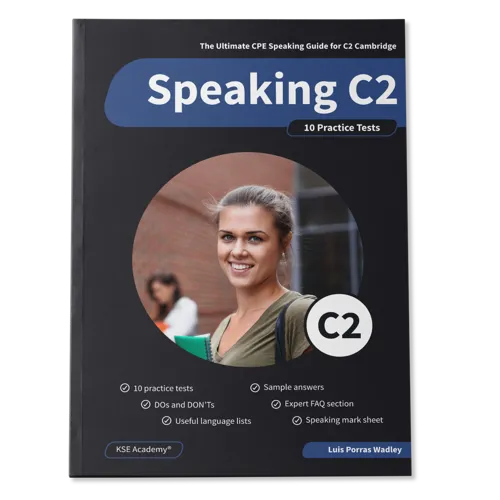
Speaking C2: The Ultimate CPE Speaking Guide
Master C2 Speaking with my comprehensive guide, which includes 10 full practice tests, sample answers for each part, tips and strategies based on my experience, and lists of useful expressions specifically designed for the C2 Proficiency Speaking test.
Get your PDF copy now!
Question types
The questions in the first part of the Cambridge C2 Speaking can be classified into several types, each designed to assess different aspects of your oral competence:
- Personal/descriptive questions: These invite you to talk about your environment, your daily life, your interests, or your current situation. For example: «Is that an interesting place to live?» or «What’s the best thing about the area where you live?»
- Opinion questions: These require you to express your point of view on a topic and justify it. For example: «Would you ever consider moving abroad for work?»
- Reflective questions: These ask you to reflect on experiences, values, or aspects of your personality. For example: «Is there anything about yourself that you would like to change?»
- Hypothetical or speculative questions: These invite you to imagine future or alternative situations. For example: «What would your dream job be?»
- Questions about habits and routines: These assess your ability to describe your daily life in an elaborate and natural way. For example: «Tell us how you usually like to spend your free time.»
At C2 level, your answers are expected to go beyond the superficial. It is not enough to say «Yes, I like it» or «No, I don’t think so»; you must develop your ideas, provide examples, qualify your opinions, and demonstrate that you are capable of using complex grammatical structures and a rich, precise vocabulary spontaneously.
Example 1 of C2 Speaking Part 1 questions
Below, I have provided two examples of Part 1 of this exam, along with sample answers. You should also keep in mind that the examiner will probably not ask all the questions, but rather one or two per candidate, depending on the time available and how long each candidate takes to respond.
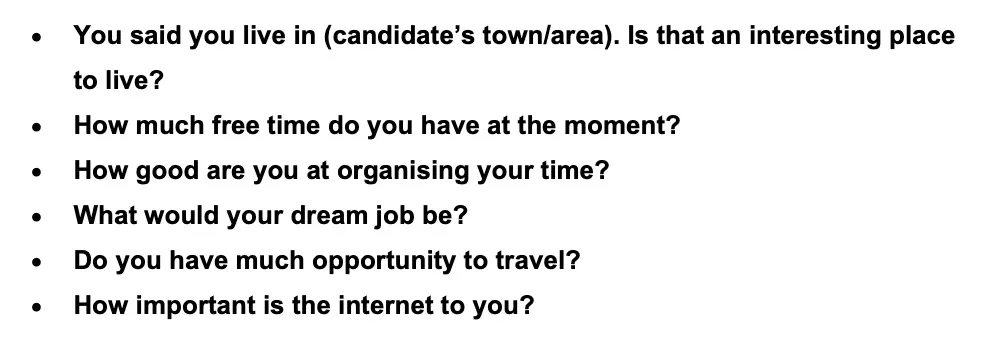
You said you live in (candidate’s town/area). Is that an interesting place to live?
Yes, absolutely. I’d say it’s a really vibrant city with a lot going on culturally. There are always exhibitions, concerts and festivals happening, which I find quite stimulating. It also has a good mix of old and new — historic architecture alongside modern developments — which gives it a unique character.
How much free time do you have at the moment?
Not as much as I’d like, to be honest. Between work and other commitments, I find myself with very little downtime during the week. I do try to carve out some time at the weekends, though, to unwind and catch up with friends or pursue hobbies.
How good are you at organising your time?
I’d say I’m reasonably good at it, though there’s always room for improvement. I tend to use digital tools like calendars and to-do lists to keep track of things, which helps me stay on top of deadlines. That said, I do sometimes underestimate how long tasks will take, which can throw things off a bit.
What would your dream job be?
That’s a tough one. I think it would be something that combines creativity with a sense of purpose — perhaps working in documentary filmmaking or environmental journalism. I’d love to be in a role where I’m constantly learning, travelling and contributing to something meaningful.
Do you have much opportunity to travel?
Not as much as I’d like, unfortunately. My work schedule can be quite demanding, so I don’t get away as often as I used to. When I do travel, though, I try to make the most of it — exploring off-the-beaten-path destinations rather than sticking to the usual tourist spots.
How important is the internet to you?
Extremely important, I’d say. It’s become so integral to almost every aspect of daily life — from work and communication to entertainment and learning. I honestly can’t imagine functioning without it at this point, though I do try to be mindful about not becoming too dependent on it.
Example 2 of C2 Speaking Part 1 questions
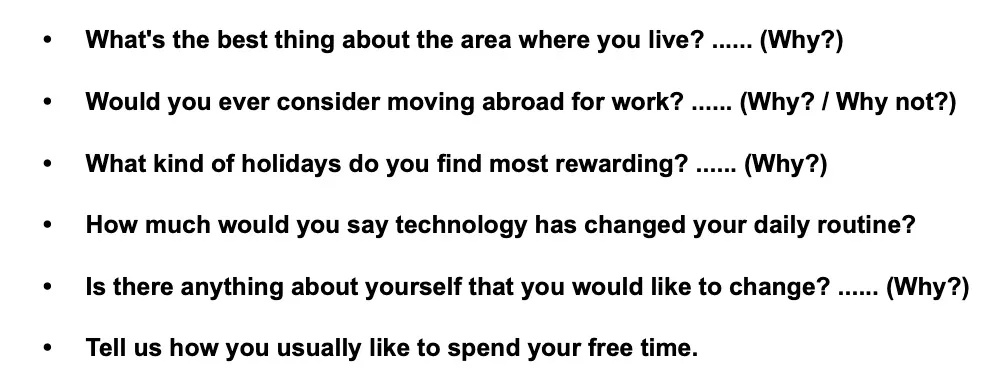
What’s the best thing about the area where you live? …… (Why?)
I think the sense of community is what I value most. People tend to know each other, and there’s a real neighbourly spirit, which is quite rare these days. It makes the place feel safe and welcoming, and I think that contributes enormously to quality of life.
Would you ever consider moving abroad for work? …… (Why? / Why not?)
Yes, I’d definitely consider it, provided the opportunity was right. I think living and working in a different country can be incredibly enriching — both professionally and personally. It broadens your perspective and challenges you in ways that staying in one place simply doesn’t.
What kind of holidays do you find most rewarding? …… (Why?)
I’d say the ones that involve some kind of cultural immersion. I’m not really one for lying on a beach for a week — I prefer exploring cities, trying local food, meeting people and learning about different ways of life. I find that kind of travel far more fulfilling and memorable.
How much would you say technology has changed your daily routine?
Quite significantly, I’d say. Everything from how I communicate to how I work and even how I relax has been shaped by technology. It’s made life more convenient in many ways, but it’s also blurred the boundaries between work and personal time, which can be a bit of a double-edged sword.
Is there anything about yourself that you would like to change? …… (Why?)
I think I’d like to be a bit more patient, particularly when things don’t go according to plan. I tend to get frustrated quite easily, which isn’t always helpful. Developing a bit more resilience and learning to take things in my stride would definitely be beneficial.
Tell us how you usually like to spend your free time.
I’m quite an avid reader, so I spend a fair amount of time with a good book. I also enjoy cooking — experimenting with new recipes is something I find quite therapeutic. And when I can, I like to get outdoors, whether that’s going for a long walk or doing a bit of cycling.
Common topics in C2 Speaking Part 1
Given that C2 level represents a near-native command of English, any reasonable topic can appear in the exam. Unlike lower levels such as B1 or B2, where themes are usually more limited to everyday situations, at C2 you are expected to be able to speak fluently and precisely about a wide range of matters, including abstract, complex, or current affairs topics.
Here is a list of the most common topics that may appear in this part of the exam:
- Personal values and beliefs
- Professional and academic life
- Cultural experiences and travel
- Society and current trends
- Technology and the internet
- Time management and personal organisation
- Ambitions, plans, and life goals
- Friends, family, and social life
- Habits, routines, and personality
- Free time and leisure activities: art, sport, reading, cinema, music, etc.
- Places and environments: cities, countries, residential areas
- Language learning
- Work and professional career
- Changes and adaptation
As you can see, the variety of topics is very broad. That is why it is essential to practise speaking about different areas and feel comfortable expressing opinions, reflecting on experiences, and speculating about hypothetical situations in English.
Essential tips to succeed in C2 Speaking Part 1
Now that you know the format, question types, and common topics of C2 Speaking Part 1, it’s time to review some key tips that will help you perform at your best in this part of the exam:
- Listen carefully and answer precisely: Make sure you understand exactly what you are being asked before responding. An irrelevant answer, no matter how well-constructed, will not help you demonstrate your level.
- Develop your answers without going on for too long: Since this part lasts only 2 minutes in total, you don’t have time for long monologues. Provide complete and well-justified answers, but get to the point and avoid rambling.
- Show linguistic sophistication from the start: Use precise vocabulary, natural idiomatic expressions, and complex grammatical structures. Do not settle for basic answers; this is your moment to shine.
- Be natural and spontaneous: Avoid sounding rehearsed or robotic. Examiners quickly detect when someone is reciting memorised answers, and that can work against you. Respond in an authentic and conversational way.
- Practise, but don’t memorise: It is useful to practise with questions similar to those in the exam to gain confidence, but never memorise answers word for word. Instead, familiarise yourself with the type of language and structures you can use.
- Stay calm if you are interrupted: The examiner may interrupt you if they feel you have already said enough. This is completely normal and does not mean you have done poorly; they are simply managing the time.
- Pay attention to your partner: Even though you do not interact directly with them in this part, listening to their answers can help you relax and, in some cases, even inspire your own responses.
- Finish your answers clearly: Avoid leaving your answers half-finished or letting them fade away without a clear conclusion. Close your ideas naturally and coherently.
- Smile and show confidence: A positive and relaxed attitude will not only help you feel better but will also create a good impression on the examiners.
- Warm up before going in: Speak in English with your partner or someone else before entering the exam room. This will help you get into the flow and reduce the chances of getting stuck at the beginning.
C2 Speaking Part 1 video
Watching real-life examples of candidates performing the C2 Proficiency Speaking can be extremely useful for better understanding what is expected of you and how C2-level answers sound in practice. Below, I have provided an official Cambridge video of a real C2 Proficiency exam:
Pay close attention also to the dynamics of the interaction and how the examiners manage time and questions.
Prepare thoroughly with my C2 Proficiency Speaking book
Speaking C2: The Ultimate CPE Speaking Guide
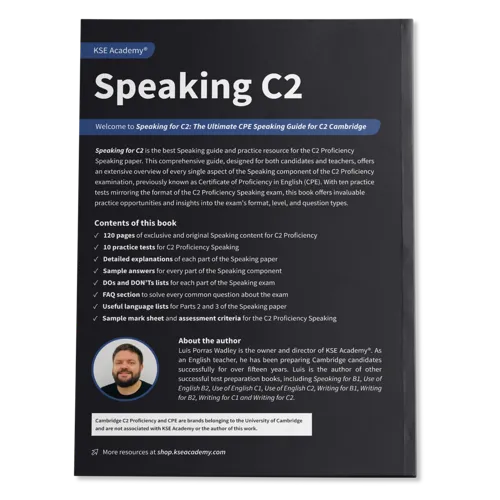
Master C2 Speaking with my comprehensive guide, which includes 10 full practice tests, sample answers for each part, tips and strategies based on my experience, and lists of useful expressions specifically designed for the C2 Proficiency Speaking test.
Get your PDF copy now!
If you want to prepare fully and effectively for the C2 Proficiency Speaking exam, I recommend you take a look at my C2 Speaking book in PDF. In it, you will find:
- A detailed guide to each of the three parts of the C2 Proficiency Speaking exam.
- 10 full Speaking tests with real and up-to-date questions.
- List of useful expressions that will help you maximise your opportunities in the different parts of the exam.
- Model answers for each part, written with the level of sophistication expected at C2.
- Specific tips for each task, based on my experience as a teacher and Cambridge exam coach.
- Access to the official assessment scales so you know exactly how you will be evaluated.
This book is designed so that you can practise independently or with a partner, and it will provide you with all the tools you need to face the exam with confidence and reach the score you desire.
And until the next article, don’t forget to keep smiling!
