
Tabla de contenidos
¿Eres aficionado al deporte? ¿O a cualquier tipo de juego? Supongo que te gusta ganar (a mí también), pero ¿estás usando bien el verbo win? Fíjate en estas dos frases e intenta averiguar por qué son incorrectas:
❌ I’m better than you at chess. I can win you any time!
❌ Manchester United won Liverpool 3-0 in the last game.
¿Lo has adivinado? No te preocupes si no, porque es uno de los errores más comunes de los hispanohablantes, y tiene explicación: en español usamos «ganar» para casi todo (ganar un partido, ganar a alguien, ganar un premio), pero en inglés hay dos verbos distintos, win y beat, y cada uno tiene su sitio. En esta guía te explico la diferencia con una regla muy simple, te doy tablas de colocaciones, las formas irregulares con su pronunciación, los otros significados de beat (que no tienen nada que ver con ganar), los errores más típicos y tres ejercicios con soluciones. ¡Vamos allá! 🙂
La regla en una frase: ganas un partido, pero vences a un rival
El verbo win se usa para eventos y competiciones: ganas a game, a match, a tournament, a race. También para premios: a prize, a medal, the lottery. En cambio, no puedes ganar a una persona o a un equipo con win. Para eso existe el verbo beat, que en español se traduce como «vencer», «ganar a» o «derrotar». Si te quedas con una sola idea de este post, que sea esta:
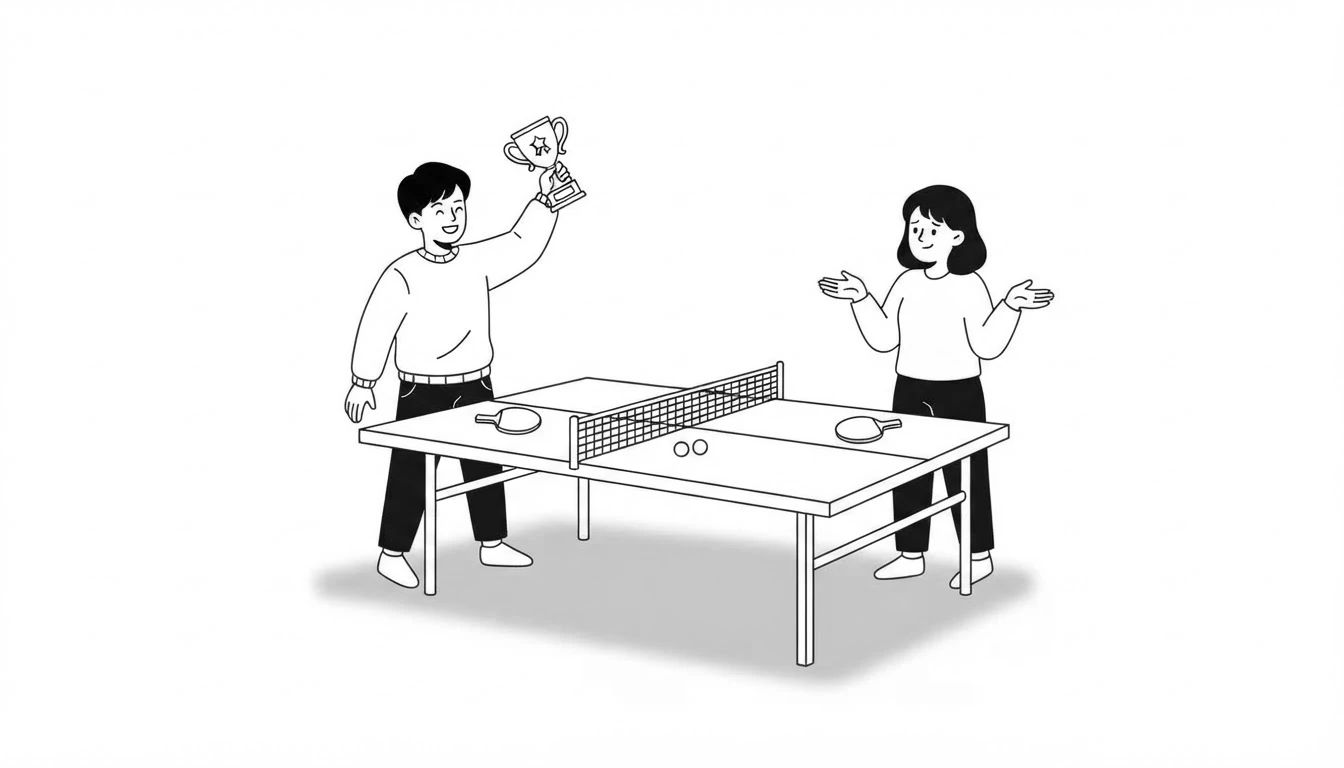
You WIN a GAME, but you BEAT an OPPONENT.

| Verbo | Va seguido de… | 🇪🇸 Se traduce como | Ejemplo |
|---|---|---|---|
| win | un evento, una competición o un premio | ganar (algo) | We won the match. |
| beat | una persona, un equipo o un rival | ganar a, vencer, derrotar | We beat our rivals. |
Mira cómo cambia la frase según el verbo, sin cambiar el significado:
- My dad used to beat me at table tennis when I was younger. (mi padre me ganaba al tenis de mesa)
- My dad used to win every table tennis game we played when I was younger. (mi padre ganaba todas las partidas)
- Big teams like Real Madrid usually beat smaller teams. (los equipos grandes suelen ganar a los pequeños)
- Big teams like Real Madrid usually win matches against smaller teams. (los equipos grandes suelen ganar los partidos contra los pequeños)
Y así quedan corregidas las dos frases del principio: ✅ I can beat you any time! y ✅ Manchester United beat Liverpool 3-0 in the last game.
Cómo usar WIN
Win es el verbo del resultado: lo que consigues cuando acabas primero o te llevas algo. Las colocaciones más habituales son estas:
| 🇬🇧 win + | 🇪🇸 Significado | Ejemplo |
|---|---|---|
| a game / a match | ganar un juego o un partido | They won the match on penalties. |
| a race / a competition | ganar una carrera o un concurso | She won the race by two seconds. |
| a prize / a medal / a trophy | ganar un premio, una medalla, un trofeo | He won a gold medal. |
| the lottery | ganar la lotería | My cousin won the lottery last year. |
| an election | ganar unas elecciones | Who do you think will win the election? |
| an argument | ganar una discusión | I never win arguments with my sister. |
| money / a fortune | ganar dinero en un juego o apuesta | He won €500 at the casino. |
Dos detalles más sobre win que te pueden ser útiles:
- Win + against: si quieres decir contra quién ganas, puedes usar win against: We won against the best team in the league. Es correcto y muy frecuente, sobre todo en inglés hablado. Lo que no puedes hacer es poner a la persona directamente detrás de win.
- Win + persona + cosa: sí puedes usar una persona, pero como destinatario de lo que se gana: That goal won us the match (ese gol nos dio el partido).
Cómo usar BEAT
Beat es el verbo del enfrentamiento: siempre hay alguien (o algo) al otro lado. Va seguido directamente de la persona, el equipo o el rival al que derrotas, y a menudo se añade en qué juego (at chess, at tennis) o con qué marcador (3-0).
| 🇬🇧 Estructura | Ejemplo |
|---|---|
| beat + persona / equipo | Spain beat Italy in the semi-final. |
| beat + persona + at + juego | I can’t beat my brother at chess. |
| beat + persona + marcador | Liverpool beat Everton 3-0. |
| be beaten (by) (voz pasiva) | We were beaten by a much better team. |
| beat + récord / marca | She beat the world record. |
Fíjate en que el marcador va después del rival: beat Everton 3-0, y no «beat 3-0 Everton».
Formas irregulares: win y beat
Los dos son verbos irregulares, y los dos tienen alguna trampa:
| 🇬🇧 Infinitive | Past simple | Past participle | 🇪🇸 Significado |
|---|---|---|---|
| win /wɪn/ | won /wʌn/ | won /wʌn/ | ganar |
| beat /biːt/ | beat /biːt/ | beaten /ˈbiːtn/ | vencer, ganar a |
- Won se pronuncia exactamente igual que one (/wʌn/): He won y He one suenan igual. No lo leas con la «o» del español: no rima con on, sino con sun.
- Beat tiene el pasado igual que el infinitivo (I beat him yesterday), pero el participio es distinto: beaten. El error típico es decir I have beat him: lo correcto es I have beaten him. (En inglés americano informal verás have beat alguna vez, pero para estudiar y para los exámenes usa siempre beaten.)
Otros significados de BEAT (que no tienen que ver con ganar)
Si buscabas «beat significado» y has llegado hasta aquí, este es el apartado que te interesa. Beat es un verbo con muchos usos, y casi todos aparecen en el inglés de cada día:

| 🇬🇧 Expresión | 🇪🇸 Significado | Ejemplo |
|---|---|---|
| beat the eggs | batir (huevos, nata…) | Beat the eggs and add the sugar. |
| my heart is beating | latir | My heart was beating very fast. |
| beat a drum | golpear, tocar un tambor | He beat the drum in time with the music. |
| beat up (phrasal verb) | dar una paliza | He was beaten up outside the bar. |
| beat the traffic / the queue | evitar, adelantarse a | Let’s leave early to beat the traffic. |
| beat the clock | ganar al reloj | They finished just in time, beating the clock. |
| beat around the bush | andarse por las ramas | Stop beating around the bush and tell me. |
| It beats me. | No tengo ni idea. | Why did he leave? It beats me. |
| Nothing beats… | No hay nada como… | Nothing beats a cup of tea on a rainy day. |
| I’m beat. | Estoy agotado (informal). | I’m beat. I need to sit down. |
| beat yourself up | castigarse, culparse | Don’t beat yourself up about it. |
| the beat (sustantivo) | el ritmo, el compás | I love the beat of this song. |
Verbos que se parecen: defeat, lose to, draw
Alrededor de win y beat hay otros verbos que te conviene tener a mano para hablar de resultados:
| 🇬🇧 Verbo | 🇪🇸 Significado | Ejemplo |
|---|---|---|
| defeat | derrotar (como beat, pero más formal; típico de noticias) | The champions were defeated in the final. |
| lose | perder | We lost the game. |
| lose to | perder contra | Liverpool lost to Chelsea. |
| draw / tie | empatar | The match ended in a draw. |
| come first | quedar primero | She came first in the race. |
Una forma sencilla de comprobar que has elegido bien: X beat Y es lo mismo que Y lost to X. Si el rival cambia de sitio, la frase sigue significando lo mismo.
Errores comunes con win y beat
| ❌ Incorrecto | ✅ Correcto | Por qué |
|---|---|---|
| I won my brother at chess. | I beat my brother at chess. | Detrás de win no va una persona. |
| Spain won Italy 2-1. | Spain beat Italy 2-1. | Un equipo rival necesita beat. |
| We beat the match. | We won the match. | Un partido no es un rival: se gana. |
| She has beat me twice. | She has beaten me twice. | El participio de beat es beaten. |
| He won to me. | He beat me. | En inglés no hay preposición «a» que traduzca «ganar a». |
| He wined the lottery. | He won the lottery. | El pasado de win es won, no wined. |
Win y beat en los exámenes de Cambridge
Este par de verbos es un buen candidato para el Use of English de los exámenes de B2 First y C1 Advanced. En la Part 1 (multiple-choice cloze) puede aparecer una frase con un hueco y cuatro opciones donde tengas que elegir entre win, beat, defeat o earn. Y en la Part 4 (key word transformation) es muy fácil que te pidan reescribir una frase con beat o won y la palabra clave dada. Por ejemplo:
- Our team defeated them in the final. BEAT
Our team ______ in the final. → beat them - We lost to a much better team. BEATEN
We ______ a much better team. → were beaten by
Fíjate en que en las dos hay que acordarse de que detrás de beat va el rival y de que el participio es beaten. Son justo los puntos que has visto en este post.
Tabla resumen
| 🇬🇧 WIN | 🇬🇧 BEAT | |
|---|---|---|
| Qué ganas | un evento, una competición, un premio | a un rival (persona o equipo), un récord |
| Lo que va detrás | a match, a prize, the lottery | an opponent, a team, me |
| Past simple | won /wʌn/ | beat /biːt/ |
| Past participle | won /wʌn/ | beaten /ˈbiːtn/ |
| Ejemplo | We won the game. | We beat them. |
¿Se puede decir «win against»?
Sí. We won against Chelsea es correcto y muy habitual. Si prefieres poner el rival directamente detrás del verbo, usa beat: We beat Chelsea. Lo que no existe es win Chelsea.
¿Cuál es el pasado de win y de beat?
El pasado de win es won (y el participio también). El pasado de beat es beat, y el participio es beaten.
¿«Beat» solo significa vencer?
No. También significa batir, latir, golpear y muchas expresiones más. Las tienes en la tabla de otros significados de beat.
Ejercicios de win y beat
Treinta frases para comprobar que lo tienes claro. Aquí abajo tienes tres ejercicios interactivos que se corrigen solos, así que sabrás al momento qué tal lo has hecho.
Y si prefieres una versión en texto que puedas copiar y pegar, la tienes aquí abajo 👇
Exercise 1: complete with win, won, winning, beat or beaten
Write the correct form of win or beat in each gap.
- Our team _______________ the final last year.
- Spain _______________ Italy 2-1 in the semi-final.
- I’ve never _______________ my sister at chess.
- Who do you think will _______________ the election?
- She _______________ me at tennis again yesterday.
- He dreams of _______________ a gold medal one day.
- We were _______________ by a much better team.
- Nobody can _______________ my dad at table tennis.
- My cousin _______________ €500 in the lottery last year.
- Real Madrid have _______________ Barcelona twice this season.
Ver respuestas
- won
- beat
- beaten
- win
- beat
- winning
- beaten
- beat
- won
- beaten
Exercise 2: win or beat?
Choose the correct verb in each sentence.
- Brazil (won / beat) Germany in the final.
- Brazil (won / beat) the World Cup.
- I (won / beat) my brother at FIFA.
- She (won / beat) a free trip to Rome.
- They (won / beat) us by three goals.
- Which team (won / beat) the match?
- He tried to (win / beat) the world record.
- I never (win / beat) arguments with her.
- Can you (win / beat) me at chess?
- It’s hard to (win / beat) a team that never gives up.
Ver respuestas
- beat
- won
- beat
- won
- beat
- won
- beat
- win
- beat
- beat
Exercise 3: complete the second sentence
Complete the second sentence so that it means the same as the first. Use win or beat in the correct form, and write only the missing words.
- Our team defeated them 3-0.
Our team _______________ 3-0. - We lost to a much better team.
We _______________ a much better team. - Liverpool were the winners of the match.
Liverpool _______________ the match. - Nobody has ever defeated him at chess.
He has never _______________ at chess. - My sister was given first prize in the competition.
My sister _______________ first prize in the competition. - I’m sure I’m a better tennis player than you.
I’m sure I can _______________ at tennis. - England were defeated by Spain in the final.
Spain _______________ in the final. - Who is going to be the winner of the race?
Who is going to _______________ the race? - Nobody defeated them last season.
They were not _______________ by anybody last season. - Their last victory in a league match was in March.
They haven’t _______________ a league match since March.
Ver respuestas
- beat them / won against them
- were beaten by
- won
- been beaten
- won
- beat you
- beat England / won against England
- win
- beaten
- won
Conclusión
Resumiendo en tres ideas: ganas un partido, pero vences a un rival (win para eventos y premios, beat para personas y equipos); los dos son irregulares, con won (que suena como one) y beat-beaten; y beat tiene muchos más significados que solo vencer, así que merece la pena conocerlos.
Si te gustan estos pares de verbos que se confunden, mira también mis posts sobre lie y lay y suggest y recommend. Y si lo tuyo es el deporte, tienes el vocabulario de deporte en inglés y el vocabulario de fútbol en inglés.
¿Te ha parecido útil este post? Compártelo con otros estudiantes y profesores de inglés. Y si quieres más contenido como este, suscríbete a mi newsletter y sígueme en Facebook, Twitter, Pinterest, Instagram y YouTube.
Nos vemos en el próximo post. Hasta entonces, don’t forget to keep smiling! 🙂
