

Tabla de contenidos
La Parte 3 del Speaking de C2 Proficiency es, sin duda, el momento del examen donde realmente demuestras tu dominio del inglés de forma individual y en pareja. No solo se trata de hablar durante dos minutos seguidos, sino de mantener un discurso estructurado, complejo y capaz de interactuar con las ideas de tu compañero en una discusión profunda.
En esta guía vamos a desglosar cómo afrontar el C2 Proficiency (CPE) Speaking Part 3, analizando su estructura, viendo un ejemplo hipotético con la transcripción de la conversación completa entre interlocutor y candidatos, y te voy a dar las frases clave que te harán sonar como un auténtico nativo.
Si quieres dominar el Speaking del C2 Proficiency, sigue leyendo. 👇
C2 Speaking Part 3: descripción, estructura y duración
Esta parte del examen se centra en la producción de un discurso extenso y la interacción posterior sobre temas complejos o abstractos.
Se divide fundamentalmente en dos fases: los turnos largos individuales y la discusión final.
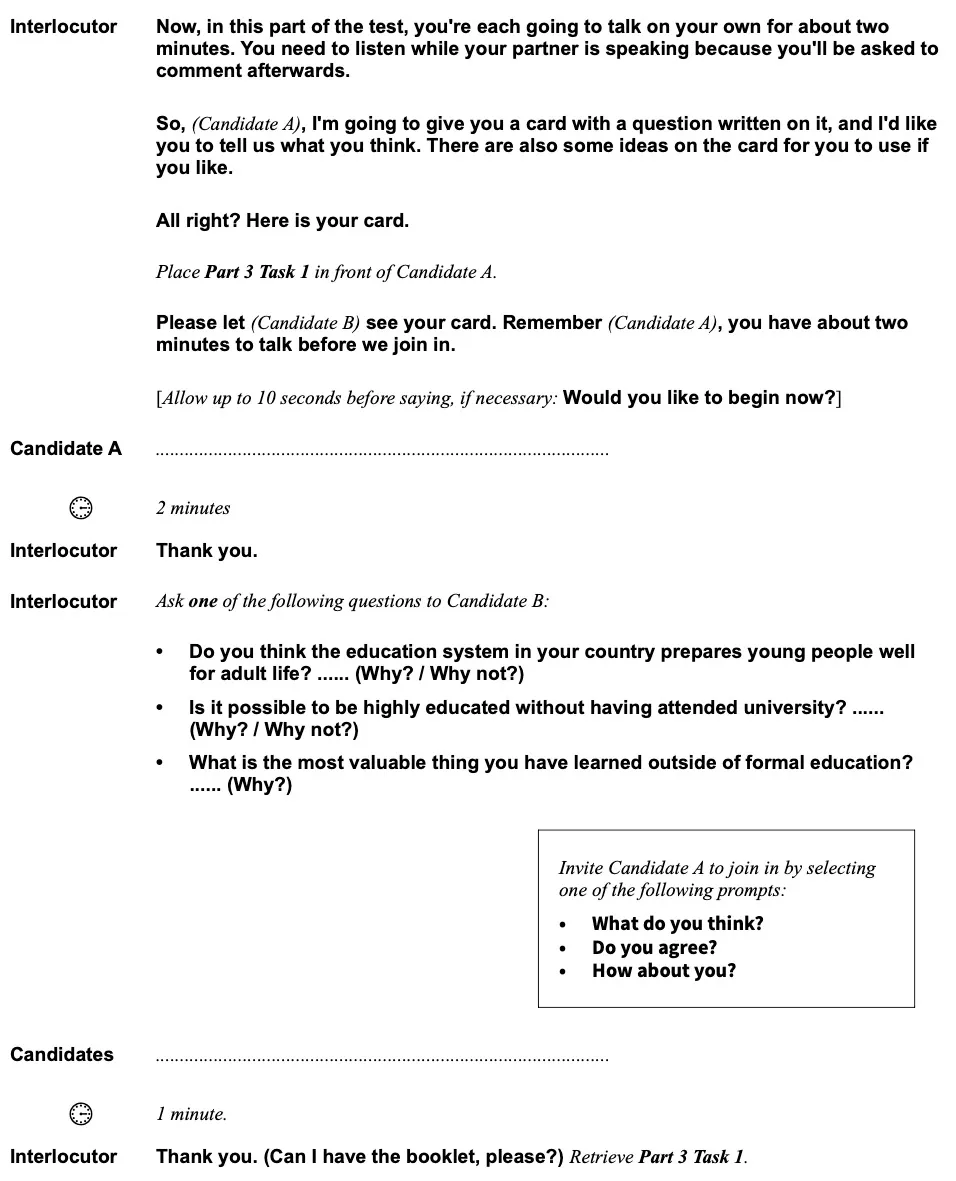
- Turnos largos (Long Turns): Cada candidato recibe una tarjeta con una pregunta y tres puntos de apoyo. Debes hablar durante 2 minutos sin interrupciones.
- Preguntas de seguimiento (Follow-up): Tras el turno largo de tu compañero/a, el Interlocutor te hará una pregunta corta para que comentes lo que él o ella ha dicho durante aproximadamente 1 minuto, donde también se invita a tu compañero/a a participar.
- Discusión temática (Final Discussion): Al finalizar ambos turnos, el Interlocutor plantea preguntas más complejas y abstractas relacionadas con el tema para que ambos candidatos debatáis libremente.
En cuanto a la duración, la Parte 3 ocupa aproximadamente 10 minutos del total de la prueba:
- 2 minutos de exposición individual para cada candidato.
- 1 minuto de interacción/comentario tras cada turno largo.
- 6 minutos de discusión conjunta al final.
Ejemplo de C2 Proficiency Speaking Part 3
Para entender mejor cómo funciona, nada mejor que un ejemplo práctico. A continuación, verás las instrucciones que reciben los candidatos, las tarjetas de apoyo (prompt cards) y la transcripción de una respuesta de nivel C2.
Task 1 – Candidate A’s long turn
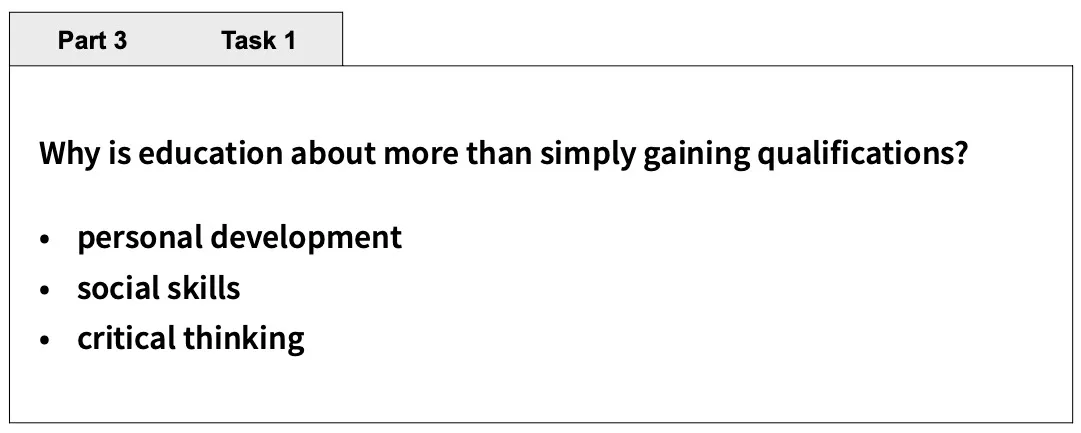
Candidate A: Well, it’s a fairly common misconception that education is merely a gateway to a professional career or a means of ticking off a series of academic boxes. In reality, it’s a much more profound process, primarily centred on personal development. Beyond the syllabus, education serves as a crucible for character building; it challenges our preconceived notions and forces us to confront diverse perspectives, which is fundamental to becoming a well-rounded individual.
Furthermore, we can’t overlook the vital role of social skills. Schools and universities are essentially microcosms of society where we learn the intricacies of negotiation, empathy, and collaborative problem-solving. These interpersonal nuances are often far more influential in one’s life than the ability to recite historical dates or solve complex equations. It’s about learning how to navigate the human experience alongside others.
Finally, perhaps the most quintessential aspect of a true education is the cultivation of critical thinking. In an era saturated with information—and indeed, misinformation—the ability to scrutinise a source, detect bias, and construct a logical argument is an invaluable asset. Education shouldn’t just tell us what to think; it should equip us with the cognitive tools to discern how to think for ourselves. Ultimately, while a degree might get you an interview, it is this intellectual autonomy and social maturity that truly define an educated person.
Interlocutor: Thank you. Candidate B, is it possible to be highly educated without having attended university?
Candidate B: I’m inclined to believe it is, yes. While university provides a structured environment and a certain ‘stamp of approval,’ we live in an age where information is democratised. An individual with a voracious appetite for reading and the discipline for self-study can certainly attain a level of erudition that rivals any graduate. However, they might miss out on the rigorous peer review and the diverse social interactions that a campus naturally facilitates.
Interlocutor: What do you think, Candidate A?
Candidate A: I see your point, and I agree that ‘self-made’ intellectuals are often the most passionate. That said, I think the institutional framework of a university provides a unique level of intellectual friction. It’s that constant, face-to-face debate with experts and peers that really polishes one’s critical thinking skills in a way that solitary study might not quite achieve.
Task 2 – Candidate B’s long turn
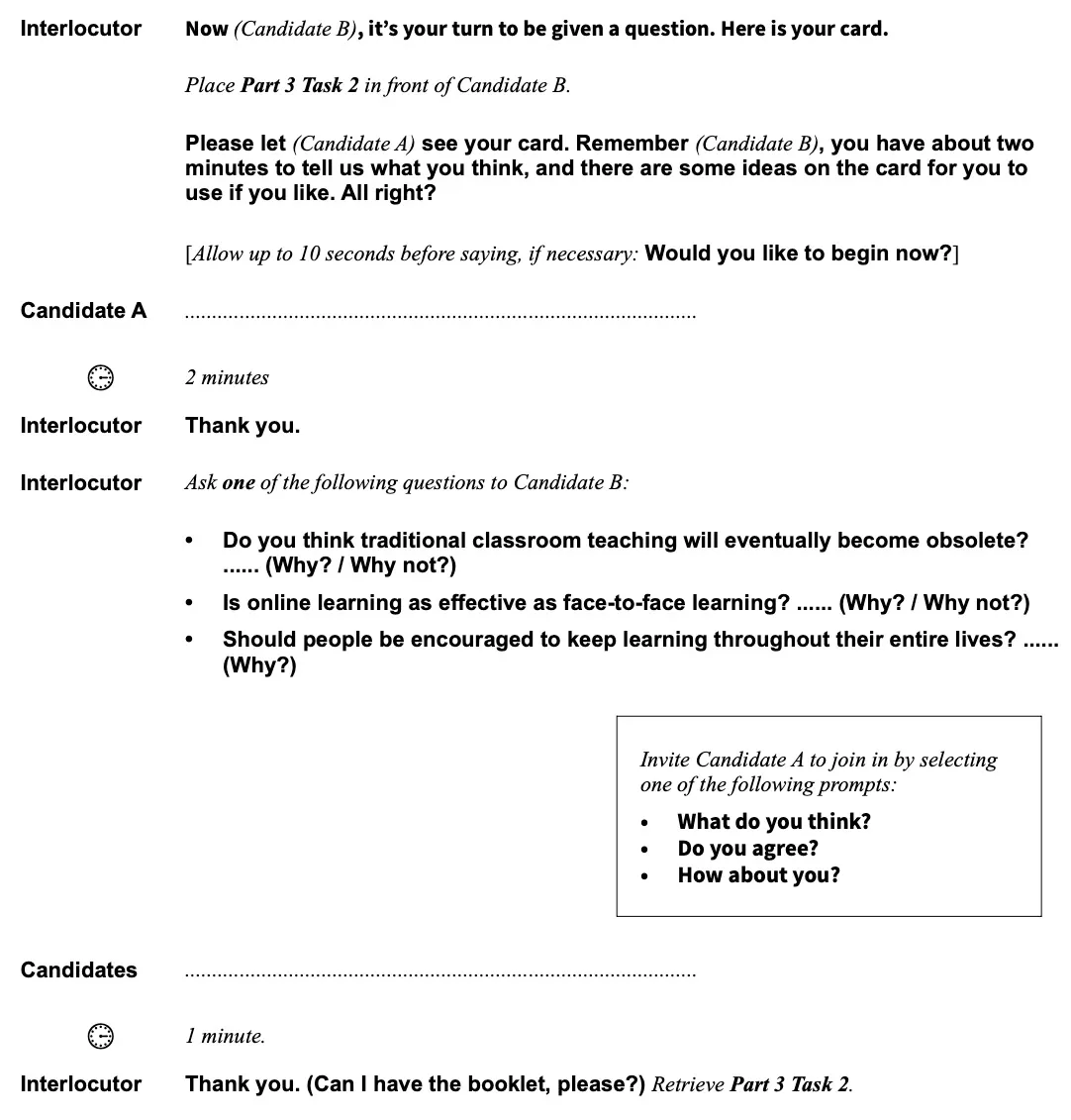
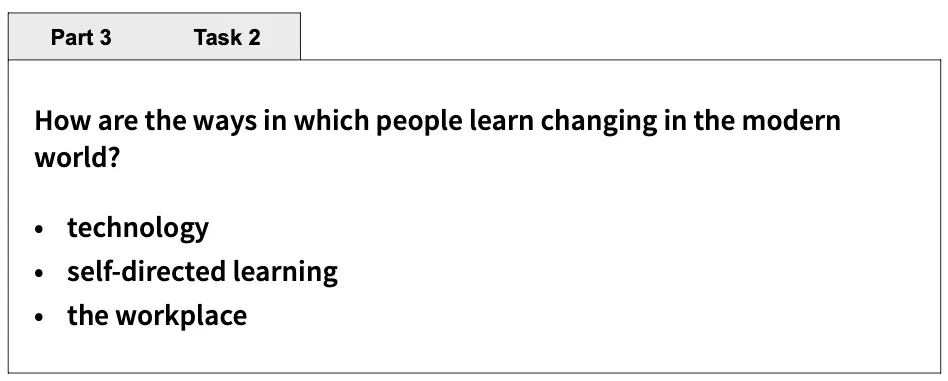
Candidate B: The landscape of learning has undergone a radical transformation in recent years, largely driven by the relentless march of technology. The advent of digital platforms has effectively dismantled the traditional barriers to knowledge. We’re no longer tethered to a physical classroom; instead, a vast array of resources, from open-courseware to interactive tutorials, is available at our fingertips.
This has led to a significant shift towards self-directed learning, where individuals take the reins of their own intellectual growth. This autonomy is particularly evident in how people curate their own ‘learning paths.’ We see a move away from the ‘one-size-fits-all’ model toward a more modular approach, where learners can cherry-pick specific skills that are relevant to their personal or professional goals. It’s an empowering shift that caters to different cognitive styles and allows for a much more flexible, pace-to-suit-the-individual experience.
Interlocutor: Thank you. Candidate A, should people be encouraged to keep learning throughout their entire lives?
Candidate A: Unquestionably. Aside from the obvious professional benefits of staying relevant, lifelong learning is crucial for cognitive health. There’s a wealth of evidence suggesting that keeping the mind engaged with new challenges can delay the onset of cognitive decline. Moreover, in a rapidly changing world, a commitment to learning fosters a sense of curiosity and adaptability that makes life far more enriching.
Interlocutor: Do you agree, Candidate B?
Candidate B: I couldn’t agree more. Beyond the pragmatic side of career longevity, there’s an intrinsic joy in discovery. A person who stops learning essentially stops growing, and in such a dynamic era, that would be a missed opportunity. Staying curious is what keeps our perspective fresh and prevents us from becoming intellectually stagnant.
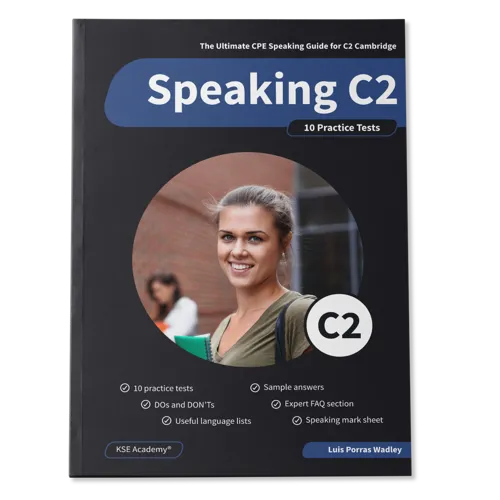
Speaking C2: The Ultimate CPE Speaking Guide
Domina el Speaking del C2 con mi guía completa, que incluye 10 simulacros completos, respuestas de ejemplo para cada parte, consejos y estrategias basadas en mi experiencia y listas de expresiones útiles diseñadas específicamente para la prueba de Speaking de C2 Proficiency.
¡Consigue ya tu ejemplar en PDF!
Task 3 – Final discussion
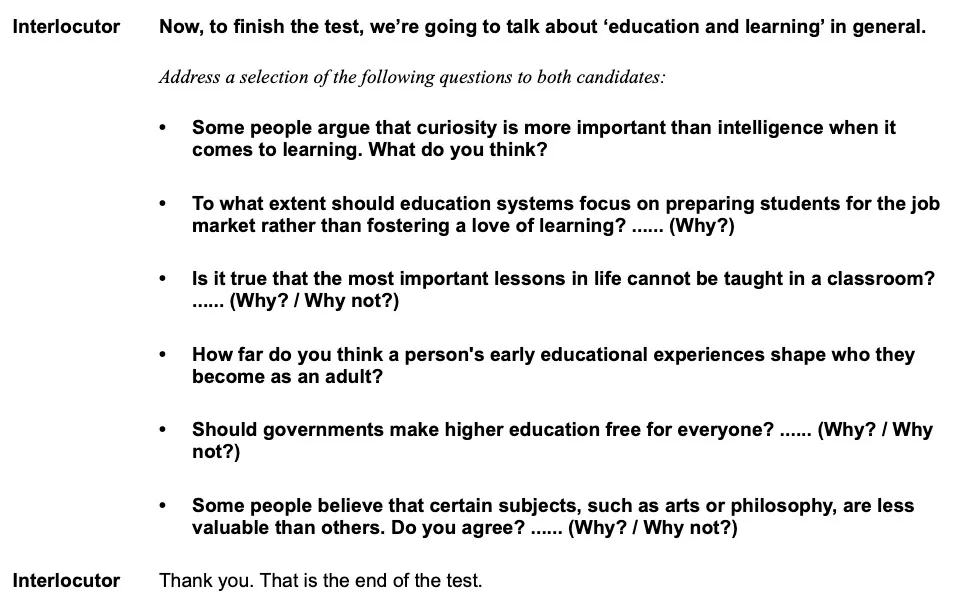
Interlocutor: Some people argue that curiosity is more important than intelligence when it comes to learning. What do you think, Candidate B?
Candidate B: I’d argue that curiosity is the engine that drives intelligence. You can have a high IQ, but if you lack the inquisitive spark to ask ‘why,’ that potential often goes untapped. Curiosity ensures that the learning process is active rather than passive; it’s the difference between merely absorbing facts and truly seeking to understand the underlying mechanisms of a subject.
Candidate A: I’m totally with you there. While intelligence might determine the speed at which you grasp a concept, curiosity determines the depth and the persistence of the pursuit. I’ve often seen that a moderately gifted but deeply curious student will eventually outstrip a highly intelligent one who is simply bored. Curiosity is what sustains you through the inevitable plateaus of the learning journey.
Interlocutor: Is it true that the most important lessons in life cannot be taught in a classroom?
Candidate A: To a large extent, yes. While a classroom can provide the theoretical foundation for things like ethics or social dynamics, the most visceral lessons—things like resilience in the face of failure, or the complexities of emotional intelligence—can only be forged in the ‘real world.’ These are experiential truths that require us to actually live through situations, make mistakes, and navigate the consequences.
Candidate B: That resonates with me. A teacher can explain the concept of ‘integrity,’ but you only truly learn its value when you’re faced with a difficult choice where your own interests are at stake. However, I’d add that a good education provides the ‘framework’ that allows us to reflect on those life lessons more effectively. It gives us the vocabulary and the analytical skills to make sense of our experiences.
Interlocutor: Some people believe that certain subjects, such as arts or philosophy, are less valuable than others. Do you agree?
Candidate B: I find that perspective quite short-sighted, actually. In a world increasingly dominated by STEM, the arts and philosophy are more vital than ever. They are the disciplines that teach us how to be human—how to grapple with ambiguity, how to empathise with the ‘other,’ and how to ask the big ethical questions about where our technology is taking us. Without them, we risk producing a generation of technically proficient but ethically adrift individuals.
Candidate A: Spot on. There’s a tendency to view education through a purely vocational lens, but that’s a red herring. The ‘value’ of a subject shouldn’t be measured solely by its immediate salary potential. Philosophy, for instance, hones the very critical thinking and logic skills that are transferable to almost any high-level profession. It’s the ultimate ‘meta-skill.’ A society that neglects the humanities is a society that loses its ability to reflect on its own purpose.
Análisis del ejemplo de C2 Speaking Part 3
El ejemplo que acabamos de ver es un modelo excelente de lo que los examinadores de Cambridge esperan encontrar en un candidato de nivel C2. Vamos a analizar los aspectos clave que hacen que estas intervenciones obtengan puntuaciones altas:
- Estructura clara y coherente: Ambos candidatos organizan sus turnos largos con una introducción que establece su posición («it’s a fairly common misconception that education is merely a gateway to a professional career»), desarrollan tres puntos utilizando los apoyos de la tarjeta, y cierran con una conclusión contundente. Utilizan marcadores discursivos sofisticados como «Furthermore», «Ultimately» y «That said» para guiar al oyente sin que suene mecánico.
- Vocabulario preciso y sofisticado: El léxico va mucho más allá de lo básico. Expresiones como «a crucible for character building», «the relentless march of technology», «voracious appetite for reading» o «intellectually stagnant» demuestran un dominio natural de colocaciones avanzadas y lenguaje abstracto. No se limitan a decir «technology changed learning»; dicen «digital platforms have effectively dismantled the traditional barriers to knowledge».
- Rango gramatical complejo: Los candidatos emplean estructuras sofisticadas con total naturalidad: cláusulas concesivas («While university provides a structured environment… we live in an age where information is democratised»), subordinadas complejas, pasivas elaboradas y condicionales implícitos. Lo crucial es que estas estructuras no parecen forzadas, sino que forman parte de su repertorio natural.
- Interacción genuina y construcción de ideas: Durante los follow-ups y la discusión final, los candidatos demuestran que escuchan activamente. El Candidato A responde «I see your point, and I agree that ‘self-made’ intellectuals are often the most passionate» antes de añadir su propio matiz con «That said, I think the institutional framework of a university provides a unique level of intellectual friction». Este patrón de reconocer-desarrollar-matizar es característico del nivel C2.
- Profundidad y pensamiento crítico: Los candidatos no se quedan en la superficie. Cuando hablan de educación, exploran dimensiones complejas como el desarrollo del carácter, la importancia de la fricción intelectual en el campus, o la distinción entre conocer un concepto teórico y aprenderlo vivencialmente. El Candidato B hace una reflexión particularmente sofisticada: «A teacher can explain the concept of ‘integrity,’ but you only truly learn its value when you’re faced with a difficult choice», antes de matizar que la educación formal proporciona el marco para reflexionar sobre esas experiencias.
- Naturalidad y fluidez: A pesar de la complejidad del lenguaje, el discurso suena natural y espontáneo. Los candidatos utilizan estrategias sofisticadas para ganar tiempo cuando lo necesitan («I’m inclined to believe it is, yes», «That resonates with me») sin romper la fluidez. Este equilibrio entre complejidad y naturalidad es precisamente lo que define una actuación sobresaliente en C2 Proficiency.
Frases útiles para la Parte 3 del C2 Speaking
El nivel C2 no solo se demuestra con un vocabulario amplio, sino también con la capacidad de estructurar el discurso, matizar opiniones y gestionar la conversación de forma natural. Las siguientes frases te ayudarán a destacar en cada fase de la Parte 3, desde tu turno largo hasta la discusión final.
Para introducir tu turno largo
Un buen inicio marca el tono de tu intervención. Estas frases te permiten establecer tu posición desde el principio de forma clara y sofisticada:
- «What strikes me immediately is that…»
- «It’s worth beginning by acknowledging that…»
- «The question invites us to consider…»
- «It’s a fairly common misconception that…»
- «My instinct is to say that…»
- «This is a particularly complex issue because…»
Para organizar y estructurar el discurso
Durante tu turno largo, necesitas guiar al oyente a través de tus ideas de forma lógica. Estos conectores y marcadores discursivos son esenciales para lograrlo:
- «To begin with…» / «First and foremost…»
- «Moving on to…» / «Turning to the question of…»
- «Beyond the obvious…» / «Beyond that…»
- «Furthermore…» / «Moreover…»
- «That said…» / «Having said that…»
- «On the other hand…» / «Conversely…»
- «Ultimately…» / «On balance…»
- «What this all points to is…»
Para expresar opiniones complejas y matizadas
En el nivel C2 se espera que tus opiniones vayan más allá de lo binario. Estas expresiones te permiten añadir profundidad y matices a tus argumentos:
- «I’m inclined to believe that…»
- «I’d be tempted to argue that…»
- «It’s an interesting paradox that…»
- «The picture is somewhat more nuanced than that.»
- «One can’t overlook the vital role of…»
- «This raises the question of whether…»
- «There’s a real danger that…» / «There’s a risk of…»
- «To a large extent, yes, but…»
- «It depends enormously on…»
Para especular y hacer hipótesis
La Parte 3 a menudo requiere que especules sobre escenarios futuros o situaciones hipotéticas. Estas frases son perfectas para esos momentos:
- «One could argue that…»
- «It’s conceivable that…» / «It’s plausible that…»
- «In all likelihood…»
- «Were this to happen, we might see…»
- «It stands to reason that…»
- «The implication would be that…»
Para estar de acuerdo (parcial o totalmente)
Durante la fase de interacción y la discusión final, necesitarás reaccionar a lo que dice tu compañero. Estas expresiones te ayudan a mostrar acuerdo de forma sofisticada:
- «I’m totally with you on that.» / «I’m entirely with you there.»
- «I couldn’t agree more.»
- «That’s a really important point.»
- «You’ve identified something crucial there.»
- «That resonates with me.»
- «I see your point, and I’d also add that…»
- «I think what [Candidate X] said about… is exactly right.»
- «Much the same, really.»
- «I’d build on that by saying…»
Para mostrar desacuerdo educado
Discrepar con elegancia y diplomacia es una habilidad clave en el nivel C2. Estas frases te permiten hacerlo sin resultar agresivo:
- «I see what you’re saying, but I’m not entirely convinced that…»
- «I find that perspective quite short-sighted, actually.»
- «I take a slightly different view on this.»
- «I’m not sure I’d go that far.»
- «That’s one way of looking at it, but…»
- «With respect, I think that oversimplifies the issue.»
- «I’d challenge the assumption that…»
Para añadir ejemplos y evidencia
Apoyar tus argumentos con ejemplos concretos demuestra madurez intelectual. Estas frases te ayudan a introducirlos de forma natural:
- «Take the example of…»
- «If you look at…»
- «There’s a wealth of evidence suggesting that…»
- «I’m thinking particularly of…»
- «A case in point would be…»
- «This is particularly evident in…»
Para concluir o resumir
Cerrar tu turno largo con una conclusión clara demuestra control del discurso. Usa estas frases para redondear tus ideas:
- «So on balance, I’d contend that…»
- «Ultimately, what this comes down to is…»
- «In the final analysis…»
- «All things considered…»
- «What this all points to is…»
- «So in summary, I’d argue that…»
Para ganar tiempo para pensar
Incluso a nivel C2, necesitas tiempo para organizar tus pensamientos. Estas expresiones te dan unos segundos sin romper la fluidez:
- «That’s genuinely difficult to answer.»
- «That’s an interesting question.»
- «Let me think about that for a moment…»
- «Well, if I’m honest…»
- «How can I put this…»
- «Where to begin, really…»
Los 10 mejores consejos para el Speaking Part 3 del C2
Después de años examinando candidatos de C2 Proficiency, he observado patrones claros que distinguen a quienes obtienen las puntuaciones más altas. Aquí tienes mis diez consejos esenciales, basados en esa experiencia, para que domines la Parte 3 del Speaking:
- Establece tu posición desde el principio: No des vueltas durante los primeros 30 segundos de tu turno largo. Deja claro cuál es tu punto de vista general en las primeras frases y luego desarróllalo a través de los puntos de apoyo de la tarjeta. Una introducción contundente como «What strikes me immediately is that…» te permite tomar el control del discurso desde el inicio.
- Usa los puntos de apoyo de la tarjeta (pero con flexibilidad): Los tres puntos que aparecen en la tarjeta (prompt card) están ahí para ayudarte, no para limitarte. Úsalos como columna vertebral de tu turno largo, pero siéntete libre de añadir tus propios ejemplos o matices. No tienes que seguir el orden exacto si encuentras una forma más lógica de organizarlo.
- Escucha activamente a tu compañero durante su turno largo: Recuerda que el examinador te hará una pregunta relacionada con lo que tu compañero acaba de decir. Si no prestas atención, tu respuesta será vaga y superficial, lo que penalizará tu puntuación en Interactive Communication. Toma mentalmente nota de alguna idea clave que mencione para poder referenciarla después.
- Evita el lenguaje memorizado: Los examinadores detectan al instante cuando un candidato está recitando un texto aprendido de memoria. El lenguaje preparado suena rígido, poco natural y no se adapta a las preguntas específicas del examen. En lugar de memorizar respuestas completas, practica chunks de lenguaje útil (como las frases de la sección anterior) que puedas adaptar espontáneamente a diferentes contextos.
- No hagas listas; desarrolla ideas: Uno de los errores más comunes es limitarse a enumerar puntos sin profundizar en ellos. Por ejemplo, decir «Education is important for personal development, social skills and critical thinking» y pasar al siguiente tema es insuficiente para C2. Necesitas explicar por qué, dar ejemplos, matizar o establecer conexiones entre ideas. Cada punto debe ocuparte al menos 30-40 segundos de desarrollo genuino.
- Acepta la complejidad gramatical y léxica: No simplifiques tu lenguaje por miedo a cometer errores. En el nivel C2, los examinadores esperan ver estructuras sofisticadas (condicionales mixtos, inversión, cláusulas nominales, pasivas complejas) y vocabulario abstracto. Un par de pequeños deslices son perfectamente aceptables si demuestran que estás intentando usar un rango amplio de lenguaje. La precisión sin ambición lingüística no te llevará a la banda más alta.
- Sé conciso pero sustancial en los follow-ups: Cuando el examinador te pide que comentes lo que ha dicho tu compañero, tienes aproximadamente un minuto (a veces menos). No te enrolles con introducciones innecesarias; ve directo al punto, pero asegúrate de que tu comentario añade algo nuevo a la conversación. Frases como «I think what Candidate A said about… is exactly right, and I’d add that…» funcionan muy bien porque muestran que has escuchado y que puedes ampliar la idea.
- Mantén el nivel hasta el final de la discusión: Es fácil relajarse (y bajar el nivel de tu lenguaje) durante los últimos minutos de la Parte 3, especialmente si llevas ya 14-15 minutos de examen. Resiste esa tentación. La discusión final es tu última oportunidad de impresionar a los examinadores, y algunas de las preguntas más complejas e interesantes suelen aparecer en este momento. Mantén la energía, la precisión y la sofisticación hasta la última intervención.
- No temas discrepar con tu compañero: Muchos candidatos creen que deben estar siempre de acuerdo para crear un ambiente «amigable», pero esto es un error. Los examinadores valoran la capacidad de expresar desacuerdo de forma educada y razonada. Un intercambio donde ambos candidatos debaten con respeto y argumentos sólidos es mucho más impresionante que una conversación donde ambos asienten constantemente. Usa frases como «I see what you’re saying, but I’m not entirely convinced that…» para mostrar tu capacidad de negociar significados.
- Practica la gestión del tiempo en tus turnos largos: Dos minutos pueden parecer mucho tiempo, pero pasan rápido cuando estás nervioso. Si te quedas corto (1 minuto 20 segundos), parecerá que no tienes suficiente que decir. Si te pasas mucho (3 minutos), el examinador tendrá que interrumpirte, lo que puede afectar a la impresión general. Practica en casa con un cronómetro hasta que puedas producir turnos largos de entre 1 minuto 50 segundos y 2 minutos 10 segundos de forma natural. Ese es el rango ideal.
Ejemplo de C2 Proficiency Speaking [VÍDEO]
Ver un examen real puede darte la confianza que necesitas. En este vídeo oficial de Cambridge puedes observar la interacción entre los candidatos y el ritmo de la prueba.
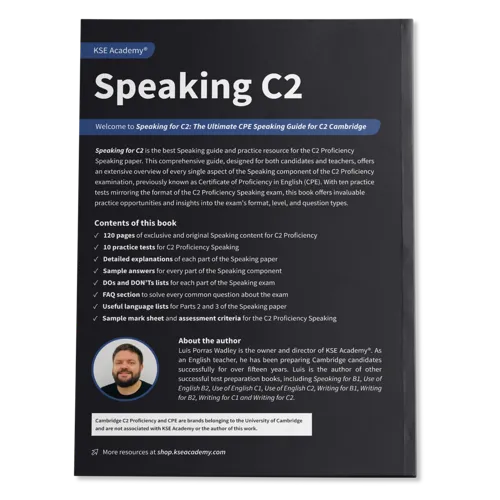
¿Conoces mi libro de Speaking C2? ¡Consigue tu copia en PDF!
Si te estás preparando para el examen por tu cuenta o necesitas material de calidad para tus alumnos, mi libro de C2 Speaking es la herramienta definitiva. Con más de 120 páginas de contenido exclusivo, incluye 10 exámenes de práctica completos que imitan fielmente el formato real de Cambridge.
Speaking C2: The Ultimate CPE Speaking Guide
Domina el Speaking del C2 con mi guía completa, que incluye 10 simulacros completos, respuestas de ejemplo para cada parte, consejos y estrategias basadas en mi experiencia y listas de expresiones útiles diseñadas específicamente para la prueba de Speaking de C2 Proficiency.
¡Consigue ya tu ejemplar en PDF!
Dentro encontrarás listas detalladas de Useful Language, guías de qué hacer (y qué no hacer) en cada parte, y criterios de evaluación explicados para que sepas exactamente qué busca el examinador. Es el paso definitivo para conquistar el C2 Proficiency con total confianza.
Y hasta el próximo artículo, don’t forget to keep smiling!
