

Table of contents
Speaking Part 3 of C2 Proficiency is, without a doubt, the point in the exam where you truly demonstrate your command of English both individually and in pairs. It is not just about speaking for two minutes straight, but about maintaining a structured, complex discourse and being able to interact with your partner’s ideas in a profound discussion.
In this guide, we are going to break down how to tackle C2 Proficiency (CPE) Speaking Part 3, analysing its structure, looking at a hypothetical example with the transcript of the full conversation between interlocutor and candidates, and I will give you the key phrases that will make you sound like a true native speaker.
If you want to master C2 Proficiency Speaking, keep reading. 👇
C2 Speaking Part 3: description, structure and duration
This part of the exam focuses on the production of a long turn and the subsequent interaction on complex or abstract topics.
It is essentially divided into two phases: the individual long turns and the final discussion.
- Long Turns: Each candidate receives a card with a question and three prompts. You must speak for 2 minutes without interruption.
- Follow-up questions: After your partner’s long turn, the Interlocutor will ask you a short question so you can comment on what they have said for approximately 1 minute, where your partner is also invited to participate.
- Final Discussion: Once both turns are finished, the Interlocutor poses more complex and abstract questions related to the topic for both candidates to debate freely.
Regarding the duration, Part 3 takes up approximately 10 minutes of the total test:
- 2 minutes of individual exposition for each candidate.
- 1 minute of interaction/commentary after each long turn.
- 6 minutes of joint discussion at the end.
Example of C2 Proficiency Speaking Part 3
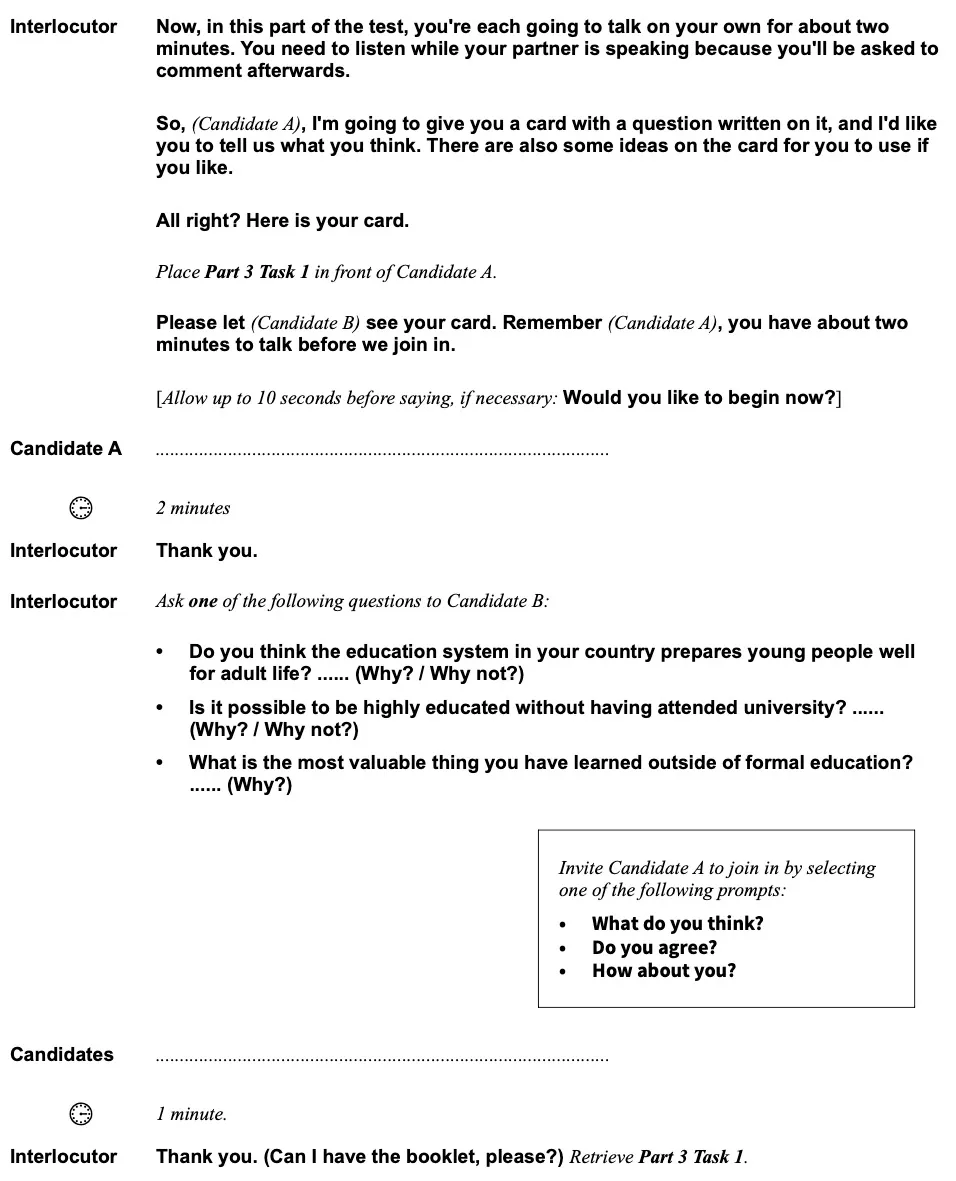
To better understand how it works, there is nothing better than a practical example. Below, you will see the instructions the candidates receive, the prompt cards and the transcript of a C2-level response.
Task 1 – Candidate A’s long turn
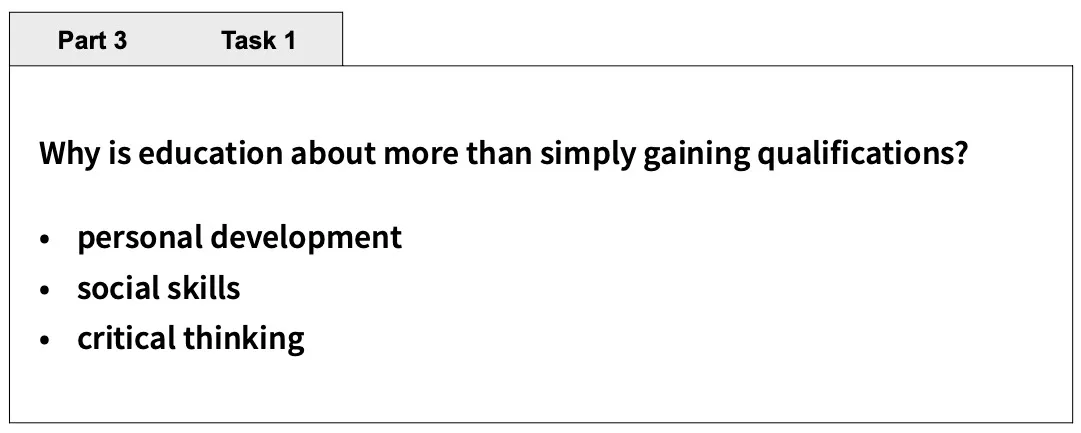
Candidate A: Well, it’s a fairly common misconception that education is merely a gateway to a professional career or a means of ticking off a series of academic boxes. In reality, it’s a much more profound process, primarily centred on personal development. Beyond the syllabus, education serves as a crucible for character building; it challenges our preconceived notions and forces us to confront diverse perspectives, which is fundamental to becoming a well-rounded individual.
Furthermore, we can’t overlook the vital role of social skills. Schools and universities are essentially microcosms of society where we learn the intricacies of negotiation, empathy, and collaborative problem-solving. These interpersonal nuances are often far more influential in one’s life than the ability to recite historical dates or solve complex equations. It’s about learning how to navigate the human experience alongside others.
Finally, perhaps the most quintessential aspect of a true education is the cultivation of critical thinking. In an era saturated with information—and indeed, misinformation—the ability to scrutinise a source, detect bias, and construct a logical argument is an invaluable asset. Education shouldn’t just tell us what to think; it should equip us with the cognitive tools to discern how to think for ourselves. Ultimately, while a degree might get you an interview, it is this intellectual autonomy and social maturity that truly define an educated person.
Interlocutor: Thank you. Candidate B, is it possible to be highly educated without having attended university?
Candidate B: I’m inclined to believe it is, yes. While university provides a structured environment and a certain ‘stamp of approval,’ we live in an age where information is democratised. An individual with a voracious appetite for reading and the discipline for self-study can certainly attain a level of erudition that rivals any graduate. However, they might miss out on the rigorous peer review and the diverse social interactions that a campus naturally facilitates.
Interlocutor: What do you think, Candidate A?
Candidate A: I see your point, and I agree that ‘self-made’ intellectuals are often the most passionate. That said, I think the institutional framework of a university provides a unique level of intellectual friction. It’s that constant, face-to-face debate with experts and peers that really polishes one’s critical thinking skills in a way that solitary study might not quite achieve.
Task 2 – Candidate B’s long turn
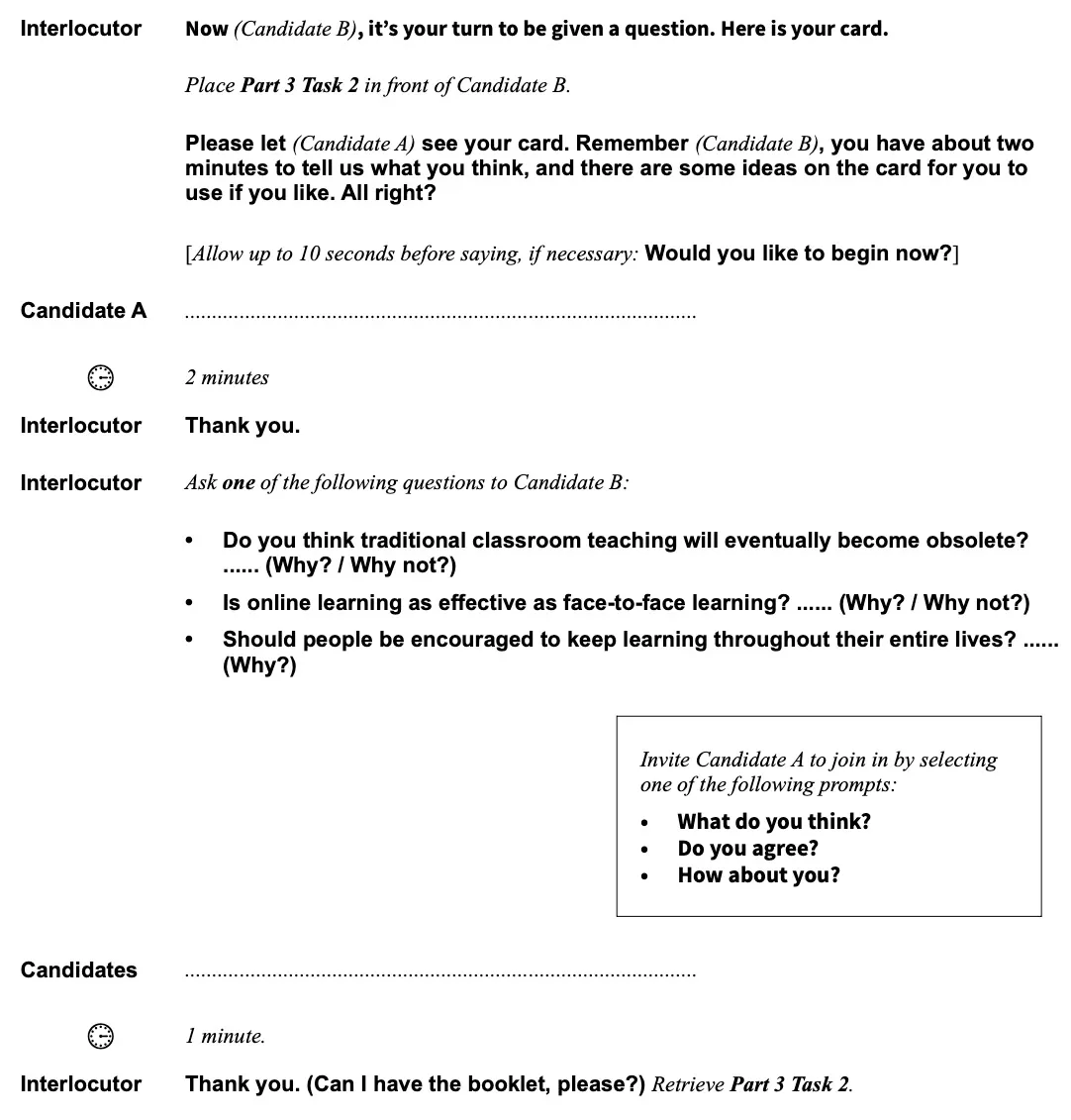
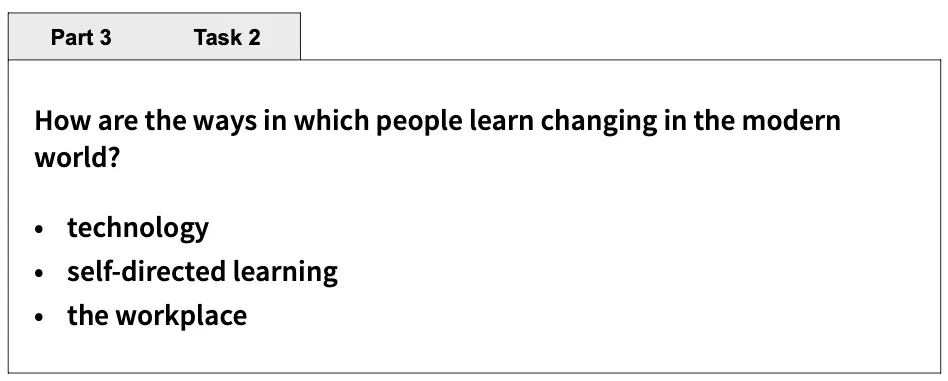
Candidate B: The landscape of learning has undergone a radical transformation in recent years, largely driven by the relentless march of technology. The advent of digital platforms has effectively dismantled the traditional barriers to knowledge. We’re no longer tethered to a physical classroom; instead, a vast array of resources, from open-courseware to interactive tutorials, is available at our fingertips.
This has led to a significant shift towards self-directed learning, where individuals take the reins of their own intellectual growth. This autonomy is particularly evident in how people curate their own ‘learning paths.’ We see a move away from the ‘one-size-fits-all’ model toward a more modular approach, where learners can cherry-pick specific skills that are relevant to their personal or professional goals. It’s an empowering shift that caters to different cognitive styles and allows for a much more flexible, pace-to-suit-the-individual experience.
Interlocutor: Thank you. Candidate A, should people be encouraged to keep learning throughout their entire lives?
Candidate A: Unquestionably. Aside from the obvious professional benefits of staying relevant, lifelong learning is crucial for cognitive health. There’s a wealth of evidence suggesting that keeping the mind engaged with new challenges can delay the onset of cognitive decline. Moreover, in a rapidly changing world, a commitment to learning fosters a sense of curiosity and adaptability that makes life far more enriching.
Interlocutor: Do you agree, Candidate B?
Candidate B: I couldn’t agree more. Beyond the pragmatic side of career longevity, there’s an intrinsic joy in discovery. A person who stops learning essentially stops growing, and in such a dynamic era, that would be a missed opportunity. Staying curious is what keeps our perspective fresh and prevents us from becoming intellectually stagnant.
Speaking C2: The Ultimate CPE Speaking Guide
Master C2 Speaking with my comprehensive guide, which includes 10 full mock exams, example answers for every part, tips and strategies based on my experience, and lists of useful expressions specifically designed for the C2 Proficiency Speaking test.
Get your PDF copy now!
Task 3 – Final discussion
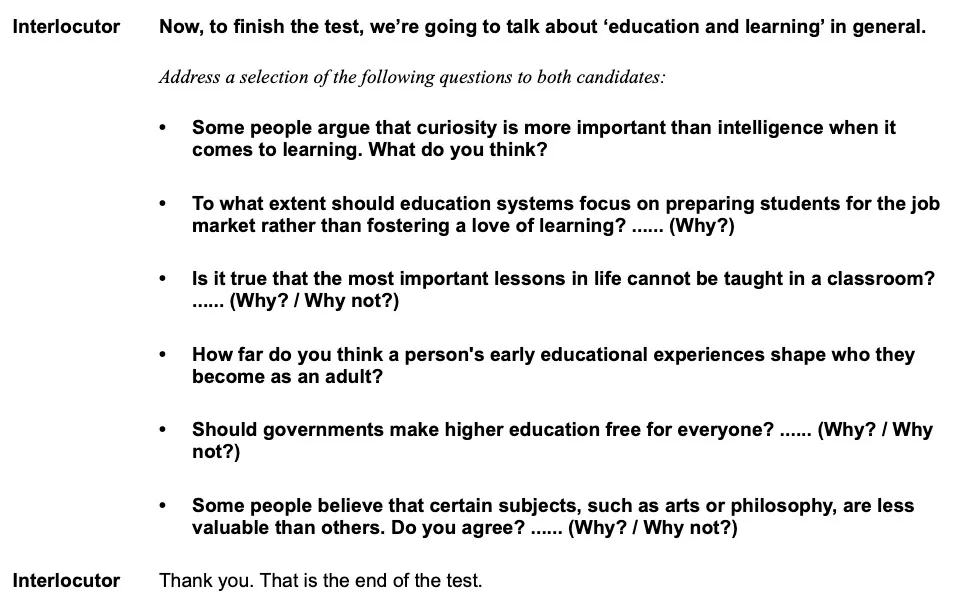
Interlocutor: Some people argue that curiosity is more important than intelligence when it comes to learning. What do you think, Candidate B?
Candidate B: I’d argue that curiosity is the engine that drives intelligence. You can have a high IQ, but if you lack the inquisitive spark to ask ‘why,’ that potential often goes untapped. Curiosity ensures that the learning process is active rather than passive; it’s the difference between merely absorbing facts and truly seeking to understand the underlying mechanisms of a subject.
Candidate A: I’m totally with you there. While intelligence might determine the speed at which you grasp a concept, curiosity determines the depth and the persistence of the pursuit. I’ve often seen that a moderately gifted but deeply curious student will eventually outstrip a highly intelligent one who is simply bored. Curiosity is what sustains you through the inevitable plateaus of the learning journey.
Interlocutor: Is it true that the most important lessons in life cannot be taught in a classroom?
Candidate A: To a large extent, yes. While a classroom can provide the theoretical foundation for things like ethics or social dynamics, the most visceral lessons—things like resilience in the face of failure, or the complexities of emotional intelligence—can only be forged in the ‘real world.’ These are experiential truths that require us to actually live through situations, make mistakes, and navigate the consequences.
Candidate B: That resonates with me. A teacher can explain the concept of ‘integrity,’ but you only truly learn its value when you’re faced with a difficult choice where your own interests are at stake. However, I’d add that a good education provides the ‘framework’ that allows us to reflect on those life lessons more effectively. It gives us the vocabulary and the analytical skills to make sense of our experiences.
Interlocutor: Some people believe that certain subjects, such as arts or philosophy, are less valuable than others. Do you agree?
Candidate B: I find that perspective quite short-sighted, actually. In a world increasingly dominated by STEM, the arts and philosophy are more vital than ever. They are the disciplines that teach us how to be human—how to grapple with ambiguity, how to empathise with the ‘other,’ and how to ask the big ethical questions about where our technology is taking us. Without them, we risk producing a generation of technically proficient but ethically adrift individuals.
Candidate A: Spot on. There’s a tendency to view education through a purely vocational lens, but that’s a red herring. The ‘value’ of a subject shouldn’t be measured solely by its immediate salary potential. Philosophy, for instance, hones the very critical thinking and logic skills that are transferable to almost any high-level profession. It’s the ultimate ‘meta-skill.’ A society that neglects the humanities is a society that loses its ability to reflect on its own purpose.
Analysis of the C2 Speaking Part 3 example
The example we have just seen is an excellent model of what Cambridge examiners expect to find in a C2-level candidate. Let’s analyse the key aspects that make these interventions achieve high scores:
- Clear and coherent structure: Both candidates organise their long turns with an introduction that establishes their position («it’s a fairly common misconception that education is merely a gateway to a professional career»), develop three points using the prompts on the card, and close with a strong conclusion. They use sophisticated discourse markers such as «Furthermore», «Ultimately» and «That said» to guide the listener without sounding mechanical.
- Precise and sophisticated vocabulary: The lexis goes far beyond the basics. Expressions such as «a crucible for character building», «the relentless march of technology», «voracious appetite for reading» or «intellectually stagnant» demonstrate a natural command of advanced collocations and abstract language. They don’t just say «technology changed learning»; they say «digital platforms have effectively dismantled the traditional barriers to knowledge».
- Complex grammatical range: The candidates employ sophisticated structures completely naturally: concessive clauses («While university provides a structured environment… we live in an age where information is democratised»), complex subordinates, elaborate passives and implied conditionals. Crucially, these structures don’t seem forced, but are part of their natural repertoire.
- Genuine interaction and building on ideas: During the follow-ups and the final discussion, the candidates demonstrate that they are listening actively. Candidate A responds «I see your point, and I agree that ‘self-made’ intellectuals are often the most passionate» before adding their own nuance with «That said, I think the institutional framework of a university provides a unique level of intellectual friction». This pattern of acknowledging-developing-nuancing is characteristic of the C2 level.
- Depth and critical thinking: The candidates don’t stay on the surface. When talking about education, they explore complex dimensions like character development, the importance of intellectual friction on campus, or the distinction between knowing a theoretical concept and learning it experientially. Candidate B makes a particularly sophisticated reflection: «A teacher can explain the concept of ‘integrity,’ but you only truly learn its value when you’re faced with a difficult choice», before nuancing that formal education provides the framework to reflect on those experiences.
- Naturalness and fluency: Despite the complexity of the language, the discourse sounds natural and spontaneous. The candidates use sophisticated strategies to gain time when they need it («I’m inclined to believe it is, yes», «That resonates with me») without breaking the flow. This balance between complexity and naturalness is precisely what defines an outstanding performance in C2 Proficiency.
Useful phrases for Part 3 of C2 Speaking
C2 level is not only demonstrated with a wide vocabulary, but also with the ability to structure discourse, nuance opinions and manage conversation naturally. The following phrases will help you stand out in every phase of Part 3, from your long turn to the final discussion.
To introduce your long turn
A good start sets the tone for your intervention. These phrases allow you to establish your position from the beginning in a clear and sophisticated way:
- «What strikes me immediately is that…»
- «It’s worth beginning by acknowledging that…»
- «The question invites us to consider…»
- «It’s a fairly common misconception that…»
- «My instinct is to say that…»
- «This is a particularly complex issue because…»
To organise and structure discourse
During your long turn, you need to guide the listener through your ideas logically. These connectors and discourse markers are essential to achieve this:
- «To begin with…» / «First and foremost…»
- «Moving on to…» / «Turning to the question of…»
- «Beyond the obvious…» / «Beyond that…»
- «Furthermore…» / «Moreover…»
- «That said…» / «Having said that…»
- «On the other hand…» / «Conversely…»
- «Ultimately…» / «On balance…»
- «What this all points to is…»
To express complex and nuanced opinions
At C2 level, your opinions are expected to go beyond the binary. These expressions allow you to add depth and nuance to your arguments:
- «I’m inclined to believe that…»
- «I’d be tempted to argue that…»
- «It’s an interesting paradox that…»
- «The picture is somewhat more nuanced than that.»
- «One can’t overlook the vital role of…»
- «This raises the question of whether…»
- «There’s a real danger that…» / «There’s a risk of…»
- «To a large extent, yes, but…»
- «It depends enormously on…»
To speculate and make hypotheses
Part 3 often requires you to speculate about future scenarios or hypothetical situations. These phrases are perfect for those moments:
- «One could argue that…»
- «It’s conceivable that…» / «It’s plausible that…»
- «In all likelihood…»
- «Were this to happen, we might see…»
- «It stands to reason that…»
- «The implication would be that…»
To agree (partially or totally)
During the interaction phase and the final discussion, you will need to react to what your partner says. These expressions help you show agreement in a sophisticated way:
- «I’m totally with you on that.» / «I’m entirely with you there.»
- «I couldn’t agree more.»
- «That’s a really important point.»
- «You’ve identified something crucial there.»
- «That resonates with me.»
- «I see your point, and I’d also add that…»
- «I think what [Candidate X] said about… is exactly right.»
- «Much the same, really.»
- «I’d build on that by saying…»
To show polite disagreement
Disagreeing with elegance and diplomacy is a key skill at C2 level. These phrases allow you to do so without being aggressive:
- «I see what you’re saying, but I’m not entirely convinced that…»
- «I find that perspective quite short-sighted, actually.»
- «I take a slightly different view on this.»
- «I’m not sure I’d go that far.»
- «That’s one way of looking at it, but…»
- «With respect, I think that oversimplifies the issue.»
- «I’d challenge the assumption that…»
To add examples and evidence
Supporting your arguments with concrete examples demonstrates intellectual maturity. These phrases help you introduce them naturally:
- «Take the example of…»
- «If you look at…»
- «There’s a wealth of evidence suggesting that…»
- «I’m thinking particularly of…»
- «A case in point would be…»
- «This is particularly evident in…»
To conclude or summarise
Closing your long turn with a clear conclusion shows control of the discourse. Use these phrases to round off your ideas:
- «So on balance, I’d contend that…»
- «Ultimately, what this comes down to is…»
- «In the final analysis…»
- «All things considered…»
- «What this all points to is…»
- «So in summary, I’d argue that…»
To gain time to think
Even at C2 level, you need time to organise your thoughts. These expressions give you a few seconds without breaking the flow:
- «That’s genuinely difficult to answer.»
- «That’s an interesting question.»
- «Let me think about that for a moment…»
- «Well, if I’m honest…»
- «How can I put this…»
- «Where to begin, really…»
The 10 best tips for C2 Speaking Part 3
After years of examining C2 Proficiency candidates, I have observed clear patterns that distinguish those who obtain the highest scores. Here are my ten essential tips, based on that experience, for you to master Speaking Part 3:
- Establish your position from the beginning: Don’t beat around the bush during the first 30 seconds of your long turn. Make your general point of view clear in the first few sentences and then develop it through the prompts on the card. A strong introduction like «What strikes me immediately is that…» allows you to take control of the discourse from the start.
- Use the prompts on the card (but with flexibility): The three points on the prompt card are there to help you, not to limit you. Use them as the backbone of your long turn, but feel free to add your own examples or nuances. You don’t have to follow the exact order if you find a more logical way to organise it.
- Listen actively to your partner during their long turn: Remember that the examiner will ask you a question related to what your partner has just said. If you don’t pay attention, your answer will be vague and superficial, which will penalise your score in Interactive Communication. Take a mental note of any key idea they mention so you can reference it later.
- Avoid memorised language: Examiners detect instantly when a candidate is reciting a text learned by heart. Prepared language sounds stiff, unnatural and doesn’t adapt to the specific questions of the exam. Instead of memorising full answers, practise chunks of useful language (like the phrases in the previous section) that you can adapt spontaneously to different contexts.
- Don’t make lists; develop ideas: One of the most common mistakes is simply listing points without delving into them. For example, saying «Education is important for personal development, social skills and critical thinking» and moving on to the next topic is insufficient for C2. You need to explain why, give examples, nuance or establish connections between ideas. Each point should take at least 30-40 seconds of genuine development.
- Embrace grammatical and lexical complexity: Don’t simplify your language for fear of making mistakes. At C2 level, examiners expect to see sophisticated structures (mixed conditionals, inversion, noun clauses, complex passives) and abstract vocabulary. A couple of small slips are perfectly acceptable if they demonstrate that you are trying to use a wide range of language. Accuracy without linguistic ambition will not get you into the highest band.
- Be concise but substantial in follow-ups: When the examiner asks you to comment on what your partner has said, you have approximately one minute (sometimes less). Don’t ramble with unnecessary introductions; go straight to the point, but make sure your comment adds something new to the conversation. Phrases like «I think what Candidate A said about… is exactly right, and I’d add that…» work very well because they show you’ve listened and can expand on the idea.
- Keep the level up until the end of the discussion: It is easy to relax (and lower the level of your language) during the final minutes of Part 3, especially if you have already been in the exam for 14-15 minutes. Resist that temptation. The final discussion is your last chance to impress the examiners, and some of the most complex and interesting questions usually appear at this point. Maintain energy, precision and sophistication until the very last intervention.
- Don’t be afraid to disagree with your partner: Many candidates believe they must always agree to create a «friendly» atmosphere, but this is a mistake. Examiners value the ability to express disagreement politely and logically. An exchange where both candidates debate with respect and solid arguments is much more impressive than a conversation where both constantly nod. Use phrases like «I see what you’re saying, but I’m not entirely convinced that…» to show your ability to negotiate meaning.
- Practise time management in your long turns: Two minutes can seem like a long time, but they pass quickly when you are nervous. If you fall short (1 minute 20 seconds), it will seem like you don’t have enough to say. If you go too long (3 minutes), the examiner will have to interrupt you, which can affect the overall impression. Practise at home with a stopwatch until you can produce long turns of between 1 minute 50 seconds and 2 minutes 10 seconds naturally. That is the ideal range.
Example of C2 Proficiency Speaking [VIDEO]
Seeing a real exam can give you the confidence you need. In this official Cambridge video, you can observe the interaction between the candidates and the pace of the test.
Do you know about my C2 Speaking book? Get your PDF copy now!
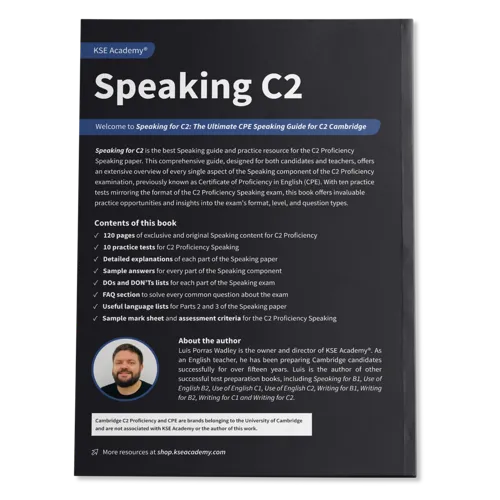
If you are preparing for the exam on your own or need quality material for your students, my C2 Speaking book is the ultimate tool. With over 120 pages of exclusive content, it includes 10 full practice exams that faithfully mimic the real Cambridge format.
Speaking C2: The Ultimate CPE Speaking Guide
Master C2 Speaking with my comprehensive guide, which includes 10 full mock exams, example answers for every part, tips and strategies based on my experience, and lists of useful expressions specifically designed for the C2 Proficiency Speaking test.
Get your PDF copy now!
Inside you will find detailed Useful Language lists, guides on what to do (and what not to do) in each part, and assessment criteria explained so you know exactly what the examiner is looking for. It is the definitive step to conquering C2 Proficiency with total confidence.
And until the next article, don’t forget to keep smiling!
