
Cómo escribir un Essay para el C2 Proficiency (CPE) [Guía 2026]
Aprende a escribir un Essay perfecto para el C2 Proficiency Writing. Guía completa con ejemplos, estructura, expresiones útiles y consejos de experto.

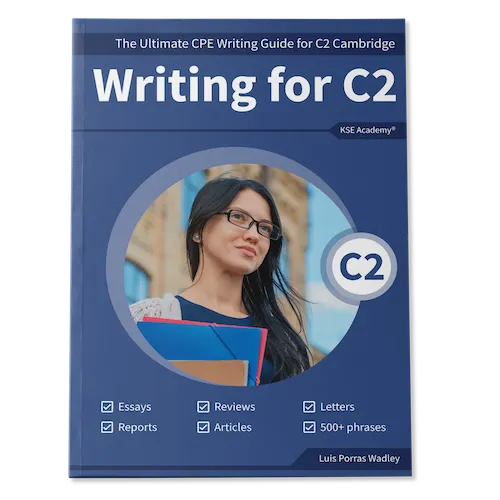
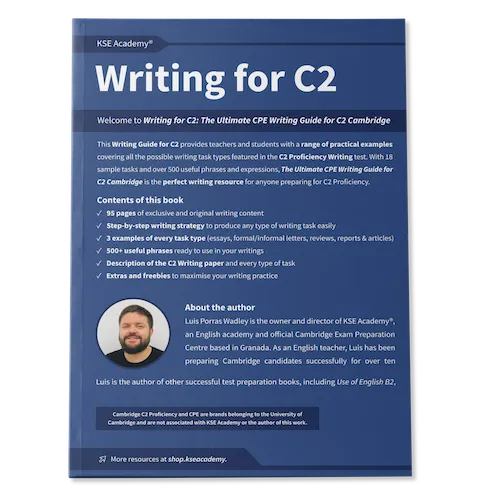
Tabla de contenidos
El Writing C2 es una de las partes más desafiantes del examen de Cambridge C2 Proficiency (CPE), y el essay es el tipo de texto que siempre aparece en la Parte 1. A diferencia de otros niveles, el ensayo de C2 requiere que demuestres un dominio del inglés prácticamente nativo, con la capacidad de resumir, evaluar y sintetizar información compleja de forma sofisticada. En este artículo te voy a explicar cómo escribir un Essay para el C2 Proficiency paso a paso, con ejemplos reales y todos los consejos que necesitas para conseguir la mejor nota posible.
¿Qué partes tiene el Writing del C2 Proficiency de Cambridge?
El Writing del C2 Proficiency consta de dos partes, y tienes un total de 1 hora y 30 minutos para completar ambas. Cada parte tiene sus propias características y requisitos específicos:
- Writing Part 1: En esta parte siempre tendrás que escribir un essay (ensayo). No hay opciones para elegir, por lo que es absolutamente imprescindible que domines este tipo de texto. En la tarea se te presentan dos textos breves (de aproximadamente 100 palabras cada uno) que ofrecen perspectivas contrastadas o complementarias sobre un tema específico. Tu trabajo consiste en leer ambos textos, identificar los puntos clave, resumirlos, evaluar los argumentos presentados y expresar tus propias ideas sobre el tema. Deberás escribir entre 240 y 280 palabras.
- Writing Part 2: En esta parte tienes 3 opciones para elegir, y los tipos de Writing que pueden aparecer son los siguientes: Para la Part 2 deberás escribir entre 280 y 320 palabras.
- Letter/Email (formal o informal)
- Report (informe)
- Review (reseña)
- Article (artículo)
Como puedes ver, el essay de la Part 1 es obligatorio, así que dediquemos todo nuestro esfuerzo a entender cómo hacerlo de la mejor manera posible.
¿Qué es un essay?
Un essay (ensayo, en español) es un texto formal y académico en el que analizas un tema, situación o problema desde diferentes puntos de vista, considerando múltiples perspectivas y presentando argumentos bien fundamentados. En el contexto del C2 Proficiency, el essay tiene una particularidad muy importante: no solo debes expresar tu opinión, sino que también tienes que resumir y evaluar dos textos breves que se te proporcionan en las instrucciones. Es decir, tu ensayo debe integrar las ideas de ambos textos, analizarlas críticamente y luego añadir tus propias reflexiones al respecto.
Este tipo de essay es discursivo, lo que significa que debe presentar una exploración equilibrada y objetiva del tema en cuestión, demostrando tu capacidad para sintetizar información compleja y comunicarla de forma clara y sofisticada.
Diferencias entre el Essay de C1 Advanced y el Essay de C2 Proficiency
Aunque tanto en el C1 Advanced como en el C2 Proficiency la Part 1 del Writing consiste en escribir un essay, hay diferencias fundamentales entre ambos que es importante conocer. La estructura de las instrucciones y las expectativas son completamente distintas:
| Aspecto | C1 Advanced Essay | C2 Proficiency Essay |
|---|---|---|
| Textos input | No hay textos que leer. Se te dan puntos o notas breves para desarrollar. | Dos textos de aprox. 100 palabras cada uno con perspectivas contrastadas o complementarias. |
| Tarea principal | Analizar y discutir 2 de los 3 puntos proporcionados, más uno propio. | Resumir y evaluar los puntos clave de ambos textos e incluir tus propias ideas. |
| Número de palabras | 220-260 palabras | 240-280 palabras |
| Enfoque | Discursivo y argumentativo, analizando diferentes opciones o soluciones. | Analítico y sintético, integrando información de fuentes externas y evaluándola críticamente. |
| Habilidades clave | Argumentación, justificación y expresión de opinión. | Síntesis, evaluación crítica, parafraseo y comparación de perspectivas. |
| Uso de propias palabras | Importante, pero no crítico. | Esencial. Debes parafrasear y no copiar del texto original. |
Como puedes ver, el essay de C2 requiere no solo que expreses tu opinión de forma sofisticada, sino que también demuestres tu capacidad para comprender, resumir y evaluar información compleja procedente de textos académicos. Esto lo convierte en un reto mayor, pero con la práctica adecuada es totalmente alcanzable.
Cómo escribir un Essay para el C2 Writing de Cambridge
Ahora que ya sabes qué es un essay de C2 y en qué se diferencia del de C1, vamos a ver las características principales que debe tener tu ensayo para conseguir la máxima puntuación:
- Propósito: El objetivo principal de un essay de C2 es presentar un análisis equilibrado y objetivo de un tema, integrando y evaluando las perspectivas presentadas en los dos textos proporcionados. No se trata simplemente de dar tu opinión, sino de demostrar tu capacidad para sintetizar información compleja, evaluar argumentos de forma crítica y comunicar tus propias ideas de manera sofisticada y bien fundamentada.
- Tono y registro: El essay es siempre un texto formal y académico. Debes utilizar un tono objetivo y distanciado, evitando expresiones coloquiales, contracciones (como don’t, can’t, won’t) y palabras demasiado comunes o vagas (como things, stuff, get, nice, etc.). Tu lenguaje debe reflejar un nivel C2, con vocabulario preciso, sofisticado y variado, así como estructuras gramaticales complejas y bien controladas.
- Estructura: Un essay de C2 debe tener una estructura clara y bien organizada. Lo más habitual es incluir: En total, tu essay debería tener entre 4 y 5 párrafos bien diferenciados.
- Título: Aunque no es obligatorio, es muy recomendable incluir un título que resuma el tema del ensayo de forma concisa.
- Introducción: Presenta el tema de forma general y establece el contexto del debate o la discusión.
- Desarrollo (2-3 párrafos): Aquí es donde resumes y evalúas los puntos clave de cada texto. Puedes dedicar un párrafo a cada perspectiva, o bien integrar ambas en un análisis comparativo. Es fundamental que uses tus propias palabras y que no copies directamente de los textos originales.
- Conclusión: Resume tus reflexiones finales, integra tu propia opinión y cierra el ensayo de forma coherente y elegante.
- Opinión: Aunque en un essay discursivo debes mantener un tono equilibrado y objetivo, también es importante que expreses tu propia perspectiva. Lo más habitual es hacerlo en el último párrafo (la conclusión), pero también puedes integrar tu opinión de forma sutil a lo largo del desarrollo, siempre que esté bien justificada y fundamentada en los argumentos presentados.
- Coherencia y cohesión: La coherencia es absolutamente fundamental en un essay de C2. Tus ideas deben seguir una progresión lógica y natural, conectadas mediante conectores sofisticados y apropiados al nivel (como nevertheless, conversely, furthermore, consequently, on the flip side, etc.). El lector debe poder seguir tu línea argumentativa sin esfuerzo, sintiendo que cada párrafo fluye naturalmente hacia el siguiente.
- Parafraseo: Una de las habilidades más importantes en el essay de C2 es la capacidad de usar tus propias palabras. Las instrucciones siempre te recuerdan «use your own words throughout as far as possible«. Esto significa que no puedes limitarte a copiar frases de los textos originales. Debes reformularlas, utilizando sinónimos, estructuras gramaticales diferentes y expresiones variadas. Esta habilidad de parafraseo es clave para demostrar tu dominio del idioma a nivel C2.
- Lenguaje de nivel C2: Tu essay debe demostrar un uso sofisticado del inglés. Esto incluye:
- Vocabulario avanzado y preciso
- Estructuras gramaticales complejas (inversiones, pasivas, estructuras condicionales avanzadas, etc.)
- Variedad de conectores y expresiones académicas
- Control total de la gramática, con errores mínimos o inexistentes
Ejemplo de C2 Essay
Ahora que ya conoces las características principales de un essay de C2, vamos a ver un ejemplo completo. Primero te mostraré las instrucciones de la tarea y luego una respuesta modelo con todos sus elementos.
Instrucciones de ejemplo de un Essay de C2
Read the two texts below.
Write an essay summarising and evaluating the key points from both texts. Use your own words throughout as far as possible, and include your own ideas in your answer.
Write your answer in 240-280 words.
The Case for Universal Basic Income
As automation and artificial intelligence continue to reshape the workforce, millions of jobs are at risk of disappearing. Universal Basic Income (UBI)—a regular, unconditional cash payment to all citizens—offers a potential solution to this looming crisis. Proponents argue that UBI would provide financial security, reduce poverty, and give people the freedom to pursue education, start businesses, or engage in creative endeavours without the constant pressure of survival. Moreover, by simplifying the welfare system, UBI could reduce bureaucracy and ensure that support reaches everyone who needs it, rather than getting lost in complex eligibility requirements.
The Pitfalls of Universal Basic Income
While Universal Basic Income may sound appealing in theory, critics warn that it could have devastating economic consequences. The cost of providing every citizen with a regular income would be astronomical, potentially requiring massive tax increases or cuts to essential public services like healthcare and education. Furthermore, there are concerns that UBI might discourage people from working, leading to labour shortages and reduced economic productivity. Sceptics also question whether a one-size-fits-all approach can truly address the diverse needs of different communities, arguing that targeted support programmes are more effective at helping those who genuinely need assistance.
Analicemos los aspectos principales de estas instrucciones:
- Temática: El debate sobre la Renta Básica Universal (Universal Basic Income), un tema social, económico y político de gran actualidad.
- Dos perspectivas: El primer texto presenta los argumentos a favor de la UBI (seguridad financiera, reducción de pobreza, libertad, simplificación del sistema). El segundo texto presenta los argumentos en contra (coste económico, posible desmotivación laboral, falta de especificidad).
- Tu tarea: Debes resumir los puntos clave de ambos textos, evaluar los argumentos presentados e incluir tus propias ideas y reflexiones sobre el tema.
- Consideraciones importantes:
- Debes usar tus propias palabras, no copiar directamente de los textos
- Debes mantener un tono objetivo y equilibrado
- Debes integrar tu propia opinión de forma fundamentada
- Debes respetar el límite de palabras (240-280)
Respuesta de ejemplo de un Essay de C2
Ahora vamos a ver cómo estructuraríamos la respuesta a esta tarea. La estructura que seguiré es la siguiente:
- Título: Breve y descriptivo
- Introducción: Presentación del tema y contexto del debate
- Párrafo 2: Resumen y evaluación de los argumentos a favor de la UBI
- Párrafo 3: Resumen y evaluación de los argumentos en contra de la UBI
- Conclusión: Reflexión personal y opinión fundamentada
Universal Basic Income: A Viable Solution or Economic Fantasy?
As technological advancement accelerates and artificial intelligence increasingly permeates the labour market, the debate surrounding Universal Basic Income has intensified considerably. This policy proposal—which would provide unconditional regular payments to all citizens—has become a focal point in discussions about the future of work and social welfare systems.
Advocates of UBI present compelling arguments rooted in pragmatism and social justice. They contend that such a scheme would establish a financial safety net in an era where automation threatens to render vast swathes of the workforce obsolete. Beyond mere survival, proponents argue that UBI would liberate individuals to pursue entrepreneurial ventures, invest in their education, or engage in creative pursuits that might otherwise remain unaffordable luxuries. The streamlining of bureaucratic welfare systems represents an additional advantage, potentially ensuring more equitable distribution of resources.
Conversely, critics raise legitimate concerns about the economic viability of such an ambitious undertaking. The financial burden of providing every citizen with regular payments would be staggering, potentially necessitating either punitive taxation or the dismantling of crucial public services. Furthermore, sceptics question whether removing the incentive to work might inadvertently trigger labour shortages and diminish overall economic productivity. The one-size-fits-all nature of UBI also comes under scrutiny, with opponents arguing that more targeted interventions better address specific community needs.
On balance, whilst I acknowledge the fiscal challenges inherent in implementing UBI, I believe the concept warrants serious consideration as automation continues its inexorable advance. Perhaps a more nuanced approach—such as pilot programmes in regions particularly vulnerable to technological unemployment—could provide valuable empirical data whilst mitigating the risks of wholesale implementation. Ultimately, the discourse should focus less on whether UBI is perfect and more on how we can adapt our social safety nets to an increasingly automated world.
Veamos por qué este essay es un buen ejemplo de C2 Writing:
- Título eficaz: El título «Universal Basic Income: A Viable Solution or Economic Fantasy?» resume perfectamente el debate y genera interés en el lector.
- Introducción clara: El primer párrafo establece el contexto del debate de forma sofisticada, utilizando vocabulario avanzado como «accelerates, permeates, focal point«.
- Resumen efectivo: Los párrafos 2 y 3 resumen los puntos clave de ambos textos utilizando parafraseo constante. Por ejemplo:
- Texto original: «provide financial security» → Parafraseo: «establish a financial safety net«
- Texto original: «jobs are at risk of disappearing» → Parafraseo: «automation threatens to render vast swathes of the workforce obsolete«
- Texto original: «devastating economic consequences» → Parafraseo: «legitimate concerns about the economic viability«
- Evaluación crítica: El essay no se limita a resumir, sino que evalúa los argumentos. Por ejemplo, describe los argumentos a favor como «compelling arguments rooted in pragmatism and social justice» y los argumentos en contra como «legitimate concerns«.
- Conectores sofisticados: Se utilizan conectores de nivel C2 como «beyond mere survival, conversely, furthermore, on balance, whilst, ultimately«.
- Estructuras gramaticales complejas: El essay incluye estructuras avanzadas como:
- Oraciones pasivas: «would be provided«
- Estructuras con inversión: «Beyond mere survival, proponents argue that…«
- Oraciones condicionales complejas: «such as pilot programmes… could provide valuable empirical data whilst mitigating…«
- Vocabulario de nivel C2: El essay está repleto de vocabulario sofisticado y preciso: «intensified considerably, focal point, pragmatism, liberate, swathes, obsolete, entrepreneurial ventures, staggering, punitive taxation, dismantling, inadvertently, inexorable advance, empirical data, wholesale implementation«, etc.
- Opinión bien fundamentada: La conclusión presenta una opinión personal matizada y bien argumentada, proponiendo una solución intermedia (programas piloto) que demuestra pensamiento crítico.
- Coherencia y cohesión: Las ideas fluyen de forma natural y lógica de un párrafo a otro, manteniendo siempre el hilo conductor del debate.
- Número de palabras: El essay tiene 276 palabras, perfectamente dentro del rango requerido (240-280).
Otro ejemplo de Essay C2
Para que puedas practicar y ver diferentes estilos de essay, aquí tienes otro ejemplo completo con instrucciones y respuesta.
Read the two texts below.
Write an essay summarising and evaluating the key points from both texts. Use your own words throughout as far as possible, and include your own ideas in your answer.
Write your answer in 240-280 words.
The Merits of Space Exploration
Investing in space exploration represents one of humanity’s most visionary endeavours. Beyond the immediate scientific discoveries, space programmes drive technological innovation that benefits society in countless ways—from satellite communications to medical advances. The search for life beyond Earth could fundamentally transform our understanding of existence itself, whilst the potential to mine asteroids for rare minerals or establish colonies on other planets offers solutions to resource scarcity and overpopulation. Moreover, space exploration inspires younger generations to pursue careers in science and engineering, fostering the innovation necessary to tackle future challenges.
Questioning Our Priorities in Space
Whilst the allure of space exploration is undeniable, we must question whether it should be a priority when pressing issues plague our own planet. The billions spent on rockets and space stations could instead address poverty, hunger, climate change, and inadequate healthcare systems. Critics argue that the benefits of space programmes are often overstated and primarily serve the egos of billionaires rather than humanity’s genuine needs. Furthermore, space exploration carries environmental costs, with rocket launches contributing to atmospheric pollution. Perhaps we should focus on making Earth sustainable and equitable before looking to the stars.
Space Exploration: Visionary Investment or Misguided Extravagance?
The allocation of substantial resources towards space exploration programmes remains one of the most contentious issues in contemporary policy debates. As humanity pushes the boundaries of cosmic discovery, questions arise about whether such ventures represent prudent investment or a distraction from more immediate terrestrial concerns.
Those championing space exploration emphasise its multifaceted benefits extending far beyond the realm of pure science. They highlight how space programmes catalyse technological breakthroughs with widespread earthly applications, from telecommunications infrastructure to medical innovations. The prospect of discovering extraterrestrial life or harnessing celestial resources presents tantalising possibilities for addressing fundamental questions about our existence and future sustainability. Additionally, advocates note the inspirational effect such endeavours have on aspiring scientists and engineers, cultivating the intellectual capital necessary for future progress.
Nevertheless, detractors raise compelling ethical questions about resource allocation. With billions channelled into cosmic ventures, critics contend that such funds would yield more immediate humanitarian dividends if redirected towards combating poverty, environmental degradation, or healthcare inadequacies. The argument that space exploration primarily serves the vanity projects of wealthy entrepreneurs rather than collective human welfare carries considerable weight. Furthermore, the environmental footprint of rocket launches undermines claims that these programmes benefit humanity’s long-term prospects.
In my assessment, this debate presents a false dichotomy. Rather than viewing space exploration and addressing earthly challenges as mutually exclusive, we should recognise how technological advances from space programmes often yield solutions to terrestrial problems. However, greater transparency regarding costs and benefits, alongside stricter environmental regulations for space activities, would be necessary to justify continued investment in this arena.
Este segundo ejemplo demuestra cómo puedes abordar un tema completamente diferente manteniendo la misma calidad y estructura. Observa cómo se utilizan diferentes expresiones y vocabulario, pero se mantiene el mismo nivel de sofisticación, coherencia y análisis crítico que caracteriza un essay de C2.
¿Me penalizan si escribo menos de 240 palabras o más de 280?
Esta es, sin duda, una de las preguntas más frecuentes que me hacen los estudiantes, y la respuesta es: depende. Los examinadores no cuentan las palabras palabra por palabra para penalizarte automáticamente si te pasas o te quedas corto. Sin embargo, el número de palabras recomendado (240-280 para el essay de C2) está calculado cuidadosamente para que puedas cumplir con todos los requisitos de la tarea de forma completa y equilibrada.
Si escribes menos de 240 palabras, es muy probable que tu essay carezca de la profundidad necesaria. Puede que no hayas desarrollado suficientemente los argumentos de ambos textos, que tu análisis sea demasiado superficial, o que tu conclusión sea demasiado breve. Todo esto afectará negativamente a tu puntuación en los criterios de Content (contenido) y Communicative Achievement (logro comunicativo).
Por otro lado, si te pasas considerablemente de las 280 palabras (digamos, 320, 350 o más), probablemente estés incluyendo información irrelevante, repeticiones innecesarias o detalles que no aportan valor a tu argumentación. Esto puede hacer que tu essay pierda foco y claridad, lo cual también afectaría negativamente a tu nota.
Mi recomendación es que intentes mantenerte dentro del rango recomendado, aunque está perfectamente bien si te pasas unas 10-15 palabras. Lo más importante es que tu essay cumpla con todos los requisitos de la tarea, esté bien organizado, sea coherente y demuestre un nivel C2 de inglés. Si cumples todo eso y tienes 290 palabras en lugar de 280, no te preocupes en absoluto.
Vídeo explicativo sobre cómo escribir un Essay para C2
La mejor guía para el C2 Proficiency Writing con ejemplos y expresiones útiles
Si este artículo te ha resultado útil y quieres llevar tu preparación al siguiente nivel, te recomiendo encarecidamente que eches un vistazo a mi libro «Writing for C2: The Ultimate CPE Writing Guide». Esta guía completa ha sido diseñada específicamente para ayudarte a dominar todas las tareas del Writing C2, no solo el essay.
En este libro encontrarás:
- 3 ejemplos completos de Essays con análisis detallado
- 3 ejemplos de cada tipo de Writing de la Part 2: Letters/Emails (formales e informales), Reports, Reviews y Articles
- Más de 500 expresiones útiles organizadas por tipo de tarea, listas para usar en tus writings
- Estrategia paso a paso para abordar cada tipo de tarea con confianza
- Descripción completa del Writing Paper y cómo se evalúa
- Mark sheet de muestra para que puedas autoevaluar tus propios writings
Este libro es perfecto tanto si eres un estudiante preparándote para el examen como si eres profesor y buscas materiales de calidad para tus clases. Puedes conseguir tu copia en la Guía de Writing para C2 Proficiency.
Espero que este artículo te haya resultado útil y que ahora tengas una comprensión mucho más clara de cómo escribir un essay para el C2 Proficiency. Recuerda que la clave está en la práctica constante, en leer buenos ejemplos y en familiarizarte con el tipo de vocabulario y estructuras que se esperan en este nivel. Con dedicación y los recursos adecuados, conseguirás la nota que te mereces.
¡Mucho ánimo con tu preparación y nos vemos en el próximo artículo! Don’t forget to keep smiling! 🙂